
HR Analytics Market Summary:
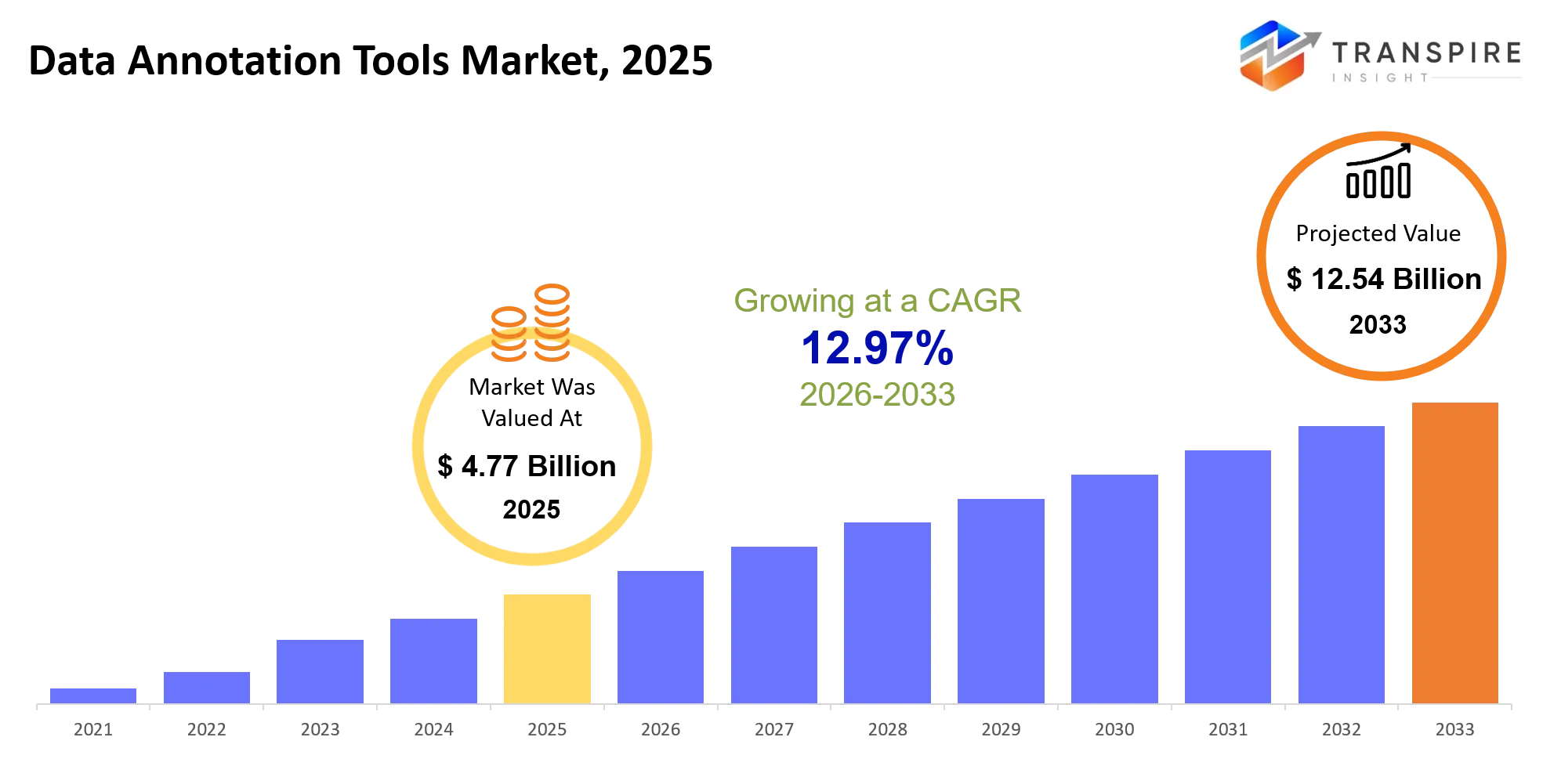
As per Transpire Insight Analysis, the HR Analytics Market size is estimated at USD 4.77 billion in 2025 and is anticipated to reach USD 12.54 billion by 2033, growing at a CAGR of 12.97% from 2026 to 2033.
The human resource analytics market is assisting organisations in taking strategic decisions concerning recruitment, retention, performance, skill set, and planning through employee data. Increasingly, the technology used in HR is blending employee information with the computing technologies that identify patterns and highlight potential risks within the organisation.In the past three to five years, the industry has moved from simple reports to more advanced ways of looking at people data using predictions and smart technology. Things like cloud-based systems, easy-to-use dashboards and having all the workforce data in one place have made it less necessary to do everything by hand. AI is being used to find trends and help with planning. A big reason for this change has been the use of smart computer systems across different parts of businesses. This has made companies need to better understand their workers' skills, productivity, retention, and which jobs are changing. As HR departments get access to connected data and smart insights, more companies are looking for these kinds of tools because they can make better and quicker choices about their people.
HR Analytics Market Size & Forecast:
- Market Size 2025: USD 4.77 Billion
- Expected Market Value (2033): USD 12.54 Billion
- Forecast CAGR (2026–2033): 12.97%
- Leading Region in 2025: North America
- Fastest Growing Region: Asia Pacific
- Key Company Profiles: IBM, SAP, Oracle, Workday, ADP, Visier, UKG, Ceridian, Cornerstone OnDemand, Tableau, Microsoft, Deloitte, PwC, Accenture, Eightfold AI
Key Market Insights:
The market for HR analytics services is moving away from simple workforce reporting as companies begin using data-driven technologies to make better decisions regarding talent, planning, and management of their workforces.
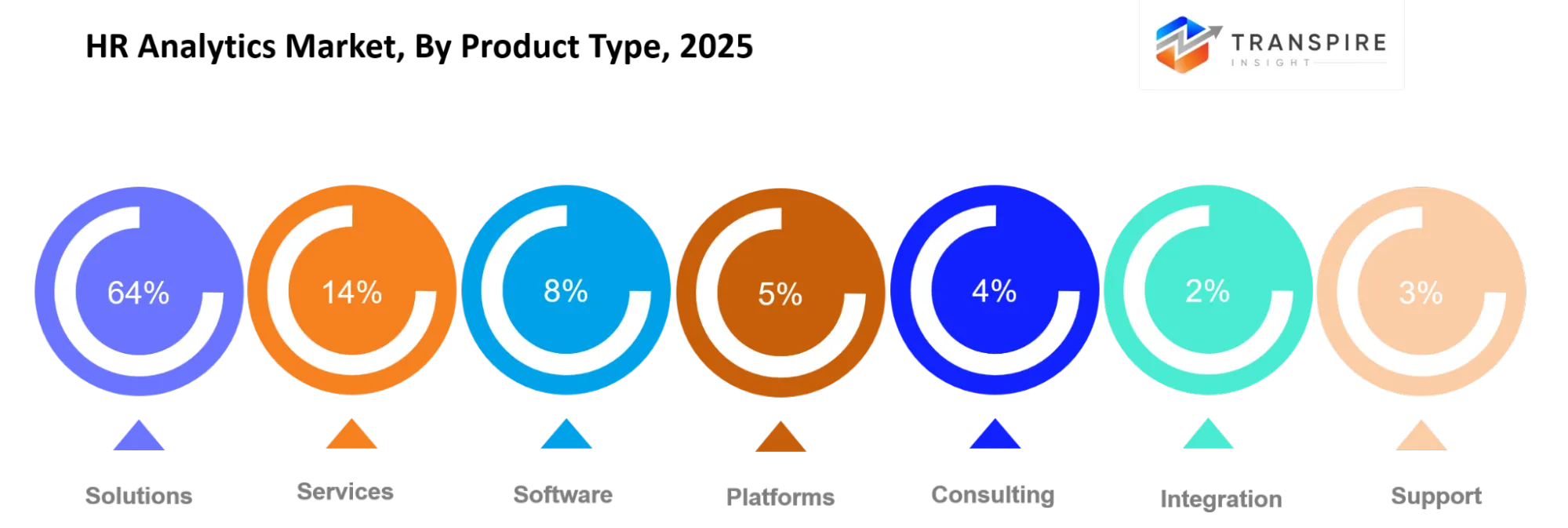
- Solutions constitute 64% of the total market share, due to the high popularity of HR analytics tools that allow for centralising workforce data.
- Services account for 14%, because firms still need implementation and customisation of HR analytics solutions.
- Software makes up 8% of the market, as the application of digital HR systems is becoming more widespread.
- Platforms make up 5% of the market because companies look for connected environments that will integrate HR data and analytics.
- Consulting comprises 4% of the market, since firms apply special expertise for improving analytics strategies.
- Integration comprises 2% of the market, due to the necessity of integrating HR analytics with enterprise and workforce-management systems.
What are the Key Drivers, Restraints, and Opportunities in the HR Analytics Market?
Drivers
The market is driven by the transition from manual HR reports to data-driven workforce decision-making. Enterprises are leveraging analytics to look into the performance of their employees, results from the recruitment process, patterns of retention, and workforce needs. The increasing adoption of cloud-based HR management systems has also facilitated easy collection and analysis of workforce data, thus making enterprises adopt more analytics.
Restraints
Privacy, security, and issues around data integration still pose barriers. HR analytics solutions may be required to integrate payroll, recruitment, performance, and employee management software solutions. Integrating these software solutions could necessitate major technological investments and proper management of sensitive employee data. All these factors could impede adoption, especially in the case of organisations whose legacy systems are not well integrated.
Opportunities
The use of predictive and artificial intelligence-based analytics can be another driver for future growth. Companies can go beyond just using their analytics system to report and look at predicting future needs for workforce, detecting areas with a risk of turnover and helping to plan employee skills. Cloud computing and digitalisation of HR in developing countries can open more doors. Providers offering predictive analytics along with better integration, data governance, and workforce analytics, can cover this emerging need.
What Has the Impact of Artificial Intelligence Been on the HR Analytics Market?
AI is transforming HR analytics as it enables organisations to analyse large amounts of data about their workforce and detect certain patterns that might be difficult to detect otherwise. AI-powered applications can automate some processes in data analysis for employees, hiring processes, workforce planning, performance management, etc., enabling HR staff to devote their time not to report creation but to take action based on the insights received. Predictive analytics could help organisations understand possible workforce needs, risks, and emerging trends among their employees.AI technology is transforming HR by integrating the data of different workforce systems and providing fast insights based on that data for decision-making purposes. Predictive analytics is especially crucial since the market is transitioning from historical data analysis to workforce prediction analysis. Nevertheless, there are certain limitations associated with the use of AI technology in HR due to the high implementation costs, the need for integration of data, and accuracy issues related to the use of incomplete or inconsistent workforce data.
Instance
In March 2026, Workday introduced Sana for Workday, an AI-based system that enables analysis of HR data, answers employees’ queries, and performs HR tasks automatically. The innovation assists organisations in transitioning from conventional HR reporting to AI-based HR insights and decisions.
Key Market Trends:
In the HR analytics market, there is a growing shift away from conventional human capital measurement practices towards advanced analytics that provide the basis for strategic decision-making in an automated manner.
- The HR department has shifted its approach from traditional reporting to predictive analysis, leading to an increased need for solutions that would predict the needs of the workforce.
- Cloud HR analytics is growing, as the organisation needs easy access to workforce data and more flexible IT infrastructure.
- AI technologies are being used more and more in HR analytics, allowing for quick processing of data, identifying patterns, and automated insights.
- Companies are linking HR analytics with recruitment, payroll, performance management, and workforce management to achieve a comprehensive picture of the workforce.
- Self-service analytics is gaining traction, since HR professionals require faster access to dashboards and workforce data without heavy reliance on technical staff.
- Workforce analytics is getting more oriented towards employee retention, as firms analyse workforce patterns and recognise possible threats and talent planning opportunities.
HR Analytics Market Segmentation
By Component
Solutions is the largest component with a market share of 64%, followed by Services holds 14%, Software with 8%, and Platforms with 5%. Consulting comprises 4%, Integration and Support are both 2%, while Others account for 1%. The high ranking of solutions is due to the increased use of analytics for employee decision-making and planning.
By Deployment
The market is classified into Cloud, On-premise, Hybrid, SaaS, Private Cloud, Public Cloud, Multi-cloud, and Others. The increasing relevance of cloud-based deployment arises from the need for flexible access to workforce data and analytics. Hybrid and multi-cloud can be used by organizations which require to integrate their existing infrastructures along with new cloud-based HR systems.
By Applications
Applications such as Workforce Planning, Recruitment Analytics, Performance Analytics, Compensation Analytics, Retention Analytics, Learning Analytics, Employee Engagement, and Others have been developed. In these applications, organisations are able to analyse the various dimensions of the work force, for example, recruitment, performance, retention, and development of employees. The increase in the number of applications can enhance the use of analytics in HR.
By Enterprise
The market includes Large Enterprises, SMEs,Business Software, Startups, Government, Non-profits, Multinationals, and Others. Large enterprises can adopt HR analytics in highly complex and widespread workforces. SMEs and startups can increasingly adopt analytics due to the scalability provided by cloud-based solutions.
By End User
BFSI, IT & Telecom, Healthcare, Retail, Manufacturing, Government, Education, and Others are some of the key end user industries that produce varying demands on workforces, leading to diverse applications of HR analytics. The industries with larger workforces and more complex workforces can apply analytics to facilitate activities such as recruitment, workforce management, performance evaluation, and retention.
By Analytics Type
There are Descriptive, Diagnostic, Predictive, Prescriptive, Real-time, Workforce Intelligence, Sentiment Analytics, and Other types of HR analytics available in the market. The fastest-growing market segment is Predictive Analytics, with a 15.2% CAGR due to the move towards the application of workforce data for future predictions instead of merely reporting past activities.
By Functions
HR analytics can be used for various purposes such as Recruitment, Talent Management, Payroll, Workforce Management, Learning & Development, Employee Experience, Compliance, and Others. These various functions help organisations use their workforce data in different phases of their employees' lifecycle. The more integrated the HR functions, the better it will be to use analytics across different HR functions instead of single HR functions.
What are the Key Use Cases Driving the HR Analytics Market?
The use cases of HR analytics solutions are used in workforce planning, recruitment analytics, and performance management, which support firms in knowing their staffing needs and making better decisions on workforces. These use cases fit into the leading Solutions segment of the market. Extended use cases are retention analytics, compensation analytics, learning analytics, and employee engagement, whereby firms are able to analyse workforce patterns at various points within the lifecycle of the employee. Other use cases are predictive workforce planning, real-time workforce intelligence, and sentiment analysis. The Predictive Analytics segment is an indication that more interest has been shown in making predictions using workforce data other than analysing performance.
|
Report Metrics |
Details |
|
Market size value in 2025 |
USD 4.77 Billion |
|
Market size value in 2026 |
USD5.34 Billion |
|
Revenue forecast in 2033 |
USD 12.54 Billion |
|
Growth rate |
CAGR of 12.97% from 2026 to 2033 |
|
Base year |
2025 |
|
Historical data |
2021 - 2024 |
|
Forecast period |
2026 - 2033 |
|
Report coverage |
Revenue forecast, competitive landscape, growth factors, and trends |
|
Regional scope |
United States; Canada; Mexico; United Kingdom; Germany; France; Italy; Spain; Denmark; Sweden; Norway; China; Japan; India; Australia; South Korea; Thailand; Brazil; Argentina; South Africa; Saudi Arabia; United Arab Emirates |
|
Key company profiled |
IBM, SAP, Oracle, Workday, ADP, Visier, UKG, Ceridian, Cornerstone OnDemand, Tableau, Microsoft, Deloitte, PwC, Accenture, Eightfold AI |
|
Customization scope |
Free report customization (country, regional & segment scope). Avail customized purchase options to meet your exact research needs. |
|
Report Segmentation |
By Component (Solutions, Services, Software, Platforms, Consulting, Integration, Support, Others); By Deployment (Cloud, On-premise, Hybrid, SaaS, Private Cloud, Public Cloud, Multi-cloud, Others); By Application (Workforce Planning, Recruitment Analytics, Performance Analytics, Compensation Analytics, Retention Analytics, Learning Analytics, Employee Engagement, Others); By Enterprise Size (Large Enterprises, SMEs, Mid-sized Enterprises, Startups, Government, Nonprofits, Multinational Corporations, Others); By End User (BFSI, IT & Telecom, Healthcare, Retail, Manufacturing, Government, Education, Others); By Analytics Type (Descriptive, Diagnostic, Predictive, Prescriptive, Real-time, Workforce Intelligence, Sentiment Analytics, Others); By Function (Recruitment, Talent Management, Payroll, Workforce Management, Learning & Development, Employee Experience, Compliance, Others) |
Which Regions are Driving the HR Analytics Market Growth?
North America
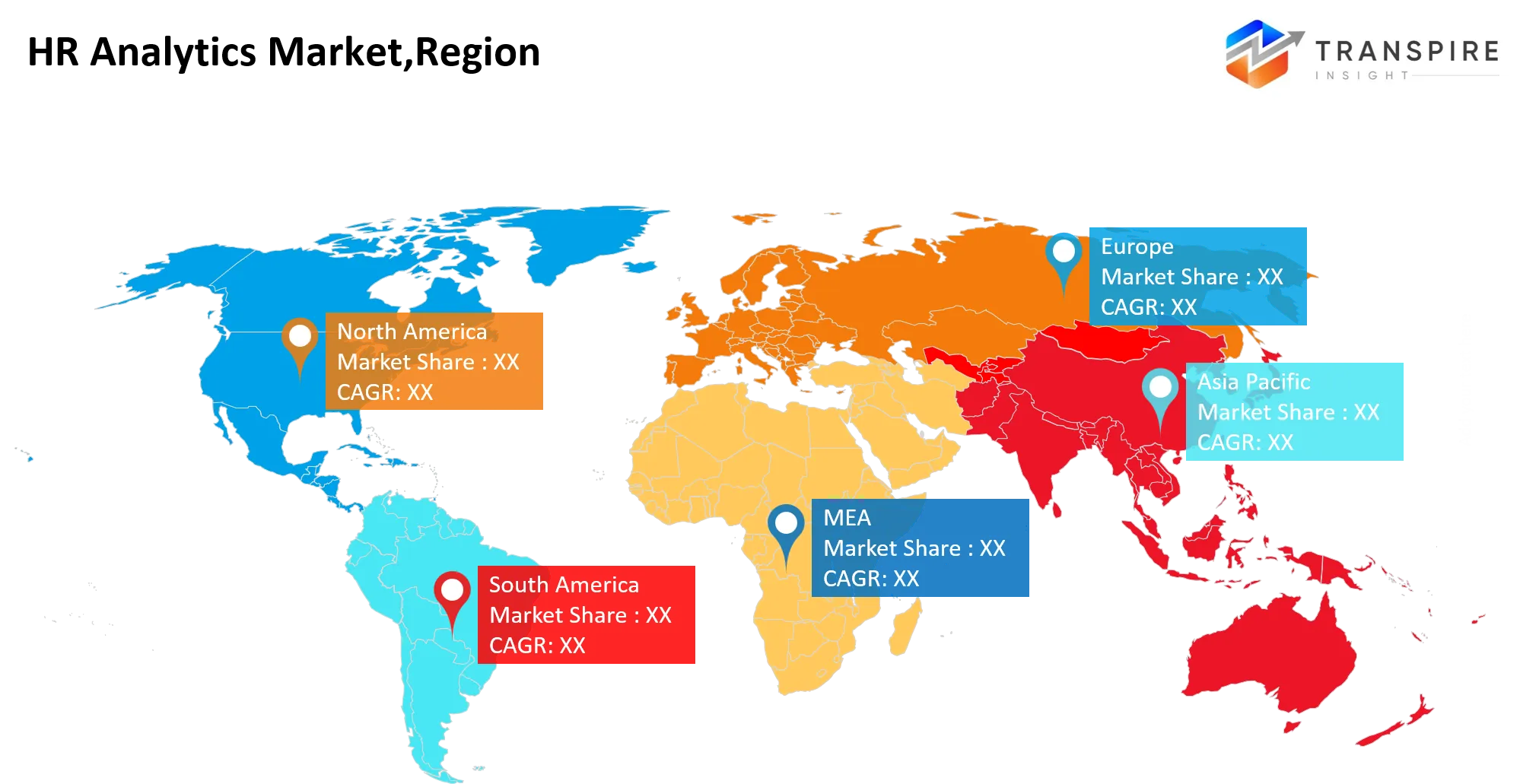
North America dominates the HR analytics market with a 39% share owing to high technology adoption and advanced HR digital infrastructure. Companies across North America are adopting workforce analytics solutions for recruitment, retention, performance management, and workforce planning purposes. In addition, the availability of technology vendors and advanced cloud infrastructure facilitates market adoption. Investment in workforce data management technologies is aiding market leaders to maintain their leading positions in the region.
In June 2026, The U.S. Office of Personnel Management (OPM) chose Oracle to upgrade federal human resources systems via a cloud-based integrated platform that would enhance management and decision-making regarding workforces
Europe
Europe represents a 29% share in the HR analytics market, backed by developed enterprises and rising interest in managing workforce data. Companies are adopting analytics software for employee planning, performance management, and talent management purposes. Data governance and proper management of employee data in the region drive market growth in terms of technology adoption. Digitalisation of business processes in Europe is expected to aid market demand.
In January 2025, E.ON picked Oracle Fusion Cloud HCM to upgrade their HR processes by enabling the company to consolidate workforce information and have access to data about employees.
https://www.oracle.com/uk/news/announcement/eon-relies-on-oracle-cloud-hcm-2025-01-29
Asia Pacific
Asia Pacific region holds a market share of 23%, and at present, this region is the fastest-growing region with a CAGR of 14.8%. This region’s growth is due to the growth in the level of digitisation and technological adoption within enterprises and investments made in human resource technology solutions. Companies are increasingly leveraging cloud based analytics using AI for managing their large workforce.
In May 2026, Tech Mahindra and UKG worked together to fast-track workforce transformation through AI by increasing the adoption of workforce technology and AI-powered solutions in HR management and employee analytics.
Who are the Key Players in the HR Analytics Market, and how do they compete?
Competition within the HR analytics market features both enterprise technology vendors and specialised people analytics vendors. Increasingly, the focus of the competition is on the depth of analytics, AI capability, data integration, and ability to turn workforce data into actionable business insights. Workday features People Analytics within its HCM ecosystem, featuring workforce insights across a number of dimensions, such as hiring, attrition, leadership and skills. The company's strategy involves building analytics right into the HR workflow, rather than creating a separate environment for analytics.
Oracle competes through its Fusion HCM Analytics, providing pre-built workforce KPIs, machine learning and connections with Oracle Cloud HCM. Its unique value proposition lies in the integration of analytics within the larger enterprise cloud ecosystem and addressing issues related to retention, talent acquisition, compensation and diversity within the workforce. SAP is developing people intelligence capabilities through its SAP SuccessFactors and connected workforce data, including such issues as skills gaps, compensation trends and attrition risks. Visier has focused more on specialisation in people analytics and workforce data integration, predictive analytics and AI-driven analysis through its Vee platform.
HR Analytics Market companies
- IBM
- SAP
- Oracle
- Workday
- ADP
- Visier
- UKG
- Ceridian
- Cornerstone OnDemand
- Tableau
- Microsoft
- Deloitte
- PwC
- Accenture
- Eightfold AI
Recent Development News
In October 2025, SAP launched People Intelligence, integrating workforce, skills, and business data using SAP Business Data Cloud. The offering has been created to provide insights that can be used to make decisions regarding the workforce and talent
In May 2026, Workday expanded its strategic alliance with Google Cloud, enabling AI agents for HR and Finance to enter employees’ workflow. The two companies have combined their HR agent functionalities with the help of Google Cloud’s enterprise AI platform
What Strategic Insights Define the Future of the HR Analytics Market?
The future of the HR analytics market at the level will involve a transition from traditional HR analytics towards connected workforce intelligence using AI technology, where the focus of HR analytics will shift from the generation of HR reporting to workforce planning, skills management, retention and decision-making. A hidden risk associated with the use of AI in workforce intelligence is poor data governance and quality. Inadequate data can make analytical output unreliable and may lead to privacy and compliance issues. Opportunities in the future include predictive workforce planning and AI-based skills intelligence, especially when an organisation is looking to forecast skills gaps and workforce insights based on business requirements. From a strategic perspective, market players need to ensure that data foundations, integration, explainability of analytics and human oversight are prioritised when building AI capabilities. Such a strategy will allow vendors to move away from stand-alone dashboards to workforce intelligence.
By Component
- Solutions
- Services
- Software
- Platforms
- Consulting
- Integration
- Support
- Others
By Deployment
- Cloud
- On-premise
- Hybrid
- SaaS
- Private Cloud
- Public Cloud
- Multi-cloud
- Others
By Application
- Workforce Planning
- Recruitment Analytics
- Performance Analytics
- Compensation Analytics
- Retention Analytics
- Learning Analytics
- Employee Engagement
- Others
By Enterprise Size
- Large Enterprises
- SMEs
- Mid-sized Enterprises
- Startups
- Government
- Nonprofits
- Multinational Corporations
- Others
By End User
- BFSI
- IT & Telecom
- Healthcare
- Retail
- Manufacturing
- Government
- Education
- Others
By Analytics Type
- Descriptive
- Diagnostic
- Predictive
- Prescriptive
- Real-time
- Workforce Intelligence
- Sentiment Analytics
- Others
By Function
- Recruitment
- Talent Management
- Payroll
- Workforce Management
- Learning & Development
- Employee Experience
- Compliance
- Others
Frequently Asked Questions
Find quick answers to common questions.
The hr analytics market size was valued at USD 4.77 billion in 2025 and is poised to reach USD 12.54 billion by 2033, expanding at a 12.97%CAGR.
Key segments for the hr analytics market are By Component (Solutions, Services, Software, Platforms, Consulting, Integration, Support, Others); By Deployment (Cloud, On-premise, Hybrid, SaaS, Private Cloud, Public Cloud, Multi-cloud, Others); By Application (Workforce Planning, Recruitment Analytics, Performance Analytics, Compensation Analytics, Retention Analytics, Learning Analytics, Employee Engagement, Others); By Enterprise Size (Large Enterprises, SMEs, Mid-sized Enterprises, Startups, Government, Nonprofits, Multinational Corporations, Others); By End User (BFSI, IT & Telecom, Healthcare, Retail, Manufacturing, Government, Education, Others); By Analytics Type (Descriptive, Diagnostic, Predictive, Prescriptive, Real-time, Workforce Intelligence, Sentiment Analytics, Others); By Function (Recruitment, Talent Management, Payroll, Workforce Management, Learning & Development, Employee Experience, Compliance, Others)
Growth is primarily driven by increasing use of AI and cloud-based HR applications, increased demand for evidence-based workforce planning, increased emphasis on employee retention, and the need for effective recruitment and performance management.
The market is led by major manufacturers including IBM, SAP, Oracle, Workday, ADP, Visier, UKG, Ceridian, Cornerstone OnDemand, Tableau, Microsoft, Deloitte, PwC, Accenture, Eightfold AI
The North American region dominates 39% share of the HR analytics market owing to the widespread use of cloud HR solutions, presence of many vendors of HR technology, and advanced digital infrastructure, among other factors.
Opportunities in the HR analytics market include the increasing requirement for HR analytics based on AI, cloud-based HR analytics solutions, predictive employee retention software, recruitment analytics, and SME-focused HR analytics solutions.
- IBM
- SAP
- Oracle
- Workday
- ADP
- Visier
- UKG
- Ceridian
- Cornerstone OnDemand
- Tableau
- Microsoft
- Deloitte
- PwC
- Accenture
- Eightfold AI
About the Authors

Mayur Shinde
I am Mayur Shinde, a Senior Research Analyst at Transpire Insight, specializing in the Automotive & Transportation and Information & Communication Technology (ICT) Industry. My work focuses on analyzing emerging market trends, technological advancements, competitive landscapes, and industry developments to deliver accurate, data-driven insights. I am passionate about transforming complex market information into clear, actionable content that helps businesses, professionals, and decision-makers stay informed and make confident strategic decisions.

Chakradhar Khansole
Chakradhar serves as the Research Director at Transpire Insight, bringing over 8 years of experience in technology, innovation, and strategic market intelligence. He specializes in transforming complex market data into actionable business insights that enable organizations to make informed, growth-oriented decisions. Recognized for his strategic vision and analytical expertise, Chakradhar leads high-impact research initiatives, delivering comprehensive market assessments, competitive intelligence, and forward-looking industry analysis.
Recently Published Reports
-
Apr 2026
3D Optical Profiler Market
3D Optical Profiler Market Size, Share & Analysis Report By Type (Desktop 3D Optical Profiler, and Portable 3D Optical Profiler), By Technology (Confocal Technology, and White Light Interference), By End-Use Industry (Manufacturing, Research Institutions, Automotive, Aerospace and Defense, Medical Devices, and Other), and Geography (North America, Europe, Asia-Pacific, Middle East and Africa, South and Central America), 2021 - 2031
-
Apr 2026
Depth Sensor Market
Depth Sensor Market Size, Share & Analysis Report By Type (Infrared Depth Sensors, Time-of-Flight (ToF) Sensors, Stereo Vision Sensors, Structured Light Sensors, Ultrasonic Depth Sensors), By Application (Automotive, Robotics, Gaming, Consumer Electronics, Industrial Automation, Healthcare, Security & Surveillance, Others), By End Users (Automotive Manufacturers, Consumer Electronics Companies, Healthcare Providers, Industrial Companies, Security Agencies, Gaming Companies, Robotics Companies, Others), and Geography (North America, Europe, Asia-Pacific, Middle East and Africa, South and Central America), 2021 – 2031
-
Apr 2026
Digital Manufacturing Market
Digital Manufacturing Market Size, Share & Analysis Report By Component (Hardware, Software, and Services), By Technology (Robotics, 3D Printing, Internet of Things (IoT), and Others), By Application (Automotive and Transportation, Aerospace and Defense, Consumer Electronics, Industrial Machinery, and Others), By Process Type (Computer-Based Designing, Computer-Based Simulation, Computer 3D Visualization, Analytics, and Others), and Geography (North America, Europe, Asia-Pacific, Middle East and Africa, South and Central America), 2021 – 2031
-
Apr 2026
Digital Visa Services Market
Digital Visa Services Market Size, Share & Analysis Report By Type (Individual Travelers, Group Travelers), By Application (Tourism, Business Travel, Others), and Geography (North America, Europe, Asia-Pacific, Middle East and Africa, South and Central America), 2021 – 2031