

Houston Data Center Market Summary:
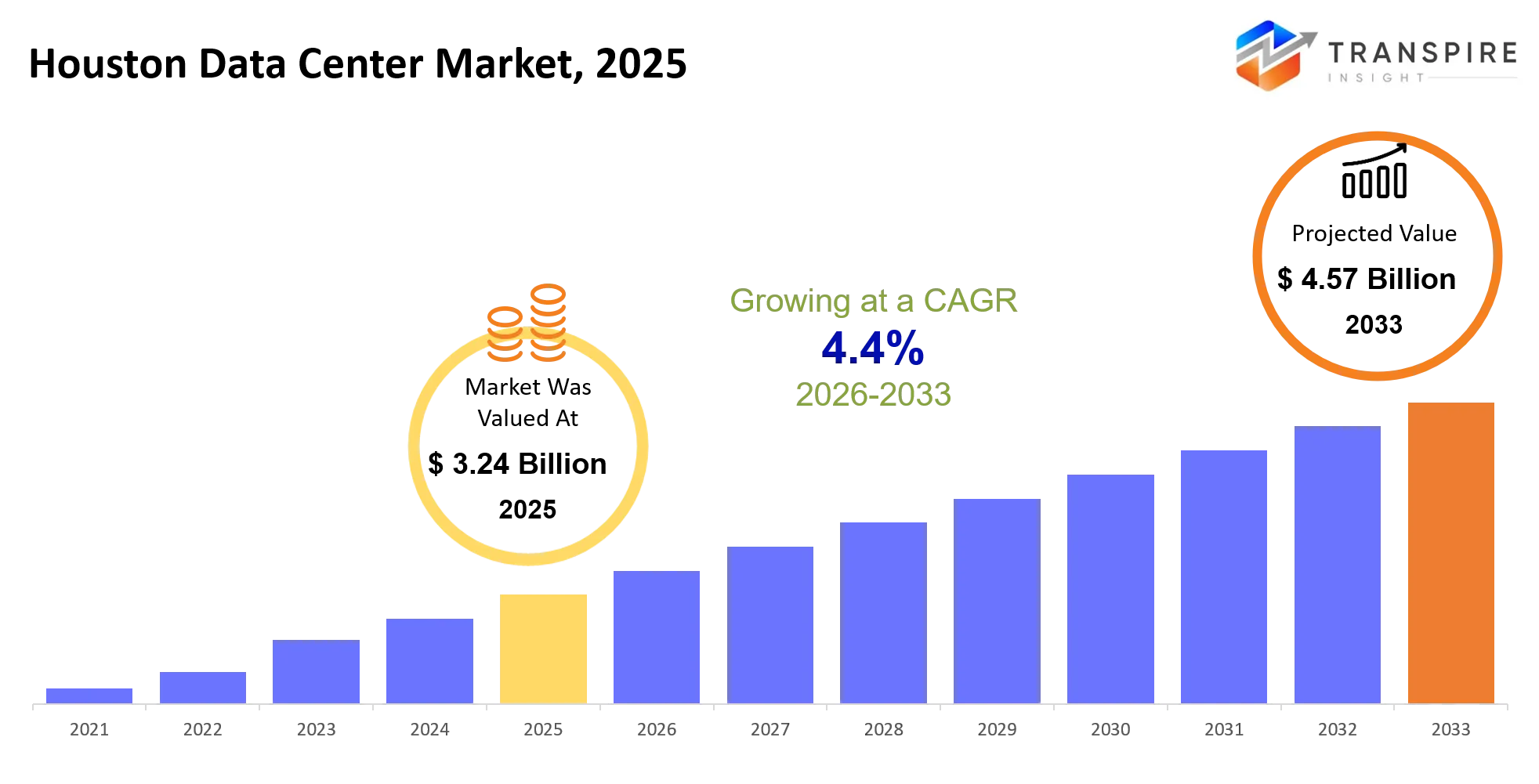
As per Transpire Insight Analysis, the Houston Data Center Market size is estimated at USD 3.24 billion in 2025 and is anticipated to reach USD 4.57 billion by 2033, growing at a CAGR of 4.4% from 2026 to 2033.
The Houston data center market offers businesses, cloud platforms and tech providers ready-to-use spaces for servers, storage, networking and digital services. They don’t have to build all the infrastructure from scratch. Colocation is the part of the market making up 46.2%. That’s because it gives shared access to power, cooling, security and networks. Things that save time and money. Over the past three to five years, the market has changed. It’s moving away from traditional enterprise hosting and toward bigger, denser facilities. These new centers are made for cloud computing, data analytics and artificial intelligence. Generative AI is a reason for this shift. It needs a lot of computing power. Uses more electricity and cooling than before. Data centre operators are reacting by building halls using modular construction and adding better cooling systems. Because of this, reliability is key. Clear timelines for getting things built are now just as important as fast internet connections when choosing a site. Houston has an edge because of its experience in the energy industry. Still future growth will depend on how much power is available, how efficiently centres run and how well local resources are managed.
Houston Data Center Market Size & Forecast:
- Market Size 2025: USD 3.24 Billion
- Expected Market Value (2033): USD 4.57 Billion
- Forecast CAGR (2026–2033): 4.4%
- Leading Region in 2025: North America
- Fastest Growing Region: Asia Pacific
- Key Company Profiles: Digital Realty, Equinix, CyrusOne, QTS Realty Trust, DataBank, Flexential, Stream Data Centers, STACK Infrastructure, Vantage Data Centers, Aligned Data Centers, Iron Mountain Data Centers, TierPoint, Cologix, Switch, NTT Data Centers
Key Market Insights:
The market is heading towards colocation facilities and rapid expansion of hyperscale infrastructure. Investments made in Houston also indicate a move towards AI-ready capacity and bigger facilities, along with power.
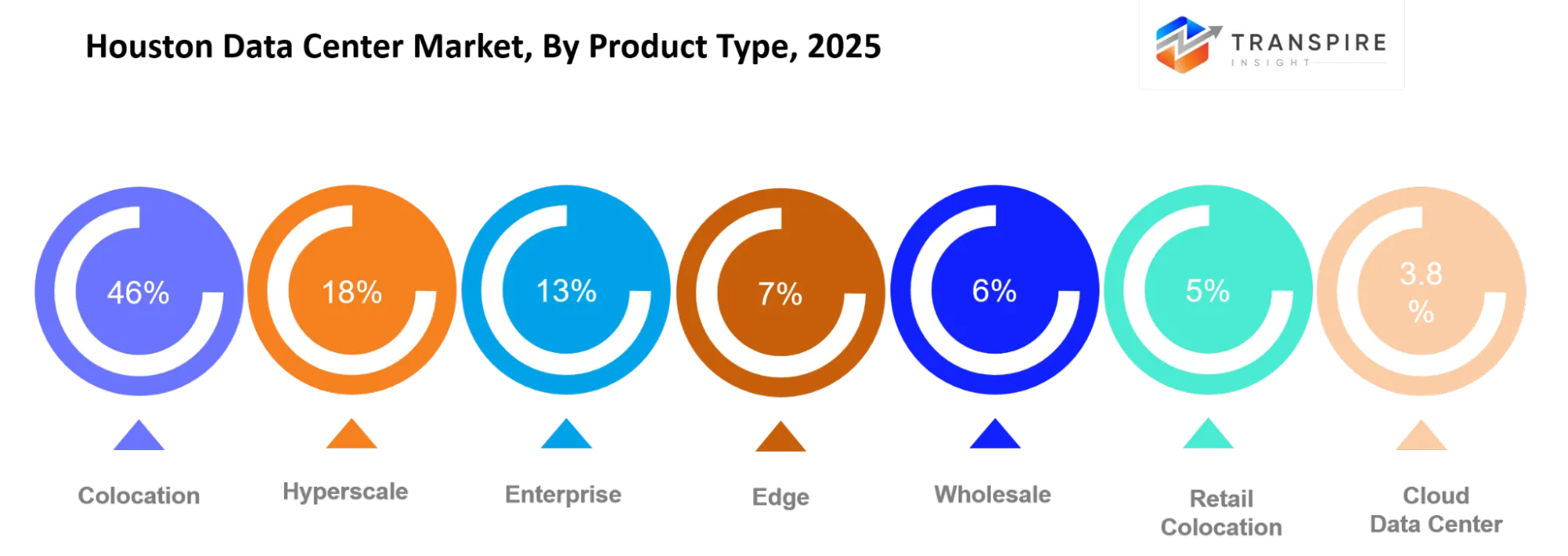
- Colocation data centres account for 46.2% of the market, as firms such as Element Critical invest in shared infrastructure to meet rising demand for secure facilities, reliable electricity, and flexible capacity.
- Hyperscale data centres account for 18% of the supplied market mix and are expected to grow at a 15.8% CAGR as cloud vendors continue to scale computing infrastructure for artificial intelligence and high-performance workloads.
- Enterprises constitute 13% of the market, whereas corporations examine hybrid infrastructures and colocation due to the need to manage their costs and ease the process of managing their data.
- Edge data centres constitute 7% of the market because technology suppliers offer assistance in handling applications that require fast data processing in areas close to industries and IoT devices.
- Wholesale data centres account for 6% of the market, where capacity leasing allows firms such as cloud firms and technology companies to have infrastructure for future growth.
- The retail colocation market segment accounts for 5%, where organisations prefer small-scale deployment and flexible infrastructure instead of having owned data centres.
What are the Key Drivers, Restraints, and Opportunities in the Houston Data Center Market?
Drivers
The growth of the market is driven by the presence of energy companies, healthcare establishments, banking services, and IT end-users in Houston, leading to a diverse customer profile for the data centres in the area. Computing capabilities and data storage security are needed for digital monitoring, cloud computing, manufacturing analytics, and AI utilisation. Such business is likely to make organisations opt for outsourcing their infrastructure through colocation providers or by choosing bigger facilities. AI-ready capacity investments serve as an additional example of how operators deal with increased demands for high-density computing.
Restraints
Electricity provision, grid connection timelines, cooling demands and construction costs can determine the rate of expansion. Larger buildings need bigger electricity infrastructures, and in some cases, delays are caused by a lack of sufficient capacity or grid connections. Moreover, the denser the servers, the more difficult cooling gets, and the more expensive operation becomes. These are among the barriers that will determine the economics of projects, commissioning plans and total capacities available to service providers.
Opportunities
The opportunities in the market are that developers can adopt the concept of build-to-suit facilities, power-efficient cooling and power management technologies. The industrial customers based in Houston are giving room for designing infrastructure with a focus on energy analytics, healthcare computing and critical applications. Serverfarm completed structural development of its planned 60 MW CTX2 facility in Houston. This represents an investment in highly dense infrastructure and waterless cooling technology.
What is the Impact of artificial intelligence on the Houston Data Center Market?
Artificial intelligence has revolutionised the data center needs in Houston by increasing the demand for computing facilities for model training, inference, industrial analytics, and real-time computing. Artificial intelligence will enable energy companies to analyse data about their devices and operational data using AI, and healthcare organisations and banks will use artificial intelligence to implement machine learning on some of the selected tasks. Artificial intelligence applications will need to have computing, reliable communication, data storage, and an infrastructure capable of handling the additional computational load. Artificial intelligence will also influence the way facilities are built. Higher-density data centres are being designed, improved power supply and different ways to cool down are being considered to be able to cope with additional heat produced by artificial intelligence servers. AI-driven analytics will allow operators to detect abnormal temperature behaviour, predict the time of device breakages, optimise cooling, and plan maintenance. However, such implementation will demand costs for installing special hardware, collecting data, software development, and people with proper knowledge. Mistaken predictions may reduce expected advantages from installation.
Instance
In October 2025, Apple started delivering AI servers from its new manufacturing facility in Houston, Texas, to power its U.S. data centres. The servers have been built using special chips made for artificial intelligence applications, thereby indicating how the adoption of AI is boosting the need for high-performance computing hardware.
https://www.reuters.com/business/apple-begins-shipping-ai-servers-houston-factory-2025-10-23/
Key Market Trends:
market trend is driven by the demand to optimise between computing capacity and electrical power, efficiency, and speed of deployment. The market trend reflects adaptation on the part of the operators to customer demand changes.
- In facility planning, there is increased focus on power availability and grid access, which encourages developers to consider power infrastructure early in the process.
- The provision of colocation is becoming more advanced with the combination of various features such as connectivity, security, remote services, and infrastructure management.
- Cooling options are changing as companies explore options such as liquid cooling and closed-loop cooling in response to higher-density computing.
- Enterprise buying is increasingly being affected by the deployment time, leading to increased demand for modular facilities, custom data halls, and capacity-based solutions.
- The digitalisation of the industry is expanding the customer base, especially in cases where energy operations, connectivity of equipment, and data-intensive applications need local infrastructure.
- The planning of infrastructure is receiving increased attention in terms of water consumption and performance due to the impact on operating costs.
Houston Data Center MarketSegmentation
By Data Center Type
The colocated data centres represent a 46.2% share of market distribution by type. This is because of the advantage offered in the form of utilisation of professional facilities, power supply, security measures, and connections without having to build an infrastructure of one’s own. The share of hyperscale data centres is 18%, enterprise data centres is 13%, edge data centres is 7%, wholesale data centres is 6%, retail colocation is 5%, cloud data centres is 3%, and other types take up 1.8% each. The fastest-growing segment among these data centre types is hyperscale centres, with an expected CAGR of 15.8%.
By Tier
Facilities in the tiers I and II cater to applications which have limited redundancy needs compared to tiers III and IV that cater to increasing availability and fault tolerance needs. Hybrid, modular, and edge-tier solutions offer other options for companies trying to achieve balance between resiliency, speed of deployment, and cost effectiveness. The energy, healthcare, and financial services sectors in Houston are likely to value the need for reliable infrastructure in their own ways depending on their requirements. Further investments will be determined by how the service level needs of the customers, power availability and costs of maintaining redundancy interrelate.
By Service
Services such as collocation, managed hosting, cloud computing, connectivity, disaster recovery, security, and remote hands will cater to the varying needs of the customers. Through colocation, companies will be able to place their infrastructure in professionally managed centres, while through managed hosting and cloud computing, companies will get to lessen the burden of running their infrastructure. Connectivity helps in enabling communications within business and digital platforms, while disaster recovery and security services will ensure the continuity of the business.
By Enterprise Size
The requirement for enterprises is the capacity to scale, security and customised infrastructure. SMEs and startups can choose shared facilities and managed services that can help to reduce costs and staffing requirements. Government organisations, banks, healthcare organisations, and technology organisations may also have different requirements due to compliance, sensitive data and application performance. All of this makes it feasible for cloud companies to provide custom services as well as economic infrastructure services to their customers.
By End User
Cloud providers utilise data centres to offer computing, storage, and digital services in bulk. BFSI firms rely on secure infrastructure for transaction processing and business applications. Healthcare firms rely on reliable infrastructure for clinical applications and data management. IT and telecom firms need infrastructure for connectivity and computing capacity. Government agencies, retailers, and energy firms utilise infrastructure for their own digital operations. The energy sector in Houston is highly relevant because industrial monitoring, analysis, and connected systems create special infrastructure needs. Future demand depends on workload, security, and capacity.
By Infrastructure
Computers and servers create the hardware infrastructure of the data centers. Networking allows data centers and devices inside them to communicate with the outside world and each other. Power, backup and cooling systems provide uninterrupted operations, while physical security is used to protect devices and the information from intruders and environmental hazards. Monitoring systems are necessary to watch for the temperature, power consumption and other operational characteristics of the data center's equipment. In case of increased computing density the focus in investment decision will move to electricity supply, heat management, equipment efficiency and use of monitoring systems.
By Ownership
Self-owned data centres enable a higher degree of control by organisations while requiring large amounts of money invested in them. Collocation and leasing provide options for companies that wish to have access to professionals and their data centers without full-fledged purchasing them. Capacity in a "build-to-suit" project may be designed according to specific company needs. A joint venture provides opportunities for distribution of costs and risks among partners.
What are the Key Use Cases Driving the Houston Data Center Market?
The use of colocation in Houston is another area that includes energy firms, healthcare companies, financial firms, and tech firms who will place their devices in safe, power-sufficient locations. This will minimise the construction of infrastructure by such companies. New applications will include the use of cloud computing, enterprise application hosting, disaster recovery services, storage and analysis of data, and industrial big data analytics. They help with providing a continuous process of operation and business transaction processes and management of large amounts of operational data. Some upcoming applications include AI inference, supercomputing, predictive maintenance, and real-time analytics of data. Such an opportunity may be useful for energy firms in the fast processing of information about devices and operations, and for healthcare and financial firms in the use of appropriate computing environments.
|
Report Metrics |
Details |
|
Market size value in 2025 |
USD 3.24 Billion |
|
Market size value in 2026 |
USD 3.38 Billion |
|
Revenue forecast in 2033 |
USD 4.57 Billion |
|
Growth rate |
CAGR of 4.4% from 2026 to 2033 |
|
Base year |
2025 |
|
Historical data |
2021 - 2024 |
|
Forecast period |
2026 - 2033 |
|
Report coverage |
Revenue forecast, competitive landscape, growth factors, and trends |
|
Regional scope |
United States; Canada; Mexico; United Kingdom; Germany; France; Italy; Spain; Denmark; Sweden; Norway; China; Japan; India; Australia; South Korea; Thailand; Brazil; Argentina; South Africa; Saudi Arabia; United Arab Emirates |
|
Key company profiled |
Digital Realty, Equinix, CyrusOne, QTS Realty Trust, DataBank, Flexential, Stream Data Centers, STACK Infrastructure, Vantage Data Centers, Aligned Data Centers, Iron Mountain Data Centers, TierPoint, Cologix, Switch, NTT Data Centers |
|
Customization scope |
Free report customization (country, regional & segment scope). Avail customized purchase options to meet your exact research needs. |
|
Report Segmentation |
By Data Center Type (Colocation, Hyperscale, Enterprise, Edge, Wholesale, Retail Colocation, Cloud Data Center, Others); By Tier (Tier I, Tier II, Tier III, Tier IV, Hybrid Tier, Modular, Edge Tier, Others); By Service (Colocation, Managed Hosting, Cloud Services, Connectivity, Disaster Recovery, Security, Remote Hands, Others); By Enterprise Size (Large Enterprises, SMEs, Startups, Government, Financial Institutions, Healthcare, Technology Companies, Others); By End User (Cloud Providers, BFSI, Healthcare, IT & Telecom, Government, Retail, Energy, Others); By Infrastructure (Servers, Storage, Networking, Power, Cooling, Security, Monitoring, Others); By Ownership (Owned, Colocation, Leased, Build-to-suit, Joint Venture, Managed, Hybrid, Others) |
Which Regions are Driving the Houston Data Center Market Growth?
North America
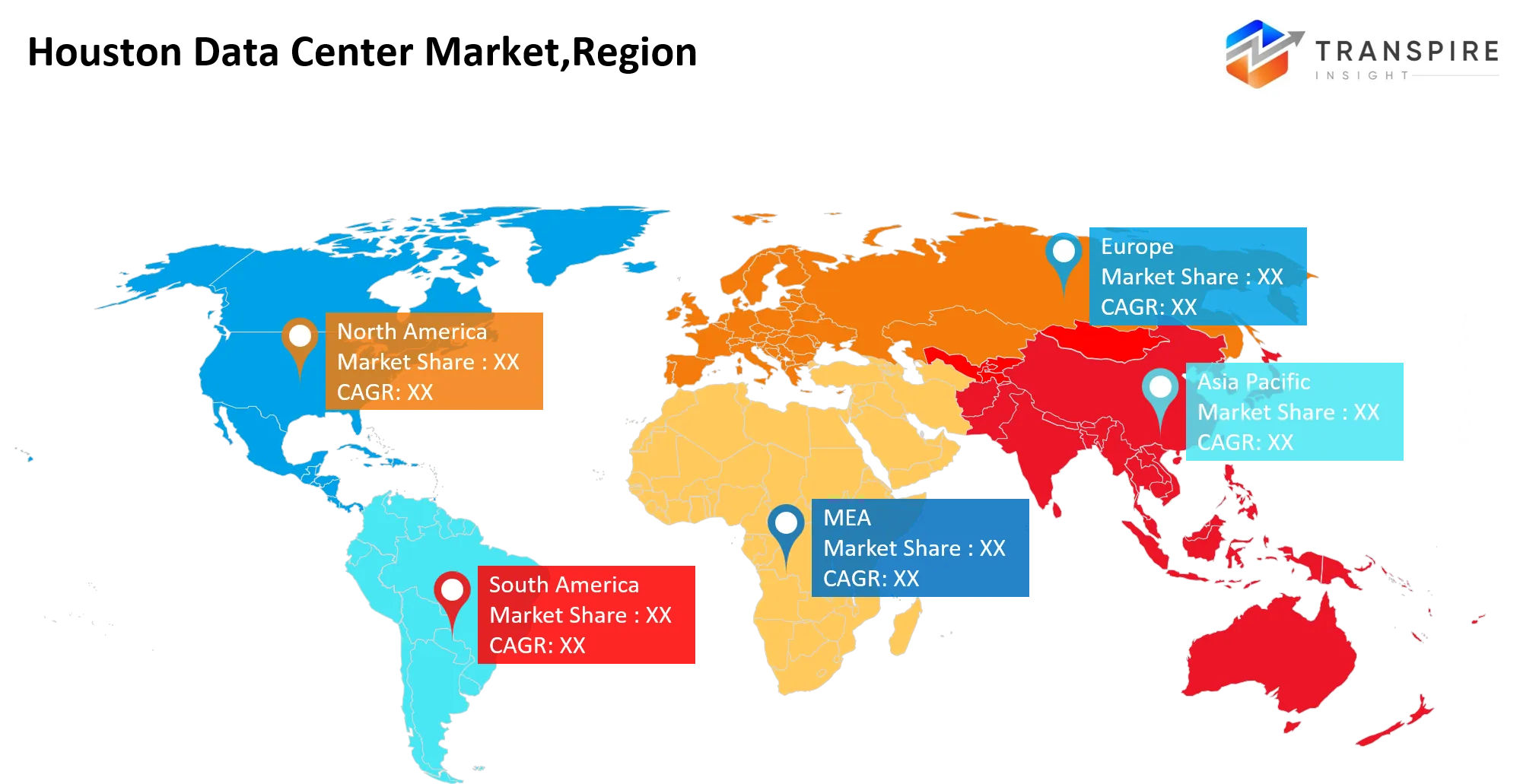
North America is the leader in terms of regional distribution, accounts for 100% share being attributed to the region based on geographical considerations, as indicated in the provided data. Houston enjoys the advantage of having a developed energy sector, business infrastructure, and demand for data storage, cloud computing, and industrial digitisation services. This means that investments can be made in colocation facilities and other specialised data centre infrastructures.
In June 2026,Dataprana declared that it had acquired two sites in the metro Houston area, having a total capacity of 92 MW for AI data centres. The sites are capable of providing capacities of 45 MW and 47 MW, respectively. It has been said that the acquisition would allow energy supply within one year, emphasising the importance of the availability of power facilities and quick deployments at Houston.
Europe
Europe constitutes 0% of the supplied regional distribution. However, the percentage cannot be used as an indicator of lack of data centre activity. Unlike Houston, Europe operates in a different regulatory environment and is driven by regional business demand, connectivity and power infrastructure. Digital services and enterprise demands can provide stability to the market, while the cost of energy and availability of infrastructure determine expansion.
In June 2025, CyrusOne announced its plan to set up a new data centre called LON6 in Iver Heath near London. LON6 aims to increase the European capacity of CyrusOne by providing 30,000 square meters of technical space. The project aims to meet the requirements of increasing cloud and digital infrastructure.
Asia Pacific
Asia Pacific emerges as the fastest-growing region with a projected CAGR of 12.6%. Investments made in cloud infrastructure, AI computing and digital services require more data centre capacity in some markets of the Asia Pacific region. Opportunities for growth vary, with Houston's demand driven by energy. Regional expansion in the market is facilitated by enterprise digitalisation and cloud ecosystem development. The 12.6% CAGR should remain unchanged.
In May 2025, NTT DATA made land purchases in seven strategic markets located in North America, Europe and Asia. It has acquired about 1 GW worth of data centre capacity in the strategic locations. The plan includes a location for establishing two data centres, having a total capacity of 100 MW in Tochigi, Japan, and 36 MW in Osaka.
Who are the Key Players in the Houston data centre marketand how do they compete?
Competition in Houston's data centers is based on the reliability of the facilities, availability of power, connectivity, deployment time, and the ability to cater to specialised computing needs. Competition in this market is based on different infrastructure models as opposed to prices. Some of the providers in the Houston market include DataBank, Lumen, Digital Realty, Equinix, CyrusOne, Serverfarm, and Element Critical. The former two offer their services using their existing local infrastructure and connectivity, while the latter two compete in the market using colocation and interconnected data centre services. Their differentiation is based on facility specifications, network access, customer needs, and the capacity available for certain deployments. CyrusOne offers services to enterprises and large-scale computing needs, but its commercial value is based on the provision of adequate capacity and infrastructure. In terms of expansion, these competitors use development of facilities, capacity upgrades, customised infrastructure, and cooling and power system investments. Providers who can offer reliable capacity on time and at low energy costs have an advantage in meeting computing needs.
Houston Data Center Market companies
- Digital Realty
- Equinix
- CyrusOne
- QTS Realty Trust
- DataBank
- Flexential
- Stream Data Centers
- STACK Infrastructure
- Vantage Data Centers
- Aligned Data Centers
- Iron Mountain Data Centers
- TierPoint
- Cologix
- Switch
- NTT Data Centers
Recent Development News
In February 2026, A press release from Serverfarm noted that structural completion of the 60 MW CTX2 data centre facility in Houston was completed, with the cooling system planned using a closed loop and without water evaporation. This is a project where a lot of attention was paid to investments in high-density computing and cooling systems.
November 2025, Element Critical starts the development of a 20,000-square-foot data hall with the capacity of 10 MW for high-density IT infrastructure at Houston One. The company expects the first delivery to be 4.5 MW by the end of 2026.
https://elementcritical.com/element-critical-adds-10mw-of-ai-ready-capacity-at-houston-one-campus/
What Strategic Insights Define the Future of the Houston Data Center Market?
Houston Data Center Market is shifting towards scalable computing infrastructure coupled with power supply, efficient cooling systems and faster deployment. The colocation segment is currently the largest among the provided segments, but the expected increase in hyperscale data centres implies that there may be some opportunities associated with cloud computing and artificial intelligence workloads. Nevertheless, developers should not expect that customers’ demand will make their projects successful. One of the underestimated risks that can negatively affect the project is the mismatch between the intended capacity and the infrastructure for power supply, which can affect deployment and profitability. The use of water, cooling system costs and the demands of high-density servers are additional issues that need to be considered during planning. The development of customised data centers for energy analytics, enterprise computing and artificial intelligence needs. Developers should consider power availability, scalability options, cooling efficiency and customer agreements when investing in data centre projects. Validation of the demand and constraints can help operators select more profitable projects.
By Data Center Type
- Colocation
- Hyperscale
- Enterprise
- Edge
- Wholesale
- Retail Colocation
- Cloud Data Center
- Others
By Tier
- Tier I
- Tier II
- Tier III
- Tier IV
- Hybrid Tier
- Modular
- Edge Tier
- Others
By Service
- Colocation
- Managed Hosting
- Cloud Services
- Connectivity
- Disaster Recovery
- Security
- Remote Hands
- Others
By Enterprise Size
- Large Enterprises
- SMEs
- Startups
- Government
- Financial Institutions
- Healthcare
- Technology Companies
- Others
By End User
- Cloud Providers
- BFSI
- Healthcare
- IT & Telecom
- Government
- Retail
- Energy
- Others
By Infrastructure
- Servers
- Storage
- Networking
- Power
- Cooling
- Security
- Monitoring
- Others
By Ownership
- Owned
- Colocation
- Leased
- Build-to-suit
- Joint Venture
- Managed
- Hybrid
- Others
Frequently Asked Questions
Find quick answers to common questions.
The houston data center market size was valued at USD 3.24 billion in 2025 and is poised to reach USD 4.57 billion by 2033, expanding at a 4.4% CAGR.
Key segments for the houston data center market are By Data Center Type (Colocation, Hyperscale, Enterprise, Edge, Wholesale, Retail Colocation, Cloud Data Center, Others); By Tier (Tier I, Tier II, Tier III, Tier IV, Hybrid Tier, Modular, Edge Tier, Others); By Service (Colocation, Managed Hosting, Cloud Services, Connectivity, Disaster Recovery, Security, Remote Hands, Others); By Enterprise Size (Large Enterprises, SMEs, Startups, Government, Financial Institutions, Healthcare, Technology Companies, Others); By End User (Cloud Providers, BFSI, Healthcare, IT & Telecom, Government, Retail, Energy, Others); By Infrastructure (Servers, Storage, Networking, Power, Cooling, Security, Monitoring, Others); By Ownership (Owned, Colocation, Leased, Build-to-suit, Joint Venture, Managed, Hybrid, Others)
Growth is primarily driven by increase in the need for cloud computing services, artificial intelligence (AI) systems, high-performance computing resources, high storage needs, the rise in the size of hyperscale data centers, digitalization in all industries, and investment in energy supply syst
The market is led by major manufacturers including Digital Realty, Equinix, CyrusOne, QTS Realty Trust, DataBank, Flexential, Stream Data Centres, STACK Infrastructure, Vantage Data Centres, Aligned Data Centres, Iron Mountain Data Centres, TierPoint, Cologix, Switch, NTT Data Centres
North America holds 100% of the Houston Data Centre Market’s geographical coverage, as Houston is in the United States. The growth of the market is fueled by growing demands in cloud computing, AI workloads, hyperscale data centres, digital infrastructure, reliable connectivity, and investments by tech giants.
The commercial potential in the international market for Houston data centres includes growth of AI-enabled and hyperscale data centres, rising need for cloud computing and colocation solutions, implementation of energy-efficient cooling solutions, use of renewable energy, and increased demand for secure data storage solutions. The companies can also gain from the favorable energy infrastructure in Houston and rising demand for digital solutions.
- Digital Realty
- Equinix
- CyrusOne
- QTS Realty Trust
- DataBank
- Flexential
- Stream Data Centers
- STACK Infrastructure
- Vantage Data Centers
- Aligned Data Centers
- Iron Mountain Data Centers
- TierPoint
- Cologix
- Switch
- NTT Data Centers
About the Authors

Avinash Kumar
I’m Avinash Kumar, a Senior Research Analyst at Transpire Insight, with expertise in the Electronics and Semiconductor and Energy & Power industry. My work focuses on analyzing emerging technologies, market trends, industry developments, and innovation across these sectors. I specialize in transforming complex technical and market insights into clear, research-backed content that helps professionals, businesses, and decision-makers stay informed. Through continuous industry research and data-driven analysis, I strive to deliver accurate, reliable, and practical perspectives on the latest advancements shaping the semiconductor and energy landscape.

Chakradhar Khansole
Chakradhar serves as the Research Director at Transpire Insight, bringing over 8 years of experience in technology, innovation, and strategic market intelligence. He specializes in transforming complex market data into actionable business insights that enable organizations to make informed, growth-oriented decisions. Recognized for his strategic vision and analytical expertise, Chakradhar leads high-impact research initiatives, delivering comprehensive market assessments, competitive intelligence, and forward-looking industry analysis.
Recently Published Reports
-
Apr 2026
Fiber Optic Faceplates Market
Fiber Optic Faceplates Market Size, Share & Analysis Report By Type (< 300 mm2, 300-350 mm2, and > 350 mm2, By Application (Night Vision, Holographic Imaging, Medical, and Others), and Geography (North America, Europe, Asia-Pacific, Middle East and Africa, South and Central America), 2021 - 2031
-
Apr 2026
High Temperature Superconductors Market
High Temperature Superconductors Market Size, Share & Analysis Report By Type (1G HTS, and 2G HTS), By Application (Power Cable, Fault Current Limiter, and Transformer), and Geography (North America, Europe, Asia-Pacific, Middle East and Africa, South and Central America), 2021 - 2031
-
Apr 2026
Industrial Plugs and Socket Market
Industrial Plugs and Socket Market Size, Share & Analysis Report By Type (Industrial Plugs, Industrial Sockets), By Current (Up to 32 A, 32 to 125 A, Above 125 A), By Protection (Dustproof and Splash Proof, Waterproof, Explosion Proof), By End User (Heavy Industries, Oil and Gas, Chemicals and Pharmaceuticals, Power Generation, Others), and Geography (North America, Europe, Asia-Pacific, Middle East and Africa, South and Central America), 2021 - 2031
-
Apr 2026
InGaAs Avalanche Photodiodes Market
InGaAs Avalanche Photodiodes Market Size, Share & Analysis Report By Type (1100 - 1700 nm, and 1000 - 1600 nm), By Application (Missile Warning System, Muzzle Flash Detection, Wafer Defect Inspection, Laser Rangefinders, and Others), and Geography (North America, Europe, Asia-Pacific, Middle East and Africa, South and Central America), 2021 - 2031