
Healthcare Communication Solutions Market Summary:
According to Transpire Insights, a detailed research report on the market reflects that the clinical communication platforms application segment dominates the Healthcare Communication Solutions Market, accounting for approximately 60% of the total share worldwide. Oracle Health leads the market with approximately (around USD 57.4 billion) in annual revenue and an estimated 18-22% market share, making it the leading contributor to market development, innovation, advanced healthcare communication solutions, expanding digital healthcare capabilities, and growth dynamics.
Market Snapshot
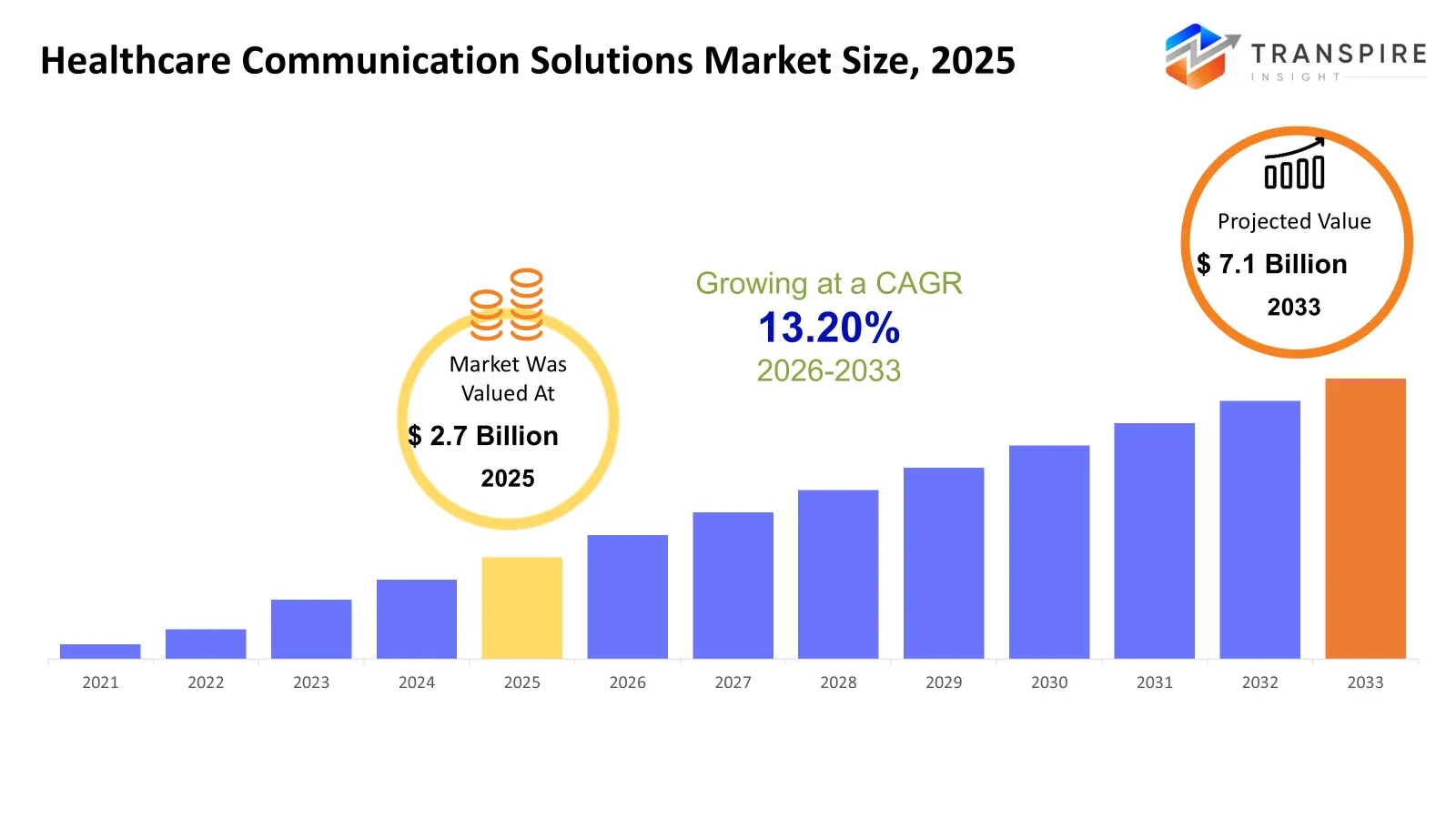
- Market Value (2025): USD 2.7 Billion.
- Expected Market Value (2026): USD 3.0 Billion.
- Estimated Market Value (2033): USD 7.1 Billion.
- Forecast CAGR (2026-2033): 13.20%.
- Leading Region in 2025: North America
- Second-largest Region: Europe
- Fastest Growing Region: Asia Pacific
Introduction
Software, technology and services that facilitate safe, real-time information exchange, workflow coordination, and patient involvement among physicians, nurses, patients, and health organizations make up the market for healthcare communication solutions. Healthcare communication solutions hospitals, physicians and patients employ digital and voice platforms, such as cloud contact centers, encrypted mobile messaging, and electronic health record (EHR) connection tools, to swiftly and safely exchange critical medical information. Clinical communication and collaboration (CC&C) software programs that enable care teams to coordinate patient treatment workflows inside a medical facility, communicate securely, and deliver real-time warnings. By maximizing task coordination among healthcare personnel, cutting down on communication delays, and simplifying clinical handoffs, healthcare communication systems increase workflow efficiency. By facilitating quicker reactions to vital warnings, test results, and care coordination needs, these cutting-edge technologies improve patient outcomes. Automated appointment reminders, omnichannel communication tactics that improve provider-patient interactions, and round-the-clock accessibility all contribute to increased patient satisfaction. Strong data security frameworks, encrypted messaging systems, and secure information management systems also guarantee adherence to strict healthcare privacy laws, facilitating dependable, effective, and patient-focused digital healthcare communication across clinics, hospitals, and healthcare networks ly.
For instance: The market for healthcare communication solutions, including clinical communication, contact centers, and patient engagement, is dominated by North America. Strict patient experience requirements, cloud-based designs, and significant corporate and venture capital expenditures in AI are the main drivers of growth.
Market Highlights: -
- North America is expected to grow at a rapid CAGR in the Healthcare Communication Solutions Market by holding around 46% of the share during the forecast period.
- Europe is anticipated to hold roughly 27% share of the Healthcare Communication Solutions Market over the predicted timeframe.
- Asia Pacific is anticipated to hold roughly 21% share of the Healthcare Communication Solutions Market over the predicted timeframe.
- By solution type, the Telehealth Communication segment dominated the market and holds roughly 44% share in 2025 and is projected to grow at a substantial CAGR during the forecast period.
- By end user, the Hospitals segment dominated the market and holds nearly 42% share in 2025 and is projected to grow at a substantial CAGR during the forecast period.
- By application, the Clinical Communication segment dominated the market and holds nearly 38% share in 2025 and is projected to grow at a substantial CAGR during the forecast period.
- Ayushman Bharat Digital Mission (ABDM): To facilitate safe health data exchange, remote teleconsultations and smooth communication between patients and healthcare providers, India's national digital health infrastructure initiative offers distinct Ayushman Bharat Health Account (ABHA) IDs and interoperable digital health platforms. The program aids in the development of digital healthcare ecosystems and boosts the market for healthcare communication solutions worldwide.
How is Technology Driving Growth in the Healthcare Communication Solutions Market?
Cloud-native platforms, telemedicine, artificial intelligence (AI) and cutting-edge cybersecurity technologies are revolutionizing the healthcare communication solutions market. While AI-powered automation simplifies patient interaction and clinical documentation, cloud-based communication technologies facilitate real-time data exchange and smooth collaboration across healthcare networks. Patient-provider communication and remote care accessibility are improved by the quick uptake of telehealth and mobile health (mHealth) technologies. Furthermore, strong cybersecurity frameworks, secure messaging services, and cutting-edge encryption technologies improve data security, guarantee regulatory compliance, and promote confidence in digital healthcare communication, all of which encourage innovation and long-term market expansion.
Market Drivers
Demand for integrated healthcare communication systems that facilitate seamless virtual care and real-time patient involvement is being driven by the quick growth of telehealth services. In order to increase operational effectiveness and lessen administrative burden, AI-powered triage systems, intelligent call routing, and workflow automation are being adopted more quickly due to the growing shortage of healthcare workers. Additionally, scalability, interoperability, and safe, round-the-clock access to clinical data are improved by switching from old infrastructure to cloud-based communication platforms. The adoption of encrypted messaging, secure communication networks, and compliance-driven digital solutions is further encouraged by strict healthcare data protection legislation, supporting effective, safe, and patient-centered healthcare communication ly. By maximizing staff coordination, automating appointment scheduling, and expediting clinical operations, healthcare communication technologies improve operational efficiency. By reducing communication errors, enhancing care coordination, and facilitating quicker reactions in urgent medical circumstances, these systems enhance patient care. Through individualized digital health portals, automated notifications, and round-the-clock accessibility, advanced communication technologies also boost patient engagement. Additionally, cloud-based infrastructure and secure communications systems offer strong data protection through encryption and adherence to strict healthcare laws, guaranteeing privacy, dependability, and confidence. These advantages are propelling the adoption of healthcare communication solutions in clinics, hospitals, and healthcare networks.
For Instance: -
- Due to increased investments in both public and commercial systems, digital hospital improvements, and high smartphone penetration, South Africa's healthcare communication and collaboration sector is growing quickly. The market for local business collaboration and communication technologies is expected to grow rapidly because of the high need for mobile coordination and remote health.
- AI integration, cloud use, and value-based care are driving the rapid growth of the market for healthcare contact centers and communication systems. With a significant portion of all IT investments, the United States leads North America, the largest regional market in the world.
Restrain
The adoption of healthcare communication systems is hampered by a number of factors, including high implementation costs, difficult legacy system integration, strict healthcare compliance standards, and interoperability issues. Deployment among smaller healthcare providers is constrained by significant investments in cybersecurity, infrastructure, employee training, and regulatory compliance. Additionally, the smooth sharing of data between healthcare networks is hampered by uneven communication standards.
Analysis of Prices and Consumer Behaviour
Around 60% of the demand within the healthcare communication solutions market is attributed to clinical communication platforms and integrated healthcare communication systems, given the growing implementation of advanced healthcare communications in hospitals, telehealth providers, healthcare networks, and digital health organizations. The solution cost for advanced healthcare communication solutions with automated AI capabilities, interoperability features, and high cybersecurity level will be around 25-30% more than the cost of the basic communications solutions. The cloud solutions are involved in roughly 55% of all implementation projects due to their scalability, accessibility from afar, and capability of exchanging data in real time. The demand from hospitals, clinics, and healthcare networks is about 65-70% of the overall demand amid the growing technological transformation processes and the fight for high efficiency in clinical processes. According to effective communications solutions organizations, the data security, reliability, and regulatory compliance are the most important aspects to be taken into account while implementing solutions, with around 65% of organizations reporting that they would prefer forming strategic partnerships and entering into long-term contracts (35-40% of all surveyed organizations).
Top Companies in the Healthcare Communication Solutions Market
- Microsoft
- Cisco
- Zoom
- Oracle Health
- Epic Systems
- TigerConnect
- Spok Holdings
- RingCentral
- Avaya
- Altera Digital Health
- Vonage
- Twilio
- 8x8 Inc.
- NEC Corporation
- Vocera (Stryker)
Market Segmentation
The Healthcare Communication Solutions Market share is divided into five categories: By service type, deployment, end user, application and enterprise size.
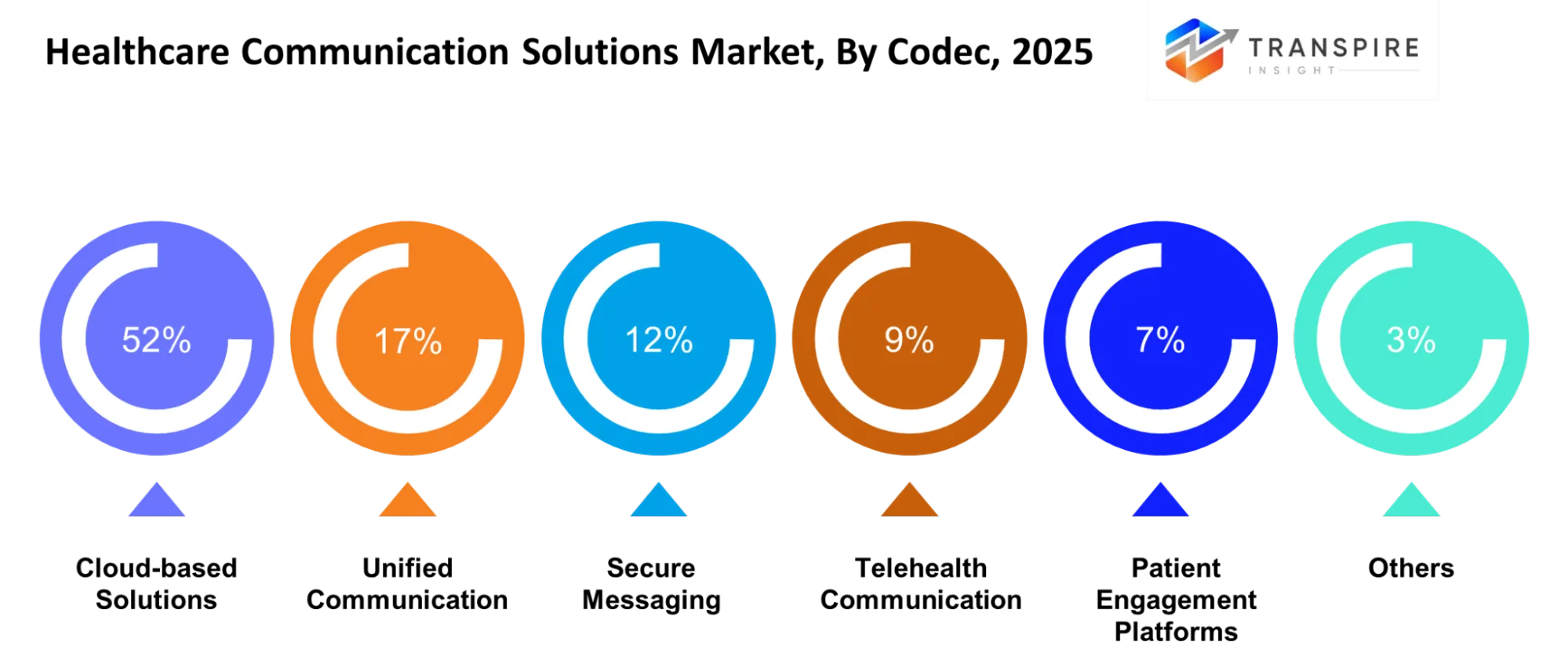
The Telehealth Communication dominated the market, accounting for roughly 44% in 2025 and is expected to rise at a significant CAGR during the forecast period.
The Healthcare Communication Solutions Market is segmented by Solution type into Unified Communication, Secure Messaging, Telehealth Communication, Patient Engagement Platforms, Contact Center Solutions, Others. Among these, the Telehealth Communication segment dominated the market, accounting for roughly 44% in 2025 and expected to increase at a significant CAGR during the forecast period. The market was dominated by the Telehealth Communication category, which held over 44% of the market in 2025. This was due to the growing demand for convenient patient-provider communication, the expansion of digital health infrastructure, and the growing use of remote healthcare services. Over the course of the projection period, segment growth is anticipated to increase at a considerable CAGR thanks to developments in secure telemedicine platforms, enhanced internet connectivity, and supportive healthcare legislation.
The Hospitals dominated the market, accounting for nearly 42% in 2025, and is expected to rise at a significant CAGR during the forecast period.
The Healthcare Communication Solutions Market is segmented by end user into Hospitals, Clinics, Diagnostic Centers, Health Systems, Others. Among these, the Hospitals segment dominated the market, accounting for nearly 42% in 2025 and expected to increase at a significant CAGR during the forecast period. Due to the extensive use of cutting-edge digital healthcare infrastructure, integrated patient communication systems, and rising demand for coordinated clinical treatment, hospitals accounted for about 42% of the market in 2025. Over the course of the forecast period, increasing investments in telehealth technology, electronic health records, and remote patient monitoring are anticipated to boost segment expansion at a notable CAGR.
The Clinical Communication dominated the market, accounting for nearly 38% in 2025 and is expected to rise at a significant CAGR during the forecast period.
The Healthcare Communication Solutions Market is segmented by application into Clinical Communication, Patient Communication, Administrative Communication, Emergency Communication, Others Among these, the Clinical Communication segment dominated the market, accounting for nearly 38% in 2025 and expected to increase at a significant CAGR during the forecast period. Driven by the increasing demand for seamless care coordination, real-time information transmission, and better patient outcomes, the Clinical Communication segment dominated the market, holding almost 38% of the market in 2025. Over the course of the projection period, considerable CAGR growth is anticipated due to the growing adoption of electronic health records (EHRs), secure clinical messaging systems, and interoperability solutions.
Regional Segment Analysis of the Healthcare Communication Solutions Market:
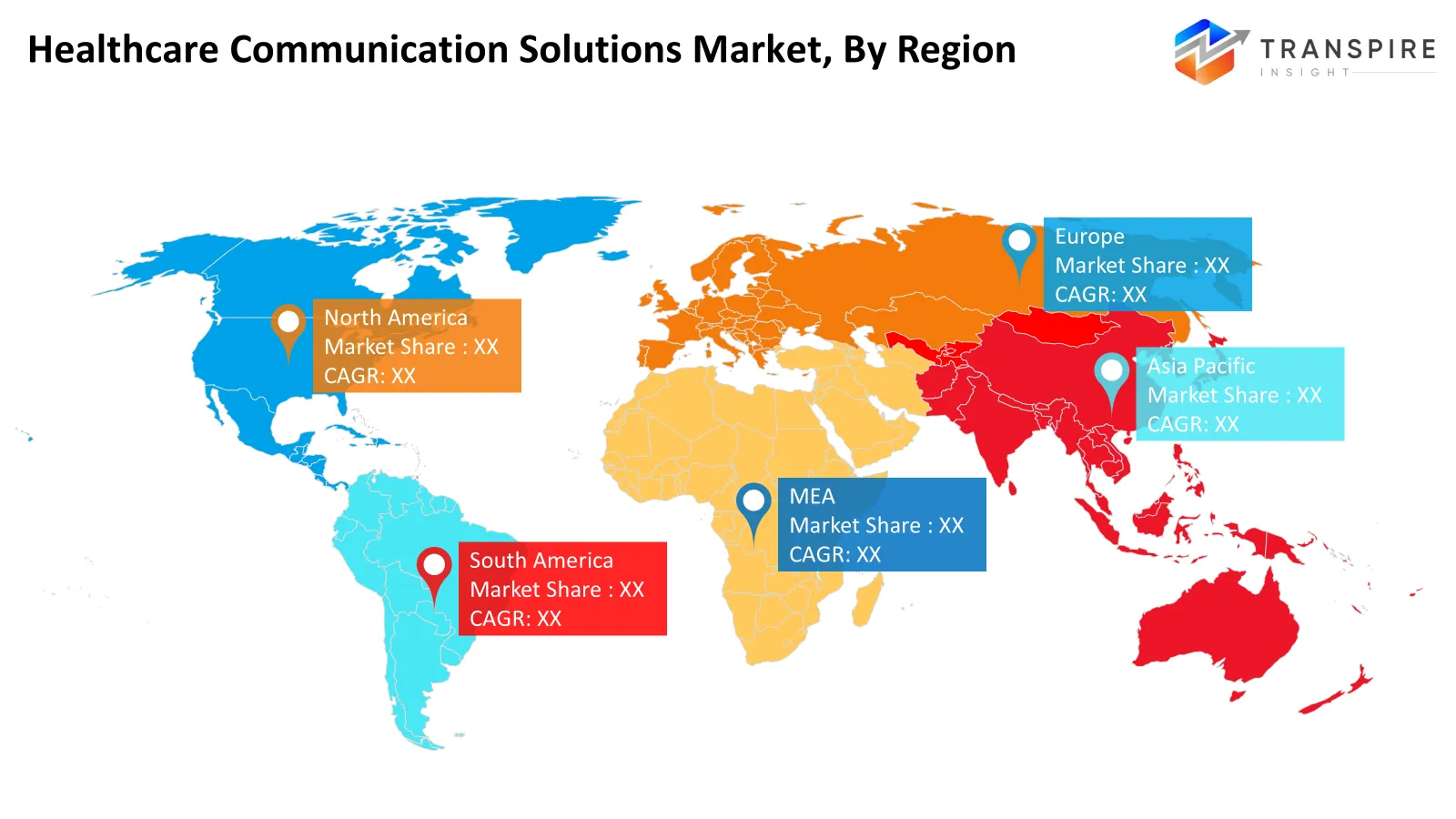
- North America (U.S., Canada, Mexico)
- Europe (Germany, France, U.K., Italy, Spain, Rest of Europe)
- Asia-Pacific (China, Japan, India, Rest of APAC)
- South America (Brazil and the Rest of South America)
- The Middle East and Africa (UAE, South Africa, Rest of MEA)
North America is the fastest-growing region in the Healthcare Communication Solutions Market during the period, holding around 46% share.
North America is expected to grow at a rapid CAGR in the Healthcare Communication Solutions Market holding around 46% share during the forecast period. With a 46% market share, North America is the fastest-growing area in the healthcare communication solutions market. This is due to the region's sophisticated healthcare IT infrastructure, extensive use of digital communication platforms, and rising telehealth technology investments. Regional market growth is still being accelerated by supportive government initiatives, rising demand for interoperable healthcare systems, and the quick integration of cloud-based communication solutions.
Europe is expected to grow at a rapid CAGR in the Healthcare Communication Solutions Market, holding roughly 27% of the share during the forecast period
Europe is expected to grow at a rapid CAGR in the Healthcare Communication Solutions Market holding roughly 27% share during the forecast period. Over the course of the forecast period, Europe is anticipated to account for over 27% of the healthcare communication solutions market, which is predicted to grow at a quick compound annual growth rate. Stricter healthcare data protection laws, growing acceptance of interoperable communication platforms, growing investments in telemedicine, connected care, and patient engagement technologies throughout the area, and growing digital healthcare transformation are the main drivers of growth.
Asia Pacific is the fastest-growing region in the Healthcare Communication Solutions Market during the period, holding roughly 21% share.
Asia pacific is the fastest-growing region in the Healthcare Communication Solutions Market during the forecast period, holding roughly 21% share during the forecast period. With a 21% market share, Asia Pacific is the fastest-growing region in the healthcare communication solutions market. This growth is fueled by the rapid digitalization of healthcare, growing telehealth adoption, rising smartphone penetration, and increased investments in healthcare IT infrastructure. Growing patient populations, government programs promoting digital health, and the need for effective clinical communication solutions are all driving regional market expansion.
Strategies for Market Growth in Non-Leading Regions:
The construction of non-leading areas through successfully productive and expandable healthcare communication solution infrastructure will be profitable for small and medium-sized healthcare establishments and since organization companies. It is possible to deploy communications systems, cloud-based healthcare systems and synchronized communication systems locally in order to preserve the healthcare stakeholders from using advanced healthcare centers which can provide all the people only with expensive healthcare services. The establishment of mutually beneficial strategic partnerships will broaden the market possibilities of healthcare communication solutions. It is also very important to organize training and improve the quality of knowledge related to digital healthcare platforms, interoperability, cybersecurity standards and communication system management. It should be noted that flexible financial structures, long-term technology contracts and managed service partnerships will make the product itself affordable for the customers. The establishment of joint strategies with governmental bodies of the health care sector and IT organizations can help to improve the access to stated healthcare communication solutions.
Future Market Trends for the Healthcare Communication Solutions Market: -
- Cloud-Based Platforms: Hospitals are switching from outdated on-premise systems to scalable, round-the-clock cloud infrastructure that lowers overhead expenses.
- Interoperability and Integration: To reduce data fragmentation, communication tools now directly integrate with Customer Relationship Management (CRM) and Electronic Health Records (EHR).
- Advanced Wireless Technology: Wearable technology and real-time hospital data transmission are still anchored by Wi-Fi and Bluetooth.
- AI and Chatbots: To speed up response times, routine scheduling, triage, and patient inquiries are handled by virtual agents and intelligent routing.
- Unified CC&C Platforms: Clinical Communication and Collaboration (CC&C) solutions that integrate patient records, messaging, and alarms onto a single dashboard.
Recent Development
- In July 2026: The goal of the CMMI ACCESS (Advancing Chronic Care with Effective, Scalable Solutions) Model is to increase the use of digital healthcare services, virtual care solutions, and outcome-aligned payment pathways in chronic disease management. By encouraging remote monitoring, secure patient-provider connectivity, and integrated digital care delivery models, the effort increases the uptake of healthcare communication technology and supports the expansion of the market for healthcare communication solutions.
- In May 2026: AnaTelTM, an AI-native software development platform for healthcare and MedTech businesses, was introduced by Tata Elxsi with the goal of accelerating the development of connected health technologies, digital healthcare innovation, and regulatory compliance. By facilitating intelligent processes, enhanced interoperability, and technology-driven connectedness within contemporary healthcare ecosystems, the platform advances healthcare communication solutions.
Market Segment
This study forecasts revenue at , regional and country levels from 2020 to 2033. Transpire Insights has segmented the Healthcare Communication Solutions Market based on the below-mentioned segments:
Healthcare Communication Solutions Market, By Solution Type
- Unified Communication
- Secure Messaging
- Telehealth Communication
- Patient Engagement Platforms
- Contact Center Solutions
- Others
Healthcare Communication Solutions Market, By Deployment
- Cloud-based
- On-premise
- Hybrid
- Others
Healthcare Communication Solutions Market t, By End User
- Hospitals
- Clinics
- Diagnostic Centers
- Health Systems
- Others
Healthcare Communication Solutions Market, By Application
- Clinical Communication
- Patient Communication
- Administrative Communication
- Emergency Communication
- Others
Healthcare Communication Solutions Market, By Enterprise Size
- Large Enterprises
- SMEs
- Others
Healthcare Communication Solutions Market, By Regional Analysis
North America
- US
- Canada
- Mexico
Europe
- Germany
- UK
- France
- Italy
- Spain
- Russia
- Rest of Europe
Asia Pacific
- China
- Japan
- India
- South Korea
- Australia
- Rest of Asia Pacific
South America
- Brazil
- Argentina
- Rest of South America
Middle East & Africa
- UAE
- Saudi Arabia
- Qatar
- South Africa
- Rest of the Middle East & Africa
Frequently Asked Questions
Find quick answers to common questions.
Telehealth adoption, digital transformation, AI integration, cloud platforms, and secure communication demand are driving healthcare communication market growth.
Telehealth Communication dominates with 44% share in 2025 due to increasing remote care adoption and digital healthcare expansion.
Hospitals lead with 42% share due to advanced IT infrastructure, clinical communication needs, and integrated patient care systems.
North America dominates with 46% share due to advanced healthcare infrastructure, digital adoption, and telehealth technology investments.
AI improves communication through automation, intelligent workflows, virtual assistants, clinical support, and enhanced patient engagement across healthcare systems.
- Microsoft
- Cisco
- Zoom
- Oracle Health
- Epic Systems
- TigerConnect
- Spok Holdings
- RingCentral
- Avaya
- Altera Digital Health
- Vonage
- Twilio
- 8x8 Inc.
- NEC Corporation
- Vocera (Stryker)
About the Authors

Pankaj Ghogare Patil
I am Pankaj Ghogare Patil, a Senior Research Analyst at Transpire Insight, specializing in the Pharmaceutical, Chemicals & Materials, Healthcare IT, and Biotechnology industry. My expertise lies in conducting comprehensive market research, analyzing industry trends, evaluating competitive landscapes, and translating complex data into actionable insights. At Transpire Insight, I closely follow emerging technologies, regulatory developments, and market innovations to create accurate, well-researched, and informative content that helps businesses and professionals make informed decisions. I am committed to producing credible, evidence-based articles that reflect industry best practices while making technical topics accessible and valuable for a broad audience.

Chakradhar Khansole
Chakradhar serves as the Research Director at Transpire Insight, bringing over 8 years of experience in technology, innovation, and strategic market intelligence. He specializes in transforming complex market data into actionable business insights that enable organizations to make informed, growth-oriented decisions. Recognized for his strategic vision and analytical expertise, Chakradhar leads high-impact research initiatives, delivering comprehensive market assessments, competitive intelligence, and forward-looking industry analysis.
Recently Published Reports
-
Apr 2026
AI in Diabetic Retinopathy Market
AI in Diabetic Retinopathy Market Size, Share & Analysis Report By Type (Screening AI Systems, Diagnostic AI Systems, and Predictive AI Models), By Application Segment (Hospitals, Ophthalmology Clinics, Diagnostic Centers, and Research and Development), and Geography (North America, Europe, Asia-Pacific, Middle East and Africa, South and Central America), 2021 - 2031
-
Apr 2026
Psychometric Tests Market
Psychometric Tests Market Size, Share & Analysis Report By Type (Personality Tests, Ability/Aptitude Tests, Skill/Knowledge Tests, and Others), By Application (Talent Acquisition and Talent Management), and Geography (North America, Europe, Asia-Pacific, Middle East and Africa, South and Central America), 2021 – 2031
-
Apr 2026
Rare Biological Sample Collection Market
Rare Biological Sample Collection Market Size, Share & Analysis Report By Type (Isolation Kits & Reagent, Blood Collection Tubes, and Others), By Application (Oncology, Transcriptomics, Pharmacogenomics, and Others), and Geography (North America, Europe, Asia-Pacific, Middle East and Africa, South and Central America), 2021 – 2031
-
Jul 2026
Diabetic Retinopathy Market
Diabetic Retinopathy Market Size, Share & Analysis Report By Type (Proliferative Diabetic Retinopathy, and Diabetic Macular Edema (DME)), By Treatment Type (Anti VEGF Drug, Steroid Implants, Laser Surgeries, and Vitrectomy), and Geography (North America, Europe, Asia-Pacific, Middle East and Africa, South and Central America), 2021 – 2031
Our Clients







