

Market Summary
The global Gut Health Supplements market size was valued at USD 11.6 billion in 2025 and is projected to reach USD 30.6 billion by 2033, growing at a CAGR of 12.80% from 2026 to 2033. The gut health supplement market is registering a CAGR due to increasing gut microbiome-related health awareness among people worldwide. Moreover, an upsurge in the incidence of lifestyle diseases and the overuse of antibiotics and other medications is driving the demand for preemptive gut health supplements in the global market. Emerging online shopping and direct-to-consumer distribution also aid in increasing customer compliance in this sector.
Market Size & Forecast
- 2025 Market Size: USD 11.6 Billion
- 2033 Projected Market Size: USD 30.6 Billion
- CAGR (2026-2033): 12.80%
- North America: Largest Market in 2026
- Asia Pacific: Fastest Growing Market
To learn more about this report,  Download Free Sample Report
Key Market Trends Analysis
- It is observed that, among the different segments in North America, there is a strong consumer preference for probiotics and synbiotics. Convenience and palatability make the dominant forms capsules and gummies, while strong adoption is observed among adults and millennials due to e-commerce and DTC channels.
- In the U.S., there is fast growth of functional gut-health beverages and enzyme blends supported by awareness campaigns, diet-conscious consumers, and integrations of gut wellness into preventive healthcare regimens.
- Asia Pacific drives the powdered and sachet formulations for probiotics and prebiotics owing to increasing health-conscious middle-class consumers, urbanization, and rising online and retail channels that offer affordable and flexible solutions.
- Capsules continue to be the most popular format globally because of the consumer demand for accuracy and ease of dosing and because of the proven format of clinical supplements. Gummies and drinks continue to rapidly increase their shares as there is a trend towards easier dosing and compliance.
- Probiotics remain the cornerstone in the market because of their established scientific basis and recognition, and synbiotics are emerging as a fast-growing segment because they complement each other according to the trends related to personalization and holistic approaches for gut health.
- The foremost application of interest is related to digestive health, while applications related to immune/metabolic health are also growing in popularity due to the increasing awareness of the role of the gut in the systemic health of the individual.
- The Pharmacies & Drugstores maintains its strong position due to trust and convenience, although online shopping and direct-to-consumers are causing a paradigm shift through subscriptions, personalization, education, and widespread adoption, especially among developed as well as developing countries.
So, The global gut health supplements market is presently experiencing substantial growth due to increasing consumer education on digestive wellness and its inextricable association with general wellness. Rising research on gut wellness and its correlation with the immune system, metabolic conditions, and mental wellness is leading to an escalating demand for gut wellness supplements comprising probiotics, prebiotics, synbiotics, and enzyme supplements. Increasing prevalence of digestive conditions, lifestyle diseases, and the use of antibiotics is encouraging consumers to opt for preventatives through supplements. Growing consumer interest in health-supporting foods and drinks, in addition to a focus on disposable income, is encouraging established as well as new companies to innovate in various segments of supplements such as softgels, powder, gummies, and drinks.
Advances due to technological innovations, personalization, as well as marketing through modern channels, are additionally acting as catalysts for the accelerated growth of the market. Additionally, the rise in e-commerce, subscription, as well as healthcare consultations, is supporting the uptake of the market, thus leading to a CAGR for the market, which is set to remain positive across all demographics.
Gut Health Supplements Market Segmentation
By Form
- Capsules
Capsules drive adoption because of their accurate dosing capacity, convenient ingestion, and close alignment with proven probiotic and enzymatic supplements. In fact, capsules are generally well-liked by adults, as well as the ageing population, who wish to take a well-structured, prolonged gut health supplement regime on a daily basis.
- Powders
Powders are preferred due to their adaptability and ease of incorporation into foods and beverages. This dosage form is attractive to health-consciously predisposed consumers favoring flexible dosing and is well-accepted in the Asia Pacific and sports nutritional segments.
- Gummies
Gummies are witnessing a rapid rise in popularity owing to their taste, ease of consumption, and a high level of user compliance. They tend to lure kids, millennials, and new consumers, thus enabling brands to tap a wider base of customers than the traditional supplement user base.
- Beverages
Gut health drinks are becoming a trend with functional beverages like probotics juices and kombucha. The "on-the-go” nature of this product makes it an accessible and frequent consumption option, without feeling fatigued from pills.
- Softgels
The softgels provide good bioavailability capabilities compared to others, in terms of taste masking for the oil formulations, making way for sensitive products. They are positioned in the premium category for digestive and immune care supplements.
- Sachets
The sachet package format ensures portability, portion control, and convenience. It is gaining adherence in emerging markets because it is cheap and can be easily mixed with water or food.
By Product Type
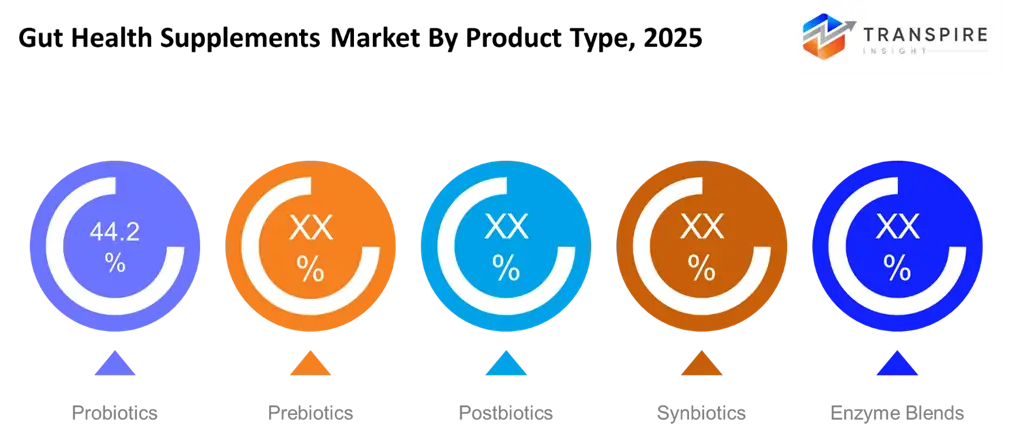
- Probiotics
Probiotics represent the largest segment, because of strong scientific evidence coupled with increased consumer awareness. Probiotics find their application in maintaining gut microbiome balance, enhancing digestion, and immune function in all age groups.
- Prebiotics
Prebiotics are substances that foster the growth of good bacteria in the gut and are more and more being adopted as prevention nutrition solutions. Their soft, fiber-based character appeals to the consumer looking for a natural, long-term digestive health support.
- Postbiotics
Due to stability and safety, postbiotics are gaining increasing interest, hence finding favor in formulation for sensitive consumers by providing consistent benefits on digestion and the immune system without viability liabilities.
- Synbiotics
Synbiotics: It is a combination of probiotics and prebiotics, offering greater synergy in gut health benefits. It is closely related to the trend of personalized nutrition concepts. Growth rate for this segment is increasing at a faster rate among health-conscious consumers.
- Enzymes
Enzyme combinations target the issues of digestive efficacy and nutrient uptake, especially for people with food intolerance. They are often used in conjunction with probiotics, extending the use of probiotics from general gut support to digestive support.
To learn more about this report, Download Free Sample Report
By Application
- Digestive Health
This is the core application that drives the demand for the product. Bloating, Constipation, and Difficulty passing Bowels are all addressed by the product. Prevalence of digestive health issues due to a lifestyle supports frequent usage across various age sections.
- Immune Support
Functional uses related to the immune system are on the rise, given the increased recognition of the link between the gut and the immune system by consumers. The use of gut health supplements in the daily immunity routine has started to pick up after the pandemic.
- Metabolic Health
The applications related to metabolic health are gaining popularity owing to an increasing number of associations between gut microbiome, weight management, as well as glucose control. This product type would attract lifestyle-conscious consumers who are keen on overall wellness as well as preventative healthcare.
- Mental Wellbeing
The area of mental health is a relatively newer use case supported by evidence of gut–brain connections. Supplements for stress relief, mental wellness, or brain health have gained popularity among the urban work class.
- Antibiotic Recovery
Antibiotic recovery supplements are used as a means to promote a proper balance of the intestinal tract’s microbiome following a course of medicinal treatment. It is a use that benefits from recommendations by doctors and a better understanding of the need to take care of one's digestive tract
- Inflammatory Conditions (IBD, IBS)
Inflammatory Conditions, the niche application deals with digestive problems by offering specialized formulations. Though the scale of operations is small, the engagement is quite high because of its importance as a treatment for specialized gut needs.
By Distribution Channel
- Hospitals & Clinics
Hospitals &Clinics act as an integral part of gut supplements for post-antibiotic recovery and digestive-related health issues. Doctor’s recommendations increase credibility and facilitate the usage of gut health supplements that are evidence-based and therapeutic in nature.
- Pharmacies & Drugstores
Pharmacies and drugstores lead in the distribution channel, and this is due to issues of accessibility, trust, and expert advice. Customers prefer such means in purchasing the regulated product and in making decisions on the use of gut supplements after consulting the pharmacist.
Specialty Stores
- Special Specialty health and wellness brands appeal to consumers who are informed about premium, organic, or specialized probiotics for gut health needs. Recommendations for specialized products help the buyer purchase at a premium rate.
- Online Retail
E-commerce is growing in popularity due to the convenience, range of goods and competitive pricing being offered. Customers are able to compare, review and subscribe to the services of online retail.
- Direct to Consumer
The direct-to-consumer channel is gaining popularity through individualized products, subscription models, and open communication from the brands. The strategy enhances customer interaction and loyalty, especially among health-conscious consumers.
Regional Insights
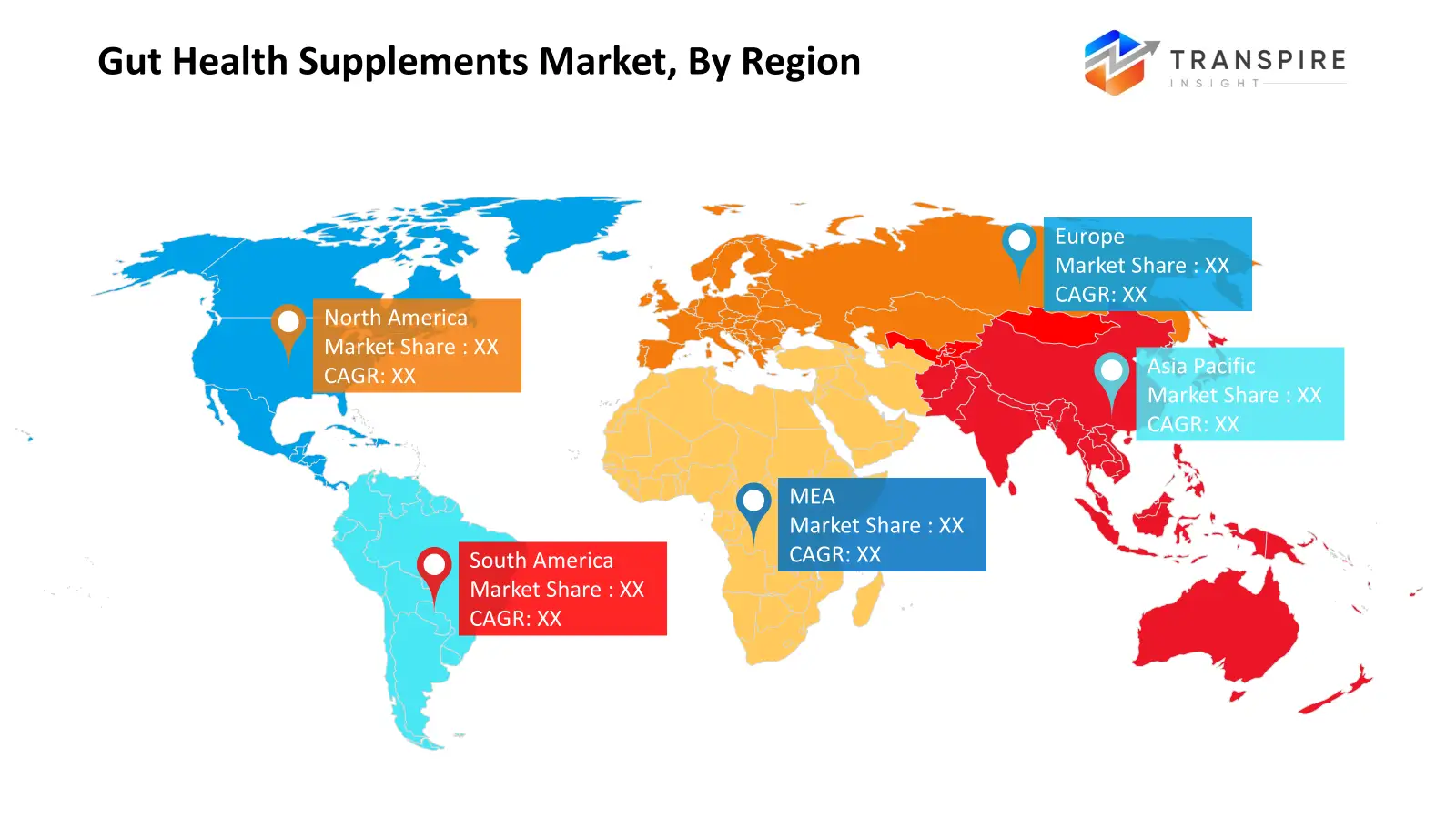
The global market performance pertaining to gut health supplements remains divergent from region to region. The North American market encompassing countries namely the United States, Canada, and Mexico leads this market owing to higher awareness among consumers regarding digestive as well as immune system health, extensive proof, as well as accessibility through pharmacy or online retailers. The United States represents their chief source of revenue, with an emphasis on high-quality products from Canada, followed by consistent growth from Mexico owing to urbanization. The European region, comprising Germany, the UK, France, Spain, and Italy, and Rest of Europe, is a mature and a regulated market. The demand in the market comes from Germany, the UK, and France because of a high penetration rate in functional nutrition, and an increased interest in Southern Europe because of lifestyle-related digestive problems.
The Asia Pacific is the fastest-growing market, driven by countries such as Japan, China, India, South Korea, and the Australia & New Zealand regions. This growth is fueled by the rising number of mid-class households, the urban culture, and the overall awareness of the health relationship between the gut and the brain, and the popularity of the powder and sachet formats is increasing South America, which comprises Brazil, Argentina, and Rest of South America, is also moving at a moderate rate due to an increasing number of stores and disposable income. Middle East & Africa, led by Saudi Arabia, UAE, and South Africa, – the emerging region that shows promise with the forces of transformation in the health care sector, urbanization, and increased need for preventative nutrition.
To learn more about this report, Download Free Sample Report
Recent Development News
- October 2025, Danone has established the OneBiome Lab in Paris-Saclay in a bid to fast-track microbiome sciences in the realms of clinical research and artificial intelligence, thus bolstering the company’s offering in the probiotics, prebiotics, postbiotics and synbiotics categories.
(Source:https://www.nutritioninsight.com/news/danone-onebiome-lab-gut-health-microbiome-research.html)
- October 2025, A microbiome science company Seed Health, launched Co-Biotics, a two-time release formula featuring a combination of human and microbiome-specific formulas. The new category, beyond traditional probiotics refers to overall wellness and microbiome synergy, reflecting a rise in demands for advanced solutions to support healthy digestion.
|
Report Metrics |
Details |
|
Market size value in 2025 |
USD 11.6 Billion |
|
Market size value in 2026 |
USD 13 Billion |
|
Revenue forecast in 2033 |
USD 30.1 Billion |
|
Growth rate |
CAGR of 12.80% from 2026 to 2033 |
|
Base year |
2025 |
|
Historical data |
2021 – 2024 |
|
Forecast period |
2026 – 2033 |
|
Report coverage |
Revenue forecast, competitive landscape, growth factors, and trends |
|
Regional scope |
North America; Europe; Asia Pacific; Latin America; Middle East & Africa |
|
Country scope |
United States; Canada; Mexico; United Kingdom; Germany; France; Italy; Spain; Denmark; Sweden; Norway; China; Japan; India; Australia; South Korea; Thailand; Brazil; Argentina; South Africa; Saudi Arabia; United Arab Emirates |
|
Key company profiled |
Danone S.A, Nestlé S.A, Yakult Honsha Co., Ltd., Chr. Hansen Holding A/S, DuPont Nutrition & Health (IFF), Probi AB, BioGaia AB, Archer Daniels Midland Company (ADM), Kerry Group plc, Amway Corporation, Nature’s Bounty Co, NOW Foods, Blackmores, Seed Health, Glanbia plc |
|
Customization scope |
Free report customization (country, regional & segment scope). Avail customized purchase options to meet your exact research needs. |
|
Report Segmentation |
By Form(Capsules, Gummies, Powders, Beverages, Softgels, Sachets), By Product Type (Probiotics, Prebiotics, Postbiotics, Synbiotics, Enzyme Blends), By Application (Digestive Health, Immune Support, Metabolic Health, Mental Wellbeing, Antibiotic Recovery, Inflammatory Conditions (IBD, IBS)) and By Distribution Channel (Hospitals & Clinics, Pharmacies & Drugstores, Specialty Stores, Online Retail, Direct-to-Consumer (DTC)) |
Key Gut Health Supplements Company Insights
Danone S.A. is purporting to be a strong global leader within the market for gut health supplements via a broad portfolio of probiotics, functional, and dairy-related gut health segments, with a strong scientific foundation. With their key lines such as Activia positioned within scientific, microbiome-formulated solutions, Danone is poised to tackle overall wellness and specific needs within the digestive category across various demographic profiles. Its wide distribution channel, ongoing R&D development, and acquisition initiatives allow the company to sustain strong globalization, especially within established geographies such as North America and Europe. Consumer education and a strong emphasis on sustainability, initiated and practiced by Danone, further boost overall acceptance of gut health supplements within the global setting.
Key Gut Health Supplements Companies:
- Danone S.A
- Nestlé S.A
- Yakult Honsha Co., Ltd.
- Hansen Holding A/S
- DuPont Nutrition & Health (IFF)
- Probi AB
- BioGaia AB
- Archer Daniels Midland Company (ADM)
- Kerry Group plc
- Amway Corporation
- Nature’s Bounty Co
- NOW Foods
- Blackmores
- Seed Health
- Glanbia plc
Global Gut Health Supplements Market Report Segmentation
By Form
- Capsules
- Gummies
- Powders
- Beverages
- Softgels
- Sachets
By Product Type
- Probiotics
- Prebiotics
- Postbiotics
- Synbiotics
- Enzyme Blends
By Application
- Digestive Health
- Immune Support
- Metabolic Health
- Mental Wellbeing
- Antibiotic Recovery
- Inflammatory Conditions (IBD, IBS)
By Distribution Channel
- Hospitals & Clinics
- Pharmacies & Drugstores
- Specialty Stores
- Online Retail
- Direct-to-Consumer (DTC)
Regional Outlook
- North America
- United States
- Canada
- Mexico
- Europe
- Germany
- United Kingdom
- France
- Spain
- Italy
- Rest of Europe
- Asia Pacific
- Japan
- China
- Australia & New Zealand
- South Korea
- India
- Rest of Asia Pacific
- South America
- Brazil
- Argentina
- Rest of South America
- Middle East & Africa
- Saudi Arabia
- United Arab Emirates
- South Africa
- Rest of the Middle East & Africa
Frequently Asked Questions
Find quick answers to common questions.
The approximate Gut Health Supplements Market size for the market will be USD 30.1billion in 2033.
Key segments for the Gut Health Supplements Market are By Form(Capsules, Gummies, Powders, Beverages, Softgels, Sachets), By Product Type (Probiotics, Prebiotics, Postbiotics, Synbiotics, Enzyme Blends), By Application (Digestive Health, Immune Support, Metabolic Health, Mental Wellbeing, Antibiotic Recovery, Inflammatory Conditions (IBD, IBS)) and By Distribution Channel (Hospitals & Clinics, Pharmacies & Drugstores, Specialty Stores, Online Retail, Direct-to-Consumer (DTC).
Major Gut Health Supplements Market players are Danone S.A, Nestlé S.A, Yakult Honsha Co., Ltd., Chr. Hansen Holding A/S, DuPont Nutrition & Health (IFF).
The North America region is leading the Gut Health Supplements Market.
The CAGR of the Gut Health Supplements Market is 12.80%.
- Danone S.A
- Nestlé S.A
- Yakult Honsha Co., Ltd.
- Hansen Holding A/S
- DuPont Nutrition & Health (IFF)
- Probi AB
- BioGaia AB
- Archer Daniels Midland Company (ADM)
- Kerry Group plc
- Amway Corporation
- Nature’s Bounty Co
- NOW Foods
- Blackmores
- Seed Health
- Glanbia plc
Recently Published Reports
-
Apr 2026
Biosimilars Market
Biosimilars Market By Product Type (Monoclonal Antibodies, Recombinant Hormones, Erythropoietin, G-CSF, Others), By Indication (Oncology, Autoimmune Diseases, Blood Disorders, Diabetes, Others), By Manufacturing Type (In-House Manufacturing, Contract Manufacturing), By Distribution Channel (Hospital Pharmacies, Retail Pharmacies, Online Pharmacies), By Industry Analysis, Size, Share, Growth, Trends, and Forecasts 2021-2033
-
Apr 2026
Gastrointestinal Endoscopy Market
Gastrointestinal Endoscopy Market By Type (Rigid Gastrointestinal Endoscope, Flexible Gastrointestinal Endoscopes, Disposable Gastrointestinal Endoscope), By Procedure Type (Colonoscopy, Gastroscopy, Duodenoscopy, Enteroscopy, Flexible Sigmoidoscopy, Others), By Application (Diagnosis, Treatment), By End-Users (Hospitals, Ambulatory Surgical Centers, Specialty Clinics, Laboratories, Others), By Industry Analysis, Size, Share, Growth, Trends, and Forecasts 2021-2033
-
Apr 2026
Rare Inherited Metabolic Disorder Drug Market
Rare Inherited Metabolic Disorder Drug Market By Drug Class (Enzyme Replacement Drugs, Gene Therapy Drugs, Substrate Reduction Drugs, Small Module Drugs, Protein Drugs), By Route of Administration(Parenteral, Oral, Intrathecal), By Clinical Development (Marketed Drugs, Late Stage Clinical Phase III, Early Stage Clinical Phase I-II, Preclinical Candidates), By Indication (Lysosomal Storage Disorders, Urea Cycle Disorders, Amino Acid Metabolic Disorders, organic Acidemias, Peroximal Disorders), By Industry Analysis, Size, Share, Growth, Trends, and Forecasts 2021-2033
-
Jan 2026
Pharmaceutical Cleanroom Technology Market
Pharmaceutical Cleanroom Technology Market By Product (Equipment, Consumables, Services); By Cleanroom Type (Standard Cleanrooms, Modular Cleanrooms); By End Use (Pharmaceutical Companies, Biotechnology Companies), By Industry Analysis, Size, Share, Growth, Trends, and Forecasts 2021-2033