

Gravure Printing Machines Market Summary:
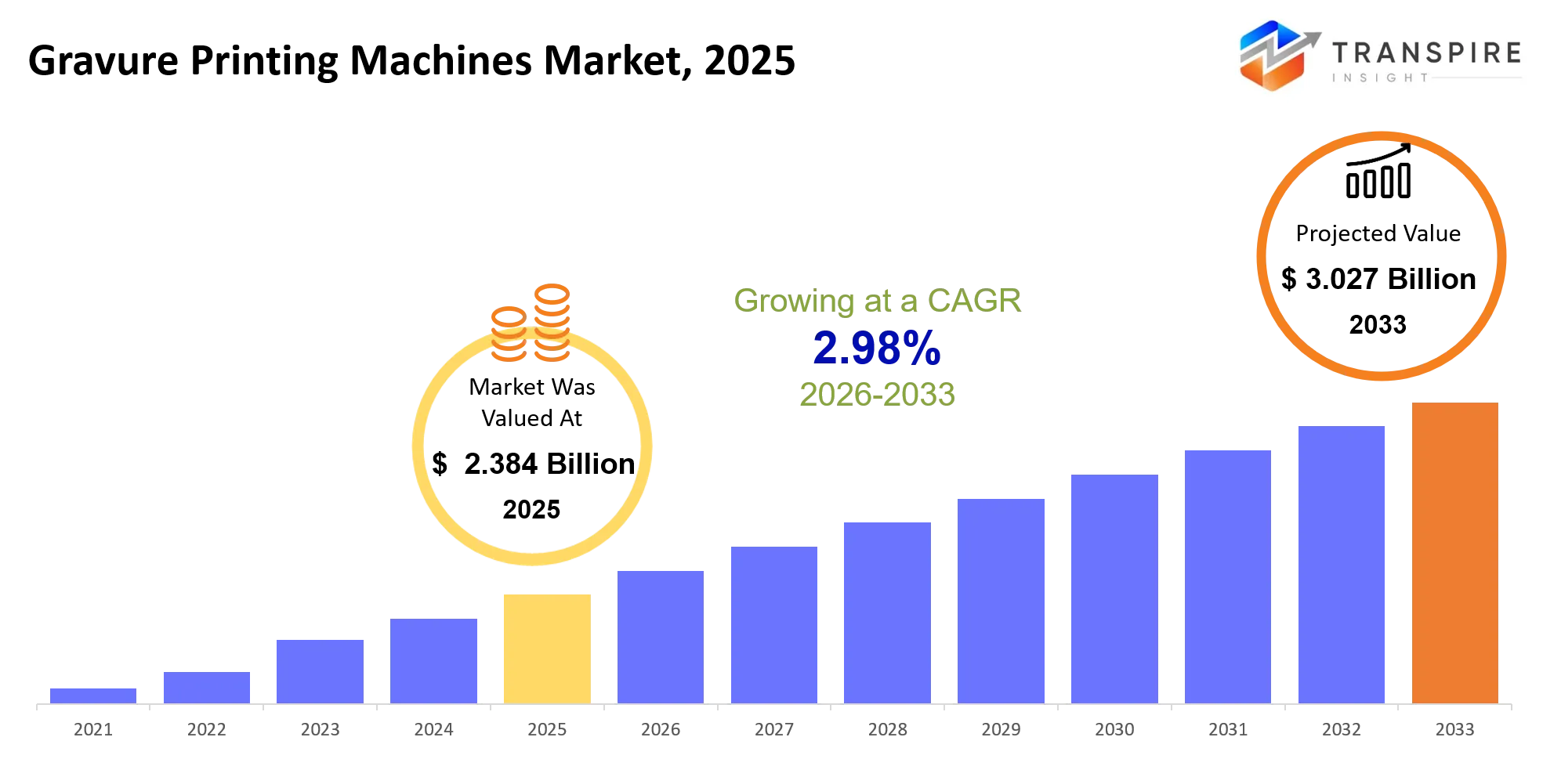
As per Transpire Insight Analysis, the Gravure Printing Machines Market size is estimated at USD 2.384 billion in 2025 and is anticipated to reach USD 3.027 billion by 2033, growing at a CAGR of 2.98% from 2026 to 2033.
The gravure printing machines market is being shaped by packaging converters who need print quality, dependable production speeds and smart use of inks and materials. Gravure technology still plays a role in long production runs for flexible packaging, decorative materials, labels and some industrial uses. Over the last three to five years, machine manufacturers have been putting their efforts into automation, digital colour control, fast job set-up and material management. An enormous shift is taking place: the transition from traditional machine control to integrated production systems, which will minimise manual adjustments and ensure consistency of results. The introduction of digital colour-control solutions has proved that gravure printing machines can improve their productivity and lower waste levels. It is crucial due to the fact that packaging producers are facing the challenge of maintaining high quality while reducing expenses. Therefore, when purchasing equipment, companies pay attention to productivity and flexibility.
Gravure Printing Machines Market Size & Forecast:
- Market Size 2025: USD 2.384 Billion
- Expected Market Value (2033): USD 3.027 Billion
- Forecast CAGR (2026–2033): 2.98%
- Leading Region in 2025: Asia Pacific
- Fastest Growing Region: Middle East & Africa
- Key Company Profiles: Bobst, Windmöller & Hölscher, Koenig & Bauer, Comexi, Uteco, Cerutti Group, Fuji Kikai Kogyo, Shaanxi Beiren, J.M. Heaford, KYMC, HCI, DCM ATN, Rotatek, Pelican Rotoflex, WIFAG-Polytype
Key Market Insights:
The market is moving towards reflecting the high applicability of gravure for large-volume packaging and consistent colour reproduction. Equipment vendors are reacting to this through their solutions in automation, quick changeovers, and process control.
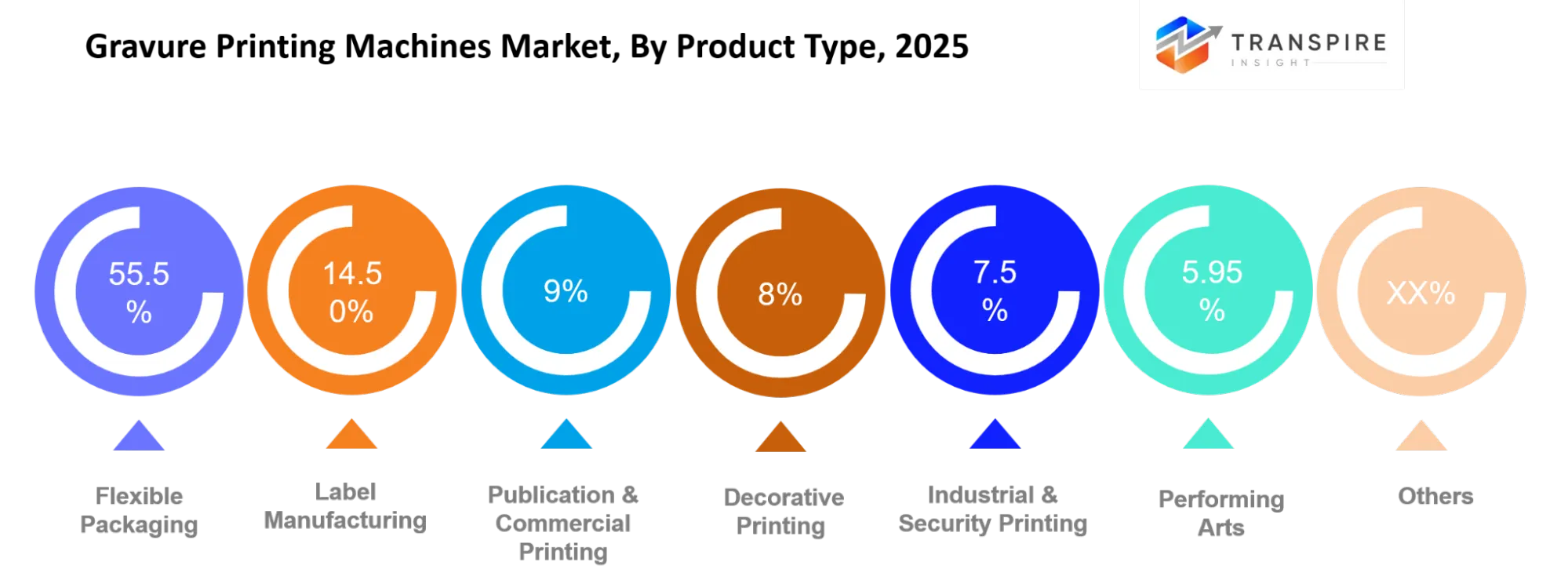
- Flexible Packaging represents 55.05% of the application share, driving equipment makers to concentrate on efficient gravure presses designed for large-volume packaging and order repeats.
- Label Manufacturing represents 14.50% of the share, contributing to the interest in accurate colour reproduction and equipment that can handle various label types.
- Publications & Commercial Printing comprise 9.00%, while existing gravure suppliers provide products for applications that require consistent performance within long printings.
- Decorative Printing represents 8.00% of applications, providing potential for the manufacture of machines used for patterns and finishing on interior and surface materials.
- Industrial & Security Printings represent 7.50% of the share, where production requirements lead to the development of application-specific printing machines.
- Other Applications make up 5.95% of the market, driven by smaller or speciality end users requiring specialised machines.
What are the Key Drivers, Restraints, and Opportunities in the Gravure Printing Machines Market?
Drivers
Demand for high-speed, high-volume flexible packaging is also a factor. Food, personal care and household brands are demanding graphics-rich packaging in which colour reproduction is reliable on large runs. This drives more converters to acquire gravure presses, which offer the ability to preserve print quality for many hours, a feature enabled by automation and enhanced colour management. Automation helps with set-up time and waste minimisation, while cost control is boosted by reduced production costs.
Restraints
The high entry cost is the primary constraint for gravure presses, cylinders, systems and support equipment. More extensive etching and preparation may be prohibitively costly for smaller printers using less than full press capacity. The expensive job changeovers for gravure cylinders, systems, press and equipment set-up, and the cost of solvent handling, air ventilation, and quality regulations contribute to its higher costs.
Opportunities
Opportunities are equipment modernisation and eco-friendly printing. Equipment manufacturers should consider presses that enable the use of lower-solvent inks, enhance drying control, reduce energy consumption, and address quality inspection in a fully automated manner. Collaborating with machine builders, ink suppliers, and packaging converters may help to speed up improvement. New packaging production capacity in Asia Pacific will allow equipment suppliers to supply machines that perform well, have good after-sales service, offer education to equipment operators, and deliver access to financing.
|
Driver |
Relative Impact on Growth (%) |
Geographic Relevance |
Impact Timeline |
Demand Strength |
Growth Mechanism (5–10 words) |
Key Beneficiaries (5–10 words) |
Major Constraint (5–10 words) |
|
Rising demand for flexible packaging and high-volume printing |
28% |
Asia Pacific, North America, Europe |
Short-term (≤2 years) |
High |
Expands demand for consistent, high-speed packaging production |
Gravure press manufacturers, packaging converters, ink suppliers |
Competition from flexible digital and flexographic printing |
|
Increasing consumption of packaged food, beverages, and consumer goods |
23% |
Asia Pacific, North America, Latin America |
Medium-term (2–4 years) |
High |
Increases packaging volumes requiring durable, attractive printed designs |
Packaging printers, cylinder makers, consumer goods manufacturers |
Volatile consumer demand and packaging material costs |
|
Technological advancements in automation and precision printing |
19% |
Europe, Asia Pacific, North America |
Medium-term (2–4 years) |
High |
Improves registration accuracy, productivity, and production efficiency |
Machine OEMs, automation vendors, industrial control suppliers |
High equipment investment and integration complexity |
|
Growing demand for sustainable inks and regulatory-compliant packaging |
16% |
Europe, North America, Asia Pacific |
Long-term (≥4 years) |
Medium |
Encourages cleaner ink systems and resource-efficient printing processes |
Sustainable ink suppliers, press manufacturers, packaging converters |
Costly compliance upgrades and solvent recovery requirements |
|
Modernization of printing facilities and industrial capacity expansion |
14% |
Asia Pacific, Middle East, Latin America |
Medium-term (2–4 years) |
Medium |
Drives replacement purchases and capacity-enhancing machinery investments |
Gravure machine OEMs, engineering firms, equipment service providers |
Financing constraints and long equipment replacement cycles |
|
Total |
100% |
— |
— |
— |
— |
— |
— |
What Has the Impact of Artificial Intelligence Been on the Gravure Printing Machines Market?
The use of artificial intelligence and digital technology opens up the possibilities for enhancing gravure printing by means of automatic inspections, process control, and production optimisation. Inspection cameras are able to detect colour differences, misregistrations, streaks, and other surface defects, thus allowing operators to correct errors before wasting significant amounts of material. When linked to proper production data, analytical systems are capable of detecting patterns of quality issues and aiding in making decisions about machine adjustments, maintenance scheduling, and production planning. Predictive maintenance is another area where the use of AI could potentially bring benefits. Through analysis of operating conditions, vibrations, temperature, and equipment components' performance, manufacturers will be able to detect patterns that will serve as warnings about possible wear or breakdown of equipment. One should note that these opportunities do not imply that the implementation of artificial intelligence will become a general practice in gravure equipment. Nowadays, many technological advancements are being achieved without the use of advanced AI techniques. In order to integrate smart systems into existing machinery, additional sensors, software, and training of operators are often required.
Instance
In May 2025, CMD Corporation launched the Crossover HS print inspection system equipped with artificial intelligence-based defect detection for flexography and gravure printing. This will assist in detecting printing defects at faster production rates and increase efficiency in the gravure printing machines market.
Key Market Trends:
Gravure printing is now evolving into more automated and environmentally friendly systems rather than faster printing. More and more equipment suppliers are now using automation, process stability, and reduced material use as differentiators.
- Machine automation is expanding from controls to fully-integrated systems that make setups easier, more repeatable, and less reliant on manual adjustments.
- Digital colour management is becoming more important as converters are looking for consistency throughout each production batch and shorter time needed for preparation.
- Increasing attention is being paid to ink circulation, solvent usage, and drying efficiency as a means of cost and environmental control.
- Packaging converters are now seeking systems capable of handling more varied designs and production while still being able to print in large volumes.
- Quality inspection is moving from sampling to continuous inspection via cameras, which allow for earlier detection of printing errors.
- Modernisation of machines is becoming an option for some converters that require better controls but cannot afford replacement of their printing lines.
- Cooperation between press and software vendors enables integration of pre-press preparation with on-press colour control and correction.
Gravure Printing Machines Market Segmentation
By Machine Type
The sheet-fed gravure machine is used for printing applications where single sheets are important. The web-fed gravure machine is designed for the production of rolls of material. This is useful for packaging converters who need to maximise their throughput. The electronic line shaft and shaftless gravure machine provide more flexibility in drive control and registration, while the CI gravure and inline gravure machine is designed to meet the particular production needs. The metal decorating machine is used for printing applications where metal is involved. Other machines are used for specialised production needs.
By Application
The application category is dominated by flexible packaging, which has a market share of 55.05%, attributed to its usage in food packaging, personal care packaging, and household products. The label manufacturing application comprises 14.50% and is attributed to the high demand for graphics and high-quality print. The publication and commercial print account for 9.00%, whereas decorative printing has a market share of 8.00%. The industrial and security printing application holds 7.50%, which is attributed to specialised requirements that demand consistent print. Other applications account for 5.95%. Industrial and security printing have been found to be the fastest-growing application at a rate of 1.65% CAGR based on the supplied estimates.
By Substrate
Flexible-packaging applications are where plastic films matter most, while paper and paperboard sustain specific trade, commercial and packaging uses. The right ink transfer, drying and web-handling systems are needed for metallic foils, aluminium foil and laminates to deliver predictable outcomes. Substrates including textiles have specific uses that may require specialised processing parameters and materials-handling characteristics. Because every converter has to deal with a variety of different structures, the ability of equipment to accommodate that full substrate spectrum without compromising quality should be a key buying factor and may provide a higher return on investment.
By Printing Speed
The rapid pace of production and quality standards required make not all machines appropriate for production lines or products. Not every requirement justifies using the fastest machine speeds, however, so the 201-350 m/min range balances output with process control, while the over 350 m/min range targets high-speed production performance. Lower, medium, high and ultra-high-speed classifications are also valuable in assessing various options. Besides speed, other factors include the time to set up the machine, the capacity of the dryer, substrate stability and how often new jobs are needed.
By Ink Type
The solvent inks have an application in gravure printing where there is need for quick drying and flexibility of packaging materials. The water-based inks are likely to play a part in limiting the use of organic solvents depending on the adherence of the packages to the substrates, drying capabilities and application. The UV and e-beam processes cater for the areas of demand through specific curing mechanisms. There are also low VOC, bio-based and hybrid inks available to limit the environmental pollution due to their formulation, regulations, requirements for drying/curing and costs in the process.
By End User
Printers are general customers because gravure supports repeatable high volumes of printed packaging stock. Printing companies buy presses based on customer volumes, turnaround times and mix of jobs. Food manufacturers and consumer-goods companies determine equipment demand by product specifications and supplier guidelines. Pharmaceutical companies may dictate specific print quality, traceability and specialised packaging controls. Textile companies employ printing technology for limited decorative applications; security printers specify controlled production and speciality printed products.
What are the Key Use Cases Driving the Gravure Printing Machines Market?
Flexible packaging represents an application for gravure printing machines. Packaging for food products, laminated packaging films, pouches, and packaging for cosmetics should have good graphics and constant colour quality during the entire run. Gravure printing machines fit the described needs if there is enough production volume to justify the cost of the equipment and cylinder making. Labelling is another significant application of the technology, especially when a brand needs consistency in its visual representation within several batches. A gravure printing machine will be helpful in this case because it allows reproducing patterns and textures on specific surface materials. Some emerging applications include industrial printing, security printing, and production systems that provide automatic inspection and enhanced process control. Such applications will take advantage of improved registration, reduced defect rates, and better control of production quality.
|
Report Metrics |
Details |
|
Market size value in 2025 |
USD 2.384 Billion |
|
Market size value in 2026 |
USD 2.464 Billion |
|
Revenue forecast in 2033 |
USD 3.027 Billion |
|
Growth rate |
CAGR of 2.98 % from 2026 to 2033 |
|
Base year |
2025 |
|
Historical data |
2021 - 2024 |
|
Forecast period |
2026 - 2033 |
|
Report coverage |
Revenue forecast, competitive landscape, growth factors, and trends |
|
Regional scope |
United States; Canada; Mexico; United Kingdom; Germany; France; Italy; Spain; Denmark; Sweden; Norway; China; Japan; India; Australia; South Korea; Thailand; Brazil; Argentina; South Africa; Saudi Arabia; United Arab Emirates |
|
Key company profiled |
Bobst, Windmöller & Hölscher, Koenig & Bauer, Comexi, Uteco, Cerutti Group, Fuji Kikai Kogyo, Shaanxi Beiren, J.M. Heaford, KYMC, HCI, DCM ATN, Rotatek, Pelican Rotoflex, WIFAG-Polytype |
|
Customization scope |
Free report customization (country, regional & segment scope). Avail customized purchase options to meet your exact research needs. |
|
Report Segmentation |
Machine Type (Sheet-Fed Gravure, Web-Fed Gravure, Electronic Line Shaft, Shaftless Gravure, CI Gravure, Inline Gravure, Metal Decorating Machines, Others)Application (Flexible Packaging, Labels, Publication Printing, Decorative Printing, Industrial Printing, Security Printing, Commercial Printing, Others)Substrate (Plastic Films, Paper, Paperboard, Metallic Foils, Laminates, Aluminum Foil, Textiles, Others)Printing Speed (Up to 200 m/min, 201–350 m/min, Above 350 m/min, Low-Speed, Medium-Speed, High-Speed, Ultra-High-Speed, Others)Ink Type (Solvent-Based, Water-Based, UV-Curable, Electron Beam, Low-VOC, Bio-Based, Hybrid, Others)End User (Packaging Companies, Printing Companies, Food Manufacturers, Consumer Goods, Pharmaceutical Companies, Textile Companies, Security Printers, Others) |
Which Regions are Driving the Gravure Printing Machines Market Growth?
North America
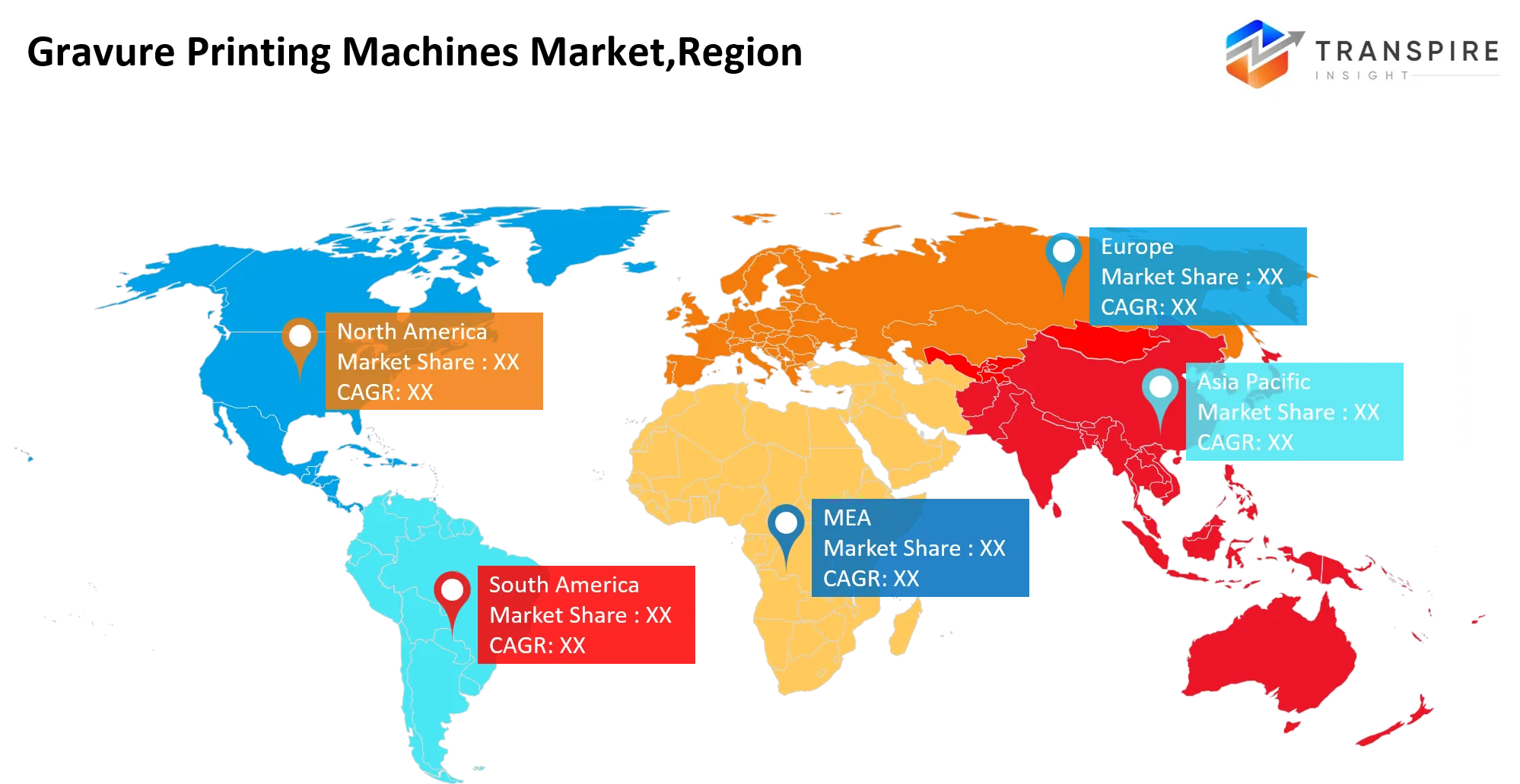
North America holds 20.02% of the supplied market, with demand coming from packaging converters and proven food, consumer goods and industrial supply chain sectors. Investments in machinery are driven by the availability of labour, efficiency in production, reliability of machines and the cost of maintaining current machines. Some companies might focus on investing in automation and inspection machines to increase efficiency and decrease downtime that is otherwise unnecessary. The areas of opportunity for suppliers will lie in upgrades, servicing and equipment that clearly improves productivity.
Europe
Europe accounts for 30.66 % of the market in supplied regional data, with a proven capability in printing equipment and packaging production. Machinery purchase decisions are guided by efficiency in terms of productivity, process, energy consumption and environmental performance. Specialised engineering and industrial supply networks will make it easier for converters to get machinery, components and services. In comparison to Asia-Pacific, Europe's opportunities in the market will have a particular focus on equipment, processes and systems investments to improve efficiency.
Asia-Pacific
The Asia-Pacific region is the leading region, accounting for 42.16 % of the market. These prospects are due to well-established packaging production capabilities, growth in consumer products production and the presence of converters serving the domestic and export markets. Investments in the manufacture and packaging conversion enable opportunities for the sale of machines with stable operation, competitive prices, and readily available technical services. The future success of the region will also be determined by the ability of manufacturers to update their equipment and satisfy the packaging demands.
Who are the Key Players in the Gravure Printing Machines Market and how do they compete?
Competition in the gravure printing machines market revolves around the efficiency of printing, automation, reliability of equipment, serviceability, and the capacity to meet special needs for packaging. The established machinery manufacturers compete with regional suppliers who provide special applications and varied pricing options. Buyers consider total cost of operation involving setup time, ink use, maintenance, and wastage in production, rather than depending on price alone.BOBST has the edge of packaging-printing technology and process automation. The development of the smartGRAVURE solution with Esko involves linking digital prepress capabilities with on-press colour control. UFlex is a combination of packaging industry experience with equipment design and business. Collaboration with Gravtech on CERUFLEX 500 is an example of this company’s strategy. SOMA emphasises press technology and customer-specific production demands, including investment in water-based printing applications. Windmöller & Hölscher and Comexi are also some of the companies worth considering in the broader flexible packaging machinery market; their existing gravure-specific products need confirmation before assigning them competitive positions.
Gravure Printing Machines Market companies
- Bobst
- Windmöller & Hölscher
- Koenig & Bauer
- Comexi
- Uteco
- Cerutti Group
- Fuji Kikai Kogyo
- Shaanxi Beiren
- J.M. Heaford
- KYMC
- HCI
- DCM ATN
- Rotatek
- Pelican Rotoflex
- WIFAG-Polytype
|
Company |
Est. Revenue Share Range |
Key Offerings |
Strategic Positioning |
Geographic Strength |
Technology Focus |
|
BOBST Group SA |
Estimated 8–14% |
MASTER 6003, 5003 platform, RS 6002, EXPERT GP presses |
Premium supplier with integrated packaging solutions |
Europe, North America, Asia Pacific |
Electronic shaft drives, register control, automated changeovers, energy efficiency |
|
Windmöller & Hölscher (W&H) |
Estimated 7–12% |
HELIOSTAR II A, HELIOSTAR II S, gravure press retrofits, web-handling systems |
High-performance packaging presses emphasizing productivity and print quality |
Europe, Asia Pacific, North America |
High-speed printing, precision web tension, automated setup, process monitoring |
|
Uteco Converting S.p.A. |
Estimated 5–9% |
NEXT 350, NEXT 450, rotogravure presses, coating and lamination integration |
Flexible-packaging specialist balancing quality and operating costs |
Europe, Asia Pacific, Latin America |
Automatic cylinder handling, enclosed inking, energy-saving ventilation, touchscreen controls |
|
Shaanxi Beiren Printing Machinery Co., Ltd. |
Estimated 5–10% |
Plastic-film gravure presses, unit-type rotogravure presses, paper gravure presses, integrated laminating lines |
Large Chinese manufacturer competing through scale and value pricing |
Asia Pacific, Middle East & Africa, Latin America |
High-speed web printing, automated tension control, integrated converting, customized machinery |
|
Comexi Group Industries |
Estimated 3–7% |
Gravure printing presses, flexible-packaging equipment, laminating and converting solutions |
Flexible-packaging specialist competing through application expertise |
Europe, Latin America, Asia Pacific |
Process automation, substrate handling, production efficiency, integrated converting |
|
Fuji Kikai Kogyo Co., Ltd. |
Estimated 3–6% |
FSR series, FTS series, MD series, PMD series gravure presses |
Precision-focused manufacturer serving packaging and decorative printing |
Asia Pacific, Europe, North America |
Automatic cylinder exchange, sectional drives, precision registration, remote diagnostics |
|
DCM-ATN |
Estimated 2–5% |
Rotogravure presses, coating equipment, laminating machinery, converting systems |
Specialized European supplier for customized converting applications |
Europe, Asia Pacific, Latin America |
Configurable press systems, web handling, integrated coating, process optimization |
|
Rotatek S.A. |
Estimated 1–3% |
Gravure printing equipment, mid-web presses, specialized printing systems |
Niche printing-equipment supplier serving specialized production requirements |
Europe, Latin America, Asia Pacific |
Precision registration, modular press configurations, flexible production setup |
|
Hsing Wei Machine Industry Co., Ltd. |
Estimated 1–4% |
Gravure printing presses, flexible-packaging printing equipment, converting machinery |
Regional challenger competing on customization and cost efficiency |
Asia Pacific, Middle East & Africa, Latin America |
Automated web handling, multicolor printing, configurable press systems |
|
Pelican Rotoflex Pvt. Ltd. |
Estimated 1–3% |
Rotogravure printing presses, flexible-packaging machinery, laminating and converting equipment |
Value-oriented manufacturer serving domestic and export customers |
Asia Pacific, Middle East & Africa, Latin America |
Customized machine configurations, production automation, cost-efficient web printing |
Recent Development News
In March 2026, Soma reported that Excellent Gravure Industrial had inked a deal for the Optima press suitable for water-based printing. This is SOMA's first press to be installed in Taiwan and is an indication of investment in the provision of sustainable printing solutions that meet the manufacturing needs of companies. In addition, it is an area through which SOMA will grow its regional presence.
In January 2025, Bobst and Esko showcased the smartGRAVURE partnership, whereby the solution includes both prepress and colour reading and control on the press. The innovation was meant to reduce the time taken in colour matching by at least 50% as well as downtime by 70 %.
What Strategic Insights Define the Future of the Gravure Printing Machines Market?
The future of the gravure printing machines market will not depend as much on printing speed and more on ensuring quality while keeping the operating costs competitive. The main demand driver will be flexible packaging, and therefore automation, ink management and web handling will be critical areas where investments need to be made. One of the risks often neglected is that costly gravure cylinders and setup could undermine the profitability of small batches, especially in view of the increased design variety demanded by customers. Compliance with environmental regulations and the cost of modernising old machines could play a role in determining investments. One potential area of development is the integration of gravure machines with digital colour control, automated inspection and predictive maintenance functions. This can assist converters in reducing waste and increasing availability. Machine manufacturers should pay attention to productivity increases, compatibility with low-solvent printing processes and post-sales support. Machine buyers should consider the total cost of ownership, which includes maintenance, energy consumption, consumables and set-up time, rather than choosing machines based only on their cost or speed.
Machine Type
- Sheet-Fed Gravure
- Web-Fed Gravure
- Electronic Line Shaft
- Shaftless Gravure
- CI Gravure
- Inline Gravure
- Metal Decorating Machines
- Others
Application
- Flexible Packaging
- Labels
- Publication Printing
- Decorative Printing
- Industrial Printing
- Security Printing
- Commercial Printing
- Others
Substrate
- Plastic Films
- Paper
- Paperboard
- Metallic Foils
- Laminates
- Aluminum Foil
- Textiles
- Others
Printing Speed
- Up to 200 m/min
- 201–350 m/min
- Above 350 m/min
- Low-Speed
- Medium-Speed
- High-Speed
- Ultra-High-Speed
- Others
Ink Type
- Solvent-Based
- Water-Based
- UV-Curable
- Electron Beam
- Low-VOC
- Bio-Based
- Hybrid
- Others
End User
- Packaging Companies
- Printing Companies
- Food Manufacturers
- Consumer Goods
- Pharmaceutical Companies
- Textile Companies
- Security Printers
- Others
Frequently Asked Questions
Find quick answers to common questions.
The gravure printing machines market size was valued at USD 2.384 Billion in 2025 and is poised to reach USD 3.027 billion by 2033, expanding at a 2.98% CAGR
Key segments for the gravure printing machines market are Machine Type (Sheet-Fed Gravure, Web-Fed Gravure, Electronic Line Shaft, Shaftless Gravure, CI Gravure, Inline Gravure, Metal Decorating Machines, Others)Application (Flexible Packaging, Labels, Publication Printing, Decorative Printing, Industrial Printing, Security Printing, Commercial Printing, Others)Substrate (Plastic Films, Paper, Paperboard, Metallic Foils, Laminates, Aluminum Foil, Textiles, Others)Printing Speed (Up to 200 m/min, 201–350 m/min, Above 350 m/min, Low-Speed, Medium-Speed, High-Speed, Ultra-High-Speed, Others)Ink Type (Solvent-Based, Water-Based, UV-Curable, Electron Beam, Low-VOC, Bio-Based, Hybrid, Others)End User (Packaging Companies, Printing Companies, Food Manufacturers, Consumer Goods, Pharmaceutical Companies, Textile Companies, Security Printers, Others)
Growth is primarily driven by increasing demand for flexible packaging, rising consumption of packaged food and beverages, expansion of e-commerce, and the need for high-quality, high-volume printing. Technological advancements in automation, improved printing efficiency, and growing demand for consistent print quality across packaging applications are further supporting market growth
The market is led by major manufacturers including Bobst, Windmöller & Hölscher, Koenig & Bauer, Comexi, Uteco, Cerutti Group, Fuji Kikai Kogyo, Shaanxi Beiren, J.M. Heaford, KYMC, HCI, DCM ATN, Rotatek, Pelican Rotoflex, WIFAG-Polytype
The Asia Pacific region has a 42.16% market share in gravure printing machines due to the fast-growing packaging industry, high demand for flexible packaging, rise in e-commerce activities, and the presence of manufacturing industries in China, India, and Japan. Cost-effective production and investment in advanced technology further strengthen the position of the region in the market.
Commercial opportunities for the gravure printing machine market are growing demand for flexible packaging, increasing automation and efficiency in printers, and the growing demand for superior quality printing in food, pharmaceuticals, and consumer goods packaging. Companies can further enhance their commercial footprint by designing sustainable printing solutions and establishing a presence in emerging markets, especially the Asia Pacific region.
- Bobst
- Windmöller & Hölscher
- Koenig & Bauer
- Comexi
- Uteco
- Cerutti Group
- Fuji Kikai Kogyo
- Shaanxi Beiren
- J.M. Heaford
- KYMC
- HCI
- DCM ATN
- Rotatek
- Pelican Rotoflex
- WIFAG-Polytype
About the Authors

Kartik bhong
I am Kartik Bhong, a Senior Research Analyst at Transpire Insight, specializing in the Packaging, Manufacturing, and Construction industry. My work focuses on analyzing market trends, emerging technologies, industry regulations, and competitive landscapes to deliver accurate, data-driven insights. I am passionate about transforming complex industry information into clear, practical content that helps businesses, professionals, and decision-makers stay informed and make confident strategic decisions. Through continuous research and a strong commitment to accuracy, I strive to create reliable, well-researched content that reflects the latest developments across these dynamic industries and supports the vision of Transpire Insight in delivering valuable market intelligence.

Chakradhar Khansole
Chakradhar serves as the Research Director at Transpire Insight, bringing over 8 years of experience in technology, innovation, and strategic market intelligence. He specializes in transforming complex market data into actionable business insights that enable organizations to make informed, growth-oriented decisions. Recognized for his strategic vision and analytical expertise, Chakradhar leads high-impact research initiatives, delivering comprehensive market assessments, competitive intelligence, and forward-looking industry analysis.
Recently Published Reports
-
Apr 2026
Handling and Lifting Equipment Market
Handling and Lifting Equipment Market Size, Share & Analysis Report By Product (Cranes and Hoists, Forklifts, Conveyor Systems, Aerial Work Platforms, Others), By Application (E-Commerce, Automotive and Railway, Food and Beverages, Aviation, Others), and Geography (North America, Europe, Asia-Pacific, Middle East and Africa, South and Central America), 2021 - 2031
-
Nov 2026
HVAC Equipment Market
HVAC Equipment Market Size, Share & Analysis Report By Heating Equipment Type (Boilers and Furnaces, Heat Pumps, and Unitary Heaters), By Ventilation Equipment (Air Handling Units, Humidifiers and Dehumidifiers, Air Filters, and Fan Coiling Units), By Air Conditioning Equipment (Unitary Air Conditioners, Room Air Conditioners, Packaged Terminal Air Conditioners, and Chillers), By End User (Commercial, Residential, Industrial, and others), and Geography (North America, Europe, Asia-Pacific, Middle East and Africa, South and Central America), 2021 – 2031
-
Apr 2026
Refrigeration Valves Market
Refrigeration Valves Market Size, Share & Analysis Report By Type (Solenoid Valves, Expansion Valves, Check Valves, Service Valves, Others), By Application (Commercial Refrigeration, Industrial Refrigeration, Transport Refrigeration, Residential Refrigeration, Air Conditioning Systems), By End User (Food and Beverage Industry, Pharmaceutical Industry, HVAC Industry, Chemical Industry, Others), and Geography (North America, Europe, Asia-Pacific, Middle East and Africa, South and Central America), 2021 – 2031
-
Apr 2026
E-Commerce Packaging Materials Market
E-Commerce Packaging Materials Market By Material Type (Corrugated Boxes, Paper & Paperboard, Foam & Cushioning Materials, Plastic Packaging, Flexible Packaging, Protective Packaging, Others), By Product(Primary Packaging, Secondary Packaging, Tertiary Packaging), By Packaging Function (Protective Packaging, Branding & Presentation Packaging, Transit & Logistic Packaging, Sustainable Packaging, Tamper Evidence Packaging), By End-User (Retail & Consumer Goods, Electronic Appliances, Food & Beverages, Healthcare & Pharmaceutical, Fashion & Apparel, Home & Furnishing, Others); By Industry Analysis, Size, Share, Growth, Trends, and Forecasts 2021-2033