
Graphic Film Market Summary:
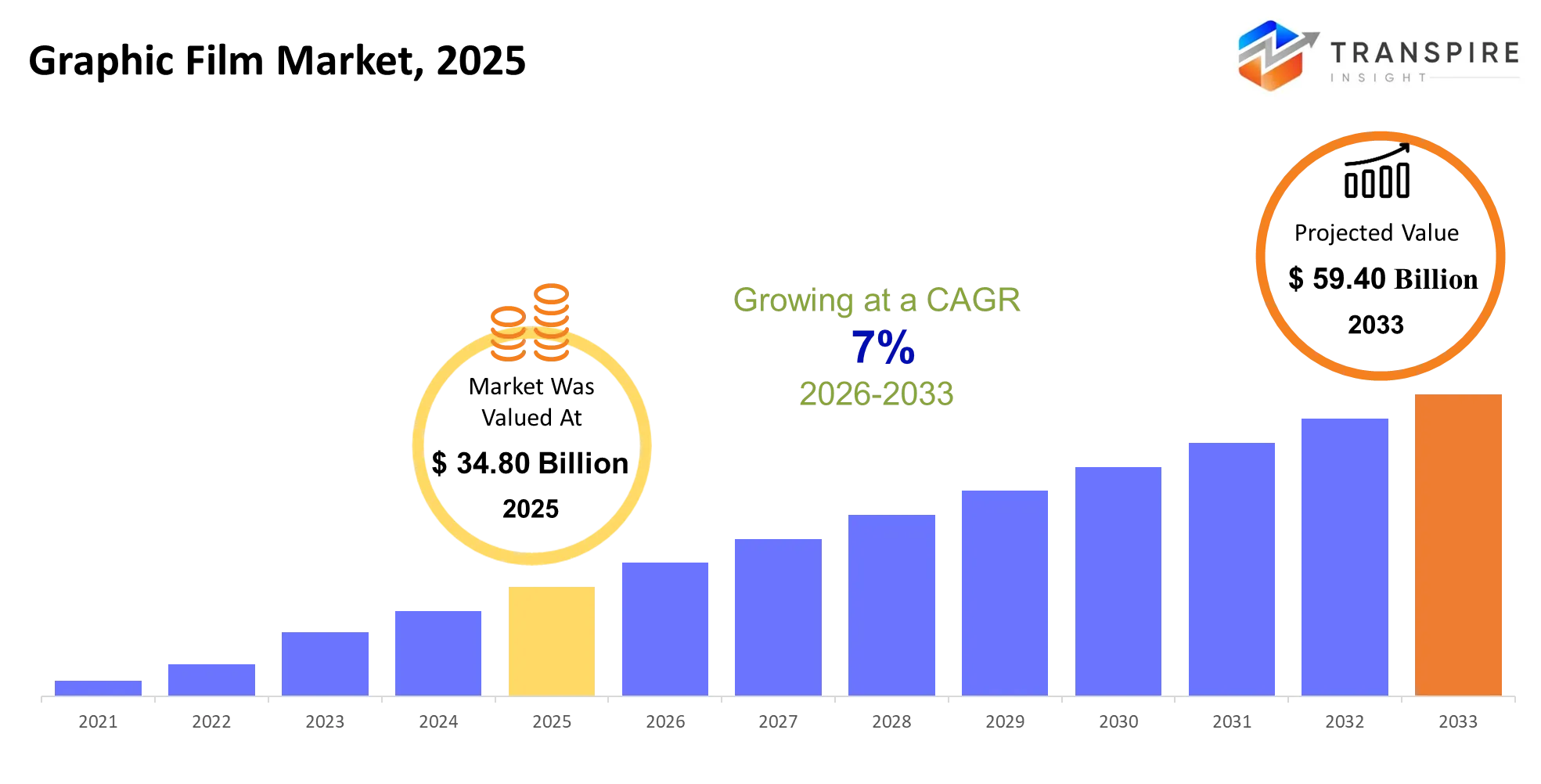
As per Transpire Insight Analysis, the Graphic Film Market size is estimated at USD 34.80 billion in 2025 and is anticipated to reach USD 59.40 billion by 2033, growing at a CAGR of 7% from 2026 to 2033.
The Graphic Film Market provides businesses with high-quality visual displays for advertising purposes, branding, car wrapping, communication at the retail level and interior purposes. Graphic films are generally employed in vehicles, storefronts, buildings, promotional signage and product surfaces in cases where excellent and durable graphics are required. Over the past few years, the industry has shifted towards digital print film, improved adhesive technologies and materials suited for outdoor applications. The growth in printing technology has enabled companies to create customised graphics in small quantities through shorter turnaround times. One major development in the market has been the focus on environmentally-friendly products due to increased green concerns among manufacturers. The growth within branding, exterior advertising and vehicle customisation sectors will drive companies to invest in superior graphic films, which would facilitate wider usage in business and industrial settings.
Graphic Film Market Size & Forecast:
- Market Size 2025: USD 34.80 Billion
- Expected Market Value (2033): USD 59.40 Billion
- Forecast CAGR (2026–2033): 7%
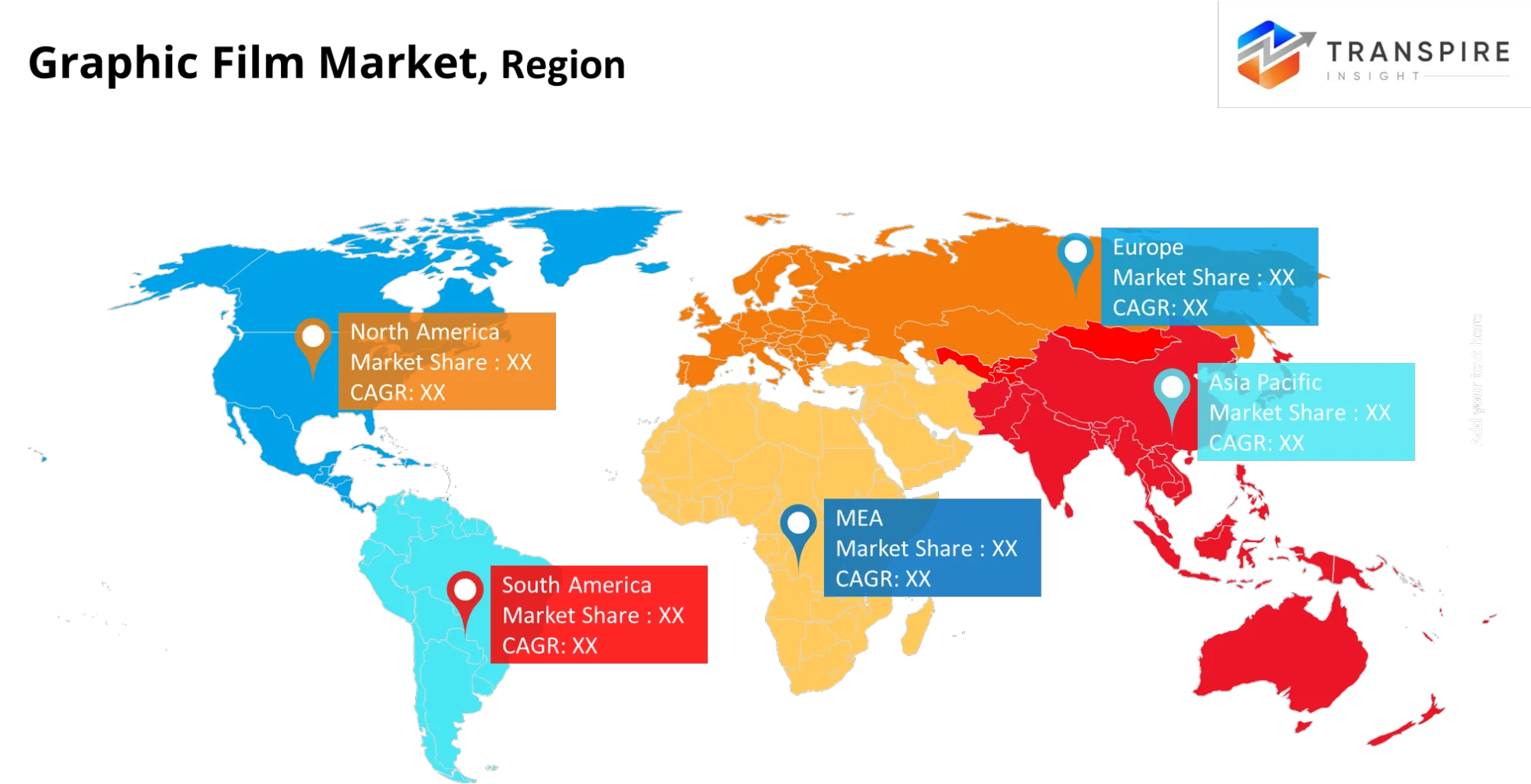
- Leading Region in 2025: Asia Pacific
- Fastest Growing Region: Middle East & Africa
- Key Company Profiles: 3M, Avery Dennison, Hexis, Orafol, LG Hausys, Lintec, Arlon Graphics, Kay Premium Marking Films, Cosmo Films, Metamark, KPMF, Ritrama, Drytac, SWAROVSKI, Cover Styl'
Key Market Insights:
market is moving towards a blend of digital printing technology, customised branding, and durable media for communication needs. PVC products continue to lead within the industry, with innovations in digital printing presenting more possibilities for film specialists.
- The PVC product constitutes 48.0% of the product segment due to its flexibility, printability, and use in both indoor and outdoor graphical purposes.
- The PET product accounts for 18.0% of the market due to the incorporation of its dimensional stability and high-performance surface into graphic designs.
- Digital printing films are set to grow at a 7.9% CAGR as companies opt for customised graphics and shorter production runs.
- Digital printing equipment manufacturers have been increasing their efficiencies through print speed, colour consistency, and print capabilities of various films.
- The increase in demand for customised graphics on vehicles and architectural designs will spur manufacturers into supplying more speciality films and adhesives.
What are the Key Drivers, Restraints, and Opportunities in the Graphic Film Market?
Drivers
The increasing trend of using customised advertisements and branded materials is one of the main factors that support the growth of the graphic film industry. Chain stores, auto companies, transportation firms, and organisers of events rely more and more often on printed graphics in order to convey their message about brands. The advancements in digital printing technologies facilitate the creation of sophisticated designs, campaigns, and short-run graphics without having to go through a long process of conventional printing. It pushes businesses to turn to graphic films for vehicle wraps, retail store windows and other marketing campaigns, which creates extra sales opportunities for the suppliers of the materials.
Restraint
The dependence on petroleum-based materials, especially conventional PVC, poses a challenge to the industry. The fluctuations in the price of raw materials influence the costs of production and the price of products. Environmental issues associated with plastic waste, material disposal, and recycling can also be a source of pressure for manufacturers.
Opportunities
There is a major opportunity in the production of films that are recyclable, not made of PVC, and have digital capability. Manufacturers could branch out to more advertising films, decorative architectural films, and vehicle wraps. There are other opportunities for suppliers in commercial construction and retail investment in the Asia-Pacific region and the Middle East.
|
Driver |
Relative Impact on Growth (%) |
Geographic Relevance |
Impact Timeline |
Demand Strength |
Growth Mechanism (5–10 words) |
Key Beneficiaries (5–10 words) |
Major Constraint (5–10 words) |
|
Rising Demand for Promotional and Advertising Graphics |
25% |
North America, Asia Pacific, Europe |
Short-term |
High |
Expands demand for branded displays, banners, and signage |
Graphic film manufacturers, printers, advertising agencies, retailers |
Advertising budget fluctuations and digital media competition |
|
Growing Adoption of Digital Printing Technologies |
23% |
North America, Europe, Asia Pacific |
Medium-term |
High |
Enables faster customization and high-quality short-run printing |
Film producers, digital printing companies, equipment manufacturers |
High equipment costs and technical skill requirements |
|
Increasing Vehicle Customization and Fleet Branding |
20% |
North America, Europe, Asia Pacific |
Short-term |
High |
Increases demand for vehicle wraps and fleet graphics |
Automotive film suppliers, installers, vehicle branding companies |
Installation costs and changing consumer spending patterns |
|
Expansion of Construction and Architectural Applications |
18% |
Asia Pacific, Middle East, North America |
Medium-term |
High |
Supports decorative surfaces, window films, and building graphics |
Architectural film manufacturers, construction firms, interior designers |
Construction slowdowns and strict material performance requirements |
|
Rising Demand for Sustainable and PVC-Free Graphic Films |
14% |
Europe, North America, Asia Pacific |
Long-term |
Medium |
Encourages adoption of recyclable and low-emission film materials |
Sustainable material producers, converters, environmentally conscious brands |
Higher production costs and limited recycling infrastructure |
|
Total |
100% |
— |
— |
— |
— |
— |
What Has the Impact of Artificial Intelligence Been on the Graphic Film Market?
AI is transforming the graphic film industry in terms of design preparation, printing processes, and production management. The design preparation systems enhanced by AI would enable graphic designers to customise artwork, alter layouts and optimise images for various printing surfaces. These systems would assist printing companies to meet the needs of their customers, especially when it comes to designing graphics for vehicles, retail advertising, and large promotional displays. Manufacturing companies can benefit from AI inspection systems that would help them to detect printing defects, colour variances, surface scratching and coating issues. Automated systems would also allow manufacturing companies to monitor the efficiency of machines and determine scenarios that could result in production breakdowns. Predictive maintenance systems that utilise data from the machines would detect unusual behaviours of machines, thus allowing the maintenance staff to service machines before any failure occurs. The workflow optimisation facilitated by AI would allow better material utilisation through reduced printing, decreased production mistakes, and job scheduling. Implementation of AI-powered inspection and production systems would require procurement of the software, sensors, equipment integration, and training of employees. Small printing companies might find it hard to adopt these technologies.
Instance
In September 2025, the Printing United Alliance explained how AI technology is revolutionising the world of print production in terms of automation, colour management, and quality control. https://www.printing.org/newsroom/news-details/2025/09/16/the-role-of-artificial-intelligence-in-modern-print-production
Key Market Trends:
Industry trends are pointing away from conventional promotional graphics towards customizable, digitally printed, and high-performance films.
- Digital printing has been gradually moving graphic production towards customizable short runs of print instead of relying on traditional bulk printing.
- Vehicle wrapping has evolved from basic branding on vehicles into full body wraps and, as such, it is driving development of conformable films.
- Manufacturing companies are now looking into using PVC-free materials due to environmental considerations that affect new product development and sales.
- Graphic films are now used more often in interior design where printed surfaces are applied to walls and furniture.
- Advances in UV-resistant coating and laminate technologies help preserve the colour and surface properties of graphic films when they are exposed to the outdoor environment.
Graphic Film Market Segmentation
By Product Type
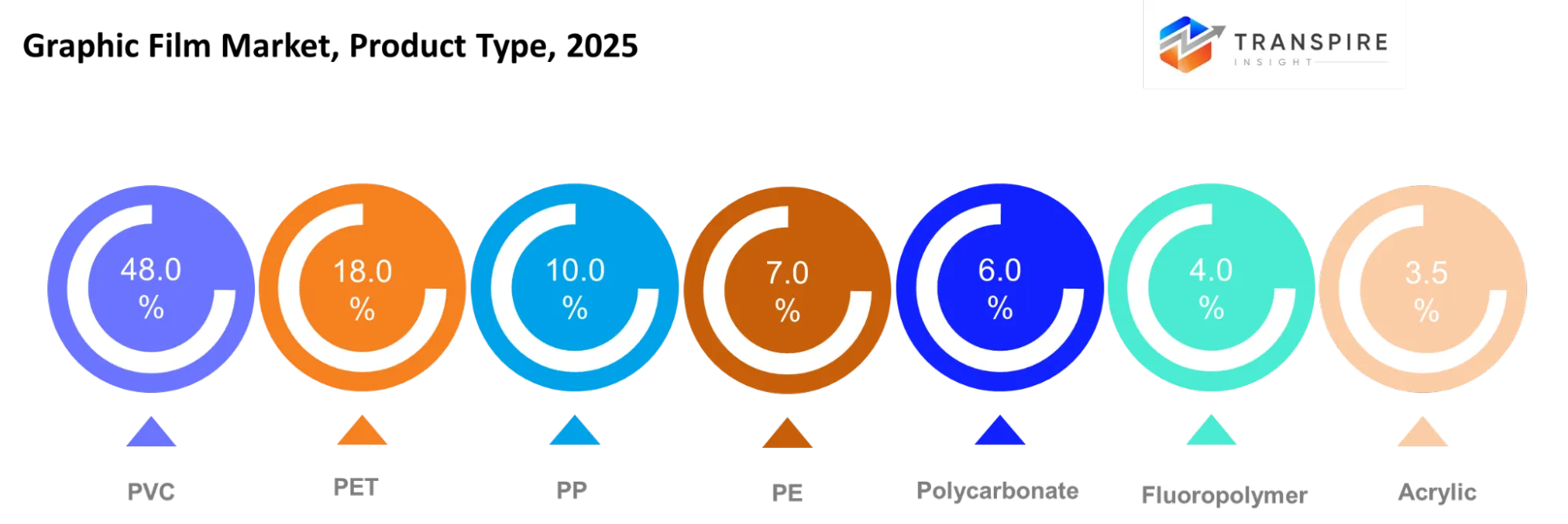
PVC Films have the largest share of 48.0% due to their flexibility, cost-effectiveness, and suitability for various printing techniques. PET Films make up 18.0%, characterised by dimensional stability and environmental resistance. PP Films constitute 10.0%, whereas PE Films make up 7.0% because of their flexibility and light weight. Polycarbonate Films comprise 6.0%, primarily used in applications requiring strength and impact resistance. Fluoropolymer Films form 4.0%, followed by Acrylic Films with 3.5% and Other Speciality Materials with 3.5%. Although PVC is still the most popular material, there is potential for manufacturers to explore other substrates as well.
By Manufacturing Process
This section includes categories of calendered, cast, extruded, laminated, coated, printed, metallised, and other manufacturer-produced films. Cost-effective calendered films are used for general signage, short-to-medium-term promotional graphics, where affordability is a key consideration. Cast film is a flexible film with excellent conformability that holds its shape after installation, making it ideal for vehicle wrap applications and other curved surface applications. Extruded films offer excellent quality for a range of applications such as when specific film thickness and application characteristics are required. Laminated and coated films, meanwhile, offer a range of additional surface attributes. Manufacturers are increasingly focused on building the production quality and surface performance for each application.
By Printing Technology
In printing technology, among the different types of printing technology, which include flexography, digital, screen, offset, gravure, inkjet, UV, and others, digital printing is the fastest-growing segment, with a CAGR of 7.9% as companies today need on-demand personalisation, shorter production runs, and shorter campaign cycles. Inkjet and UV printing allow for intricate patterns and big-format graphics, respectively, with UV printing on various film substrates for durability. Flexography and gravure are still relevant for volume printing and screen for selected niche applications.
By Application
The application segment includes promotional and advertising graphics, vehicle graphics, signs, window graphics, wall coverings, labels, packaging and others. Promotional and advertising applications can take advantage of graphic film's capacity for communicating brand messaging across retail outlets, in commercial buildings, and outdoors. Vehicle graphics are emerging as an important application for commercial fleet operators and other enterprises seeking mobile advertising offerings. Wall coverings are being adopted as interior décor; labels and packaging applications provide another channel for specialised printed films.
By Film Type
The market can be divided into the following segments on the basis of film type. opaque, transparent, translucent, reflective, metallic, textured, matte and others. Opaque films are commonly seen on advertising, promotional graphics, and fleet wraps where the visibility of a colour is critical. Transparent and translucent films are used for window graphics, glass decor, illuminated signage, and so on. Reflective films are suitable for enhanced visibility in transportation and safety graphics. Metallic and textured films are used for vehicle wraps and wall decor. Matte films are used by businesses to give a non-glossy appearance. Manufacturers offer a wide variety of finishing options for commercial and decorative use.
By End User
An end-user segment such as retail, automotive, advertising, construction, transportation, consumer goods, events, and others uses graphic films. Retailers use graphic films for advertising, seasonal displays, window decals, and storefront branding. Automotive and vehicle owners use them for customisation, vehicle branding, and wrapping. Advertising companies or agencies rely on printing films for their outdoor campaigns and advertising. Construction companies and engineering contractors buy decorative films, architectural films, window films, building wraps, graphics, and other film products for branding and decoration of internal and external walls and other surface areas. Transportation companies use wraps and graphics for buses, commercial fleets, trucks, and outdoor advertising. And lastly, consumer products and event management companies use customised displays and graphics for event promotions, product positioning, and communication.
What are the Key Use Cases Driving the Graphic Film Market?
Graphic films find widespread use in promoting advertisements, commercial signage, and retail branding; therefore, these applications form a key source of market demand. Films made of polyvinyl chloride (PVC), find extensive use in advertising, signage, and promotional graphics owing to their flexibility and printability. Another significant application for graphic films is the vehicle graphics application, which allows the branding of vehicles such as cars, buses, and trucks by automotive companies and businesses. Digital printing films are aiding the vehicle graphics application with customisation and production flexibility. Other applications that include wall coverings, window graphics, event graphics, and decorative consumer goods find increasing demand for film manufacturers to focus on films with improved surface finish, adhesion properties, and environmental benefits.
|
Report Metrics |
Details |
|
Market size value in 2025 |
USD 34.80 Billion |
|
Market size value in 2026 |
USD 37.10 Billion |
|
Revenue forecast in 2033 |
USD 59.40 Billion |
|
Growth rate |
CAGR of 7% from 2026 to 2033 |
|
Base year |
2025 |
|
Historical data |
2021 - 2024 |
|
Forecast period |
2026 - 2033 |
|
Report coverage |
Revenue forecast, competitive landscape, growth factors, and trends |
|
Regional scope |
United States; Canada; Mexico; United Kingdom; Germany; France; Italy; Spain; Denmark; Sweden; Norway; China; Japan; India; Australia; South Korea; Thailand; Brazil; Argentina; South Africa; Saudi Arabia; United Arab Emirates |
|
Key company profiled |
3M, Avery Dennison, Hexis, Orafol, LG Hausys, Lintec, Arlon Graphics, Kay Premium Marking Films, Cosmo Films, Metamark, KPMF, Ritrama, Drytac, SWAROVSKI, Cover Styl' |
|
Customization scope |
Free report customization (country, regional & segment scope). Avail customized purchase options to meet your exact research needs. |
|
Report Segmentation |
Product Type (PVC Films, PET Films, PP Films, PE Films, Polycarbonate Films, Fluoropolymer Films, Acrylic Films, Others)Manufacturing Process (Calendered, Cast, Extruded, Laminated, Coated, Printed, Metallized, Others)Printing Technology (Flexography, Digital Printing, Screen Printing, Offset Printing, Gravure, Inkjet, UV Printing, Others)Application (Promotional & Advertising, Vehicle Graphics, Signage, Window Graphics, Wall Coverings, Labels, Packaging, Others)Film Type (Opaque, Transparent, Translucent, Reflective, Metallic, Textured, Matte, Others)End User (Retail, Automotive, Advertising, Construction, Transportation, Consumer Goods, Events, Others) |
Which Regions are Driving the Graphic Film Market Growth?
North America
North America constitutes 21.0%, with the presence of well-established advertising service providers, commercial printing firms, and vehicle customising operations. In addition, the U.S. is playing a significant role owing to the well-developed signage industry in the region and widespread practice of fleet branding in the transportation and logistics segments. There is increasing use of digitally printed films for creating retail displays, vehicle wraps, and customised promotional campaigns, among others.
In February 2026, Avery Dennison introduced digitally printable cast wrapping films meant for vehicle wrapping, branding fleets and commercial signs. This development is in line with the increased demand for graphic films in advertising, transport and promotional applications in North America. https://graphics.averydennison.com/ap-en/home.html
Europe
The European region accounts for 24.5% of the market, aided by the presence of a well-developed automotive industry, well-established manufacturing base, and demand for professional advertising solutions. Countries such as Germany, France, Italy, and the UK are contributing to the growth on account of vehicle customisation, commercial signage, and architectural decoration applications. Growing environmental regulations and sustainability programs are driving manufacturers to seek PVC-free film substrates.
In November 2025, Spandex introduced the Imageperfect iD9 range of printable polymeric films in the UK. The films have a nine-year lifespan and are suitable for vehicle wraps, wall graphics, window displays and commercial signs. The launch is in line with the rising demand for durable and versatile graphic film solutions in Europe. https://insight.spandex.com/en/spandex-launches-imageperfect-id9-a-series-of-high-performance-films-to-suit-any-digital-application/
Asia-Pacific
The Asia-Pacific , accounting for 46.3%. This is due to the existence of a well-developed manufacturing sector, robust retail infrastructure, and the development of commercial advertising. Countries such as China, India, Japan, and South Korea have contributed to the growth of the segment through the production of printing materials, automotive manufacturing, and the increase in graphic promotion use. There is an opportunity to create new application areas due to growing construction activity and investments into shopping centres, transport infrastructure, and commercial properties.
In April 2026,Dai Nippon Printing (DNP) announced the beginning of mass production of decorative films for automotive displays starting from China. The films utilise decorative patterns and optical technology to enhance display visibility. DNP plans to expand into India, Japan and South Korea. https://www..dnp/en/news/detail/2026/04/02/
Who are the Key Players in the Graphic Film Marketand how do they compete?
Competition exists in the Graphic Film Market through material manufacturers, speciality films, and film companies that offer solutions in digital printing and adhesives. Companies differentiate themselves through product durability, compatibility with prints, application specific technologies, distributions and sustainability initiatives. Key players include 3M, Avery Dennison, ORAFOL, Arlon Graphics, HEXIS, Mactac, Ritrama, FDC Graphic Films, Dunmore and Spandex. The competitive advantage of Avery Dennison includes their digitally printable films, vehicle wraps and adhesive technologies. This company's product range features commercially fleets, outdoor signs and vehicle specific application films. The competitive advantage of 3M includes speciality materials, innovation in adhesives and graphic solutions for professionals. ORAFOL gains competitive edge through reflective materials, automotive graphics and digital printing films. The competitive advantage of Arlon Graphics lies in the speciality films and PVC free polyurethane films for architectural and texturing wall applications. HEXIS and Mactac compete with product diversity and application specific printing films. Other competitors such as Ritrama, FDC Graphic Films, Dunmore and Spandex include regionally specific solutions for commercial printers and signmakers.
Graphic Film Marketcompanies
- 3M
- Avery Dennison
- Hexis
- Orafol
- LG Hausys
- Lintec
- Arlon Graphics
- Kay Premium Marking Films
- Cosmo Films
- Metamark
- KPMF
- Ritrama
- Drytac
- SWAROVSKI
- Cover Styl'
|
Company |
Est. Revenue Share Range |
Key Offerings |
Strategic Positioning |
Geographic Strength |
Technology Focus |
|
3M Company |
Estimated 3–6% |
Scotchcal Graphic Films, Controltac Print Films, Scotchlite Reflective Films, Wrap Films |
Premium supplier with advanced adhesive solutions |
North America, Europe, Asia Pacific |
Repositionable adhesives, conformable films, reflective coatings |
|
Avery Dennison Corporation |
Estimated 3–6% |
MPI Digital Films, Supreme Wrapping Film, 900 Supercast, DOL Overlaminates |
Innovation-led leader in printable and vehicle wrapping films |
North America, Europe, Asia Pacific |
Easy Apply RS, advanced conformability, durable adhesive systems |
|
ORAFOL Group |
Estimated 2–4% |
ORACAL Graphic Films, ORAJET Digital Films, ORAGUARD Laminates, ORALITE Reflective Films |
Diversified specialist with integrated graphic film portfolio |
Europe, North America, Asia Pacific |
RapidAir technology, specialty coatings, high-durability films |
|
HEXIS S.A.S. |
Estimated 1–2% |
HX20000 Wrapping Films, Suptac Films, Digital Printing Films, Protective Laminates |
Premium specialist focused on vehicle customization |
Europe, North America, Asia Pacific |
HEX'Press adhesive technology, cast vinyl, surface conformability |
|
Arlon Graphics LLC |
Estimated 1–2% |
SLX Cast Wrap, DPF Digital Films, IllumiNITE Wrap, Series 3220 Overlaminate |
Performance-driven supplier for fleet and vehicle graphics |
North America, Europe, Asia Pacific |
FLITE Technology, X-Scape air-release, cast film engineering |
|
Fedrigoni Self-Adhesives (Ritrama) |
Estimated 1–2% |
Ri-Jet Digital Films, Ri-Mark Plotter Films, F-Wrap Cast Films, Ri-Lam Overlaminates |
Broad self-adhesive portfolio serving diverse graphic applications |
Europe, North America, Asia Pacific |
Pressure-sensitive adhesives, printable coatings, flexible film constructions |
|
LINTEC Corporation |
Estimated 1–2% |
Graphic Films, Adhesive Films, Decorative Films, Specialty Surface Films |
Materials technology specialist with diversified film applications |
Asia Pacific, North America, Europe |
Precision coating, pressure-sensitive adhesives, functional film development |
|
LX Hausys Ltd. |
Estimated 0.5–1.5% |
BENIF Interior Films, Decorative Surface Films, Architectural Finishing Films |
Specialized supplier of decorative and architectural films |
Asia Pacific, North America, Europe |
Surface texturing, decorative laminates, self-adhesive film technology |
|
Drytac Corporation |
Estimated 0.5–1.5% |
Polar Printable Films, ReTac Removable Films, SpotOn Films, Protac Overlaminates |
Specialty supplier focused on wide-format graphics and visual communication |
North America, Europe, Asia Pacific |
Removable adhesives, printable coatings, air-release technology |
|
FDC Graphic Films, Inc. |
Estimated 0.5–1.5% |
Digital Print Films, Intermediate Calendered Films, Cast Vinyl Films, Specialty Graphic Films |
Value-oriented supplier serving sign makers and graphic converters |
North America, Latin America |
Calendered vinyl processing, pressure-sensitive adhesives, print compatibility |
Recent Development News
In February 2026, Avery Dennison launched its MPI 1903 Cast Wrapping Film, a digitally printable film that is suitable for vehicle branding, full and partial vehicle wraps, interior walls, and outdoor signage applications. This addition to its professional products range improves its installation flexibility, printability, and repositionable adhesive technology. https://graphics.averydennison.com/en/home/news/press-releases/mpi-1903.html
In April 2025, Arlon Graphics unveiled its DPF V9500, a printable polyurethane film for use in textured wall surfaces. The product is made from a PVC-free formulation and employs high-tack adhesive technology. https://www.arlon.com/na_en/press/
What Strategic Insights Define the Future of the Graphic Film Market?
The future of the Graphic Film Market will be based more on manufacturers' ability to find harmony between the effectiveness of their product, its printability, and eco-sustainability. Despite the fact that today PVC films are dominant, the growing popularity of options such as reusable or PVC-free films can lead in the future to changes in material choice in both advertising and architectural use of films. One of the unseen challenges will be the industry's reliance on oil-based products that create problems related to changes in price policy and eco-requirements of companies. Digital printing films (pro) will become promising because of custom-made vehicle graphics and retail branding. The focus on investment in alternative substrates, new adhesives and print-ready substrates should be done by companies along with increasing the number of partners in Asia Pacific and developing countries.
Product Type
- PVC Films
- PET Films
- PP Films
- PE Films
- Polycarbonate Films
- Fluoropolymer Films
- Acrylic Films
- Others
Manufacturing Process
- Calendered
- Cast
- Extruded
- Laminated
- Coated
- Printed
- Metallized
- Others
Printing Technology
- Flexography
- Digital Printing
- Screen Printing
- Offset Printing
- Gravure
- Inkjet
- UV Printing
- Others
Application
- Promotional & Advertising
- Vehicle Graphics
- Signage
- Window Graphics
- Wall Coverings
- Labels
- Packaging
- Others
Film Type
- Opaque
- Transparent
- Translucent
- Reflective
- Metallic
- Textured
- Matte
- Others
End User
- Retail
- Automotive
- Advertising
- Construction
- Transportation
- Consumer Goods
- Events
- Others
By Regional Analysis
North America
- US
- Canada
- Mexico
Europe
- Germany
- UK
- France
- Italy
- Spain
- Russia
- Rest of Europe
Asia Pacific
- China
- Japan
- India
- South Korea
- Australia
- Rest of Asia Pacific
South America
- Brazil
- Argentina
- Rest of South America
Middle East & Africa
- UAE
- Saudi Arabia
- Qatar
- South Africa
- Rest of the Middle East & Africa
Frequently Asked Questions
Find quick answers to common questions.
The graphic film market size was valued at USD 34.80 Billion in 2025 and is poised to reach USD 59.40 Billion by 2033, expanding at a 7% CAGR.
Key segments for the graphic film market are Product Type (PVC Films, PET Films, PP Films, PE Films, Polycarbonate Films, Fluoropolymer Films, Acrylic Films, Others)Manufacturing Process (Calendered, Cast, Extruded, Laminated, Coated, Printed, Metallized, Others)Printing Technology (Flexography, Digital Printing, Screen Printing, Offset Printing, Gravure, Inkjet, UV Printing, Others)Application (Promotional & Advertising, Vehicle Graphics, Signage, Window Graphics, Wall Coverings, Labels, Packaging, Others)Film Type (Opaque, Transparent, Translucent, Reflective, Metallic, Textured, Matte, Others)End User (Retail, Automotive, Advertising, Construction, Transportation, Consumer Goods, Events, Others)
Growth is primarily driven by increasing demand for advertising and promotional graphics, rising vehicle customization and wrapping activities, expanding retail and commercial infrastructure, growing use of decorative films, and advancements in digital printing technologies
The market is led by major manufacturers including 3M, Avery Dennison, Hexis, Orafol, LG Hausys, Lintec, Arlon Graphics, Kay Premium Marking Films, Cosmo Films, Metamark, KPMF, Ritrama, Drytac, SWAROVSKI, Cover Styl'
The Asia Pacific region leads the world in the graphics films market with a market share of 46.3%, supported by fast-paced industrialisation, burgeoning automotive and construction industries, rising demand for advertisements and graphics, and efficient production facilities. Increased investments in infrastructure and the use of advanced digital printing technology support the dominance of the region in this market.
The commercial opportunities in the graphic film market are the increase in demand for vehicle wraps and customisations, use of decorative films in architecture and interior design, growth in digital printing and advertising applications, and increased usage of sustainable film products. The emerging markets present another set of commercial prospects through increased retail, infrastructural, and advertising activities.
- 3M
- Avery Dennison
- Hexis
- Orafol
- LG Hausys
- Lintec
- Arlon Graphics
- Kay Premium Marking Films
- Cosmo Films
- Metamark
- KPMF
- Ritrama
- Drytac
- SWAROVSKI
- Cover Styl'
About the Authors

Kartik bhong
I am Kartik Bhong, a Senior Research Analyst at Transpire Insight, specializing in the Packaging, Manufacturing, and Construction industry. My work focuses on analyzing market trends, emerging technologies, industry regulations, and competitive landscapes to deliver accurate, data-driven insights. I am passionate about transforming complex industry information into clear, practical content that helps businesses, professionals, and decision-makers stay informed and make confident strategic decisions. Through continuous research and a strong commitment to accuracy, I strive to create reliable, well-researched content that reflects the latest developments across these dynamic industries and supports the vision of Transpire Insight in delivering valuable market intelligence.

Chakradhar Khansole
Chakradhar serves as the Research Director at Transpire Insight, bringing over 8 years of experience in technology, innovation, and strategic market intelligence. He specializes in transforming complex market data into actionable business insights that enable organizations to make informed, growth-oriented decisions. Recognized for his strategic vision and analytical expertise, Chakradhar leads high-impact research initiatives, delivering comprehensive market assessments, competitive intelligence, and forward-looking industry analysis.
Recently Published Reports
-
Apr 2026
Pharmaceutical Cold Chain Packaging Market
Pharmaceutical Cold Chain Packaging Market By Material (Plastic,(Polyethylene (PE), Polypropylene (PP), Polyethylene Terephthalate (PET), Expanded Polystyrene (EPS), Polyurethane (PU),Others), Paper, Metal, Others), By Product (Small Boxes, Pallets, Large Sized Pallet Containers, Others), By End Use (Biopharmaceutical Companies, Clinical Research Organizations, Hospitals, Research Institutes, Logistics and Distribution Companies, Others)”, By Industry Analysis, Size, Share, Growth, Trends, and Forecasts 2026-2033
-
Apr 2026
Active & Intelligent Packaging Market
Active & Intelligent Packaging Market By Type (Active Packaging, Smart Packaging), By Material (Polymer-Based, Paper & Board-Based, Metal-Based, Glass-Based), By Technology (Time-Temperature Indicators, Freshness Indicators, RFID, Antimicrobial Packaging, Modified Atmosphere Packaging), By Application (Food & Beverages, Pharmaceutical, Cosmetics & Personal Care, Electronics & Consumer Goods, Others), By Industry Analysis, Size, Share, Growth, Trends, and Forecasts 2026-2033
-
Apr 2026
Biodegradable Cut Flower Packaging Market
Biodegradable Cut Flower Packaging Market By Material Type (Paper & Paperboard, Biodegradable Plastics, Natural Fibers, Molded Pulp, Others), By Product Type (Sleeves, Wraps, Boxes & Cartons, Bags & Pouches, Inserts & Holders), By Application (Roses, Carnations, Tulips, Chrysanthemums, Mixed Flowers, Others) and By Distribution Channel (Direct Sales, Distributors & Wholesalers, Online Channels), By Industry Analysis, Size, Share, Growth, Trends, and Forecasts 2026-2033
-
May 2026
Pharmaceutical Packaging Market
Pharmaceutical Packaging Market By Material Type (Plastic, Glass, Metal, Paper & Paperboard, Others), By Packaging Type (Bottles, Blister Packs, Vials, Ampoules, Pouches & Sachets, Others) and By End User (Hospitals & Clinics, Retail Pharmacies, Online Pharmacies, Pharmaceutical Manufacturers), By Industry Analysis, Size, Share, Growth, Trends, and Forecasts 2026-2033