

Gotas Oftálmicas para el Alivio de Alergias Market Summary:
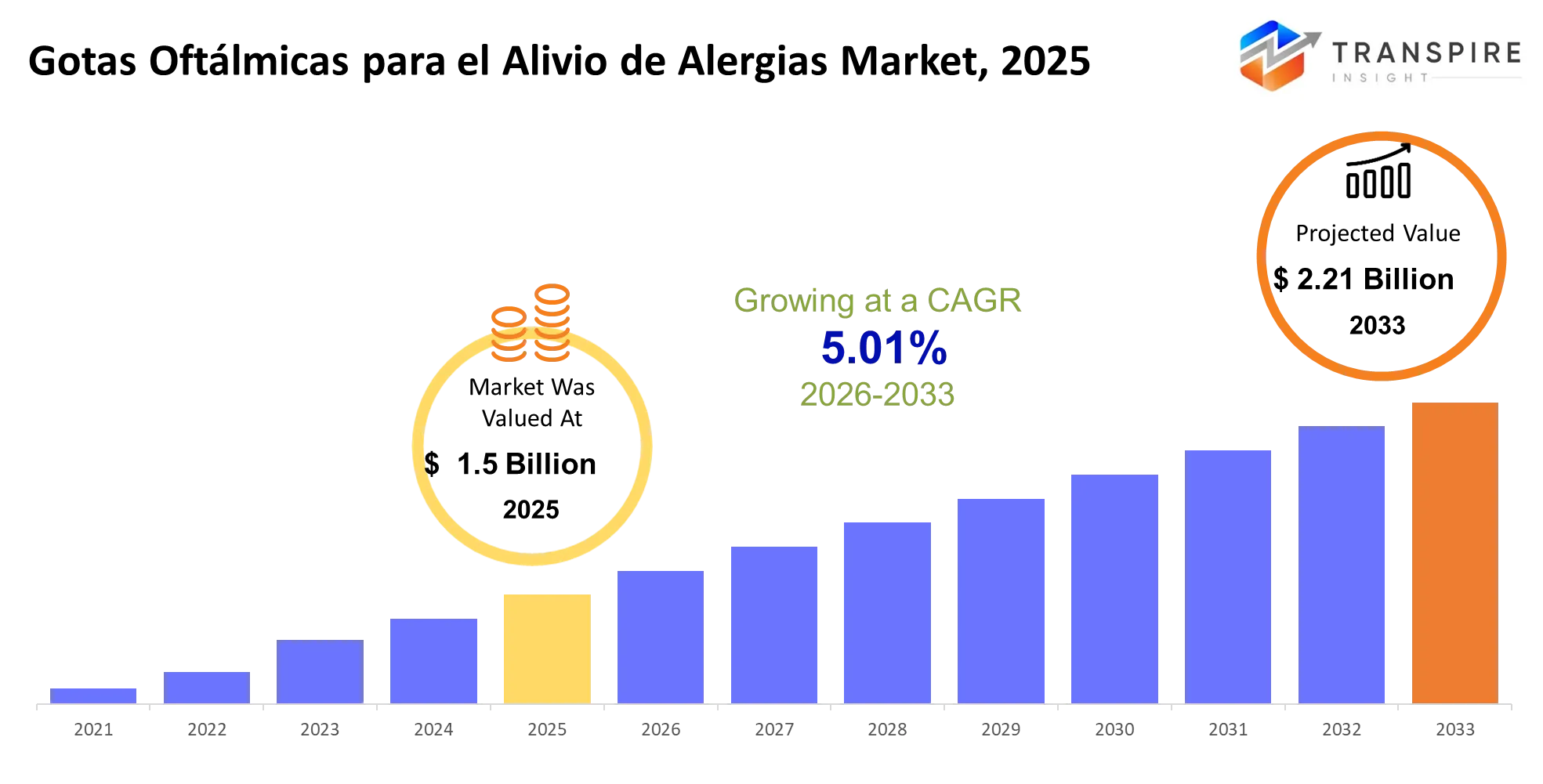
As per the Transpire Insight Analysis, The Gotas Oftálmicas para el Alivio de Alergias Market size is estimated at USD 1.5 billion in 2025 and is anticipated to reach USD 2.21 billion by 2033, growing at a CAGR of 5.01% from 2026 to 2033.
The gotas oftálmicas para el alivio de alergias marketoffers rapid, localised symptomatic relief of eye itch, redness, watering, and irritation caused by seasonal or perennial allergens. The trend has been for an increasing focus on convenience and self-administration. There has been a paradigm shift over the last 3-5 years from traditional symptom control to longer-acting antihistamines, dual-action products, preservative-free products, non-preserved products, and OTC availability. Key market and formulation changes include a move towards preservative-free, easy-to-use formulations, which were initiated by recent OTC launches that offer greater tolerability for consumers and ease of use. Simultaneously, growing pollen and perennial allergen exposure and recurring seasonal episodes mean there is greater impact from recurring, earlier treatment behaviours (and pre-treatment behaviours) before peak flower days. As a result, growth is concentrated within the cause-and-effect cycle of easier access and improved formulation design reducing treatment barriers, and more proactive allergy management resulting in repeat visits to pharmacies, online and other self-care providers.
Gotas Oftálmicas para el Alivio de Alergias Market Size & Forecast:
- Market Size 2025: USD 1.5 Billion
- Expected Market Value (2033): USD 2.21 Billion
- Forecast CAGR (2026–2033): 5.01%
- Leading Region in 2025: North America
- Fastest Growing Region: Asia-Pacific
- Key Company Profiles: Alcon, Bausch + Lomb, Johnson & Johnson Vision, Santen Pharmaceutical, Théa Pharma, AbbVie, Novartis, Harrow, Akorn, Viatris, Pfizer, Bayer, Sun Pharma, Cipla, Alembic Pharmaceuticals.
Key Gotas Oftálmicas para el Alivio de Alergias Market Insights:
The market is shifting from occasional symptom control to OTC, preservative-sensitive, convenience, repeat-buy, and extended-duration control eye care. The availability of basic antihistamines is no longer a competitive advantage; it's now the formulation tolerance, retail access, and specific chronic-allergy use cases.
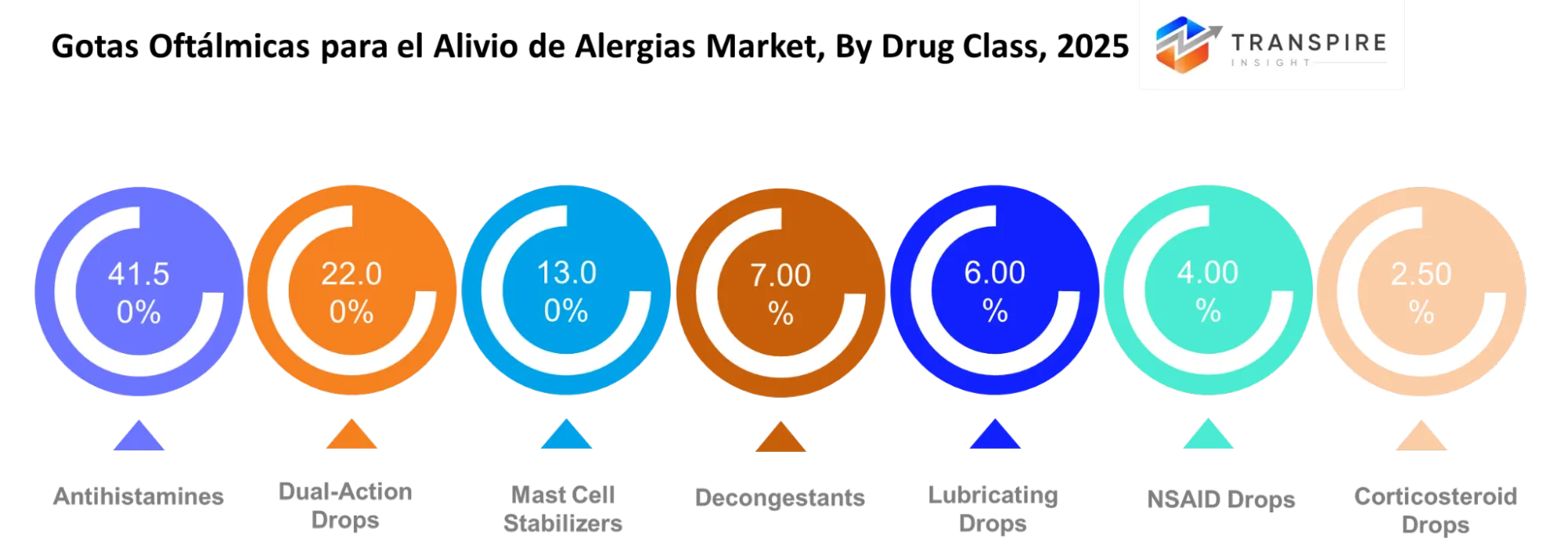
- Antihistamines account for 41.50%, and Alcon expanded the OTC availability of Pataday, moving consumers to self-managed, once-daily itch relief.
- Dual-action drops account for 22.00% of the total; Bausch + Lomb strengthens its allergy and surface-care positioning for recurrent symptoms.
- Mast-cell stabilisers make up 13.00%, and Santen's chronic ocular-allergy portfolio allows for earlier preventive use before pollen peaks.
- Decongestant drops contain 7.00%, and there is a growing trend to educate patients about the short course of use, which helps to minimise the risk of rebound redness.
- Lubricating allergy drops contain 6.00%, and Théa's preservative-free formula caters to screen-exposed and sensitive-eye users.
- NSAID drops account for 4.00% of sales; AbbVie's differentiator is through specialist-led inflammatory eye-care pathways, not mass OTC promotion.
- Combination and other formulations account for 4.00%, and Cipla and Sun Pharma add multi-symptom ophthalmic products to value-oriented portfolios.
- Corticosteroid drops make up 2.50%, and Harrow competes in the prescription specialties that demand monitored anti-inflammatory use.
- Users are increasingly valuing preservative-free repeat dosing over standard bottles, with single-dose and sterile multidose systems taking over.
What are the Key Drivers, Restraints, and Opportunities in the Gotas Oftálmicas para el Alivio de Alergias Market?
Driver:
The strongest growth driver is the expansion of self-medication through OTC allergy eye drops. Japan’s 2026 approval of epinastine hydrochloride for OTC use demonstrates how prescription-to-nonprescription switching can transform established therapies into pharmacy-led purchases. Similarly, OTC olopatadine products in the U.S. have strengthened consumer access to established allergy treatments. This regulatory shift reduces dependence on physician consultations for mild, recurring symptoms, shortens treatment decisions, and encourages earlier intervention. As pharmacies, supermarkets and online channels expand availability, manufacturers can reach seasonal allergy sufferers more directly, supporting higher product adoption and repeat purchases while broadening the overall consumer base.
Restraint:
Safety, formulation stability and preservative exposure remain structural constraints. Allergy drops are often used repeatedly during pollen seasons, so irritation, compatibility with sensitive eyes, and inappropriate prolonged use can limit acceptance. Preservative-free formats can improve tolerability but may require more complex packaging, manufacturing controls, and higher unit economics.
Opportunity:
Product design can unlock incremental adoption by combining efficacy with easier dosing, smaller packs and preservative-free delivery. Rohto’s 2026 epinastine launch, for example, uses a preservative-free formulation and a compact two-bottle pack, addressing seasonal users who may otherwise discard unused product. Digital symptom tracking can further connect pollen conditions, symptom timing, and treatment reminders, creating opportunities for targeted OTC engagement and better adherence. This can lift basket value when consumers choose premium delivery formats.
What has the impact of artificial intelligence been on the gotas oftálmicas para el alivio de alergias market?
AI is just now beginning to enter the allergy eye-drop market via the diagnosis, monitoring, and development side of the process rather than the actual production of the product. In ophthalmology, reporting on explainable AI using slit-lamp images can identify allergic-conjunctival conditions, such as hyperemia and papillae, to help providers differentiate diseases and gauge severity. One published model, which used 4,942 images, has demonstrated an 86.2% accuracy in diagnosing allergic conjunctivitis, paving the way for automated image-supported triage.
Digital allergy tools can incorporate symptom diaries, medication use and weather conditions to drive more proactive timing. For companies, analytics can improve pollen season forecasts, optimise local inventories and reveal adherence trends in over-the-counter and pharmaceutical channels. AI in R&D may also support the screening of formulation variables and sorting of patient types for clinical trials. Integration is the key: ophthalmic databases, validated workflows and regulatory controls are already in place, and model accuracy may vary by device, patient population and disease spectrum. As a result, AI may act as an intuitive decision aid rather than a replacement.
Key Gotas Oftálmicas para el Alivio de Alergias Market Trends:
The market is shifting from reactive relief to earlier, more convenient and preservative-sensitive allergy management, with increased OTC availability creating a greater consumer path. Increasingly, the changes in technology and formulation are linked to adherence, seasonal behaviour and personalised treatment timing.
- Switching from prescription to OTC is expanding access to pharmacies and increasing the number of less severe allergy events treated at home.
- Dual-action drops are becoming increasingly strategic because they provide relief from the symptoms of an allergic reaction and mast-cell stabilisation in a single dose.
- Preservative-free delivery is becoming a more common differentiator and a feature that is more tolerable for frequent users.
- The smaller packs are a response to seasonal consumers who use drops during the pollen periods and are a waste-reduction measure.
- Early-treatment messaging is gaining momentum as products are promoting use before the onset of high pollen levels, instead of when symptoms are severe.
- Repeat seasonal purchases are becoming easier on online pharmacy channels, and so is the linkage between the two with faster replenishment.
- Pollen and medication use and personal patterns can be used as triggers for reminders, with digital symptom and trigger tracking creating a pathway.
- The use of AI in ophthalmic imaging is helping to more accurately quantify allergic conjunctival findings and enhance triage and treatment decisions.
- The OTC regulatory pathways are pushing the repurposing of existing actives for wider access to consumers.
- Packaging aids in eliminating seasonal waste and maintaining dosing convenience.
Gotas Oftálmicas para el Alivio de Alergias Market Segmentation
Drug Class:
Antihistamines lead with 41.50%, supported by their established role in rapidly relieving allergy-related itching and redness. Dual-Action Drops account for 22.00%, combining immediate symptom relief with preventive activity, while Mast Cell Stabilizers represent 13.00% and support longer-term control. Dual-Action Antihistamine + Mast Cell Stabilizer formulations are advancing at a 6.1% CAGR, reflecting efforts to reduce dosing complexity. Decongestants hold 7.00%, Lubricating Drops 6.00%, NSAID Drops 4.00%, Corticosteroid Drops 2.50%, and Combination/Other formulations 4.00%, creating opportunities for differentiated products targeting tolerability, convenience, and specific allergy symptoms.
Formulation:
Sterile Liquid remains the practical base format because it supports consistent dosing and broad ophthalmic use. Preservative-Free Liquid is gaining attention among frequent users seeking improved ocular-surface tolerability, while Gel, Emulsion, and Suspension formats provide differentiated delivery characteristics. Single-Dose Vials support portability, sterility and reduced preservative exposure, particularly for sensitive users. Multi-Dose Bottles remain convenient for repeated seasonal treatment. Manufacturers are therefore balancing shelf stability, dosing accuracy, packaging efficiency, and patient comfort when developing next-generation allergy eye-drop formulations.
Distribution Channel:
Prescription remains clinically important for patients requiring physician-supervised treatment, while OTC channels are expanding access to mild and recurring allergy symptoms. Pharmacies remain important because pharmacists can guide product selection and repeat purchases, while Online Pharmacies improve convenience through home delivery and digital replenishment. Supermarkets broaden visibility for routine self-care products, whereas Clinics retain relevance for diagnosis and treatment escalation. Direct-to-Consumer models increasingly support education, product discovery and targeted promotions, strengthening the connection between seasonal symptoms and purchasing behaviour.
End User:
Adults represent the broadest commercial pool because allergy symptoms frequently translate into self-managed treatment purchases. Children require age-appropriate formulations, dosing guidance, and stronger safety considerations, while Elderly users may favour simple administration and products compatible with multiple therapies. Contact-Lens Users create demand for formulations designed around ocular-surface compatibility and appropriate lens-use instructions. Allergy Patients support broad treatment demand, while Seasonal Allergy Patients generate concentrated purchases during pollen periods. Chronic Allergy Patients provide opportunities for repeat treatment and longer-term product adherence.
Indication:
Seasonal Allergic Conjunctivitis remains closely connected to pollen cycles, creating concentrated treatment requirements during peak allergy periods. Perennial Allergic Conjunctivitis supports more consistent year-round usage because symptoms can arise from persistent indoor allergens. Itching remains a major treatment trigger, while redness and watery eyes influence consumer product selection and symptom-relief expectations. Irritation and allergy-associated dryness broaden the role of supportive formulations. These indication patterns encourage manufacturers to tailor dosing frequency, formulation characteristics, packaging, and channel strategies around symptom severity and treatment duration.
What are the Key Use Cases Driving the Gotas Oftálmicas para el Alivio de Alergias Market?
The core use case is rapid relief of allergic eye symptoms, supporting the dominant Antihistamine segment at 41.50%. These drops address itching, redness, and watering triggered by pollen, dust, and animal dander, making fast relief central to OTC and pharmacy purchases.
Expanding applications centre on seasonal self-care and recurring exposure. Seasonal Allergic Conjunctivitis drives concentrated treatment during pollen periods, while Perennial Allergic Conjunctivitis supports year-round use. Preservative-free liquids and single-dose vials improve convenience and tolerability for frequent users.
Emerging use cases combine treatment with digital monitoring and earlier intervention. Mobile tools can track symptoms and triggers, while AI-assisted imaging may support clinical assessment of allergic eye conditions. Children and contact-lens users also create opportunities for safer, specialized formulations and convenient dosing formats.
|
Report Metrics |
Details |
|
Market size value in 2025 |
USD 1.5 Billion |
|
Market size value in 2026 |
USD 1.57 Billion |
|
Revenue forecast in 2033 |
USD 2.21 Billion |
|
Growth rate |
CAGR of 5.01% from 2026 to 2033 |
|
Base year |
2025 |
|
Historical data |
2021 - 2024 |
|
Forecast period |
2026 - 2033 |
|
Report coverage |
Revenue forecast, competitive landscape, growth factors, and trends |
|
Regional scope |
United States; Canada; Mexico; United Kingdom; Germany; France; Italy; Spain; Denmark; Sweden; Norway; China; Japan; India; Australia; South Korea; Thailand; Brazil; Argentina; South Africa; Saudi Arabia; United Arab Emirates |
|
Key companies profiled |
Alcon, Bausch + Lomb, Johnson & Johnson Vision, Santen Pharmaceutical, Théa Pharma, AbbVie, Novartis, Harrow, Akorn, Viatris, Pfizer, Bayer, Sun Pharma, Cipla, Alembic Pharmaceuticals. |
|
Customization scope |
Free report customization (country, regional & segment scope). Avail customised purchase options to meet your exact research needs. |
|
Report Segmentation |
Drug Class (Antihistamine Drops, Mast Cell Stabilizers, Dual-Action Drops, Decongestant Drops, NSAID Drops, Lubricating Drops, Corticosteroid Drops, Combination Formulations); Formulation (Sterile Liquid, Preservative-Free Liquid, Gel, Emulsion, Suspension, Single-Dose Vials, Multi-Dose Bottles, Others); Distribution Channel (Prescription, OTC, Pharmacies, Hospital Pharmacies, Online Pharmacies, Supermarkets, Clinics, Direct-to-Consumer); End User (Adults, Children, Elderly, Contact-Lens Users, Allergy Patients, Seasonal Allergy Patients, Chronic Allergy Patients, Others); Indication (Seasonal Allergic Conjunctivitis, Perennial Allergic Conjunctivitis, Itching, Redness, Watery Eyes, Irritation, Dryness Associated with Allergy, Others). |
Which Regions are Driving the Gotas Oftálmicas para el Alivio de Alergias Market Growth?
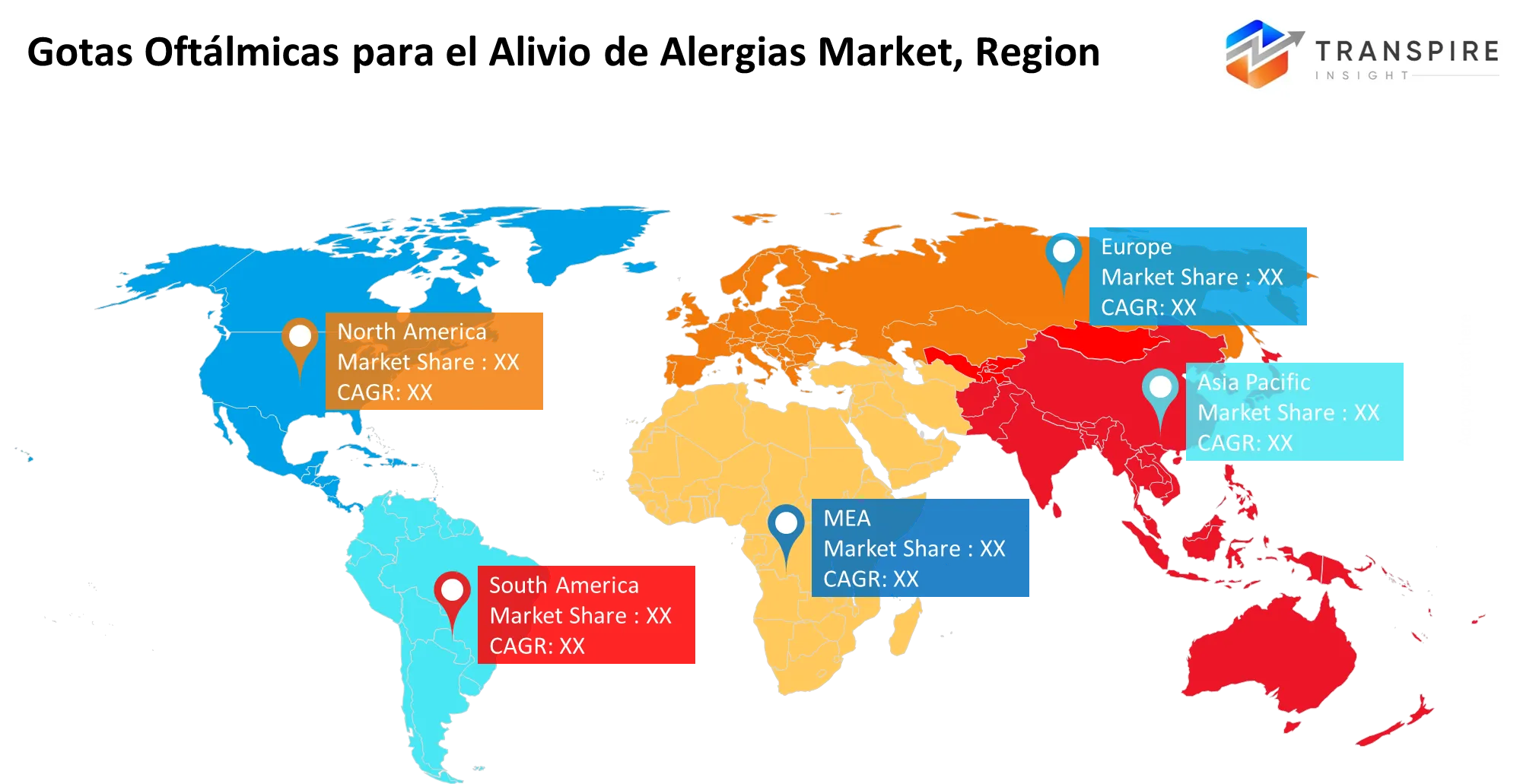
North America contributes to more than 40.30% of the Market due to extensive retail-pharmacy coverage, greater consumer awareness, and established eye-care referral systems. The North American region benefits from FDA-approved switches from prescription to OTC and off-label indications, helping reduce visits to physicians for validated allergy treatment. For instance, Accutane's Pataday eye drops 0.1%, 0.2%, and 0.7% convert to OTC access from prescription use and registered demand increase to volume in the retail channel. Sealed digital pharmacy fulfilment, seasonal adaptations, and insurer-associated eye-care capacity also increase repeat buy in the market.
In July 2026, Alcon and RxSight announced a strategic collaboration to develop customizable intraocular lenses. This partnership integrates advanced adjustable lens technologies into Alcon's surgical ecosystem to significantly optimize specialized visual acuity and post-operative precision for eye-care patients.https://www.alcon.com/newsroom/
Europe holds 27.90% market share, with growth coming more from formulations with high clinical stewardship and quality rather than over-the-counter marketing at high volume. The regulatory environment and pharmacy-based counselling in Europe provide a vehicle to inform consumers about preservative-free options for sensitive eyes and frequent users. Despite the challenges facing the OTC category, demand remains buoyant due to its ageing population, contact lens wearers and the persistent exposure to pollen, ensuring demand for year-round treatment. Consumers in Europe spend on clinically differentiated formulations they find well-tolerated.
In July 2026, Théa established a long-term strategic industrial partnership with Unither Pharmaceuticals to build a dedicated ophthalmic production facility in Gannat, France.https://thea.com/en_WW/news/thea-and-unither-launch-new-ophthalmic-production-facility
Asia-Pacific has the highest growth rate of 23.80% and is forecast to have a compound annual growth rate of 6.0%, driven by urban pollution, rising middle-class healthcare spend and access to modern retail pharmacies. A recent development has been Santen's preservative-free Verkazia in China, used for pediatric severe vernal keratoconjunctivitis, which highlights the move from primary acute-relief products into targeted, chronic ocular-allergy products. The next frontier presents opportunities for premium, localised OTC portfolios, e-commerce distribution, and affordable preservative-free packaging for the heavily populated urban environments.
In January 2026, Nemera partnered with Haohai Qisheng to secure regulatory approval in China for the Novelia® multi-dose closing tip system. This action allowed Shanghai Haohai to launch its new preservative-free lubricant eye drop, Eyesucom, in a specialized 15 mL multi-dose dispenser designed to protect the ocular surface from contamination and irritation while meeting the dense urban demand for highly convenient, long-term dry eye and contact lens care.https://manufacturingchemist.com/nemera-s-novelia-preservative-free-multi-dose-eyedropper-approved
Who are the Key Players in the Gotas Oftálmicas para el Alivio de Alergias Market, and how do they compete?
The market is now separating into three models: premium, trust-in-brand over-the-counter (OTC) brands for consumers; specialist ophthalmology companies for highly complex diseases; and inexpensive generic manufacturers for access expansion. Alcon, B+L, J&J Vision, Bayer, Novartis and AbbVie compete on brand equity, clinical relationships, retail reach and eye-care bundles. With its FDA-approved PATADAY OTC range of 3 olopatadine strengths, of which its extra-strength, 0.7% PATADAY provides 24-hour relief, Alcon is able to set itself apart.
Santen Pharma and Théa Pharma focus on glaucoma, dry eye, and speciality preservative-free ophthalmology by differentiating around light-sensitive proprietary products for chronic care, children, and eyes with light sensitivity. Santen is planning to use a 2025 China launch of preservative-free Verkazia to move into a geography-specific, different indication of high unmet need, rather than price competition. Among other examples of price-focused generic players are Viatris, Pfizer, Harrow, Akorn, Alembic, Sun, Cipla, and others competing on lower-cost products, contract manufacturing, local registration, and pharmacy access. Their challenge is to transition from a commodity service mentality to stable and sterile supply, with differentiated preservative-free delivery formats.
Key Players are:
- Alcon
- Bausch + Lomb
- Johnson & Johnson Vision
- Santen Pharmaceutical
- Théa Pharma
- AbbVie
- Novartis
- Harrow
- Akorn
- Viatris
- Pfizer
- Bayer
- Sun Pharma
- Cipla
- Alembic Pharmaceuticals
Recent Development News
- In May 2026, Huons launched Hurotadine Eye Drops 0.7% in South Korea. The preservative-free, multi-dose olopatadine hydrochloride formulation was introduced as Korea’s first product of its type, targeting improved patient convenience and reducing the cost burden associated with allergy eye-drop treatment.https://www.huons.com/eng/home.php?go=pds.list&pds_type=8&start=0&num=5782&s_key1=&s_que=&s_head=
- In February 2026, ROHTO Pharmaceutical announced the launch of Rohto Alguard Epinastine Eye Drops in Japan. The product, launched in March 2026, became the first OTC eye drop in Japan containing epinastine hydrochloride, previously used as a prescription ingredient, supporting wider self-care options for allergy-related itchy and bloodshot eyes.https://www.rohto.co.jp/en/news/release/2026/0210_01
- In January 2026, Dr Reddy's Laboratories Ltd. announced the first-to-market launch of its over-the-counter (OTC) Olopatadine Hydrochloride Ophthalmic Solution USP, 0.7% in the United States. This introduction provides consumers with a lower-cost generic alternative to Extra Strength Pataday Once-Daily Relief for the temporary mitigation of ocular itching caused by seasonal and environmental allergens.https://trial.medpath.com/news/dr-reddy-s-launches-first-to-market-generic-olopatadine-0-7-eye-drops-in-us
What Strategic Insights Define the Future of the Gotas Oftálmicas para el Alivio de Alergias Market?
The market is converging on a hybrid that bridges over-the-counter access, speciality treatment, and adherence-motivated delivery methods, rather than just speed of symptom control. The greatest strategic shift is expected to be driven by products that are dosed less frequently, preservative-free, and allow for earlier start of a seasonal treatment that can be dosed before symptoms take hold. A potential challenge for product expansion via over-the-counter switching is potential increased misuse for long-standing or severe symptoms, an issue that could cause challenges in safety, labelling, and consumer education for manufacturers and regulators.
A new opportunity on the horizon is combining allergy products with digital symptom trackers, pollen forecasts, and personalized dosing reminders to provide greater opportunities for repetition without altering the core medicine – so expect innovation in formulation and in regulatory switching routes, pharmacy partnerships, and data-driven digital support.
Santen's 2026 Alesion partnership illustrates a broad commercial ecosystem for better access.
Key Segmentations are:
Drug Class
- Antihistamine Drops
- Mast Cell Stabilisers
- Dual-Action Drops
- Decongestant Drops
- NSAID Drops
- Lubricating Drops
- Corticosteroid Drops
- Combination Formulations
Formulation
- Sterile Liquid
- Preservative-Free Liquid
- Gel
- Emulsion
- Suspension
- Single-Dose Vials
- Multi-Dose Bottles
- Others
Distribution Channel
- Prescription
- OTC
- Pharmacies
- Hospital Pharmacies
- Online Pharmacies
- Supermarkets
- Clinics
- Direct-to-Consumer
End User
- Adults
- Children
- Elderly
- Contact-Lens Users
- Allergy Patients
- Seasonal Allergy Patients
- Chronic Allergy Patients
- Others
Indication
- Seasonal Allergic Conjunctivitis
- Perennial Allergic Conjunctivitis
- Itching
- Redness
- Watery Eyes
- Irritation
- Dryness Associated with Allergy
- Others
By Regional Analysis
North America
- US
- Canada
- Mexico
Europe
- Germany
- UK
- France
- Italy
- Spain
- Russia
- Rest of Europe
Asia Pacific
- China
- Japan
- India
- South Korea
- Australia
- Rest of Asia Pacific
South America
- Brazil
- Argentina
- Rest of South America
Middle East & Africa
- UAE
- Saudi Arabia
- Qatar
- South Africa
- Rest of the Middle East & Africa
Frequently Asked Questions
Find quick answers to common questions.
The gotas oftálmicas para el alivio de alergias market size was valued at USD 1.5 billion in 2025 and is poised to reach USD 2.21 billion by 2033, expanding at a 5.01% CAGR.
Key segments for the gotas oftálmicas para el alivio de alergias market are Drug Class (Antihistamine Drops, Mast Cell Stabilizers, Dual-Action Drops, Decongestant Drops, NSAID Drops, Lubricating Drops, Corticosteroid Drops, Combination Formulations); Formulation (Sterile Liquid, Preservative-Free Liquid, Gel, Emulsion, Suspension, Single-Dose Vials, Multi-Dose Bottles, Others); Distribution Channel (Prescription, OTC, Pharmacies, Hospital Pharmacies, Online Pharmacies, Supermarkets, Clinics, Direct-to-Consumer); End User (Adults, Children, Elderly, Contact-Lens Users, Allergy Patients, Seasonal Allergy Patients, Chronic Allergy Patients, Others); Indication (Seasonal Allergic Conjunctivitis, Perennial Allergic Conjunctivitis, Itching, Redness, Watery Eyes, Irritation, Dryness Associated with Allergy, Others).
Growth is primarily driven by expanding OTC access, self-medication, preservative-free formulations, dual-action therapies, seasonal allergy management, and wider pharmacy and online distribution.
The gotas oftálmicas para el alivio de alergias market is led by major manufacturers, including Alcon, Bausch + Lomb, Johnson & Johnson Vision, Santen Pharmaceutical, Théa Pharma, AbbVie, Novartis, Harrow, Akorn, Viatris, Pfizer, Bayer, Sun Pharma, Cipla, Alembic Pharmaceuticals.
North America holds 40.30% of the market, supported by mature OTC channels, established ophthalmic brands, strong pharmacy infrastructure, and widespread consumer adoption of allergy self-care.
Key opportunities include preservative-free and dual-action formulations, OTC product expansion, digital allergy monitoring, convenient packaging, and growing self-care adoption in Asia-Pacific.
- Alcon
- Bausch + Lomb
- Johnson & Johnson Vision
- Santen Pharmaceutical
- Théa Pharma
- AbbVie
- Novartis
- Harrow
- Akorn
- Viatris
- Pfizer
- Bayer
- Sun Pharma
- Cipla
- Alembic Pharmaceuticals
About the Authors

Pankaj Ghogare Patil
I am Pankaj Ghogare Patil, a Senior Research Analyst at Transpire Insight, specializing in the Pharmaceutical, Chemicals & Materials, Healthcare IT, and Biotechnology industry. My expertise lies in conducting comprehensive market research, analyzing industry trends, evaluating competitive landscapes, and translating complex data into actionable insights. At Transpire Insight, I closely follow emerging technologies, regulatory developments, and market innovations to create accurate, well-researched, and informative content that helps businesses and professionals make informed decisions. I am committed to producing credible, evidence-based articles that reflect industry best practices while making technical topics accessible and valuable for a broad audience.

Chakradhar Khansole
Chakradhar serves as the Research Director at Transpire Insight, bringing over 8 years of experience in technology, innovation, and strategic market intelligence. He specializes in transforming complex market data into actionable business insights that enable organizations to make informed, growth-oriented decisions. Recognized for his strategic vision and analytical expertise, Chakradhar leads high-impact research initiatives, delivering comprehensive market assessments, competitive intelligence, and forward-looking industry analysis.
Recently Published Reports
-
Apr 2026
AI in Diabetic Retinopathy Market
AI in Diabetic Retinopathy Market Size, Share & Analysis Report By Type (Screening AI Systems, Diagnostic AI Systems, and Predictive AI Models), By Application Segment (Hospitals, Ophthalmology Clinics, Diagnostic Centers, and Research and Development), and Geography (North America, Europe, Asia-Pacific, Middle East and Africa, South and Central America), 2021 - 2031
-
Apr 2026
Psychometric Tests Market
Psychometric Tests Market Size, Share & Analysis Report By Type (Personality Tests, Ability/Aptitude Tests, Skill/Knowledge Tests, and Others), By Application (Talent Acquisition and Talent Management), and Geography (North America, Europe, Asia-Pacific, Middle East and Africa, South and Central America), 2021 – 2031
-
Apr 2026
Rare Biological Sample Collection Market
Rare Biological Sample Collection Market Size, Share & Analysis Report By Type (Isolation Kits & Reagent, Blood Collection Tubes, and Others), By Application (Oncology, Transcriptomics, Pharmacogenomics, and Others), and Geography (North America, Europe, Asia-Pacific, Middle East and Africa, South and Central America), 2021 – 2031
-
Jul 2026
Diabetic Retinopathy Market
Diabetic Retinopathy Market Size, Share & Analysis Report By Type (Proliferative Diabetic Retinopathy, and Diabetic Macular Edema (DME)), By Treatment Type (Anti VEGF Drug, Steroid Implants, Laser Surgeries, and Vitrectomy), and Geography (North America, Europe, Asia-Pacific, Middle East and Africa, South and Central America), 2021 – 2031
Our Clients







