Global Vessel Chartering Service Market Summary:
According to Transpire Insights, a detailed research report on the market reflects that the container shipping application segment dominates the Global Vessel Chartering Service Market, accounting for approximately 45% of the total share worldwide. A.P. Moller, Maersk leads the market with approximately (around USD 55 billion) in annual revenue and an estimated 10–15% global market share, making it a leading contributor to global market development, innovation, advanced vessel chartering solutions, expanding fleet capabilities, digital shipping services, and growth dynamics.
Market Snapshot
- Global Market Value (2025): USD 23.5 Billion.
- Expected Market Value (2026): USD 24.6 Billion.
- Estimated Market Value (2033): USD 33.8 Billion.
- Forecast CAGR (2026–2033): 4.64%.
- Leading Region in 2025: Asia Pacific
- Second-largest Region: Europe
- Fastest Growing Region: North America
Introduction
The maritime sector segment where cargo owners and logistics providers rent (charter) ships from shipowners instead of owning complete fleets is known as the Global Vessel Chartering Service Market. It gives companies vital flexibility so they may utilize specialist vessels for international trade and increase shipping capacity. Shipowner the organization that provides the vessel and is in charge of insurance, maintenance and crew. The company that controls the cargo and rents the ship is known as the charterer. In the maritime shipping sector, ship chartering, also known as vessel chartering, is the practice of a charterer renting or hiring a vessel or space on a vessel from a shipowner for a particular voyage or a predetermined amount of time. Cost-effectiveness it does away with the enormous initial capital outlays and ongoing maintenance expenses that come with creating and maintaining a fleet. Operational flexibility unlike fixed-schedule liners, chartering enables businesses to choose specialized boats that are precisely suited to their cargo requirements, define customized schedules, and demand direct routes. Scalability without committing to long-term assets, businesses can readily modify their transportation capacity in response to changing market demands. Risk mitigation by shifting operational risks to the shipowner, such as crew management, routine maintenance and vessel depreciation, financial predictability is provided. Direct market entry chartering makes it simpler to distribute goods internationally, enabling businesses to easily investigate new foreign markets.
- For instance:- North America is an investment hotspot worth around $5.7 billion, accounting for over 39% of global ship leasing income. This is largely due to localized luxury yacht charters, strong container activity, and LNG exports from the United States and Canada.

Market Highlights: -
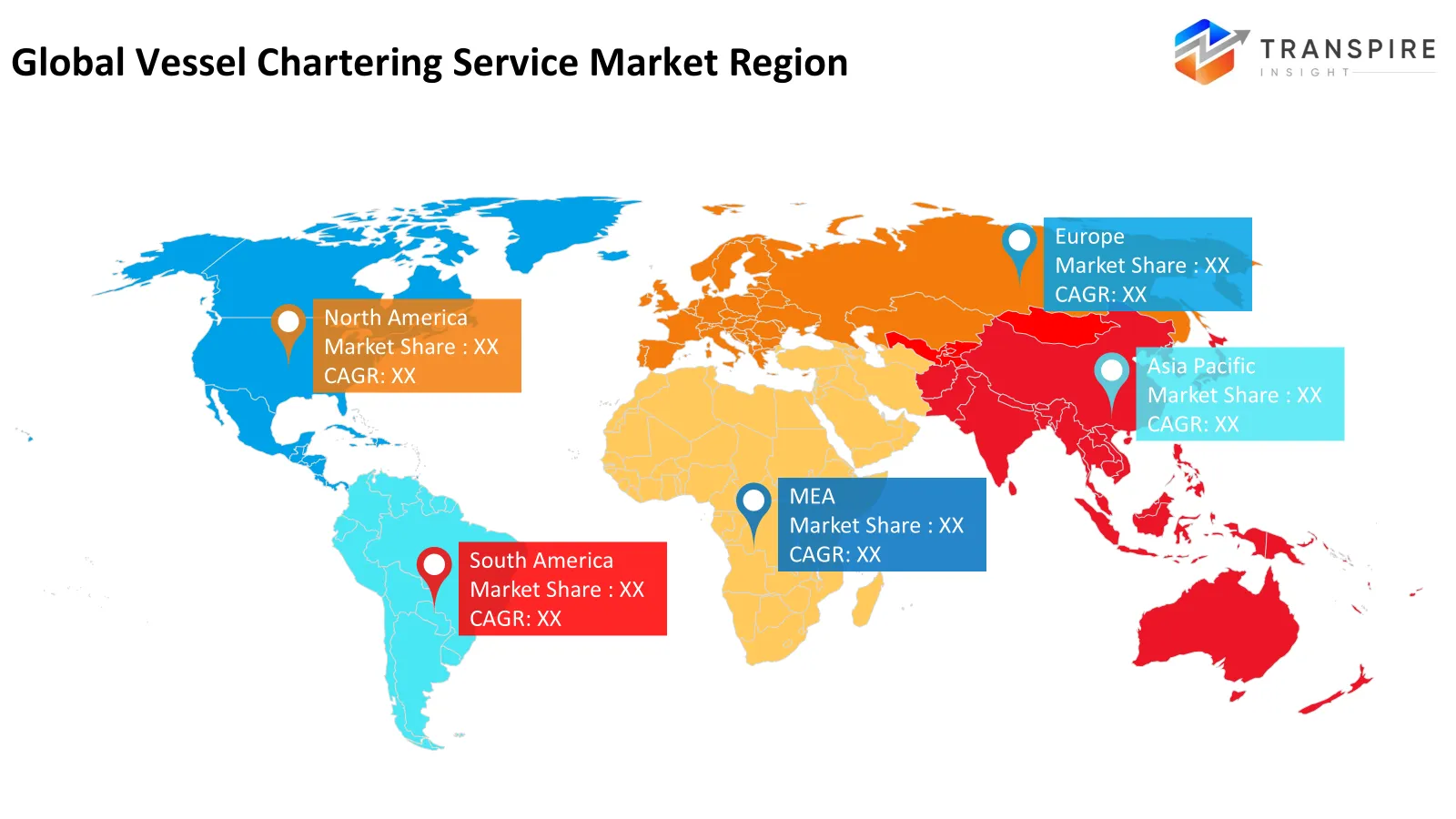
- Asia Pacific is anticipated to hold around 38% share of the Global Vessel Chartering Service Market over the predicted timeframe.
- Europe is anticipated to hold around 20% share of the Global Vessel Chartering Service Market over the predicted time frame.
- North America is expected to grow at a rapid CAGR in the Global Vessel Chartering Service Market by holding an estimated 18% of the share during the forecast period.
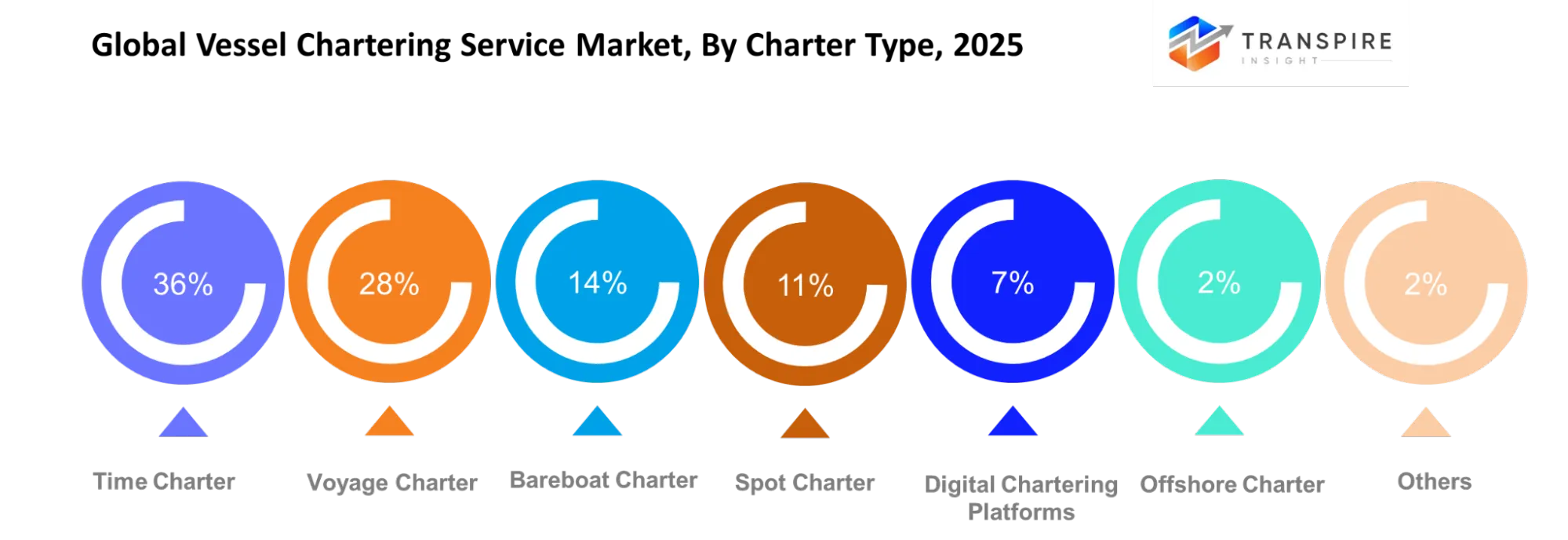
- By charter type, the Time Charter segment dominated the market and holds nearly 40% share in 2025 and is projected to grow at a substantial CAGR during the forecast period.
- By end user, the Oil & Gas Companies segment dominated the market and holds nearly 42% share in 2025 and is projected to grow at a substantial CAGR during the forecast period.
- By application, the Dry Bulk Transport segment dominated the market and holds nearly 36% share in 2025 and is projected to grow at a substantial CAGR during the forecast period.
- Digital Reforms & Regulatory Support: By digitizing foreign vessel licensing for export-import (EXIM) activities through the Directorate General of Shipping (DGS) e-Governance Portal, India is bolstering its vessel chartering ecosystem. Furthermore, GIFT City (IFSC) enhances India's appeal as a global hub for maritime services by providing competitive tax benefits and a business-friendly regulatory framework for ship leasing and maritime finance.
How is Technology Driving Growth in the Global Vessel Chartering Service Market?
AI and Predictive Analytics: Cutting-edge AI-driven solutions improve operational efficiency and save fuel usage by forecasting freight demand, optimizing vessel routing, and enabling predictive maintenance. Digital Chartering Platforms: Through automated procedures, digital chartering solutions increase cargo-vessel matching, expedite vessel booking, and speed up transactions. IoT and Cloud Integration: Supply chain visibility, operational transparency, and decision-making are enhanced by fleet analytics, cloud-based data sharing, and real-time vessel monitoring. Blockchain Technology: Smart contracts powered by blockchain improve paperwork, payment security, efficiency, and transparency in all aspects of vessel chartering.
Market Drivers
Growing international trade & seaborne volumes consistent, high-volume cargo transportation is necessary due to the expansion of regional commodity exchanges, global manufacturing and e-commerce. Because of this, both short-term and long-term charters are essential for aligning vessel capacity with changing market demands. LNG and energy transition expansion as the world moves toward cleaner energy sources and energy security efforts, there is an increasing need for specialist charters, especially LNG carriers and renewable energy support vessels. Offshore exploration projects the need for long-term charters of specialist platform supply vessels (PSVs) and offshore support boats is being driven by the expansion of deepwater and ultra-deepwater oil and gas operations. Tight environmental regulations the International Maritime Organization's (IMO) stricter emissions regulations encourage charterers to switch from outdated fleets to more contemporary, fuel-efficient, hybrid/alternative-fuel boats, increasing demand for specialized charter services. Digital transformation the broker-charterer matchmaking process is being streamlined by the use of AI for route optimization, blockchain in contracts and digital booking platforms, which immediately reduces operating expenses. High Cost-Efficiency: Reduces long-term maintenance and decommissioning costs and avoids significant upfront capital expenditures (CAPEX) when buying vessels. Operational flexibility businesses can choose bespoke ports, schedules and routing in addition to selecting the precise type of ship (such as tankers, bulk carriers, or heavy-lift boats). Scalability without being dependent on permanent fleet assets, businesses can adjust their shipping capacity during periods of strong demand.
- For Instance: - The global vessel chartering market is undergoing structural change, moving toward fleet modernization, sustainability-related retrofits, and digital platforms. Massive investments in LNG and dry bulk charters to reroute energy and commodities supply chains away from Russian activities have been prompted by geopolitical upheavals following the war in Ukraine.
- The Middle East and Africa area as a whole represents a $6.3 billion market in South Africa, with local investments concentrating on offshore energy, LNG projects, and port expansion.
Restrain
Volatile freight rates, tighter environmental rules, growing operational and maintenance costs, supply chain disruptions, tariff and geopolitical unpredictability, and high technology adoption costs are some of the difficulties facing the ship chartering market. These elements raise financial risk, lower profitability, make long-term planning more difficult, and erect obstacles to effective fleet management and long-term market expansion.
Analysis of Prices and Consumer Behaviour
The sector of the marine transportation services market that is most significant is seen to be that of bulk and container ship chartering activities (roughly 60–65% of total market share; mainly because of the increasing international trade flows, transportation of goods, energy transportation, and supply chains). Prices for high-tech ship chartering services amount to about 20–30% more than comparative ordinary charter services. Dry bulk and container shipping segments account for almost 50% of overall demand for vessel chartering, with the international trade flow increasing by many times and the increasing number of cargo traffic. The three industries of manufacturing, energy, mining, and commodities make around 70% of the demand for shipping services, as there is a need for transporting goods by sea. Customer behavior is sought to define 55–60% of charterers' focus because of the presence of performance, price efficiency, and security in maritime transportation.
Top Companies in the GlobalVessel Chartering Service Market
- Maersk
- MSC
- COSCO Shipping
- Clarksons
- Braemar
- BRS Group
- Cargill Ocean Transportation
- Norden
- Oldendorff Carriers
- NYK Line
- MOL
- K Line
- V.Group
- Anglo-Eastern
- Pacific Basin Shipping
Market Segmentation
The Global Vessel Chartering Service Market share is divided into five categories: By charter type, vessel type, end user, application and booking mode.
The Time Charter dominated the market, accounting for nearly 40% in 2025 and is expected to rise at a significant CAGR during the forecast period.
The Global Vessel Chartering Service Market is segmented by charter type into Voyage Charter, Time Charter, Bareboat Charter, Spot Charter, Contract of Affreightment, Offshore Charter, Others. Among these, the Time Charter segment dominated the market, accounting for nearly 40% in 2025 and expected to increase at a significant CAGR during the forecast period. Due to its cost stability, long-term vessel availability, and flexibility for cargo owners and operators, the Time Charter segment led the market, accounting for about 40% in 2025. Over the course of the projected period, substantial CAGR growth is anticipated to be driven by expanding international trade, the need for dependable transportation capacity, and decreased sensitivity to freight rate volatility.
The Oil & Gas Companies dominated the market, accounting for nearly 42% in 2025, and is expected to rise at a significant CAGR during the forecast period.
The Global Vessel Chartering Service Market is segmented by end user into Oil & Gas Companies, Commodity Traders, Shipping Companies, Government Agencies, Logistics Providers, Others. Among these, the Oil & Gas Companies segment dominated the market, accounting for nearly 42% in 2025 and expected to increase at a significant CAGR during the forecast period. Due to the significant reliance on maritime transportation for shipments of crude oil, LNG, and petroleum products, the Oil & Gas Companies segment led the market in 2025, accounting for about 42%. Over the course of the projected period, considerable CAGR growth is anticipated to be supported by growing global energy commerce, offshore exploration activities, long-term vessel charter agreements, and the need for dependable tanker capacity.
The Dry Bulk Transport dominated the market, accounting for nearly 36% in 2025 and is expected to rise at a significant CAGR during the forecast period.
The Global Vessel Chartering Service Market is segmented by application into Dry Bulk Transport, Liquid Cargo Transport, Offshore Operations, Container Shipping, Project Cargo, Others. Among these, the Dry Bulk Transport segment dominated the market, accounting for nearly 36% in 2025 and expected to increase at a significant CAGR during the forecast period. Due to the growing international commerce of commodities such coal, iron ore, grains, and minerals, the Dry Bulk Transport sector dominated the market in 2025, accounting for about 36%. Significant CAGR growth is anticipated over the projection period due to rising industrial production, infrastructural expansion, and the need for effective bulk cargo transportation.
Regional Segment Analysis of the GlobalVessel Chartering Service Market:
- North America (U.S., Canada, Mexico)
- Europe (Germany, France, U.K., Italy, Spain, Rest of Europe)
- Asia-Pacific (China, Japan, India, Rest of APAC)
- South America (Brazil and the Rest of South America)
- The Middle East and Africa (UAE, South Africa, Rest of MEA)
Asia Pacific is the fastest-growing region in the Global Vessel Chartering Service Market during the period, holding around 38% share.
Asia Pacific is the fastest-growing region in the Global Vessel Chartering Service Market during the forecast period, holding around 38% share during the forecast period. With a 38% market share, Asia Pacific is the fastest-growing area in the global vessel chartering service market. This is because of growing international trade, fast industrialization, rising seaborne cargo volumes, and rising port infrastructure investments. Regional market expansion is being accelerated by the existence of significant shipping hubs, growing energy imports, the expansion of manufacturing, and the growing need for effective maritime logistics services.
Europe is expected to grow at a rapid CAGR in the GlobalVessel Chartering Service Market, holding around 20% of the share during the forecast period
Europe is expected to grow at a rapid CAGR in the Global Vessel Chartering Service Market holding around 20% share during the forecast period. Due to robust maritime trade networks, sophisticated port infrastructure, rising demand for energy and bulk commodities, and expanding acceptance of digital shipping solutions, Europe is predicted to develop at a quick compound annual growth rate (CAGR) in the global vessel chartering service market, holding a 20% share. Regional market expansion is also being aided by fleet modernization programs and sustainability standards.
North America is the fastest-growing region in the Global Vessel Chartering Service Market during the period, holding an estimated 18% share.
North America is expected to grow at a rapid CAGR in the Global Vessel Chartering Service Market holding estimated 18% share during the forecast period. With an estimated 18% of the global vessel chartering service market, North America is the fastest-growing region due to increased international trade, rising energy exports, rising demand for bulk and container shipping, and improvements in port infrastructure. Increased maritime transportation activity, digital shipping use, and sophisticated logistics networks all contribute to growth.
Strategies for Market Growth in Non-Leading Regions:
Efficient vessel chartering service solutions could assist both small and medium shipping operators and the development of non-leading regions. Fleet capacity would increase, modern port infrastructure would develop, and local maritime services would appear, which would reduce dependence on a limited number of transportation networks. Good relations and strategic partnerships with shipowners, freight operators, logistics companies, port authorities, and international trade companies will provide vessel chartering service providers with better market penetration. For better knowledge in maritime operations, digital chartering platforms, compliance with regulations, fleet management, and sustainability in shipping certain training programs and skills improvement would be needed. Moreover, there should be introduced flexible financial solutions, long-term charter contracts, and sharing of fleets possible to make vessel chartering services more available for the introduction.
Future Market Trends for the Global Vessel Chartering Service Market: -
1.Decarbonization & Green Fleet Modernization: Stricter International Maritime Organization (IMO) requirements are forcing the use of eco-friendly boats. Operators are replacing aged fleets with ships fueled by alternative fuels (LNG, biofuels), dramatically increasing the demand for Ship Chartering Services Market advising around green financing and newbuilding.
2.Digitalization and AI Optimization: The industry is evolving away from traditional manual broking toward digital booking platforms. AI and predictive analytics are now being applied to optimize routes, increase asset utilization, and automate contract execution.
3.ShiftToward Short-Term Leases: Driven by economic instability and unpredictable trade volumes, many shippers are turning away from long-term contracts in favor of spot-market transactions and shorter-term chartering options to maintain flexibility.
4.Emergence of the Asia-Pacific Hub: Asia-Pacific remains the fastest-growing and leading region, grabbing over 35% of the market share. Expanding industrial production and ambitious fleet expansion initiatives by key operators (such as the Shipping Corporation of India's recent capital expenditure for over 200 vessels) are central to regional growth.
5.Blockchain for Transparency: Blockchain technology is being integrated into chartering to improve contract visibility, minimize transaction friction, and ensure verifiable compliance with emissions reporting criteria
Recent Development
- In January 2026: Mitsui O.S.K. Lines (MOL) completed the delivery of the dual-fuel (LPG/HFO) Very Large Gas Carrier (VLGC) Energia Grandeur, which entered into a long-term time charter agreement with a TotalEnergies subsidiary. The vessel enhances sustainable gas transportation capabilities and supports the expansion of advanced vessel chartering services through energy-efficient maritime solutions.
- In February 2, 2026: A.P. Moller – Maersk received delivery of the Tangier Maersk, a 9,000 TEU dual-fuel methanol-capable container vessel and deployed it into service connecting East Asia with the US Gulf Coast. The vessel enhances sustainable fleet operations, supports maritime decarbonization initiatives, and strengthens the adoption of advanced vessel chartering solutions.
- In June 2026: (Seasonal Service) A.P. Moller – Maersk introduced its TPX seasonal Transpacific service, deploying seven vessels with an average capacity of approximately 4,000 TEU. The service strengthens connectivity between key Asian markets and the U.S. West Coast while improving fleet utilization, capacity flexibility, and operational efficiency across global vessel chartering and maritime logistics networks.
This study forecasts revenue at global, regional and country levels from 2020 to 2033. Transpire Insights has segmented the Global Vessel Chartering Service Market based on the below-mentioned segments:
Global Vessel Chartering Service Market, By Charter Type
- Voyage Charter
- Time Charter
- Bareboat Charter
- Spot Charter
- Contract of Affreightment
- Offshore Charter
- Others
Global Vessel Chartering Service Market, By Vessel Type
- Bulk Carriers
- Tankers
- Container Ships
- LNG Carriers
- Offshore Support Vessels
- General Cargo Ships
- Others
Global Vessel Chartering Service Market, By End User
- Oil & Gas Companies
- Commodity Traders
- Shipping Companies
- Government Agencies
- Logistics Providers
- Others
Global Vessel Chartering Service Market, By Application Type
- Dry Bulk Transport
- Liquid Cargo Transport
- Offshore Operations
- Container Shipping
- Project Cargo
- Others
Global Vessel Chartering Service Market, By Booking Mode
- Direct Charter
- Ship Brokers
- Digital Chartering Platforms
- Others
Global Vessel Chartering Service Market, By Regional Analysis
North America
- United States
- Canada
- Mexico
Europe
- Germany
- United Kingdom
- France
- Italy
- Spain
- Russia
- Rest of Europe
Asia Pacific
- China
- Japan
- India
- South Korea
- Australia
- Rest of Asia Pacific
South America
- Brazil
- Argentina
- Rest of South America
Middle East & Africa
- Saudi Arabia
- United Arab Emirates
- Qatar
- South Africa
- Rest of the Middle East & Africa
Frequently Asked Questions
Find quick answers to common questions.
The market is expected to grow at a 4.64% CAGR, reaching USD 33.8 Billion by 2033 from USD 23.5 Billion in 2025.
The Time Charter segment dominates with nearly 40% share in 2025, driven by flexibility, cost stability, and long-term vessel availability.
Asia-Pacific dominates with approximately 38% market share, supported by trade growth, industrialization, port expansion, and rising maritime activities.
AI, blockchain, IoT, and digital platforms enhance vessel booking, route optimization, transparency, operational efficiency, and predictive maintenance capabilities.
Growth is driven by global trade expansion, energy demand, offshore activities, fleet modernization, sustainability regulations, and cost-efficient shipping solutions.
- Maersk
- MSC
- COSCO Shipping
- Clarksons
- Braemar
- BRS Group
- Cargill Ocean Transportation
- Norden
- Oldendorff Carriers
- NYK Line
- MOL
- K Line
- V.Group
- Anglo-Eastern
- Pacific Basin Shipping
About the Authors

Mayur Shinde
I am Mayur Shinde, a Senior Research Analyst at Transpire Insight, specializing in the Automotive & Transportation and Information & Communication Technology (ICT) Industry. My work focuses on analyzing emerging market trends, technological advancements, competitive landscapes, and industry developments to deliver accurate, data-driven insights. I am passionate about transforming complex market information into clear, actionable content that helps businesses, professionals, and decision-makers stay informed and make confident strategic decisions.

Chakradhar Khansole
Chakradhar serves as the Research Director at Transpire Insight, bringing over 8 years of experience in technology, innovation, and strategic market intelligence. He specializes in transforming complex market data into actionable business insights that enable organizations to make informed, growth-oriented decisions. Recognized for his strategic vision and analytical expertise, Chakradhar leads high-impact research initiatives, delivering comprehensive market assessments, competitive intelligence, and forward-looking industry analysis.
Recently Published Reports
-
Apr 2026
ATV & UTV Market
ATV & UTV Market Size, Share & Analysis Report By Type (ATV, and UTV), By Variants (Less Than 400 CC, 400 CC To 800 CC, and More Than 800 CC), and Geography (North America, Europe, Asia-Pacific, Middle East and Africa, South and Central America), 2021 - 2031
-
Apr 2026
Automotive Central Gateway Module Market
Automotive Central Gateway Module Market Size, Share & Analysis Report By Type (Ethernet Central Gateway Module, CAN Central Gateway Module, LIN Central Gateway Module, and FlexRay), By Application (Powertrain Control, Body Control, Infotainment System, Advanced Driver Assistance Systems (ADAS), and Others), By End User (Passenger Vehicles, and Commercial Vehicles), and Geography (North America, Europe, Asia-Pacific, Middle East and Africa, South and Central America), 2021 - 2031
-
Apr 2026
Automotive Engine Oil Filter Market
Automotive Engine Oil Filter Market Size, Share & Analysis Report By Filter Type (Fuel Filter, Engine Oil Filter, Hydraulic Oil Filter, and Others), By Filter Media (Cellulose, Synthetic, and Micro), By Sales Channel (OEMs, and Aftermarket), By Vehicle Type (Passenger Cars, Light Commercial Vehicles, Heavy Duty Trucks, Buses and Coaches, and Off-road Vehicles), and Geography (North America, Europe, Asia-Pacific, Middle East and Africa, South and Central America), 2021 - 2031
-
Apr 2026
Automotive Parts Aluminium Die Casting Market
Automotive Parts Aluminium Die Casting Market Size, Share & Analysis Report By Production Process (Pressure Die Casting, Vacuum Die Casting, Squeeze Die Casting, Gravity Die Casting), By Application (Body Parts, Engine Parts, Transmission Parts, Battery And Related Components, Other Application Types), and Geography (North America, Europe, Asia-Pacific, Middle East and Africa, South and Central America), 2021 - 2031
Our Clients