
Global Trichlorosilane Market Size & Forecast
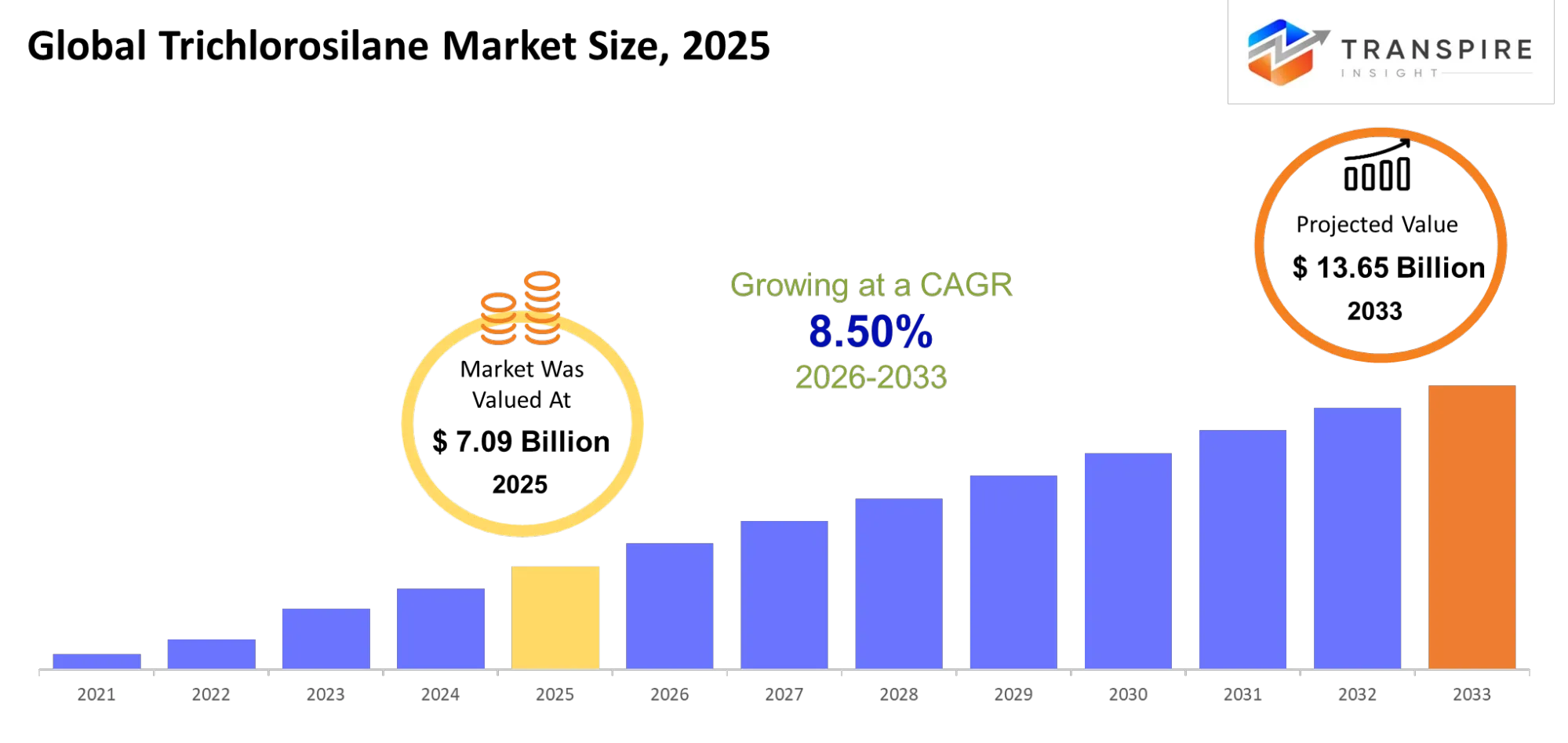
- Global Trichlorosilane Market Size 2025: USD 7.09 Billion
- Global Trichlorosilane Market Size 2033: USD 13.65 Billion
- Global Trichlorosilane Market CAGR: 8.50%
- Global Trichlorosilane Market Segments: By Application (Polysilicon Production, Silicone Production, Chemical Intermediates), By End-User Industry (Solar Energy, Semiconductor Industry, Chemical Industry), By Purity Level (Electronic Grade, Industrial Grade)
To learn more about this report,  Download Free Sample Report
Global Trichlorosilane Market Summary
The Global Trichlorosilane Market was valued at USD 7.09 Billion in 2025. It will reach USD 13.65 Billion by 2033. The CAGR over this period is 8.50%.
Trichlorosilane (TCS) is that all-important chemical starting point that the global photovoltaic and semiconductor industries can't live without really. The compound is the main raw material used to produce polysilicon - the base stuff in solar panels and silicon wafers.
The market's entire framework is based on the Siemens process - the very dominant industrial way of purifying silicon where TCS is pumped into a reactor with hydrogen so that super-pure silicon gets deposited onto heated rods. This process accounts for more than 80 percent of all global polysilicon production. Because polysilicon manufacturers use up TCS in enormous quantities all the time, TCS demand follows polysilicon production capacity expansion almost perfectly every time. Every new polysilicon factory announced globally adds a very predictable, quantifiable amount of TCS demand.
The solar energy explosion has been the driving force of demand over the past decade. China alone added more than 216 GW of new solar capacity back in 2023, and global installations keep going at a record pace still. Every gigawatt of solar installed requires roughly 5,000 to 6,000 metric tons of polysilicon - which in turn requires several times that amount of TCS as raw material. Alongside solar, the semiconductor industry's move to advanced nodes below 3nm creates steady demand for electronic-grade TCS with purity standards way over 99. 9999 percent - a very high-value niche that really commands significant price premiums over regular industrial-grade product.
Key Global Trichlorosilane Market Insights
- Asia-Pacific really leads the world in trichlorosilane (TCS) production, accounting for about 65% of revenue in 2025 - driven by China's massive production capacity for polysilicon, which makes up more than 85% of global polysilicon output and uses most of the world's available TCS supply.
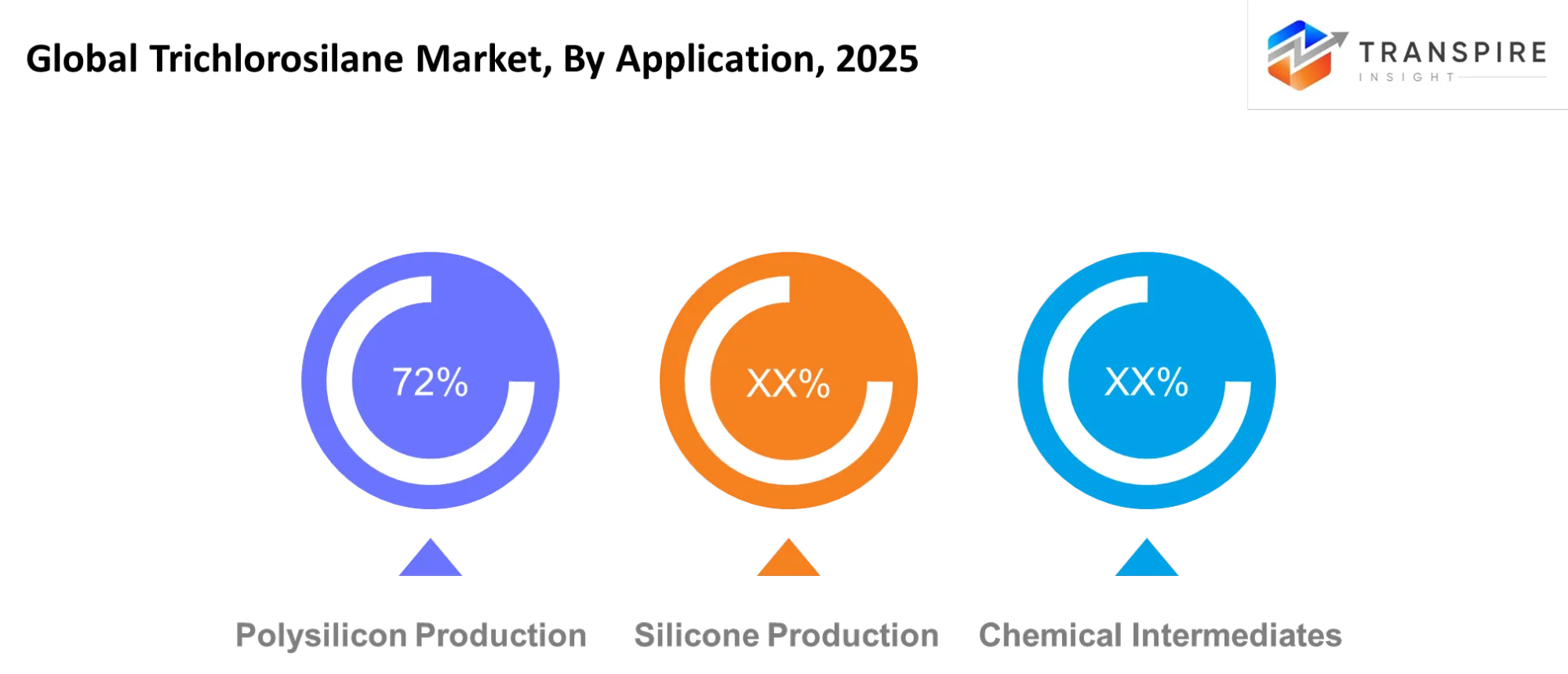
- Polysilicon Production is the largest application segment at about 72% of global TCS revenue in 2025, very closely tied to our planet's increasing global solar energy capacity and the manufacture of semiconductor-grade silicon wafers for creating very advanced computer chips.
- Solar Energy is the biggest end-user industry segment, making up approximately 58% of TCS end-use demand in 2025, because photovoltaic manufacturing is growing very aggressively to meet renewable energy targets in China, Europe, the United States, and India.
- Electronic Grade TCS commands a substantial price premium of 30 to 50 percent over Industrial Grade product due to the extremely tight purity specifications needed for semiconductor wafer and advanced materials applications.
- Wacker Chemie AG and Hemlock Semiconductor Corporation are the leading Western TCS and polysilicon producers, competing based on purity certification, supply chain reliability, and long-term offtake contracts with major semiconductor fabricators.
- GCL Technology Holdings and Jiangsu Zhongneng are the dominant Asian TCS-to-polysilicon integrated producers, leveraging China's lower energy costs and close proximity to solar panel manufacturing to compete very aggressively on industrial-grade product pricing.
- The semiconductor industry's transition to more advanced nodes below 5nm really drives sustained demand growth for electronic-grade TCS, where Shin-Etsu Chemical and Tokuyama Corporation hold leading positions through decades of expertise in purification processes.
- Europe's TCS production base faces structural cost pressure from elevated natural gas prices, which directly increase the energy-intensive chemical synthesis and purification costs that represent 35 to 45% of total TCS production expense.
- REC Silicon ASA restarted its Moses Lake, Washington facility in 2022 to serve the US semiconductor market, reflecting strategic onshoring demand as US chip legislation created incentives for domestic advanced materials supply chains.
- The Chemical Intermediates application segment is the smallest but strategically important niche, as TCS serves as a precursor for organosilane compounds used in adhesives, coatings, and surface treatment agents across automotive and construction industries.
What are the Key Drivers, Restraints, and Opportunities in the Global Trichlorosilane Market?
Primary drivers include a massive global solar energy buildup. Governments throughout China, Europe, the United States, and India have set out to achieve renewable energy targets that necessitate very rapid expansion of photovoltaic manufacturing over many decades. China's 14th Five-Year Plan calls for 1,200 GW of installed solar capacity by 2030 - a feat demanding incredible ongoing polysilicon production and subsequently, by direct association, tremendous TCS feedstock at scale. The US Inflation Reduction Act gives investment tax credits to domestic solar manufacturing, further increasing TCS demand into entirely new geographic markets. Every GW of global solar capacity added generates around 5,000 to 6,000 metric tons of polysilicon demand and many multiples of that in TCS consumption, creating quite a solid, policy-backed demand floor that extends well beyond our 2033 forecast period.
Energy cost volatility is the greatest production cost risk in TCS manufacturing. The Siemens-process synthesis and purification of TCS necessitates ongoing high-temperature operation - resulting in natural gas and electricity costs being the single largest variable production expense, usually representing 35 to 45% of total cost of goods. European TCS producers including Wacker Chemie AG encountered very severe margin compression in 2022 and 2023 as natural gas prices sharply increased after the Russia-Ukraine conflict. Meanwhile, Chinese producers running on subsidized energy costs and fully integrated supply chains from TCS to finished solar modules were able to keep a lot of pricing pressure on Western suppliers, setting up quite a structural cost asymmetry that severely limits Western producer profitability - all independently of demand conditions.
The semiconductor supply chain onshoring push in the United States, Europe, Japan, and South Korea really presents a key high-value opportunity for electronic-grade TCS producers with certified purity standards. The US CHIPS and Science Act allocates more than $52 billion towards domestic semiconductor manufacturing, and new fab investments from TSMC, Intel, Samsung, and Micron in the United States require a guaranteed domestic or allied-nation supply of electronic-grade materials including TCS. Producers that can certify electronic-grade products to leading-edge fab standards and provide under long-term supply agreements to the newly constructed US fabs will really get hold of the highest-margin part of TCS demand - within a supply chain where security of supply takes priority over even small price differences.
What Has the Impact of Artificial Intelligence Been on the Global Trichlorosilane Market?
AI really enters the trichlorosilane (TCS) market through two main paths: demand forecasting for capacity planning and process optimization within TCS synthesis and purification operations. On the demand side, TCS producers and polysilicon manufacturers are now deploying machine learning models that integrate satellite images of solar panel installation activity, power purchase agreement filing data, and government tender databases to generate much more accurate 12 to 36-month demand forecasts. With much better demand visibility, inventory build and drawdown cycles - which often caused price fluctuations in the TCS market - decrease, improving working capital efficiency for both producers and buyers.
Process optimization is where AI creates the biggest economic impact for TCS producers. The Siemens process involves really tightly coupled chemical reactions - temperature, gas flow ratios, and pressure gradients must be kept within very narrow windows to get target purity levels and silicon deposition rates. Machine learning controllers trained on years of reactor operation data can identify subtle parameter correlations that even the best human operators miss, improving reactor yield by 2 to 5 percentage points - and reducing energy consumption per kilogram of output. For a large TCS facility processing tens of thousands of metric tons every year, a 3% yield improvement equals millions of dollars in annual cost reduction.
The indirect AI effect on TCS demand through semiconductor advancement also really deserves attention. AI speeds up the design and tape-out of new semiconductor devices, greatly compressing the time between chip architecture decisions and wafer production. Faster chip design cycles increase wafer start volumes at the top fabs, which directly increases demand for electronic-grade TCS. As AI workload demand drives GPU and accelerator chip volumes much higher, the semiconductor segment of TCS demand is expected to grow faster than the overall market average through the entire forecast period.
Key Market Trends
- China's polysilicon production capacity exceeded 1.5 million metric tons per year in 2024, consuming the majority of global TCS supply and creating an integrated supply chain from TCS synthesis through to finished solar modules.
- GCL Technology Holdings and Jiangsu Zhongneng Polysilicon account for a combined 40 to 50% of global polysilicon output, making them the largest single source of structural TCS demand globally.
- Electronic-grade TCS demand grows faster than industrial-grade as advanced semiconductor nodes require increasingly stringent purity certification, with leading-edge fabs specifying TCS purity above 99.9999%.
- The US CHIPS and Science Act drives new TCS supply chain investment in North America, with REC Silicon's Moses Lake restart and several announced expansions targeting domestic semiconductor fab supply requirements.
- Wacker Chemie AG and Hemlock Semiconductor pursued long-term supply agreement structures in 2023 and 2024 with major semiconductor fabricators to stabilize revenue visibility and justify capital investment in electronic-grade capacity expansion.
- Silicone production, the second-largest TCS application, grows steadily as electric vehicle battery sealing, medical device manufacturing, and construction sealant demand sustains broad industrial-grade TCS consumption globally.
- Energy transition policies in the European Union, India, and the United States create multi-year polysilicon demand visibility that supports TCS capacity investment decisions with 5 to 10-year return horizons.
- Japanese producers Shin-Etsu Chemical, Tokuyama Corporation, and Mitsubishi Materials maintain premium positioning in electronic-grade TCS through proprietary purification process technology that enables consistent ultra-high purity output.
- Linde plc and Air Products and Chemicals supply specialty gases and process chemicals into TCS manufacturing operations, creating adjacent market exposure to TCS production growth without direct commodity price risk.
- Vertical integration from TCS production through polysilicon refining to ingot and wafer manufacturing accelerates among Chinese producers, compressing margins available to standalone TCS suppliers and driving consolidation in the non-integrated segment.
Global Trichlorosilane Market Segmentation
By Application
Polysilicon production commands 72% of global TCS revenue in 2025. This supremacy is structurally locked in by the Siemens process - which converts TCS into high-purity silicon through hydrogen reduction at quite high temperatures. Every metric ton of solar-grade or semiconductor-grade polysilicon produced in this way demands numerous metric tons of TCS as feedstock. As global solar installations keep going at a record-breaking pace - and semiconductor wafer demand expands due to increasing chip complexity - polysilicon output quantities will scale upwards - drawing TCS consumption with them right through the entire 2033 forecast period.
Silicone production is the second biggest application - making up approximately 18 to 20 percent of TCS usage. TCS reacts with methanol or other reagents to produce methylchlorosilane intermediate products - the fundamental components of silicone polymers, resins, and fluids used in automotive, electronics, healthcare, and construction sectors all over the world. Silicone demand keeps growing steadily as electric vehicle battery systems require special thermal management fluids and sealants - and with medical device manufacturing expanding internationally. This sector gives relatively stable returns compared to polysilicon's exposure to solar installation timing - making it somewhat counter-cyclical.
To learn more about this report, Download Free Sample Report
By End-User Industry
Solar Energy is the dominant end-user at approximately 58% of TCS demand in 2025, driven entirely by polysilicon consumption in photovoltaic cell manufacturing. The solar sector's demand for TCS is non-discretionary: without polysilicon, there are no solar cells. China's solar manufacturing complex, the world's largest by a wide margin, drives the majority of this demand, with additional pull from new thin-film and heterojunction cell manufacturing in Southeast Asia, India, and the United States. Solar's share of TCS demand is expected to remain dominant through 2033 as the energy transition intensifies.
The Semiconductor Industry accounts for approximately 25 to 30% of TCS demand, with a disproportionately high revenue contribution because semiconductor-grade TCS sells at a significant premium over solar-grade product. Leading-edge logic fabs, DRAM manufacturers, and NAND flash producers all consume electronic-grade TCS in wafer deposition and epitaxial growth processes. The segment is less price-sensitive than solar because purity certification and supply continuity take precedence over unit cost. TSMC, Samsung Foundry, Intel, and Micron collectively drive the majority of semiconductor-grade TCS procurement.
The Chemical Industry segment uses TCS primarily for silicone polymer production and specialty organosilane synthesis. Dow Inc., Evonik Industries, and Wacker Chemie are the largest participants in this segment, using TCS as a starting material for higher-value chemical products. Growth in this segment tracks industrial production indices in key manufacturing economies rather than the policy-driven acceleration seen in solar and semiconductors, making it more predictable but slower-growing than the other two end-user categories.
By Purity Level
Electronic Grade TCS holds the higher-value position in the purity segment split, serving semiconductor wafer fabrication and advanced materials applications that require silicon purity above 99.9999%. Producing electronic-grade TCS requires proprietary multi-stage distillation and purification processes that only a small number of global producers have mastered consistently at commercial scale. This creates a defensible competitive moat for established producers including Shin-Etsu Chemical, Tokuyama, Hemlock Semiconductor, and Wacker Chemie, and commands pricing premiums of 30 to 50 percent over industrial-grade equivalents.
Industrial Grade TCS serves polysilicon production for solar applications and silicone manufacturing, where purity specifications are significantly less demanding than semiconductor applications. The bulk of global TCS volume falls in the industrial-grade category because solar-grade polysilicon production volumes dwarf semiconductor consumption volumes by a wide margin. Pricing in this segment is more competitive and more directly exposed to energy cost movements and Chinese producer pricing behavior. Producers competing in industrial-grade TCS differentiate on delivery reliability, contract structure, and proximity to customer facilities rather than on technical product differentiation.
What are the Key Use Cases Driving the Global Trichlorosilane Market?
The predominant application case is the production of polysilicon for solar photovoltaic manufacturing purposes. A solar cell starts out as metallurgical-grade silicon that is processed into TCS, purified via the Siemens method into polysilicon, then crystallized into ingots, sliced into wafers, and fabricated into cells and modules. TCS is that indispensable chemical interface in this production line. The scale of solar deployment all over the world really means that this one application case accounts for 72% of all TCS consumption, and its growth trend is actually indexed to the speed of global solar installation - which has set new records every year for the last five years.
Semiconductor wafer production is our second very important use case - and it's the one with the highest per-unit TCS value. Electronic-grade TCS undergoes chemical vapor deposition or epitaxial growth processes within semiconductor fabrication facilities so as to form very thin silicon layers on wafers. As chip geometries decrease to below 5nm and 3nm, the number of deposition cycles per wafer increases - which raises TCS consumption per wafer start. The AI-driven surge in GPU and HBM memory chip demand has driven wafer start volumes at advanced fabs to capacity limits, translating directly into higher quantities of electronic-grade TCS procurement.
Silicone intermediate production represents TCS demand that is less visible but structurally quite stable. Producers of silicone sealants, fluids, and resins for electric vehicle battery packs, medical grade tubing, and construction weatherproofing materials consume industrial-grade TCS consistently regardless of solar installation timing or semiconductor cycle conditions. This application case acts like a demand stabilizer for TCS manufacturers, smoothing revenue against the more volatile polysilicon and semiconductor segments during periods of supply chain disruption or end-market demand softness.
Report Overview Table
|
Report Metrics |
Details |
|
Market size value in 2025 |
USD 7.09 Billion |
|
Market size value in 2026 |
USD 7.71 Billion |
|
Revenue forecast in 2033 |
USD 13.65 Billion |
|
Growth rate |
CAGR of 8.50% from 2026 to 2033 |
|
Base year |
2025 |
|
Historical data |
2021 - 2024 |
|
Forecast period |
2026 - 2033 |
|
Report coverage |
Revenue forecast, competitive landscape, growth factors, and trends |
|
Regional scope |
United States; Canada; Mexico; United Kingdom; Germany; France; Italy; Spain; Denmark; Sweden; Norway; China; Japan; India; Australia; South Korea; Thailand; Brazil; Argentina; South Africa; Saudi Arabia; United Arab Emirates |
|
Key companies profiled |
Wacker Chemie AG, Hemlock Semiconductor Corporation, OCI Company Ltd., Tokuyama Corporation, Mitsubishi Materials Corporation, REC Silicon ASA, Dow Inc., Evonik Industries AG, GCL Technology Holdings Ltd., Linde plc, Shin-Etsu Chemical Co. Ltd., Sumitomo Chemical Co. Ltd., Air Products and Chemicals Inc., KCC Corporation, Jiangsu Zhongneng Polysilicon Technology Development Co. Ltd. |
|
Customization scope |
Free report customization (country, regional & segment scope). Avail customized purchase options to meet your exact research needs. |
|
Report Segmentation |
By Application (Polysilicon Production, Silicone Production, Chemical Intermediates), By End-User Industry (Solar Energy, Semiconductor Industry, Chemical Industry), By Purity Level (Electronic Grade, Industrial Grade) |
Which Regions are Driving the Global Trichlorosilane Market Growth?
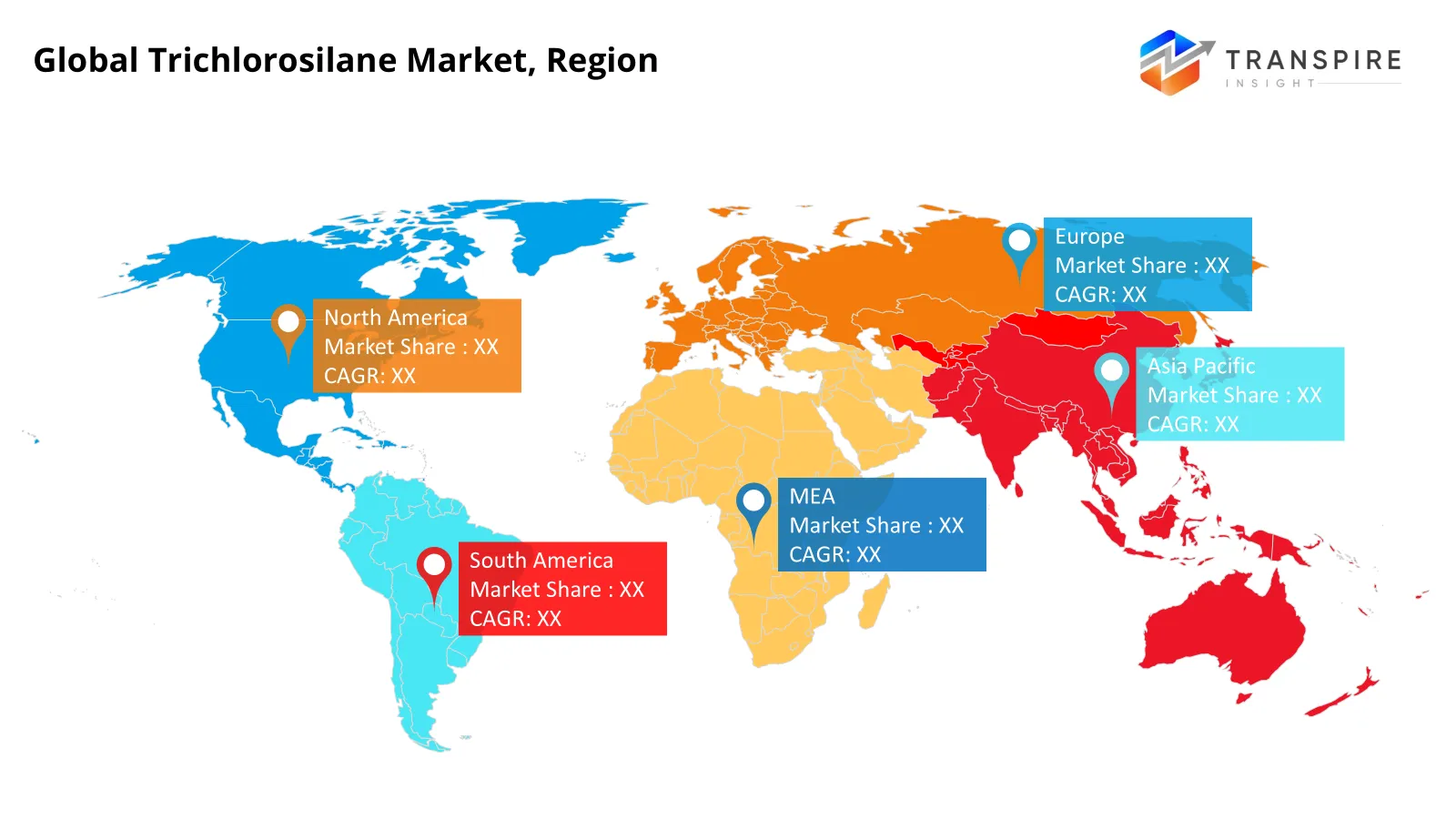
Asia-Pacific really dominates the global trichlorosilane market - about 65% of revenue in 2025. China's truly the biggest production and consumption hub - hosting the world's biggest polysilicon production site and using most of the world's TCS supply within vertically integrated supply chains that go all the way from TCS synthesis to finished solar panels. China made more than 1. 5 million metric tons of polysilicon in 2024 - a number that no other region gets close to. South Korea and Japan are secondary Asian markets identified by high-value semiconductor applications much more than by solar volume, with Shin-Etsu Chemical, Tokuyama, and Samsung SDI really pushing for precision chemical sourcing.
North America is a strategically reshaping market. The US CHIPS and Science Act and Inflation Reduction Act together have triggered a whole new wave of semiconductor fab and solar manufacturing investments that need really reliable domestic or allied-nation TCS supply. REC Silicon restarting its Moses Lake facility and several announced expansions really show the strategic value that US policymakers and manufacturers put on supply chain security over even a little extra cost. The United States isn't in a position to replace Asia-Pacific on industrial-grade volume, but it's building the infrastructure to serve domestic electronic-grade TCS demand from next-generation semiconductor fabs all through the forecast period.
Europe is the third major market, mainly anchored by Wacker Chemie AG's integrated polysilicon and TCS operations in Germany and Evonik Industries' specialty silane production. European TCS demand really ties closely to semiconductor manufacturing in Germany and the Netherlands and to silicone production for industrial applications. Since 2022, really high natural gas prices have structurally changed European TCS production economics, making a strategic shift towards higher-margin electronic-grade and specialty silane products where European producers can keep their pricing power against lower-cost Asian competition even stronger.
To learn more about this report, Download Free Sample Report
Who are the Key Players in the Global Trichlorosilane Market and How Do They Compete?
The worldwide trichlorosilane (TCS) market really divides itself into two pretty distinct competitive areas - the high-volume industrial-grade sector controlled mostly by Chinese integrated producers, and the premium electronic-grade section where Japanese and Western chemical companies have a very secure footing due to their proprietary purification technology and decades-long supply relationship qualification with top semiconductor manufacturers. The two areas hardly ever directly compete with each other since their customers, specifications, and business models are all quite different fundamentally.
Wacker Chemie AG competes as an integrated TCS-to-polysilicon producer with both solar-grade and semiconductor-grade capabilities, benefiting greatly from long-term customer relationships with European chemical and semiconductor buyers. Hemlock Semiconductor Corporation, a joint venture involving Dow Inc. and Shin-Etsu Chemical, holds a very strong position in North American electronic-grade polysilicon supply and is a key beneficiary of US semiconductor onshoring investment. Tokuyama Corporation and Shin-Etsu Chemical lead the Japanese electronic-grade TCS market with proprietary multi-stage distillation processes that always achieve the extremely high purity levels required by top-of-the-line semiconductor fabs worldwide.
GCL Technology Holdings and Jiangsu Zhongneng Polysilicon dominate Asian industrial-grade TCS consumption through vertically integrated operations that combine very low-cost energy access, very large-scale TCS synthesis, and closeness to China's solar manufacturing hubs. OCI Company Ltd. occupies a very strong position in South Korea, supplying both semiconductor and solar sectors with very competitive cost structures. Linde plc and Air Products and Chemicals participate in the TCS value chain as specialty gas and process chemical suppliers to TCS and polysilicon manufacturers, capturing margins from production growth without having to directly deal with commodity prices themselves.
Global Trichlorosilane Market Companies
- Wacker Chemie AG
- Hemlock Semiconductor Corporation
- OCI Company Ltd.
- Tokuyama Corporation
- Mitsubishi Materials Corporation
- REC Silicon ASA
- Dow Inc.
- Evonik Industries AG
- GCL Technology Holdings Ltd.
- Linde plc
- Shin-Etsu Chemical Co. Ltd.
- Sumitomo Chemical Co. Ltd.
- Air Products and Chemicals Inc.
- KCC Corporation
- Jiangsu Zhongneng Polysilicon Technology Development Co. Ltd.
Recent Developments
In April 2026, Orsero S.p.A. announced acquisition. The company acquired a majority stake in a regional fresh produce distributor in Northern Italy to strengthen its domestic supply chain and expand fruit sourcing capabilities. https://www.orsero.it
In March 2026, Conserve Italia announced acquisition. The cooperative completed the acquisition of a local fresh vegetable processing firm to enhance its ready-to-eat fresh produce portfolio and improve vertical integration. https://www.conserveitalia.it
What Strategic Insights Define the Future of the Global Trichlorosilane Market?
Over the 2026 to 2033 forecast period, the global trichlorosilane market shall exhibit a profoundly divided strategic landscape. In the industrial-grade polysilicon segment, Chinese vertically integrated producers will continue to dominate both in terms of cost and scale - and non-Chinese producers can hardly compete based on volume economics alone. Western and Japanese producers attempting to compete head-on against Chinese companies in industrial-grade TCS for solar applications will still face persistent margin pressure. A very rational strategic response is to focus your capital and innovation investments on electronic-grade TCS and specialty silane products wherever purity certification requirements, qualification barriers, and supply security premiums will continue to sustain pricing power.
The semiconductor industry supply chain 'reshoring' trend creates the most significant strategic opportunity in the TCS market that we have seen in over a decade. New fabrication plants in the United States, Germany, Japan, and India will take many years to qualify and receive all necessary certifications for electronic-grade materials before reaching full production. Companies that start their qualification processes with these fabrication plants right now, during the construction and commissioning phases, will set up multi-year preferred supplier relationships that generate a lot of revenue with minimal competition pressure from the commodity segment. The qualification investment is quite significant, usually requiring 12 to 24 months and a considerable amount of technical expertise - but the resulting supply agreements can lock in above-market pricing for five to ten years.
The structural risk that market participants should monitor very closely indeed is technology substitution risk in the solar segment. Alternative polysilicon production methods, such as the fluidized bed reactor process promoted by REC Silicon, consume different precursor chemistries and may reduce TCS intensity per unit of polysilicon over time. If the fluidized bed reactor technology gains more market share against the Siemens process at the margins projected by some technology forecasts, then TCS demand growth could actually be lower than the solar installation growth rate by 2030 to 2033. This risk will not threaten the market's overall growth - but it will affect the economics of capacity investments for producers planning large-scale industrial-grade TCS expansions.
Global Trichlorosilane Market Report Segmentation
By Application
- Polysilicon Production
- Silicone Production
- Chemical Intermediates
By End-User Industry
- Solar Energy
- Semiconductor Industry
- Chemical Industry
By Purity Level
- Electronic Grade
- Industrial Grade
Frequently Asked Questions
Find quick answers to common questions.
The Global Trichlorosilane Market size is expected to reach USD 13.65 Billion by 2033.
The key segments are By Application (Polysilicon Production, Silicone Production, Chemical Intermediates), By End-User Industry (Solar Energy, Semiconductor Industry, Chemical Industry), and By Purity Level (Electronic Grade, Industrial Grade).
Major players include Wacker Chemie AG, Hemlock Semiconductor Corporation, OCI Company Ltd., Tokuyama Corporation, Mitsubishi Materials Corporation, REC Silicon ASA, Dow Inc., Evonik Industries AG, GCL Technology Holdings Ltd., Linde plc, Shin-Etsu Chemical Co. Ltd., Sumitomo Chemical Co. Ltd., Air Products and Chemicals Inc., KCC Corporation, and Jiangsu Zhongneng Polysilicon Technology Development Co. Ltd.
The Global Trichlorosilane Market size is USD 7.09 Billion in 2025.
The Global Trichlorosilane Market CAGR is 8.50% from 2026 to 2033.
- Wacker Chemie AG
- Hemlock Semiconductor Corporation
- OCI Company Ltd.
- Tokuyama Corporation
- Mitsubishi Materials Corporation
- REC Silicon ASA
- Dow Inc.
- Evonik Industries AG
- GCL Technology Holdings Ltd.
- Linde plc
- Shin-Etsu Chemical Co. Ltd.
- Sumitomo Chemical Co. Ltd.
- Air Products and Chemicals Inc.
- KCC Corporation
- Jiangsu Zhongneng Polysilicon Technology Development Co. Ltd.
Recently Published Reports
-
Apr 2026
Healthcare Polymer Packaging Market
Healthcare Polymer Packaging Market Size, Share & Analysis Report By Packaging Type (Syringes, IV Bottles and Pouches, Clamshells, Blisters, Bottles & Jars, Containers, Tubes, IV Parental Packaging, Others), By Type (Regulated, Non-regulated), By Polymer Type (LDPE (Low-Density Polyethylene), HDPE (High-Density Polyethylene), Homo-polymer (Homo), Random Copolymer (Random), Block Copolymer (Block), PET, Polystyrene, Polyvinyl Chloride, Polyamide/EVOH, Others), and Geography (North America, Europe, Asia-Pacific, Middle East and Africa, South and Central America), 2021 - 2031
-
Apr 2026
Hydrophilic Tape (Waterstop) Market
Hydrophilic Tape (Waterstop) Market Size, Share & Analysis Report By Type (Bentonite-Based Hydrophilic Tape, Rubber-Based Hydrophilic Tape), By Application (Residential Buildings, Commercial Buildings, Infrastructure Projects), and Geography (North America, Europe, Asia-Pacific, Middle East and Africa, South and Central America), 2021 - 2031
-
Apr 2026
Metalens Market
Metalens Market Size, Share & Analysis Report By Type (Visible Light Metalens, and Infrared Metalens), By Application (Consumer Electronics, Automotive Electronics, Industrial, Medical, and Others), and Geography (North America, Europe, Asia-Pacific, Middle East and Africa, South and Central America), 2021 - 2031
-
Apr 2026
PBT Resin Market
PBT Resin Market Size, Share & Analysis Report By Type (Reinforced PBT Resin, Unreinforced PBT Resin), By Processing Method (Injection Molding, Extrusion, Blow Molding, Others), By End-User (Automotive, Electrical & Electronics, Consumer Appliances, Industrial Machinery, Medical Devices, Packaging, Others), and Geography (North America, Europe, Asia-Pacific, Middle East and Africa, South and Central America), 2021 - 2031