

Global Future of the Tourism Industry Loyalty Programs Market Size & Forecast:
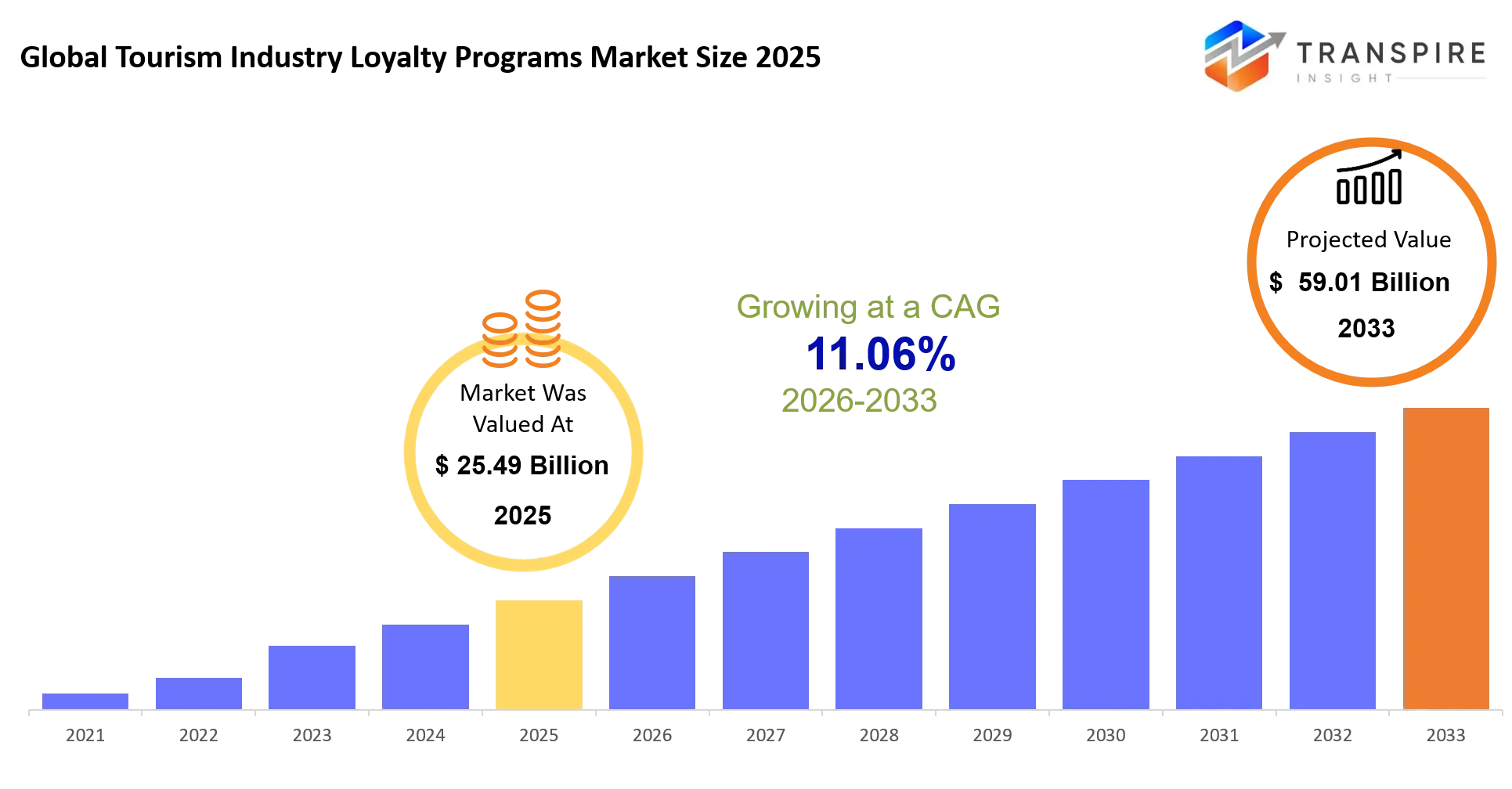
- Global Future of the Tourism Industry Loyalty Programs Market Size 2025: USD 25.49 Billion
- Global Future of the Tourism Industry Loyalty Programs Market Size 2033: USD 59.01 Billion
- Global Future of the Tourism Industry Loyalty Programs Market CAGR: 11.06%
- Global Future of the Tourism Industry Loyalty Programs Market Segments: By Program Type (Points-based, Tier-based, Cashback Programs, Coalition Programs, Subscription Programs, Others); By End User (Hotels, Airlines, Cruise Lines, Travel Agencies, Theme Parks, Others); By Deployment (Cloud, On-premise, Hybrid, Others); By Application (Customer Retention, Rewards, Personalization, Customer Analytics, Others); By Organization Size (Large Enterprises, SMEs, Others)
Global Future of the Tourism Industry Loyalty Programs Market Summary
As per Transpire Insight Analysis, the Tourism Industry Loyalty Programs Market size is estimated at USD 25.49 Billion in 2025 and is anticipated to reach USD 59.01 Billion by 2033, growing at a CAGR of 11.06% from 2026 to 2033. This engagement infrastructure sector provides the specialized reward mechanics, digital membership portals, and data tracking platforms required to issue points, manage elite tiers, and distribute experiential perks across travel networks. Over the past few years - a massive surge in mobile-first travel bookings alongside intense competition for direct reservations has forced brands away from rigid, static reward charts toward flexible, real-time redemption options. This progression triggered a major structural shift as travel providers transitioned to cloud-based predictive engines to deliver automated, individualized room upgrades, flight offers - customized lifestyle rewards. By transforming generic discounts into immediate, personalized traveling experiences, these platforms maximize repeat booking behaviors and prevent customer churn across highly volatile digital travel ecosystems.
Key Market Insights
The global tourism industry loyalty programs landscape - transitioning from generic, delayed points-accumulation tables toward micro-personalized, real-time experiential reward networks. Driven by the critical requirement to secure direct consumer bookings over third-party aggregators and maximize lifetime value, global hospitality and aviation networks are swapping siloed reward databases for integrated, cloud-native engagement ecosystems that deliver immediate gratification.
- Locking down a dominant 42% market share, Points-based Programs lead the program type matrix, with Marriott International expanding its Bonvoy platform to integrate real-time retail and dining point earning mechanics outside traditional hotel stays.
- Expanding at a market-accelerating standalone CAGR of 17.6%, AI-powered Personalization solutions dominate application growth as travel brands transition from static, rule-based marketing to predictive machine learning engines that auto-generate custom trip itineraries.
- Capturing a dominant 36% of total global revenue, North America functions as the largest geographic market, backed by massive co-branded credit card portfolios and high-density corporate travel rewards spend.
- Pacing market growth with a massive regional CAGR of 18.8%, the Asia Pacific theater acts as the fastest-growing territory, fueled by surging middle-class tourism networks and widespread mobile wallet ecosystem integrations across regional transport hubs.
- Holding a stable 29% market slice, Europe drives high tier-based program optimization, pushing cross-border hospitality brands like Accor to launch lifestyle loyalty ecosystems that merge hotel stays with regional sporting and entertainment ticketing benefits.
- Securing 23% of total industry demand, Tier-based Programs remain an essential foundation for corporate traveller retention, with Delta Air Lines upgrading its SkyMiles Medallion structure to prioritize choice benefits, automated seat upgrades, and exclusive lounge access vectors.
- Representing 14% of the program matrix, Cashback Programs face heavy adoption among budget-conscious millennial and Gen Z demographics as digital booking agents optimize instant wallet credits over long-term milestone metrics.
- Accounting for a targeted 9% slice of the market footprint, Subscription Programs expand rapidly across premium travel segments, with InterContinental Hotels Group (IHG) scaling paid membership layers that unlock guaranteed discounts and late checkouts instantly.
- Claiming an integrated 5% market presence, the Middle East & Africa region represents an emerging luxury development zone, where mega-carriers like Emirates deploy bespoke lifestyle partnerships to retain high-net-worth international transit passengers.
- Capturing the remaining 4% slice of global revenue, Latin America is accelerating its loyalty footprint, relying on cross-industry coalition loyalty networks between local airlines and retail banking groups to lower baseline rewards fulfillment costs.
What Are the Key Drivers, Restraints, and Opportunities in the Global Future of the Tourism Industry Loyalty Programs Market?
Driver
The market expansion is heavily propelled by intense customer acquisition costs and rising margin pressures from third-party online travel aggregators - forcing major travel brands to prioritize direct-to-consumer digital channels. Relying on external booking networks drains 15% to 22% of baseline room or flight revenue via third-party commissions, creating massive financial friction for hospitality and airline groups. This commercial challenge triggered a wholesale transition toward robust, cross-brand loyalty ecosystems that incentivize direct bookings through immediate points redemption and exclusive property perks. This industry-wide strategic redirection drives massive platform integration and software subscription revenue as enterprise brands build extensive co-branded credit card networks and lifestyle partnerships to capture recurring travel spend.
Restraint
Severe system fragmentation and complex balance-sheet liabilities associated with unredeemed member points act as a major structural barrier holding back rapid ecosystem scaling. Travel groups must carry the financial value of unused points as deferred revenue liabilities, which can create volatile balance-sheet exposure during macroeconomic dips or fluctuating reward redemption cycles. This operational friction persists because legacy reservation infrastructure and disjointed point-tracking software across separate airline, hotel, and car rental partners lack unified API connectivity, leading to frequent system lag times and delayed partner settlement reconciliation.
Opportunity
The most lucrative growth window lies in the deployment of blockchain-backed coalition loyalty models and immediate, point-to-cash micro-redemption networks optimized for ancillary non-travel spending. Fusing immutable ledger ledgers with open-banking software nodes lets regional travel groups effortlessly unite distinct local transit, dining, and retail providers into a single, real-time loyalty federation. This structural transition unlocks highly profitable, interactive customer engagement channels, allowing tier-one travel operators in emerging travel hubs to lower reward fulfillment costs by letting users instantly redeem miles for everyday micro-purchases.
What Has the Impact of Artificial Intelligence Been on the Global Future of the Tourism Industry Loyalty Programs Market?
Artificial intelligence is completely reinventing the tourism industry loyalty programs market, shifting standard customer retention frameworks away from rigid, manual milestone tiers toward automated, hyper-personalized experiential reward pathways. Instead of requiring digital marketing teams to manually build static email promotion schedules based on general age brackets, travel enterprises deploy advanced machine learning engines to evaluate real-time booking behavior and automatically serve personalized upgrade options.
Inside high-velocity booking environments - built-in AI models drive operational improvements through predictive inventory management and active churn prevention tracking. These algorithms continually evaluate real-time search queries, historical hotel choices, and co-branded credit card transaction frequencies, predicting exactly when an elite member's brand loyalty is beginning to drift toward external competitors. By anticipating these subtle behavioral shifts, the system automatically triggers localized, predictive pricing adjustments or customized, high-value experiential packages—such as private airport lounge passes—to secure direct conversions before the consumer exits the brand's primary application ecosystem.
However - a serious operational limitation persists around complex multi-vendor data integration gaps and upfront computational costs. Training deep learning recommendation algorithms requires continuous access to deeply siloed, multi-tenant database records, creating a steep technical implementation hurdle that can slow down enterprise hardware transitions across older legacy reservation platforms.
In May 2026, online travel marketplace pioneer Expedia Group officially unveiled its advanced AI travel marketplace capabilities at its Explore 2026 conference, rolling out predictive Package Price Insights and automated conversational planning toolkits. This framework integrates machine learning engines directly into its unified One Key loyalty architecture, replacing generic tier structures with automated property comparison matrices that evaluate location, vibe, and historical user reviews simultaneously. By utilizing these real-time data loops to predict pricing drops and auto-generate custom trip recommendations, the deployment enables the platform to significantly increase active user conversion metrics while driving repeat direct booking frequencies.
Key Market Trends
The global tourism industry loyalty programs space - shifting away from isolated, transaction-bound points tables toward unified, cross-industry experiential engagement ecosystems. Driven by a massive demographic influx of digitally native, value-seeking travelers and intense platform competition from third-party aggregators, hospitality and aviation leaders are replacing slow milestone charts with dynamic, mobile-first redemption networks.
- Corporate loyalty managers used to focus exclusively on standard business travel flights and room bookings, but they are now shifting toward everyday non-travel retail and dining integrations to keep members engaged between major trips.
- Airline operations are moving away from traditional mileage-accumulating tables to implement dynamic, revenue-based calculation structures that link elite status qualification directly to real-time cash expenditures.
- Hospitality groups are replacing static, generic discount emails with advanced predictive recommendation feeds that auto-populate personalized room configurations and localized excursion options directly on mobile applications.
- Travel networks are transitioning from complex, slow multi-month tier progression timelines to roll out subscription-based paid loyalty frameworks that unlock priority transit lanes and guaranteed lounge access instantly.
- Cruise line operators are abandoning manual, offline onboard paper coupon booklets to deploy wearable IoT smart bands that track guest activity and seamlessly issue localized digital loyalty perks on the fly.
- Co-branded credit card networks are moving far past standard single-brand redemption structures, focusing instead on flexible, multi-transfer portal configurations that let users shift points instantly into various international alliance programs.
- Theme park marketing squads are shifting from rigid seasonal package promotions to launch immersive, gamified mobile challenges featuring digital badges and real-time food-and-beverage reward credits.
- Corporate procurement boards are stepping away from siloed enterprise travel booking paths to adopt integrated coalition platforms that automatically combine flight, car, and lodging points into a single corporate wallet.
- Digital booking agents are moving away from legacy web portals to deploy cloud-native mobile applications featuring instant cashback modules to lower user friction across millennial and Gen Z demographics.
- Travel agency conglomerates are transitioning from generalized mass communication to embed AI-powered conversational planning tools that cross-reference historical user reviews to instantly bundle custom loyalty rewards.
Global Future of the Tourism Industry Loyalty Programs Market Segmentation
By Program Type
Points-based Programs command the largest share of market capital, holding a dominant 42% of global revenue due to their high consumer familiarity, straightforward value proposition, and massive adoption across co-branded credit card ecosystems. Tier-based Programs follow at 23%, Cashback Programs hold 14%, while Subscription Programs and other custom mechanics account for the remaining 21% of the total industry footprint. This division is shaped by the strategic balance between immediate financial gratification and long-term aspirational travel milestones. Points-based Programs maintain this peak position because multi-brand hospitality conglomerates and global airline alliances leverage point currencies as a lucrative B2B revenue driver, selling bulk points directly to financial institutions for credit card spend incentives. Moving forward, structural designs will pivot toward instant cash-equivalent point values, forcing loyalty software developers to eliminate delayed conversion schedules and integrate real-time point-to-cash micro-redemption networks directly into mobile retail wallets.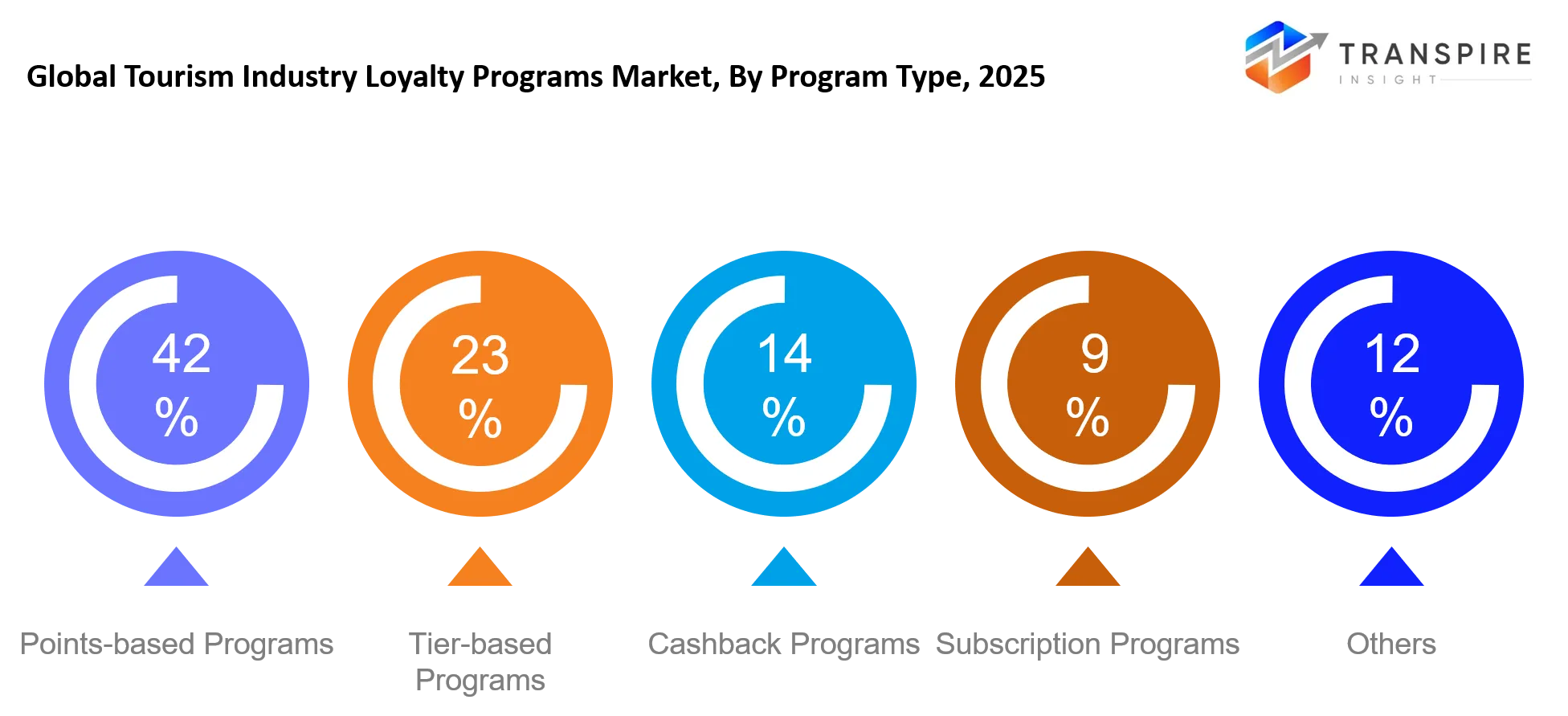
By End User
Hotels serve as the primary financial engine of the market, controlling massive loyalty budgets as they seek to capture high-margin direct bookings and eliminate third-party online travel agency commissions. Airlines follow closely as a dominant secondary force, while Cruise Lines, Travel Agencies, and Theme Parks represent highly active secondary segments. The underlying growth logic relies on transactional frequency and property-level engagement opportunities, where hotels utilize localized stay data to cross-sell ancillary amenities and airlines capitalize on heavy corporate frequent flyer spend. Hotels lead the market position because global hospitality brands manage expansive real estate portfolios that allow for continuous guest engagement across diverse dining, spa, and lodging touchpoints. Moving forward, industry success will require full cross-industry partner integration, compelling hotel developers to supply open API frameworks that seamlessly merge local transportation, retail, and experiential event rewards into a single customer itinerary right out of the box.
By Deployment
Cloud-native platforms maintain a commanding grip on this segment, locking down a dominant portion of total industry revenue, while Hybrid setups follow as the fastest-growing operational standard for large legacy operators. On-premise infrastructure holds a shrinking secondary share, primarily restricted to isolated regional resort groups. This distribution pattern is driven by the intense technical requirement for real-time, global data synchronicity across hundreds of disparate booking touchpoints. Cloud deployment leads because modern travel networks demand instant processing agility, infinite capacity scaling, and cross-border data replication to adjust member perks instantly during active check-in workflows. Moving forward, deployment strategies will focus heavily on serverless architecture, pushing loyalty software providers to deliver low-latency distributed control planes that calculate and push custom promotional offers to a user's mobile app in less than two seconds from point-of-sale interaction.
By Application
Customer Retention functions as the undisputed anchor of this matrix, while Personalization stands out as the fastest-accelerating market driver, expanding at an explosive standalone CAGR of 17.6%. Rewards management and Customer Analytics follow closely as critical data foundations for corporate marketing squads. This division is shaped by the macro transition away from generalized mass marketing toward algorithmic consumer behavior tracking. Customer Retention leads because stabilizing direct return-booking metrics is significantly cheaper than acquiring new travelers through expensive public digital ad auctions. Moving forward, application tech will focus heavily on predictive machine learning models, forcing software developers to build automated software layers that leverage artificial intelligence to actively flag member inactivity or anticipate a user's next destination preference before they begin an external web search.
By Organization Size
Large Enterprises command the largest share of market capital, holding a dominant position in global revenue due to the massive scale of international hotel groups, global airline alliances, and their multi-million-dollar co-branded banking partnerships. Small & Medium Enterprises (SMEs) follow as the fastest-growing segment, driven by localized boutique hotel groups utilizing plug-and-play white-label loyalty software to compete with major chains. This division persists because constructing and maintaining a global, secure, multi-currency rewards framework requires deep engineering infrastructure and massive capital reserves. Large Enterprises maintain their peak position because global hospitality networks must orchestrate cross-border points tracking and elite milestone benefits across multiple global legal jurisdictions. Moving forward, the industry will pivot sharply toward zero-touch software-as-a-service (SaaS) frameworks, enabling mid-market operators to easily deploy complex, tier-based engagement platforms without maintaining an in-house development team.
What Are the Key Use Cases Driving the Global Future of the Tourism Industry Loyalty Programs Market?
The dominant deployment of points-based reward platforms is heavily driven by the execution of direct-to-consumer hotel and airline booking incentives to maximize customer lifetime value. Hospitalities and commercial carriers integrate cloud-native loyalty engines directly into their reservation checkouts, allowing high-frequency business and leisure travelers to seamlessly accumulate point currencies and redeem immediate room upgrades or flight seat adjustments, which systematically bypasses high-commission third-party travel aggregators.
Beyond primary hospitality operations, expanding deployment is visible across cross-brand coalition loyalty configurations and co-branded credit card transaction pipelines. Sourcing networks and retail banks integrate multi-partner API modules to enable real-time point-to-cash conversions, allowing casual travelers to accumulate miles on routine daily groceries and instantly clear vacation balances.
Emerging operational use cases are focusing on AI-driven dynamic personalization and predictive churn prevention right at the digital application layer. Travel technology groups actively deploy machine learning models to analyze real-time search queries and historical vacation patterns - allowing platforms to auto-generate customized experiential itineraries and push tailored reward vouchers before a member drifts to a competitor.
|
Report Metrics |
Details |
|
Market size value in 2025 |
USD 25.49 Billion |
|
Market size value in 2026 |
USD 28.31 Billion |
|
Revenue forecast in 2033 |
USD 59.01 Billion |
|
Growth rate |
CAGR of 11.06% from 2026 to 2033 |
|
Base year |
2025 |
|
Historical data |
2021 - 2024 |
|
Forecast period |
2026 - 2033 |
|
Report coverage |
Revenue forecast, competitive landscape, growth factors, and trends |
|
Regional scope |
United States; Canada; Mexico; United Kingdom; Germany; France; Italy; Spain; Denmark; Sweden; Norway; China; Japan; India; Australia; South Korea; Thailand; Brazil; Argentina; South Africa; Saudi Arabia; United Arab Emirates |
|
Key company profiled |
Marriott International, Hilton, Hyatt, IHG Hotels & Resorts, Wyndham Hotels, Expedia Group, Booking Holdings, Delta Air Lines, Emirates, Lufthansa Group, Amadeus, Sabre, Oracle Hospitality, Salesforce, Accor |
|
Customization scope |
Free report customization (country, regional & segment scope). Avail customized purchase options to meet your exact research needs. |
|
Report Segmentation |
By Program Type (Points-based, Tier-based, Cashback Programs, Coalition Programs, Subscription Programs, Others); By End User (Hotels, Airlines, Cruise Lines, Travel Agencies, Theme Parks, Others); By Deployment (Cloud, On-premise, Hybrid, Others); By Application (Customer Retention, Rewards, Personalization, Customer Analytics, Others); By Organization Size (Large Enterprises, SMEs, Others) |
Which Regions are Driving the Global Future of the Tourism Industry Loyalty Programs Market Growth?
North America maintains a commanding grip on the tourism industry loyalty programs market, capturing a dominant 36% of all worldwide industry revenue. This geographic leadership is heavily driven by a highly mature co-branded credit card ecosystem and significant volumes of premium corporate travel expenditure. The regional ecosystem is structurally supported by major hospitality conglomerates and multi-carrier aviation hubs that embed unified point redemption trackers natively into consumer digital wallets. Consequently, moving away from fragmented, multi-brand rewards systems toward frictionless digital asset accumulation has become the primary operational benchmark for local travel providers.
In June 2026, major carrier Delta Air Lines, in partnership with American Express, officially rolled out comprehensive travel benefit enhancements across its full portfolio of co-branded SkyMiles credit cards. This structural deployment integrates automated ancillary perks—such as complimentary checked bags on domestic flights and recurring monthly statement credits for rideshare applications—directly into core card member accounts without inflating baseline annual fees. By executing these everyday value additions, the partnership actively deepens ecosystem engagement and secures high-velocity consumer spending loops within its primary North American retail and business aviation networks.
Europe serves as a highly stable, predictable secondary pillar for the global market, locking down an essential 29% share of total industry demand. While North American expansion is propelled by heavy transactional credit card volumes, European loyalty adoption is shaped by rigid consumer data privacy frameworks and a strong regional demand for sustainable, carbon-offset travel incentives. This regional market stability is structurally insulated by centralized lifestyle reward models that seamlessly merge hospitality bookings with cultural entertainment, cross-border train networks, and local sporting events. To minimize customer acquisition friction and capture premium multi-destination European transit, continental brands prioritize long-term relational benefits over short-term transaction-heavy points tables.
In January 2026, European hospitality leader Accor officially partnered with global trend forecasting agency Globetrender to unveil its comprehensive experiential travel and points-maximizing strategy for its ALL Accor loyalty program. This structural transformation rolls out an integrated lifestyle ecosystem that connects members to over 7,000 global events annually, transforming traditional transaction-bound point accumulation into highly curated experiential rewards. By utilizing advanced human insight and localized data streams to guide user journeys across 110 countries, this strategic development enables the hospitality group to capture premium traveler segments and build emotional brand attachment.
The Asia Pacific region has emerged as the fastest-growing territory globally, accelerating at a market-leading CAGR of 18.8% to capture a 26% slice of global sales. This sudden structural shift is driven by massive middle-class tourism expansion, aggressive digital transformation campaigns across municipal transport networks, and widespread adoption of super-app mobile wallet systems. Historically, regional leisure travelers relied on separate travel agencies, but a rapid push toward smartphone-optimized booking platforms has forced operators to deliver real-time, cross-industry reward fulfillment. Looking ahead, future development in this booming corridor relies heavily on deploying unified point-to-cash micro-redemption networks that capture local non-travel retail and dining transactions affordably.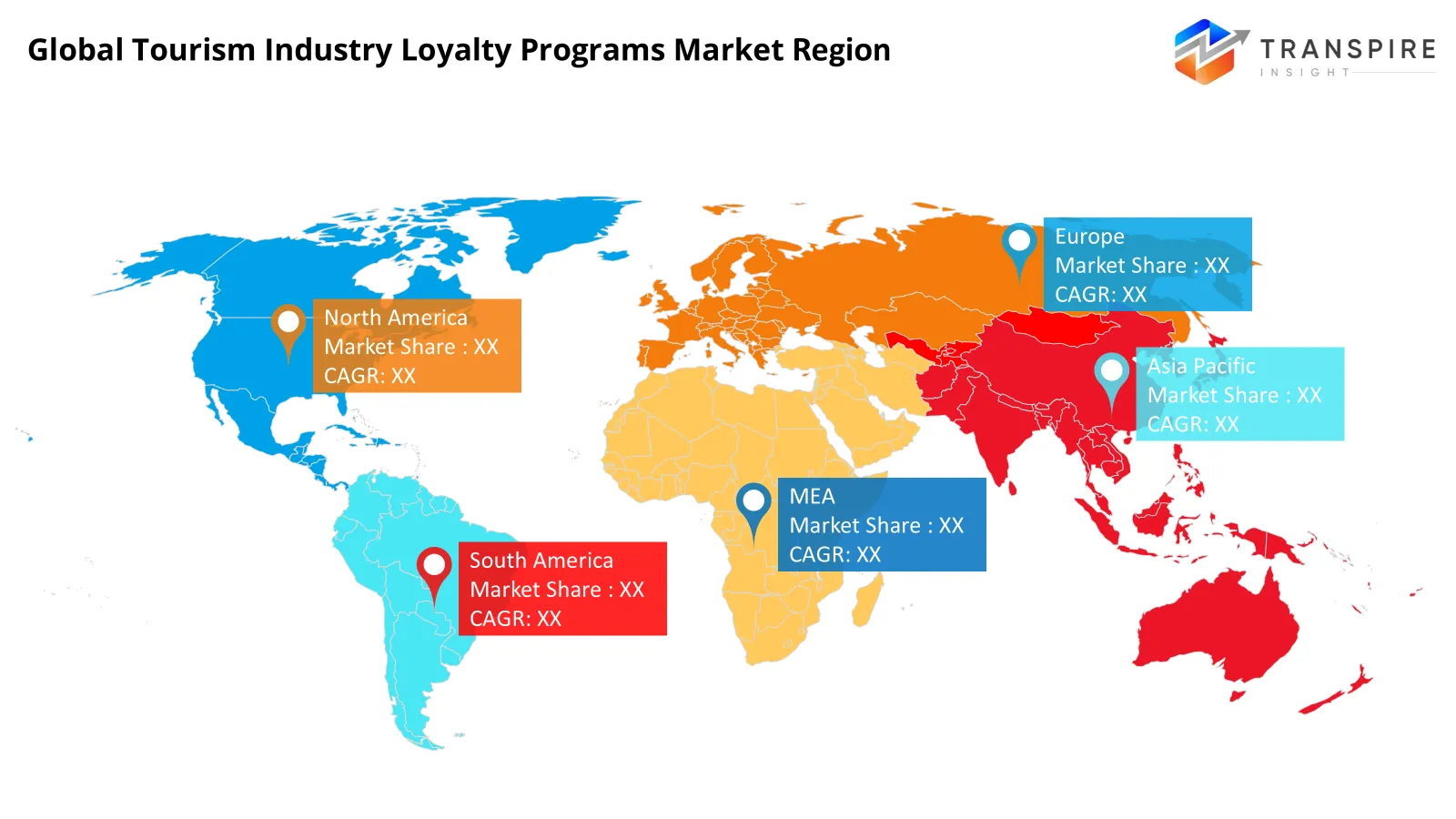
Who Are the Key Players in the Global Future of the Tourism Industry Loyalty Programs Market and How Do They Compete?
The global tourism industry loyalty programs space - an intense battleground between massive multinational hospitality groups, commercial airline conglomerates, and specialized travel technology providers. With consumer preferences shifting rapidly away from slow milestone accumulation to immediate, digitally native rewards, vendors compete on three fronts - embedding real-time AI personalization engines, building high-value cross-industry co-branded financial networks, and delivering zero-friction mobile micro-redemptions.
Marriott International utilizes an innovation-focused strategy, positioning its multi-tier Marriott Bonvoy framework around premium experiential rewards and global lifestyle ecosystem integrations. What makes them stand out is their extensive B2B financial synergy, allowing them to monetize their loyalty currency by selling points in bulk directly to major credit card providers for premium consumer spend incentives. The company expands its global market footprint by launching hyper-localized, cross-brand entertainment partnerships across international entertainment sectors to capture non-travel spending.
Expedia Group runs a highly optimized platform-niche strategy focused squarely on the high-velocity online travel agency market and multi-brand consumer segments. The vendor differentiates its market presence by deploying its consolidated One Key program, which unlocks flexible - immediate cash-equivalent reward credits that users can seamlessly mix and match across separate flights, vacation rentals, and car rentals. They expand their industrial footprint by integrating white-label software-as-a-service (SaaS) loyalty architectures directly into regional mid-market travel operators and independent hospitality networks.
Company List
- Marriott International
- Hilton
- Hyatt
- IHG Hotels & Resorts
- Wyndham Hotels
- Expedia Group
- Booking Holdings
- Delta Air Lines
- Emirates
- Lufthansa Group
- Amadeus
- Sabre
- Oracle Hospitality
- Salesforce
- Accor
Recent Development News
In December 2025, hospitality titan Hilton officially finalized an exclusive, long-term luxury ocean travel partnership with Explora Journeys to debut its "Hilton Honors Adventures" program extension. This strategic alignment embeds premium cruise bookings natively within Hilton's central loyalty architecture, allowing its more than - 250 million global members to seamlessly earn and redeem reward points across luxury cruise voyages from the Mediterranean to the Caribbean starting in summer 2026. [https://stories.hilton.com
In February 2026, Hyatt Hotels Corporation officially announced a major structural expansion to its World of Hyatt loyalty award chart, shifting its baseline redemption model from three tiers to five fixed-point levels. This operational update replaces its old peak-and-valley metrics with Lowest, Low, Moderate, Upper, and Top reward categorization brackets across its 63 million active members, enabling the group to execute precise regional pricing strategies without replacing its foundational fixed-threshold guarantee. [https://www.businesstravelnews.com
In March 2026, travel technology innovator Expedia Group launched its upgraded Rapid API platform extension specifically engineered for global Travel Management Companies (TMCs). This software release integrates advanced B2B automation tools and first-party customer analytics directly into corporate reservation flows, helping large-scale travel distributors close the execution gap between rising employee personalization demands and legacy corporate travel loyalty programs. [https://ir.expediagroup.com
What Strategic Insights Define the Global Future of the Tourism Industry Loyalty Programs Market?
The tourism industry loyalty programs market is heading toward full decentralized cross-brand asset liquidity, where fixed loyalty points transform into highly fungible, real-time digital currencies capable of instant multi-sector micro-redemption.
A significant hidden risk lies in "unredeemed balance-sheet toxicity." As brands aggressively distribute point rewards to capture casual consumers, the accumulated volume of unredeemed miles creates a massive deferred revenue liability that can trigger sudden corporate credit-rating downgrades or crippling financial restatements if redemption velocity surges during economic contractions.
Conversely, a major emerging opportunity is the monetization of anonymized first-party zero-party data via localized retail advertising networks, enabling travel groups to sell predictive booking behaviors directly to luxury consumer goods conglomerates.
Strategic recommendation: Travel networks must transition away from closed, delayed point structures and implement open-API, cloud-native engagement platforms that continuously liquidate point balances through daily non-travel micro-purchases to minimize financial liability and anchor daily user engagement.
By Program Type
- Points-based
- Tier-based
- Cashback Programs
- Coalition Programs
- Subscription Programs
- Others
By End User
- Hotels
- Airlines
- Cruise Lines
- Travel Agencies
- Theme Parks
- Others
By Deployment
- Cloud
- On-premise
- Hybrid
- Others
By Application
- Customer Retention
- Rewards
- Personalization
- Customer Analytics
- Others
By Organization Size
- Large Enterprises
- SMEs
- Others
Regional Outlook
North America
- United States
- Canada
- Mexico
Europe
- Germany
- United Kingdom
- France
- Spain
- Italy
- Rest of Europe
Asia Pacific
- Japan
- China
- Australia & New Zealand
- South Korea
- India
- Rest of Asia Pacific
South America
- Brazil
- Argentina
- Rest of South America
Middle East & Africa
- Saudi Arabia
- United Arab Emirates
- South Africa
- Rest of the Middle East & Africa
Frequently Asked Questions
Find quick answers to common questions.
The Global Future of the Tourism Industry Loyalty Programs Market size was valued at USD 25.49 Billion in 2025 and is poised to reach USD 59.01 Billion by 2033, expanding at an 11.06% CAGR.
Key segments for the Global Future of the Tourism Industry Loyalty Programs Market are By Program Type (Points-based, Tier-based, Cashback Programs, Coalition Programs, Subscription Programs, Others); By End User (Hotels, Airlines, Cruise Lines, Travel Agencies, Theme Parks, Others); By Deployment (Cloud, On-premise, Hybrid, Others); By Application (Customer Retention, Rewards, Personalization, Customer Analytics, Others); By Organization Size (Large Enterprises, SMEs, Others).
Growth is primarily driven by intense customer acquisition costs and rising margin pressures from third-party online travel aggregators, forcing major travel brands to prioritize direct-to-consumer digital channels and reward ecosystems that incentivize repeat direct bookings.
The global market is led by major manufacturers including Marriott International, Hilton, Hyatt, IHG Hotels & Resorts, Wyndham Hotels, Expedia Group, Booking Holdings, Delta Air Lines, Emirates, Lufthansa Group, Amadeus, Sabre, Oracle Hospitality, Salesforce, and Accor.
North America holds a dominant 36% share of total worldwide market revenue. This massive footprint influences global dynamics because its highly mature co-branded credit card ecosystem and significant volumes of premium corporate travel expenditure establish the primary operational benchmarks and technical integration standards for automated digital rewards worldwide.
Lucrative opportunities exist in the deployment of blockchain-backed coalition loyalty models and immediate, point-to-cash micro-redemption networks optimized for ancillary non-travel spending. This transition allows travel operators to lower reward fulfillment costs by letting users instantly redeem miles for everyday local purchases like groceries and dining.
- Marriott International
- Hilton
- Hyatt
- IHG Hotels & Resorts
- Wyndham Hotels
- Expedia Group
- Booking Holdings
- Delta Air Lines
- Emirates
- Lufthansa Group
- Amadeus
- Sabre
- Oracle Hospitality
- Salesforce
- Accor
About the Authors

Mayur Shinde
I am Mayur Shinde, a Senior Research Analyst at Transpire Insight, specializing in the Automotive & Transportation and Information & Communication Technology (ICT) Industry. My work focuses on analyzing emerging market trends, technological advancements, competitive landscapes, and industry developments to deliver accurate, data-driven insights. I am passionate about transforming complex market information into clear, actionable content that helps businesses, professionals, and decision-makers stay informed and make confident strategic decisions.

Chakradhar Khansole
Chakradhar serves as the Research Director at Transpire Insight, bringing over 8 years of experience in technology, innovation, and strategic market intelligence. He specializes in transforming complex market data into actionable business insights that enable organizations to make informed, growth-oriented decisions. Recognized for his strategic vision and analytical expertise, Chakradhar leads high-impact research initiatives, delivering comprehensive market assessments, competitive intelligence, and forward-looking industry analysis.
Recently Published Reports
-
Apr 2026
3D Optical Profiler Market
3D Optical Profiler Market Size, Share & Analysis Report By Type (Desktop 3D Optical Profiler, and Portable 3D Optical Profiler), By Technology (Confocal Technology, and White Light Interference), By End-Use Industry (Manufacturing, Research Institutions, Automotive, Aerospace and Defense, Medical Devices, and Other), and Geography (North America, Europe, Asia-Pacific, Middle East and Africa, South and Central America), 2021 - 2031
-
Apr 2026
Depth Sensor Market
Depth Sensor Market Size, Share & Analysis Report By Type (Infrared Depth Sensors, Time-of-Flight (ToF) Sensors, Stereo Vision Sensors, Structured Light Sensors, Ultrasonic Depth Sensors), By Application (Automotive, Robotics, Gaming, Consumer Electronics, Industrial Automation, Healthcare, Security & Surveillance, Others), By End Users (Automotive Manufacturers, Consumer Electronics Companies, Healthcare Providers, Industrial Companies, Security Agencies, Gaming Companies, Robotics Companies, Others), and Geography (North America, Europe, Asia-Pacific, Middle East and Africa, South and Central America), 2021 – 2031
-
Apr 2026
Digital Manufacturing Market
Digital Manufacturing Market Size, Share & Analysis Report By Component (Hardware, Software, and Services), By Technology (Robotics, 3D Printing, Internet of Things (IoT), and Others), By Application (Automotive and Transportation, Aerospace and Defense, Consumer Electronics, Industrial Machinery, and Others), By Process Type (Computer-Based Designing, Computer-Based Simulation, Computer 3D Visualization, Analytics, and Others), and Geography (North America, Europe, Asia-Pacific, Middle East and Africa, South and Central America), 2021 – 2031
-
Apr 2026
Digital Visa Services Market
Digital Visa Services Market Size, Share & Analysis Report By Type (Individual Travelers, Group Travelers), By Application (Tourism, Business Travel, Others), and Geography (North America, Europe, Asia-Pacific, Middle East and Africa, South and Central America), 2021 – 2031