

Global Steam Trap Market Size & Forecast:
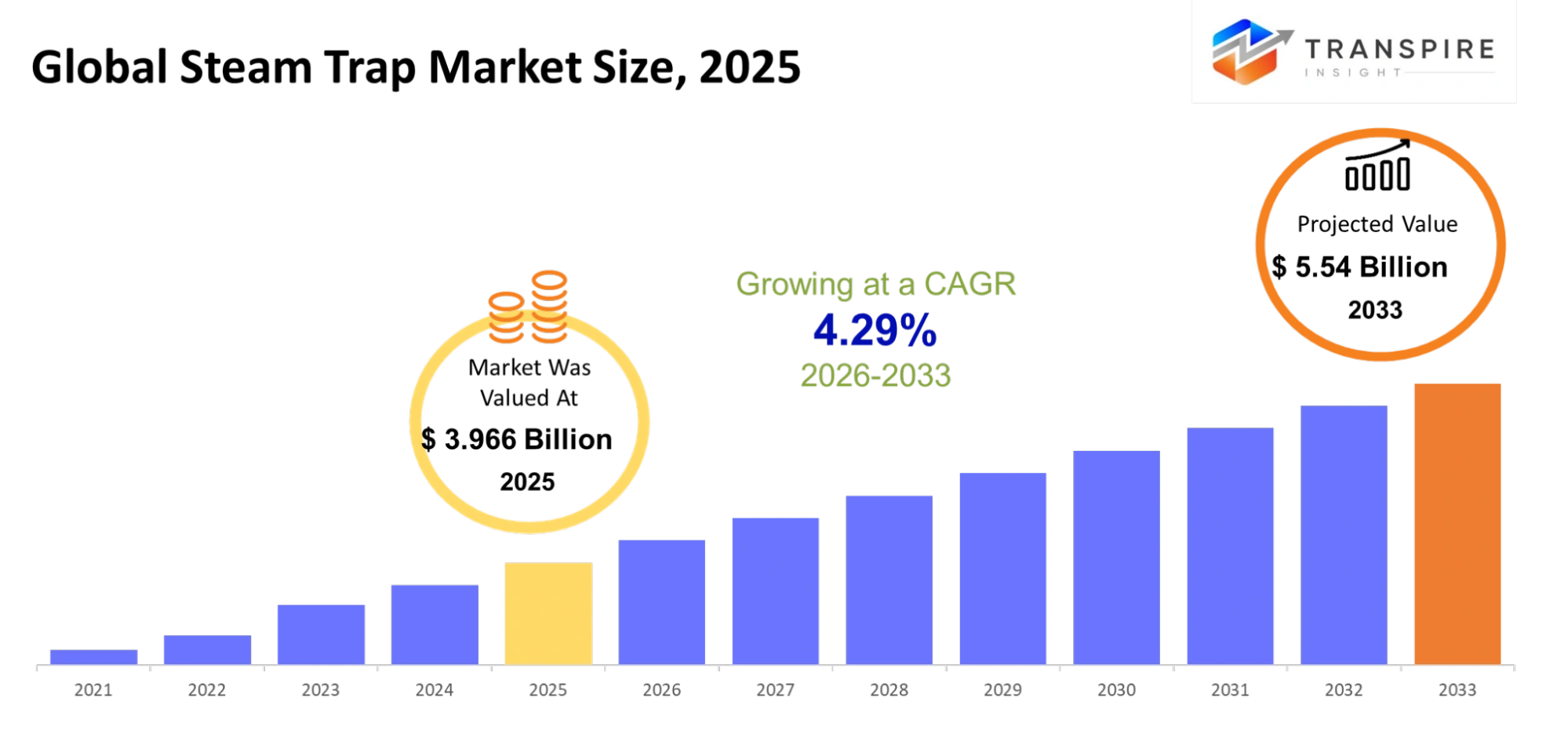
Steam Trap Market Size 2025: USD 3.966 Billion
Steam Trap Market Size 2033: USD 5.54 Billion
Steam Trap Market CAGR: 4.29%
Steam Trap Market Segments: By Product Type (Thermodynamic Steam Traps, Mechanical Steam Traps, Thermostatic Steam Traps), By Application (Steam Distribution, Steam Tracing, Process Applications), By End-User Industry (Oil & Gas, Power Generation, Chemicals, Food & Beverage, Pharmaceuticals).
To learn more about this report,  Download Free Sample Report
Global Steam Trap Market Summary:
The Global Steam Trap Market was valued at USD 3.966 billion in 2025 and is forecast to reach USD 5.54 billion by 2033, at a CAGR of 4.29% from 2026 to 2033. Steam traps are automatic valves that discharge condensate and non-condensable gases from steam systems without letting live steam escape. Every steam distribution network, heat exchange system, and steam-traced pipeline depends on them working correctly. A failed-open trap bleeds live steam into the condensate return system, wasting energy and loading downstream equipment. A failed-closed trap allows condensate to build up in the line, creating water hammer risk and reducing heat transfer efficiency. Neither failure mode is acceptable in a continuously operating industrial plant.
The disc-and-seat mechanism is affected by differences in the rate of liquid flow between flash steam and condensate at the trap inlet, cycling all the way open whenever there's an accumulation of subcooled condensate and shutting off when steam pressure keeps the disc against the seat. They are really not one of the most energy-efficient trap types, even if sized correctly - their very broad tolerance for varying operating conditions and their extremely low maintenance costs make them pretty much the default choice in distribution systems when regular maintenance access is often a major problem.
Mechanical traps - which include float-and-thermostatic and inverted bucket types - are commonly used whenever continuous condensate discharge is necessary without the periodic cycling produced by thermodynamic traps. Process heat exchangers and reboilers quite often need mechanical traps, because their carefully managed discharge really helps prevent condensate backing up, which would otherwise decrease the heat transfer area. This also leads to greater instability in the control of temperature during the process itself. Thermostatic traps rely on the temperature difference between steam and subcooled condensate, and they're quite standard in steam tracing applications and sometimes even in radiator heating systems where smaller, low-pressure service is typical.
Replacement demand really drives this market. Steam traps all have limited lifespans. Within a very large refinery or chemical plant - with hundreds of thousands of traps installed - a certain number of them will stop working every year, and a proper trap management system will locate and replace them on a predetermined schedule. That replacement cycle really operates independently from changes in capital investment trends, giving the Steam Trap Market a lot more stability than markets really driven mainly by building brand-new facilities.
Key Market Trends & Insights:
- Replacement demand from existing industrial steam systems - more so than constructing new facilities - really provides the most consistent quantities in the market and shields it somewhat from those cyclical fluctuations in capital spending.
- Steam trap monitoring systems, ranging from simple ultrasonic testers to ongoing on-line detection with wireless data communication, are gaining wider acceptance as plant owners attempt to lower the energy losses caused by unseen trap failures within their very large existing installations.
- Oil and gas, power generation, and chemicals constitute the majority of end-user demand, and all three industries operate quite large steam systems whereby trap population management is indeed a documented maintenance expense.
- Increased pressure for energy efficiency - both by lowering operating costs and through regulatory means - is leading to more frequent trap survey programmes, thus generating replacement volumes even when plant operation itself remains quite stable.
Global Steam Trap Market Segmentation
By Product Type
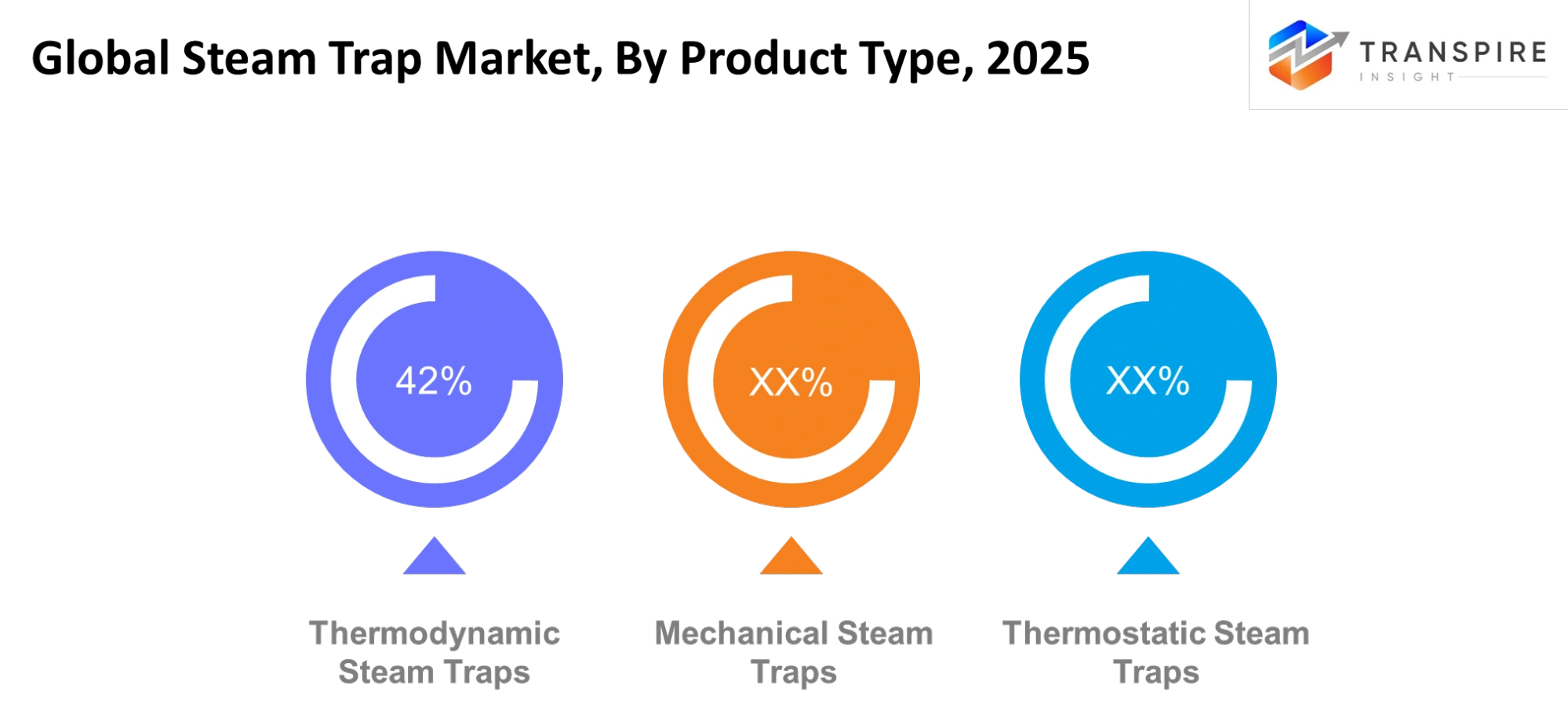
Thermodynamic Steam Traps: Thermodynamic steam traps represent the biggest product group in the Steam Trap Market - about 42% of the revenue. They operate by applying the thermodynamic principle that flash steam and live steam have a higher velocity and lower density than subcooled condensate at the same pressure. When condensate enters the trap body, the lower fluid velocity enables the disc to lift off its seat and the condensate discharges. When flash steam or live steam reaches the inlet, the higher-velocity fluid creates a low-pressure zone beneath the disc, which holds it closed against the seat. The cycle repeats as pressure equalizes and condensate accumulates once more. Thermodynamic traps are quite compact - with very few moving parts - making them much less likely to experience mechanical failure than float or bucket mechanisms in high-pressure service. They are frequently installed on steam mains, drip legs, and tracer lines wherever the installation density is very high - and the intermittent discharge pattern they generate is acceptable.
Mechanical Steam Traps: Mechanical steam traps rely on a float or bucket mechanism to respond to the physical presence of condensate instead of its temperature or thermodynamic characteristics. Float-and-thermostatic traps use a buoyant float to open the discharge valve relative to condensate level, giving a continuous, modulating discharge that really keeps heat exchange surfaces free of condensate backup. Inverted bucket traps have a bucket that sinks when condensate fills the trap body - opening the discharge valve - and rises when steam enters - closing it. Mechanical traps are usually specified for process heat exchangers, reboilers, and dryers - wherever a continuous, controlled condensate removal is necessary to keep the heat transfer stable. They are a bit more mechanically complex than thermodynamic traps - requiring a lot more careful selection for the exact pressure and load conditions they will encounter - yet they outperform thermodynamic types on applications where condensate backup would have some very serious effects on the process quality or throughput itself.
Thermostatic Steam Traps: Thermostatic steam traps will open when the condensate temperature drops below the saturation temperature at the existing pressure - and they'll close as steam approaches. The sensing element is usually a bimetallic strip or a liquid-filled bellows capsule that expands slightly as temperature increases towards the steam saturation temperature - closing the valve seat itself. Thermostatic traps are most commonly seen in steam tracing, radiator heating, and low-pressure process services - where quite small amounts of condensate and rather tight spaces really suit their very compact design. Their main weakness is that they hold onto subcooled condensate in the system right up until it's cooled enough to initiate opening - meaning they're not very well-suited for process applications needing very rapid condensate removal. Balanced-pressure thermostatic traps - using a fluid that vaporises very close to the steam saturation temperature - are a more sensitive type used in even better quality steam tracing installations.
To learn more about this report, Download Free Sample Report
By Application
Steam Distribution: Steam distribution is by far the biggest application in the Steam Trap Market. Each and every steam main and distribution header really needs drip legs fitted with steam traps to take out condensate that forms since steam loses heat to the pipe walls. Without functioning traps at drip points, condensate accumulates in the line, decreases steam quality at the point of use, causes water hammer when slugs of condensate are pushed by steam pressure through bends and fittings - and even damages pipe internals and downstream equipment. Large industrial plants often have hundreds or even thousands of trap stations on their steam distribution system, and the replacement cycle for these traps creates a very consistent, recurring demand. Thermodynamic traps are usually the first choice for most steam distribution drip points since their pressure range and mechanical simplicity match the application perfectly.
Steam Tracing: Steam tracing employs very thin-bore steam lines, commonly half-inch or three-quarter-inch, run right alongside process pipework so as to keep the temperature of viscous, solidifying, or freeze-sensitive liquids. Each tracer circuit ends at a steam trap station that takes out condensate and lets the tracer continue flowing through the steam. Tracing systems might have many individual trap stations, each handling a quite small condensate load, and the traps used are usually thermostatic types sized for low flow at the tracer operating pressure. Tracing applications are super common in oil refining, chemicals, and liquefied gas facilities - wherever product lines need to be held above a minimum temperature all the time. Failed traps on tracing circuits can lead to product solidification in the traced line - an extremely costly and sometimes hazardous maintenance problem indeed.
Process Applications: Process applications include steam-heated heat exchangers, reboilers, reactors with steam jackets, dryers, autoclaves, and quite a few other items of equipment whereby steam gives off heat as an integral part of a manufacturing procedure instead of just maintaining temperature in a distribution system. These applications usually demand ongoing, carefully managed condensate removal - they are much more sensitive to trap efficiency than distribution or tracing services are. A failed-closed trap on a process exchanger will deplete the heating surface of steam - and thus reduce heat transfer. A failed-open trap, meanwhile, will flood the condensate return line - and this could lead to problems with steam quality further up the line. Mechanical traps, particularly float-and-thermostatic types, are specified all the time here even more so than they would be for distribution applications. Getting the right size trap for the maximum and minimum condensate loads the process will generate is way more critical here than it is in distribution services.
By End-User Industry
Oil & Gas: Oil and gas remain the largest end-user industries in the Steam Trap Market. Refineries, gas processing plants, and petrochemical facilities utilise very large steam systems for process heating, reboilers, vacuum ejectors, steam turbine drives, and product heating and tracing. A big refinery could have many thousands of steam trap stations - and the cost of unnoticing trap failures, in wasted steam and energy, is quite enough that major operators run very structured trap survey and replacement programs on set cycles. The oil and gas end-user segment is also the one most exposed to the long-term transition away from fossil fuel processing - even so, near-term demand from existing facilities and their continuous maintenance needs keeps the segment's position steady over the forecast period.
Power Generation: Steam traps are widely used in power generation facilities, both fossil fuel and nuclear, for feedwater heating, turbine warming, drip leg service on steam distribution headers, and heat tracing of auxiliary piping. Turbine drain traps need really reliable operation under very variable pressure conditions because turbine load changes, and failures here have operational risk beyond simple energy loss. Combined heat and power plants and industrial cogeneration facilities also add to this end-user segment. Power generation demand is quite stable and driven by the maintenance requirements of a very large installed fleet of plants - lots of which have extended their operational lifetimes much beyond the original design assumptions - making the replacement of components really important.
Chemicals: Chemicals use steam for heating reactors, reboilers in distillations, evaporators, dryers, and also for heating various process fluids over a wide variety of manufacturing processes. Chemical plants usually require quite an exacting set of processes - making trap selection and sizing much more important than in distribution services: a poorly functioning trap on a distillation reboiler could affect product quality and the stability of the column itself. Trap populations in chemical facilities are extensive and quite varied, covering numerous pressure levels and types of condensates, which demands a much wider range of trap types than even a rather complex distribution system might need. The chemicals area creates both new plant installation demand and ongoing replacement quantity from existing facilities all the time.
Food & Beverage: Food and beverage manufacturers use steam for cooking, pasteurizing, sterilizing, drying, and also for 'cleaning in place'. Steam quality needs in this sector are much tighter than in many other industrial applications since the steam touches or gets extremely close to our food products, and contamination of condensate is actually a major issue in food safety. Trap selection in food and beverage facilities really takes into account hygienic design requirements - including smooth internal surfaces, a drainage-friendly shape, and material compatibility with the various cleaning agents used. Stainless steel body construction and sanitary end fittings are usually necessary in any direct-contact or very close-proximity steam applications. This segment is slightly smaller than oil and gas or power generation when it comes to the total number of traps installed, but carries incredibly high standards per unit product specifications altogether.
Pharmaceuticals: Pharmaceutical manufacturers use steam for sterilization of equipment and product, clean steam generation, and process heating in active pharmaceutical ingredient production. Steam quality in pharmaceutical applications is governed by regulatory standards, and the trap components in contact with clean or pure steam systems must meet material purity and surface finish specifications that go beyond what industrial applications require. Trap failure in a pharmaceutical steam system can compromise sterilization efficacy, which has direct regulatory and product quality implications. The pharmaceutical end-user segment is the most specification-driven in the Steam Trap Market, which tends to concentrate purchasing toward a smaller number of suppliers who have qualified their products for pharmaceutical service.
Country Insights
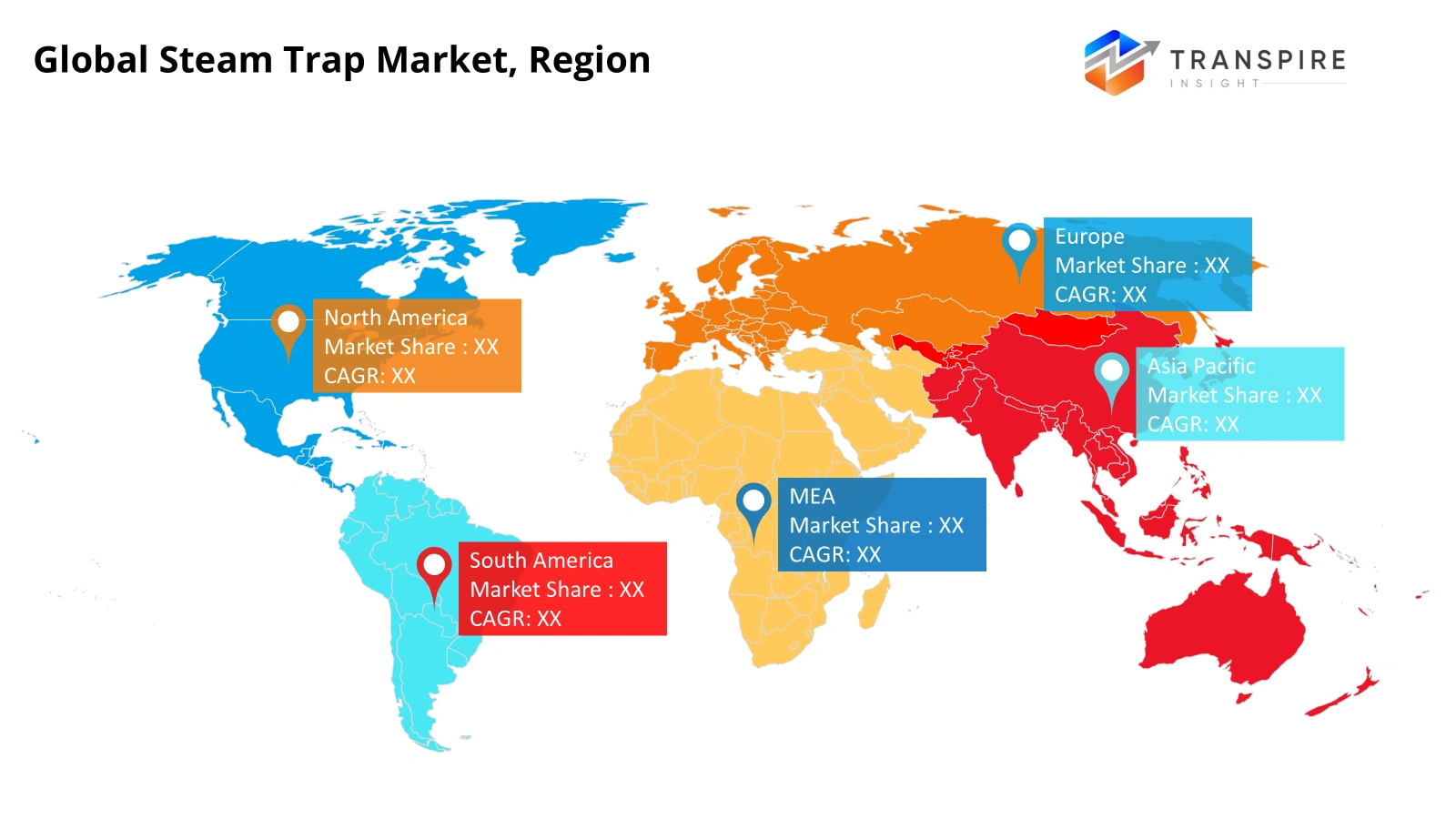
The United States is the largest national market in the Steam Trap Market, reflecting the scale of its refining, chemical, and power generation industries and their large installed steam infrastructure. US industrial plants typically run structured trap management programs, and federal and state energy efficiency programs have historically supported investment in steam system audits and trap replacement. Major steam trap manufacturers have strong distribution and service networks in the US, and domestic industrial MRO distributors carry trap inventory across all major product types.
Europe is a significant market, with Germany, the UK, France, and the Netherlands contributing the most activity through their chemical, refining, and power generation sectors. Energy prices in Europe have provided a sharper economic incentive for steam trap survey and replacement programs than in some other regions, since the cost of live steam loss through failed-open traps is directly proportional to fuel cost. European pharmaceutical and food and beverage manufacturing also generates demand for higher-specification trap products.
Asia-Pacific is the fastest-growing region. China's refining capacity expansion, chemical industry growth, and power generation infrastructure have created demand for large volumes of steam traps in new plant construction and in the maintenance of recently commissioned facilities. India's refining and chemical sectors are also growing and investing in steam system infrastructure. Japan has a long-established industrial steam system culture and hosts several of the leading trap manufacturers, including TLV and Yoshitake, whose products are specified globally in demanding applications.
The Middle East, particularly Saudi Arabia and the UAE, has large petrochemical and refining complexes with substantial steam trap populations. These facilities operate continuously and run scheduled trap survey programs as part of their maintenance regimes. South Korea and Southeast Asia contribute additional demand through their refining and petrochemical industries.
To learn more about this report, Download Free Sample Report
Recent Development News
Several manufacturers in the Steam Trap Market have developed wireless acoustic monitoring systems that attach to trap bodies and transmit continuous performance data to plant maintenance systems. These systems detect the acoustic signature of steam blowthrough, indicating a failed-open trap, and discriminate it from the normal cycling noise of a functioning thermodynamic trap. The practical value is that large trap populations, previously checked manually on annual or biannual survey cycles, can be monitored continuously and failures flagged for targeted replacement rather than waiting for the next scheduled survey.
There has also been product development in stainless steel and duplex alloy trap bodies for corrosive service and pharmaceutical applications, where the previous standard of carbon steel with internal lining has proven inadequate for specific process chemistries. Some manufacturers have standardized sanitary-connection trap assemblies that reduce installation and cleaning time in food and beverage hygienic piping systems.
Report Metrics
|
Report Metrics |
Details |
|
Market size value in 2025 |
USD 3.966 Billion |
|
Market size value in 2026 |
USD 4.129 Billion |
|
Revenue forecast in 2033 |
USD 5.54 Billion |
|
Growth rate |
CAGR of 4.29% from 2026 to 2033 |
|
Base year |
2025 |
|
Historical data |
2021 - 2024 |
|
Forecast period |
2026 - 2033 |
|
Report coverage |
Revenue forecast, competitive landscape, growth factors, and trends |
|
Country scope |
Global |
|
Key company profiled |
Spirax-Sarco Engineering plc, Emerson Electric Co., Armstrong International Inc., TLV Co. Ltd., Forbes Marshall Pvt. Ltd., Thermax Limited, Watson McDaniel Company, Yoshitake Inc., CIRCOR International Inc., Velan Inc., Schlumberger Limited, Pentair plc, Flowserve Corporation, Danfoss A/S, MIYAWAKI Inc. |
|
Customization scope |
Free report customization (country, regional & segment scope). Avail customized purchase options to meet your exact research needs. |
|
Report Segmentation |
By Product Type (Thermodynamic Steam Traps, Mechanical Steam Traps, Thermostatic Steam Traps), By Application (Steam Distribution, Steam Tracing, Process Applications), By End-User Industry (Oil & Gas, Power Generation, Chemicals, Food & Beverage, Pharmaceuticals). |
Key Global Steam Trap Company Insights
The Steam Trap Market is led by a group of specialized flow control and steam system companies alongside broader industrial valve and instrumentation manufacturers. Spirax-Sarco Engineering is the largest dedicated steam systems company in the market, with a global service network and a product portfolio that extends from traps and control valves to condensate recovery equipment and steam system monitoring. Armstrong International and TLV have similarly deep steam system specialization and maintain strong positions in North America and Asia respectively. These companies compete not just on trap product specifications but on the technical service, application engineering, and trap management programs they offer to large industrial customers.
Broader industrial companies including Emerson, Flowserve, Pentair, and CIRCOR compete in steam traps as part of wider valve and flow control portfolios. Their competitive position tends to be strongest where procurement is consolidated across product categories and where existing relationships with plant engineering and purchasing teams give them access to trap replacement contracts alongside larger instrumentation and control work. Japanese manufacturers TLV, Yoshitake, and MIYAWAKI have strong positions in high-specification applications and export markets, with products known for tight tolerance manufacturing and long service intervals.
Company List
- Spirax-Sarco Engineering plc
- Emerson Electric Co.
- Armstrong International Inc.
- TLV Co. Ltd.
- Forbes Marshall Pvt. Ltd.
- Thermax Limited
- Watson McDaniel Company
- Yoshitake Inc.
- CIRCOR International Inc.
- Velan Inc.
- Schlumberger Limited
- Pentair plc
- Flowserve Corporation
- Danfoss A/S
- MIYAWAKI Inc.
Steam Trap Market Report Segmentation
By Product Type
- Thermodynamic Steam Traps
- Mechanical Steam Traps
- Thermostatic Steam Traps
By Application
- Steam Distribution
- Steam Tracing
- Process Applications
By End-User Industry
- Oil & Gas
- Power Generation
- Chemicals
- Food & Beverage
- Pharmaceuticals
Frequently Asked Questions
Find quick answers to common questions.
The Global Steam Trap Market is expected to reach approximately USD 5.54 billion by 2033.
Key segments include Product Type (Thermodynamic Steam Traps, Mechanical Steam Traps, Thermostatic Steam Traps), Application (Steam Distribution, Steam Tracing, Process Applications), and End-User Industry (Oil & Gas, Power Generation, Chemicals, Food & Beverage, Pharmaceuticals).
Major players include Spirax-Sarco Engineering plc, Emerson Electric Co., Armstrong International Inc., TLV Co. Ltd., Forbes Marshall Pvt. Ltd., Thermax Limited, Watson McDaniel Company, Yoshitake Inc., CIRCOR International Inc., Velan Inc., Schlumberger Limited, Pentair plc, Flowserve Corporation, Danfoss A/S, and MIYAWAKI Inc.
The Global Steam Trap Market size is approximately USD 3.966 billion in 2025.
The Global Steam Trap Market is expected to grow at a CAGR of 4.29% from 2026 to 2033.
- Spirax-Sarco Engineering plc
- Emerson Electric Co.
- Armstrong International Inc.
- TLV Co. Ltd.
- Forbes Marshall Pvt. Ltd.
- Thermax Limited
- Watson McDaniel Company
- Yoshitake Inc.
- CIRCOR International Inc.
- Velan Inc.
- Schlumberger Limited
- Pentair plc
- Flowserve Corporation
- Danfoss A/S
- MIYAWAKI Inc.
Recently Published Reports
-
Apr 2026
Fiber Optic Faceplates Market
Fiber Optic Faceplates Market Size, Share & Analysis Report By Type (< 300 mm2, 300-350 mm2, and > 350 mm2, By Application (Night Vision, Holographic Imaging, Medical, and Others), and Geography (North America, Europe, Asia-Pacific, Middle East and Africa, South and Central America), 2021 - 2031
-
Apr 2026
High Temperature Superconductors Market
High Temperature Superconductors Market Size, Share & Analysis Report By Type (1G HTS, and 2G HTS), By Application (Power Cable, Fault Current Limiter, and Transformer), and Geography (North America, Europe, Asia-Pacific, Middle East and Africa, South and Central America), 2021 - 2031
-
Apr 2026
Industrial Plugs and Socket Market
Industrial Plugs and Socket Market Size, Share & Analysis Report By Type (Industrial Plugs, Industrial Sockets), By Current (Up to 32 A, 32 to 125 A, Above 125 A), By Protection (Dustproof and Splash Proof, Waterproof, Explosion Proof), By End User (Heavy Industries, Oil and Gas, Chemicals and Pharmaceuticals, Power Generation, Others), and Geography (North America, Europe, Asia-Pacific, Middle East and Africa, South and Central America), 2021 - 2031
-
Apr 2026
InGaAs Avalanche Photodiodes Market
InGaAs Avalanche Photodiodes Market Size, Share & Analysis Report By Type (1100 - 1700 nm, and 1000 - 1600 nm), By Application (Missile Warning System, Muzzle Flash Detection, Wafer Defect Inspection, Laser Rangefinders, and Others), and Geography (North America, Europe, Asia-Pacific, Middle East and Africa, South and Central America), 2021 - 2031