
Global Splicing Tape Market Size & Forecast:
- Global Splicing Tape Market Size 2025: USD 1.86 Billion
- Global Splicing Tape Market Size 2033: USD 2.84 Billion
- Global Splicing Tape Market CAGR: 5.36%
- Global Splicing Tape Market Segments: By Material (Polyester, Polyimide, Paper, PVC, Acrylic, Silicone, Aluminum Foil, Others); By Adhesive (Rubber, Acrylic, Silicone, Others); By End User (Packaging, Electronics, Printing, Automotive, Paper & Pulp, Others); By Application (Film Splicing, Paper Splicing, Core Starting, Reel Changing, Others); By Thickness (Below 100µm, 100-200µm, Above 200µm, Others)

Global Splicing Tape Market Summary
The Global Splicing Tape Market size is estimated at USD 1.86 Billion in 2025 and is anticipated to reach USD 2.84 Billion by 2033, growing at a CAGR of 5.36% from 2026 to 2033. This specialized materials industry manufactures high-tack - temperature-resistant adhesive tapes engineered to join raw rolls of paper, film, or foil into continuous webs during high-speed production runs. Over the last few years, the dramatic expansion of e-commerce packaging demands and ultra-fast digital printing lines forced factories to run processing equipment at maximum velocity. This operational acceleration triggered a major structural shift, pushing manufacturers away from manual, static machinery shutdowns toward fully automated web-handling and flying-splice setups. When a production line runs at 1,000 meters per minute, manual roll changes create massive throughput bottlenecks. Industrial converters are rapidly embedding advanced splicing tapes to execute seamless, instant roll changes on the fly. This practical integration permanently eliminates machinery downtime and costly substrate tearing, driving continuous material procurement worldwide.
Key Market Insights
The Global Splicing Tape Market is fundamentally shifting from manual web-handling sequences to fully automated, high-speed continuous manufacturing configurations that maximize industrial line throughput. Driven by the relentless operating speeds of modern conversion machinery, industrial operators are replacing legacy mechanical stapling and slow adhesive methods with advanced high-tack flying splice systems to preserve continuous web tension without experiencing costly line tears.
- Holding a dominant 36% share of market revenue, Film Splicing leads the application segment as 3M introduces ultra-thin polyester backings that survive extreme mechanical pulling forces.
- Accelerating at a market-leading 11.8% CAGR, Electronics-grade Splicing Tapes lead end-user growth as Nitto Denko launches silicone-free, low-outgassing variants to securely assemble delicate display layers.
- Capturing a dominant 38% slice of global industry volume, Asia Pacific maintains its status as the largest geographic market, backed by massive regional packaging fab expansions across China and India.
- Surging forward at a market-leading 12.6% CAGR, North America operates as the fastest-growing territory as Avery Dennison deploys automated spatial coating techniques to supply local high-tech fabs.
- Commanding a stable 29% market share, Europe drives advanced material innovation, pushing firms like tesa to supply repulpable paper splicing tapes that comply with strict circular economy recycling codes.
- Accounting for 22% of total segment demand, Paper Splicing remains an essential application pillar, compelling major print houses to purchase high-shear heat-resistant tapes for continuous web-fed presses.
- Representing 14% of application procurement, Core Starting tape formulations face major upgrades as industrial converters integrate high-initial-tack rubber adhesives to eliminate initial spin slippage.
- Securing a distinct 10% share of the application landscape, Reel Changing formats are expanding rapidly as automation engineers deploy specialized functional markers to trigger precise mechanical blade cuts.
What are the Key Drivers, Restraints, and Opportunities in the Global Splicing Tape Market?
Driver
The market is expanding due to the rapid shift toward automated, high-speed production lines across the packaging and printing industries. Modern manufacturing demands continuous web processing at extreme velocities - making legacy manual roll changes or static splicing completely unviable. This operational pressure was triggered by the explosive growth of e-commerce packaging volumes and high-speed digital printing lines, forcing factories to maximize machinery uptime. Consequently, companies are widely adopting advanced flying-splice tape systems to link material rolls without dropping line speed, permanently eliminating downtime and boosting factory floor yields.
In March 2025, adhesive materials leader tesa expanded its industrial web-processing portfolio by deploying a new series of high-tack repulpable splicing tapes ahead of the major ICE Europe trade exhibition for flexible web converting. This technical rollout introduces advanced shear-resistant acrylic adhesives that bind instantly at maximum line tension, preventing expensive sheet breaks during automated, high-velocity roll transfers. By providing these specialized, highly reliable bonding agents directly to large-scale packaging fabs, this product development substantially drives market adoption and secures higher processing efficiency for automated conversion lines. [https://www.tesa.com/en-gb/about-tesa/insights/stories/it-s-that-time-again-ice-europe-2025-is-around-the-corner.html]
Restraint
A severe structural challenge stems from extreme adhesive formulation failures when exposed to intense chemical solvents or extreme thermal variations inside industrial curing ovens. Standard low-cost rubber and acrylic splicing tapes experience immediate polymer degradation, adhesive bleeding, or complete structural shear failure when subjected to temperatures exceeding 200°C or direct UV curing cycles. This operational bottleneck persists because developing specialized silicone-based backings and advanced fluoropolymer liners requires immense R&D investment and unique raw material chemical synthesis, leaving many conventional converters stuck with frequent line disruptions during heavy manufacturing cycles.
Opportunity
The most lucrative growth window lies in developing specialized - ultra-thin polyimide and polyester splicing tapes optimized for advanced multi-layer electronics manufacturing and flexible display processing. Fusing silicone-free - low-outgassing adhesive formulas with micro-scale carriers allows manufacturing hubs to securely join delicate light-management films, touchscreens, and flexible printed circuits without risking chemical contamination or microscopic layer thickness mismatches. This technical transition unlocks massive, long-term procurement agreements as tier-one consumer electronics brands across Asia Pacific and North America aggressively scale up the production of rollable and multi-fold smartphone form factors that demand flawless web-handling precision.
What Has the Impact of Artificial Intelligence Been on the Global Splicing Tape Market?
Artificial intelligence is completely overhauling how industrial converters manage web-handling lines, moving the splicing tape market away from rigid rule-based mechanics into a predictive, automated environment. Instead of manually tuning tape tension thresholds or dealing with sudden line tears, factory operators are utilizing deep-learning machine vision systems to continuously monitor roll transitions at extreme line speeds.
Inline vision platforms feed continuous image data straight into localized edge processors to analyze adhesive application and backing alignment during high-speed flying splices. These smart networks automatically evaluate visual variation across shifting roll textures, predicting sheet-break vulnerabilities or adhesive bleed-outs before they cause a full machine shutdown. This real-time automation allows packaging and electronics converters to run continuous high-speed webs without losing material tension, dramatically optimizing processing throughput. However, a major integration limitation persists: deep-learning models trained on rigid, clean lab datasets frequently struggle with real-world dust, glare, and material shifting in active factories, occasionally triggering false rejects.
Key Market Trends
The global splicing tape landscape is undergoing a rapid, structural transformation, shifting from standard single-sided adhesive strips toward advanced, multi-functional double-sided and automated flying-splice configurations. Driven by the unrelenting speed requirements of modern converting and web-handling lines, manufacturing engineering teams are systematically replacing manual reel-threading procedures with specialized structural tapes that split cleanly upon activation to maintain continuous, high-speed web tension without losing a single meter of substrate material.
- For years, flexible packaging converters relied on standard rubber-based masking formulas for reel-to-reel links, but field teams are rapidly migrating toward high-shear acrylic flying-splice tapes to prevent adhesive bleed-out during fast roll transfers.
- Instead of running generic non-woven tissue carriers that warp under extreme mechanical tension, manufacturing operators are actively equipping automated unwinders with ultra-thin polyester backing materials to survive violent web pull forces.
- Traditional paper mill managers historically accepted significant fiber waste during roll changeovers, but modern industrial teams are aggressively shifting toward completely water-soluble, repulpable splicing tapes to feed recycled paper scraps directly back into the pulping slurry without clogging downstream machinery.
- To eliminate severe static electricity build-up and subsequently localized spark hazards along high-speed winding lines, coating engineers are pivoting away from standard insulating films to integrate specialized conductive aluminum foil splicing tapes.
- Rather than applying manual chevron-patterned tape layouts that depend entirely on operator skill, material developers are transitioning toward straight-line, pre-engineered splicing configurations containing built-in integrated splitting strips to guarantee perfect, hands-free reel openings.
- Commercial printing houses are pushing web speeds far beyond historical limits, driving a massive operational move toward high-temperature heat-set splicing tapes capable of passing through 200°C thermal curing ovens without adhesive degradation.
- Instead of deploying generic multi-purpose tapes that fail to bond with low-surface-energy substrates, flexible film converters are deeply embedding advanced cross-linked silicone adhesives onto their lines to securely splice tricky silicone-coated release liners and fluoropolymer films.
- Local lithium-ion battery assembly plants are completely overhauling their anode and cathode coating workflows, pushing a strategic transition toward specialized chemical-resistant, zero-outgassing splicing tapes to prevent contamination within ultra-clean vacuum chambers.
Global Splicing Tape Market Segmentation
By Material
Polyester and paper-backed formulations command the largest share of market capital, collectively holding a dominant position in global manufacturing revenue. Polyimide and silicone variants follow as critical technical lines, while PVC, acrylic, aluminum foil, and alternative specialized carriers account for the remaining industry share. This distribution persists because high-speed industrial converting lines place severe mechanical stress on moving substrates, requiring highly specialized carrier materials to absorb intense shear and pulling forces. Polyester carriers maintain a commanding market position because flexible packaging and film converters demand ultra-thin, tear-resistant materials that pass through tight machinery rollers without snapping. Concurrently, polyimide and specialized foil categories are accelerating rapidly as electronics manufacturers demand zero-outgassing, dimensionally stable tapes to handle extreme temperature loads within high-tech vacuum-deposition lines. Moving forward, structural material sourcing will transition fully toward ultra-engineered, multi-layered synthetic films. Material providers will focus heavily on delivering micro-thin carriers integrated with conductive or anti-static properties to meet the rigid tolerances of miniaturized consumer electronics and automated assembly systems.
By Adhesive
Acrylic formulations lock down the largest portion of global procurement revenue due to their balanced high-shear stability and long-term aging characteristics. Silicone-based adhesives stand as the undisputed market accelerator, driving the fastest growth across premium technical sectors, while rubber-based compounds provide a reliable, low-cost structural base for general-purpose applications. This clear segmentation relies on the varying chemical demands of modern production substrates, where standard rubber compounds provide high initial tack for simple cardboard joints, but struggle under high thermal environments. Acrylic systems maintain their dominant stance because web converters require highly stable bonding agents that resist structural slippage and adhesive bleeding under heavy line tension. Meanwhile, silicone adhesive categories are surging as flexible film manufacturers increasingly deploy low-surface-energy (LSE) materials like fluoropolymer films and specialized release liners that repel traditional bonding agents. Looking ahead, chemical development will focus heavily on cross-linked, smart adhesive systems. Chemical manufacturers will prioritize solvent-free, UV-curable acrylics and clean-peeling silicone formulations that eliminate chemical contamination while adhering instantly during high-velocity roll transitions.
By End User
Packaging applications function as the undisputed volume anchor of this segment, locking down the largest portion of daily tape procurement due to the endless demands of automated box-sealing and corrugated board conversion. Concurrently, Electronics manufacturing represents the fastest-growing end-user arena, accelerating at a market-leading 11.8% CAGR. This divergence is shaped by two distinct industrial realities: the explosive growth of e-commerce shipping networks requires immense volumes of standard, high-tack paper and film splicing tapes, while the rapid evolution of consumer electronics demands ultra-precise material handling. Standard packaging tapes fail in electronic assembly plants because microscopic contaminants can ruin sensitive hardware. Electronics-grade splicing tapes resolve this issue by utilizing advanced silicone-free, low-outgassing chemical profiles that securely bind delicate display layers and flexible printed circuits. In the coming years, end-user categories will merge with high-precision electronics fabrication standards. Splicing tape suppliers will need to redesign their high-end portfolios to offer zero-residue, chemically inert tapes tailored specifically for high-growth cleanroom operations, automated battery production lines, and flexible electronics.
By Application
Film Splicing commands the largest share of market capital, holding a dominant 36% of all global revenue. Paper Splicing follows closely as an essential application pillar at 22%, with Core Starting sitting at 14%, Reel Changing at 10%, and alternative specialized splicing methods accounting for the remaining 18%. This distribution is tied directly to the massive global consumption of flexible plastic films and laminate materials used across consumer goods. Film Splicing maintains its leading position because modern plastic extrusion and conversion lines run at extreme velocities, making mechanical web breaks highly expensive for operators. Concurrently, Core Starting and Reel Changing categories are accelerating as automated factories look to eliminate the labor costs and material waste caused by manual roll setups. Moving forward, application success will require moving away from manual, multi-step tape applications. Long-term profitability will belong to tape manufacturers who provide pre-engineered, integrated flying-splice structures that allow production lines to transfer substrates automatically at maximum machine speed without dropping web tension.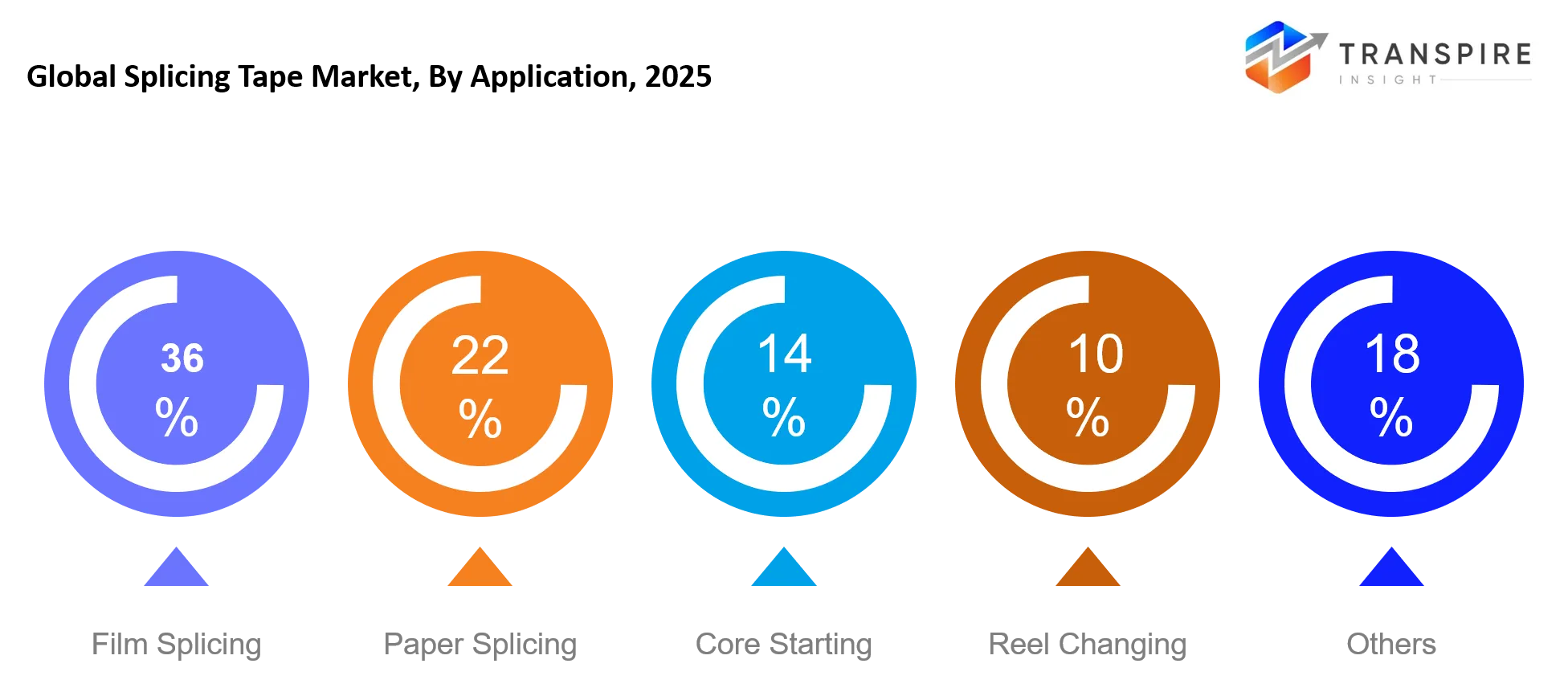
By Thickness
Tapes measuring Below 100µm capture the largest volume of day-to-day equipment orders, while ultra-thin configurations represent the market's primary growth engine. Mid-range (100–200µm) and thick (Above 200µm) specialized foils hold stable niches across heavy industrial applications. This pattern is driven by a broad manufacturing transition toward thin, lightweight profiles that pass through precise machinery gates without jamming downstream cutting blades. Legacy thick tape structures are ideal for joining heavy corrugated materials, but ultra-thin splicing configurations are gaining rapid ground because they allow continuous webs to pass seamlessly through microscopic inspection sensors and printing heads. Looking ahead, the industry will pivot sharply toward micro-scale architectural designs. Splicing tape suppliers will be forced to transition toward sub-50µm structures that maintain immense tensile strength, allowing converters to minimize the physical joint profile at the splice point and completely eliminate downstream mechanical jams.
What are the Key Use Cases Driving the Global Splicing Tape Market?
The primary use case driving this market is continuous high-speed flexible packaging and web conversion. Manufacturing plants deploy high-tack flying-splice tapes directly onto high-speed automated unwinders to instantly join expiring material rolls with fresh reels, allowing processing lines to run at maximum velocity without pausing operations, permanently eliminating machinery downtime, and maximizing factory floor throughput.
Expanding applications focus heavily on managing automated multi-layer electronics assembly within cleanroom environments. Fabrication crews utilize specialized, low-outgassing electronics-grade splicing tapes to securely join delicate optical films - flexible printed circuits, and touchscreen arrays during continuous reel-to-reel processing, avoiding the chemical contamination, adhesive bleeding, and layer thickness mismatches that ruin sensitive hardware.
An emerging use case centers on sustainable commercial paper and pulp recycling during industrial manufacturing runs. Heavy paper mills and print houses utilize completely water-soluble, repulpable splicing tapes to execute high-temperature web changes - allowing production teams to scrap leftover splice roll joints and feed them directly back into the processing slurry without clogging machinery filters or contaminating recycled paper batches.
|
Report Metrics |
Details |
|
Market size value in 2025 |
USD 1.86 Billion |
|
Market size value in 2026 |
USD 1.97 Billion |
|
Revenue forecast in 2033 |
USD 2.84 Billion |
|
Growth rate |
CAGR of 5.36% from 2026 to 2033 |
|
Base year |
2025 |
|
Historical data |
2021 - 2024 |
|
Forecast period |
2026 - 2033 |
|
Report coverage |
Revenue forecast, competitive landscape, growth factors, and trends |
|
Regional scope |
United States; Canada; Mexico; United Kingdom; Germany; France; Italy; Spain; China; Japan; India; Australia; South Korea; Brazil; Argentina; South Africa; Saudi Arabia; United Arab Emirates |
|
Key company profiled |
3M, Nitto Denko, Tesa, Avery Dennison, Intertape Polymer Group, Scapa, Shurtape, Lohmann, Berry Global, LINTEC, Saint-Gobain, Adhesives Research, CCT Tapes, Cantech, Nichiban |
|
Customization scope |
Free report customization (country, regional & segment scope). Avail customized purchase options to meet your exact research needs. |
|
Report Segmentation |
By Material (Polyester, Polyimide, Paper, PVC, Acrylic, Silicone, Aluminum Foil, Others); By Adhesive (Rubber, Acrylic, Silicone, Others); By End User (Packaging, Electronics, Printing, Automotive, Paper & Pulp, Others); By Application (Film Splicing, Paper Splicing, Core Starting, Reel Changing, Others); By Thickness (Below 100µm, 100-200µm, Above 200µm, Others) |
Which Regions are Driving the Global Splicing Tape Market Growth?
Asia Pacific maintains a commanding grip on the splicing tape market, capturing a dominant 38% of all worldwide industry revenue. This geographic leadership is heavily driven by the massive concentration of high-volume flexible packaging converters, paper mills, and industrial print houses across China, India, and Southeast Asia. The regional ecosystem is structurally supported by a colossal manufacturing infrastructure network and aggressive national industrialization frameworks that prioritize continuous, high-speed factory output to satisfy both domestic consumption and massive global export pipelines. Consequently, integrating high-shear film and paper splicing tapes into high-velocity automated web lines has become an absolute operational standard for regional converters looking to eliminate machinery downtime entirely.
In April 2026, Japanese adhesive materials giant Lintec Corporation finalized a major production expansion at its advanced industrial coating facilities in Chiba to scale the regional supply of its high-performance electronic and film splicing tape arrays. This strategic capacity deployment introduces highly specialized, ultra-thin polyester backing configurations to serve the soaring demand from automated flexible display and semiconductor fabrication plants across the regional market. By providing these specialized, zero-defect adhesive lines directly to local tech hubs, this facility scaling allows Asia Pacific electronics manufacturers to streamline high-speed roll-to-roll conversion workflows seamlessly.
Europe serves as a highly stable, predictable secondary pillar for the global market, locking down an essential 29% share of total industry demand. While Asia Pacific manufacturing concentrates heavily on massive volume expansion, European tape adoption is driven entirely by stringent environmental compliance codes and a regional structural shift toward fully circular industrial materials. This regional market stability is structurally insulated by strict zero-waste mandates and an engineering focus on integrating completely water-soluble, repulpable splicing tapes that dissolve flawlessly during paper recycling loops. To maintain strict workflow integrity amid rising regulatory pressures, European print houses and paper mills steadily invest in premium, plasticizer-free acrylic tape lines that can pass through high-temperature curing ovens without chemical degradation.
In January 2026, German adhesive solutions leader tesa officially entered a long-term commercial partnership with a major European paper manufacturing consortium to deploy its latest sustainable, completely repulpable flying-splice tape systems across multiple production plants in Western Europe. This comprehensive alliance model explicitly integrates water-soluble adhesive chemistries that allow operators to recycle scrap paper roll joints directly back into the primary pulping slurry without clogging downstream machinery or contaminating paper batches. This long-term contract deployment ensures a steady procurement pipeline for high-reliability web-handling hardware across mature European packaging hubs looking to meet strict regional circular economy targets.
North America has emerged as the fastest-growing territory globally, accelerating at a market-leading CAGR of 12.6% to capture a 23% slice of global sales. This sudden structural shift is driven by a massive, high-tech manufacturing resurgence and the rapid rollout of automated Industry 4.0 smart factory ecosystems that rely heavily on real-time web tension monitoring and automated flying splices. Historically, regional conversion facilities utilized standard general-purpose tapes applied manually, but the territory has now rapidly pivoted toward high-end, electronics-grade and specialized silicone splicing tapes capable of bonding with low-surface-energy substrates. Looking ahead, future equipment procurement in this booming corridor relies entirely on deploying advanced, micro-thin multi-layer splicing tools that integrate seamlessly with deep-learning machine vision sensors to execute perfect, high-speed roll transfers.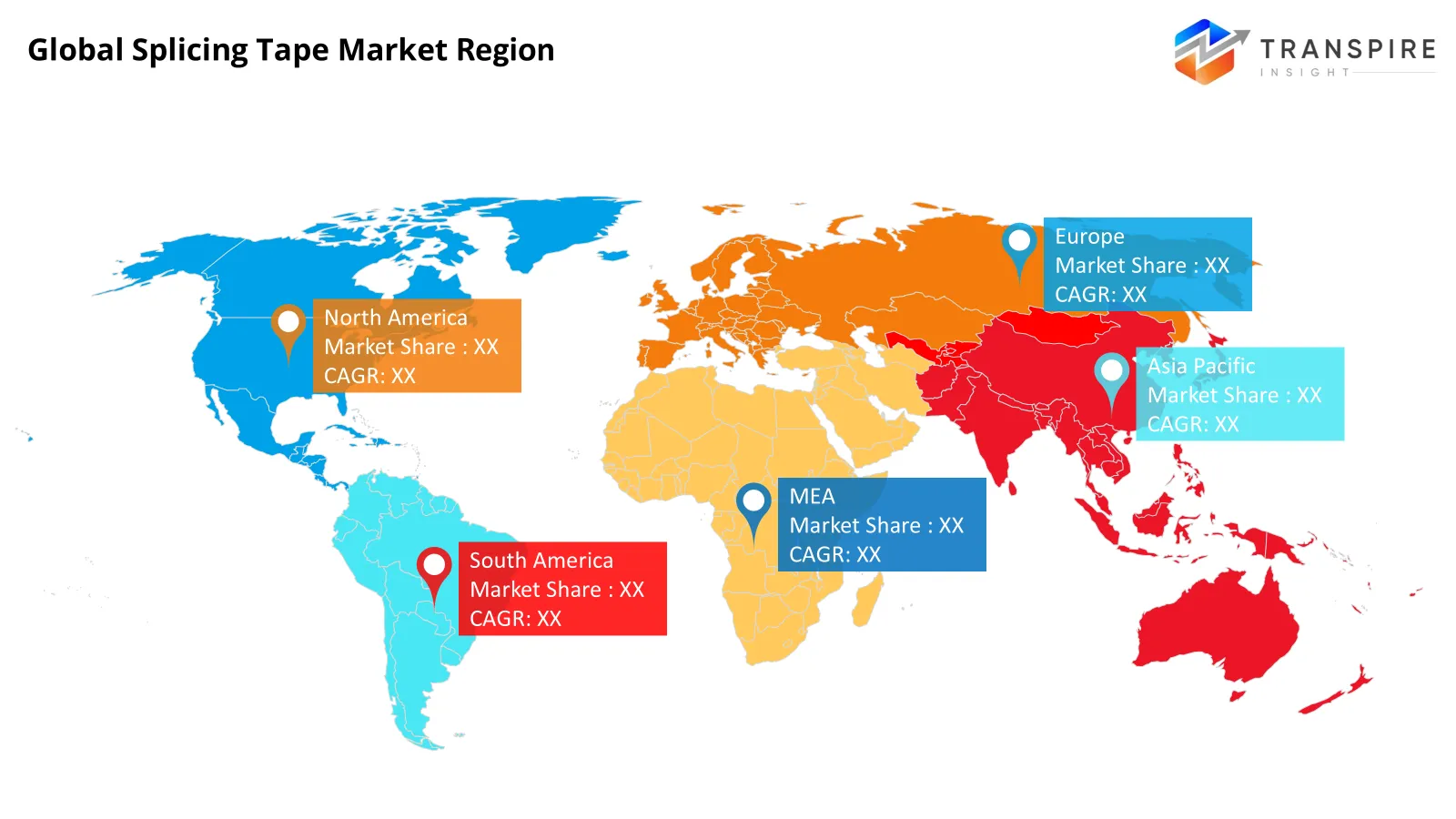
Who are the Key Players in the Global Splicing Tape Market and how do they Compete?
The Global Splicing Tape Market features a highly consolidated competitive landscape where international materials science corporations battle specialized adhesive manufacturers for industrial dominance. Competition is primarily dictated by raw adhesive formulation engineering, tape thickness minimization, and the ability to prevent structural web tears on automated machinery running at maximum velocities. Manufacturers compete intensely across diverse application fronts, trying to establish long-term framework procurement agreements with tier-one consumer electronics makers, commercial printing consortiums, and large-scale flexible packaging converters.
American industrial pioneer 3M leverages an aggressive product innovation strategy to differentiate its portfolio from low-cost market alternatives. The firm maintains an extensive array of advanced, fiber-free splittable flying-splice tapes that utilize multi-layered film backings rather than paper tissue to eliminate particle shedding during rapid web conversions. By providing these zero-contamination, clean-releasing adhesive tools directly to automated flexographic print setups, 3M actively scales its market presence across high-end commercial packaging hubs.
In contrast, Japanese electronics specialist Nitto Denko pursues a strict technical niche strategy focused closely on high-precision electronics and extreme-temperature industrial applications. The company differentiates itself through proprietary chemical synthesis - delivering ultra-thin, low-outgassing, and silicone-free splicing tape variants that securely hold delicate display layers and touch sensors without inducing chemical contamination. Nitto Denko aggressively expands its commercial footprint by embedding its processing lines directly within high-growth lithium-ion battery and semiconductor manufacturing clusters across the Asia Pacific region.
Company List
- 3M
- Nitto Denko
- Tesa
- Avery Dennison
- Intertape Polymer Group
- Scapa
- Shurtape
- Lohmann
- Berry Global
- LINTEC
- Saint-Gobain
- Adhesives Research
- CCT Tapes
- Cantech
- Nichiban
Recent Development News
In January 2025, consumer packaging manufacturer Berry Global Group announced a definitive asset sale agreement to divest its core pressure-sensitive specialty tapes and adhesives business unit to private equity firm Nautic Partners for USD 540 million. This structural divestiture redirects major capital allocation toward consumer packaging, handing Nautic multiple tape production centers in New York, Kentucky, and Rhode Island to form an independent - pure-play industrial adhesive tape supplier. [https://www.packagingdive.com
In April 2026, adhesive technologies developer tesa and automotive automation specialist AUMOVIO entered an engineering partnership to launch a novel resource-efficient, debondable adhesive solution for large-scale vehicle infotainment display assemblies. This technical integration blends standardized structural backing layers with a automated debonding-on-demand mechanism to secure automotive display films under harsh cabin temperatures while allowing complete separation for easy screen repairs. [https://www.tesa.com
In June 2026, materials pioneer 3M officially commercialized its "Ask 3M" agentic artificial intelligence platform to provide manufacturing clients self-service technical guidance for complex bonding challenges. This specialized digital assistant utilizes verified engineering documentation across 49 technological platforms to instantly match substrates and thermal thresholds with specific industrial transfer tapes, enabling web-processing engineers to resolve splicing film alignments within minutes. [https://news.3m.com/
What Strategic Insights Define the Global Future of the Splicing Tape Market?
The future of splicing tapes hinges entirely on accommodating automated, tension-dynamic web environments operating at ultra-high velocities. As industrial conversion lines push processing boundaries, the market is heading toward smart, functional splicing tapes embedded with machine-readable optical codes that allow unwinding machinery to synchronize roll transfers with absolute geometric precision without human oversight.
However, a hidden risk lies in the structural incompatibility between conventional synthetic adhesive backings and the next-generation bioplastics or recycled film substrates gaining global traction. These raw alternative webs often display irregular surface energy fields, causing catastrophic shear failure or severe chemical bleeding within high-temperature curing ovens. Conversely, a major emerging opportunity is opening in automated cleanroom electronics assembly, where silicone-free, ultra-thin polyimide splicing tapes can securely join micro-scale optical films and flexible smartphone display layers.
Strategic Recommendation: Material providers must shift from a transactional product-delivery model to an integrated chemical consultation service, engineering multi-layered, brand-agnostic flying splice configurations tailored dynamically to specific variable substrate properties.
By Material
- Polyester
- Polyimide
- Paper
- PVC
- Acrylic
- Silicone
- Aluminum Foil
- Others
By Adhesive
- Rubber
- Acrylic
- Silicone
- Others
By End User
- Packaging
- Electronics
- Printing
- Automotive
- Paper & Pulp
- Others
By Application
- Film Splicing
- Paper Splicing
- Core Starting
- Reel Changing
- Others
By Thickness
- Below 100µm
- 100-200µm
- Above 200µm
- Others
Regional Outlook
North America
- United States
- Canada
- Mexico
Europe
- Germany
- United Kingdom
- France
- Spain
- Italy
- Rest of Europe
Asia Pacific
- Japan
- China
- Australia & New Zealand
- South Korea
- India
- Rest of Asia Pacific
South America
- Brazil
- Argentina
- Rest of South America
Middle East & Africa
- Saudi Arabia
- United Arab Emirates
- South Africa
- Rest of the Middle East & Africa
Frequently Asked Questions
Find quick answers to common questions.
The Global Splicing Tape Market size was valued at USD 1.86 Billion in 2025 and is poised to reach USD 2.84 Billion by 2033, expanding at a 5.36% CAGR.
Key Segments for the Global Splicing Tape Market are Material (Polyester, Polyimide, Paper, PVC, Acrylic, Silicone, Aluminum Foil, Others), Adhesive (Rubber, Acrylic, Silicone, Others), End User (Packaging, Electronics, Printing, Automotive, Paper & Pulp, Others), Application (Film Splicing, Paper Splicing, Core Starting, Reel Changing, Others), and Thickness (Below 100µm, 100-200µm, Above 200µm, Others).
Growth is primarily driven by the rapid shift toward automated, high-speed production lines across the Packaging and Printing industries, where the explosive rise in e-commerce fulfillment volumes requires continuous web processing at extreme velocities and completely eliminates the tolerance for machinery downtime during roll changes.
The Global Market is led by Major Manufacturers including 3M, Nitto Denko, Tesa, Avery Dennison, Intertape Polymer Group, Scapa, Shurtape, Lohmann, Berry Global, LINTEC, Saint-Gobain, Adhesives Research, CCT Tapes, Cantech, and Nichiban.
Asia Pacific holds a dominant 38% share of worldwide revenue, heavily influencing market dynamics due to its massive, consolidated manufacturing infrastructure network, a high concentration of large-scale flexible packaging converters, and aggressive regional industrialization frameworks across China and India prioritizing continuous factory output.
Commercial Opportunities Exist in the Engineering of specialized, low-outgassing, ultra-thin polyimide and polyester splicing tapes optimized for advanced cleanroom electronics fabrication, allowing manufacturing hubs to securely join delicate optical layers and flexible smartphone displays without risking chemical contamination.
- 3M
- Nitto Denko
- Tesa
- Avery Dennison
- Intertape Polymer Group
- Scapa
- Shurtape
- Lohmann
- Berry Global
- LINTEC
- Saint-Gobain
- Adhesives Research
- CCT Tapes
- Cantech
- Nichiban
About the Authors

Kartik bhong
I am Kartik Bhong, a Senior Research Analyst at Transpire Insight, specializing in the Packaging, Manufacturing, and Construction industry. My work focuses on analyzing market trends, emerging technologies, industry regulations, and competitive landscapes to deliver accurate, data-driven insights. I am passionate about transforming complex industry information into clear, practical content that helps businesses, professionals, and decision-makers stay informed and make confident strategic decisions. Through continuous research and a strong commitment to accuracy, I strive to create reliable, well-researched content that reflects the latest developments across these dynamic industries and supports the vision of Transpire Insight in delivering valuable market intelligence.

Chakradhar Khansole
Chakradhar serves as the Research Director at Transpire Insight, bringing over 8 years of experience in technology, innovation, and strategic market intelligence. He specializes in transforming complex market data into actionable business insights that enable organizations to make informed, growth-oriented decisions. Recognized for his strategic vision and analytical expertise, Chakradhar leads high-impact research initiatives, delivering comprehensive market assessments, competitive intelligence, and forward-looking industry analysis.
Recently Published Reports
-
Apr 2026
Pharmaceutical Cold Chain Packaging Market
Pharmaceutical Cold Chain Packaging Market By Material (Plastic,(Polyethylene (PE), Polypropylene (PP), Polyethylene Terephthalate (PET), Expanded Polystyrene (EPS), Polyurethane (PU),Others), Paper, Metal, Others), By Product (Small Boxes, Pallets, Large Sized Pallet Containers, Others), By End Use (Biopharmaceutical Companies, Clinical Research Organizations, Hospitals, Research Institutes, Logistics and Distribution Companies, Others)”, By Industry Analysis, Size, Share, Growth, Trends, and Forecasts 2026-2033
-
Apr 2026
Active & Intelligent Packaging Market
Active & Intelligent Packaging Market By Type (Active Packaging, Smart Packaging), By Material (Polymer-Based, Paper & Board-Based, Metal-Based, Glass-Based), By Technology (Time-Temperature Indicators, Freshness Indicators, RFID, Antimicrobial Packaging, Modified Atmosphere Packaging), By Application (Food & Beverages, Pharmaceutical, Cosmetics & Personal Care, Electronics & Consumer Goods, Others), By Industry Analysis, Size, Share, Growth, Trends, and Forecasts 2026-2033
-
Apr 2026
Biodegradable Cut Flower Packaging Market
Biodegradable Cut Flower Packaging Market By Material Type (Paper & Paperboard, Biodegradable Plastics, Natural Fibers, Molded Pulp, Others), By Product Type (Sleeves, Wraps, Boxes & Cartons, Bags & Pouches, Inserts & Holders), By Application (Roses, Carnations, Tulips, Chrysanthemums, Mixed Flowers, Others) and By Distribution Channel (Direct Sales, Distributors & Wholesalers, Online Channels), By Industry Analysis, Size, Share, Growth, Trends, and Forecasts 2026-2033
-
May 2026
Pharmaceutical Packaging Market
Pharmaceutical Packaging Market By Material Type (Plastic, Glass, Metal, Paper & Paperboard, Others), By Packaging Type (Bottles, Blister Packs, Vials, Ampoules, Pouches & Sachets, Others) and By End User (Hospitals & Clinics, Retail Pharmacies, Online Pharmacies, Pharmaceutical Manufacturers), By Industry Analysis, Size, Share, Growth, Trends, and Forecasts 2026-2033