
Global Smart Lock Market Size & Forecast
- Global Smart Lock Market Size 2025: USD 3,315.7 Million
- Global Smart Lock Market Size 2033: USD 14,135.2 Million
- Global Smart Lock Market CAGR: 19.90%
- Global Smart Lock Market Segments: By Product Type (Deadbolt Smart Locks, Lever Handle Smart Locks, Padlock Smart Locks), By Technology (Bluetooth, Wi-Fi, Zigbee, Z-Wave), By End-User (Residential, Commercial, Government)
To learn more about this report,  Download Free Sample Report
Global Smart Lock Market Summary
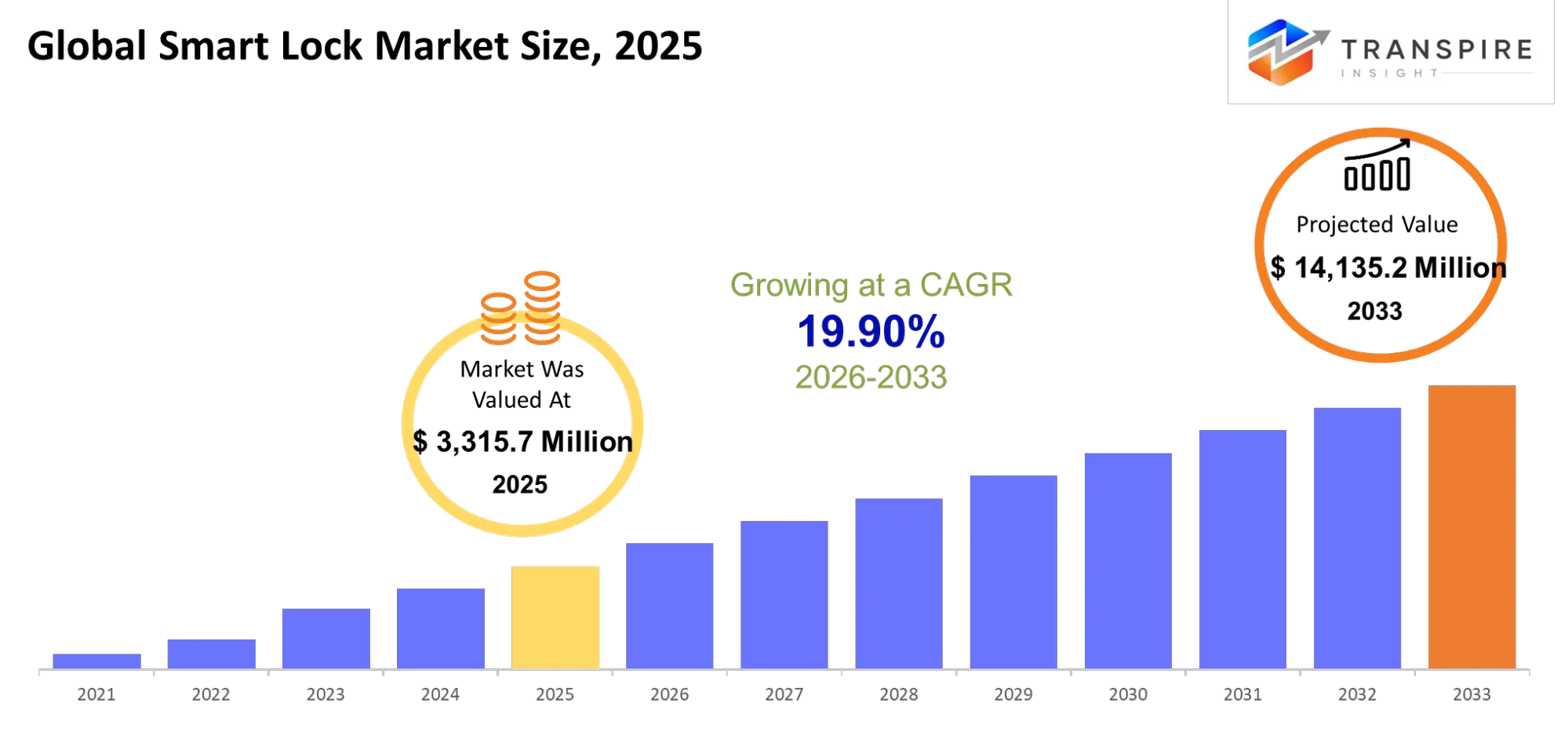
The Global Smart Lock Market was valued at USD 3,315.7 million in 2025. It will reach USD 14,135.2 Million by 2033. The CAGR over this period is 19.90%.
Smart locks substitute mechanical keys with digital identifiers. Residents swipe their smartphones, a property manager sends a temporary code to a delivery driver, or a hotel guest checks in via an application - all without going to a front desk. The global smart lock market encompasses the hardware, firmware, and cloud network layers that make this possible - ranging from residential front doors to commercial access points and even government-controlled facilities.
The biggest architectural shift over the last five years is moving from standalone Bluetooth locks to cloud-linked, multi-protocol platforms. Early consumer smart locks linked with a phone over Bluetooth and essentially stopped there. Amazon Alexa Guard, Apple HomeKit, and Google Home really pulled smart lock adoption into a larger smart home system, completely transforming what makes up a minimum viable product itself.
What accelerated this shift was the huge increase in short-term rentals and remote property management during the pandemic. When landlords couldn't physically hand over keys, cloud-connected locks were practically essential. That very forced adoption turned millions of property owners into active smart lock users between 2020 and 2022 - building a massive installed base that now drives sales of accessories, software subscriptions, and upgrade cycles right through 2033.
Key Global Smart Lock Market Insights
- North America holds approximately 35% of global smart lock market revenue in 2025, driven by high smart home penetration and over 1.3 million active short-term rental listings across the United States and Canada.
- Asia-Pacific is the fastest-growing regional market, expanding above 22% CAGR through 2033, led by China's smart city mandates, South Korea's high penetration, and India's accelerating urban PropTech adoption.
- Deadbolt Smart Locks command 58% of global product segment revenue in 2025 as deadbolts serve as the primary exterior security mechanism across residential and light commercial properties worldwide.
- Bluetooth-enabled locks represent 42% of the technology segment in 2025, valued for low-latency proximity authentication and 12 to 18-month battery life without requiring a home Wi-Fi network.
- Wi-Fi smart locks are the fastest-growing technology segment, projected above 24% CAGR through 2033, driven by remote unlock, real-time access logs, and property management platform integrations.
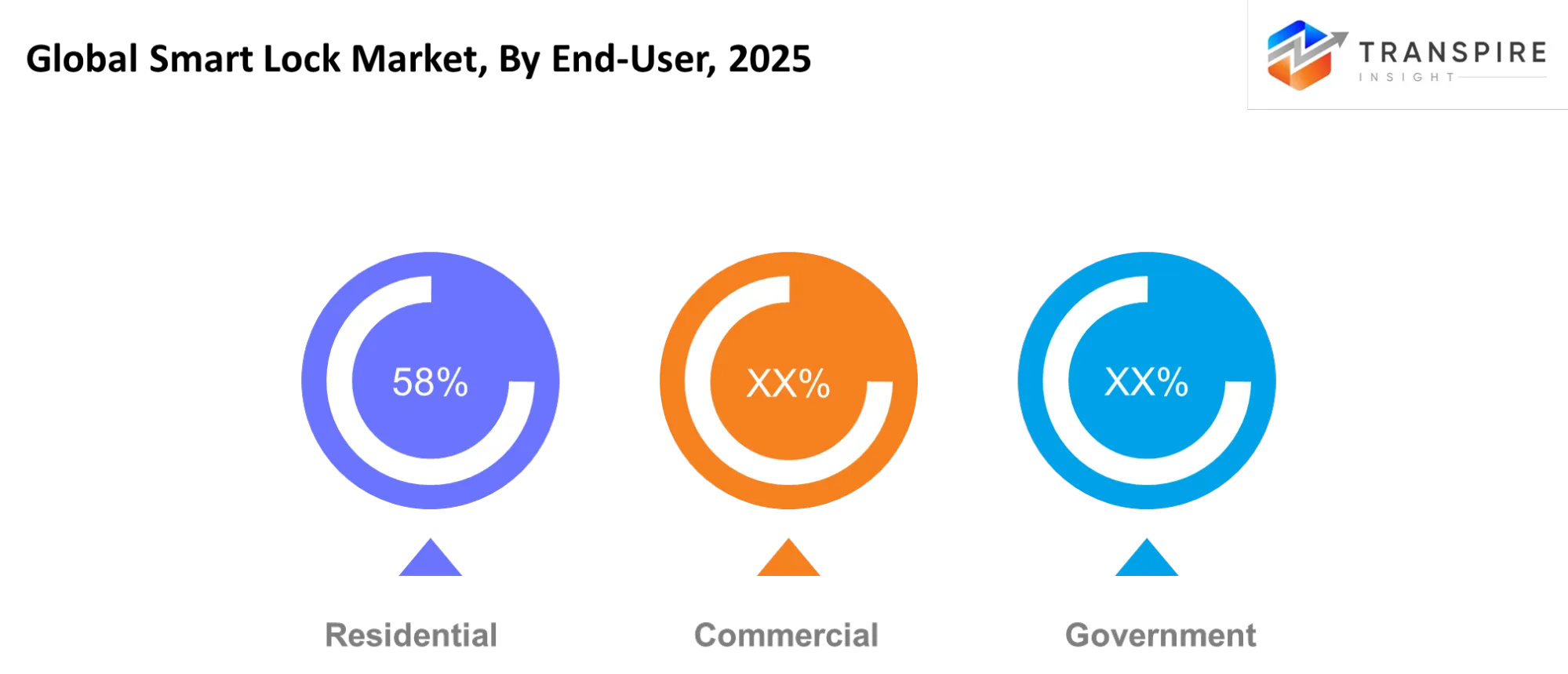
- Residential end-users account for 58% of global smart lock revenue in 2025, covering homeowners, apartment residents, and short-term rental hosts who require keyless entry and remote access management.
- ASSA ABLOY AB and Allegion plc together hold over 30% of the global smart lock market through Yale Locks, Schlage, HID Global, and several regional commercial access control brands.
- Xiaomi Corporation and Samsung Electronics expand share in Asia-Pacific by bundling smart locks with IoT hubs at price points 30 to 40 percent below Western equivalents.
- August Home Inc. and Schlage drive software subscription revenue through cloud access management plans at USD 3 to USD 15 per device per month, shifting business models toward recurring income.
- Cybersecurity certification requirements tightened in 2024 under the EU Cyber Resilience Act and US IoT Cybersecurity Improvement Act, raising compliance costs and lengthening enterprise sales cycles by 6 to 18 months.
What are the Key Drivers, Restraints, and Opportunities in the Global Smart Lock Market?
The main driving force is a structural increase in property access complexity. Short-term rental platforms exploded from about 1 million active Airbnb listings globally in 2017 to over 7 million by 2024. Each listing practically demands a smart lock since exchanging physical keys at scale isn't operationally practical. Exactly the same logic applies to co-working real estate, multi-family residential, logistics delivery, and healthcare facility management - all generating ongoing device replacement and software subscription revenue instead of one-time hardware purchases.
Cybersecurity risk is our biggest structural hurdle. Smart locks store authentication credentials and access logs in cloud environments - and a breach literally compromises a building itself rather than just exposing data. Researchers have shown vulnerabilities such as replay attacks on Bluetooth Low Energy protocols and API authentication weaknesses in cloud platforms. Enterprise and government facility managers demand third-party security certifications before even considering connected access control devices, lengthening enterprise sales cycles by 6 to 18 months and raising per-unit compliance costs by 15 to 30 percent.
Integration into building management systems presents the clearest forward opportunity. Commercial operators really want unified platforms connecting access control, HVAC, lighting, and occupancy sensing all in one operational layer. Vendors offering certified integrations with Honeywell Forge, Siemens Desigo CC, or Johnson Controls OpenBlue set up their hardware as a necessary building specification. Salto Systems already holds an integration library that covers more than 400 third-party software platforms - showing the commercial appeal. As green building certification increasingly demands smart access to allow occupancy-based energy management, BMS integration becomes a compliance requirement.
What Has the Impact of Artificial Intelligence Been on the Global Smart Lock Market?
Artificial intelligence really makes its entrance into the smart lock market through three distinct layers: detecting anomalies in access events, predicting the maintenance of your hardware, and authenticating the behavior of users at the device itself. Cloud platforms are now running machine learning classifiers over streams of access events to flag any suspicious patterns. An unlock at 3 a. m. in a property that's never had nighttime access - or a credential used from two geographically very far away locations in just minutes - triggers automated alerts all on its own, without even looking at the logs manually. August Home and Schlage have actually set up their own versions of this technology, significantly reducing detection time from hours to mere seconds.
Predictive maintenance applies machine learning to motor torque readings, battery discharge patterns, and signal logs so we can forecast when hardware will fail even before it happens. Real-world data shows predictive alerts can cut down emergency service calls by about 25 to 35 percent in buildings with active monitoring systems. Behavioral authentication, which creates a profile of how a user interacts with a lock based on time, approach speed, and grip pattern, requires around 60 to 90 days of consistent access data to build a really reliable baseline, making it quite impractical for high-turnover environments. Integration costs are also adding about USD 40 to USD 80 per device for the necessary on-device processing hardware, severely limiting adoption - especially for large commercial deployments.
Key Market Trends
- North America holds approximately 35% of global revenue in 2025, anchored by over 1.3 million active US short-term rental listings requiring contactless access infrastructure.
- Asia-Pacific grows above 22% annually through 2033, with China's smart city construction program mandating connected access control in new residential and government buildings since 2022.
- Deadbolt Smart Locks hold 58% of product segment revenue in 2025, driven by retrofit demand from residential properties replacing mechanical deadbolts without structural modification.
- Lever Handle Smart Locks are the fastest-growing product type, above 23% CAGR through 2033, as commercial developers specify lever hardware in ADA-compliant building projects.
- Bluetooth holds 42% technology share in 2025, but Wi-Fi locks grew 31% year-over-year in 2024 as remote access became a standard buyer expectation rather than a premium option.
- Matter protocol adoption from 2022 onward reduced Zigbee and Z-Wave integration friction across Apple HomeKit, Google Home, and Amazon Alexa, renewing interest in mesh-network lock deployments.
- Residential drives 58% of global revenue but commercial and government segments are growing 24% faster as multi-family developers and hospitality operators mandate smart access as a standard building feature.
- ASSA ABLOY completed multiple software-defined access control acquisitions in 2023 and 2024, signaling a strategic shift from hardware margin toward software subscription revenue.
- Subscription cloud access management plans now generate USD 3 to USD 15 per device per month in recurring revenue, a margin layer that did not exist before 2020.
- The EU Cyber Resilience Act and US IoT Cybersecurity Improvement Act imposed mandatory security update and vulnerability disclosure requirements on connected lock manufacturers from 2024 onward.
Global Smart Lock Market Segmentation
By Product Type
Deadbolt smart locks will be holding 58% of product segment revenue by 2025. The deadbolt is really the standard exterior door mechanism both in residential and lightweight commercial construction - and homeowners changing out mechanical ones with connected models won't require any structural changes at all. Replacement cycles tend to last around four to seven years, driven by battery exhaustion, software discontinuation, or our desire for even newer connectivity protocols. Smart home ecosystem integration just keeps making connected access a common residential expectation right on through 2033.
Lever handle smart locks are the fastest-growing product type, beating out 23 percent CAGR through 2033. Commercial office buildings, healthcare facilities, and hospitality properties absolutely demand lever hardware for ADA compliance - and growth really accelerates when we see API-first platforms from Salto Systems and Dormakaba delivering enterprise access management at mid-market price points. Multi-family developers now specify lever smart locks in new construction as a basic amenity, allowing direct specification selling that improves vendor margin all around.
Padlock smart locks serve a purpose where frame-mounted access control is either very impractical or not feasible. Storage units, construction sites, bike-sharing stations, and portable asset containers really use Bluetooth and cellular-connected smart padlocks to manage assets that get accessed fairly infrequently - without having to deal with the hassle of a physical key logistics chain. Growth really ties to the expansion of last-mile logistics networks and urban package locker infrastructure right throughout the forecast period itself.
By Technology
Bluetooth Low Energy dominates at 42% of technology segment revenue in 2025 - it offers sub-one-second proximity authentication and 12 to 18 months of battery life without needing a home network. However, growth is somewhat limited by the need to be physically close, pushing buyers more towards Wi-Fi alternatives or Bluetooth-plus-bridge configurations so they can have remote access capability.
Wi-Fi Smart Locks see a 24% compound annual growth rate (CAGR) up to 2033. The ability to remotely unlock from any internet-connected location, receive real-time notifications, and directly integrate into cloud platforms really makes Wi-Fi the chosen technology for short-term rental hosts and commercial property managers. But battery life still remains a major problem - Wi-Fi locks need to be replaced about every three to six months. Hybrid architectures that only turn on Wi-Fi when necessary for remote commands do partially alleviate this constraint.
Zigbee and Z-Wave serve smart home builders and commercial integrators who require really reliable mesh network performance across multi-device buildings. Both protocols gained more relevance when the Matter standard was launched in 2022, allowing native cross-platform compatibility - without separate app ecosystems. Combined share remains below Wi-Fi and Bluetooth in terms of volume but grows fairly steadily in multi-device smart home and commercial integration projects.
By End-User
Residential end-users are responsible for generating 58% of global smart lock revenue by 2025. Three separate demand levels really drive this segment: first-time buyers who specify smart locks in brand-new houses, existing homeowners who upgrade as smart home systems promote cross-category adoption - and short-term rental operators for whom connected access is simply a necessity. Entry-level Wi-Fi deadbolt models are now sold for under $150, significantly less than the $250 or so in 2018, bringing adoption very much within reach of a substantially broader market.
Commercial end-users generate the highest average revenue per installation. A commercial deployment will cover several access points per facility plus software subscriptions, installation services, and maintenance contracts - all creating revenue streams that aren't present in residential sales. This segment spans multi-family housing, co-working spaces, hospitality, healthcare, and retail chains - each with quite distinct access management needs. Vendors in this segment really compete on integration depth and software capabilities, rather than hardware pricing itself.
Government end-users demand hardware that meets very specific cybersecurity standards - such as FIPS 201 in the US. Vendors hoping to get government contracts have to get third-party certifications and agree to comply with the Buy American Act requirements for federal installations. Growth over the forecast period really depends on the US federal Physical Access Control System modernization program, which is expected to generate around $450 million in procurement activity by 2028.
To learn more about this report, Download Free Sample Report
What are the Key Use Cases Driving the Global Smart Lock Market?
The dominant use case is actually residential keyless entry and remote access management for short-term rental properties. A host managing five units really can't hand keys to guests arriving on different schedules - and duplicate key management at that scale creates significant security liabilities. Smart locks issue time-limited digital credentials tied to reservation periods, access automatically revokes itself at checkout, and hosts manage everything all remotely. This use case produces the most consistent demand by linking device replacement and software subscription revenue to the continued growth of global short-term rental platforms.
Commercial property access management is expanding fast as co-working operators and multi-family residential developers standardize on smart lock infrastructure. Co-working operators issue member credentials through their booking software, enable 24-hour access for premium tiers, and get real-time facility utilization data from access logs all the time. Multi-family developers specify smart locks at the building, floor, and unit level in their new construction to support higher rents and lower tenant turnover rates. These multi-point deployments generate a lot more revenue per property than single-unit residential sales do.
The emerging use case really gaining the most traction for 2026 to 2033 is integration within autonomous last-mile delivery infrastructure. Package carriers and pharmacy delivery networks are piloting unattended access systems where a one-time credential gives a delivery driver entry - without requiring the recipient to be there. Amazon Key for Business operates in over 1 million apartment buildings right across the United States. As same-day delivery volumes grow, demand for smart padlocks and access-controlled entry points enabling this model is expected to become a substantial standalone revenue category by 2028.
Report Overview Table
|
Report Metrics |
Details |
|
Market size value in 2025 |
USD 3,315.7 Million |
|
Market size value in 2026 |
USD 3,968.9 Million |
|
Revenue forecast in 2033 |
USD 14,135.2 Million |
|
Growth rate |
CAGR of 19.90% from 2026 to 2033 |
|
Base year |
2025 |
|
Historical data |
2021 - 2024 |
|
Forecast period |
2026 - 2033 |
|
Report coverage |
Revenue forecast, competitive landscape, growth factors, and trends |
|
Regional scope |
United States; Canada; Mexico; United Kingdom; Germany; France; Italy; Spain; Denmark; Sweden; Norway; China; Japan; India; Australia; South Korea; Thailand; Brazil; Argentina; South Africa; Saudi Arabia; United Arab Emirates |
|
Key companies profiled |
ASSA ABLOY AB, Allegion plc, Dormakaba Group, Spectrum Brands Holdings Inc., Xiaomi Corporation, Samsung Electronics Co. Ltd., Honeywell International Inc., August Home Inc., Schlage (Allegion), Yale Locks (ASSA ABLOY), Kwikset (Spectrum Brands), Salto Systems S.L., Onity Inc., HavenLock Inc., Ultraloq (U-tec Group) |
|
Customization scope |
Free report customization (country, regional & segment scope). Avail customized purchase options to meet your exact research needs. |
|
Report Segmentation |
By Product Type (Deadbolt Smart Locks, Lever Handle Smart Locks, Padlock Smart Locks), By Technology (Bluetooth, Wi-Fi, Zigbee, Z-Wave), By End-User (Residential, Commercial, Government) |
Which Regions are Driving the Global Smart Lock Market Growth?
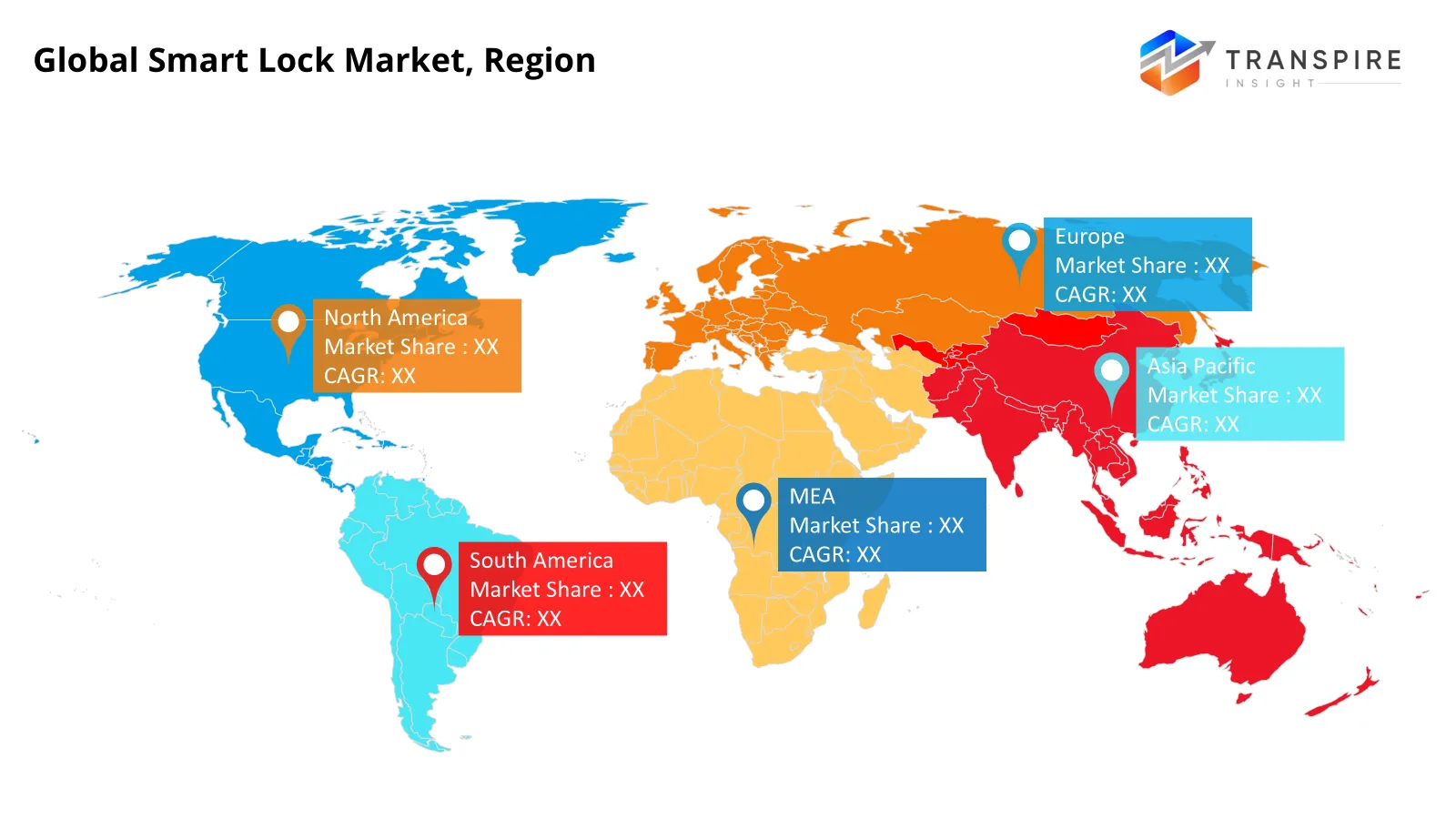
North America heads the international smart lock market, claiming around 35% of all revenue by 2025. The United States truly drives this percentage through incredibly high smart home adoption - more than 1. 3 million active Airbnb listings necessitate contactless infrastructure - and significant PropTech investments in commercial property. US specialty retail and a rather developed online channel provide very efficient ways to market for both consumer and business products, and North America still serves as the main location for smart lock innovation and product launch.
Europe is the second-biggest market, producing roughly 28% of the world's revenue by 2025. Greater urban residential density in Germany, France, the Netherlands, and the UK creates a big demand for building-wide access control systems rather than just locking individual units. The General Data Protection Regulation sets very specific requirements on cloud platforms holding access event records, making it really difficult for low-cost Asian competitors and protecting well-established European suppliers. Dormakaba Group and ASSA ABLOY retain quite strong European positions through GDPR-compliant cloud platforms that competitors have a hard time matching at scale.
Asia-Pacific grows more than 22% every year until 2033. China's smart city development plan forces the government to install connected access control in new residential and public buildings all over tier-1 and tier-2 cities. South Korea holds one of the highest per-capita smart lock penetration rates worldwide. India shows the biggest potential opportunity as urban residential construction volumes accelerate and the PropTech sector expands rapidly. Entrants to the market should really localize their product and compliance strategies for each specific sub-market instead of applying a single regional approach.
To learn more about this report, Download Free Sample Report
Who are the Key Players in the Global Smart Lock Market and How Do They Compete?
The global smart lock market is quite consolidated at the top end, with ASSA ABLOY AB and Allegion plc combining to earn more than 30% of total revenue through Yale Locks, Schlage, and some commercial access control brands. Below these two major players, the market really fragments among mid-tier hardware specialists, smart home ecosystem participants, and regional champions. The main competitive areas of focus are the level of technology integration, the ability to get products into various distribution channels, and the capacity for software subscriptions.
ASSA ABLOY AB competes by having a very diverse product line, employing Yale and HID Global across both residential and commercial markets. Its 2023 and 2024 purchases of software-defined access control companies indicate a strategic move towards more recurring subscription-based income. Allegion plc differentiates itself by having extremely strong relationships with commercial architects who design buildings that include Schlage hardware in their plans, thus creating a demand that competitors find hard to intercept. Dormakaba Group holds a pretty strong market position in Europe and Asia-Pacific by specializing in the hospitality industry, with its mobile key platforms installed in over 15,000 hotels all around the globe.
Xiaomi and Samsung compete based on integrating locks within their smart home ecosystems rather than relying on security brand value, offering locks bundled with IoT hubs at prices about 30 to 40 percent lower than those found in the West in the Asia-Pacific region. August Home Inc. focuses on software and cloud connectivity, selling hardware at nearly cost price and generating income through subscription plans - which over a 3-5 year period of the device's lifespan can create two to three times the original hardware profit margin. Salto Systems differentiates itself through a platform with over 400 third-party software integrations via an API-first approach, making it the preferred choice for commercial property managers who require seamless connectivity with their existing property management systems.
Global Smart Lock Market Companies
- ASSA ABLOY AB
- Allegion plc
- Dormakaba Group
- Spectrum Brands Holdings Inc.
- Xiaomi Corporation
- Samsung Electronics Co. Ltd.
- Honeywell International Inc.
- August Home Inc.
- Schlage (Allegion)
- Yale Locks (ASSA ABLOY)
- Kwikset (Spectrum Brands)
- Salto Systems S.L.
- Onity Inc.
- HavenLock Inc.
- Ultraloq (U-tec Group)
Recent Developments
In February 2026, ASSA ABLOY AB completed the acquisition of a smart access software platform focused on multi-family residential property management, strengthening its software subscription revenue base in North America. The acquisition extends cloud access management capability to apartment operators managing connected lock fleets across multiple properties. https://www.assaabloy.com
In March 2026, Salto Systems S.L. entered a strategic partnership with a leading European PropTech platform to integrate its cloud access management API into property management software used by over 80,000 commercial tenants across Germany, France, and the Netherlands. Landlords can now issue and revoke tenant access credentials directly from their existing property management software without logging into a separate access control platform. https://www.saltosystems.com
What Strategic Insights Define the Future of the Global Smart Lock Market?
Over the next five to seven years, the global smart lock market will consolidate around multi-protocol, software-first access platforms rather than single-purpose hardware devices. Commercial real estate and PropTech operators want unified platforms connecting access control, occupancy sensing, energy management, and visitor logging in one operational layer. Vendors positioning hardware as a node in a larger building intelligence network will capture the high-value commercial and institutional segments that generate the largest lifetime revenue per installation.
The hidden risk that headline growth rates do not capture is Matter protocol consolidation commoditizing smart lock hardware. If all major smart locks become interchangeable nodes on a unified standard, buyers select on price rather than brand, and the premium margins Western vendors currently enjoy will compress toward levels that Asian manufacturers can sustain. ASSA ABLOY and Allegion can partially offset this through software subscription revenue and commercial specification relationships, but consumer-focused brands competing primarily on hardware features face real margin compression risk over 2027 to 2030.
The opportunity not yet reflected in most analyses is smart lock integration into autonomous last-mile delivery infrastructure. Package carriers and pharmacy delivery networks are actively piloting unattended access systems that require certified smart lock hardware at building entrances and package lockers. The strategic recommendation is direct: build delivery carrier partnerships now. The first vendors to certify hardware compatibility with major carrier platforms will gain a specification advantage that latecomers will find expensive to displace.
Global Smart Lock Market Report Segmentation
By Product Type
- Deadbolt Smart Locks
- Lever Handle Smart Locks
- Padlock Smart Locks
By Technology
- Bluetooth
- Wi-Fi
- Zigbee
- Z-Wave
By End-User
- Residential
- Commercial
- Government
Frequently Asked Questions
Find quick answers to common questions.
The Global Smart Lock Market size is expected to reach USD 14,135.2 Million by 2033.
The key segments are By Product Type (Deadbolt Smart Locks, Lever Handle Smart Locks, Padlock Smart Locks), By Technology (Bluetooth, Wi-Fi, Zigbee, Z-Wave), and By End-User (Residential, Commercial, Government).
Major players include ASSA ABLOY AB, Allegion plc, Dormakaba Group, Spectrum Brands Holdings Inc., Xiaomi Corporation, Samsung Electronics Co. Ltd., Honeywell International Inc., August Home Inc., Schlage (Allegion), Yale Locks (ASSA ABLOY), Kwikset (Spectrum Brands), Salto Systems S.L., Onity Inc., HavenLock Inc., and Ultraloq (U-tec Group).
The Global Smart Lock Market size is USD 3,315.7 Million in 2025.
The Global Smart Lock Market CAGR is 19.90% from 2026 to 2033.
- ASSA ABLOY AB
- Allegion plc
- Dormakaba Group
- Spectrum Brands Holdings Inc.
- Xiaomi Corporation
- Samsung Electronics Co. Ltd.
- Honeywell International Inc.
- August Home Inc.
- Schlage (Allegion)
- Yale Locks (ASSA ABLOY)
- Kwikset (Spectrum Brands)
- Salto Systems S.L.
- Onity Inc.
- HavenLock Inc.
- Ultraloq (U-tec Group)
Recently Published Reports
-
Apr 2026
Bottled Water Market
Bottled Water Market Size, Share & Analysis Report By Product Type (Still Bottled Water, Carbonated Bottled Water, Functional Bottled Water, and Others), By Packaging (PET, Cans, and Others), By Sales Channel (Supermarkets/Hypermarkets, Convenience Stores/Drug Stores, Grocery Stores/Club Stores, Foodservice, and Others) and Geography (North America, Europe, Asia-Pacific, Middle East and Africa, South and Central America), 2021 - 2032
-
Apr 2026
Color Cosmetic Packaging Market
Color Cosmetic Packaging Market Size, Share & Analysis Report By Application (Mascara Packaging, Liquid Packaging, and Liquid Face), By Type (Tubes & Bottles, Pens & Markers, Compacts & Containers, and Droppers & Pumps), and Geography (North America, Europe, Asia-Pacific, Middle East and Africa, South and Central America), 2021 - 2031
-
Apr 2026
External Microphone For Camera Market
External Microphone For Camera Market Size, Share & Analysis Report By Type (Shotgun Microphone, Lavalier Microphone, and Others), By Application (Digital Camera, Professional Video Camera, and Others), and Geography (North America, Europe, Asia-Pacific, Middle East and Africa, South and Central America), 2021 - 2031
-
Apr 2026
Foot Orthotic Insoles Market
Foot Orthotic Insoles Market Size, Share & Analysis Report By Type (Pre-fabricated, and Custom-made), By Material (Thermoplastic, Composite Carbon Fiber, and Others), By Distribution Channel (Drug Stores, Hospitals & Clinics, and Others), and Geography (North America, Europe, Asia-Pacific, Middle East and Africa, South and Central America), 2021 - 2031