
Global Semiconductor Epoxy Mold Compound Market Size & Forecast:
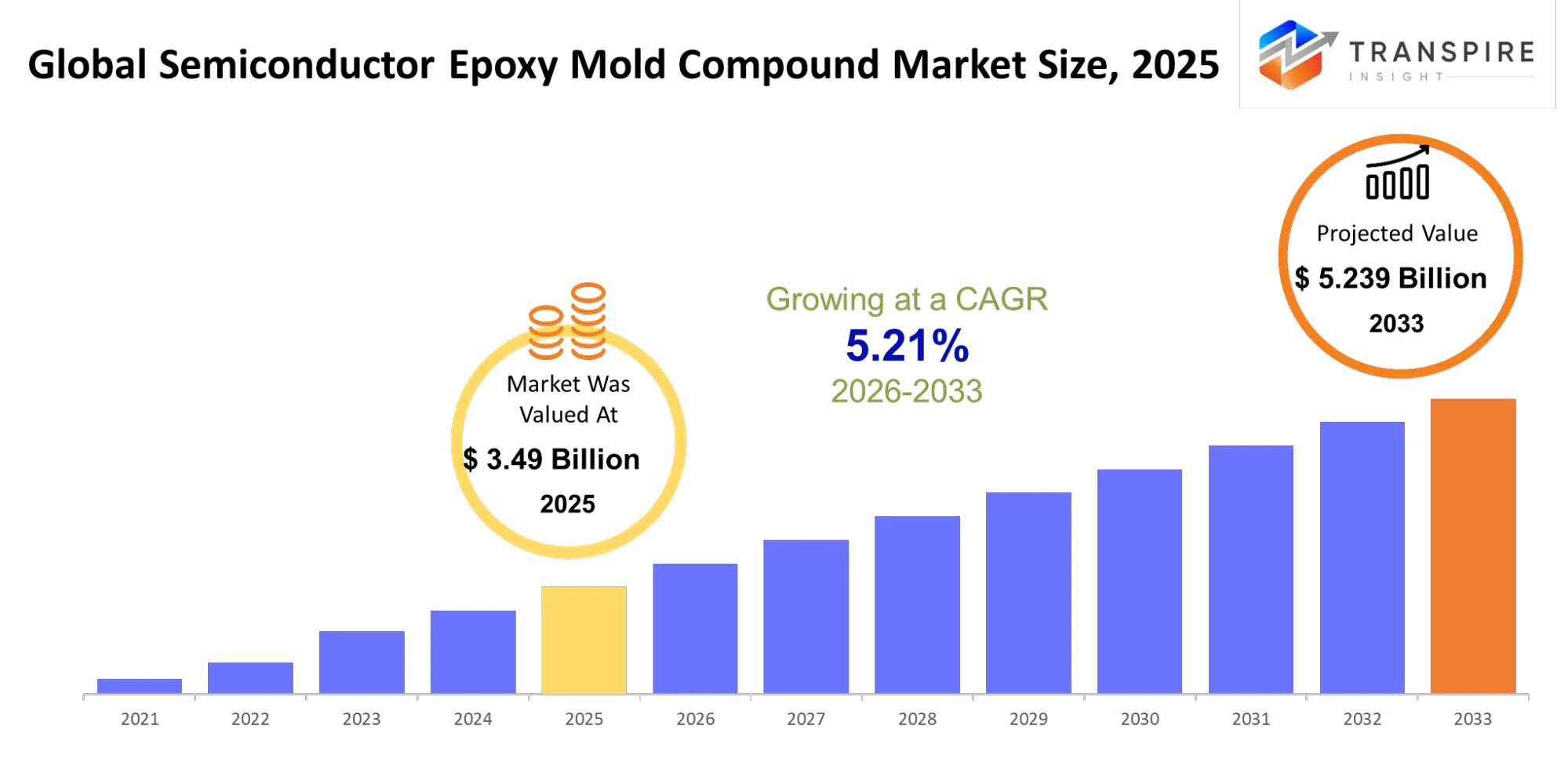
- Global Semiconductor Epoxy Mold Compound Market Size 2025: USD 3.49 billion
- Global Semiconductor Epoxy Mold Compound Market Size 2033: USD 5.239 billion
- Global Semiconductor Epoxy Mold Compound Market CAGR: 5.21%
- Global Semiconductor Epoxy Mold Compound Market Segments: By Type (Novolac Epoxy Mold Compounds, Cresol Novolac Compounds, Biphenyl Epoxy Compounds, Halogen-free Compounds, Green Mold Compounds, High Thermal Conductivity Compounds, Others); By Application (Integrated Circuits, Transistors, Memory Chips, Power Modules, Consumer Electronics Semiconductors, Others); By End-User (Semiconductor Manufacturers, Electronics OEMs, Automotive Electronics Producers, Others); By Form (Granular Compounds, Powder Compounds, Pelletized Compounds, Others)
Global Semiconductor Epoxy Mold Compound Market Summary:
The Global Semiconductor Epoxy Mold Compound Market size is estimated at USD 3.49 billion in 2025 and is anticipated to reach USD 5.239 billion by 2033, growing at a CAGR of 5.21% from 2026 to 2033. The semiconductor Epoxy Mold Compound (EMC) market provides absolute protection for microchips. Rather than leaving raw silicon unprotected from environmental threats. Manufacturers inject this specialized thermosetting plastic to sum up the chip, sealing it tightly against moisture, mechanical shock, and electrical interference.
In recent years, the volatile growth of artificial intelligence and electric vehicles (EVs) has completely upended standard packaging requirements. High-efficiency computing chips produce higher heat, while EV powertrains rely on advanced silicon carbide (SiC) semiconductors that operate at excess thermal limits. This pressures a massive structural change away from ordinary, low-cost resins toward ultra-high thermal conductivity compounds featuring specialized silica and alumina fillers.
A major real-world trigger happened as global factories quickly scaled production for High-Bandwidth Memory (HBM) and chiplet architectures (like TSMC’s CoWoS packaging). Due to these multi-layered stacks easily twisting under heat, the industry needed advanced liquid and granular EMCs engineered with ultra-low thermal growth. Thus, the market is growing fast. The physical demand for denser, hotter, and more complex chip layouts directly fuels a lucrative need for highly engineered, premium-grade encapsulation materials.
Key Market Insights:
The semiconductor epoxy mold compound has evolved steadily.
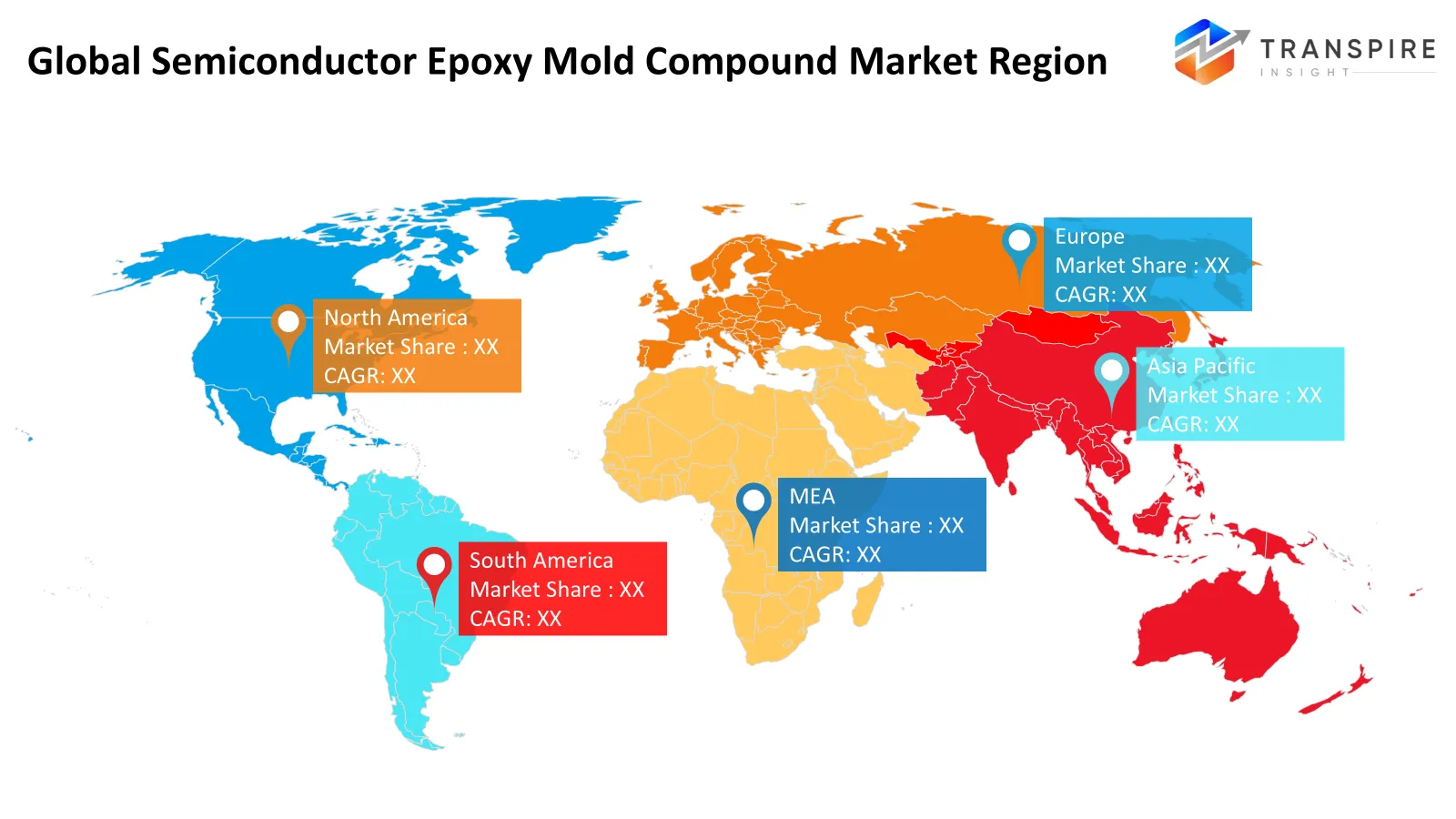
- Asia-Pacific is the dominating region with 46% market share.
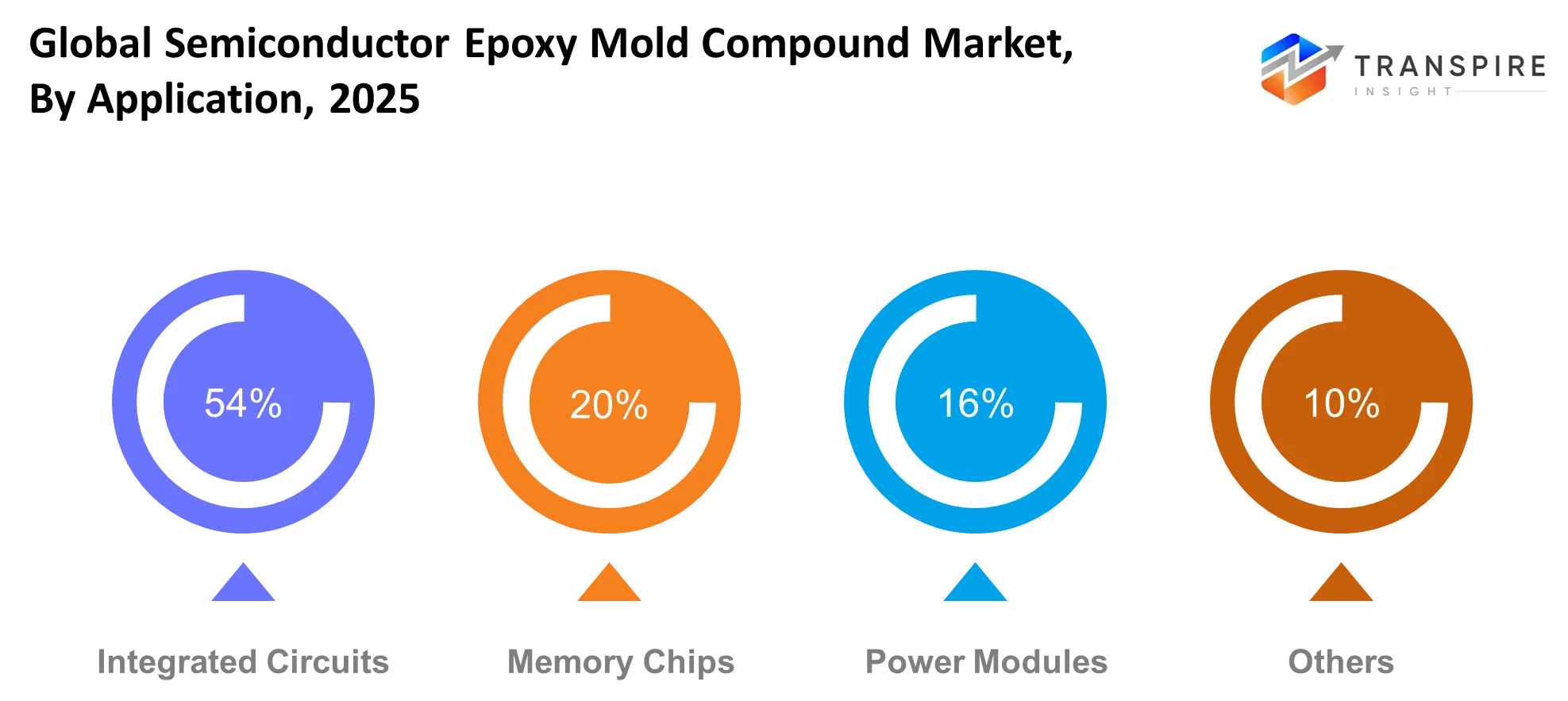
- Integrated circuits have a market share of 54%.
- North America is the fastest-growing region with a CAGR of 8.7%.
- Europe has a 22% market share.
- North America have 24% market share of semiconductor epoxy mold compound.
- Memory Chips has a market share of 20%.
- Power Modules has 16% market share in the semiconductor epoxy mold compound market.
What are the Key Drivers, Restraints, and Opportunities in the Semiconductor Epoxy Mold Compound Market?
Drivers
The transformation of 800 V architectures increases the need for high-voltage isolation. This drives high-margin specialized, thermally conductive EMCs. Faster arrangement of high-density AI accelerators requires advanced packaging (like CoWoS). This pushes a change to ultra-low warpage EMCs to protect massive, multi-die systems, accelerating revenue. The transformation to millimeter-wave occurrences requires low-loss materials to prevent signal degradation, sparking large adoption in RF modules. Nagase Mobility introduced new insert-molding technologies to improve heat scattering, reduce inductance, and support lighter EV designs. The advancement reflects increasing industry need for highly reliable semiconductor encapsulation materials in electric vehicles.
(Source- https://group.nagase.com/mobilitysolutions/en/columns/insert-molding-power-modules/ )
- In January 2026,Nagase Mobility highlighted new insert-molding technologies for automotive power modules that improve heat dissipation, reduce inductance, and support lighter EV designs. The development reflects growing industry demand for high-reliability semiconductor encapsulation materials in electric vehicles.
Restraints
Many countries are restricting risky flame-retardant chemicals. Companies must generate safer epoxy materials, but changing formulas is costly and inefficient. These strict safety and environmental laws continue to slow market growth and increase production costs for semiconductor epoxy mold manufacturers. Epoxy materials can break or weaken after long exposure to very high temperatures. Because of this, their use is limited in heavy industrial and aerospace electronics, where strong heat resistance and long-term durability are very important.
Opportunities
Combining silicon photonics with processors unlocks ultra-low-loss EMC advancement. For instance, huge R&D investment in Japan for optical-clear mold compounds. Moving from slices to big rectangular panels cuts costs in an extreme way. Keeping this in mind, Taiwan is expanding its packaging lines. Interchanging petroleum-based resins with sustainable options unlocks green supply chains.
What Has the Impact of Artificial Intelligence Been on the Semiconductor Epoxy Mold Compound Market?
AI has completely revolutionized the semiconductor Epoxy Mold Compound (EMC) market by fueling demand for advanced packaging solutions, such as 2.5D/3D integration, and by reengineering material design. Formulators use machine learning algorithms to automate and optimize molecular compounding. Rather than going through the trial and error of chemistry, AI mimics interactions between various resin matrix structures and silica fillers. This speeds up the development of compounds that conduct heat well and don't warp, which are key to high-performance computing.
Product reliability has also been dramatically enhanced as a result of better predictive capabilities. Stress variables for extreme thermal cycling are used to predict critical modes of failure, including die cracking, wire sweep, and delamination, in advance of a physical prototype being cast using AI models. Samsung Electronics boosted the capacity of semiconductor packaging of its AI chips for next-generation applications in automotive electronics and AI systems, employing new Epoxy Mold Compounds (Epoxies). The shift helped drive the global demand for high-performance semiconductor encapsulation materials.
(Source- https://www.sumibe.co.jp/english/?utm_source=chatgpt.com )
- In May 2026, Sumitomo Bakelite Co., Ltd. announced the trial launch of a new liquid encapsulant material for advanced AI semiconductor packages. The development supports high-performance AI chips by improving package reliability, heat resistance, and large-chip integration demand in the Semiconductor Epoxy Mold Compound Market.
Key Market Trends:
The global Epoxy Mold Compound (EMC) market has shifted from low-cost and general-purpose type encapsulation material to highly customised and thermally conductive materials. So that it can withstand dense and heterogeneous chip integration is shifting towards the direction of the latter.
- The solid pellet transfer molding method, which is traditional, is slowly being replaced by liquid and granular compression materials.
- To avoid wire sweep problems, the geometry of millimeter-sized fillers is being replaced by nano-spherical silica and alumina shapes.
- EMC's role is evolving from environmental protection to essential warpage management, and many new multi-functional epoxy systems are emerging to offset mismatched coefficients of thermal expansion.
- The adoption of Gallium Nitride (GaN) and Silicon Carbide (SiC) in EV power modules has resulted in high glass transition temperature compounds that are not degraded at temperatures above 175°C.
- The transition to environmentally friendly, halogen-free, or bio-based resins has been going on.
- Global packaging houses have been asking for geographic diversification and regional material validation from their EMC vendors due to continuing trade relations and tariff shifts.
- The entire material design behavior is predicting critical delamination risk based on machine learning simulations before volume casting.
Global Semiconductor Epoxy Mold Compound Market Segmentation
By Type
Biphenyl and the high thermal conductivity segment are the most dominant segments in this category, with their excellent thermal management capabilities. As artificial intelligence infrastructure and high-performance computing grow, these materials are technically needed to keep these chips from overheating in dense architectures. This is because their growth logic is different from traditional resins, which are not capable of coping with the intense heat dissipations required by next-generation processors. It results in a structural market lock-in for advanced biphenyl systems.
On the other hand, Green Mold Compounds is the fastest-growing segment with a rapid 9.8% CAGR. The growth is fuelled by ambitious global decarbonisation requirements and customer electronics OEMs requiring a high degree of halogen-free and bio-based materials to meet carbon-neutrality targets.
By Application
The Integrated Circuits (IC) segment dominates the global market with a huge market share of 54%. This is made possible by the common practice of heterogeneous integration, in which multiple chiplets are combined in a single module for consumer, industrial, and enterprise hardware. Here, the growth logic is bound to the complexity of the technology, with global tech infrastructure moving towards more complex System-in-Package configurations. IC encapsulation is an absolute manufacturing standard.
The application frontiers that are seeing the biggest growth are Memory Chips, particularly High Bandwidth Memory (HBM). Generative AI servers are being deployed on an unprecedented scale, requiring unprecedented data processing speeds, made possible by multi-layered, vertically stacked memory architectures. Due to the need for highly specialized molded underfill to flow smoothly between micro-bumps, avoiding defects, this application is forcing compound formulators to completely redesign low-viscosity materials.
Consumer Electronics semiconductors are in a mixed market, whereas transistors are in a mixed market. The consumer market is cyclical, dependent on the demand for smartphones and PCs, but power transistors are growing steadily, and specifically in the electric vehicle market. The successful development of this mixed segment will depend upon the availability of materials with a wide-bandgap, such as Silicon Carbide, that can operate in conditions above 175°C, and which are only just being made suitable for packaging.
By End-User
The top end-user segment is Semiconductor Manufacturers and Outsourced Assembly and Test (OSAT) providers. They are highly produced, and that production significantly impacts the global material standards. Their growth logic is tied very much to the mass production of silicon wafers across the world.
Automotive Electronics Producers are becoming the largest end-user segment. The sensor arrays used in autonomous driving and vehicle electrification are just one of a number of technologies that are rapidly evolving in the automotive sector, and demand a huge amount of high-reliability and specialized chips on a per-vehicle basis.
Electronic OEMs are standing at a crossroads and influencing position in the electronic market ecosystem. Although they do not necessarily buy raw epoxy mold compounds, they do indicate a change in behavior regarding sustainability, which directly impacts the rest of the supply chain.
By Form
Granular and Pelletized Compounds dominate the market because they can be used on high-volume, automated production lines. Traditional multi-cavity transfer molding processes have been using pellets for a long time, and now, the granular form has rapidly become the new trend in large panel compression molding.
Powder Compounds, meanwhile, are in steady decline and remain a small, “legacy” market share. They are still being used in low-grade, low-cost discrete component packaging, but physical properties cause contamination and void formation during the molding process.
What are the Key Use Cases Driving the Semiconductor Epoxy Mold Compound Market?
The primary use case that is shaping the market is high-density packaging for the dominant Integrated Circuits (IC) application. It is particularly for advanced heterogeneous integration, such as System-in-Package (SiP). In this case, epoxy mold compounds (EMCs) are used to control structural warpage and to insulate between multiple dies in a complex layout.
Automotive electronics continues to drive expansion, with the need to electrify vehicles demanding the development of special power modules. Such applications require an EMC with high thermal conductivity that can withstand the extreme wide-bandgap in electric vehicle traction inverters.
Use cases are emerging, and the focus is very strong on AI infrastructure and High Bandwidth Memory (HBM). The ultra-low viscosity, liquid or granular molded underfill (MUF) of these next-generation chip architectures ensures flawless, void-free, and leak-free flows between tightly packed micro-bumps.
Report Metrics
|
Report Metrics |
Details |
|
Market size value in 2025 |
USD 3.49 Billion |
|
Market size value in 2026 |
USD 3.672 Billion |
|
Revenue forecast in 2033 |
USD 5.239 Billion |
|
Growth rate |
CAGR of 5.21% from 2026 to 2033 |
|
Base year |
2025 |
|
Historical data |
2021 - 2024 |
|
Forecast period |
2026 - 2033 |
|
Report coverage |
Revenue forecast, competitive landscape, growth factors, and trends |
|
Regional scope |
United States; Canada; Mexico; United Kingdom; Germany; France; Italy; Spain; Denmark; Sweden; Norway; China; Japan; India; Australia; South Korea; Thailand; Brazil; Argentina; South Africa; Saudi Arabia; United Arab Emirates |
|
Key company profiled |
Sumitomo Bakelite, Hitachi Chemical, Panasonic, Samsung SDI, Henkel, Nitto Denko, Resonac Holdings, Kyocera, BASF, Shin-Etsu Chemical, Chang Chun Group, Eternal Materials, Hexion, NAMICS, Tong Hsing |
|
Customization scope |
Free report customization (country, regional & segment scope). Avail customized purchase options to meet your exact research needs. |
|
Report Segmentation |
By Type (Novolac Epoxy Mold Compounds, Cresol Novolac Compounds, Biphenyl Epoxy Compounds, Halogen-free Compounds, Green Mold Compounds, High Thermal Conductivity Compounds, Others); By Application (Integrated Circuits, Transistors, Memory Chips, Power Modules, Consumer Electronics Semiconductors, Others); By End-User (Semiconductor Manufacturers, Electronics OEMs, Automotive Electronics Producers, Others); By Form (Granular Compounds, Powder Compounds, Pelletized Compounds, Others). |
Which Regions are Driving the Global Semiconductor Epoxy Mold Compound Market Growth?
Asia Pacific is the major region leading this global Semiconductor epoxy mold compound market, accounting for 46% of the market share. The region's compounding effect is the large number of outsourced semiconductor assembly and test facilities (OSATs) and big electronics firms. Some of the significant players in this region are Sumitomo Bakelite Co., Ltd., Resonac, Samsung SDI, and KCC Corporation.
Sumitomo Bakelite introduced a new line of liquid encapsulants for advanced semiconductor packages, called EME-L. In order to satisfy the requirements of AI-driven 2.5D/3D chip packaging and large chiplet architecture, the new material features increased low warpage performance and package reliability. This is the launch that propels the growth of the region. In May 2026, Sumitomo Bakelite announced the trial launch of its EME-L series liquid encapsulant for advanced semiconductor packages. The new material was designed for AI-driven 2.5D/3D chip packaging and large chiplet architectures, improving low warpage performance and package reliability.
North America is the second largest market with 24% market share. North America, it seems, can match it for the high level of technologically advanced designs with a high dollar value, although it appears to be lagging behind it in terms of actual production volume. Hexion Inc., Henkel, and Eastman Chemical Company are some of the key players in the region. At the 2026 Technology Symposium in California, TSMC announced its next-generation A13 semiconductor technology. The launch showcased the growing demand for advanced semiconductor packaging materials, such as high-performance epoxy mold compounds for thermal protection, chip durability, and packaging of AI processors in North America. In April 2026, TSMC launched its next-generation A13 semiconductor technology during the 2026 North America Technology Symposium in California. The launch highlighted rising demand for advanced semiconductor packaging materials, including high-performance epoxy mold compounds used for thermal protection, chip durability, and AI processor packaging in North America.
Also, North America is the fastest-growing region with a CAGR of 8.7%. The impetus for this sudden acceleration has come from aggressive diversification of supply chains, domestic tariff policies, and strategic government-based incentives that strongly favour local sourcing of materials. This is causing global compounders to increasingly move production nearer to home and work with domestic resin developers to limit the impact of geopolitical events on production lines. Advanced semiconductor packaging experienced higher investments in North America as Intel boosts its investments in advanced chips for AI and data-center applications, driving demand for low-temperature curing semiconductor epoxy mold compounds, critical for advanced chip packaging, encapsulation, and thermal protection.
Who are the Key Players in the Global Semiconductor Epoxy Mold Compound Market and how do they Compete?
The global Semiconductor Epoxy Mold Compound Market is highly competitive, with the presence of several diversified electronics conglomerates and specialized chemical companies dominating in advanced packaging. It's a competitive market for companies based on how pure the material is, and its thermal reliability and ability to fit in next-generation chip architectures, such as 3D stacking and fan-out wafer-level packaging.
Sumitomo Bakelite differentiates its offering through high-growth, aggressive product innovation, and expansion through dedicated production units in the region for ultra-low stress materials used in the manufacture of AI chips. Resonac Holdings (previously known as Hitachi Chemical) pursues a niche strategy, targeting high-reliability thermal management resins used in automotive power modules, with expansion coming from joint ventures with wafer foundries. Panasonic sets the price in line with the cost, offers a variety of high-yield, standardized encapsulated sheets, and is growing through the use of highly automated manufacturing lines with high volume production in Asia. Shin-Etsu Chemical's strategy is to innovate, differentiate with its exclusive high-purity synthetic quartz fillers, and expand by incorporating upstream silicon supply chains. Lastly, Henkel applies a niche strategy and differentiates by developing new liquid epoxy encapsulants for specific medical microelectronics and continues its growth through strategic acquisitions of regional specialty chemical formulators.
Key Epoxy Mold Compound Market Companies
- Sumitomo Bakelite
- Hitachi Chemical
- Panasonic
- Samsung SDI
- Henkel
- Nitto Denko
- Resonac Holdings
- Kyocera
- BASF
- Shin-Etsu Chemical
- Chang Chun Group
- Eternal Materials
- Hexion
- NAMICS
- Tong Hsing
Recent Development News
In May 2026, Henkel launched Technomelt PA 6370, an ultra-low viscosity molding material for advanced electronic device protection. The launch improved rugged protection and reliability for semiconductor and electronics components used in harsh environments.
(Source- https://www.henkel.com)
What Strategic Insights Define the Future of the Semiconductor Epoxy Mold Compound Market?
The industry is moving towards green thermal resins to cater to high-power AI chips and EV modules. But there is a covert threat of an upstream shortage of ultrafine spherical silica fillers, which could disrupt the development of these new materials. The solution is for suppliers to capitalize on an untapped opportunity, which is the development of green resins that are halogen-free and bio-based, adhering to global environmental regulations. The key to mitigating such geopolitical threats is to take a strong vertical approach to supply chain management through supply agreements or refining partnerships domestically.
Global Semiconductor Epoxy Mold Compound Market Segmentation
By Type
- Novolac Epoxy Mold Compounds
- Cresol Novolac Compounds
- Biphenyl Epoxy Compounds
- Halogen-free Compounds
- Green Mold Compounds
- High Thermal Conductivity
- Compounds
- Others
By Application
- Integrated Circuits
- Transistors, Memory Chips
- Power Modules
- Consumer Electronics Semiconductors
- Others
By End-User
- Semiconductor Manufacturers
- Electronics OEMs
- Automotive Electronics Producers
- Others
By Form
- Granular Compounds
- Powder Compounds
- Pelletized Compounds
- Others
Frequently Asked Questions
Find quick answers to common questions.
The global semiconductor epoxy mold compound market size was valued at USD 3.49 billion in 2025 and is poised to reach USD 5.239 billion by 2033, expanding at a 5.21% CAGR.
Key segments for the global semiconductor epoxy mold compound market are By Type (Novolac Epoxy Mold Compounds, Cresol Novolac Compounds, Biphenyl Epoxy Compounds, Halogen-free Compounds, Green Mold Compounds, High Thermal Conductivity Compounds, Others); By Application (Integrated Circuits, Transistors, Memory Chips, Power Modules, Consumer Electronics Semiconductors, Others); By End-User (Semiconductor Manufacturers, Electronics OEMs, Automotive Electronics Producers, Others); By Form (Granular Compounds, Powder Compounds, Pelletized Compounds, Others).
Growth of the global semiconductor epoxy mold compound market is primarily driven by high-power automotive electronics, AI data center scaling, 5G/6G High-Frequency Hardware, and IoT Miniaturization.
The global semiconductor epoxy mold compound market is led by major manufacturers, such as Sumitomo Bakelite, Hitachi Chemical, Panasonic, Samsung SDI, Henkel, Nitto Denko, Resonac Holdings, Kyocera, BASF, Shin-Etsu Chemical, Chang Chun Group, Eternal Materials, Hexion, NAMICS, and Tong Hsing.
Asia-Pacific holds 46% of the global semiconductor epoxy mold compound market, driven by strong semiconductor manufacturing in China, Taiwan, South Korea, and Japan. The region dominates due to high AI chip production, advanced packaging facilities, rising EV electronics demand, and large investments in semiconductor supply chains.
Commercial opportunities in the global semiconductor epoxy mold compound market include ultra-low-loss EMC development for silicon photonics and AI processors, large rectangular panel packaging expansion in Taiwan to reduce costs, and sustainable bio-based resin adoption for greener semiconductor supply chains.
- Sumitomo Bakelite
- Hitachi Chemical
- Panasonic
- Samsung SDI
- Henkel
- Nitto Denko
- Resonac Holdings
- Kyocera
- BASF
- Shin-Etsu Chemical
- Chang Chun Group
- Eternal Materials
- Hexion
- NAMICS
- Tong Hsing
About the Authors

Pankaj Ghogare Patil
I am Pankaj Ghogare Patil, a Senior Research Analyst at Transpire Insight, specializing in the Pharmaceutical, Chemicals & Materials, Healthcare IT, and Biotechnology industry. My expertise lies in conducting comprehensive market research, analyzing industry trends, evaluating competitive landscapes, and translating complex data into actionable insights. At Transpire Insight, I closely follow emerging technologies, regulatory developments, and market innovations to create accurate, well-researched, and informative content that helps businesses and professionals make informed decisions. I am committed to producing credible, evidence-based articles that reflect industry best practices while making technical topics accessible and valuable for a broad audience.

Chakradhar Khansole
Chakradhar serves as the Research Director at Transpire Insight, bringing over 8 years of experience in technology, innovation, and strategic market intelligence. He specializes in transforming complex market data into actionable business insights that enable organizations to make informed, growth-oriented decisions. Recognized for his strategic vision and analytical expertise, Chakradhar leads high-impact research initiatives, delivering comprehensive market assessments, competitive intelligence, and forward-looking industry analysis.
Recently Published Reports
-
May 2026
Healthcare Polymer Packaging Market
Healthcare Polymer Packaging Market Size, Share & Analysis Report By Packaging Type (Syringes, IV Bottles and Pouches, Clamshells, Blisters, Bottles & Jars, Containers, Tubes, IV Parental Packaging, Others), By Type (Regulated, Non-regulated), By Polymer Type (LDPE (Low-Density Polyethylene), HDPE (High-Density Polyethylene), Homo-polymer (Homo), Random Copolymer (Random), Block Copolymer (Block), PET, Polystyrene, Polyvinyl Chloride, Polyamide/EVOH, Others), and Geography (North America, Europe, Asia-Pacific, Middle East and Africa, South and Central America), 2021 - 2031
-
Apr 2026
Hydrophilic Tape (Waterstop) Market
Hydrophilic Tape (Waterstop) Market Size, Share & Analysis Report By Type (Bentonite-Based Hydrophilic Tape, Rubber-Based Hydrophilic Tape), By Application (Residential Buildings, Commercial Buildings, Infrastructure Projects), and Geography (North America, Europe, Asia-Pacific, Middle East and Africa, South and Central America), 2021 - 2031
-
Apr 2026
Metalens Market
Metalens Market Size, Share & Analysis Report By Type (Visible Light Metalens, and Infrared Metalens), By Application (Consumer Electronics, Automotive Electronics, Industrial, Medical, and Others), and Geography (North America, Europe, Asia-Pacific, Middle East and Africa, South and Central America), 2021 - 2031
-
Apr 2026
PBT Resin Market
PBT Resin Market Size, Share & Analysis Report By Type (Reinforced PBT Resin, Unreinforced PBT Resin), By Processing Method (Injection Molding, Extrusion, Blow Molding, Others), By End-User (Automotive, Electrical & Electronics, Consumer Appliances, Industrial Machinery, Medical Devices, Packaging, Others), and Geography (North America, Europe, Asia-Pacific, Middle East and Africa, South and Central America), 2021 - 2031