
Global Self-Tanning Products Market Summary:
According to Transpire Insights, a detailed research report on the market reflects that the lotions segment dominates the Global Self-Tanning Products Market, accounting for approximately 44% of the total market share worldwide. Beiersdorf AG leads the market with approximately EUR 9.5 billion (USD 10.3 billion) in annual revenue and an estimated 16–20% global market share, making it a leading contributor to market growth through advanced self-tanning formulations, continuous product innovation, clean beauty and skincare solutions, enhanced long-lasting tanning performance, and expanding applications across personal care, cosmetics, and beauty retail channels.
Market Snapshot
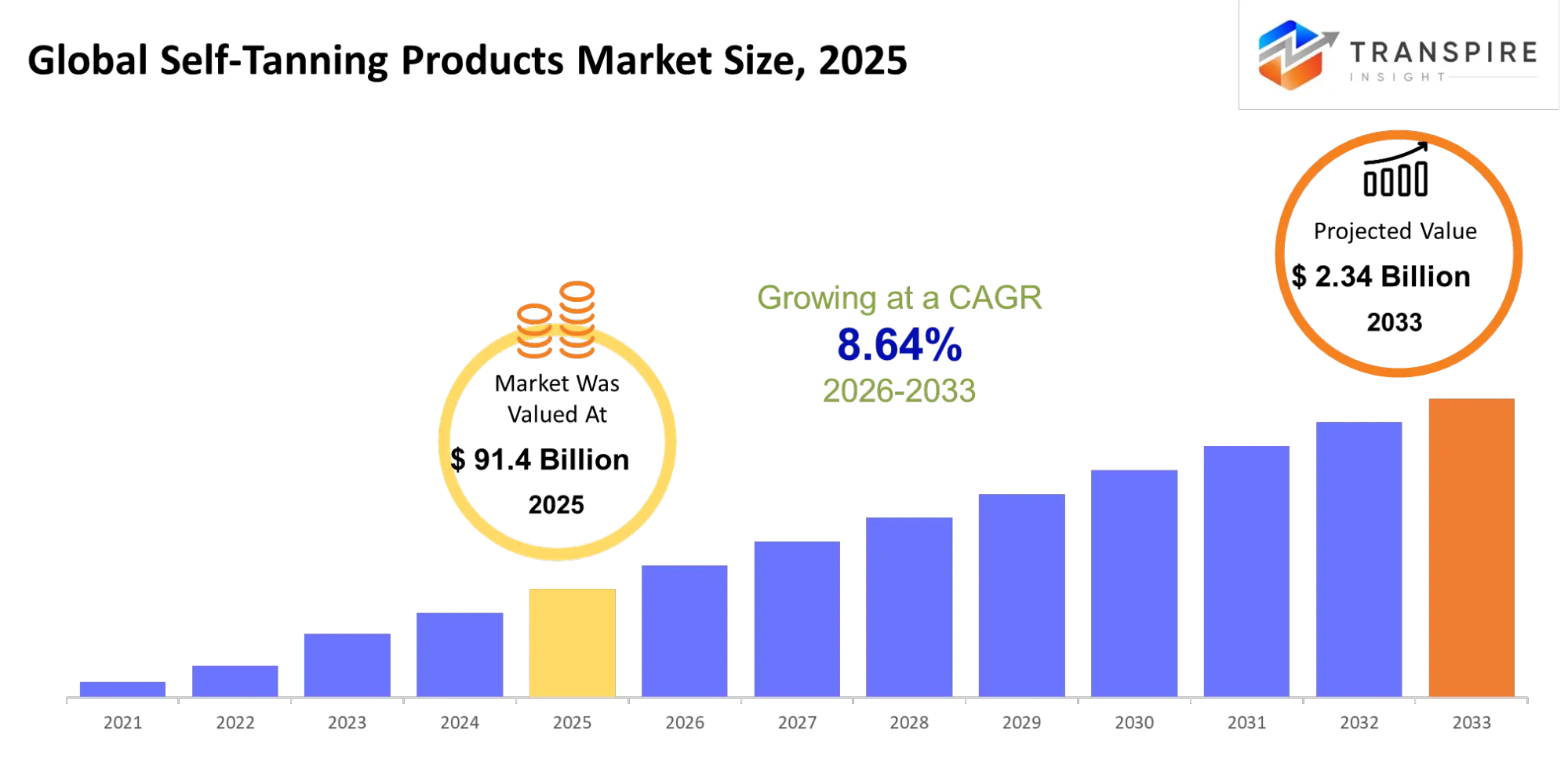
- Global Market Value (2025):USD 91.4 Billion.
- Expected Market Value (2026): USD 1.31 Billion.
- Estimated Market Value (2033): USD 2.34 Billion.
- Forecast CAGR (2026–2033): 8.64%
- Leading Region in 2025: Asia Pacific
- Second-largest Region: Europe
- Fastest Growing Region: North America
Introduction
The Self-Tanning Products Market comprises cosmetic formulations designed to provide a sunless tan by temporarily darkening the skin without exposure to ultraviolet (UV) radiation. These products are developed using advanced formulation technologies and skin-friendly ingredients to deliver natural-looking, streak-free, and long-lasting tanning results while meeting stringent cosmetic safety, clean beauty, and regulatory standards across lotions, mousses, sprays, gels, serums, and wipes.
Sunless Tanning Solution: Provides a natural-looking tan without harmful UV exposure. Skin-Friendly Formulations: Enhances skin appearance while incorporating moisturizing and nourishing ingredients. Clean Beauty Innovation: Supports naturally derived, vegan, cruelty-free, and skin-conscious product development. Regulatory Compliance: Meets global cosmetic safety, labeling, and quality standards.
- For instance: Growing consumer preference for UV-free tanning solutions, increasing awareness of skin health and sun protection, rising demand for clean and vegan beauty products, and expanding personal care and cosmetics industries are driving the demand for self-tanning products.
Market Highlights: -
- Asia Pacific is expected to grow at a rapid CAGR in the Global Self-Tanning Products Market by holding nearly 39% of the share during the forecast period.
- North America is the fastest-growing region in the Global Self-Tanning Products Market during the period, holding around 31% share.
- Europe is anticipated to hold approximately 24% share of the Global Self-Tanning Products Market over the predicted timeframe.
- By Product Type, the Self-Tanning Lotions segment dominated the market and holds nearly 44.0% share in 2025 and is projected to grow at a substantial CAGR during the forecast period.
- By Application, the Body Tanning segment dominated the market and holds almost 46.8% share in 2025 and is projected to grow at a substantial CAGR during the forecast period.
- By End User, the Women segment dominated the market and holds approximately 48.2% share in 2025 and is projected to grow at a substantial CAGR during the forecast period.
- By Ingredient Type, the DHA-based segment dominated the market and holds roughly 47.3% share in 2025 and is projected to grow at a substantial CAGR during the forecast period.
- By Distribution Channel, the Online Retail segment dominated the market and holds around 42.6% share in 2025 and is projected to grow at a substantial CAGR during the forecast period.
- Growing Consumer Preference for UV-Free Tanning Solutions and Increasing Adoption of Clean Beauty Products: Cosmetic manufacturers, skincare brands, beauty retailers, professional salons, and e-commerce platforms across Asia Pacific, North America, and Europe are increasing investments in self-tanning products, skin-friendly formulations, clean-label beauty innovations, and advanced tanning technologies to deliver natural-looking, long-lasting results while meeting evolving consumer demand for safe, convenient, and sunless tanning solutions.
How is Technology Driving Growth in the Self-Tanning Products Market?
The market for self-tanning products is expanding due to continuous advancements in cosmetic formulation technologies, skin-friendly ingredient development, and innovative product delivery systems. Modern solutions such as advanced DHA formulations, erythrulose-enhanced tanning technologies, microencapsulation techniques, fast-drying formulations, and precision blending technologies provide natural-looking results, improved skin compatibility, and long-lasting tanning performance. Innovations in airless packaging, automated manufacturing systems, quality monitoring technologies, ingredient standardization, advanced emulsion technologies, and automated quality control enable cosmetic manufacturers to achieve consistent product performance while complying with stringent cosmetic safety and quality regulations. These technological developments are driving wider adoption across cosmetic manufacturers, skincare brands, beauty retailers, professional salons, e-commerce platforms, and personal care companies while improving product quality, formulation reliability, operational efficiency, and sustainable beauty manufacturing.
Market Drivers
The global market for Self-Tanning Products is being driven by growing consumer preference for UV-free tanning solutions and increasing awareness of the harmful effects of excessive sun exposure. The rising adoption of clean beauty products, skin-friendly cosmetic formulations, and premium self-care routines is accelerating demand for self-tanning products that deliver natural-looking results while promoting healthier skincare practices. These trends are encouraging manufacturers and cosmetic companies to invest in advanced formulation technologies, innovative tanning ingredients, and high-performance self-tanning solutions. In the Global Self-Tanning Products Market, companies are expanding product portfolios, enhancing formulation performance, improving skin compatibility, and creating new growth opportunities.
- For Instance: - Beiersdorf AG continues to advance skincare innovation by developing high-performance self-tanning product solutions that deliver natural-looking tanning results, enhance skin hydration, comply with global cosmetic safety standards, and improve the quality of premium personal care and beauty products.
Restrain
The main obstacles to the Global Self-Tanning Products Market are high product development costs and stringent cosmetic safety and regulatory compliance requirements. Production expenses are further increased by advanced formulation technologies, premium skincare ingredients, extensive product testing, and continuous research and development activities. Complex manufacturing processes, fluctuating raw material prices, and higher production costs associated with clean-label, vegan, and skin-friendly self-tanning formulations compared to conventional cosmetic products limit widespread adoption. These factors may hinder the large-scale commercialization and market growth of self-tanning products.
Analysis of Prices and Consumer Behaviour
The Global Self-Tanning Products Market demonstrates diverse pricing trends based on formulation quality, ingredient composition, brand positioning, and product format. Premium self-tanning products formulated with advanced DHA, erythrulose, organic plant-based ingredients, and skin-nourishing formulations are typically priced 25–40% higher than conventional self-tanning products due to superior performance, longer-lasting results, and enhanced skincare benefits. Consumers increasingly prioritize natural-looking results, clean-label ingredients, vegan and cruelty-free certifications, ease of application, and long-lasting tanning performance over low-cost alternatives. Online retail platforms and specialty beauty stores continue to influence purchasing decisions by offering wider product availability, competitive pricing, product reviews, and personalized recommendations. Premium and dermatologist-tested self-tanning products account for nearly 58% of total market revenue, while online retail contributes approximately 43% of total product sales, reflecting strong consumer preference for convenient shopping experiences and high-quality skincare solutions.
Top Companies in the Global Self-Tanning Products Market
- L'Oréal
- Estée Lauder
- St. Tropez
- Bondi Sands
- Isle of Paradise
- Coco & Eve
- Beiersdorf
- Johnson & Johnson
- Clarins
- Vita Liberata
- Tan-Luxe
- Loving Tan
- Bali Body
- MineTan
- Australian Gold
Market Segmentation
The Global Self-Tanning Products Market share is divided into five categories: Product Type, Ingredient Type, End User, Distribution Channel, Application.
The Self-Tanning Lotionsdominated the market, accounting for nearly 44.0% in 2025, and is expected to rise at a significant CAGR during the forecast period.
The Global Self-Tanning Products Market is segmented By Product Type Self-Tanning Lotions, Self-Tanning Mousses, Self-Tanning Sprays, Self-Tanning Drops, Self-Tanning Wipes, Self-Tanning Gels, Self-Tanning Serums, Others. Among these, the Self-Tanning Lotions dominated the market, accounting for nearly 44.0% in 2025 and expected to increase at a significant CAGR during the forecast period. Due to their easy application, even coverage, moisturizing properties, long-lasting results, suitability for all skin types, wide consumer acceptance, and strong availability across retail and online distribution channels.
The DHA-based segmentheld the greatest share of approximately 47.3% in 2025 and is expected to increase at a substantial CAGR over the forecast period.
The GlobalSelf-Tanning Products Marketis segmented By Ingredient Type (DHA-based, Erythrulose-based, Natural Plant-based, Organic Formulations, Vitamin-enriched, Aloe Vera-based, Hybrid Formulations, Others. Among these, the DHA-based segment held the greatest share of approximately 47.3% in 2025 and is expected to increase at a substantial CAGR over the forecast period.because they provide safe, reliable, and natural-looking tanning results, deliver consistent skin color development, are widely approved for cosmetic use, and are compatible with most self-tanning product formulations.
The Women segmentheld the greatest share of approximately 48.2%in 2025 and is expected to increase at a high CAGR over the forecast period.
The Global Self-Tanning Products Marketis segmented.By End User Women, Men, Professional Salons, Beauty Clinics, Spas, Cosmetic Retailers, Individual Consumers, Others. Among these, the Women segment held the greatest share of approximately 48.2% in 2025 and is expected to increase at a considerable CAGR over the projected period. due to higher spending on beauty and personal care products, greater adoption of self-tanning routines, strong skincare awareness, frequent product usage, and demand for premium cosmetic solutions.

Regional Segment Analysis of the Global Self-Tanning Products Market
- North America (U.S., Canada, Mexico)
- Europe (Germany, France, U.K., Italy, Spain, Rest of Europe)
- Asia-Pacific (China, Japan, India, Rest of APAC)
- South America (Brazil and the Rest of South America)
- The Middle East and Africa (UAE, South Africa, Rest of MEA)
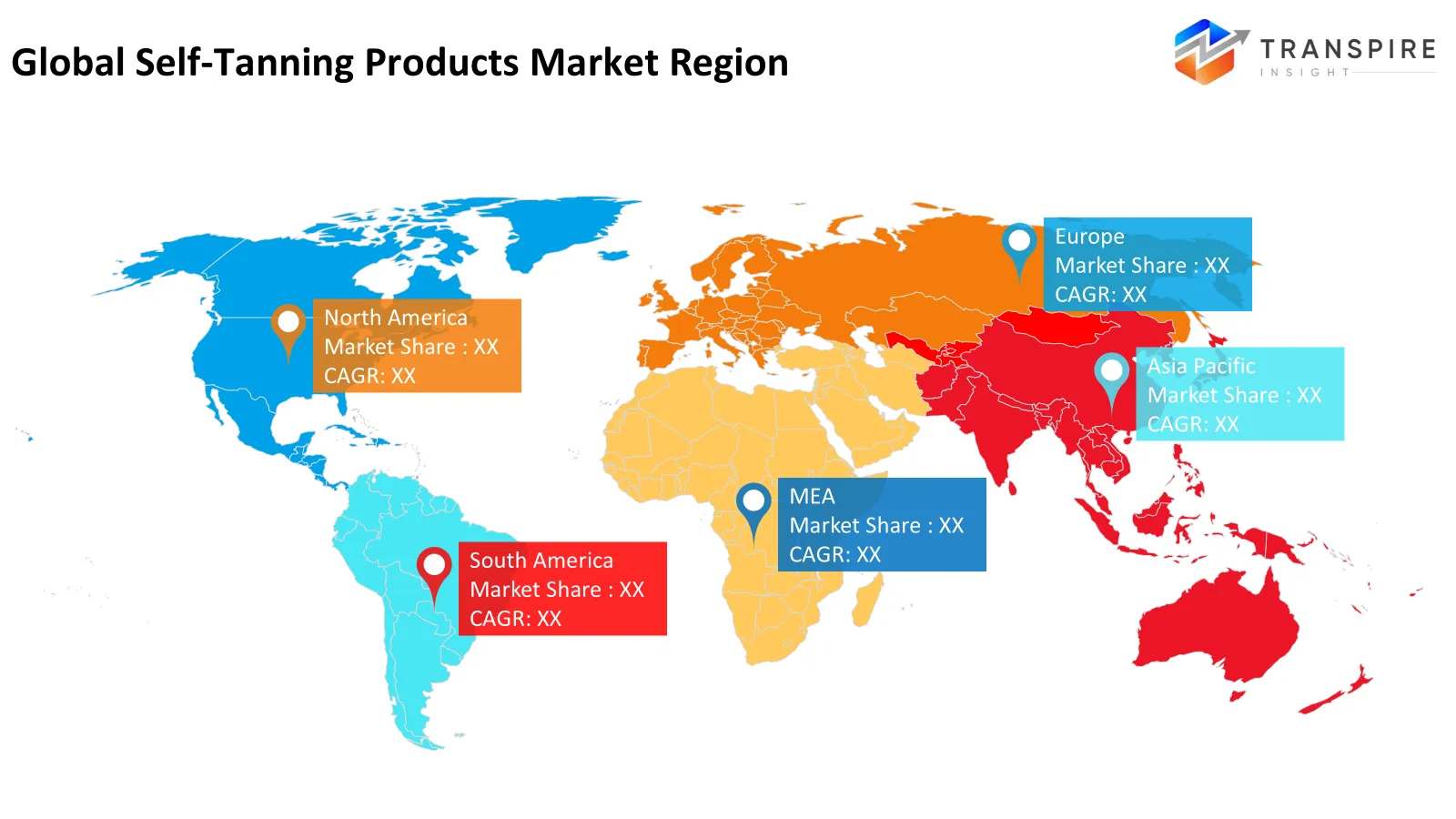
Asia Pacific is expected to grow at a rapid CAGR in the Global Self-Tanning Products Market by holding nearly 39% of the share during the forecast period.
Over the course of the forecast period, the Global Self-Tanning Products Market is anticipated to rise rapidly in Asia Pacific. It makes up about 39% of the market. The region dominates this market because of the expanding beauty and personal care industry, increasing consumer awareness of UV-free tanning solutions, rising demand for premium skincare products, and growing cosmetics manufacturing activities, particularly in China, India, Japan, South Korea, and Australia. Demand is further fueled by increasing investments in innovative cosmetic formulations, strong growth of e-commerce beauty platforms, and expanding premium beauty retail networks. Additionally, the increasing focus on clean beauty, skin health, and sunless tanning solutions is strengthening Asia Pacific's position as the leading regional market.
Europe is the fastest-growing region in the Global Self-Tanning Products Market during the period, holding approximately 24% share.
With an estimated 24% of the Global Self-Tanning Products Market share throughout the projection period, Europe is expected to grow at the highest rate. The region's expansion is driven by stringent cosmetic safety regulations, increasing consumer demand for premium beauty and skincare products, growing preference for clean and vegan cosmetic formulations, and strong investments in advanced cosmetic research and product innovation. Countries such as Germany, France, Italy, and the U.K. are emphasizing sustainable beauty, skin health, and UV-free tanning solutions. Collaborations between cosmetic manufacturers, skincare brands, research institutes, and beauty technology companies are accelerating the adoption of self-tanning products, supporting long-term market growth across Europe.
North America is anticipated to hold approximately 31% share of the Global Self-Tanning Products Market over the predicted timeframe.
North America is estimated to account for nearly 31% of the Global Self-Tanning Products Market over the forecast period. The region is expected to grow steadily, supported by stringent cosmetic safety regulations, widespread adoption of premium skincare and beauty products, and a well-established personal care and cosmetics industry. Rising demand for UV-free tanning solutions, increasing investments in advanced cosmetic formulation technologies, and continuous advancements in skin-friendly self-tanning products further contribute to market growth. Furthermore, efforts to improve product performance, enhance skin compatibility, and expand the production of clean-label, vegan, and dermatologist-tested self-tanning products are driving innovation, product adoption, and commercialization across North America.
Strategies for Market Growth in Non-Leading Regions:
Non-leading regions can spur growth by establishing cost-effective and scalable manufacturing infrastructure for self-tanning products using advanced formulation technologies, high-quality cosmetic ingredients, automated production systems, and efficient cosmetic manufacturing processes. This will reduce reliance on imported beauty products and strengthen regional personal care and cosmetics manufacturing ecosystems by developing local production and product innovation capabilities. Strategic collaborations with cosmetic manufacturers, skincare brands, beauty retailers, research institutes, technology providers, and government agencies will help accelerate commercialization and market penetration. Investments in workforce training, R&D, self-tanning formulation technologies, cosmetic ingredient innovation, quality assurance systems, process automation, and cosmetic safety management are crucial for improving product quality and operational efficiency. Additionally, government support for cosmetics manufacturing programs, beauty industry initiatives, sustainable product development incentives, and cosmetic safety regulations can improve accessibility, attract investment, and accelerate the long-term expansion of the Global Self-Tanning Products Market in emerging economies worldwide.
Future Market Trends for the Global Self-Tanning Products Market: -
- Rising Adoption of Clean Beauty and Skin-Friendly Formulations, as manufacturers focus on developing premium cosmetic products and meeting consumer demand for safe and natural beauty solutions, companies are increasingly developing self-tanning products with enhanced skin compatibility, improved hydration, and long-lasting natural-looking results.
- Growing Demand for UV-Free Tanning and Personalized Beauty Solutions, cosmetic manufacturers, skincare brands, beauty retailers, and personal care companies are increasingly integrating advanced self-tanning formulations into lotions, mousses, sprays, serums, and drops to deliver convenient application, customizable tanning intensity, and healthier alternatives to sun exposure.
- Technological and Product Innovations, companies are investing in advanced formulation technologies, microencapsulation techniques, automated cosmetic manufacturing systems, ingredient standardization, sustainable packaging, and digital quality control to improve product consistency, reduce production costs, enhance manufacturing efficiency, and support next-generation self-tanning and skincare solutions.
Recent Development
- February 17, 2026 – Beiersdorf AG (Germany): Introduced advanced self-tanning skincare solutions featuring enhanced DHA-based formulation technology and skin-hydrating ingredients. The innovation improves natural-looking tanning results, enhances skin hydration, extends tan longevity, and strengthens next-generation premium self-tanning and skincare applications.
- May 26, 2026 – L'Oréal S.A. (France): Expanded its self-tanning product portfolio with next-generation sunless tanning formulations designed for faster color development, improved streak-free application, and enhanced skin compatibility. The development improves product performance, increases formulation flexibility, and supports advanced personal care, beauty, and professional skincare applications.
Market Segment
This study forecasts revenue at global, regional, and country levels from 2020 to 2033. Transpire Insights has segmented the Global Self-Tanning Products Market based on the below-mentioned segments:
Global Self-Tanning Products Market, By Product Type
- Self-Tanning Lotions
- Self-Tanning Mousses
- Self-Tanning Sprays
- Self-Tanning Drops
- Self-Tanning Wipes
- Self-Tanning Gels
- Self-Tanning Serums
- Others
Global Self-Tanning Products Market, By Ingredient Type
- DHA-based
- Erythrulose-based
- Natural Plant-based
- Organic Formulations
- Vitamin-enriched
- Aloe Vera-based
- Hybrid Formulations
- Others
Global Self-Tanning Products Market, By End User
- Women
- Men
- Professional Salons
- Beauty Clinics
- Spas
- Cosmetic Retailers
- Individual Consumers
- Others
Global Self-Tanning Products Market, By Distribution Channel
- Online Retail
- Supermarkets & Hypermarkets
- Specialty Beauty Stores
- Pharmacies
- Direct Sales
- Department Stores
- Salons
- Others
Global Self-Tanning Products Market, By Application
- Face Tanning
- Body Tanning
- Professional Salon Use
- Home Care
- Bridal Beauty
- Sports & Fitness
- Cosmetic Enhancement
- Others
Global Self-Tanning Products Market, By Regional Analysis
North America
- United States
- Canada
- Mexico
Europe
- Germany
- United Kingdom
- France
- Italy
- Spain
- Russia
- Rest of Europe
Asia Pacific
- China
- Japan
- India
- South Korea
- Australia
- Rest of Asia Pacific
South America
- Brazil
- Argentina
- Rest of South America
Middle East & Africa
- Saudi Arabia
- United Arab Emirates
- Qatar
- South Africa
- Rest of the Middle East & Africa
Frequently Asked Questions
Find quick answers to common questions.
Rising awareness of the harmful effects of UV exposure, growing preference for sunless tanning solutions, and increasing demand for clean beauty and premium skincare products are driving global market growth.
Self-tanning lotions offer easy application, even coverage, moisturizing benefits, long-lasting results, compatibility with all skin types, and strong availability through retail and online channels.
DHA-based formulations provide safe, reliable, and natural-looking tanning results, ensure consistent color development, are widely approved for cosmetic use, and are compatible with most self-tanning product formulations.
Asia Pacific is projected to lead the market due to its expanding beauty and personal care industry, rising demand for premium skincare products, increasing consumer awareness of UV-free tanning, and strong cosmetics manufacturing.
Advanced DHA formulations, microencapsulation, fast-drying technologies, automated manufacturing, and quality control systems are improving product performance, skin compatibility, manufacturing efficiency, and sustainable beauty innovation.
- L'Oréal
- Estée Lauder
- St. Tropez
- Bondi Sands
- Isle of Paradise
- Coco & Eve
- Beiersdorf
- Johnson & Johnson
- Clarins
- Vita Liberata
- Tan-Luxe
- Loving Tan
- Bali Body
- MineTan
- Australian Gold
About the Authors

Chetan Dhatrak
I’m Chetan Dhatrak, a Senior Research Analyst at Transpire Insight, specializing in the Consumer Goods, Foods and Beverages industry. I focus on analyzing market trends, consumer behavior, competitive landscapes, and industry developments to deliver accurate, data-driven insights. My research at Transpire Insight is built on credible sources and in-depth analysis, helping businesses and readers better understand market dynamics, emerging opportunities, and evolving consumer preferences. I’m committed to creating reliable, well-researched content that supports informed decision-making and reflects the latest developments in the consumer goods and food & beverage sectors.

Chakradhar Khansole
Chakradhar serves as the Research Director at Transpire Insight, bringing over 8 years of experience in technology, innovation, and strategic market intelligence. He specializes in transforming complex market data into actionable business insights that enable organizations to make informed, growth-oriented decisions. Recognized for his strategic vision and analytical expertise, Chakradhar leads high-impact research initiatives, delivering comprehensive market assessments, competitive intelligence, and forward-looking industry analysis.
Recently Published Reports
-
Apr 2026
Bottled Water Market
Bottled Water Market Size, Share & Analysis Report By Product Type (Still Bottled Water, Carbonated Bottled Water, Functional Bottled Water, and Others), By Packaging (PET, Cans, and Others), By Sales Channel (Supermarkets/Hypermarkets, Convenience Stores/Drug Stores, Grocery Stores/Club Stores, Foodservice, and Others) and Geography (North America, Europe, Asia-Pacific, Middle East and Africa, South and Central America), 2021 - 2032
-
Apr 2026
Color Cosmetic Packaging Market
Color Cosmetic Packaging Market Size, Share & Analysis Report By Application (Mascara Packaging, Liquid Packaging, and Liquid Face), By Type (Tubes & Bottles, Pens & Markers, Compacts & Containers, and Droppers & Pumps), and Geography (North America, Europe, Asia-Pacific, Middle East and Africa, South and Central America), 2021 - 2031
-
Apr 2026
External Microphone For Camera Market
External Microphone For Camera Market Size, Share & Analysis Report By Type (Shotgun Microphone, Lavalier Microphone, and Others), By Application (Digital Camera, Professional Video Camera, and Others), and Geography (North America, Europe, Asia-Pacific, Middle East and Africa, South and Central America), 2021 - 2031
-
Apr 2026
Foot Orthotic Insoles Market
Foot Orthotic Insoles Market Size, Share & Analysis Report By Type (Pre-fabricated, and Custom-made), By Material (Thermoplastic, Composite Carbon Fiber, and Others), By Distribution Channel (Drug Stores, Hospitals & Clinics, and Others), and Geography (North America, Europe, Asia-Pacific, Middle East and Africa, South and Central America), 2021 - 2031