

Global Managed Print Services Market Size & Forecast:
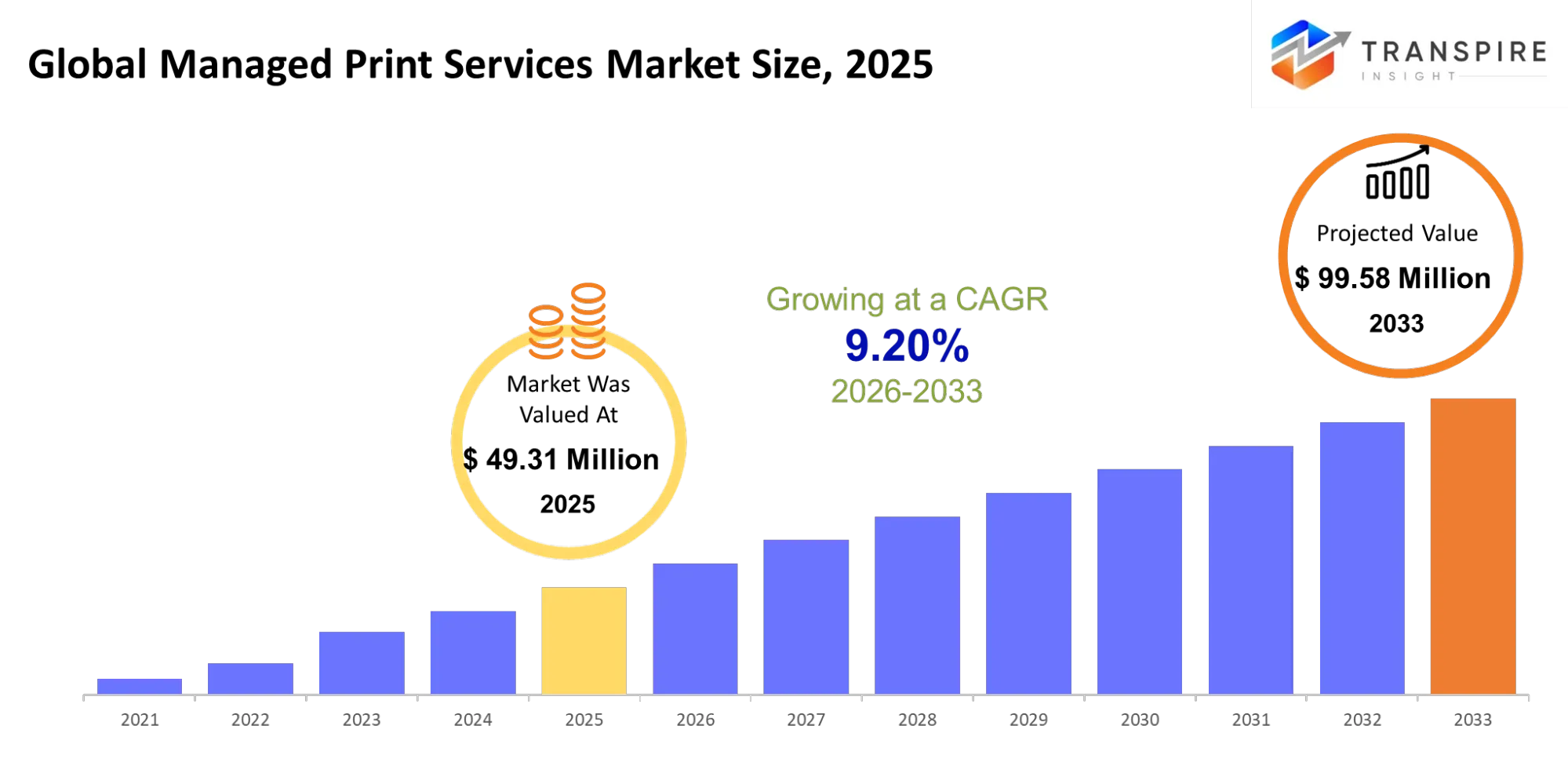
- Global Managed Print Services Market Size 2025: USD 49.31 Million
- Global Managed Print Services Market Size 2033: USD 99.58 Million
- Global Managed Print Services Market CAGR: 9.20%
- Global Managed Print Services Market Segments: By Type (Device Management Services, Print Workflow Management, Document Security Services, Cloud Print Services, Fleet Management Services, Analytics-driven Print Services, Others); By Application (Office Printing, Healthcare Documentation, Educational Printing, Financial Documentation, Government Printing, Others); By End-User (SMEs, Large Enterprises, Educational Institutions, Government Organizations, Others); By Deployment (Cloud-based Services, On-premise Services, Hybrid Print Solutions, AI-assisted Print Systems, Others)
Global Managed Print Services Market Summary:
The Global Managed Print Services Market size is estimated at USD 49.31 billion in 2025 and is anticipated to reach USD 99.58 billion by 2033, growing at a CAGR of 9.20% from 2026 to 2033.
The Global Managed Print Services Market provides a managed system that makes printing simpler for businesses, helps go paperless with docs, and cuts print costs via central control. Companies move from owning printers to subscribing to managed services, which means getting ongoing support and maintenance. In recent years, MPS expanded beyond simple print outsourcing. Now, it integrates AI and cloud technologies to manage print activities better and save resources. An important change is the use of smart, edge-connected devices that not only print but also act as data entry points for a company’s IT network. This shift happened partly because of an increase in cyberattacks on devices like printers. To protect against vulnerabilities, companies use secure print release and identity-based access controls. The main reasons for growth are a desire for more efficient ops, easing the IT teams' stress, and having better control over document management across the business.
Key Global Managed Print Services Market Insights:
Managed Print Services is transforming into a cloud-based, AI-powered enterprise infrastructure market, with the value of print volume being replaced by that of intelligent document workflows and security-based automation. Today's market has a new dynamic that moves beyond device management to hybrid working and predictive analytics, and subscription models are playing a greater role in shaping the market.
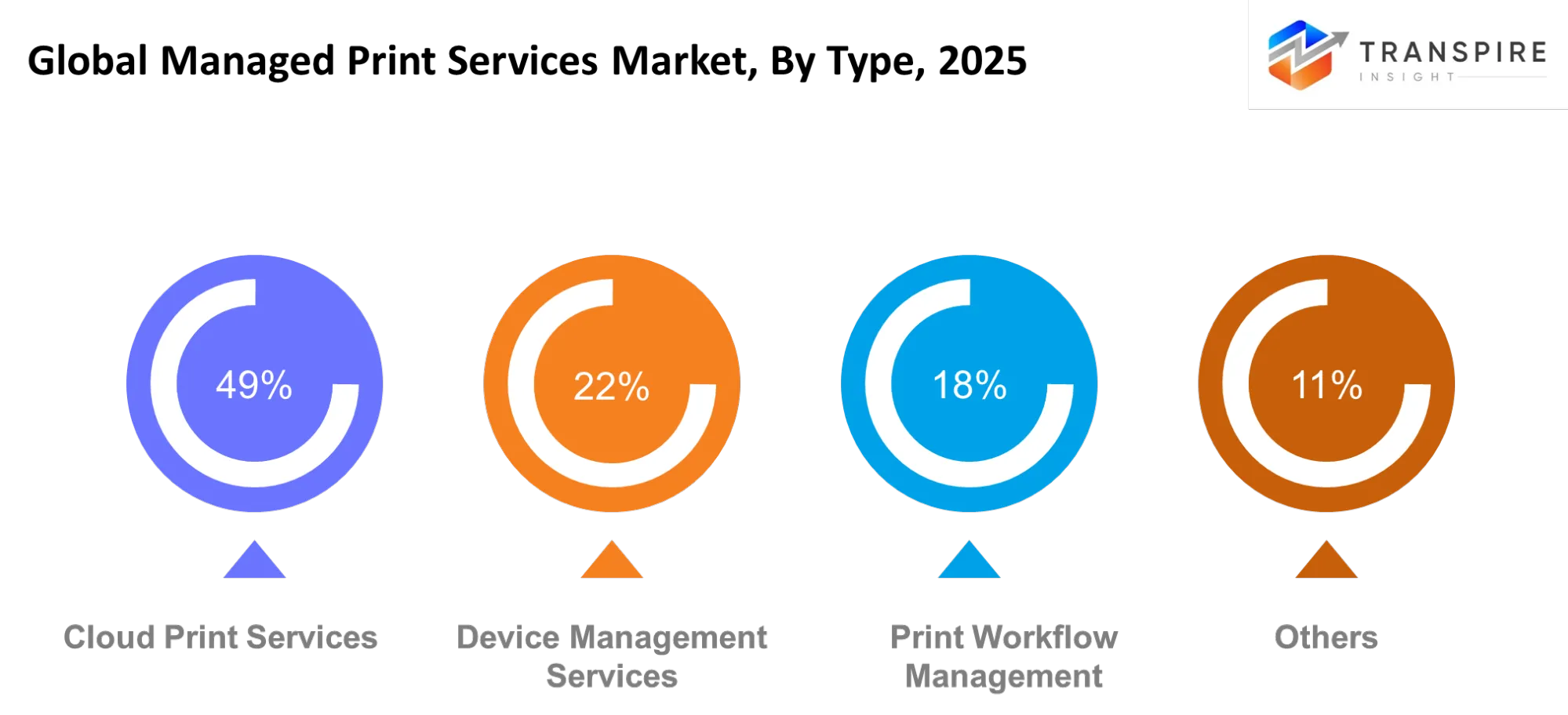
- HP Inc. and Xerox are driving the growth of the cloud-native ecosystem, providing centralized, remote print control for global enterprises, while Cloud Print Services holds a market lead of 49%.
- Among the various types of services, Device Management Services account for 22% of the market, while AI-enabled fleet monitoring and predictive maintenance are the key strengths of Canon and Ricoh, which aim to minimize downtime and service expenses.
- Print Workflow Management takes up to 18% market share as Konica Minolta and Lexmark roll out automated document routing and digital approval into enterprise workflows.
- The Print Services market is expanding at 13.3% CAGR, with the addition of AI dashboards in the market for real-time usage optimization and cost control by companies such as HP and Xerox.
- Document Security Services are growing as enterprises move to a zero-trust approach to printing with HP and Canon's implementation of identity-based authentication at the device level.
- Fleet Management Services is transforming with the help of IoT-tracking, which helps Ricoh and Kyocera to efficiently manage large-scale print environments through predictive analytics.
- SMEs are quickly moving to cloud-based MPS solutions, with Brother Industries and Epson aiming for cost-effective subscription-based small business digitization solutions.
- Hybrid Print Systems are becoming increasingly popular as businesses evolve to adopt flexible deployment; vendors are combining on-premise control with cloud intelligence to meet regulatory requirements and provide operational agility.
What are the Key Drivers, Restraints, and Opportunities in the Global Managed Print Services Market?
Drivers:
The managed print services (MPS) market is growing because, in large enterprise organizations, a change towards cost-transparent, cloud-managed document ecosystems is taking place. One of the major influences is the rise in hybrid working, which has led to the demand for centralized print control over a distributed office environment. This has led to a growing trend in companies using subscription-based MPS contracts, which include hardware, maintenance, and analytics. This has enabled vendors to pivot to more recurring revenue with long-term service contracts, resulting in more margin stability and increased customer retention. In January 2026, Iris Waves deployed a Xerox Managed Print Services (MPS) ecosystem for a Siemens Group company to support a hybrid workforce via cloud-based, AI-powered document workflows. This initiative centralized print management, transitioning away from local servers while shifting costs to a subscription model that secured long-term revenue.
Restraints:
One big challenge is the structural reduction of dependency on print as digitalization is picking up severely, particularly in the IT and BFSI industries. This transition continues as companies transition from paper to fully digital document management solutions, thereby decreasing the need for long-term device use and service levels. This puts pressure on the enterprise revenue per user (RPU) and print volume per enterprise for MPS providers.
Opportunities:
Print intelligence, enabled by AI, and platforms that optimize prints based on sustainability are good prospects. In the enterprise print fleets in Asia-Pacific, for instance, ESG adoption can be driven by predictive analytics and carbon tracking. Further upside lies in the cloud-native MPS platforms for SMEs with low maturity in IT. Emerging markets like India and Southeast Asia are also seeing growth, with digital workplace transformation projects proceeding much faster and the demand for enterprise outsourcing being driven by cost sensitivity. Moreover, cybersecurity companies are providing new revenue streams with secure print infrastructure solutions. In May 2026, Xerox was awarded by Quocirca as a leader in Automation, AI, and Cloud, and continued to build strong partnerships via events such as LEAP & DeepFest in Riyadh to expand its enterprise ecosystem in emerging markets. These projects result in optimized autonomy, better problem solving and lower costs and emissions in the print world worldwide.
Source:https://www.news.xerox.com/news/xerox-named-a-leader-in-quocircas-2026-act-assessment
What Has the Impact of Artificial Intelligence Been on the Global Managed Print Services Market?
The entire Managed Print Services (MPS) market has been changed by Artificial Intelligence, transitioning from reactive print maintenance to intelligent and automated print ecosystem management. Now adopted by print fleets, AI can handle tasks like supply management, print routing, device configuration, and more, all without human intervention, thereby optimizing workflows for distributed enterprises. AI tracks print usage to find inefficiencies such as underused devices and needless duplication, helping organizations cut waste and control costs better. Machine learning knows when devices will fail or need supplies, like toner, and schedules maintenance before issues occur. This cuts downtime, keeping everything smooth and uninterrupted. Also, AI boosts security by detecting anomalies and authenticating users in real time, which is super crucial for industries like banking and healthcare. Yet, there is a significant constraint—namely, its integration's complexity with existing print infrastructure, including the fact that it is hard to deploy at scale because of different device ecosystems and decentralized IT systems. In March 2026, HP launched its LaserJet Enterprise 5000/6000 and Pro 4000/4100 Series at HP Imagine 2026, expanding its AI-powered MPS ecosystem to support hybrid workflows. The new devices integrate on-chip AI, quantum-resistant security, and automated cloud connectivity to enable secure, autonomous document processing and optimized print management across distributed enterprise networks.
Key Global Managed Print Services Market Trends:
Managed Print Services (MPS) is going through a transition from a print-centric print management system to an AI-powered, cloud-managed workspace service layer, where print is completely part of digital workflows and enterprise IT systems. It has become more about automation, security, and optimizing in real-time than ownership of devices.
- Print infrastructure is shifting from on-premises control to cloud-based ecosystems, which provide greater visibility and less dependency on IT.
- AI-powered predictive maintenance is becoming the norm rather than the exception in enterprises, moving away from the traditional reactive service approach.
- Print authentication from basic access control has evolved to zero-trust, identity-based print authentication solutions.
- Old-style device-centric contracts are changing to “print-as-a-service” contracts that come with analytics.
- Manual handling of documents is being eliminated by AI-driven scan-to-cloud and routing applications.
- The move from cost saving toward carbon-aware printing and ESG reporting integration reflects the sustainability focus now moving from cost savings to embedding sustainability reporting into ESG.
- Real-time analytics dashboards for distributed enterprises are becoming the key to fleet management.
- Devices attached to the edge are becoming intelligent, embedded, and firmware-level devices with AI.
Global Managed Print Services Market Segmentation
By Type:
The Global Managed Print Services Market is being led by Cloud Print Services, which accounted for 49% of the market share, as organizations shift from owning devices to adopting a cloud-based, AI-driven print strategy for hybrid work and centralized management. The need for Device Management Services, 22% share to keep the hardware up and running and minimize disruption to operations, is still relevant; likewise, Print Workflow Management (18%) is becoming more relevant as organizations automate document routing and approval processes. The “Others” category (11%) encompasses services that are emerging, such as document security and fleet optimization tools. The fastest-growing area is Analytics-driven Print Services, growing at a CAGR of 13.3%, due to the demand for predictive insights, cost optimization, and AI-based usage intelligence. The future possibility is that the print infrastructures will become self-regulated, and AI will take over performance, security and resource management.
By Applications:
Office printing remains the leader, as companies often require the same documents in the office, especially in the banking, IT and professional services sectors. With stringent compliance and audit mandates and the need for secure information management, healthcare documentation and financial reporting are growing at a rapid pace. Education is stable, moving with the hybrid learning model, and the government is still using a structured procurement process and a controlled process. The growth model is focused on the tensions between digital transformation and the need for secure, controlled print environments. As time passes, it is expected that the applications will become increasingly integrated with the cloud platforms, minimizing manual tasks and allowing complete automation of the document lifecycle.
By End-User:
Large enterprises are leading the pack with complex multi-location operations and the need for central governance, while SMEs are proving to be a good growth driver as more and more IT and print infrastructure are outsourced. Documentation requirements for compliance, and long procurement cycles fund steady demand from government organizations and educational institutions. The main market growth catalyst is towards subscription-based models and AI-based services that minimize upfront expenses and enhance scalability. SMEs will gain greater traction in future adoptions as cloud-native MPS platforms open up and become more accessible.
By Deployment:
Cloud services rule because of their scalability, easy remote access, and central control. At the same time, hybrid print solutions gain traction as companies aim to strike a balance between security and flexibility, while meeting compliance needs. On-premise systems still matter a lot in heavily regulated industries needing data sovereignty and strict infrastructure management, even if they're less favoured. Plus, AI-driven print systems now have smart features like predictive analytics and smart routing, totally altering the game. These systems also enforce security automatically. Looking ahead, the trend is toward AI-native hybrid deployments, making print environments autonomous and adaptive. This fits into a broader enterprise digital transformation strategy.
What are the Key Use Cases Driving the Global Managed Print Services Market?
Managed Print Services, or MPS, is mainly about how big companies handle lots of printing securely and affordably. It’s super useful for places like banks and hospitals that need tight control over documents to meet regulatory requirements and cut costs.
Besides these core areas, MPS now shines in schools and government offices too. It makes managing digital files easier, speeding up approvals and keeping info safe and organized.
In hybrid work and sustainability programs, MPS is getting used to enable secure remote printing and cloud-based access. It also offers AI-powered analytics. Companies use these systems for ESG reporting too. They aim to reduce paper, lower energy use, and build greener print practices.
|
Report Metrics |
Details |
|
Market size value in 2025 |
USD 49.31 Billion |
|
Market size value in 2026 |
USD 53.79 Billion |
|
Revenue forecast in 2033 |
USD 99.58 Billion |
|
Growth rate |
CAGR of 9.20% from 2026 to 2033 |
|
Base year |
2025 |
|
Historical data |
2021 - 2024 |
|
Forecast period |
2026 - 2033 |
|
Report coverage |
Revenue forecast, competitive landscape, growth factors, and trends |
|
Regional scope |
United States; Canada; Mexico; United Kingdom; Germany; France; Italy; Spain; Denmark; Sweden; Norway; China; Japan; India; Australia; South Korea; Thailand; Brazil; Argentina; South Africa; Saudi Arabia; United Arab Emirates |
|
Key company profiled |
HP Inc., Xerox, Canon, Ricoh, Konica Minolta, Lexmark, Kyocera, Sharp Corporation, Epson, Toshiba Tec, Brother Industries, ARC Document Solutions, Toshiba Business Solutions, Pitney Bowes, Fujifilm Business Innovation. |
|
Customization scope |
Free report customization (country, regional & segment scope). Avail customized purchase options to meet your exact research needs. |
|
Report Segmentation |
By Type (Device Management Services, Print Workflow Management, Document Security Services, Cloud Print Services, Fleet Management Services, Analytics-driven Print Services, Others); By Application (Office Printing, Healthcare Documentation, Educational Printing, Financial Documentation, Government Printing, Others); By End-User (SMEs, Large Enterprises, Educational Institutions, Government Organizations, Others); By Deployment (Cloud-based Services, On-premise Services, Hybrid Print Solutions, AI-assisted Print Systems, Others) |
Which Regions are Driving the Global Managed Print Services Market Growth?
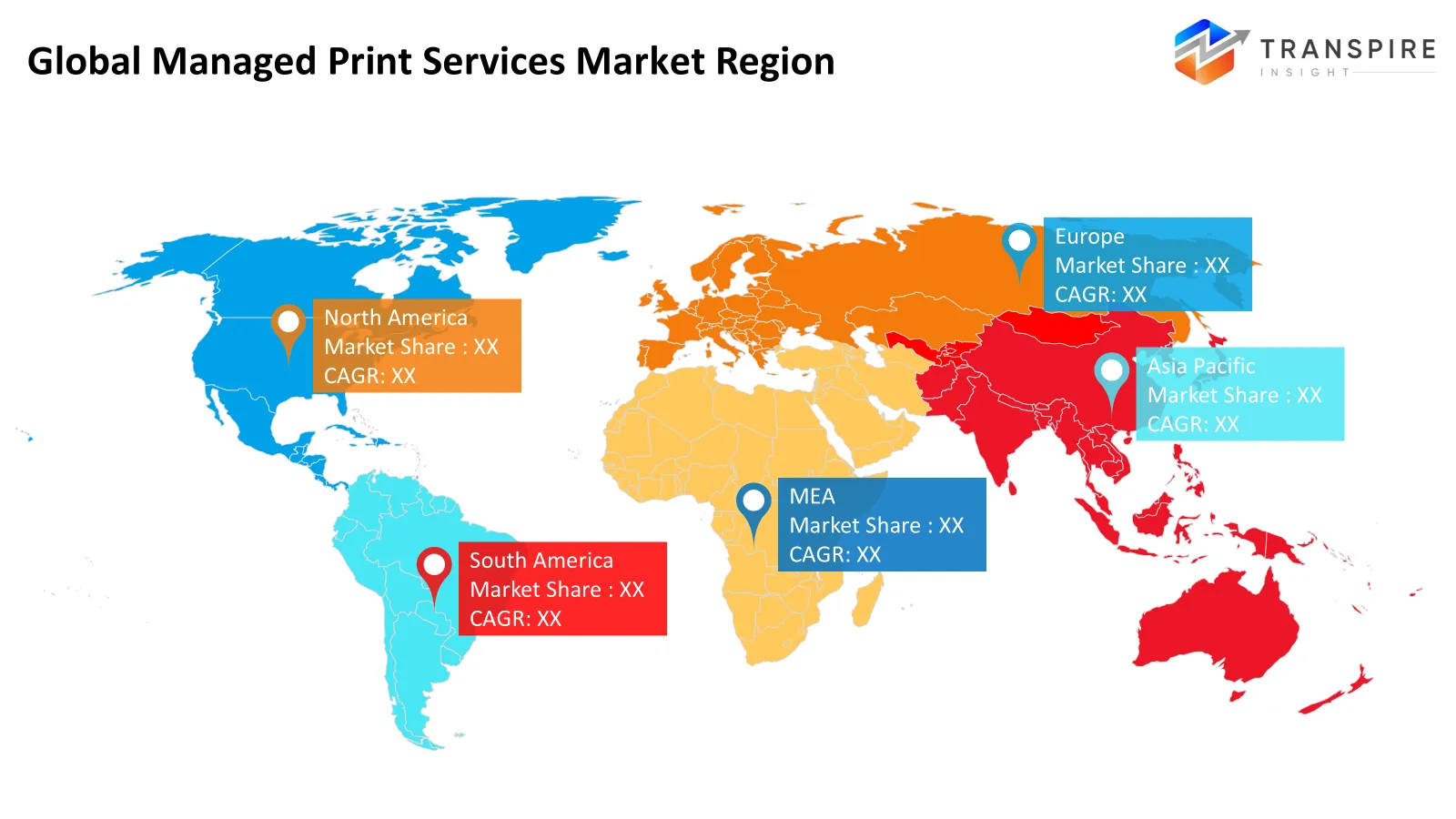
The region of North America is the largest market, accounting for approximately 40% share in the Global Managed Print Services Market, due to early adoption of digitization in enterprises and robust adoption of cloud-based IT infrastructure. Outsourced print management is essential to controlling the operational complexity of large organizations in the banking, healthcare and technology verticals. The region has established its cybersecurity frameworks, and policies are well-developed and help promote the deployment of secure printing. Moreover, ongoing investments in IT and advanced enterprise automation ecosystems remain to bolster the demand for AI-powered MPS solutions. In May 2026, Lexmark expanded its North America Managed Print Services offering by enhancing its cloud-native print management platform with advanced AI-based fleet monitoring and automated service orchestration for enterprise clients.
Europe accounts for around 28% of the market share and has robust regulatory compliance requirements and sustainability-beneficial business practices. In contrast to the tech-based expansion in North America, Europe's progress is guided by environmental regulations and policies to promote energy-efficient working practices and encourage enterprises to use print more efficiently. The region also boasts stable uptake of public sector and high levels of industrial digitization initiatives. This regulatory uniformity guarantees that the demand stays consistent even as enterprises slowly move away from paper usage, with efforts in structured digital transformation. In March 2026, Konica Minolta strengthened its European Managed Print Services portfolio by expanding cloud-based document workflow solutions across enterprise and public sector clients, focusing on sustainable print optimization and AI-driven fleet management.
Source:https://www.konicaminolta.ge/ge-en/digital-workplace/managed-print-and-workflow-automation-services
Rapid digitalization in SMEs and large enterprises propelled Asia Pacific's rapid growth, with the region's growth projected at a CAGR of approximately 12.6%. The trend of growing cloud adoption and outsourcing in IT services, such as India, China, and Southeast Asia, has been one of the most significant changes. MPS deployment is gaining footing among midsize businesses due to the fast-paced growth of hybrid working and the rise in cost-sensitive enterprise operations. This area offers great potential for the future as businesses upgrade infrastructure and move to scalable, subscription-based print management. In March 2026, Xerox expanded its Asia Pacific presence by enhancing its AI-enabled Managed Print Services ecosystem through cloud workflow integration and enterprise partnership programs in India and Southeast Asia.
Source:https://www.news.xerox.com/news/xerox-named-a-leader-in-quocirca-ai-vendor-landscape-2026-report
Who are the Key Players in the Global Managed Print Services Market and how do they Compete?
The Managed Print Services (MPS) market is very competitive and yet very consolidated as the vendors move from hardware vendors to end-to-end digital workspace service providers. Instead of being limited to hardware, competition is now in terms of integration with the cloud, security, analytics, and service ecosystems based on a subscription model. Vendors differentiate with AI-powered print management, industry-specific print workflow, and global service delivery networks.
HP Inc. and Canon, for example, take an innovation-led approach, with AI-backed fleet management tools and secure cloud printing solutions, and supporting enterprise subscriptions in hybrid workplaces. Xerox and Lexmark highlight an integration model for cost efficiency and services based on their expertise with document workflow, and a growth path through enterprise outsourcing agreements. Meanwhile, Ricoh, Konica Minolta, and Fujifilm Business Innovation take a platform diversification approach, integrating IT services, automation, and workspace digitization solutions into MPS. Niche specialists like Kyocera, Epson and Brother Industries fight each other on the basis of device reliability and solutions specially designed for SMEs that are cost-optimized, while Toshiba Tec, Sharp Corporation, ARC Document Solutions and Pitney Bowes use regional partnerships, managed service bundling, and sector-specific print workflow solutions.
Key Players are:
- HP Inc.
- Xerox
- Canon
- Ricoh
- Konica Minolta
- Lexmark
- Kyocera
- Sharp Corporation
- Epson
- Toshiba Tec
- Brother Industries
- ARC Document Solutions
- Toshiba Business Solutions
- Pitney Bowes
- Fujifilm Business Innovation
Recent Development News
- In February 2026, HP Inc. expanded its AI-enabled Managed Print Services platform across enterprise customers. The upgrade integrates predictive maintenance, automated supply replenishment, and AI-based print analytics into its existing HP Managed Print Services portfolio.
Source:https://www.inventiva.co.in
- In March 2026, Ricoh rolled out its subscription-based Managed Print Services in Europe and the Asia-Pacific. This plan includes hardware, analytics, and workflow automation under one easy monthly fee. The move caters to the rising need for predictable IT costs and a totally managed digital workspace, showing where the market's heading.
Source:https://www.ricoh-americalatina.com
What Strategic Insights Define the Future of the Global Managed Print Services Market?
The Managed Print Services (MPS) market is moving from old-fashioned cost-cutting approaches to a digital workplace orchestration model. Now, printing is just part of a larger cloud document management and workflow automation system. As more companies adopt hybrid work setups, MPS providers need to become integrated IT partners rather than just hardware sellers. There's a hidden risk, though: reliance on declining print volume sales. Less physical printing in fully digital firms can hurt long-term revenues. On the bright side, there's a big chance in AI-driven print intelligence. Predictive maintenance and usage analytics boost efficiency and security, too.
Staying competitive means moving toward subscription platforms for service providers. Cyber protection, online file storage, and one-click tools make money flow better, keeping up with digital times. So revenue moves smoothly, thanks to these handy features. These shifts matter most when paper fades into the background.
Key Segmentations are:
By Type
- Device Management Services
- Print Workflow Management
- Document Security Services
- Cloud Print Services
- Fleet Management Services
- Analytics-driven Print Services
- Others
By Application
- Office Printing
- Healthcare Documentation
- Educational Printing
- Financial Documentation
- Government Printing
- Others
By End-User
- SMEs
- Large Enterprises
- Educational Institutions
- Government Organizations
- Others
By Deployment
- Cloud-based Services
- On-premise Services
- Hybrid Print Solutions
- AI-assisted Print Systems
- Others
Regional Outlook
North America
- United States
- Canada
- Mexico
Europe
- Germany
- United Kingdom
- France
- Spain
- Italy
- Rest of Europe
Asia Pacific
- Japan
- China
- Australia & New Zealand
- South Korea
- India
- Rest of Asia Pacific
South America
- Brazil
- Argentina
- Rest of South America
Middle East & Africa
- Saudi Arabia
- United Arab Emirates
- South Africa
- Rest of the Middle East & Africa
Frequently Asked Questions
Find quick answers to common questions.
The global Managed Print Services Market size was valued at USD 49.31 billion in 2025 and is poised to reach USD 99.58 billion by 2033, expanding at a 9.20% CAGR.
Key segments for the Global Managed Print Services Market are By Type (Device Management Services, Print Workflow Management, Document Security Services, Cloud Print Services, Fleet Management Services, Analytics-driven Print Services, Others); By Application (Office Printing, Healthcare Documentation, Educational Printing, Financial Documentation, Government Printing, Others); By End-User (SMEs, Large Enterprises, Educational Institutions, Government Organizations, Others); By Deployment (Cloud-based Services, On-premise Services, Hybrid Print Solutions, AI-assisted Print Systems, Others).
Growth is primarily driven by cloud-managed document systems, hybrid work adoption, and subscription-based MPS models, while AI automation and secure workflows are further accelerating enterprise adoption.
The global Managed Print Services Market is led by major manufacturers, including HP Inc., Xerox, Canon, Ricoh, Konica Minolta, Lexmark, Kyocera, Sharp Corporation, Epson, Toshiba Tec, Brother Industries, ARC Document Solutions, Toshiba Business Solutions, Pitney Bowes, and Fujifilm Business Innovation.
North America, holding around 40% share, dominates the global Managed Print Services Market due to early enterprise digitization, strong cloud infrastructure, high IT spending, and advanced adoption of AI-driven and secure print management solutions.
Commercial opportunities include AI-powered print intelligence, ESG-driven carbon tracking, cloud-native SME adoption, expansion into emerging markets such as India and Southeast Asia, cybersecurity partnerships, and growing demand for unified digital workplace ecosystems beyond traditional print services.
- HP Inc.
- Xerox
- Canon
- Ricoh
- Konica Minolta
- Lexmark
- Kyocera
- Sharp Corporation
- Epson
- Toshiba Tec
- Brother Industries
- ARC Document Solutions
- Toshiba Business Solutions
- Pitney Bowes
- Fujifilm Business Innovation
About the Authors

Mayur Shinde
I am Mayur Shinde, a Senior Research Analyst at Transpire Insight, specializing in the Automotive & Transportation and Information & Communication Technology (ICT) Industry. My work focuses on analyzing emerging market trends, technological advancements, competitive landscapes, and industry developments to deliver accurate, data-driven insights. I am passionate about transforming complex market information into clear, actionable content that helps businesses, professionals, and decision-makers stay informed and make confident strategic decisions.

Chakradhar Khansole
Chakradhar serves as the Research Director at Transpire Insight, bringing over 8 years of experience in technology, innovation, and strategic market intelligence. He specializes in transforming complex market data into actionable business insights that enable organizations to make informed, growth-oriented decisions. Recognized for his strategic vision and analytical expertise, Chakradhar leads high-impact research initiatives, delivering comprehensive market assessments, competitive intelligence, and forward-looking industry analysis.
Recently Published Reports
-
Apr 2026
3D Optical Profiler Market
3D Optical Profiler Market Size, Share & Analysis Report By Type (Desktop 3D Optical Profiler, and Portable 3D Optical Profiler), By Technology (Confocal Technology, and White Light Interference), By End-Use Industry (Manufacturing, Research Institutions, Automotive, Aerospace and Defense, Medical Devices, and Other), and Geography (North America, Europe, Asia-Pacific, Middle East and Africa, South and Central America), 2021 - 2031
-
Apr 2026
Depth Sensor Market
Depth Sensor Market Size, Share & Analysis Report By Type (Infrared Depth Sensors, Time-of-Flight (ToF) Sensors, Stereo Vision Sensors, Structured Light Sensors, Ultrasonic Depth Sensors), By Application (Automotive, Robotics, Gaming, Consumer Electronics, Industrial Automation, Healthcare, Security & Surveillance, Others), By End Users (Automotive Manufacturers, Consumer Electronics Companies, Healthcare Providers, Industrial Companies, Security Agencies, Gaming Companies, Robotics Companies, Others), and Geography (North America, Europe, Asia-Pacific, Middle East and Africa, South and Central America), 2021 – 2031
-
Apr 2026
Digital Manufacturing Market
Digital Manufacturing Market Size, Share & Analysis Report By Component (Hardware, Software, and Services), By Technology (Robotics, 3D Printing, Internet of Things (IoT), and Others), By Application (Automotive and Transportation, Aerospace and Defense, Consumer Electronics, Industrial Machinery, and Others), By Process Type (Computer-Based Designing, Computer-Based Simulation, Computer 3D Visualization, Analytics, and Others), and Geography (North America, Europe, Asia-Pacific, Middle East and Africa, South and Central America), 2021 – 2031
-
Apr 2026
Digital Visa Services Market
Digital Visa Services Market Size, Share & Analysis Report By Type (Individual Travelers, Group Travelers), By Application (Tourism, Business Travel, Others), and Geography (North America, Europe, Asia-Pacific, Middle East and Africa, South and Central America), 2021 – 2031