

Global Eco-Friendly Straws Market Summary:
According to Transpire Insights, a detailed research report on the market reflects that the foodservice and beverage application segment dominates the global Global Eco-Friendly Straws Market, accounting for approximately 78% of the total share worldwide. Hoffmaster Group, Inc. leads the market with approximately (around USD 1.2 billion) in annual revenue and an estimated 17–21% global market share, making it the leading contributor to global market development, innovation, advanced eco-friendly straw production, expanding manufacturing capabilities, and growth dynamics.
Market Snapshot
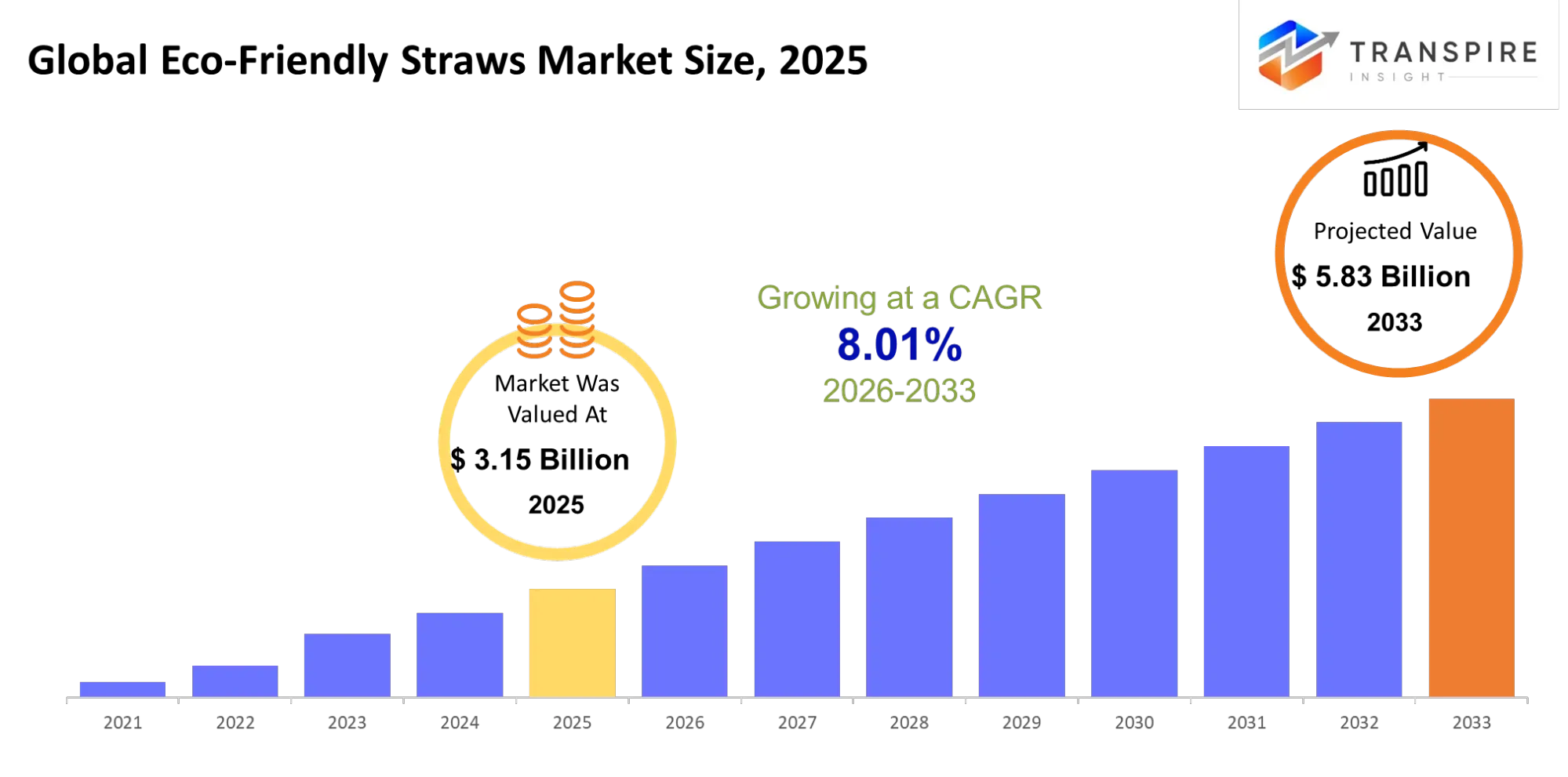
- Global Market Value (2025): USD 3.15 Billion.
- Expected Market Value (2026): USD 3.40 Billion
- Estimated Market Value (2033): USD 5.83 Billion.
- Forecast CAGR (2026–2033): 8.01%
- Leading Region in 2025: North America
- Second-largest Region: Europe
- Fastest Growing Region: Asia Pacific
Introduction
Market Overview: The global eco-friendly straws market includes the manufacture, distribution, and sale of sustainable alternatives to traditional single-use plastic straws. The market is expanding steadily as a result of rising environmental consciousness, tight plastic waste rules, and a growing customer demand for sustainable products. Biodegradable and reusable materials used to make eco-friendly straws include paper, polylactic acid (PLA), bamboo, wheat straw, stainless steel, silicone, and other plant-based alternatives. They aid in regulatory compliance, decrease environmental impact, and help firms improve their sustainability initiatives and brand reputation. Restaurants, cafes, hotels, foodservice chains, retail stores, and beverage producers are all rapidly embracing this technology. Continuous product innovation and investments in sustainable packaging solutions are projected to fuel the market's long-term growth globally.
For Instance:
Europe:
Due to strict single-use plastic rules, high consumer demand, and expanding acceptance in the foodservice and beverage industries, Europe is seeing significant investments in paper straw manufacturing, biodegradable coatings, and sustainable materials.
North America:
Corporate sustainability objectives, favorable compostability regulations, and increased demand from restaurants, cafés, and beverage industries are driving North America's investment in automated production, biodegradable materials, and sustainable packaging developments.
Market Highlights: -
- North America is expected to grow at a rapid CAGR in the Global Eco-Friendly Straws Market by holding close to 35% of the share during the forecast period.
- Europe is the fastest-growing region in the Global Eco-Friendly Straws Market during the period, holding around 30% share.
- Asia Pacific is anticipated to hold nearly 35% share of the Global Eco-Friendly Straws Market over the predicted timeframe.
- By Product Type, the Paper Straws segment dominated the market and holds approximately 60% share in 2025 and is projected to grow at a substantial CAGR during the forecast period.
- By Application, the Food Service segment dominated the market and holds around 45% share in 2025 and is projected to grow at a substantial CAGR during the forecast period.
- By End User, the Household dominated the market and holds close to 55% share in 2025 and is projected to grow at a substantial CAGR during the forecast period.
- Government assistance: The government's initiatives, such as PMEGP, Stand-Up India, MUDRA, ZED Certification, and the Agricultural Infrastructure Fund, promote sustainable manufacturing by providing financial aid, credit access, and quality certification support, allowing MSMEs to expand eco-friendly straw manufacturing with renewable and agricultural biomass inputs.
How is Technology Driving Growth in the Global Eco-Friendly Straws Market?
The rapid improvement of technology is enhancing manufacturing efficiency and product quality, as well as environmental sustainability, hence driving the Global Eco-Friendly Straws Market. Automated production methods and high-speed paper-forming technology enable manufacturers to enhance production capacity while lowering material costs and waste. Biodegradable materials such as paper, bamboo, wheat straw, sugarcane fiber, seaweed, and other plant-based alternatives are being researched and developed, with the goal of improving product performance and expanding the range of sustainable products accessible. Food-safe, moisture-resistant coatings and biodegradable adhesives have made eco-friendly straws more durable in hot and cold liquids. Furthermore, digital quality control, lifecycle assessment, and traceability technologies help manufacturers maintain consistent quality, obtain sustainability certifications, comply with environmental regulations, and boost consumer confidence, ensuring long-term market growth.
Market Drivers
Market Drivers Growing awareness of environmental issues, stringent rules on single-use plastics, and rising demand for sustainable foodservice packaging are the primary drivers of the global eco-friendly straws market. The growing use of biodegradable materials such as paper, bamboo, wheat straw, sugarcane fiber, PHA and other plant-based options is driving product innovation and market growth. Continuous innovation in moisture-resistant coatings, multi-layer paper technologies and durable biodegradable materials are enhancing product performance and end consumer acceptance. At the same time, producers are investing in automated production systems to increase efficiency, reduce costs and meet the growing demand globally. The increasing preference for reusable straws made of stainless steel, glass, and bamboo, and the growing demand for customization from restaurants, cafes, and quick-service restaurant chains are expected to further support the market growth, creating new business opportunities worldwide.
- For Instance: -Asia Pacific: The Asia Pacific area is leading the way in manufacturing investment due to low manufacturing prices, raw materials, and expanding production capacity. China, India, and Japan are increasing the world supply of paper, bamboo, and other plant-based alternatives to plastic straws.
Restrain
The Global Eco-Friendly Straws Market faces challenges due to higher production costs compared to conventional plastic straws, limiting adoption among price-sensitive businesses and consumers. Performance issues, including reduced durability of paper straws in hot or extended-use beverages, continue to affect consumer satisfaction. Additionally, inadequate industrial composting and waste management infrastructure in many regions restrict the effective disposal of biodegradable products. Price sensitivity in emerging economies and the limited availability of cost-effective sustainable raw materials further restrain widespread market adoption and growth.
Analysis of Prices and Consumer Behaviour
The largest segment of the paper straw market is the food-grade paper straw market, accounting for roughly 38% of the total paper straw market. The largest segment of the paper straw market is the food-grade paper straw market, accounting for roughly 38% of the total paper straw market. Premium moisture-resistant paper straws, with complex production processes, biodegradable coatings, and increased durability, will likely cost 20%-30% more than typical versions. Paper is the dominant eco-friendly straw material, accounting for approximately 52% of total unit sales, because it meets regulatory standards, is widely accepted by consumers, and is ideal for use with both hot and cold beverages. The restaurant and beverage business generates over 70% of total demand. Consumer purchasing behavior reveals that roughly 58% of buyers are interested in product sustainability, durability, and compostability, while approximately 35% prefer long-term supply agreements or bulk buying to save money and ensure a consistent supply of eco-friendly straws worldwide.
Top Companies in the Global Eco-Friendly Straws Market
- Hoffmaster Group
- Aardvark Straws
- Transcend Packaging
- Footprint
- Huhtamaki
- Vegware
- Biopak
- Eco-Products
- UFlex
- Tetra Pak
- Sulapac
- BioPak India
- GreenPrint
- Pappco Greenware
- TIPA
Market Segmentation
The Global Eco-Friendly Straws Market share is divided into five categories: product type, application, end user, distribution channel, material
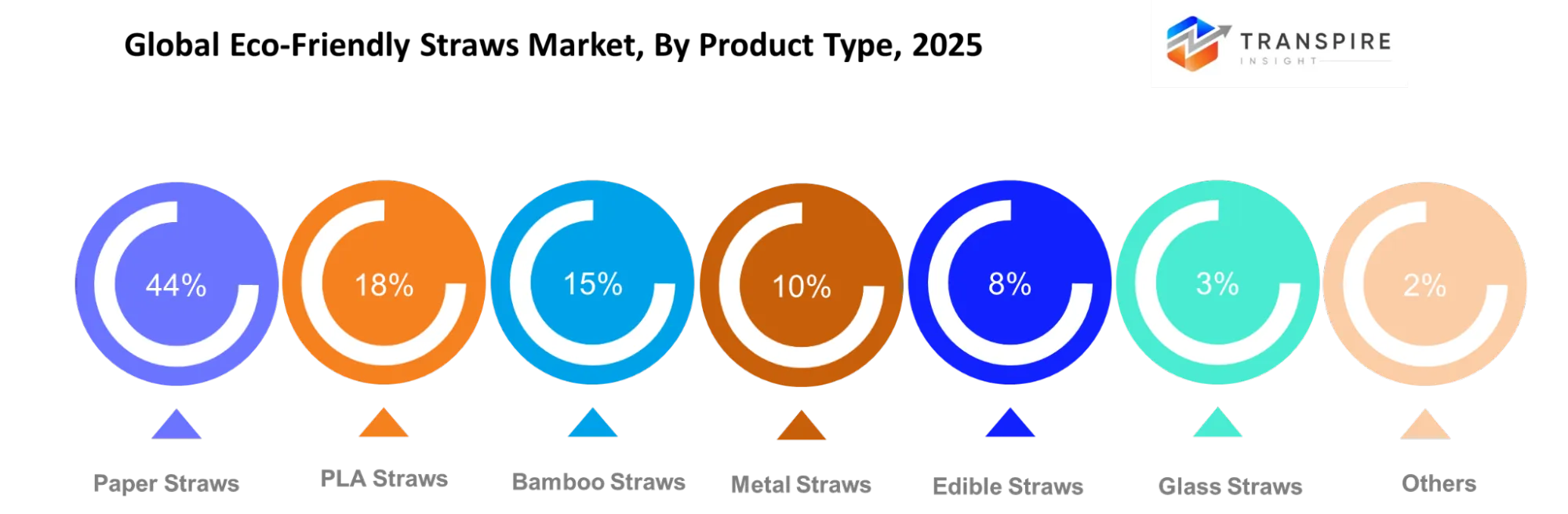
ThePaper Straws dominated the market, accounting for approximately 60%in 2025, and is expected to rise at a significant CAGR during the forecast period.
The Global Eco-Friendly Straws Marketis segmented by product type into paper straws, bamboo straws, metal straws, glass straws, pla straws, wheat straw straws, edible straws, others. Among these, Paper Straws dominated the market, accounting for approximately 60% in 2025 and expected to increase at a significant CAGR during the forecast period. The Paper Straws segment had the largest market share of approximately 60% in 2025, owing to stringent plastic regulations, increased adoption in foodservice, low-cost production, biodegradability, high consumer preference for sustainable packaging, and growing environmental initiatives around the world.
The Food Service segmentheld the greatest share of around 45% in 2025 and is expected to increase at a substantial CAGR over the forecast period.
The Global Eco-Friendly Straws Marketis segmented by application into food service, beverage industry, household use, hospitality, events & catering, retail, others. Among these, the Food Service segment held the greatest share of around 45% in 2025 and is expected to increase at a substantial CAGR over the forecast period. The Food Service segment had the greatest CAGR of approximately 45% in 2025, owing to rising demand from restaurants, cafes, fast service chains, takeaway services, environmental initiatives, and regulations restricting the use of single-use plastic straws.
The Household held the greatest share of close to 55%in 2025 and is expected to increase at a high CAGR over the forecast period.
The Global Eco-Friendly Straws Marketis segmented by end user into restaurants, cafés, hotels, beverage manufacturers, households, retail chains, others. Among these, the Household held the greatest share of close to 55% in 2025 and is expected to increase at a considerable CAGR over the projected period. The household segment accounted for the highest share of approximately 55% in 2025, owing to rising consumer awareness, a growing trend toward reusable and biodegradable straws, home beverage consumption, and eco-friendly lifestyle acceptance around the world.
Regional Segment Analysis of the Global Eco-Friendly Straws Market
- North America (U.S., Canada, Mexico)
- Europe (Germany, France, U.K., Italy, Spain, Rest of Europe)
- Asia-Pacific (China, Japan, India, Rest of APAC)
- South America (Brazil and the Rest of South America)
- The Middle East and Africa (UAE, South Africa, Rest of MEA)
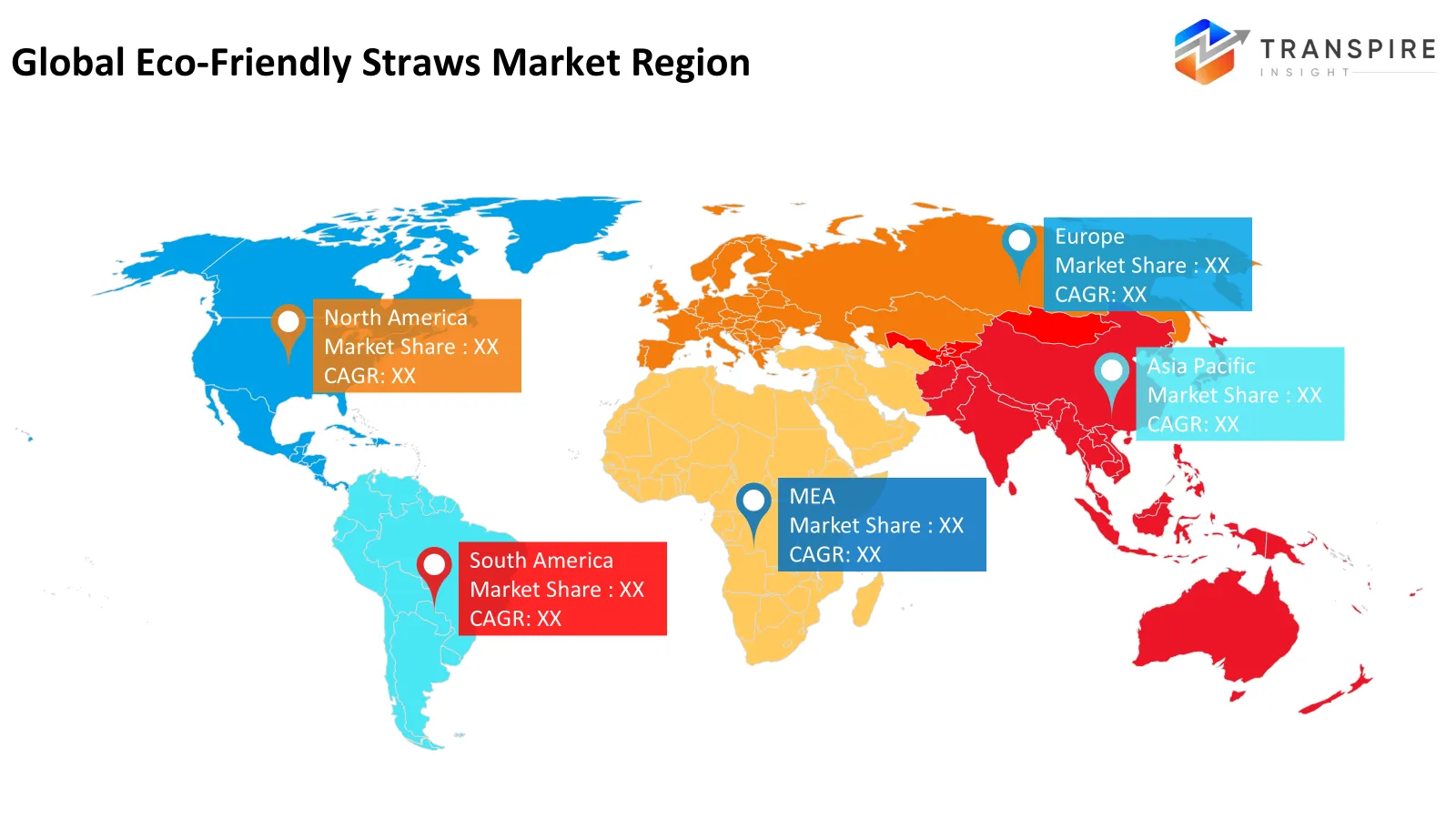
North America is expected to grow at a rapid CAGR in the Global Eco-Friendly Straws Market by holding close to 35% of the share during the forecast period.
North America is expected to have a quick CAGR in the Global Eco-Friendly Straws Market, accounting for over 35% of the total market during the forecast period. The region's supremacy is driven by tough single-use plastics rules, increased consumer awareness of environmental sustainability, and the foodservice and beverage industries' widespread embrace of eco-friendly products. To satisfy sustainability goals, major restaurant chains, cafes, and beverage companies are replacing plastic straws with paper, bamboo, and other biodegradable alternatives. Furthermore, product innovation and mass production are aided by advanced manufacturing infrastructure, ongoing investment in sustainable packaging technologies, and the presence of market leaders. The increased need for biodegradable packaging solutions, together with supportive government initiatives, strengthens the region's market position.
Europe is the fastest-growing region in the Global Eco-Friendly Straws Market during the period, holding around 30% share.
Europe is the fastest expanding region in the worldwide eco-friendly straws market, accounting for almost 30% of the global market during the projection period. The region's rise is mostly driven by stringent environmental restrictions, such as bans on single-use plastics, which has hastened the adoption of biodegradable and reusable straw alternatives. Furthermore, increased consumer awareness of sustainable products and firms' strong commitment to reducing plastic waste will drive market growth. A well-established culinary, hospitality, and retail sector in the region has created a demand for environmentally friendly straws. Furthermore, ongoing investments in sustainable packaging technology, new biodegradable materials, and circular economy activities, backed by government regulations and environmental organizations, are cementing Europe's position as a significant growth market.
Asia Pacific is anticipated to hold nearly 35% share of the Global Eco-Friendly Straws Market over the predicted timeframe.
Asia Pacific is estimated to account for roughly 35% of the Global Eco-Friendly Straws Market during the forecast period. The growth is attributable to rapid industrialization, growing foodservice & beverage industry and rising environmental awareness. Countries such as China, India, Japan and South Korea are witnessing increased demand for sustainable packaging driven by government measures to limit plastic waste and encourage biodegradable alternative. The location has the benefit of abundant renewable raw materials, cheap manufacturing capacity and a strong export-oriented production base. Furthermore, the rising investments in automated production technologies, the ongoing innovation of products, and the increasing presence of domestic and international manufacturers are also contributing to reinforcing the dominance of Asia Pacific in the worldwide eco-friendly straws market.
Strategies for Market Growth in Non-Leading Regions:
The development of non-leading regions through efficient and scalable eco-friendly straw manufacturing technology will assist small and medium-sized businesses. The use of locally sourced renewable raw materials such as paper, bamboo, wheat straw, sugarcane fiber, and other agricultural byproducts, combined with local manufacturing facilities, has the potential to reduce reliance on imports and reduce overall production costs. Flexible financing, long-term supply agreements, and contract manufacturing arrangements will be essential for improving manufacturing capabilities, quality control, sustainability standards, and product innovation. Strategic partnerships with raw material suppliers, foodservice companies, beverage manufacturers, retailers, and distributors will increase market penetration for eco-friendly straw products.
Future Market Trends for the Global Eco-Friendly Straws Market: -
- Innovative Advanced Materials: As consumer experience and environmental regulations and sustainability standards keep evolving, manufacturers will increase investments in moisture-resistant coatings, biodegradable adhesives and plant-based materials to improve straw durability.
- Sustainable Manufacturing Growth: Automated production technologies, regional manufacturing facilities and cost-efficient processes will be scaled up globally, allowing manufacturers to increase production capacity, reduce costs and meet the increasing demand from the foodservice and beverage industries.
- Increasing Use of Creative Alternatives: As consumers and businesses look for sustainable packaging and environmentally responsible product options, the demand for reusable, edible, seaweed-based, bamboo, and other plant-based straws will continue to grow.
Recent Development
- February 2026: Tetra Pak introduces next-generation paper straws with increased durability and recyclability, specifically designed for aseptic beverage cartons, to boost sustainable packaging options.
- Huhtamaki extended paper straw production capacity in the Asia-Pacific area by introducing additional manufacturing lines in March 2026 to meet the growing demand for recyclable paper straws and fiber-based beverage packaging.
- 2026: Major manufacturers introduce sophisticated moisture-resistant coating technologies and improved laminated paper straws to increase longevity, eliminate sogginess in beverages, and promote the widespread use of eco-friendly straw solutions.
Market Segment
This study forecasts revenue at global, regional, and country levels from 2020 to 2033. Transpire Insights has segmented the Global Eco-Friendly Straws Market based on the below-mentioned segments:
Global Eco-Friendly Straws Market, By Product Type
- Paper Straws
- Bamboo Straws
- Metal Straws
- Glass Straws
- PLA Straws
- Wheat Straw Straws
- Edible Straws
- Others
Global Eco-Friendly Straws Market, By Application
- Food Service
- Beverage Industry
- Household Use
- Hospitality
- Events & Catering
- Retail
- Others
Global Eco-Friendly Straws Market, By End User
- Restaurants
- Cafés
- Hotels
- Beverage Manufacturers
- Households
- Retail Chains
- Others
Global Eco-Friendly Straws Market, By Distribution Channel
- Supermarkets & Hypermarkets
- Specialty Stores
- Online Retail
- Direct Sales
- Wholesalers
- Others
Global Eco-Friendly Straws Market, By Material
- Paper
- Bamboo
- Stainless Steel
- Glass
- PLA
- Wheat Fiber
- Others
Global Eco-Friendly Straws Market, By Regional Analysis
North America
- United States
- Canada
- Mexico
Europe
- Germany
- United Kingdom
- France
- Italy
- Spain
- Russia
- Rest of Europe
Asia Pacific
- China
- Japan
- India
- South Korea
- Australia
- Rest of Asia Pacific
South America
- Brazil
- Argentina
- Rest of South America
Middle East & Africa
- Saudi Arabia
- United Arab Emirates
- Qatar
- South Africa
- Rest of the Middle East & Africa
Frequently Asked Questions
Find quick answers to common questions.
Rising plastic bans, environmental awareness, sustainable packaging demand, and increasing adoption by foodservice, hospitality, and beverage industries are driving market growth.
Paper straws dominate the market due to biodegradability, regulatory compliance, affordability, and widespread adoption across restaurants, cafés, and beverage companies.
North America leads through strict environmental regulations, strong consumer awareness, advanced manufacturing capabilities, and widespread adoption of sustainable packaging solutions.
Automation, biodegradable materials, moisture-resistant coatings, and digital quality control improve production efficiency, product durability, sustainability, and regulatory compliance.
Growing demand for reusable, edible, and plant-based straws, automated manufacturing, and sustainable material innovations will create significant future market opportunities.
- Hoffmaster Group
- Aardvark Straws
- Transcend Packaging
- Footprint
- Huhtamaki
- Vegware
- Biopak
- Eco-Products
- UFlex
- Tetra Pak
- Sulapac
- BioPak India
- GreenPrint
- Pappco Greenware
- TIPA
About the Authors

Chetan Dhatrak
I’m Chetan Dhatrak, a Senior Research Analyst at Transpire Insight, specializing in the Consumer Goods, Foods and Beverages industry. I focus on analyzing market trends, consumer behavior, competitive landscapes, and industry developments to deliver accurate, data-driven insights. My research at Transpire Insight is built on credible sources and in-depth analysis, helping businesses and readers better understand market dynamics, emerging opportunities, and evolving consumer preferences. I’m committed to creating reliable, well-researched content that supports informed decision-making and reflects the latest developments in the consumer goods and food & beverage sectors.

Chakradhar Khansole
Chakradhar serves as the Research Director at Transpire Insight, bringing over 8 years of experience in technology, innovation, and strategic market intelligence. He specializes in transforming complex market data into actionable business insights that enable organizations to make informed, growth-oriented decisions. Recognized for his strategic vision and analytical expertise, Chakradhar leads high-impact research initiatives, delivering comprehensive market assessments, competitive intelligence, and forward-looking industry analysis.
Recently Published Reports
-
Apr 2026
Bottled Water Market
Bottled Water Market Size, Share & Analysis Report By Product Type (Still Bottled Water, Carbonated Bottled Water, Functional Bottled Water, and Others), By Packaging (PET, Cans, and Others), By Sales Channel (Supermarkets/Hypermarkets, Convenience Stores/Drug Stores, Grocery Stores/Club Stores, Foodservice, and Others) and Geography (North America, Europe, Asia-Pacific, Middle East and Africa, South and Central America), 2021 - 2032
-
Apr 2026
Color Cosmetic Packaging Market
Color Cosmetic Packaging Market Size, Share & Analysis Report By Application (Mascara Packaging, Liquid Packaging, and Liquid Face), By Type (Tubes & Bottles, Pens & Markers, Compacts & Containers, and Droppers & Pumps), and Geography (North America, Europe, Asia-Pacific, Middle East and Africa, South and Central America), 2021 - 2031
-
Apr 2026
External Microphone For Camera Market
External Microphone For Camera Market Size, Share & Analysis Report By Type (Shotgun Microphone, Lavalier Microphone, and Others), By Application (Digital Camera, Professional Video Camera, and Others), and Geography (North America, Europe, Asia-Pacific, Middle East and Africa, South and Central America), 2021 - 2031
-
Apr 2026
Foot Orthotic Insoles Market
Foot Orthotic Insoles Market Size, Share & Analysis Report By Type (Pre-fabricated, and Custom-made), By Material (Thermoplastic, Composite Carbon Fiber, and Others), By Distribution Channel (Drug Stores, Hospitals & Clinics, and Others), and Geography (North America, Europe, Asia-Pacific, Middle East and Africa, South and Central America), 2021 - 2031