

Global Dental Healing Caps Market Size & Forecast:
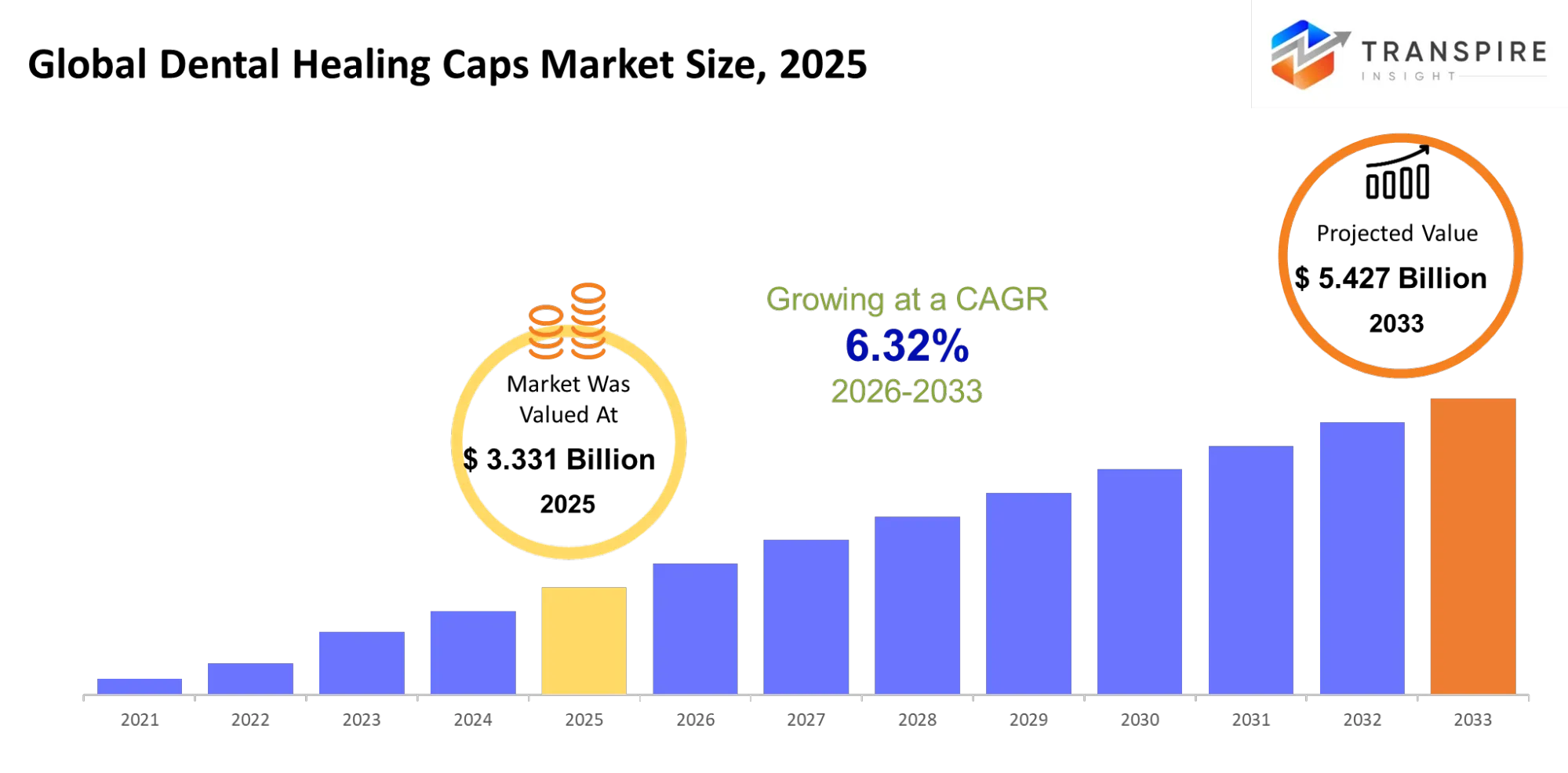
- Global Dental Healing Caps Market Size 2025: USD 3.331 Billion
- Global Dental Healing Caps Market Size 2033: USD 5.427 Billion
- Global Dental Healing Caps Market CAGR: 6.32%
- Global Dental Healing Caps Market Segments: By Type (Titanium Healing Caps, Zirconia Healing Caps, Temporary Healing Caps, Customized Healing Caps, Angled Healing Caps, Multi-unit Healing Caps, Others); By Application (Dental Implant Recovery, Soft Tissue Healing, Prosthetic Support, Full-mouth Rehabilitation, Cosmetic Dentistry, Others); By End-User (Dental Clinics, Hospitals, Implantology Centers, Specialty Dental Laboratories, Others); By Material (Titanium-based Caps, Ceramic Caps, Polymer Caps, Hybrid Material Caps, Others)
Global Dental Healing Caps Market Summary:
The Global Dental Healing Caps Market size is estimated at USD 3.331 Billion in 2025 and is anticipated to reach USD 5.427 Billion by 2033, growing at a CAGR of 6.32% from 2026 to 2033. Dental healing caps essentially work as temporary placeholders. Once an implant goes in, the cap sits on top to guide the gums as they heal, ensuring the final crown actually looks like a real tooth. Historically, surgeons just grabbed off-the-shelf metal options. But that dynamic is rapidly changing. Today, you are seeing more and more local clinics bringing 3D printers and milling equipment directly into their offices to produce customized caps on demand. A major driver here is patient expectation—people want the whole ordeal over with as fast as possible. The last thing a patient wants is a second round of surgery a few months later simply because the soft tissue didn't heal in the right shape. By seating a custom-fitted cap right after the initial procedure, dentists can get the tissue healing correctly right out of the gate. It spares the patient from frustrating follow-up visits and frees up chair time so the clinic can increase its daily caseload.
Key Market Insights
The dental implant sector is rapidly moving away from standard, off-the-shelf healing protocols in favor of highly digitized, patient-specific soft tissue management. This pivot is fueled by the explosion of in-house 3D printing and a massive consumer push to get aesthetically perfect implant restorations done in fewer clinical visits.
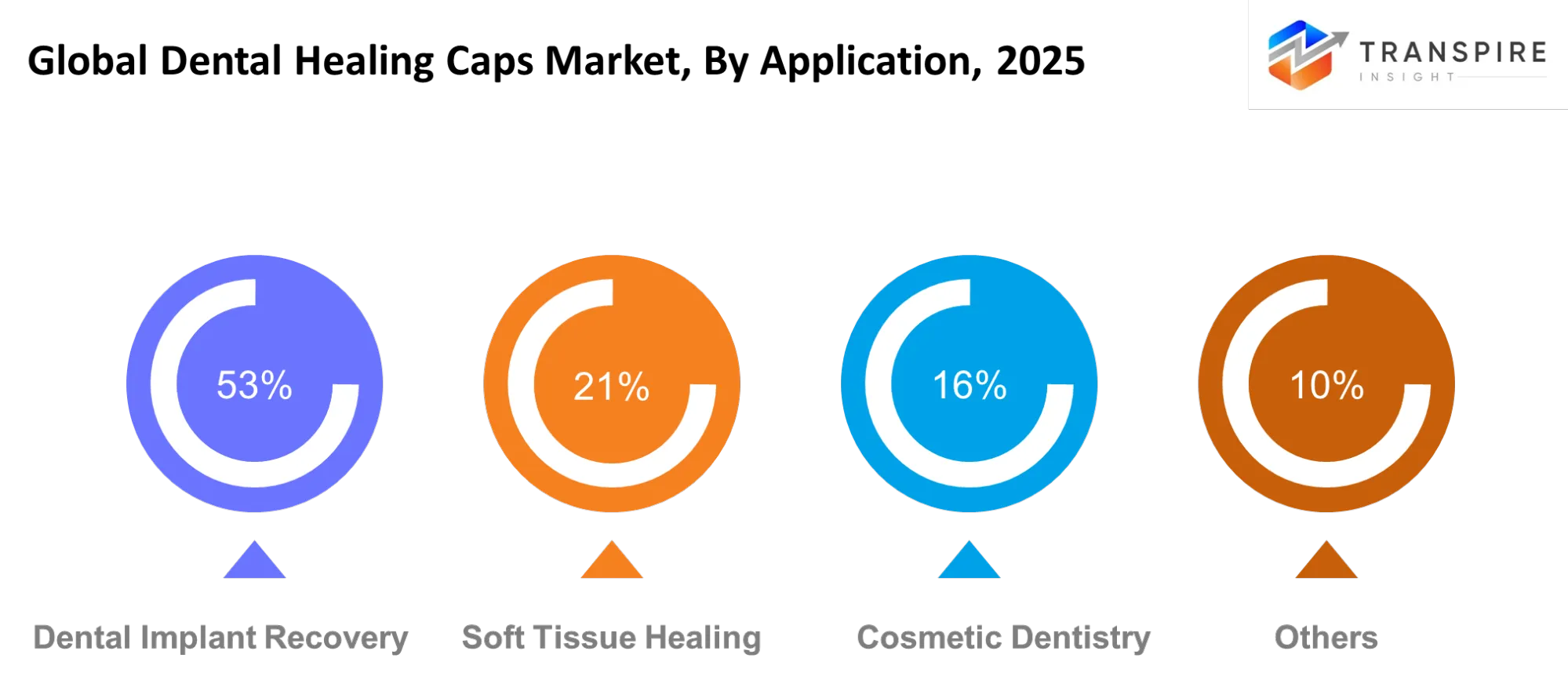
- Dental Implant Recovery dominates the landscape with a 53% market share as clinics increasingly adopt immediate placement protocols, pushing major players like Straumann to roll out advanced titanium interfaces that actively accelerate early gum healing right after surgery.
- Customized Healing Caps are tearing ahead at a 10.7% CAGR because local practices are bringing CAD/CAM tech inside their own offices, allowing dental giants like Dentsply Sirona to sell integrated milling workflows for on-the-spot chairside production.
- Europe locks down the top spot with a 35% market share, largely due to an older demographic demanding premium dental restorations and strong local manufacturers like Camlog pushing high-precision hybrid caps across the continent's well-funded clinics.
- Asia Pacific is accelerating massively at an 11.5% CAGR as booming medical tourism and rising middle-class wealth prompt regional heavyweights like Osstem Implant and Dentium to supply high-volume dental chains with cost-effective, scalable cap systems.
- North America comfortably holds 30% of the overall market, where incredibly high aesthetic expectations for "smile makeovers" drive firms like Zimmer Biomet to market advanced zirconia options that completely eliminate the gray metallic shadows often seen under thin gums.
- Soft Tissue Healing claims 21% of the total demand as periodontists focus heavily on preventing long-term gum recession, leading brands like BioHorizons to introduce specialized laser-microgrooved caps that force faster cellular attachment and thicker tissue growth.
- Cosmetic Dentistry captures a 16% slice of the volume because patients are highly sensitive about front-tooth procedures, pushing companies like Neodent and MIS Implants to rapidly expand their portfolios of specialized angled caps for complex front-of-mouth restorations.
- The "Others" application segment accounts for 10% of the market as oral surgeons tackle complex full-arch rehabilitation cases, relying on specialized builders like Southern Implants to deploy wide-bodied caps to safely manage extensive bone and tissue grafting procedures.
What are the Key Drivers, Restraints, and Opportunities in the Global Dental Healing Caps Market?
Driver
The urgent need to cut down chair time and give patients immediate results is a massive growth driver right now. People flat-out refuse to come back for a second, painful surgery just to fix collapsed gums months after getting an implant. This lack of patience has kicked off a huge trend toward "same-day smiles" and single-visit procedures. By buying custom-milled caps, dentists can mold the soft tissue perfectly on day one, which directly boosts high-margin sales for the manufacturers.In May 2025, Dentsply Sirona rolled out its CEREC Cercon 4D zirconia blocks alongside fast milling units. They designed this setup specifically so clinics can mill custom abutments and caps in just minutes. This kind of launch essentially locks in repeat orders as more local practices shift to the single-visit model.
Restraint
The high upfront cost of going digital acts as a serious roadblock. If a local clinic wants to mill custom caps on-site, the owners have to write huge checks for 3D intraoral scanners, design software, and clinical-grade milling machines. This financial hurdle simply prices smaller, independent practices out of the modern workflow. Because of that, neighborhood dentists are stuck buying basic, off-the-shelf metal pieces instead of upgrading to custom setups.
Opportunity
Bioactive surface coatings are a major shift waiting to happen. Instead of just using a cap as a physical wedge to shape the gums, manufacturers can coat these parts with antimicrobial proteins and specific growth factors. This actually prompts the soft tissue to attach faster and fights off early infections right at the surgical site. Once suppliers perfect this tech, they can easily charge a premium for biologically active caps, especially when pitching to high-end cosmetic dental centers across North America.
What Has the Impact of Artificial Intelligence Been on the Global Dental Healing Caps Market?
AI is completely redefining how dental healing caps are designed, steering the market away from generic metal pieces toward fully automated, patient-specific restorations. Instead of a technician manually clicking through CAD software for hours, machine learning models now handle the heavy lifting. After taking a 3D intraoral scan, AI algorithms instantly analyze the surrounding jawbone to automatically generate a customized healing cap design.
This brings massive predictive capabilities right to the dental chair. The software predicts exactly how a patient’s gums will heal, shaping the cap to force the soft tissue into the perfect contour for the final crown. This automated optimization drastically improves clinic operations, allowing dentists to mill a flawless cap on-site in just 15 minutes.
However, there is a frustrating limitation: AI algorithms struggle with messy data. If an intraoral scan is noisy due to excess saliva or blood during surgery, the AI gets confused and outputs an inaccurate cap design that doctors simply cannot trust. Take Dentsply Sirona’s recent rollout of its AI-powered CEREC software. By automatically analyzing full jaw morphologies from 3D scans, the system generates highly accurate, customized cap proposals in seconds, letting dentists skip manual CAD adjustments entirely.
Key Market Trends
- Dentists are actively phasing out traditional titanium healing abutments for front-tooth restorations, transitioning instead to zirconia and advanced polymers to prevent dark, metallic shadows from showing through thin gum tissue.
- Local clinics have largely abandoned sending messy silicone impressions to off-site dental labs, opting instead to shoot immediate 3D intraoral scans and mill customized caps directly chairside while the patient waits.
- Oral surgeons are rapidly moving away from the older "delayed loading" protocol—where implants were buried under the gum for months—in favor of immediate placement strategies that use a custom healing cap to shape the soft tissue on day one.
- Instead of relying on basic cylindrical caps that force the gums to heal in an unnatural circle, practitioners now digitally design the cap to perfectly mimic the specific anatomical shape of the natural tooth being replaced.
- Patients are no longer willing to tolerate multiple rounds of surgery; this widespread consumer impatience is forcing neighborhood clinics to adopt single-visit, flapless surgical techniques that rely heavily on pre-milled, precision-guided healing components.
- Manufacturers are shifting their R&D focus from just changing the physical shape of the caps to experimenting with bioactive, antimicrobial surface coatings designed to actively fight off infection during the highly vulnerable early healing phase.
- Rather than keeping massive physical inventories containing hundreds of different pre-sized stock caps, forward-thinking practices are transitioning to simply stocking raw material blocks, producing the exact size and angle they need on demand.
- Software providers are moving past isolated design tools, increasingly pushing closed-loop digital ecosystems where the jaw bone scan, the surgical drilling guide, and the custom healing cap are all generated simultaneously during one preoperative planning session.
Global Dental Healing Caps Market Segmentation
By Type
Customized Healing Caps are currently the standout growth engine in this space, surging ahead at a 10.7% CAGR. While traditional titanium caps still hold a massive historical footprint, they are rapidly losing ground. The core growth logic here is tied directly to the exploding popularity of "same-day smiles" and in-house digital dentistry. Local clinics are investing heavily in their own 3D scanners and milling machines, allowing them to carve out a patient-specific cap while the person is still sitting in the chair. This guarantees the soft tissue heals in the exact shape needed right from day one. Looking ahead, the basic, one-size-fits-all stock cap will likely become completely obsolete for high-end or front-mouth procedures. This will eventually force traditional manufacturers to pivot away from selling pre-made metal parts and focus almost entirely on selling raw milling blocks and digital design licenses.
By Application
Dental Implant Recovery absolutely anchors this segment, commanding a massive 53% share of the overall volume. Soft Tissue Healing follows with a 21% share, while Cosmetic Dentistry captures 16%. The immense footprint of implant recovery is straightforward: aging populations are replacing missing teeth at record rates, and every implant placed requires a healing phase. However, the cosmetic dentistry side is where the premium, high-margin growth actually lives. Patients are incredibly sensitive about front-tooth aesthetics and will pay top dollar to ensure their gums do not collapse or look unnatural around the final crown. Moving forward, this landscape will split sharply. Standard back-molar recovery will remain focused on cost and durability, but cosmetic and soft-tissue applications will heavily dictate the R&D pipeline, forcing suppliers to develop highly specialized angled caps just for complex "smile makeovers."
By End-User
Dental Clinics and specialized Implantology Centers act as the undisputed heavyweight buyers, completely dictating supply chain terms. Hospitals see steady trauma-related volume, but the real money is moving through the private sector. The growth logic here stems from local dentists fighting to keep highly lucrative implant procedures in-house rather than referring patients out to specialists. By purchasing their own scanners and milling units, neighborhood clinics can handle the entire surgical and restorative process under one roof. This massive shift in where the work actually happens is going to fundamentally change how suppliers operate. Instead of simply shipping boxes of bulk caps to hospital procurement officers, dental manufacturers will have to sell fully integrated software-and-hardware ecosystems directly to independent dentists, wrapping long-term tech support into the deal.
By Material
Titanium-based Caps remain the traditional, highly reliable workhorses of the industry, but Ceramic (Zirconia) and Hybrid Polymer Caps are aggressively stealing market share. The reasoning behind this shift is heavily aesthetic. While titanium is incredibly strong and integrates beautifully with bone, it often leaves a highly visible, ugly gray shadow under thin gum tissue. Because modern patients demand perfect aesthetics, practitioners are flocking to tooth-colored zirconia or hybrid polymers that blend flawlessly with the mouth's natural tones. The future implication here moves beyond just color matching. The material landscape is rapidly approaching a point where passive plastics and metals won't be enough. Manufacturers will soon be expected to deliver bioactive polymer caps that actively release antimicrobial agents or growth factors right into the surgical site to dramatically accelerate tissue healing.
What are the Key Use Cases Driving the Global Dental Healing Caps Market?
The biggest everyday use case remains straightforward dental implant recovery. Right after placing a titanium screw, oral surgeons apply a cap to keep the surgical pathway open. This physical barrier stops soft tissue from completely collapsing over the site while the jawbone solidifies underneath.
Beyond standard recovery, cosmetic dentistry is driving serious demand. For highly visible front teeth, practitioners rely on custom ceramic pieces to carefully shape the gums. The whole goal is forcing the tissue to heal into a natural scallop, ensuring the final crown blends in without any awkward dark gaps.
New applications are also appearing in complex full-mouth rehabilitation. Major implant centers now use specialized multi-unit caps to manage extensive tissue reconstruction, actively securing the soft tissue foundation for entire dental arches following severe oral trauma.
|
Report Metrics |
Details |
|
Market size value in 2025 |
USD 3.331 Billion |
|
Market size value in 2026 |
USD 3.534 Billion |
|
Revenue forecast in 2033 |
USD 5.427 Billion |
|
Growth rate |
CAGR of 6.32% from 2026 to 2033 |
|
Base year |
2025 |
|
Historical data |
2021 - 2024 |
|
Forecast period |
2026 - 2033 |
|
Report coverage |
Revenue forecast, competitive landscape, growth factors, and trends |
|
Regional scope |
United States; Canada; Mexico; United Kingdom; Germany; France; Italy; Spain; Denmark; Sweden; Norway; China; Japan; India; Australia; South Korea; Thailand; Brazil; Argentina; South Africa; Saudi Arabia; United Arab Emirates |
|
Key company profiled |
Straumann, Nobel Biocare, Dentsply Sirona, Zimmer Biomet, BioHorizons, Osstem Implant, MegaGen, MIS Implants, Camlog, Neodent, Southern Implants, Anthogyr, Bicon Dental, Dentium, Envista Holdings |
|
Customization scope |
Free report customization (country, regional & segment scope). Avail customized purchase options to meet your exact research needs. |
|
Report Segmentation |
By Type (Titanium Healing Caps, Zirconia Healing Caps, Temporary Healing Caps, Customized Healing Caps, Angled Healing Caps, Multi-unit Healing Caps, Others); By Application (Dental Implant Recovery, Soft Tissue Healing, Prosthetic Support, Full-mouth Rehabilitation, Cosmetic Dentistry, Others); By End-User (Dental Clinics, Hospitals, Implantology Centers, Specialty Dental Laboratories, Others); By Material (Titanium-based Caps, Ceramic Caps, Polymer Caps, Hybrid Material Caps, Others) |
Which Regions are Driving the Global Dental Healing Caps Market Growth?
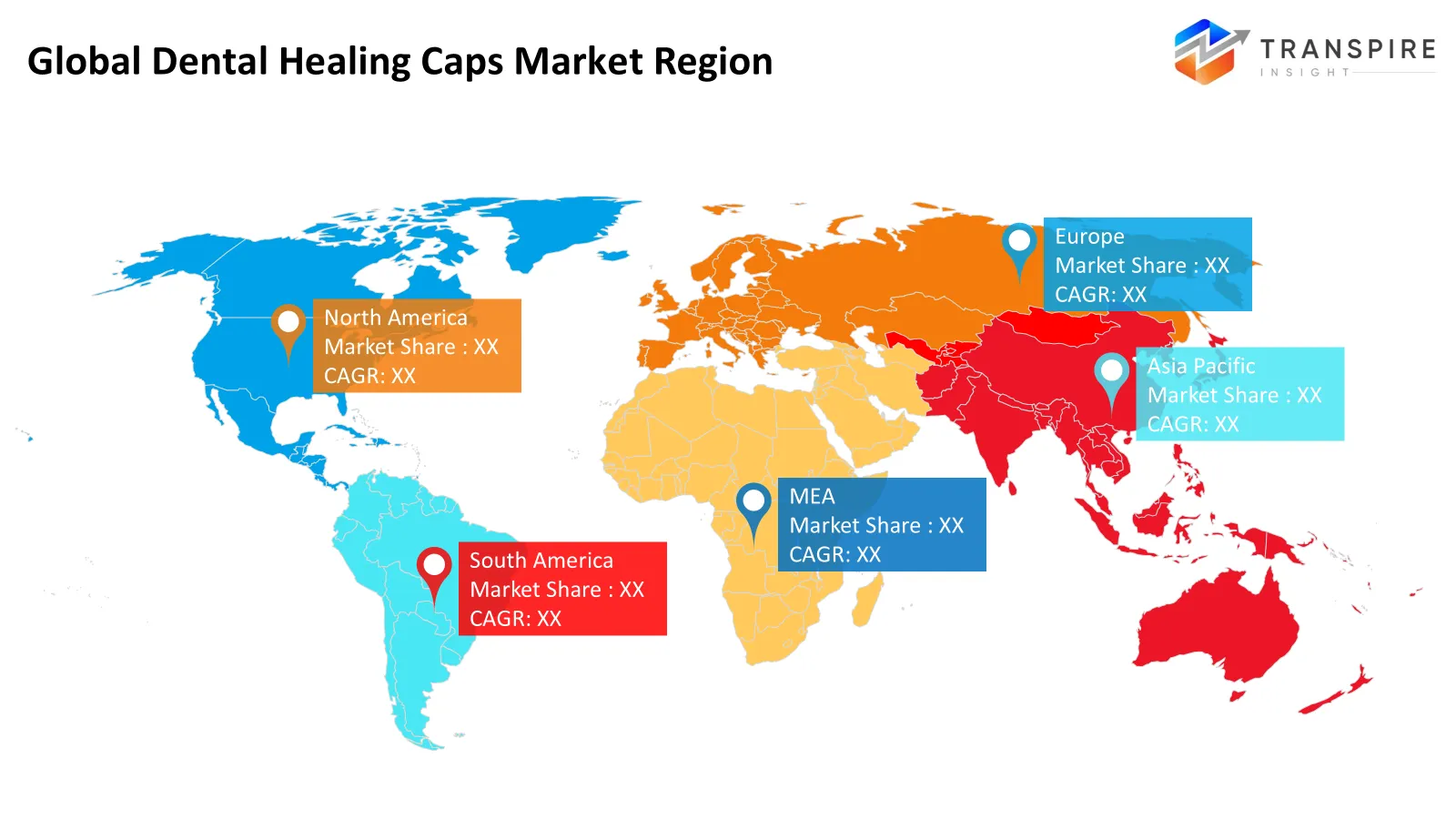
Europe accounts for roughly 35% of the global market, holding the top spot. The real driver behind this dominance simply comes down to regional demographics. An aging population across these countries strongly prefers investing in premium, long-lasting implants over basic tooth extractions. Furthermore, the region benefits from a robust local ecosystem where established manufacturing centers operate closely with well-funded clinics and highly trained prosthodontists. Because European patients have very high expectations for the final visual outcome of their dental work, local clinics are heavily incentivized to bring end-to-end digital workflows in-house. This allows them to mill accurate, custom caps directly on-site rather than outsourcing to external labs.In June 2026, Dentsply Sirona hosted the Implant Solutions World Summit in Gothenburg, Sweden, specifically to showcase these fully digital treatment workflows. This major clinical gathering really underscores how aggressively the European market is pushing toward immediate implant protocols and patient-specific soft tissue management.
North America holds a strong secondary position, capturing a 30% slice of the global market. Unlike Europe’s focus on age-related tooth replacement, the North American market is driven primarily by consumer demand for elective cosmetic "smile makeovers." This steady volume is anchored by a vast, highly privatized network of independent dental practices that invest heavily in their own CAD/CAM milling machines. Since local patients are willing to pay significant out-of-pocket premiums for perfect aesthetics, practitioners strongly prefer custom zirconia and hybrid polymer caps that guarantee a flawless, natural-looking gum line.
The Asia Pacific region is expanding at an impressive 11.5% CAGR while commanding a 26% market share. Momentum shifted recently as major countries like China and India moved away from relying purely on imported legacy components. Instead, they are actively building out highly skilled digital dentistry networks. The real opportunity here lies in a rapidly expanding middle class and a booming medical tourism sector, both demanding fast, high-quality implant procedures at a fraction of Western costs. As clinical education scales up across the continent, this region is quickly becoming the most aggressive adopter of in-house digital ecosystems, sharply driving down the cost of customized cap production. In April 2026, Osstem India officially announced its strategic roadmap to drastically expand its Osstem Implant Training Centers (OIC) alongside its integrated 'Digital Dentistry Solution'. This educational and hardware rollout actively lowers the barrier to advanced implant surgery, accelerating the local adoption of precision healing caps across the region.
Who are the Key Players in the Global Dental Healing Caps Market and how do they Compete?
Competition in the dental healing caps space has completely shifted from basic hardware manufacturing to owning the digital clinical workflow. Companies no longer fight over the price of a standard titanium cap; instead, they compete to lock dental practices into their proprietary CAD/CAM ecosystems. The ultimate goal is to make switching costs so high that a clinic automatically buys all its scanning software, milling equipment, and raw cap materials from a single vendor.
Straumann competes strictly through high-end material innovation. Rather than racing to the bottom on price, they differentiate by offering premium components featuring proprietary surface technologies that actively accelerate soft tissue healing. Their expansion approach heavily involves acquiring specialized dental software startups, letting them integrate advanced prosthetic design directly into their high-margin surgical portfolios.
Dentsply Sirona takes a slightly different angle, leveraging its CEREC platform to heavily dominate the fast chairside milling niche. Their main differentiator is providing an unbroken digital chain. This specific setup allows dentists to scan, design, and mill custom zirconia caps in under twenty minutes. To drive expansion, they actively target independent practitioners with accessible, budget-friendly milling bundles. The underlying strategy is simple: once a neighborhood clinic installs the hardware, they become permanently reliant on Dentsply's proprietary consumable blocks for all future procedures.
Company List
- Straumann
- Nobel Biocare
- Dentsply Sirona
- Zimmer Biomet
- BioHorizons
- Osstem Implant
- MegaGen
- MIS Implants
- Camlog
- Neodent
- Southern Implants
- Anthogyr
- Bicon Dental
- Dentium
- Envista Holdings
Recent Development News
In February 2026, ZimVie signed an exclusive distribution agreement with Osstem Implant to push its premium dental implant lines across China. Teaming up with an established local heavyweight instantly broadens ZimVie's reach in the Asia Pacific region, letting them scale up sales volume quickly without the headache of building a brand-new sales network from the ground up.https://www.zimvie.com
In November 2025, Straumann rolled out its iEXCEL implant system globally to bring its hardware into one connected platform. Merging several different implant lines into a single surgical workflow takes a lot of pressure off local clinics regarding inventory management and staff training. This streamlined approach makes it much easier for newer practitioners to confidently adopt in-house implantology without getting overwhelmed.https://www.eqs-news.com
What Strategic Insights Define the Future of the Global Dental Healing Caps Market?
The future of dental healing caps isn't just about selling physical hardware; it is completely shifting toward controlling the digital workflow. The market is heading toward a reality where standalone parts are obsolete, replaced by closed-loop systems where scanning, design, and chairside milling all happen under one software umbrella.
There is a hidden risk here, though. As clinics get locked into these proprietary ecosystems, a simple software glitch or sudden subscription price hike could instantly paralyze their daily surgical schedule.
Meanwhile, the next big opportunity sits with chairside 3D printing using bioactive resins, moving the industry past traditional subtractive milling into fast, additive manufacturing that actively fights gum infections.
To win, manufacturers must stop pitching individual metal pieces. Instead, they need to bundle customized caps into comprehensive software and hardware subscriptions, making the switching cost for local dentists practically impossible to justify.
Global Dental Healing Caps Market Segmentation:
By Type
- Titanium Healing Caps
- Zirconia Healing Caps
- Temporary Healing Caps
- Customized Healing Caps
- Angled Healing Caps
- Multi-unit Healing Caps
- Others
By Application
- Dental Implant Recovery
- Soft Tissue Healing
- Prosthetic Support
- Full-mouth Rehabilitation
- Cosmetic Dentistry
- Others
By End-User
- Dental Clinics
- Hospitals
- Implantology Centers
- Specialty Dental Laboratories
- Others
By Material
- Titanium-based Caps
- Ceramic Caps
- Polymer Caps
- Hybrid Material Caps
- Others
Regional Outlook
North America
- United States
- Canada
- Mexico
Europe
- Germany
- United Kingdom
- France
- Spain
- Italy
- Rest of Europe
Asia Pacific
- Japan
- China
- Australia & New Zealand
- South Korea
- India
- Rest of Asia Pacific
South America
- Brazil
- Argentina
- Rest of South America
Middle East & Africa
- Saudi Arabia
- United Arab Emirates
- South Africa
- Rest of the Middle East & Africa
Frequently Asked Questions
Find quick answers to common questions.
The Global Dental Healing Caps Market size was valued at USD 3.331 Billion in 2025 and is poised to reach USD 5.427 Billion by 2033, expanding at a 6.32% CAGR.
Key segments for the Global Dental Healing Caps Market are Type (Titanium Healing Caps, Zirconia Healing Caps, Temporary Healing Caps, Customized Healing Caps, Angled Healing Caps, Multi-unit Healing Caps, Others), Application (Dental Implant Recovery, Soft Tissue Healing, Prosthetic Support, Full-mouth Rehabilitation, Cosmetic Dentistry, Others), End-User (Dental Clinics, Hospitals, Implantology Centers, Specialty Dental Laboratories, Others), and Material (Titanium-based Caps, Ceramic Caps, Polymer Caps, Hybrid Material Caps, Others).
Growth is primarily driven by the urgent need to cut down patient chair time and deliver immediate aesthetic results. There is a massive trend toward "same-day smiles" and single-visit dentistry, pushing clinics to adopt custom-milled caps that mold soft tissue perfectly on day one and prevent the need for secondary surgeries.
The global market is led by major manufacturers including Straumann, Nobel Biocare, Dentsply Sirona, Zimmer Biomet, BioHorizons, Osstem Implant, MegaGen, MIS Implants, Camlog, Neodent, Southern Implants, Anthogyr, Bicon Dental, Dentium, and Envista Holdings.
Europe holds a dominant 35% share of the global market. This strong lead is driven by an aging demographic that prefers premium, long-lasting implants over basic tooth extractions, backed by a robust local ecosystem of highly trained prosthodontists and well-funded clinics that actively utilize in-house digital milling workflows.
Major opportunities exist in the development of bioactive surface coatings, where manufacturers treat caps with antimicrobial proteins and cellular growth factors to speed up soft tissue attachment and prevent early-stage infections. Additionally, the transition toward chairside 3D printing using bioactive resins offers a massive growth pocket for suppliers targeting high-end cosmetic dentistry.
- Straumann
- Nobel Biocare
- Dentsply Sirona
- Zimmer Biomet
- BioHorizons
- Osstem Implant
- MegaGen
- MIS Implants
- Camlog
- Neodent
- Southern Implants
- Anthogyr
- Bicon Dental
- Dentium
- Envista Holdings
About the Authors

Pankaj Ghogare Patil
I am Pankaj Ghogare Patil, a Senior Research Analyst at Transpire Insight, specializing in the Pharmaceutical, Chemicals & Materials, Healthcare IT, and Biotechnology industry. My expertise lies in conducting comprehensive market research, analyzing industry trends, evaluating competitive landscapes, and translating complex data into actionable insights. At Transpire Insight, I closely follow emerging technologies, regulatory developments, and market innovations to create accurate, well-researched, and informative content that helps businesses and professionals make informed decisions. I am committed to producing credible, evidence-based articles that reflect industry best practices while making technical topics accessible and valuable for a broad audience.

Chakradhar Khansole
Chakradhar serves as the Research Director at Transpire Insight, bringing over 8 years of experience in technology, innovation, and strategic market intelligence. He specializes in transforming complex market data into actionable business insights that enable organizations to make informed, growth-oriented decisions. Recognized for his strategic vision and analytical expertise, Chakradhar leads high-impact research initiatives, delivering comprehensive market assessments, competitive intelligence, and forward-looking industry analysis.
Recently Published Reports
-
Apr 2026
AI in Diabetic Retinopathy Market
AI in Diabetic Retinopathy Market Size, Share & Analysis Report By Type (Screening AI Systems, Diagnostic AI Systems, and Predictive AI Models), By Application Segment (Hospitals, Ophthalmology Clinics, Diagnostic Centers, and Research and Development), and Geography (North America, Europe, Asia-Pacific, Middle East and Africa, South and Central America), 2021 - 2031
-
Apr 2026
Psychometric Tests Market
Psychometric Tests Market Size, Share & Analysis Report By Type (Personality Tests, Ability/Aptitude Tests, Skill/Knowledge Tests, and Others), By Application (Talent Acquisition and Talent Management), and Geography (North America, Europe, Asia-Pacific, Middle East and Africa, South and Central America), 2021 – 2031
-
Apr 2026
Rare Biological Sample Collection Market
Rare Biological Sample Collection Market Size, Share & Analysis Report By Type (Isolation Kits & Reagent, Blood Collection Tubes, and Others), By Application (Oncology, Transcriptomics, Pharmacogenomics, and Others), and Geography (North America, Europe, Asia-Pacific, Middle East and Africa, South and Central America), 2021 – 2031
-
Jul 2026
Diabetic Retinopathy Market
Diabetic Retinopathy Market Size, Share & Analysis Report By Type (Proliferative Diabetic Retinopathy, and Diabetic Macular Edema (DME)), By Treatment Type (Anti VEGF Drug, Steroid Implants, Laser Surgeries, and Vitrectomy), and Geography (North America, Europe, Asia-Pacific, Middle East and Africa, South and Central America), 2021 – 2031
Our Clients







