

Global Cold Gas Spray Coating Services Market Size & Forecast:
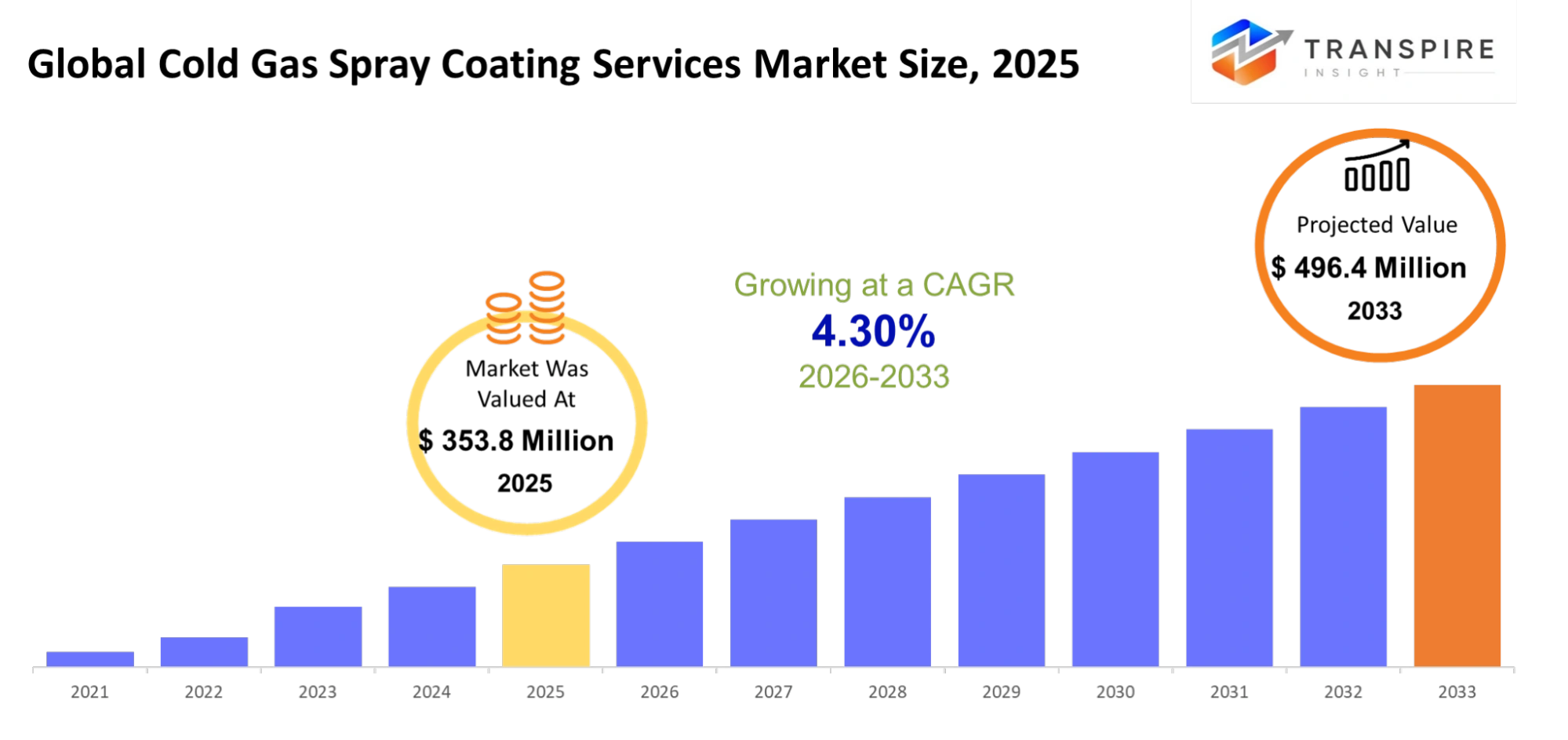
Global Cold Gas Spray Coating Services Market Size 2025: USD 353.8 Million
Global Cold Gas Spray Coating Services Market Size 2033: USD 496.4 Million
Global Cold Gas Spray Coating Services Market CAGR: 4.30%
Global Cold Gas Spray Coating Services Market Segments: By Material Type (Metals, Alloys, Composites), By Application (Aerospace, Automotive, Electronics, Industrial Equipment), By End-User Industry (Aerospace & Defense, Energy, Manufacturing, Electronics).
To learn more about this report,  Download Free Sample Report
Global Cold Gas Spray Coating Services Market Summary:
The Global Cold Gas Spray Coating Services Market was valued at USD 353.8 million in 2025 and is expected to reach USD 496.4 million by 2033, growing at a CAGR of 4.30% from 2026 to 2033. Cold gas spray, which people commonly refer to as cold spray, functions as a coating and deposition method that uses pressurized nitrogen or helium gas to propel metal powder particles at speeds exceeding the speed of sound barriers through a de Laval nozzle onto a surface. The particles maintain their solid form. The particles create surface bonds through the combination of kinetic energy and plastic deformation which occurs when they hit the surface. The process requires an absence of a thermal phase because this characteristic defines its operation while thermal spray methods become unsuitable when heat would disturb the base material or change the coating's characteristics or create stress patterns that would be activated through thermal cycling.
The concentration reflects two things: the repair economics of aerospace components and the qualification requirements that govern what coating processes are permitted on flight-critical parts. Cold spray can restore worn or corroded aluminium, titanium, and magnesium components to original dimensions without the heat-affected zone that welding or thermal spray would introduce. The cold spray process enables landing gear components and engine casings and structural fittings and all other parts which need to be replaced at high expense to receive repairs which will extend their operational life at a cost that is much lower than purchasing new components after the repairs receive approval from the necessary aviation regulatory body.
The process does not operate as a standard service which businesses can offer to customers. The aerospace sector requires precise control of process parameters and powder characteristics and gas pressure and nozzle geometry and standoff distance because both equipment costs and operator availability remain critical challenges during their operations. The market remains focused because of this factor which restricts access to a small number of businesses.
Outside aerospace, cold spray is used in electronics for copper interconnect deposition and EMI shielding, in automotive for aluminum and copper coatings on powertrain and battery components, and in industrial equipment for wear and corrosion protection on surfaces where thermal spray would cause distortion or microstructural changes the application cannot tolerate.
Key Market Trends & Insights:
- Driven by component repair economics and the process's compatibility with heat-sensitive flight-critical parts that other coating methods cannot safely restore.
- Military depot maintenance programs have become a reliable and growing revenue source for qualified cold spray service providers, as defense agencies invest in extending the service life of aging aircraft and ground vehicle fleets rather than replacing components at full procurement cost.
- Copper and aluminum cold spray coatings are finding applications in EV battery thermal management and bus bar fabrication, opening a new demand channel that did not exist at meaningful scale five years ago.
- Helium, the preferred propellant gas for depositing hard metals and achieving the highest particle velocities, remains expensive and subject to supply variability, which creates a cost and planning challenge that pushes some operators toward nitrogen-based systems where the application permits.
- Process qualification and documentation requirements in aerospace and defense have slowed adoption relative to the technical capabilities of the process, but they have also created a durable competitive barrier for providers that have completed qualification programs.
Global Cold Gas Spray Coating Services Market Segmentation
By Material Type
- Metals: Metals are the most widely deposited material class in the Global Cold Gas Spray Coating Services Market. Copper, aluminum, titanium, and nickel are the most commonly processed, each suited to different applications and substrate combinations. Copper cold spray is used for electrical conductivity applications, corrosion barriers, and thermal management surfaces. Aluminum is the workhorse material in aerospace repair, used to restore dimensions on aluminum alloy structural components and to provide sacrificial corrosion protection. Titanium deposition is more demanding, requiring higher gas pressures and temperatures to achieve the particle velocities needed for adequate bonding, and it is used primarily for aerospace and biomedical applications where titanium's strength-to-weight ratio and biocompatibility are required. Nickel and nickel-based metals are applied where hardness and corrosion resistance at moderate temperatures are needed.
- Alloys: Alloy powders allow cold spray coatings to be tailored for specific performance requirements that pure metal deposits cannot meet. Aluminum alloys, copper alloys such as bronze and brass, nickel superalloy powders, and stainless steel compositions are all processed by cold spray service providers. Alloy selection is driven by the mechanical, thermal, and corrosion requirements of the application rather than cost, since alloy powders are more expensive to produce and qualify than pure metal equivalents. In aerospace repair, alloy powders must match or exceed the properties of the parent material to satisfy repair approval requirements, which limits substitution and keeps process qualification costs high. The alloys segment captures a meaningful share of aerospace and defense revenue because many of the most valuable repair applications involve alloy substrates.
- Composites: Composite powders combine metallic and non-metallic constituents, typically a metal matrix with ceramic reinforcement particles, to produce coatings with properties that neither component could provide alone. Metal matrix composite coatings deposited by cold spray offer combinations of hardness, wear resistance, and toughness that are useful in industrial equipment, tooling, and some aerospace applications. The composite segment is smaller than metals or alloys in the Global Cold Gas Spray Coating Services Market because the process window for achieving adequate deposition efficiency with composite powders is narrower and the qualification base for these coatings in regulated industries is still developing. Research activity in this segment is higher than its current revenue share would suggest, reflecting interest from defense and industrial equipment users in wear-resistant coatings that do not require thermal processing.
By Application
- Aerospace: Aerospace is the largest application in the Global Cold Gas Spray Coating Services Market. Component repair is the primary use case: cold spray restores worn, corroded, or dimensionally out-of-specification metal parts to serviceable condition without the heat input that welding or brazing would introduce. Landing gear assemblies, magnesium gearbox housings, aluminum structural components, and engine accessory casings are among the parts regularly repaired using qualified cold spray processes. The repair economics are driven by the replacement cost of the original part: a cold spray repair that costs a fraction of a new part and is approved under the relevant airworthiness authority's supplemental type certificate or repair scheme creates clear value for the operator. New-build applications, where cold spray deposits functional coatings on components during manufacture rather than repair, are a smaller but growing part of aerospace revenue.
- Automotive: Automotive applications for cold spray are concentrated in powertrain components, thermal management surfaces, and, increasingly, electric vehicle battery and electronics packaging. Aluminum cold spray on cast components corrects dimensional defects or adds localized wear protection without distorting thin-walled castings. Copper deposition is relevant in EV applications for bus bars, cooling plate surfaces, and electrical contact areas where conductivity and bond strength both matter. Cold spray's advantage over alternative processes in automotive is primarily the absence of heat: die-cast aluminum and magnesium components that would warp or lose dimensional accuracy under thermal spray or welding can be repaired or coated by cold spray without those problems. Automotive is a smaller segment than aerospace in this market but has faster growth potential as EV platform designs create new coating requirements.
- Electronics: Electronics applications for cold spray include copper deposition for EMI shielding, interconnect repair, and local conductivity enhancement on circuit substrates. The process is well suited to depositing copper or aluminum on temperature-sensitive substrates where conventional plating would require chemicals, and where thermal spray would damage nearby components. Cold spray is also used to apply copper contacts and bus structures in power electronics modules. The electronics segment is smaller than aerospace or automotive in the Global Cold Gas Spray Coating Services Market, but it benefits from the continued growth of power electronics in industrial drives, EV inverters, and renewable energy conversion equipment, where the density of high-current copper structures on thermal management substrates creates coating requirements that cold spray addresses.
- Industrial Equipment: Industrial equipment applications cover wear protection, corrosion barriers, and dimensional restoration on pump components, valve seats, rollers, dies, and other parts where surface degradation is a maintenance cost rather than a safety or regulatory issue. Cold spray competes in this space with thermal spray, electroplating, and hard chrome alternatives, winning on applications where the substrate is heat-sensitive, where the part geometry limits access for thermal spray guns, or where the regulatory environment around hexavalent chromium has closed off the hard chrome option. The industrial equipment segment is more price-sensitive than aerospace and defense, which affects which process variants and powder specifications are practical for service providers serving this market.
By End-User Industry
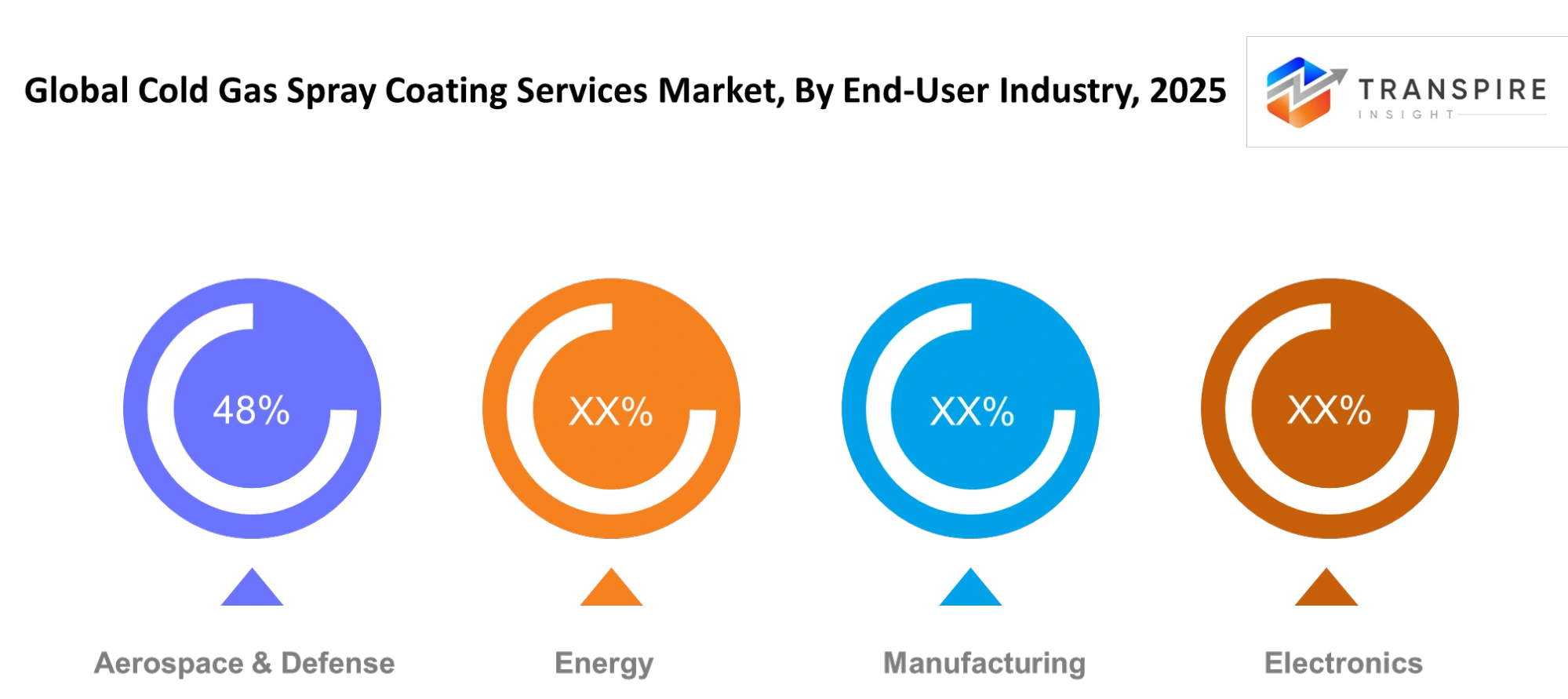
- Aerospace & Defense: Aerospace and defense is the largest end-user industry in the Global Cold Gas Spray Coating Services Market, accounting for approximately 48% of total revenue. Military and commercial aviation maintenance, repair, and overhaul operations drive the bulk of this demand. Defense depot maintenance programs at facilities operated by or under contract to the US Army, Navy, Air Force, and allied military organizations have been among the most active adopters of qualified cold spray repair processes, motivated by the need to extend the service life of aging platforms at controlled cost. Commercial MRO providers have followed as airworthiness approvals for cold spray repair schemes have expanded. The aerospace and defense segment also includes new-build coating work on defense-specific components where thermal spray is not permitted and plating chemistries are being phased out.
- Energy: The energy sector uses cold spray for corrosion and wear protection on components in oil and gas production, power generation, and, increasingly, renewable energy equipment. Pump impellers, valve bodies, and piping components in corrosive service environments benefit from cold spray metal coatings applied without the distortion risk of weld overlays. In power generation, cold spray has been used for dimensional restoration on turbine components and for corrosion protection on heat exchanger surfaces. The renewable energy segment is an emerging application area, with wind turbine components and offshore structure hardware generating interest from service providers who can offer cold spray as a field-deployable repair option. Energy is a smaller segment than aerospace in this market but has consistent maintenance-driven demand.
- Manufacturing: Manufacturing end-users apply cold spray for tooling repair, mold restoration, and wear protection on production equipment. Cold spray repair of injection molds, die casting tooling, and stamping dies can restore worn surfaces to original dimensions without the distortion and microstructural changes that welding produces in tool steel. The economics are attractive when the alternative is scrapping a tool with significant remaining cavity life. Manufacturing is a fragmented end-user category in the Global Cold Gas Spray Coating Services Market, with demand distributed across many small and mid-sized operations rather than concentrated in large, repeat-volume customers like aerospace MRO facilities. This fragmentation makes it harder for service providers to develop efficient workflows and qualification programs for manufacturing work compared to aerospace.
- Electronics: Electronics end-users include manufacturers of power conversion equipment, printed circuit board assemblies, and electronic packaging where cold spray deposits copper, aluminum, or specialty metals for functional rather than decorative purposes. The electronics end-user category overlaps with the electronics application segment but is defined by the type of company purchasing the service: electronics manufacturers buying cold spray as a production or rework process rather than an MRO service. Demand here is tied to production volumes in power electronics and to the density of copper structures required in next-generation EV inverters and fast-charging infrastructure, where cold spray offers a deposition method that avoids the chemical waste of electroplating and the thermal exposure of thermal spray.
To learn more about this report, Download Free Sample Report
Regional Insights
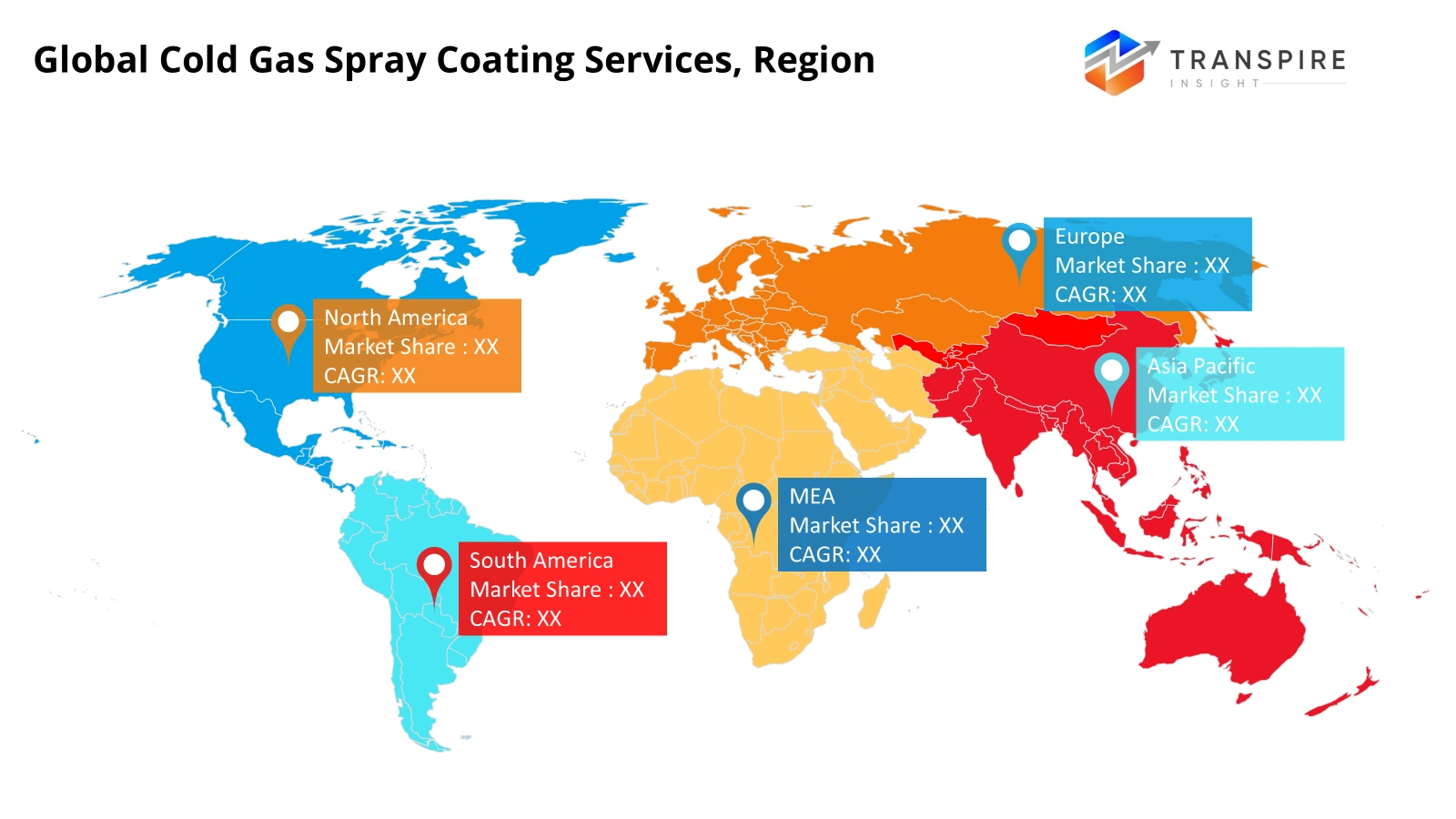
The United States is the largest national market in the Global Cold Gas Spray Coating Services Market, reflecting the scale of its aerospace and defense industrial base and the depth of military MRO investment in cold spray qualification. The US Army Research Laboratory has been a significant source of process development and qualification work over the past two decades, and that institutional investment has seeded a qualified service provider base that extends into commercial aerospace MRO. Major US defense depots, including those operated by the Army and Navy, use cold spray for aluminum and copper repairs on rotorcraft, fixed-wing aircraft, and ground vehicle components.
Europe is the second-largest regional market. Germany hosts several of the leading equipment manufacturers and research institutions that have driven process development, and the German aerospace supply chain includes qualified cold spray service operations. The UK, France, and the Netherlands have active MRO sectors for both military and commercial aviation that have adopted cold spray for approved repair schemes. Oerlikon Metco, with Swiss and European operations, is among the most globally active service and technology providers in the region.
Asia-Pacific is growing. Japan has a developed industrial cold spray user base, particularly in precision manufacturing and electronics. South Korea and Australia have defense maintenance programs that are evaluating or have adopted cold spray for specific repair applications. China has domestic equipment manufacturers and a growing service sector, though the qualification depth for aerospace applications lags that of the US and European markets.
The Middle East has defense maintenance operations, particularly for air forces operating US-supplied aircraft, that create demand for qualified cold spray repair services either delivered locally or through US-based MRO providers under existing supply agreements.
To learn more about this report, Download Free Sample Report
Recent Development News
Several service providers in the Global Cold Gas Spray Coating Services Market have been working to qualify cold spray repair processes for additional aerospace component categories beyond the aluminum and magnesium repair schemes that have formed the core of the market's aerospace revenue. Titanium and nickel alloy cold spray repair, which require higher-pressure systems and more tightly controlled powder specifications, are the primary targets for these qualification programs, as the component replacement costs in those material categories are higher and the repair value proposition is correspondingly stronger.
On the equipment side, there has been commercial activity around portable and lower-cost cold spray systems designed for field repair and depot maintenance use, rather than the fixed, high-pressure systems used for the highest-performance aerospace coatings. These lower-pressure systems trade some deposition efficiency and coating density for portability and reduced gas consumption, and they are finding users in industrial maintenance and military field repair applications where the alternative is shipping the part to a fixed facility.
Report Metrics
|
Report Metrics |
Details |
|
Market size value in 2025 |
USD 353.8 Million |
|
Market size value in 2026 |
USD 369.7 Million |
|
Revenue forecast in 2033 |
USD 496.4 Million |
|
Growth rate |
CAGR of 4.30% from 2026 to 2033 |
|
Base year |
2025 |
|
Historical data |
2021 - 2024 |
|
Forecast period |
2026 - 2033 |
|
Report coverage |
Revenue forecast, competitive landscape, growth factors, and trends |
|
Regional scope |
Global |
|
Key company profiled |
Impact Innovations GmbH, Oerlikon Metco, VRC Metal Systems LLC, Bodycote PLC, Linde PLC, Air Products and Chemicals Inc., Curtiss-Wright Corporation, Praxair Surface Technologies Inc., Plasma Giken Co. Ltd., ASB Industries Inc., Flame Spray Technologies B.V., Thermion Inc., CenterLine (Windsor) Limited, Cold Spray Technologies Inc., Inovati Inc. |
|
Customization scope |
Free report customization (country, regional & segment scope). Avail customized purchase options to meet your exact research needs. |
|
Report Segmentation |
By Material Type (Metals, Alloys, Composites), By Application (Aerospace, Automotive, Electronics, Industrial Equipment), By End-User Industry (Aerospace & Defense, Energy, Manufacturing, Electronics). |
Key Global Cold Gas Spray Coating Services Company Insights
The Global Cold Gas Spray Coating Services Market is served by a mix of equipment manufacturers who also provide coating services, dedicated surface treatment companies that have added cold spray to their process portfolios, and specialist service providers focused exclusively on cold spray for aerospace and defense. The market is not large enough for a single company to dominate across all geographies and application segments, so competitive positions tend to be built around specific qualification credentials, geographic proximity to customer facilities, and depth of application engineering capability.
Equipment manufacturers such as Impact Innovations, VRC Metal Systems, Plasma Giken, and Inovati have a natural advantage in process knowledge and access to the latest system developments. Companies like Oerlikon Metco, Bodycote, and Praxair Surface Technologies bring broader surface treatment service networks and existing MRO relationships that make cold spray an add-on capability within a larger customer account. Curtiss-Wright has focused on defense MRO applications where its existing program relationships provide access to qualification pathways that independent service providers would have to build from scratch. CenterLine and ASB Industries have established positions in the North American aerospace and industrial markets through early adoption and the process qualification work that position entails.
Company List
- Impact Innovations GmbH
- Oerlikon Metco
- VRC Metal Systems LLC
- Bodycote PLC
- Linde PLC
- Air Products and Chemicals Inc.
- Curtiss-Wright Corporation
- Praxair Surface Technologies Inc.
- Plasma Giken Co. Ltd.
- ASB Industries Inc.
- Flame Spray Technologies B.V.
- Thermion Inc.
- CenterLine (Windsor) Limited
- Cold Spray Technologies Inc.
- Inovati Inc.
Global Cold Gas Spray Coating Services Market Report Segmentation
By Material Type
- Metals
- Alloys
- Composites
By Application
- Aerospace
- Automotive
- Electronics
- Industrial Equipment
By End-User Industry
- Aerospace & Defense
- Energy
- Manufacturing
- Electronics
Frequently Asked Questions
Find quick answers to common questions.
The Global Cold Gas Spray Coating Services Market is expected to reach approximately USD 496.4 million by 2033.
Key segments include Material Type (Metals, Alloys, Composites), Application (Aerospace, Automotive, Electronics, Industrial Equipment), and End-User Industry (Aerospace & Defense, Energy, Manufacturing, Electronics).
Major players include Impact Innovations GmbH, Oerlikon Metco, VRC Metal Systems LLC, Bodycote PLC, Linde PLC, Air Products and Chemicals Inc., Curtiss-Wright Corporation, Praxair Surface Technologies Inc., Plasma Giken Co. Ltd., ASB Industries Inc., Flame Spray Technologies B.V., Thermion Inc., CenterLine (Windsor) Limited, Cold Spray Technologies Inc., and Inovati Inc.
The Global Cold Gas Spray Coating Services Market size is approximately USD 353.8 million in 2025.
The Global Cold Gas Spray Coating Services Market is expected to grow at a CAGR of 4.30% from 2026 to 2033.
- Impact Innovations GmbH
- Oerlikon Metco
- VRC Metal Systems LLC
- Bodycote PLC
- Linde PLC
- Air Products and Chemicals Inc.
- Curtiss-Wright Corporation
- Praxair Surface Technologies Inc.
- Plasma Giken Co. Ltd.
- ASB Industries Inc.
- Flame Spray Technologies B.V.
- Thermion Inc.
- CenterLine (Windsor) Limited
- Cold Spray Technologies Inc.
- Inovati Inc.
Recently Published Reports
-
Apr 2026
Healthcare Polymer Packaging Market
Healthcare Polymer Packaging Market Size, Share & Analysis Report By Packaging Type (Syringes, IV Bottles and Pouches, Clamshells, Blisters, Bottles & Jars, Containers, Tubes, IV Parental Packaging, Others), By Type (Regulated, Non-regulated), By Polymer Type (LDPE (Low-Density Polyethylene), HDPE (High-Density Polyethylene), Homo-polymer (Homo), Random Copolymer (Random), Block Copolymer (Block), PET, Polystyrene, Polyvinyl Chloride, Polyamide/EVOH, Others), and Geography (North America, Europe, Asia-Pacific, Middle East and Africa, South and Central America), 2021 - 2031
-
Apr 2026
Hydrophilic Tape (Waterstop) Market
Hydrophilic Tape (Waterstop) Market Size, Share & Analysis Report By Type (Bentonite-Based Hydrophilic Tape, Rubber-Based Hydrophilic Tape), By Application (Residential Buildings, Commercial Buildings, Infrastructure Projects), and Geography (North America, Europe, Asia-Pacific, Middle East and Africa, South and Central America), 2021 - 2031
-
Apr 2026
Metalens Market
Metalens Market Size, Share & Analysis Report By Type (Visible Light Metalens, and Infrared Metalens), By Application (Consumer Electronics, Automotive Electronics, Industrial, Medical, and Others), and Geography (North America, Europe, Asia-Pacific, Middle East and Africa, South and Central America), 2021 - 2031
-
Apr 2026
PBT Resin Market
PBT Resin Market Size, Share & Analysis Report By Type (Reinforced PBT Resin, Unreinforced PBT Resin), By Processing Method (Injection Molding, Extrusion, Blow Molding, Others), By End-User (Automotive, Electrical & Electronics, Consumer Appliances, Industrial Machinery, Medical Devices, Packaging, Others), and Geography (North America, Europe, Asia-Pacific, Middle East and Africa, South and Central America), 2021 - 2031