

Global Carbon Dioxide Utilization Market Summary:
According to Transpire Insights, a detailed research report on the market reflects that the chemical manufacturing application segment dominates the global Global Carbon Dioxide Utilization Market, accounting for approximately 73% of the total share worldwide. Linde plc leads the market with approximately (around USD 33.0 billion) in annual revenue and an estimated 18–22% global market share, making it the leading contributor to global market development, innovation, advanced carbon dioxide utilization technologies, expanding industrial capabilities, and growth dynamics.
Market Snapshot
- Market Value (2025): USD 4.2 Billion.
- Expected Market Value (2026): USD 4.95 Billion.
- Estimated Market Value (2033): USD 15.64 Billion.
- Forecast CAGR (2026–2033): 17.86%.
- Leading Region in 2025: North America
- Second-largest Region: Europe
- Fastest Growing Region: Asia-Pacific
Introduction
The Global Carbon Dioxide Utilization Market covers the business ecosystem focused on capturing carbon dioxide (CO₂) emissions from industrial processes or direct air capture and transforming them into useful products and industrial applications. As a vital component of Carbon Capture, Utilization, and Storage (CCUS), the market supports worldwide decarbonization efforts by changing CO₂ from a waste emission into an economic resource. Utilized CO₂ serves as a feedstock for chemicals, fuels, construction materials, food and beverage processing, and enhanced oil recovery, enabling sustainable revenue prospects while lowering greenhouse gas emissions. Growing investments in low-carbon technologies, favorable government policies, and breakthroughs in carbon conversion processes are propelling industry expansion. The increasing acceptance of circular carbon economy projects is further enhancing the commercial viability and long-term growth of the market.
For instance:- North America,Due to favorable government incentives like California's Low Carbon Fuel Standard (LCFS) and the United States' 45Q Tax Credit, which promote CCUS deployment and commercial carbon utilization projects, North America dominates the global carbon dioxide utilization market, accounting for roughly 38–42% of the market regionally.
Asia-Pacific Through 2033, the Asia-Pacific market is expected to grow at the fastest rate due to government funding programs, growing industrial decarbonization initiatives, rising CCUS investments, and growing adoption of CO2 utilization technologies in China, Japan, South Korea, and Australia.

Key Market Highlights: -
- North America is expected to grow at a rapid CAGR in the Global Carbon Dioxide Utilization Market by holding approximately 40% of the share during the forecast period.
- Europe is anticipated to hold close to 20.3% share of the Global Carbon Dioxide Utilization Market over the predicted timeframe.
- Asia Pacific is anticipated to hold nearly 50% share of the Global Carbon Dioxide Utilization Market over the predicted timeframe.
- By Technology, the Chemical Conversion segment dominated the market and holds around 40% share in 2025 and is projected to grow at a substantial CAGR during the forecast period.
- By Application, the Plastics Manufacturing segment dominated the market and holds roughly 31% share in 2025 and is projected to grow at a substantial CAGR during the forecast period.
- By End User, the Agriculture and Food & Beverage dominated the market and holds nearly 25% share in 2025 and is projected to grow at a substantial CAGR during the forecast period.
- Government Support & Policy Initiatives: Through the implementation of supportive policies, such as the EU Innovation Fund, the U.S. Section 45Q tax credit, and India's CCTS and CCUS roadmap, countries are supporting the global carbon dioxide utilization market by encouraging investment, commercialization, and large-scale carbon utilization initiatives.
How is Technology Driving Growth in the Global Carbon Dioxide Utilization Market?
The global market for carbon dioxide use is expanding due in large part to technological improvements. Advances in Carbon Capture, Utilization and Storage (CCUS), electrochemical and biological CO2 conversion, and better catalyst technologies are increasing carbon conversion efficiency while lowering energy consumption and operating costs. By permanently storing collected CO2 in concrete and other construction materials, carbon mineralization methods enhance material performance and sustainability. Decarbonization of industry is being aided by the creation of synthetic fuels, methanol, and other low-carbon compounds utilizing captured CO2 and green hydrogen. Wider adoption of carbon utilization technologies across many end-use industries is being facilitated by AI-driven process optimization, automation, and digital monitoring, which are improving operational efficiency, scalability, and economic feasibility.
Market Drivers
Stricter carbon emission rules, growing adoption of Carbon Capture, Utilization, and Storage (CCUS) technologies, and growing global decarbonization activities are the main factors propelling the growth of the worldwide carbon dioxide utilization market. Encouraging the implementation of large-scale carbon utilization projects at the national level in the Asia-Pacific area through government incentives including the EU Innovation Fund, the U.S. Inflation Reduction Act (IRA) Section 45Q, and CCUS initiatives. The market is anticipated to develop due to the demand for sustainable chemicals, building materials, low-carbon fuels, and enhanced oil recovery (EOR) applications. Increased investments from large corporations like ExxonMobil, Chevron, Linde, and Sinopec, together with advancements in carbon conversion technology and advantageous public-private partnerships, are also driving the market toward commercialization and long-term growth.
For Instance: -Through the implementation of updated EU ETS regulations, the start of massive carbon utilization projects, and investments in industrial decarbonization, Europe is driving market expansion. Leading nations in infrastructure development, carbon storage, and CO2 conversion initiatives include Germany, France, the Netherlands, and Norway.
Restrain
High capital and operating expenses for carbon capture, transportation, and usage infrastructure are only a few of the difficulties facing the global carbon dioxide utilization market. The availability of CO2 transport and storage networks restricts large-scale implementation, and the absence of ubiquitous infrastructure raises project costs.
Analysis of Prices and Consumer Behaviour
Because of the significant demand from the oil and gas, energy, and industrial sectors, Enhanced Oil Recovery (EOR) applications hold the greatest part of the Carbon Dioxide Utilization market (34–38% of the entire market). Because of sophisticated carbon capture methods, purification procedures, and strict quality requirements, high-purity collected CO2 is expected to fetch a 25–35% value premium over traditional industrial CO2 for usage in chemicals, synthetic fuels, and food-grade applications. Enhanced Oil Recovery (EOR) and industrial applications account for around 40–45% of the overall CO2 use volume, which is supported by current infrastructure and commercial deployment. Nearly 65–70% of the total market demand comes from the oil and gas, chemical, and construction industries. In terms of purchasing behavior, 30–35% of industrial buyers are looking for long-term supply agreements and strategic partnerships to guarantee a dependable CO2 supply and optimize operating costs at large-scale industrial facilities, while 55–60% are looking for CO2 purity, capture efficiency, and cost-effectiveness.
Top Companies in the Global Carbon Dioxide Utilization Market
- LanzaTech
- CarbonCure Technologies
- Twelve
- Carbon Clean
- Climeworks
- Air Liquide
- Linde
- Mitsubishi Heavy Industries
- SLB
- Aker Carbon Capture
- Svante
- Shell
- BASF
- Siemens Energy
- Equinor
Global Carbon Dioxide Utilization Market Segmentation
The Global Carbon Dioxide Utilization Market share is divided into five categories: Technology, Application, and end user, Source, distributed channel
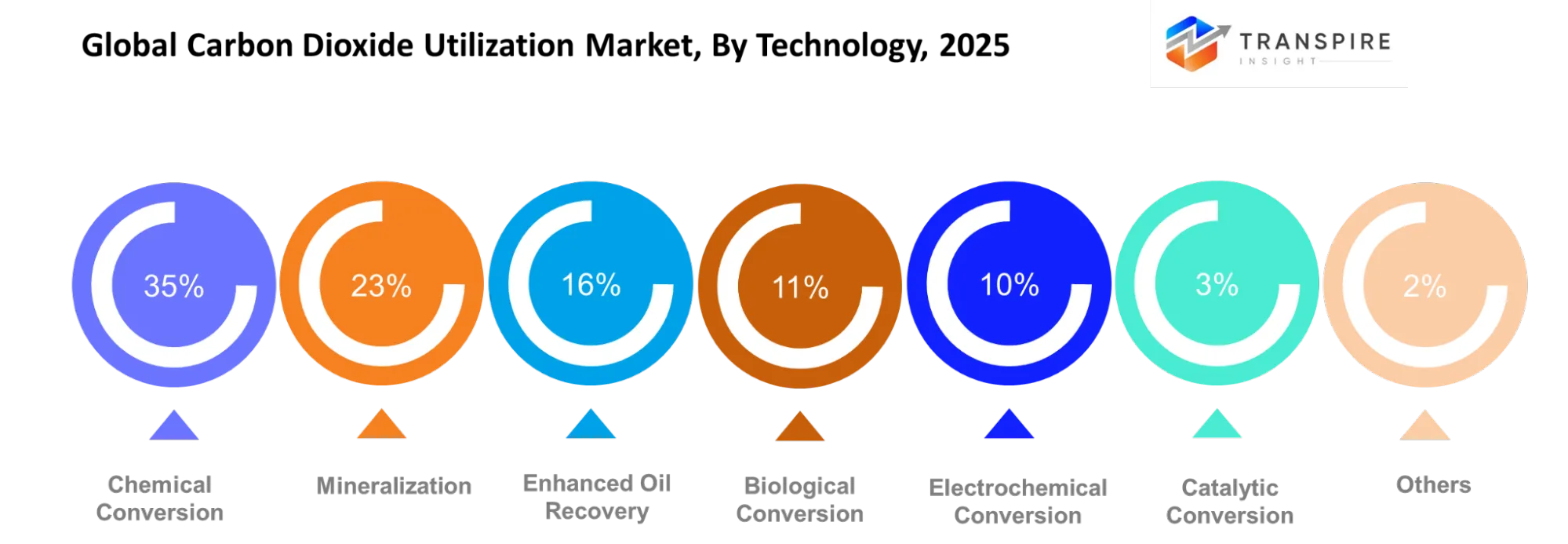
The Chemical Conversion segment dominated the market, accounting for around 40% in 2025 and is expected to rise at a significant CAGR during the forecast period.
The Global Carbon Dioxide Utilization Market is segmented by Technology into chemical conversion, biological conversion, mineralization, enhanced oil recovery, electrochemical conversion, catalytic conversion, others). Among these, the Chemical Conversion segment dominated the market, accounting for around 40% in 2025 and expected to increase at a significant CAGR during the forecast period. Due to the increasing demand for methanol, urea, polymers, and synthetic fuels, which was bolstered by CCUS developments, decarbonization efforts, and expanding industrial applications worldwide, the Chemical Conversion category held the biggest market share in 2025, at about 40%.
The Plastics Manufacturing dominated the market, accounting for roughly 31%in 2025, and is expected to rise at a significant CAGR during the forecast period.
The Global Carbon Dioxide Utilization Market is segmented by Application, into chemicals production, building materials, fuels, food & beverage, agriculture, plastics manufacturing, others. Among these, the Plastics Manufacturing segment dominated the market, accounting for roughly 31%in 2025 and expected to increase at a significant CAGR during the forecast period. Due to rising demand for CO2-based polymers, sustainable plastics, circular economy projects, and expanding industry adoption of low-carbon manufacturing technologies, the Plastics Manufacturing segment dominated the market and held about 31% of the market in 2025.
Agriculture and Food & Beverage dominated the market, accounting for nearly 25% in 2025 and is expected to rise at a significant CAGR during the forecast period.
The Global Carbon Dioxide Utilization Market is segmented end user into, chemical industry, energy industry, food & beverage companies, construction industry, agricultural sector, research institutes, others. Among these, the Agriculture and Food & Beverage segment dominated the market, accounting for nearly 25% in 2025 and expected to increase at a significant CAGR during the forecast period. With a share of about 25% in 2025, the agricultural and food and beverage market was the largest application segment. Globally, the market is anticipated to increase due to the growing need for food-grade CO2 for beverage carbonation, food preservation, greenhouse cultivation, and controlled atmosphere packaging, among other uses.
Regional Segment Analysis of the Global Carbon Dioxide Utilization Market
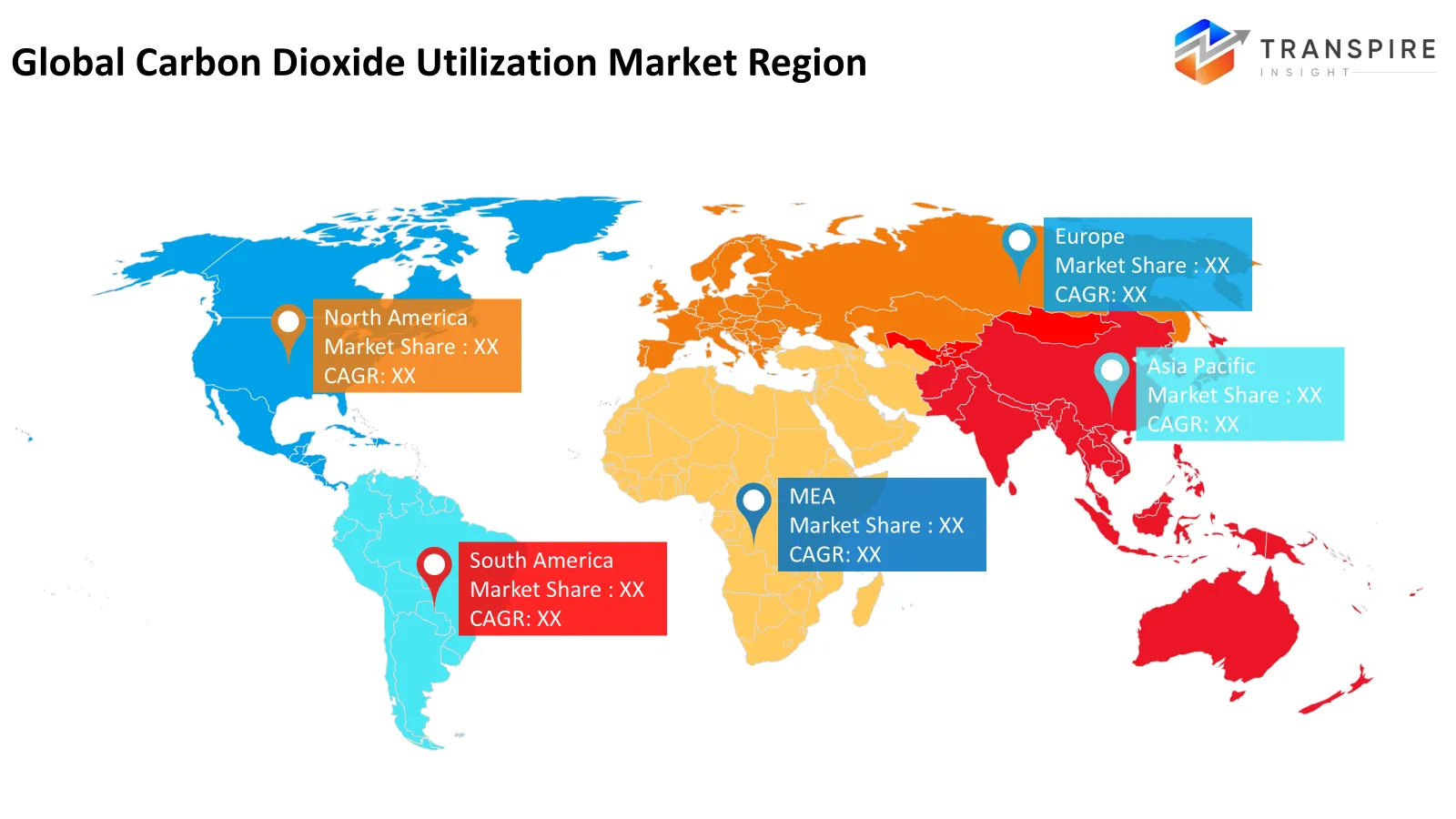
- Europe (Germany, France, U.K., Italy, Spain, Rest of Europe)
- North America (U.S., Canada, Mexico)
- Asia-Pacific (China, Japan, India, Rest of APAC)
- South America (Brazil and the Rest of South America)
- The Middle East and Africa (UAE, South Africa, Rest of MEA)
North America is expected to grow at a rapid CAGR in the Global Carbon Dioxide Utilization Market, holding approximately 40% of the share during the forecast period
With a projected 40% market share throughout the course of the forecast period, North America is expected to lead the global carbon dioxide use market. The region's strong government support through the U.S. Inflation Reduction Act (IRA) Section 45Q, the vast CCUS infrastructure, and the investments from corporations like ExxonMobil, Chevron, and Linde are all responsible for this dominance. Modern carbon capture technologies, numerous enhanced oil recovery (EOR) activities, permissive regulatory frameworks, rising demand for low-carbon fuels and chemicals, and continuous innovation in sustainable industrial decarbonization solutions are all features of the region.
Europe is the fastest-growing region in the Global Carbon Dioxide Utilization Market during the period, holding close to 20.3%share.
Due to stringent climate restrictions, the European Green Deal, and the EU Emissions Trading System (EU ETS), Europe is the fastest-growing region in the global carbon dioxide utilization industry, with a nearly 20.3% market share. The industry is propelled by rising investments in Carbon Capture, Utilization, and Storage (CCUS), encouraging funding from the EU Innovation Fund, and rising demand for low-carbon building materials, sustainable fuels, and chemicals. Germany, France, the Netherlands, and Norway are among the nations setting the standard for extensive carbon usage and decarbonization initiatives.
Asia Pacific is the fastest-growing region in the Global Carbon Dioxide Utilization Market during the period, holding nearly 50%share.
With about 50% of the global carbon dioxide utilization market during the forecast period, the Asia Pacific region is the biggest and fastest-growing regional market. Rapid industrialization, rising carbon emissions, growing CCUS deployment, and growing demand for chemicals, food-grade CO2, and enhanced oil recovery (EOR) all contribute to the region's supremacy. Faster adoption of carbon utilization technologies and the expansion of regional markets are being fueled by increased investments in decarbonization projects and large-scale initiatives in China, Japan, India, South Korea, and Australia, as well as strong government support.
Strategies for Market Growth in Non-Leading Regions:
With effective and scalable carbon capture, utilization, and storage (CCUS) technology, small and medium-sized industrial operators would profit from the development of non-leading regions. The creation of a regional infrastructure for CO2 capture, transit, utilization, and processing may reduce reliance on imports, transportation expenses, and project costs overall. Increased market penetration and faster commercial implementation of carbon utilization solutions will result from partnerships with energy firms, chemical manufacturers, cement makers, technology suppliers, and industrial gas suppliers. To develop technical skills, training programs and workforce development in carbon capture, CO2 conversion and use processes, and emissions management will be necessary. Public-private partnerships, long-term carbon supply agreements, government incentives, and flexible financing methods will all increase project affordability and promote wider adoption. Adoption of digital monitoring and AI-enabled process optimization, as well as the creation of cooperative projects with governments, academic institutions, industrial clusters, and clean energy initiatives, will improve operational effectiveness, market accessibility, and long-term, sustainable growth throughout developing regions.
Future Market Trends for the Global Carbon Dioxide Utilization Market: -
- Building using CO2 and Sustainable Fuels Expansion: Carbon mineralization technologies are becoming more popular in the building industry, permanently storing CO2 in concrete, and the manufacture of sustainable aviation fuels and synthetic e-fuels is being accelerated by the combination of collected CO2 and green hydrogen.
- Growing use of CO2 as an industrial feedstock: Using sophisticated catalytic and electrochemical conversion technologies, industries are producing methanol, urea, polymers, and other high-value chemicals from captured CO2. This lessens reliance on feedstocks derived from fossil fuels and supports circular carbon economy projects.
- Regional Expansion is Driven by Policy and Industrial Investment: Asia-Pacific exhibits the fastest growth due to rapid industrialization, government decarbonization mandates, and increasing investments in carbon utilization technologies, while North America maintains its market leadership due to strong CCUS incentives and existing infrastructure.
Recent Development
February 2026: In order to facilitate the retrofitting of existing facilities with lower energy carbon capture technology and promote widespread industrial decarbonization, modular carbon capture systems are being deployed in the steel, cement, power generating, and refining industries.
Launched in May 2026, global carbon pricing mechanisms now cover nearly 30% of greenhouse gas emissions worldwide, generating over USD 107 billion in carbon market value and encouraging major airlines and industrial companies to adopt carbon utilization technologies, carbon credits, and low-carbon investments.
This study forecasts revenue at global, regional and country levels from 2020 to 2033. Transpire Insights has segmented the Global Carbon Dioxide Utilization Market based on the below-mentioned segments:
Global Carbon Dioxide Utilization Market, By Technology
- Chemical Conversion
- Biological Conversion
- Mineralization
- Enhanced Oil Recovery
- Electrochemical Conversion
- Catalytic Conversion
- Others
Global Carbon Dioxide Utilization Market, By Application
- Chemicals Production
- Building Materials
- Fuels
- Food & Beverage
- Agriculture
- Plastics Manufacturing
- Others
Global Carbon Dioxide Utilization Market, By End User
- Chemical Industry
- Energy Industry
- Food & Beverage Companies
- Construction Industry
- Agricultural Sector
- Research Institutes
- Others
Global Carbon Dioxide Utilization Market, By Source
- Industrial CO₂
- Direct Air Capture
- Bioenergy Plants
- Natural CO₂ Sources
- Others
Global Carbon Dioxide Utilization Market, By Distribution Channel
- Direct Supply
- Industrial Gas Suppliers
- EPC Providers
- Others
Global Carbon Dioxide Utilization Market, By Regional Analysis
North America
- United States
- Canada
- Mexico
Europe
- Germany
- United Kingdom
- France
- Italy
- Spain
- Russia
- Rest of Europe
Asia Pacific
- China
- Japan
- India
- South Korea
- Australia
- Rest of Asia Pacific
South America
- Brazil
- Argentina
- Rest of South America
Middle East & Africa
- Saudi Arabia
- United Arab Emirates
- Qatar
- South Africa
- Rest of the Middle East & Africa
Frequently Asked Questions
Find quick answers to common questions.
Growing CCUS adoption, stringent emission regulations, government incentives, technological advancements, and rising demand for sustainable fuels, chemicals, and construction materials drive market growth.
North America leads the market due to strong government incentives, advanced CCUS infrastructure, extensive EOR operations, and significant industrial investments.
Chemical Conversion dominates with around 40% market share, driven by increasing demand for methanol, polymers, urea, synthetic fuels, and industrial chemicals.
Major applications include chemicals production, plastics manufacturing, sustainable fuels, building materials, agriculture, food processing, and enhanced oil recovery operations.
Leading companies include Linde, Air Liquide, CarbonCure Technologies, LanzaTech, Climeworks, BASF, Shell, SLB, Equinor, and Mitsubishi Heavy Industries.
- LanzaTech
- CarbonCure Technologies
- Twelve
- Carbon Clean
- Climeworks
- Air Liquide
- Linde
- Mitsubishi Heavy Industries
- SLB
- Aker Carbon Capture
- Svante
- Shell
- BASF
- Siemens Energy
- Equinor
About the Authors

Pankaj Ghogare Patil
I am Pankaj Ghogare Patil, a Senior Research Analyst at Transpire Insight, specializing in the Pharmaceutical, Chemicals & Materials, Healthcare IT, and Biotechnology industry. My expertise lies in conducting comprehensive market research, analyzing industry trends, evaluating competitive landscapes, and translating complex data into actionable insights. At Transpire Insight, I closely follow emerging technologies, regulatory developments, and market innovations to create accurate, well-researched, and informative content that helps businesses and professionals make informed decisions. I am committed to producing credible, evidence-based articles that reflect industry best practices while making technical topics accessible and valuable for a broad audience.

Chakradhar Khansole
Chakradhar serves as the Research Director at Transpire Insight, bringing over 8 years of experience in technology, innovation, and strategic market intelligence. He specializes in transforming complex market data into actionable business insights that enable organizations to make informed, growth-oriented decisions. Recognized for his strategic vision and analytical expertise, Chakradhar leads high-impact research initiatives, delivering comprehensive market assessments, competitive intelligence, and forward-looking industry analysis.
Recently Published Reports
-
May 2026
Healthcare Polymer Packaging Market
Healthcare Polymer Packaging Market Size, Share & Analysis Report By Packaging Type (Syringes, IV Bottles and Pouches, Clamshells, Blisters, Bottles & Jars, Containers, Tubes, IV Parental Packaging, Others), By Type (Regulated, Non-regulated), By Polymer Type (LDPE (Low-Density Polyethylene), HDPE (High-Density Polyethylene), Homo-polymer (Homo), Random Copolymer (Random), Block Copolymer (Block), PET, Polystyrene, Polyvinyl Chloride, Polyamide/EVOH, Others), and Geography (North America, Europe, Asia-Pacific, Middle East and Africa, South and Central America), 2021 - 2031
-
Apr 2026
Hydrophilic Tape (Waterstop) Market
Hydrophilic Tape (Waterstop) Market Size, Share & Analysis Report By Type (Bentonite-Based Hydrophilic Tape, Rubber-Based Hydrophilic Tape), By Application (Residential Buildings, Commercial Buildings, Infrastructure Projects), and Geography (North America, Europe, Asia-Pacific, Middle East and Africa, South and Central America), 2021 - 2031
-
Apr 2026
Metalens Market
Metalens Market Size, Share & Analysis Report By Type (Visible Light Metalens, and Infrared Metalens), By Application (Consumer Electronics, Automotive Electronics, Industrial, Medical, and Others), and Geography (North America, Europe, Asia-Pacific, Middle East and Africa, South and Central America), 2021 - 2031
-
Apr 2026
PBT Resin Market
PBT Resin Market Size, Share & Analysis Report By Type (Reinforced PBT Resin, Unreinforced PBT Resin), By Processing Method (Injection Molding, Extrusion, Blow Molding, Others), By End-User (Automotive, Electrical & Electronics, Consumer Appliances, Industrial Machinery, Medical Devices, Packaging, Others), and Geography (North America, Europe, Asia-Pacific, Middle East and Africa, South and Central America), 2021 - 2031