

Gift Card and Incentive Card Market Summary:
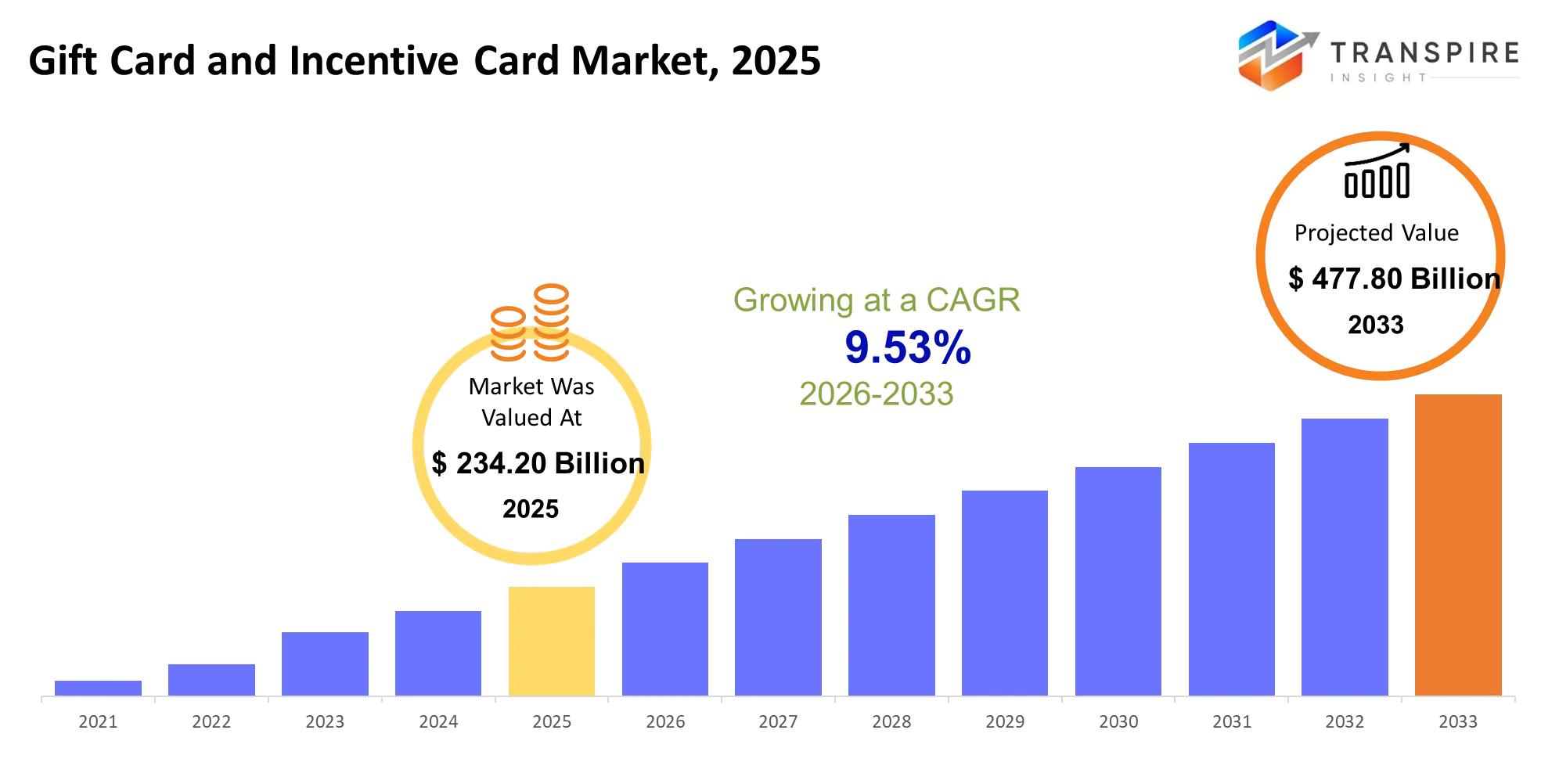
As per Transpire Insight Analysis, the Gift Card and Incentive Card Market size is estimated at USD 234.20 billion in 2025 and is anticipated to reach USD 477.80 billion by 2033, growing at a CAGR of 9.53% from 2026 to 2033.
Gift cards and incentive cards support retailers in bringing in sales ahead of time. They give customers a way to give gifts. Businesses can also use them to reward employees and customers without sending out products. In the past three to five years, the market has changed a lot. It has moved from plastic cards to digital delivery. People now use wallets and online shopping platforms more. Gift cards are being connected better with retailers, payment companies and digital commerce sites. The growth of e-commerce and remote interactions has made instant digital rewards more useful. These rewards work well for birthdays, holidays, promotions, employee recognition and keeping customers coming. Businesses can send codes fast. They can tailor rewards for groups. They can also track redemptions easily. This helps cut down delays in delivery. It also gives businesses a chance to get customers to buy again. Providers still face problems. Fraud is a concern. Some people have trouble redeeming their cards. Laws around consumer protection vary by place. These issues can damage trust. They also make reward programs less effective. So providers must keep working on these problems.
Gift Card and Incentive Card Market Size & Forecast:
- Market Size 2025: USD 234.20 Billion
- Expected Market Value (2033): USD 477.80 Billion
- Forecast CAGR (2026-2033): 9.53%
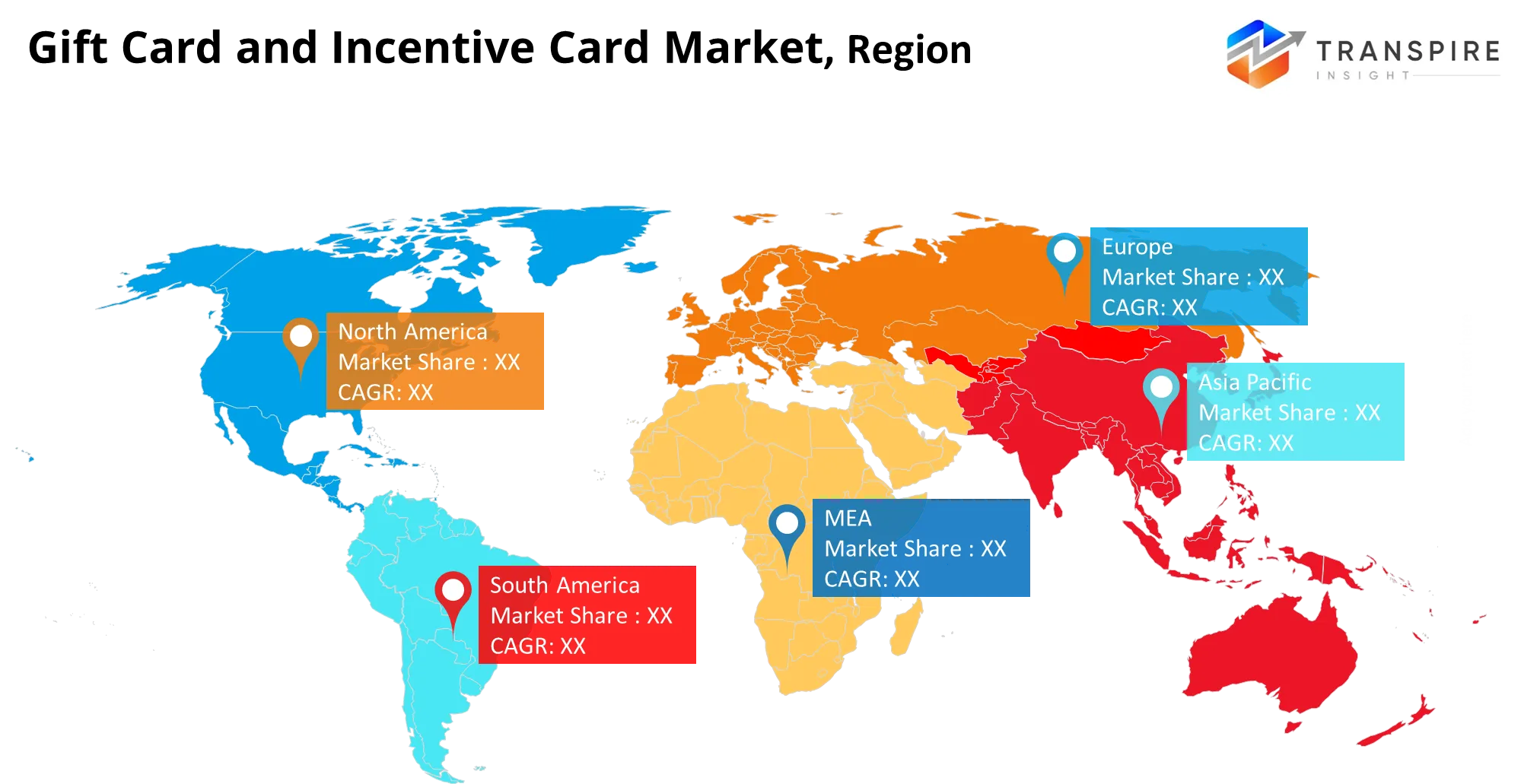
- Leading Region in 2025: North America
- Fastest Growing Region: Asia Pacific
- Key Company Profiles: Blackhawk Network, InComm Payments, Stored Value Solutions, Fiserv, The Gift Card Company, PayPal, Amazon, Apple, Google, Walmart, Target, Starbucks, Visa, Mastercard, American Express
Key Market Insights:
The market is moving towards, and incentive cards are developing from being a traditional gift product line to being a much wider vehicle for shopping, engagement, and business rewards. Competitive advantage relies on convenient redemption, technology integration, personalisation, and fraud protection.
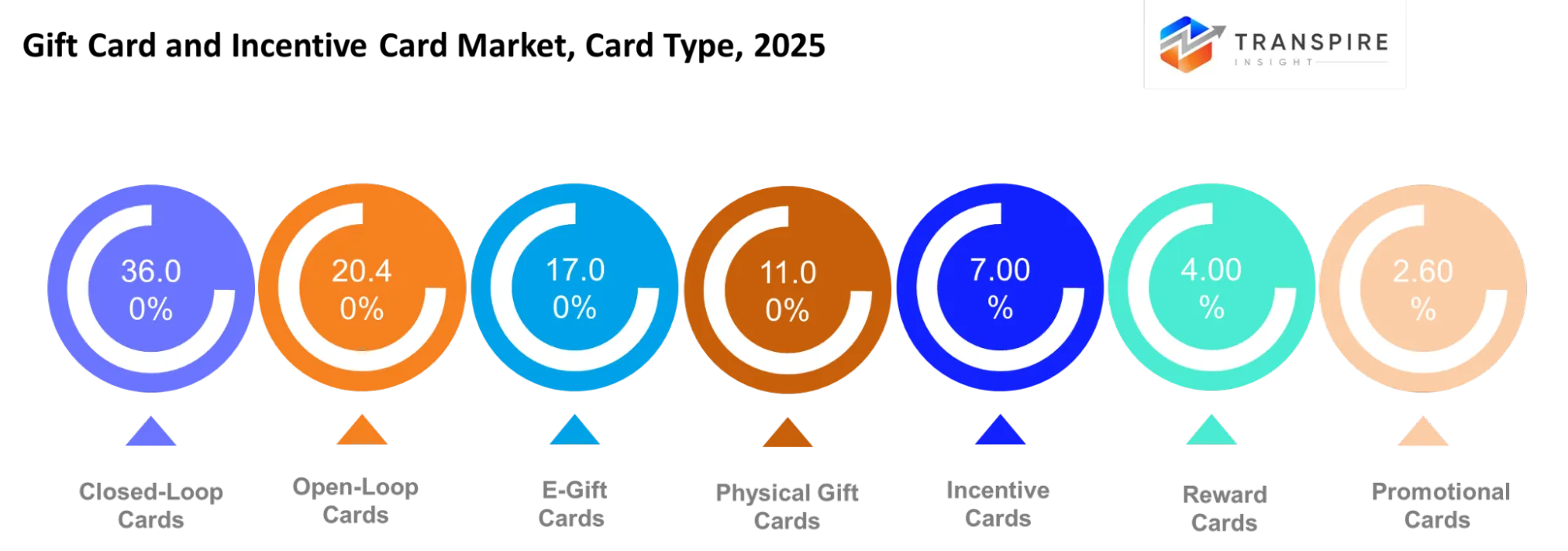
- The Closed-Loop Cards constitute 36.00% of the detailed card type breakdown and enable the promotion of sales within retailers’ physical or digital channels as well as enhance loyalty among the customers.
- The Open-Loop Cards hold 20.40% of the entire market share and increase payment options as well as improve security, payment processing and contactless transactions for the provider.
- The E-Gift Cards constitute 17.00% of the total market share and have an anticipated CAGR of 12.80% due to the popularity of instant delivery of these cards and the convenience of digital gifting.
- The Incentive Cards comprise 7.00% of the total market size as they allow companies to incentivise their staff or sales teams as well as customer actions within particular programs.
- The Promotional Cards constitute 2.60% of the total market size and allow attracting certain customers during the holiday
What are the Key Drivers, Restraints, and Opportunities in the Gift Card and Incentive Card Market?
Drivers
The growth is driven by the inclusion of digital incentives into other online retail and loyalty apps. Due to the rapid growth of online shopping, merchants are offering digital gift cards at checkout screens, on email promotions and through online accounts, which increase the speed of distribution and delivery while expanding the potential for revenue from each transaction, as business can be paid before consumers have liquidated the cards.
Restraints
Fraud is still a major barrier. Card credentials that have been stolen, access to accounts that have been hijacked, social-engineering malware, and activation deficiencies may cause consumers to lose money and lose confidence. Various rules and redemption rules and arrangements, as well as the payment infrastructure, may make distribution more difficult. Due to a lack of resources, small merchants may face further obstacles.
Opportunities
Opportunities may also arise from a synergy between personalised rewards and digital distribution. Vendors could offer application programming interfaces ( APIs) that tie e-gift systems into online retailers, employee software, and loyalty programs. As digital commerce and smartphone-based payments evolve in the Asia Pacific region, localised e-gift offerings and mobile-wallet redemption could open up. Developments in fraud analytics, automated issuance, and transparent redemption policies can help boost loyalty and recurring program income.
|
Driver |
Relative Impact on Growth (%) |
Geographic Relevance |
Impact Timeline |
Demand Strength |
Growth Mechanism |
Key Beneficiaries |
Major Constraint |
|
Digital gift card adoption and e-commerce expansion |
28% |
North America, Asia-Pacific, Europe |
Short-term (≤2 years) |
High |
Enables instant gifting and seamless online redemption |
Retailers, e-commerce platforms, digital card providers |
Cyber fraud and unauthorized code access |
|
Expansion of corporate incentive and employee reward programs |
24% |
North America, Europe, Asia-Pacific |
Medium-term (2-4 years) |
High |
Replaces cash bonuses with flexible digital rewards |
Employers, incentive platforms, prepaid card issuers |
Budget constraints and complex tax treatment |
|
Mobile wallet integration and cashless payment adoption |
20% |
Asia-Pacific, North America |
Short-term (≤2 years) |
High |
Simplifies card storage, checkout, and redemption |
Payment networks, wallet providers, merchants |
Limited interoperability across payment ecosystems |
|
Personalized loyalty programs and AI-driven reward management |
16% |
North America, Europe, Asia-Pacific |
Medium-term (2-4 years) |
High |
Uses customer insights to optimize targeted rewards |
Loyalty providers, retailers, analytics vendors |
Privacy concerns and poor-quality customer data |
|
Secure, sustainable, and interoperable card solutions |
12% |
Europe, North America, Asia-Pacific |
Long-term (≥4 years) |
Medium |
Reduces plastic usage and strengthens transaction security |
Card issuers, fintech firms, payment processors |
Compliance costs and evolving security requirements |
|
Total |
100% |
— |
— |
— |
— |
— |
|
|
Digital gift card adoption and e-commerce expansion |
28% |
North America, Asia-Pacific, Europe |
Short-term (≤2 years) |
High |
Enables instant gifting and seamless online redemption |
Retailers, e-commerce platforms, digital card providers |
Cyber fraud and unauthorized code access |
|
Expansion of corporate incentive and employee reward programs |
24% |
North America, Europe, Asia-Pacific |
Medium-term (2-4 years) |
High |
Replaces cash bonuses with flexible digital rewards |
Employers, incentive platforms, prepaid card issuers |
Budget constraints and complex tax treatment |
What Has the Impact of Artificial Intelligence Been on the Gift Card and Incentive Card Market?
Artificial intelligence is becoming increasingly useful in gift card operations by detecting fraud, providing personalised promotions, and improving redemption forecasting. Machine learning systems will detect any abnormal volume of purchases, balance inquiries, unusual transaction locations, and any redemption pattern that does not fit an established one. This will enable providers to investigate any suspicious activity and potentially limit financial losses. At the same time, automated alerts need to be evaluated thoroughly to avoid limiting access for genuine customers. Predictive analytics is useful for retailers in forecasting demand during holidays, promotions, and product launches. By analysing historical transactions, preferences of clients, timing of campaigns and redemption rates, companies will be able to make better decisions regarding availability, rewards, and marketing budget. Recommendation systems will also be able to recommend appropriate brand or card categories based on customer interests. There are certain difficulties with the implementation of artificial intelligence. Its effectiveness depends on the accuracy of transaction data. In addition, the integration of the system with existing point-of-sale, payment and human resource systems requires significant investments.
Instance
In October 2025, eGifter launched its innovative solutions AI Personalisation and AI SmartScreen. The first one enables the generation of customised pictures that are used for personalising eGift cards, and the other screens inappropriate materials provided by users. https://corporate.egifter.com/press-release-ai-personalization/
Key Market Trends:
Gift cards are evolving into a seamless part of daily business transactions rather than sticking to only the traditional gift-giving times. Competition among the providers is becoming stiff in terms of delivery time, access, security, and convenience of redeeming the balance.
- Delivery through email, SMS, and apps has gone from an additional feature to a key way of delivering gift cards, thus decreasing the time gap between the purchase and its activation.
- Businesses are including the opportunity for customers to buy and give gift cards in the checkout process of online stores.
- Digital wallets and contactless payment systems are changing the way consumers store and activate gift card value and thus decrease reliance on physical cards.
- Companies are opting for reward programs that let consumers choose from particular brands or categories of products, instead of standardised gifts.
- The development of electronic payments is driving businesses to enhance their
- Businesses are now relying on customer segmentation, customised messaging, and rewards based on milestones in the process of running promotional campaigns.
Gift Card and Incentive Card MarketSegmentation
By Card Type
the elaborate segmentation given for the market indicates that Closed-Loop Cards account for 36.00%, Open-Loop Cards make up 20.40%, E-Gift Cards account for 17.00%, Physical Gift Cards represent 11.00%, Incentive Cards constitute 7.00%, Reward Cards account for 4.00%, Promotional Cards make up 2.60%, while Corporate Gift Cards make up 2.00%. Closed-loop cards are helpful for spending at specified merchant networks and thus can prove useful for retailers wanting to retain customer spend. Open-loop cards are helpful for customers who seek broader acceptance across the participating merchants. E-gift cards have the added advantage of instant delivery and online purchases, thereby adding convenience as an important future consideration for usage. The separate number given for Closed-Loop Cards is 56.40%, which contradicts the elaborate breakdown.
By application
The market includes retail, restaurants, entertainment, travel, corporate rewards, employee incentives, customer loyalty and financial services. Retail and restaurant programs link the prepaid value directly with purchases, and corporate rewards and employee incentives give companies and employees a new alternative to having to carry a physical gift. Travel and entertainment cards will be used for planned spending, promotional uses and commercial alliances. Financial services applications will be used to grow the reach of the prepaid product into targeted payment channels and distribution channels, which will evolve as redemption, merchant acceptance and channel penetration become reliable.
By distribution channel
Gift and incentive cards can be purchased online, at retail stores, at banks, through corporate direct sales channels, via mobile apps, at supermarkets, speciality stores and through third-party providers. Online and mobile apps are best suited for on-the-spot, targeted gifting and digital delivery. Retail stores - physical cards provide a constant on-shelf reminder for consumers shopping for other goods, while banks and corporate incentive program sellers help administer managed program cards and bandulk programs, while third-party providers can supply a variety of brands from one source. Provider bridges of digital and physical point-of-sale channels can help create convenience and reduce purchase and redemption challenges.
By end user
The market serves consumers, companies, staff and clients, and government, not-for-profit and small and large business clients. Consumers buy and offer gift cards as their own gift-giving solution, as a normal purchasing choice, and as an easy spending tool, while companies recognise good employee performance, manage sales incentives, and attract and retain customers. Government and non-profits make use of reloadable solutions for some selective assistance, recognition and distribution programs, which fulfil the required criteria; small businesses require off-the-shelf solutions, and large enterprises need more advanced reporting, approvals and integration features. The modular administration capability will continue to be useful for expanding reward programs.
By card value
The market is segmented by value of the cards below USD 25, USD 25-50, USD 50-100, USD 100-250, USD 250-500, USD 500-1,000 and above USD 1,000. Low-value cards are likely to be suitable for gift-giving in everyday retail, promotional activities and smaller customer incentives. Mid-range product cards may be applied to birthdays, incentives and staff recognition; higher-value cards are potentially suitable for upscale sales and some corporate incentives. The optimal value is ultimately determined by customer expectations, merchant presence, purchasing patterns, risk levels of fraud, and the intended program.
By technology
The solutions to the problem in the market could be based on magnetic stripe cards, smart cards, QR codes, NFC, mobile wallets, cloud computing, blockchain, and artificial intelligence (AI) enabled solutions. Card solutions will provide the foundation of the current card environments, whereas QR codes, NFC and mobile wallets will allow more convenient methods for redemption. Cloud computing will help organisations in managing transactions issued by them in various locations, and blockchain will play a role only in certain scenarios that involve traceability requirements. On the other hand, AI will play an important role in detecting fraudulent activities and optimising the system for individual clients or markets. The costs for the payment system will vary depending on various factors.
What are the Key Use Cases Driving the Gift Card and Incentive Card Market?
Gifting and prepaying at the retailer level continue to be relevant use cases in the gift card and incentive card market. Closed-Loop Cards are among the card types detailed in the card type breakdown provided in the brief, which allows merchants to drive spending via their own retail outlets, restaurants, and online portals. The cards also allow merchants to engage in season-specific campaigns and earn revenue in advance. Use cases have been evolving beyond employee rewards, corporate rewards, loyalty, travel, entertainment, and financial services. The digital distribution model allows businesses to distribute rewards to scattered workforces and consumers, whereas third-party platforms give access to a larger range of brands. Upcoming use cases include targeted incentives for transportation, grocery, wellness, and customer service recovery. Prepaid cards by category can ensure that rewards are tied to needs, while mobile wallet integration and automated issuance can facilitate easier redemption.
|
Report Metrics |
Details |
|
Market size value in 2025 |
USD 234.20 Billion |
|
Market size value in 2026 |
USD 252.60 Billion |
|
Revenue forecast in 2033 |
USD 477.80 Billion |
|
Growth rate |
CAGR of 9.53% from 2026 to 2033 |
|
Base year |
2025 |
|
Historical data |
2021 - 2024 |
|
Forecast period |
2026 - 2033 |
|
Report coverage |
Revenue forecast, competitive landscape, growth factors, and trends |
|
Regional scope |
United States; Canada; Mexico; United Kingdom; Germany; France; Italy; Spain; Denmark; Sweden; Norway; China; Japan; India; Australia; South Korea; Thailand; Brazil; Argentina; South Africa; Saudi Arabia; United Arab Emirates |
|
Key company profiled |
Blackhawk Network, InComm Payments, Stored Value Solutions, Fiserv, The Gift Card Company, PayPal, Amazon, Apple, Google, Walmart, Target, Starbucks, Visa, Mastercard, American Express |
|
Customization scope |
Free report customization (country, regional & segment scope). Avail customized purchase options to meet your exact research needs. |
|
Report Segmentation |
Card Type (Closed-Loop Cards, Open-Loop Cards, E-Gift Cards, Physical Gift Cards, Incentive Cards, Reward Cards, Promotional Cards, Corporate Gift Cards); Application (Retail, Restaurants, Entertainment, Travel, Corporate Rewards, Employee Incentives, Customer Loyalty, Financial Services); Distribution Channel (Online, Retail Stores, Banks, Corporate Direct Sales, Mobile Apps, Supermarkets, Specialty Stores, Third-Party Platforms); End User (Consumers, Corporates, Employees, Customers, Government Organizations, Nonprofits, Small Businesses, Large Enterprises); Card Value (Below USD 25, USD 25-50, USD 50-100, USD 100-250, USD 250-500, USD 500-1,000, Above USD 1,000); Technology (Magnetic Stripe, Chip-Based, QR Code, NFC, Mobile Wallet, Cloud-Based, Blockchain, AI-Enabled) |
Which Regions are Driving the Gift Card and Incentive Card Market Growth?
North America
North America accounts for the highest share of the gift card and incentive card market at 38.90% of the total market. This is driven by well-developed retail gift-card programs, vibrant online retail channels, and extensive distribution networks of payment processors and distribution partners. Vendors sell these products to retailers and employers to increase consumer loyalty, promote special offers, and reward employee achievements; better online fraud protection and secure digital redemption will help maintain trust.
In January 2025, PAR Technology released PAR Gift, which is a gift card solution that allows retailers and restaurants to issue their gift cards via SMS, email, social media, and physical channels. It is an innovation that helps build customers' loyalty programs and fosters their return purchases in the retail and restaurant segments across North America. https://partech.com/press-releases/par-technology-launches-new-gift-card-solution-to-drive-customer-loyalty-and-revenue/
Europe
Europe holds 28.00% of the market, based on the presence of well-established retail networks and corporate incentives. As compared to North America, the market environment in Europe is influenced by the unique payment practices, regulations, and consumer demands in each nation. The companies utilize gift and incentive cards to enhance employee engagement, drive repeat transactions, and conduct selective cross-border business operations. Digital delivery, local redemption options, and efficient program management can help the providers gain trust among customers.
In December 2025,Enfuce teamed up with Monizze and introduced employee benefit cards in open-loop mode in Luxembourg as well as employee benefit card solutions in Belgium. It shows the growing trend of using flexible payment cards for employee benefits and rewards in Europe. https://enfuce.com/who-we-are/newsroom/enfuce-enters-belgium-and-luxembourg-with-monizze-to-launch-open-loop-employee-benefit-cards
Asia Pacific
Asia Pacific accounts for 24.00% of the supply regional market and is labelled as the fastest-growing with 10.70% CAGR. Increasing adoption of smartphones, rising online retailing and digital payments integrated into daily life offerings have increased the reach of electronic gifting. In terms of localised gift-card products, QR-based redemption and mobile-wallet partnerships offer opportunities to extend outreach beyond traditional retail presence, with future growth assured as broader merchant acceptance, omni-channel fraud detection, localised payment options and a simple redemption experience come to the fore.
In December 2025, Blackhawk Network joined hands with BIG W in Australia and issued Visa eGift cards that combine in-store purchasing and digital wallets. It shows the trend of combining traditional retailing with digital payments among gift card companies. https://www.prnewswire.com/apac/news-releases/bhn-brings-visa-egift-card-to-australian-retailers--a-digital-first-gift-card-with-in-store-convenience-302629872.html
Who are the Key Players in the Gift Card and Incentive Card Marketand how do they compete?
Gift card and incentive card competition includes branded payment networks, payment technologies, employee benefit specialists, and digital reward programs. The competitive position of Blackhawk Network is provided by the branded payment network, retail distribution, and solutions in gift cards, rewards, and payouts. The company's emphasis on digital rewards and partner integration enables companies to implement incentives in customer and employee programs. Category-based reward products will also allow solving specific spending issues and program requirements. The InComm Payments company is distinguished by its payment processing and distribution relationships among brands, retailers, and digital services. It seeks to make gift cards available for purchase in more locations and enable activation, processing, and redemption. Differentiation in the industry is increasingly provided by merchant coverage, integration speed, transaction security, reporting, and recipient choice. Large networks may expand the brand choice due to the distribution scale, and specialised platforms may compete through simple implementation and business applications. Further development of the industry will be advantageous for companies that have wide acceptance, local compliance, customer support, and digital access.
Gift Card and Incentive Card Market companies
- Blackhawk Network
- InComm Payments
- Stored Value Solutions
- Fiserv
- The Gift Card Company
- PayPal
- Amazon
- Apple
- Walmart
- Target
- Starbucks
- Visa
- Mastercard
- American Express
|
Company |
Est. Revenue Share Range |
Key Offerings |
Strategic Positioning |
Geographic Strength |
Technology Focus |
|
Amazon |
Estimated 1.5-2.5% |
Amazon gift cards, eGift cards, corporate gifting |
Retail ecosystem leadership and digital gifting scale |
North America, Europe, Asia Pacific |
E-commerce integration, digital redemption, fraud analytics |
|
Blackhawk Network |
Estimated 0.1-0.5% |
Gift card distribution, eGifts, employee rewards, incentive management |
Multi-brand distribution and enterprise rewards specialization |
North America, Europe, Asia Pacific |
Cloud gifting, digital fulfillment, API integration |
|
InComm Payments |
Estimated 0.1-0.5% |
Retail gift cards, prepaid cards, InComm InCentives, digital rewards |
Prepaid infrastructure and omnichannel distribution strength |
North America, Europe, Asia Pacific |
POS activation, gift card APIs, fraud prevention |
|
Apple |
Estimated 0.2-0.5% |
Apple Gift Cards, digital gift cards, App Store credit |
Premium brand ecosystem and customer retention |
North America, Europe, Asia Pacific |
Digital wallet integration, account-based redemption, security |
|
Walmart |
Estimated 0.2-0.5% |
Walmart gift cards, eGift cards, corporate gift cards |
Mass-market retail reach and omnichannel redemption |
North America, Latin America |
Mobile redemption, digital fulfillment, transaction security |
|
Target |
Estimated 0.1-0.3% |
Target GiftCards, digital gift cards, bulk gifting |
Retailer-owned gifting and customer loyalty strategy |
North America |
E-commerce integration, mobile gifting, fraud controls |
|
|
Estimated 0.1-0.4% |
Google Play gift cards, digital codes, entertainment credit |
Digital content ecosystem and platform-based gifting |
North America, Europe, Asia Pacific |
Digital code delivery, account-based redemption, fraud monitoring |
|
Fiserv |
Estimated 0.1-0.3% |
Gift card processing, Gyft Corporate, prepaid incentives |
Integrated card issuance and merchant processing capabilities |
North America, Europe |
Card processing, fulfillment automation, digital distribution |
|
Starbucks |
Estimated 0.1-0.3% |
Starbucks Cards, eGift cards, corporate gifting |
Loyalty-led gifting and frequent-purchase engagement |
North America, Asia Pacific |
Mobile integration, digital reloading, loyalty analytics |
|
Mastercard |
Estimated 0.1-0.3% |
Mastercard-branded gift cards, prepaid incentive cards, payment services |
Open-loop acceptance and partner-led card programs |
North America, Europe, Asia Pacific |
Payment tokenization, network security, transaction authentication |
Recent Development News
In January 2026, Blackhawk Network introduced category-specific prepaid reward cards for fuel and EV charging as well as groceries in collaboration with Mastercard. The products offer new ways for businesses to reward employees, encourage customers' loyalty, and motivate clients with options to redeem gifts both online and offline. https://blackhawknetwork.com/company-news-press/bhn-launches-category-specific-prepaid-rewards-card-for-fuel-ev-charging-and-grocery
In November 2025, Klarna increased cooperation with Blackhawk Network by allowing consumers to buy digital gift cards from more than 350 brands via Giftcards.com with the use of Klarna payments. Besides that, the companies extended Klarna's in-app Gift Card Mall into Canada and France. https://investors.klarna.com/News--Events/news/news-details/2025/Klarna-Deepens-Partnership-With-Blackhawk-Network-to-Tap-447B-U-S--Gift-Card-Market/default.aspx
What Strategic Insights Define the Future of the Gift Card and Incentive Card Market?
The gift card and incentive card industry is headed towards connected reward solutions where the product is embedded into the retail checkout process, loyalty programs, corporate employee solutions, and digital wallets. The provider should aim to compete based on redemption reliability and business impact instead of just the number of brands available. One hidden danger is that digital delivery increases the risk of scams, account takeover, and reselling, which could damage the relationship with customers. Inconsistencies in terms of balances, customer service, and redemption terms through various channels will add another layer of friction. One emerging opportunity is category-based rewards that align incentives with real needs such as travel, groceries, and employee wellness. Secure APIs, clear terms of use, fraud analytics, balance checking solutions, and local merchant networks are some of the top priorities for providers. Companies should take into consideration the redemption performance, regulatory requirements, and support costs in addition to sales forecasts before entering any new geographic markets. Personalisation, security, and simplicity are key to converting gift cards into repeatable business tools for customers and businesses.
Card Type
- Closed-Loop Cards
- Open-Loop Cards
- E-Gift Cards
- Physical Gift Cards
- Incentive Cards
- Reward Cards
- Promotional Cards
- Corporate Gift Cards
Application
- Retail
- Restaurants
- Entertainment
- Travel
- Corporate Rewards
- Employee Incentives
- Customer Loyalty
- Financial Services
Distribution Channel
- Online
- Retail Stores
- Banks
- Corporate Direct Sales
- Mobile Apps
- Supermarkets
- Specialty Stores
- Third-Party Platforms
End User
- Consumers
- Corporates
- Employees
- Customers
- Government Organizations
- Nonprofits
- Small Businesses
- Large Enterprises
Card Value
- Below USD 25
- USD 25-50
- USD 50-100
- USD 100-250
- USD 250-500
- USD 500-1,000
- Above USD 1,000
Technology
- Magnetic Stripe
- Chip-Based
- QR Code
- NFC
- Mobile Wallet
- Cloud-Based
- Blockchain
- AI-Enabled
By Regional Analysis
North America
- US
- Canada
- Mexico
Europe
- Germany
- UK
- France
- Italy
- Spain
- Russia
- Rest of Europe
Asia Pacific
- China
- Japan
- India
- South Korea
- Australia
- Rest of Asia Pacific
South America
- Brazil
- Argentina
- Rest of South America
Middle East & Africa
- UAE
- Saudi Arabia
- Qatar
- South Africa
- Rest of the Middle East & Africa
Frequently Asked Questions
Find quick answers to common questions.
The gift card and incentive card market size was valued at USD 234.20 Billion in 2025 and is poised to reach USD 477.80 Billion by 2033, expanding at a 9.53%CAGR.
Key segments for the gift card and incentive card market are Card Type (Closed-Loop Cards, Open-Loop Cards, E-Gift Cards, Physical Gift Cards, Incentive Cards, Reward Cards, Promotional Cards, Corporate Gift Cards); Application (Retail, Restaurants, Entertainment, Travel, Corporate Rewards, Employee Incentives, Customer Loyalty, Financial Services); Distribution Channel (Online, Retail Stores, Banks, Corporate Direct Sales, Mobile Apps, Supermarkets, Specialty Stores, Third-Party Platforms); End User (Consumers, Corporates, Employees, Customers, Government Organizations, Nonprofits, Small Businesses, Large Enterprises); Card Value (Below USD 25, USD 25-50, USD 50-100, USD 100-250, USD 250-500, USD 500-1,000, Above USD 1,000); Technology (Magnetic Stripe, Chip-Based, QR Code, NFC, Mobile Wallet, Cloud-Based, Blockchain, AI-Enabled)
Growth is primarily driven by increase in digital payment methods, rise in e-commerce transactions, increased requirement of convenience while gifting, employee incentive schemes in companies, and use of gift cards for improving customer loyalty and retention
The market is led by major manufacturers including Blackhawk Network, InComm Payments, Stored Value Solutions, Fiserv, The Gift Card Company, PayPal, Amazon, Apple, Google, Walmart, Target, Starbucks, Visa, Mastercard, American Express
North America has a 38.90% share of the worldwide gift card and incentive card market due to the high use of digital payments, robust retail and e-commerce network, increase in corporate reward schemes, and increasing consumer demand for gifting solutions.
Market opportunities include the increased popularity of digital gift cards, growth of e-commerce websites, corporate rewards and employee incentives, personalised gifting options, and collaborations with retailers and digital payment firms.
- Blackhawk Network
- InComm Payments
- Stored Value Solutions
- Fiserv
- The Gift Card Company
- PayPal
- Amazon
- Apple
- Walmart
- Target
- Starbucks
- Visa
- Mastercard
- American Express
About the Authors

Chetan Dhatrak
I’m Chetan Dhatrak, a Senior Research Analyst at Transpire Insight, specializing in the Consumer Goods, Foods and Beverages industry. I focus on analyzing market trends, consumer behavior, competitive landscapes, and industry developments to deliver accurate, data-driven insights. My research at Transpire Insight is built on credible sources and in-depth analysis, helping businesses and readers better understand market dynamics, emerging opportunities, and evolving consumer preferences. I’m committed to creating reliable, well-researched content that supports informed decision-making and reflects the latest developments in the consumer goods and food & beverage sectors.

Chakradhar Khansole
Chakradhar serves as the Research Director at Transpire Insight, bringing over 8 years of experience in technology, innovation, and strategic market intelligence. He specializes in transforming complex market data into actionable business insights that enable organizations to make informed, growth-oriented decisions. Recognized for his strategic vision and analytical expertise, Chakradhar leads high-impact research initiatives, delivering comprehensive market assessments, competitive intelligence, and forward-looking industry analysis.
Recently Published Reports
-
Apr 2026
Bottled Water Market
Bottled Water Market Size, Share & Analysis Report By Product Type (Still Bottled Water, Carbonated Bottled Water, Functional Bottled Water, and Others), By Packaging (PET, Cans, and Others), By Sales Channel (Supermarkets/Hypermarkets, Convenience Stores/Drug Stores, Grocery Stores/Club Stores, Foodservice, and Others) and Geography (North America, Europe, Asia-Pacific, Middle East and Africa, South and Central America), 2021 - 2032
-
Apr 2026
Color Cosmetic Packaging Market
Color Cosmetic Packaging Market Size, Share & Analysis Report By Application (Mascara Packaging, Liquid Packaging, and Liquid Face), By Type (Tubes & Bottles, Pens & Markers, Compacts & Containers, and Droppers & Pumps), and Geography (North America, Europe, Asia-Pacific, Middle East and Africa, South and Central America), 2021 - 2031
-
Apr 2026
External Microphone For Camera Market
External Microphone For Camera Market Size, Share & Analysis Report By Type (Shotgun Microphone, Lavalier Microphone, and Others), By Application (Digital Camera, Professional Video Camera, and Others), and Geography (North America, Europe, Asia-Pacific, Middle East and Africa, South and Central America), 2021 - 2031
-
Apr 2026
Foot Orthotic Insoles Market
Foot Orthotic Insoles Market Size, Share & Analysis Report By Type (Pre-fabricated, and Custom-made), By Material (Thermoplastic, Composite Carbon Fiber, and Others), By Distribution Channel (Drug Stores, Hospitals & Clinics, and Others), and Geography (North America, Europe, Asia-Pacific, Middle East and Africa, South and Central America), 2021 - 2031