
Germany Usage-based Insurance Market Summary
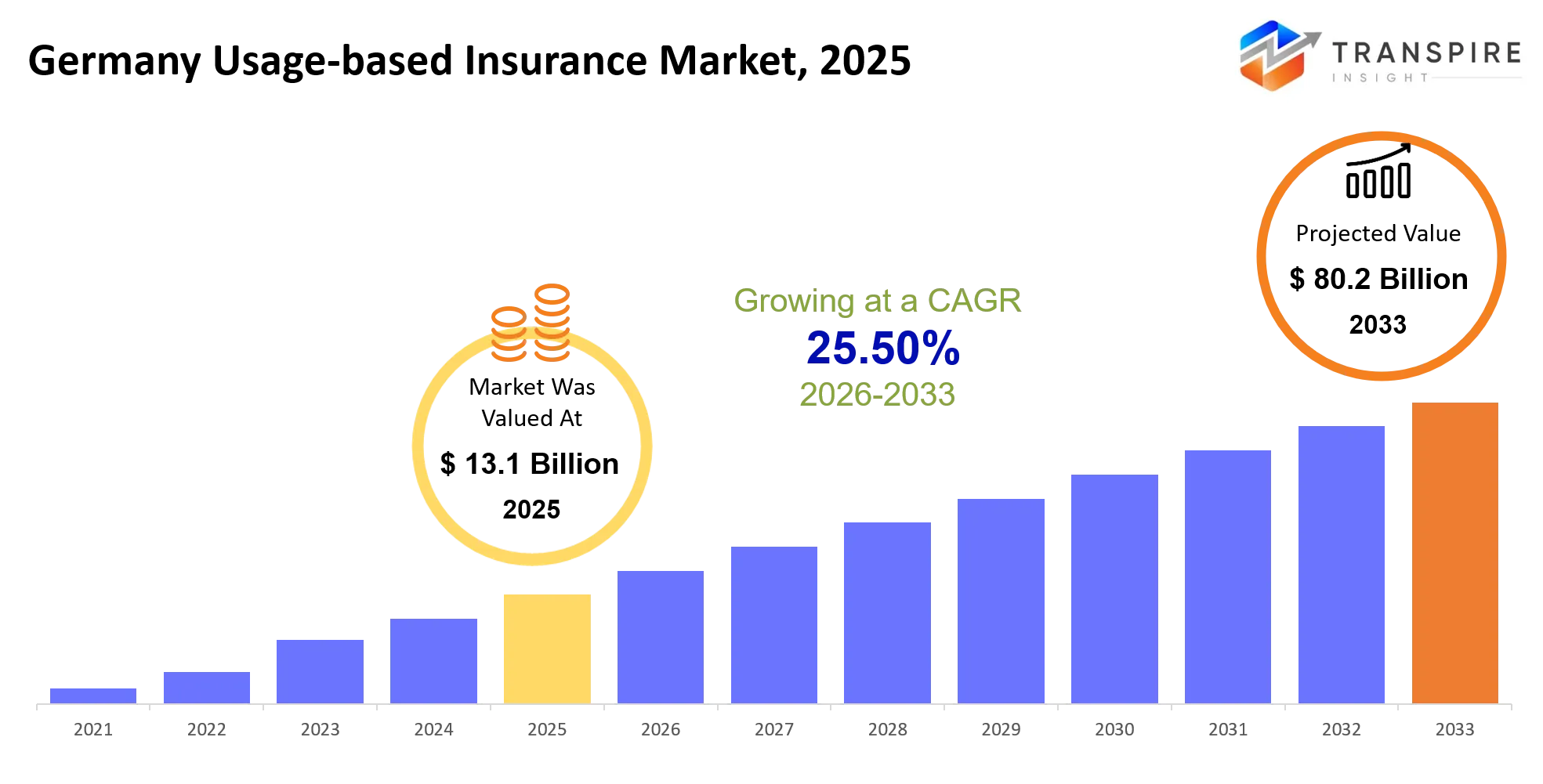
As per Transpire Insight Analysis The Germany Usage-based Insurance Market size is estimated at USD 13.1 Billion in 2025 and is anticipated to reach USD 80.2 Billion by 2033, growing at a CAGR of 25.50%from 2026 to 2033.
The Germany usage-based insurance market helps insurers price motor policies using real driving information, not just fixed factors like age, car model, and claims history. Usually, telematics apps and connected-car systems pick up speed, braking, acceleration, total mileage, and other riding behavior. That means insurers can offer more individualized premiums , plus some kind of safety related nudges. Over the last three to five years, it sort of moved from small telematics pilots to more app centered and connected vehicle programs. Allianz, HUK-COBURG, and ERGO now run programs that can give discounts up to 30%, so this usage-linked pricing has really entered normal product lines, not only experimental ones.
A big structural change happened because connected-car data became easier to obtain, while the EU Data Act and its vehicle-data guidance, also reinforced the rules and expectations around data access. Today’s growth is mostly about better risk slicing, more personal pricing, and stronger digital claims workflows. In the end, this can sharpen underwriting accuracy and also open up new ways to earn premiums and keep customers around longer.
Germany Usage-based Insurance Market Size & Forecast:
- Germany Usage-based Insurance Market Size 2025: USD 13.1 Billion
- Expected Market Value 2033: 805.3 Million
- Forecast CAGR: 25.50%
- Leading region in 2025:Bavaria
- Fastest Growing region:Baden-Württemberg
- Key Profile: Allianz SE, AXA, Generali, Zurich Insurance Group, HUK-Coburg, HDI Versicherung, ERGO Group, Signal Iduna, Admiral Group, Progressive Corporation, Verisk Analytics, Cambridge Mobile Telematics, Octo Telematics, Vodafone Automotive, LexisNexis Risk Solutions
Key Market Insights
- Germany held around 21% of Europe’s UBI market in 2025 , and it’s been backed by connected vehicles plus established insurers, not to forget a pretty mature automotive telematics setup.
- Telematics pricing has also moved well past those pilot programs , and now Allianz , HUK-COBURG , and ERGO are pushing discounts that can climb to 30% for safer driving.
- Smartphone based monitoring started gaining real momentum, so insurers and policyholders don’t have to rely as much on separate OBD devices, and the install or rollout barrier got noticeably lower.
- Connected-car integration is getting more essential too, because embedded vehicle data basically keeps supplying continuous driving context without needing extra hardware.
- Then in 2025 the EU Data Act tightened and clarified vehicle-data access rules, which opened fresh doors for insurers to tap connected-vehicle signals in a more formal way.
- Still, privacy requirements stay front and center, so insurers need solid controls for GPS, speed, behavioral patterns, and several other telematics signals.
- AI based risk scoring is drifting into day to day insurance processes now, letting insurers interpret things like speed, location, braking, acceleration, and other behavioral variables with less friction.
- And young drivers, as well as newly licensed ones, remain key UBI targets, because behavioral pricing can tackle underwriting profiles that were traditionally considered higher risk.
- Personalized discounts are also turning into a competitive lever, with insurers using driving scores to boost engagement, and to stand out among motor-policy alternatives.
- Cloud , mobile analytics , and connected-car platforms are reshaping underwriting overall, and they help insurers handle much larger volumes of behavioral data more efficiently, kind of like faster pattern reading without slowing everything down.
What are the Key Drivers, Restraints, and Opportunities in The Germany Usage-based Insurance Market?
Driver: The strongest growth driver is kind of the shift from mostly static motor-insurance pricing into telematics-based risk evaluation. In Germany, insurers can lean on speed, acceleration, braking, location, mileage, and driving-time records to tune up more individual risk profiles. Allianz, HUK-COBURG, and ERGO already run telematics programs, with discounts that may reach around 30% ,so it is pretty clear that behavioral pricing is now a commercial offer, not just a technology experiment. Also the EU Data Act is easing the rules around who can access connected-vehicle data, and that might broaden what insurers can actually use.
Restraint: Still, data privacy and governance stay the main structural brake. Telematics can reveal detailed movement patterns, so insurers have to handle GDPR demands properly, secure the data interfaces, set access controls, and address data manipulation risks. BaFin in particular points to these requirements when it comes to AI-supported telematics pricing, which is a real constraint in practice. All those obligations push up technology, compliance, and cybersecurity costs, and deployments can get delayed if insurers can’t define a clean path for customer consent and data-use workflows.
Opportunity: Connected vehicles are probably the most straightforward next-stage chance. Once embedded vehicle data becomes simpler to obtain, insurers can step back from standalone sensors and build more continuous risk models. The EU’s 2025 guidance on vehicle data also spells out that insurance providers are included, so it builds a stronger base for insurers to launch connected-car offerings and partner with OEMs, plus mobility-data providers.
What Has the Impact of Artificial Intelligence Been on The Germany Usage-based Insurance Market?
Artificial intelligence is reshaping the Germany usage-based Insurance Market by turning high-volume telematics data into faster risk assessments, personalized pricing and automated claims support. BaFin specifically points out that AI analysis of telematics data, like speed or GPS location, counts as a practical motor insurance use case. Machine learning models can judge braking, acceleration, cornering, mileage, driving times and location patterns , in order to craft individualized risk scores. Then insurers can lean on those scores to fine-tune discounts, spot unusual driving patterns, split portfolios, and make more solid underwriting decisions.
On the claims side AI helps operations as well. It can assist insurers in classifying incidents, flagging possibly inconsistent information, and choosing which cases should go first to human reviewers. Over time, more connected-vehicle data can make predictive models sharper by linking driving behavior with claims outcomes, instead of depending only on older demographic factors.
The core drawback is data governance. In Germany, insurers still need to protect personal telematics information , secure data-transfer interfaces, manage third-party access carefully, and keep contingency processes ready when real-time data just stops. This ends up increasing integration and compliance costs , and it can slow deployment, especially when insurers combine information from smartphones, vehicles, cloud platforms, and outside telematics providers.
Key Market Trends
- Since the early 2020s, insurers have sort of expanded telematics beyond those young-driver schemes , aiming at wider customer clusters with more personal pricing and kind of tailored terms.
- App based UBI has really gained momentum compared with hardware dependent models, and now ERGO delivers Safe Drive almost entirely via a smartphone application, no extra kit sort of needed.
- Allianz and HUK-COBURG have pushed behavioral incentives harder, with possible annual discounts up to 30% when driving is safer and more consistent, depending on the profile.
- Vehicle connectivity became strategically important since 2025, because EU guidance made it clearer how vehicle-data access works for insurers and automotive stakeholders, basically who can see what.
- AI has moved telematics away from basic data capturing into automated risk evaluation, using driving behavior to adjust individual policyholder profiles over time.
- Privacy governance is now more demanding , which means insurers must tighten their controls around GPS feeds, driving behavior streams, cloud interfaces, and third party data processing too.
- Connected-car partnerships are starting to carry more strategic weight, letting insurers tap into richer vehicle data while reducing dependence on separate telematics hardware.
- Digital customer engagement is also creeping into the UBI strategy, since apps can bundle driving scores, feedback, policy info, and incentive levers all in one place.
- Insurers are also increasingly connecting telematics with claims flows, creating chances to use behavioral data for fraud detection, incident understanding , and faster claims categorization.
- Data quality is turning into a real competitive differentiator , because insurers want dependable behavioral datasets that enable accurate pricing while still avoiding too much privacy risk or compliance exposure.
Germany Usage-based Insurance Market Segmentation
By Policy Type
Pay-As-You-Drive insurance sets premium amounts based on vehicle mileage , and it tends to fit motorists who want payment structures tied to real road usage. . Pay-How-You-Drive insurance kind of looks at your driving behaviour like braking , acceleration, speed, and cornering so insurers can reward careful steady habits. Manage-How-You-Drive programs also bring in driving feedback plus coaching, so it’s meant to nudge safer patterns across the whole policy period. Distance-Based Insurance mostly concentrates on the number of kilometres driven, which can fit low mileage drivers pretty well. Behaviour-Based Insurance leans on telematics scores , basically linking driving conduct with premium changes over time.
Telematics Insurance is sort of a broader umbrella that gathers driving information through connected devices and mobile applications, so it tends to cover more than just one narrow method. Fleet Insurance helps companies handling multiple vehicles, pairing policy costs with fleet-level performance on the road. Commercial Vehicle Insurance uses usage-based pricing for vans, trucks, and other work vehicles. Two-Wheeler Insurance carries that telematics-style pricing to motorcycles and scooters, while Others covers specialised policy setups meant for specific mobility needs.
By Technology
OBD Devices gather vehicle details via diagnostic ports and they stay useful even if the car doesn’t have any factory installed connectivity, mostly. Smartphone Apps, in turn, lower the hardware barrier because they use mobile sensors and location functions, to snag driving information. Then there are automotive OEM Black Box Devices, they log driving behaviour using dedicated telematics units and it’s more or less stand alone. Embedded Telematics, instead, leans on factory installed vehicle connectivity, so the data collection stays continuous. GPS Tracking basically helps with location, mileage, routes, and overall journey analysis. AI Analytics later processes telematics data to spot driving patterns and, from there, refine risk assessment.
IoT Sensors stretch the data collection across connected vehicle systems and they allow more detailed vehicle monitoring, too. Connected Vehicles give direct access to whatever the vehicle generates, and they help enable increasingly automated insurance services. Cloud Platforms are where big telematics datasets get stored and processed, so insurers can link the info into underwriting, pricing, and claims systems. Others includes emerging technologies, like stuff around data transmission, vehicle monitoring, and digital policy management, in general.
By Vehicle Type
OBD Devices grab vehicle information through diagnostic ports, and they stay useful even when the car has no factory installed connectivity, or at least not anymore. Smartphone Apps lower the hardware barrier because they tap into mobile sensors and also location functions, so they can capture driving information. Black Box Devices do the whole thing via dedicated telematics units, record driving behaviour, and Embedded Telematics leans on factory-installed vehicle connectivity for continuous data capture. GPS Tracking helps with location, mileage, route, and journey analysis, while AI Analytics takes the telematics data and figures out driving patterns too, so risk assessment can be improved.
Then there are IoT Sensors, they extend data collection across connected vehicle systems and they let you monitor things a bit more detailed than before. Connected Vehicles gives direct access to information generated by the vehicle, and they also support more and more automated insurance services. Cloud Platforms hold and process large telematics datasets, and this makes it easier for insurers to fold that data into underwriting, pricing, and claims systems. Others includes emerging technologies that help with data transmission, vehicle monitoring, and digital policy management, even when the stack is not fully obvious at first.
By Distribution Channel
Passenger Cars are kind of a major vehicle category, mostly because private motorists are such a big base for telematics based motor policies, I mean it’s not small at all. Commercial Vehicles help with usage based pricing, using things like mileage , route and driving performance data you can actually measure. Electric Vehicles open the door for specialized pricing too, especially when vehicle connectivity and driving data are available and usable. Hybrid Vehicles also fit connected insurance models, while still mixing the conventional setup with electric power systems, which feels important for underwriting. Luxury Vehicles can pull in telematics services that focus on advanced connectivity and more personalized risk assessment, kind of like a tailored view.
Fleet Vehicles work well with centralized monitoring across multiple cars or commercial units, and they let insurers judge collective driving performance, not just one driver. Two-Wheelers offer chances for smartphone and compact telematics solutions, especially in areas where low cost connectivity matters. Shared Mobility Vehicles keep generating frequent usage data across different drivers and journeys, so the insurer gets more than a single snapshot. Autonomous Vehicles are a developing category where insurance models will more and more rely on vehicle systems, software performance, and connected data rather than the usual human inputs. Others includes all those specialized vehicles, requiring tailored usage based insurance structures that fit the real operating context.
By End User
Individual Customers are a big end user group, mainly because private motorists can tap into telematics details to get personalized premiums, and also driving incentives that fit their routine. Fleet Operators, for their part, lean on vehicle level data so they can juggle multiple vehicles and judge driver performance in a more objective kind of way. Corporate Customers go further by using usage based insurance for business mobility needs and broad commercial vehicle portfolios. Ride Sharing Companies pull in huge amounts of journey and driver information, and that tends to open the door for insurance models that connect directly to how people actually travel. Logistics Companies can tie insurance pricing to mileage and routes, plus vehicle utilization, along with driving behaviour.
Government Fleets may use telematics info for vehicle oversight and risk management across public sector transport assets. SMEs count as an important customer group as well, because usage based policies help match insurance spending with real business vehicle activity. Large Enterprises can roll out telematics across wide vehicle portfolios, and fold insurance insights into fleet management systems. Leasing Companies can use connected vehicle data to track usage patterns and back up risk assessment throughout vehicle contracts. Others include specialized organizations, they sometimes need flexible coverage built around the way vehicles are used, not just on paper assumptions.
What are the Key Use Cases Driving The Germany Usage-based Insurance Market?
Private passenger-car coverage is basically the big one, it is backed by Pay-How-You-Drive and Pay-As-You-Drive patterns, even if people say it a bit differently. With telematics based pricing, insurers are able to tie the premium to mileage and actual driving conduct, not just those old school risk variables that everyone already uses. In that way, lower risk drivers may get some real money incentives. At the same time insurers can split the market more finely and boost pricing precision, rather than guessing too much.
Fleet management, this one is also growing, especially for commercial vehicle operators, logistics companies and kind of all that supply-chain stuff. Fleet Insurance can take mileage, route details, braking character, acceleration events, plus driver ratings to help with risk control and better insurance pricing. Corporate fleets and SMEs can then use connected data to keep an eye on how much the vehicles are actually being utilized, while also improving driver safety and keeping operating costs under control.
Electric vehicles and shared mobility fleets bring new openings too, as connected-vehicle adoption keeps rising. When there is embedded telematics, it can feed insurers continuous vehicle information. And later, with autonomous vehicles in the picture, there might be new insurance schemes grounded on software performance, vehicle systems health, and even recorded responsibility in driving situations. Also, connected-car data access under the EU Data Act should further enable fresh insurance applications, plus partnerships between insurers, automotive makers, and technology vendors.
|
Report Metrics |
Details |
|
Market size value in 2025 |
USD 13.1 Billion |
|
Market size value in 2026 |
USD 16.3 Billion |
|
Revenue forecast in 2033 |
USD 80.2 Billion |
|
Growth rate |
CAGR of 25.50%from 2026 to 2033 |
|
Base year |
2025 |
|
Historical data |
2021 - 2024 |
|
Forecast period |
2026 - 2033 |
|
Report coverage |
Revenue forecast, competitive landscape, growth factors, and trends |
|
Regional scope |
Germany |
|
Key company profiled |
Allianz SE, AXA, Generali, Zurich Insurance Group, HUK-Coburg, HDI Versicherung, ERGO Group, Signal Iduna, Admiral Group, Progressive Corporation, Verisk Analytics, Cambridge Mobile Telematics, Octo Telematics, Vodafone Automotive, LexisNexis Risk Solutions |
|
Customization scope |
Free report customization (country, regional & segment scope). Avail customized purchase options to meet your exact research needs. |
|
Report Segmentation |
By Policy Type (Pay-As-You-Drive, Pay-How-You-Drive, Manage-How-You-Drive, Distance-Based Insurance, Behaviour-Based Insurance, Telematics Insurance, Fleet Insurance, Commercial Vehicle Insurance, Two-Wheeler Insurance, Others); By Technology (OBD Devices, Smartphone Apps, Black Box Devices, Embedded Telematics, GPS Tracking, AI Analytics, IoT Sensors, Connected Vehicles, Cloud Platforms, Others); By Vehicle Type (Passenger Cars, Commercial Vehicles, Electric Vehicles, Hybrid Vehicles, Luxury Vehicles, Fleet Vehicles, Two-Wheelers, Shared Mobility Vehicles, Autonomous Vehicles, Others); By Distribution Channel (Insurance Agents, Brokers, Direct Sales, Online Platforms, Bancassurance, Automotive OEMs, Mobile Apps, Comparison Websites, Digital Insurers, Others); By End User (Individual Customers, Fleet Operators, Corporate Customers, Ride-Sharing Companies, Logistics Companies, Government Fleets, SMEs, Large Enterprises, Leasing Companies, Others) |
Which Regions are Driving The Germany Usage-based Insurance Market Growth?
Bavaria shows up as the top regional driver, basically backed by a big vehicle base, solid automotive manufacturing, and quick momentum in connected as well as electrified cars. Roughly 11 million vehicles were registered in Bavaria in early 2026, and that includes a bit over 395,000 battery-electric cars, plus close to 793,000 hybrids. The mix of vehicle makers, parts tech suppliers, insurers, and digitally active drivers, somehow gels into a pretty sturdy environment for telematics based insurance roll outs.
North Rhine-Westphalia looks a little different, more of a growth curve vibe. It has a huge urban population, and a lot of commercial mobility work going on, which helps keep insurance numbers steady. Dense metropolitan zones, together with business transport corridors, keep opening doors for mileage based pricing, fleet observation, and digital claims support. And it’s not just internal factors, the region also rides the bigger German automotive market wave, which landed at 2.9 million new passenger car registrations in 2025. So overall, stable commercial activity and a broad client landscape make North Rhine-Westphalia a meaningful contributor, not a straight replay of Bavaria’s tech heavy automotive cluster.
Baden-Württemberg, though, has the strongest possible runway for technology-led UBI expansion. That’s mainly because it has a very deep automotive research and supplier network. More than 300 vehicle industry businesses employ over 215,000 people in the state, and the focus is increasingly shifting toward electrification, digitalization, autonomous driving, and connected mobility. If you add digital vehicle infrastructure, plus autonomous driving initiatives, telematics adoption could get accelerated from 2026 to 2033. That would open up chances for insurers, data providers, OEMs, and mobility technology firms moving into more advanced connected vehicle applications, at least that’s the idea.
Who are the Key Players in The Germany Usage-based Insurance Market and How Do They Compete?
In Germany, competition is kinda concentrated among the big insurer groups, but tech providers are gradually shifting the whole playing field, like the way competitors can actually win. Allianz, HUK-Coburg, ERGO, AXA, and Generali go head-to-head using pricing, broader customer reach, digital services, plus telematics style features. At the same time, specialist firms such as Cambridge Mobile Telematics, Octo Telematics, and Verisk Analytics aren’t really selling insurance in the usual sense, they mostly provide the data and the analytics layer, so it’s a different lane. Honestly, the most durable competitive edge is starting to mean a combo of low-friction enrollment, dependable driving signals, risk scoring, and those privacy guardrails.
Allianz stands out with BonusDrive, it relies on smartphone based driving assessment and can provide as much as 30% in premium reductions for qualifying driving behavior. HUK-Coburg pairs the HUK Mein Auto app with a telematics sensor and also promotes up to 30% savings, with automatic crash detection built in. ERGO leans heavily on app-led engagement, while AXA and Generali are helped by wide-ranging insurance portfolios, and also by their long-established distribution channels.
Cambridge Mobile Telematics is basically taking a technology first route instead of trying to compete directly as an insurer. In March 2026 CMT got a USD 350 million strategic investment led by TPG and Allianz X. This is meant to grow its real-time AI risk models, improve crash detection, and expand the Universal Driving Score. In parallel, the longer-term Allianz arrangements give CMT stronger footing across insurance, OEM partnerships, and mobility applications, so the data-driven insurance services approach ends up being a clear advantage.
Company List
- Allianz SE
- AXA
- Generali
- Zurich Insurance Group
- HUK-Coburg
- HDI Versicherung
- ERGO Group
- Signal Iduna
- Admiral Group
- Progressive Corporation
- Verisk Analytics
- Cambridge Mobile Telematics
- Octo Telematics
- Vodafone Automotive
- LexisNexis Risk Solutions
Recent Development News
"In November 2025, Cambridge Mobile Telematics expanded DriveWell Engage with Universal Rewards and Family Connect. The product enhancements strengthened insurer and mobility-provider capabilities for driver engagement, safer driving programs, and customer retention through telematics-based feedback.https://www.cmtelematics.com
What Strategic Insights Define the Future of The Germany Usage-based Insurance Market?
The German usage-based insurance industry is going to drift from optional telematics discounts toward a more constant, data-driven underwriting model as connected vehicles make driving information kind of easier to pull. The most powerful structural push will likely be the mix of embedded vehicle connectivity , AI-based risk scoring, and more straightforward access to vehicle data under the EU Data Act. At the same time, there’s a quieter downside : data concentration. Insurers that rely heavily on just a few telematics platforms could run into higher technology costs, less negotiating leverage, or actual disruption if the terms for data access shift. There’s also another concern coming from privacy expectations, because detailed mobility logs can trigger pushback, even when the pricing advantages sound pretty attractive.
A noticeable new opportunity is embedded telematics for electric and software-defined vehicles, where insurers may be able to collect richer vehicle insights without adding separate hardware. Market players should therefore focus on direct arrangements with OEMs and telematics providers, while also developing privacy-preserving analytics. Investing early in interoperable data infrastructure should give more strategic room to maneuver than being tied to a single device or one platform alone.
Germany Usage-based Insurance Market Report Segmentation
By Policy Type
• Pay-As-You-Drive
• Pay-How-You-Drive
• Manage-How-You-Drive
• Distance-Based Insurance
• Behaviour-Based Insurance
• Telematics Insurance
• Fleet Insurance
• Commercial Vehicle Insurance
• Two-Wheeler Insurance
• Others
By Technology
• OBD Devices
• Smartphone Apps
• Black Box Devices
• Embedded Telematics
• GPS Tracking
• AI Analytics
• IoT Sensors
• Connected Vehicles
• Cloud Platforms
• Others
By Vehicle Type
• Passenger Cars
• Commercial Vehicles
• Electric Vehicles
• Hybrid Vehicles
• Luxury Vehicles
• Fleet Vehicles
• Two-Wheelers
• Shared Mobility Vehicles
• Autonomous Vehicles
• Others
By Distribution Channel
• Insurance Agents
• Brokers
• Direct Sales
• Online Platforms
• Bancassurance
• Automotive OEMs
• Mobile Apps
• Comparison Websites
• Digital Insurers
• Others
By End User
• Individual Customers
• Fleet Operators
• Corporate Customers
• Ride-Sharing Companies
• Logistics Companies
• Government Fleets
• SMEs
• Large Enterprises
• Leasing Companies
• Others
Frequently Asked Questions
Find quick answers to common questions.
The expectedGermany Usage-based Insurance Market size for the market will be USD 80.2 Billion in 2033.
Key segments for The Germany Usage-based Insurance Market are By Policy Type (Pay-As-You-Drive, Pay-How-You-Drive, Manage-How-You-Drive, Distance-Based Insurance, Behaviour-Based Insurance, Telematics Insurance, Fleet Insurance, Commercial Vehicle Insurance, Two-Wheeler Insurance, Others); By Technology (OBD Devices, Smartphone Apps, Black Box Devices, Embedded Telematics, GPS Tracking, AI Analytics, IoT Sensors, Connected Vehicles, Cloud Platforms, Others); By Vehicle Type (Passenger Cars, Commercial Vehicles, Electric Vehicles, Hybrid Vehicles, Luxury Vehicles, Fleet Vehicles, Two-Wheelers, Shared Mobility Vehicles, Autonomous Vehicles, Others); By Distribution Channel (Insurance Agents, Brokers, Direct Sales, Online Platforms, Bancassurance, Automotive OEMs, Mobile Apps, Comparison Websites, Digital Insurers, Others); By End User (Individual Customers, Fleet Operators, Corporate Customers, Ride-Sharing Companies, Logistics Companies, Government Fleets, SMEs, Large Enterprises, Leasing Companies, Others)
Major Germany Usage-based Insurance Market players are Allianz SE, AXA, Generali, Zurich Insurance Group, HUK-Coburg, HDI Versicherung, ERGO Group, Signal Iduna, Admiral Group, Progressive Corporation, Verisk Analytics, Cambridge Mobile Telematics, Octo Telematics, Vodafone Automotive, LexisNexis Risk Solutions
The Germany Usage-based Insurance Market size is USD 13.1 Billion in 2025.
The Germany Usage-based Insurance Market CAGR is 25.50% from 2026 to 2033.
- Allianz SE
- AXA
- Generali
- Zurich Insurance Group
- HUK-Coburg
- HDI Versicherung
- ERGO Group
- Signal Iduna
- Admiral Group
- Progressive Corporation
- Verisk Analytics
- Cambridge Mobile Telematics
- Octo Telematics
- Vodafone Automotive
- LexisNexis Risk Solutions
About the Authors

Mayur Shinde
I am Mayur Shinde, a Senior Research Analyst at Transpire Insight, specializing in the Automotive & Transportation and Information & Communication Technology (ICT) Industry. My work focuses on analyzing emerging market trends, technological advancements, competitive landscapes, and industry developments to deliver accurate, data-driven insights. I am passionate about transforming complex market information into clear, actionable content that helps businesses, professionals, and decision-makers stay informed and make confident strategic decisions.

Chakradhar Khansole
Chakradhar serves as the Research Director at Transpire Insight, bringing over 8 years of experience in technology, innovation, and strategic market intelligence. He specializes in transforming complex market data into actionable business insights that enable organizations to make informed, growth-oriented decisions. Recognized for his strategic vision and analytical expertise, Chakradhar leads high-impact research initiatives, delivering comprehensive market assessments, competitive intelligence, and forward-looking industry analysis.
Recently Published Reports
-
Apr 2026
ATV & UTV Market
ATV & UTV Market Size, Share & Analysis Report By Type (ATV, and UTV), By Variants (Less Than 400 CC, 400 CC To 800 CC, and More Than 800 CC), and Geography (North America, Europe, Asia-Pacific, Middle East and Africa, South and Central America), 2021 - 2031
-
Apr 2026
Automotive Central Gateway Module Market
Automotive Central Gateway Module Market Size, Share & Analysis Report By Type (Ethernet Central Gateway Module, CAN Central Gateway Module, LIN Central Gateway Module, and FlexRay), By Application (Powertrain Control, Body Control, Infotainment System, Advanced Driver Assistance Systems (ADAS), and Others), By End User (Passenger Vehicles, and Commercial Vehicles), and Geography (North America, Europe, Asia-Pacific, Middle East and Africa, South and Central America), 2021 - 2031
-
Apr 2026
Automotive Engine Oil Filter Market
Automotive Engine Oil Filter Market Size, Share & Analysis Report By Filter Type (Fuel Filter, Engine Oil Filter, Hydraulic Oil Filter, and Others), By Filter Media (Cellulose, Synthetic, and Micro), By Sales Channel (OEMs, and Aftermarket), By Vehicle Type (Passenger Cars, Light Commercial Vehicles, Heavy Duty Trucks, Buses and Coaches, and Off-road Vehicles), and Geography (North America, Europe, Asia-Pacific, Middle East and Africa, South and Central America), 2021 - 2031
-
Apr 2026
Automotive Parts Aluminium Die Casting Market
Automotive Parts Aluminium Die Casting Market Size, Share & Analysis Report By Production Process (Pressure Die Casting, Vacuum Die Casting, Squeeze Die Casting, Gravity Die Casting), By Application (Body Parts, Engine Parts, Transmission Parts, Battery And Related Components, Other Application Types), and Geography (North America, Europe, Asia-Pacific, Middle East and Africa, South and Central America), 2021 - 2031
Our Clients



