

South Korea Automotive Embedded Telematics Market Summary
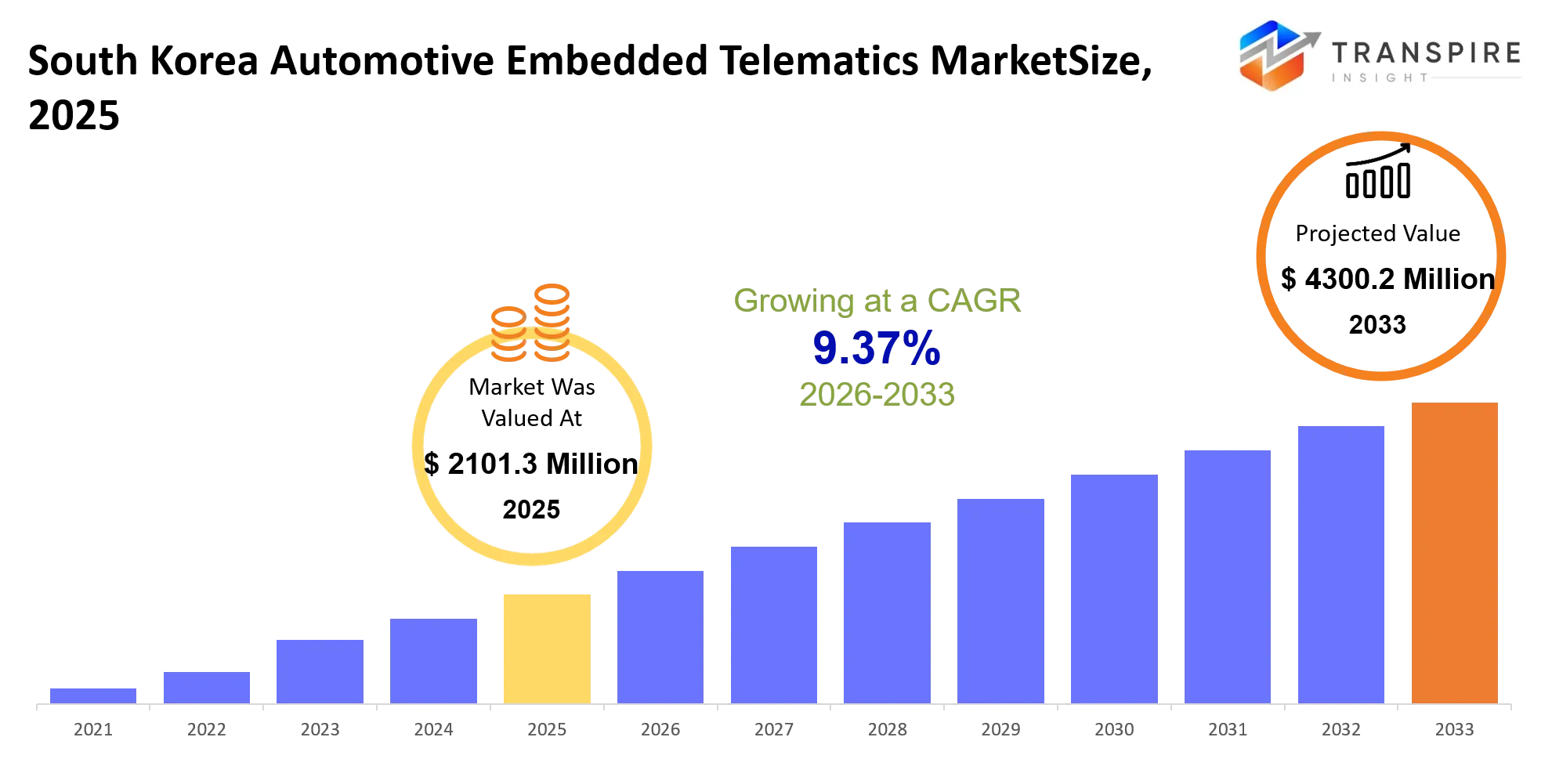
As per Transpire Insight Analysis the South Korea Automotive Embedded Telematics Market size is estimated at USD 2101.3 Million in 2025 and is anticipated to reach USD 4300.2 Million by 2033, growing at a CAGR of 9.37% from 2026 to 2033.
South Korea’s embedded telematics helps cars share current details. This includes the car’s location, which parts may need attention, how the driver is using the vehicle, and what the network connection looks like. It can also push warnings during urgent situations. For automakers and fleet operators, this adds value. It can improve safety, make maintenance easier, support smarter routes, and enable more connected services.
Over the past few years, the market has shifted. Earlier systems were mostly about basic location checks and simple remote queries. Today, many firms build cloud linked platforms. These platforms are meant to run as software. They also support 5G work, driver help tools, and updates sent over the air. They come with dashboards that sort and review vehicle data.A key driver of this change was the global chip shortage. It reduced Korean car production. That pressure caused automakers to revisit how they plan electronics. They began to use more flexible designs. They also increased oversight of connected vehicle systems.
Another reason is the rapid spread of connected and electric cars in South Korea. More such vehicles means more data is generated inside each car. That makes the data more valuable. So more embedded telematics products get purchased. Both hardware and software are included. The revenue approach also keeps expanding with ongoing digital services. You see this in maintenance predictions, fleet monitoring, and subscription features.
South Korea Automotive Embedded Telematics Market Size & Forecast:
- South Korea Automotive Embedded Telematics Market Size 2025: USD 2101.3 Million
- Expected Market Value 2033: USD 4300.2 Million
- Forecast CAGR: 9.37%
- Key Profile: Hyundai Mobis, LG Electronics, Samsung Electronics, Harman International, Bosch, Continental AG, Denso Corporation, Aptiv, Valeo, Panasonic Automotive Systems, Marelli, Visteon Corporation, ZF Friedrichshafen, Qualcomm Technologies, NXP Semiconductors
Key Market Insights
- The Seoul metro area is the biggest slice in 2025, with a forecast above 45%. Activity stays thick there, driven by OEM work, tech teams, fleet activity, and strong connectivity projects.
- Gyeonggi looks like the quickest regional mover through 2030. It has manufacturing clusters nearby. Connected mobility buildouts are also growing in that area.
- Telematics control units are pulling demand right now. They are expected to take about 55% share. OEM factory-fit systems are spreading to more new cars.
- Connectivity platforms rank next. They sit in the second spot. Makers are bundling infotainment, diagnostics, navigation, OTA updates, and vehicle data services.
- The 5G telematics option should grow the most by 2030. The main reason is faster, low-delay links. It also fits software-focused vehicle designs.
- Passenger cars still lead the application mix. They are about 65%. Hyundai and Kia keep adding connected features to both mainstream and higher-end trims.
- Fleet management is set to rise fastest as well. Route planning helps. So do remote diagnostics, driver monitoring, and live vehicle data tools.
- OEM installations are the top end-user route. Their share is forecast to be near 70%. Embedded systems fit more easily into cars made at the factory.
- Commercial fleets are the top end-user group for faster growth. Operators are turning to predictive upkeep, usage insights, safety monitoring, and remote diagnostic services.
- LG Electronics is also pushing forward. It is working on 5G telematics control units and cloud-linked vehicle platforms. These are made for major automakers worldwide.
What are the Key Drivers, Restraints, and Opportunities in the South Korea Automotive Embedded Telematics Market?
South Korea’s move toward connected, software-heavy cars is a big driver of growth. In 2024, the push for autonomous driving commercialization helped make the rules clearer for putting new vehicles on the road. Now car makers have to handle quick data sharing, over-the-air updates, vehicle checks, and links to cloud systems. Because of this, telematics often stops being a “nice to have” option and becomes part of the standard electronics. More built-in modules at the factory can raise how many cars get these systems. Cloud tools also bring money each month, not only one-time sales.
A key drag on progress is how concentrated the supply chain is for important auto electronics and connectivity parts. In practice, a few suppliers hold a large share of the embedded telematics market. It is also hard to swap vendors because each OEM has its own validation work. When a supplier change happens, it can slow down vehicle timelines instead of just moving spend to a different source. Looking at Transpire Insight’s scan of regional buying notices and product start dates, this concentration is still the main risk for execution. Even a short delay of a component, like a few months, can push back launches, delay when revenue is counted, and raise the cost to qualify the setup.
Start with 5G predictive telematics, then layer in AI analytics. In South Korea, the network reach is already strong. Big car brands also have tech partnerships lined up. Hyundai and Kia work with Samsung on software vehicle platforms. They also trade vehicle data using APIs. SmartThings is involved too. That setup means you may charge more than you would for simple connectivity. You could offer predictive maintenance. You could also tune vehicle settings for each driver. Fleet routing and planning is another option. Some customers may pay for extra add ons.Right now, the timing looks strong. Connected services are shifting away from pushing devices for sale. The payback is more tied to software fees each month or each year.
What Has the Impact of Artificial Intelligence Been on the South Korea Automotive Embedded Telematics Market?
Telematics in cars is getting reshaped by AI. The work used to be mostly about collecting data. Now the systems are meant to do more. They can watch signals and respond with better judgment.
Some new machine learning designs can scan diagnostic data all the time. They can follow battery health and driving trends. They can also log trouble codes and note link events. When the system sees strange patterns early, it can warn before a real failure shows up. That can help stop a small issue from turning into a major and expensive breakdown.
This style of monitoring supports predictive maintenance. It can also mean fewer trips to the repair shop. Fleet teams can pay attention to the vehicles that truly show wear. They do not need to treat every car the same way.
For fleet use, AI can combine more than one data stream. It can take in location, routes, driver inputs, and how the vehicle performs. With those inputs, dispatch planning can improve. The system can also flag driving habits that waste fuel or add extra strain. Over time, that can lift how well the fleet uses its vehicles.
Hyundai and Kia are moving in a similar direction. Their software focused vehicle plans and open data APIs help lay groundwork. AI can also support features that fit drivers more closely. It can connect how a car is driven to in car entertainment and to connected home tools. The Hyundai Kia Samsung SmartThings effort is one example of that kind of pairing.
Even with all of that, the outcome depends on the setup. Data still has to be kept clean. Connections must stay reliable. Up front cost is still a major barrier. Integrating the tools can be pricey. Some older car electronics may not match the new design. Data formats can also differ across systems. Security requirements must be met too. Testing and validation takes extra time. Accuracy can slip when the car hits rare driving cases. It can also drop if training data does not cover the full range of real world vehicle events.
Key Market Trends
- In 2024, more car brands started betting on software, not just hardware. That shift makes telematics budgets depend on constant updates and extra software services.
- 5G has moved past the trial stage. Some vendors are launching tools built for low delay. That helps data reach apps in near real time, including live mobility features.
- Hyundai and Kia also tightened their tech links in 2024. They worked with Samsung to connect SDVs, phone features, and SmartThings in one setup.
- Vehicle-data APIs are getting attention too. They give other firms a way to add services. They also make it easier to avoid being stuck with one closed telematics system.
- AI-driven diagnostics are showing up more often. Suppliers combine telematics signals with cloud checks. The goal is to spot trouble before a component actually fails.
- Fleet managers are using telematics in a new way. They are not only tracking where a vehicle is. They focus more on early care planning, route choices, performance stats, and driver habits.
- At the same time, more connected tools are being built into new cars. OEMs are placing features in the car electronics. They are not relying only on devices added after purchase.
- Even so, the supply market is still top heavy. One set of estimates puts the top suppliers at about 60 to 65% of South Korean telematics revenue by 2026.
- For commercial fleets, telematics is moving toward a mix of safety and diagnostics. Buyers want visible results, like fewer hours lost to downtime.
- Connections are spreading beyond the vehicle. Telematics is linking cars with homes and phones. That can create more revenue streams beyond simple navigation help.
South Korea Automotive Embedded Telematics Market Segmentation
By Component :
Telematics control units are at the center of today’s cars. Automakers want hardware that stays reliable and can link the vehicle to online services. It also needs to work with other systems inside the car. GPS units support location reporting. Communication units move that data all the way through, without major dropouts. Sensors add more inputs that help with safety checks, trouble checks, and how the car behaves on the road.Software is gaining weight each year. More OEM teams are building vehicles around software first. With that shift, connectivity tools and cloud services play a bigger part. Analytics can help as well. It can support maintenance timing, watch driver activity, and assist with fleet decisions.
Infotainment is still tied to telematics. People want navigation, media, and emergency help. Most of those functions now go through linked vehicle platforms and connected services. Because of that, the same base systems often run more than one feature.In the coming years, some buyers will ask for less focus on plain hardware. They will want software and cloud support to lead more. They often look for smaller units, better protection, and quicker computation. They may also prefer parts that can fit more than one vehicle line. OEMs sometimes like bundles that simplify install work. They also expect faster update cycles.Suppliers that offer telematics units that can grow, plus connectivity tools and analytics, should have a stronger chance. The rise of connected vehicles should keep pulling demand in that direction.
By Vehicle Type :
Most of the market is driven by passenger vehicles. More and more, Hyundai, Kia, and other companies are adding built in connectivity to newer cars.With electric cars, the need for telematics gets stronger. Both drivers and car systems want consistent updates on battery condition. They also want insight into charging routines, energy use, directions, and tools that can be triggered from far away.Hybrids need steady data too. Their systems depend on fresh info to see how the powertrain is behaving. They also track how energy is handled over time.Luxury makers often bring telematics earlier. In that buyer group, people may pay extra for richer digital features. They want remote functions and links that feel like they were built for them.
Commercial vehicles see more pull as well. Fleet teams and light commercial users rely on telematics for trip planning. They monitor driver conduct, locate vehicles, and set service dates.Heavy trucks can also benefit from remote checks. This is important for logistics and freight work. When fleets go electric, the demand grows again. Operators look for help with charge planning, battery status, and tighter control of running costs.Car makers are now putting embedded telematics into the standard build. They see it as a core electronic feature. It is not treated as an extra add on just for connectivity.
By Technology :
4G and LTE still count. A lot of roads already have solid coverage, so a car can keep a link with less downtime.5G is expanding bit by bit. It aims for very low delay and more data speed. This matters for turn by turn help, cloud apps, safety alerts that need a steady connection, and later on, self driving style functions.GNSS is the base for precise position. It supports routing and tracking. eSIM can make it simpler as well. It helps people handle plans while they travel across borders and switch between carriers without much hassle.V2X is also getting more focus. In South Korea, work on smarter road systems and upgrades to transport tech is pushing it forward.
Edge computing helps when cars must decide fast. If every request goes to a distant server, the response can lag. Keeping work closer to the vehicle reduces that delay.Bluetooth and Wi Fi still show up in daily use. They support phone pairing. They also give riders an easy way to get internet and quick short range data connections.Some suppliers now group several pieces together. A single offer may combine 5G, eSIM, edge computer, and V2X as one platform.With this setup, response can improve. Data can stay better arranged too. It can also make connected services easier to build, test, and update.
By Application :
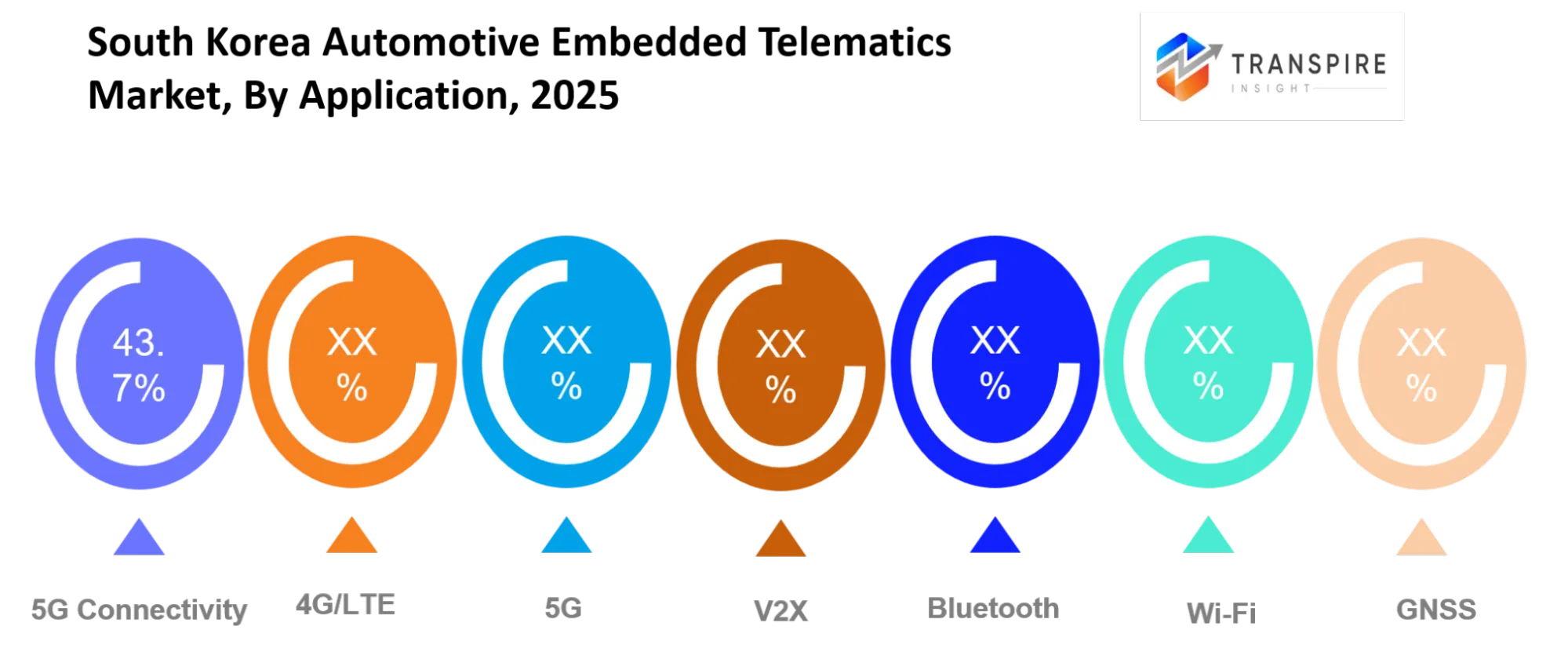
Navigation stays a key use because linked location data helps with route planning, road updates, getting to a place, and other position tools. Remote diagnostics are also moving up the list. Makers can use vehicle data to spot problems, watch how parts are doing, and cut down on visits that are not needed. Fleet management should grow as commercial teams want tighter control of how often vehicles are used. They also want better route use, improved driver behavior, and more on-time maintenance.
Vehicle safety and help in emergencies will matter more too. Connected systems can spot critical problems sooner and support quicker action. Predictive maintenance will take a bigger role as machine learning reviews fault data and looks for early wear. Tracking will still matter for logistics, rental firms, and fleets that need live location. Infotainment will link more with navigation, cloud tools, phones, and tailored digital features. Because of that, app work will shift away from simple tracking. It will focus on ongoing vehicle checks, automatic fault findings, safety support, and connected services that bring in more revenue.
By End User :
Car brands are major customers. Their telematics are made right on site. From there, the data moves into car-connected services. It can also power remote support, issue checks, software updates, and improved ways to contact drivers.Vehicle fleets and logistics firms are taking a closer look too. They use telematics to choose routes with less delay. It can aid with fuel and energy use. They can also see how much time trucks or vans actually spend on the road. It also helps them plan repairs ahead of time.Car rental groups can use similar signals. They can tell where each car sits. They can set up what car goes to which job next. They can also spot wear patterns and how the car’s state shifts over weeks and months.Insurance firms may use telematics as well. Some are piloting pay plans tied to driving behavior. Those systems pull in both how a person drives and what the vehicle reports.
Government and public agencies can lean on connected tools more often. They can use them for traffic control that reacts faster. They can also watch traffic flow and back safety work.Drivers of all kinds keep asking for help from afar. They want live maps, fast emergency help, and solid phone connections. Many will look for personal digital features that connect with their car.Spending from OEMs should keep the market moving. The OEM platform sets the telematics rules for huge vehicle runs. More take-up from fleets and logistics can add extra lift. The logic is straightforward. Less idle time, better route choices, and fuller use of each vehicle make the case for these connected systems.
What are the Key Use Cases Driving the South Korea Automotive Embedded Telematics Market?
Routing and connected-car features still come out on top. Car brands support these services, and everyday drivers use them as well. People ask for steady directions, the ability to act from a distance, safety alerts, and simple vehicle status. Since the connection is built into the car at the factory, automakers can include these tools right away.
Fleet tools are getting more attention too. This covers trucking groups, service operators, and rental fleets. They can see where each vehicle is at this moment and what it is doing. They also get notes when service may be due and data tied to the driver. For fleet owners, that can mean fewer hours wasted while vehicles sit, and better use of the fleet overall.
Work on connected compliance is starting to show progress. AI is also being used more often when fleets plan trips. Hyundai and Kia, plus the Ministry of Land, Infrastructure and Transport, and the Korea Transportation Safety Authority, are working on linked digital tachographs. The plan is for commercial vehicles to send driving logs in an automatic way starting in 2026. As more connected trucks and other commercial cars hit the road, fleet support using AI may help with smarter route picks, tighter safety monitoring, and lower operating costs.
|
Report Metrics |
Details |
|
Market size value in 2025 |
USD 2101.3 Million |
|
Market size value in 2026 |
USD 2296.8 Million |
|
Revenue forecast in 2033 |
USD 4300.2 Million |
|
Growth rate |
CAGR of 9.37% from 2026 to 2033 |
|
Base year |
2025 |
|
Historical data |
2021 - 2024 |
|
Forecast period |
2026 - 2033 |
|
Report coverage |
Revenue forecast, competitive landscape, growth factors, and trends |
|
Country scope |
South Korea |
|
Key company profiled |
Hyundai Mobis, LG Electronics, Samsung Electronics, Harman International, Bosch, Continental AG, Denso Corporation, Aptiv, Valeo, Panasonic Automotive Systems, Marelli, Visteon Corporation, ZF Friedrichshafen, Qualcomm Technologies, NXP Semiconductors . |
|
Customization scope |
Free report customization (country, regional & segment scope). Avail customized purchase options to meet your exact research needs. |
|
Report Segmentation |
By Component (Telematics Control Units, GPS Modules, Communication Modules, Sensors, Connectivity Software, Cloud Platforms, Infotainment Systems, Data Analytics, Others); By Vehicle Type (Passenger Cars, Light Commercial Vehicles, Heavy Commercial Vehicles, Electric Vehicles, Hybrid Vehicles, Luxury Vehicles, Commercial Fleets, Others); By Technology (4G/LTE, 5G, V2X, Bluetooth, Wi-Fi, GNSS, eSIM, Edge Computing, Others); By Application (Navigation, Remote Diagnostics, Fleet Management, Vehicle Safety, Emergency Assistance, Predictive Maintenance, Infotainment, Vehicle Tracking, Others); By End User (Automotive OEMs, Fleet Operators, Individual Consumers, Rental Companies, Insurance Companies, Logistics Companies, Government Agencies, Others) |
Which Regions are Driving the South Korea Automotive Embedded Telematics Market Growth?
Seoul Capital Area stands out. For 2025, it is roughly 45% of South Korea’s embedded telematics activity linked to vehicles. Good 5G access is a key reason. Smart road systems also help. Public support at both the local and national level gives companies a clear entry point for connected services and driver support work. Firms like Hyundai Motor, Kia, LG Electronics, Samsung Electronics, and major tech suppliers keep active efforts in Seoul and parts of Gyeonggi. They handle product work, field tests, and continued spend. With that steady setup of research work, software teams, vendor help, and company funding, the area is likely to stay in the lead until 2033.
Gyeongsang looks more focused on manufacturing. The region hosts large plant areas. Supplier links are already in place. Over time, rules and stable investment for vehicle output create more balanced demand for embedded connectivity tools. Factories and production lines bring repeat needs. Purchases often include telematics control units, communication parts, sensors, and connectivity software. Since the supply chain is already working, the region stays a dependable contributor as more vehicle electronics get added.
Gyeonggi is on the move. Growth is picking up in a big way. A big driver is the rise of connected car projects around major auto hubs. Another driver is fresh cash for semiconductors. On top of that, vehicle programs that lean on software are also accelerating.
Money is landing in smart mobility efforts. New vehicle tech is appearing too. So demand is rising for 5G. Many teams also want V2X features. Edge computer needs are growing. Telemetry that links to the cloud is being asked for more often. You can also find many OEM engineering teams in the area. Nearby are plenty of tech companies. This kind of mix can make it easier for system integrators and parts suppliers to land projects.From 2026 through 2033, more growth may come from new players. They are likely to bring systems that work well together. Security knowledge will be a key need. Scalable services for vehicle data should see strong demand.
Who are the Key Players in the South Korea Automotive Embedded Telematics Market and How Do They Compete?
Competition still feels close. A lot of new entrants stall because OEM links are hard to get. Work on electronic systems is heavy. Cyber rules are strict. Testing takes a long time too. Because of that, entry is not fast. The market still sits with a small set of firms.Cost is not the main driver anymore. Buyers look more at what a supplier can make and keep running inside vehicles. Now teams face rivals on several fronts. 5G links matter. Vehicle systems are software heavy. Cloud tools are part of the deal. Over the air updates are expected. Data from the car also needs to turn into clear insights. Larger firms keep trying to lock in OEM contracts. Meanwhile, tech companies and telecom firms aim to sell connected services that pay more.
Samsung Electronics is moving beyond typical consumer items. With SmartThings, it connects with Hyundai and Kia. The goal is to stand out with home connected features and phone based experiences.LG Electronics leans on car connectivity parts and the related software. It uses 5G telematics functions. It also builds ties with OEM partners in many places. That supports its growing role in automotive electronics.Hyundai Mobis pushes with telematics control units and in-car software. It works closely with Hyundai Motor Group platforms. It also aligns its vehicle electronics design inside the group.
SK Telecom leans into network links and mobility data. It spends less on basic vehicle hardware. It uses its 5G setup and partner networks. Those help it back connected mobility services.Harman, with help from Samsung Electronics, brings together telematics, in car entertainment, cyber protection, and digital cockpit tools. This gives car makers wider options for software and connectivity bundles.Next, winners will likely rely on more than one layer. Embedded hardware has to be strong. Software needs to scale well. The system also needs safe cloud connections. On top of that, paid updates and ongoing digital services will matter more over time.
Company List
- Hyundai Mobis
- LG Electronics
- Samsung Electronics
- Harman International
- BoschTelematics
- Continental AG
- Denso Corporation
- Aptiv
- Valeo
- Panasonic Automotive Systems
- Marelli
- Visteon Corporation
- ZF Friedrichshafen
- Qualcomm Technologies
- NXP Semiconductors
Recent Development News
In January 2026, Hyundai Mobis announced development of a 5G antenna-integrated Multi-function Telematics Control Unit (MTCU). The new product targets connected and software-defined vehicles with higher-speed communication, remote control, high-precision mapping, OTA updates, and advanced infotainment capabilities, strengthening Hyundai Mobis’s next-generation telematics offering. Source https://www.mobis.com/
In February 2026, LG Electronics unveiled a next-generation smart telematics solution integrating a Telematics Control Unit and antenna into a single module. The solution combines 5G, GPS, V2X, and satellite communication capabilities while reducing hardware size and improving system efficiency, supporting LG Electronics’ expansion of integrated connectivity solutions for global automotive customers.
Source https://www.lg.com/
What Strategic Insights Define the Future of the South Korea Automotive Embedded Telematics Market?
South Korea’s embedded telematics market is likely to move in the next few years toward 5G designs. Those designs are expected to link with edge computing. They also fit a shift toward car software that is easier to update. Much of this comes from OEM goals to keep value flowing after sales, through regular software updates and features that stay connected.
Hyundai Mobis is aiming to have a 5G telematics control unit with an integrated antenna ready by 2026. That timing lines up with the move away from older 4G setups. The newer design is built for over the air updates. It also supports improved map data. In addition, it is meant to work with software tools tied to more advanced driving functions.
There is a risk to watch as well. If a small set of vendors ends up in charge of major parts, switching suppliers can become slow. Vehicle parts often need long testing and approval cycles. If there are delays in supply, it can push back vehicle production schedules. That, in turn, may affect how fast telematics revenue grows.
Still, the upside looks real. Interest is rising around 5G and V2X links for driver help systems. It also supports work toward automated mobility. When cars can share data with nearby road systems and other vehicles close to real time, driving safety can improve through shared awareness. It may also support use cases similar to Level 4 applications.
To balance these points, some firms may want telematics hardware that is modular. Modular designs can fit across different vendor choices. Partnerships with telecom and semiconductor groups may also help. With that setup, replacing parts later can be simpler. Rollout timelines may improve too.
South Korea Automotive Embedded Telematics Market Report Segmentation
By Component
- Telematics Control Units
- GPS Modules
- Communication Modules
- Sensors
- Connectivity Software
- Cloud Platforms
- Infotainment Systems
- Data Analytics
By Vehicle Type
- Passenger Cars
- Light Commercial Vehicles
- Heavy Commercial Vehicles
- Electric Vehicles
- Hybrid Vehicles
- Luxury Vehicles
- Commercial Fleets
By Technology
- 4G/LTE
- 5G
- V2X
- Bluetooth
- Wi-Fi
- GNSS
- eSIM
- Edge Computing
By Application
- Navigation
- Remote Diagnostics
- Fleet Management
- Vehicle Safety
- Emergency Assistance
- Predictive Maintenance
- Infotainment
- Vehicle Tracking
By End User
- Automotive OEMs
- Fleet Operators
- Individual Consumers
- Rental Companies
- Insurance Companies
- Logistics Companies
- Government Agencies
Frequently Asked Questions
Find quick answers to common questions.
The expected South Korea Automotive Embedded Telematics Market size for the market will be USD 4300.2 Million in 2033.
Key segments for the South Korea Automotive Embedded Telematics Market are By Component (Telematics Control Units, GPS Modules, Communication Modules, Sensors, Connectivity Software, Cloud Platforms, Infotainment Systems, Data Analytics, Others); By Vehicle Type (Passenger Cars, Light Commercial Vehicles, Heavy Commercial Vehicles, Electric Vehicles, Hybrid Vehicles, Luxury Vehicles, Commercial Fleets, Others); By Technology (4G/LTE, 5G, V2X, Bluetooth, Wi-Fi, GNSS, eSIM, Edge Computing, Others); By Application (Navigation, Remote Diagnostics, Fleet Management, Vehicle Safety, Emergency Assistance, Predictive Maintenance, Infotainment, Vehicle Tracking, Others); By End User (Automotive OEMs, Fleet Operators, Individual Consumers, Rental Companies, Insurance Companies, Logistics Companies, Government Agencies, Others) .
Major South Korea Automotive Embedded Telematics Market players are Hyundai Mobis, LG Electronics, Samsung Electronics, Harman International, Bosch, Continental AG, Denso Corporation, Aptiv, Valeo, Panasonic Automotive Systems, Marelli, Visteon Corporation, ZF Friedrichshafen, Qualcomm Technologies, NXP Semiconductors .
The South Korea Automotive Embedded Telematics Market size is USD 2101.3 Million in 2025.
The South Korea Automotive Embedded Telematics Market CAGR is 9.37% from 2026 to 2033.
- Hyundai Mobis
- LG Electronics
- Samsung Electronics
- Harman International
- Bosch
- Continental AG
- Denso Corporation
- Aptiv
- Valeo
- Panasonic Automotive Systems
- Marelli
- Visteon Corporation
- ZF Friedrichshafen
- Qualcomm Technologies
- NXP Semiconductors
About the Authors

Mayur Shinde
I am Mayur Shinde, a Senior Research Analyst at Transpire Insight, specializing in the Automotive & Transportation and Information & Communication Technology (ICT) Industry. My work focuses on analyzing emerging market trends, technological advancements, competitive landscapes, and industry developments to deliver accurate, data-driven insights. I am passionate about transforming complex market information into clear, actionable content that helps businesses, professionals, and decision-makers stay informed and make confident strategic decisions.

Chakradhar Khansole
Chakradhar serves as the Research Director at Transpire Insight, bringing over 8 years of experience in technology, innovation, and strategic market intelligence. He specializes in transforming complex market data into actionable business insights that enable organizations to make informed, growth-oriented decisions. Recognized for his strategic vision and analytical expertise, Chakradhar leads high-impact research initiatives, delivering comprehensive market assessments, competitive intelligence, and forward-looking industry analysis.
Recently Published Reports
-
Apr 2026
ATV & UTV Market
ATV & UTV Market Size, Share & Analysis Report By Type (ATV, and UTV), By Variants (Less Than 400 CC, 400 CC To 800 CC, and More Than 800 CC), and Geography (North America, Europe, Asia-Pacific, Middle East and Africa, South and Central America), 2021 - 2031
-
Apr 2026
Automotive Central Gateway Module Market
Automotive Central Gateway Module Market Size, Share & Analysis Report By Type (Ethernet Central Gateway Module, CAN Central Gateway Module, LIN Central Gateway Module, and FlexRay), By Application (Powertrain Control, Body Control, Infotainment System, Advanced Driver Assistance Systems (ADAS), and Others), By End User (Passenger Vehicles, and Commercial Vehicles), and Geography (North America, Europe, Asia-Pacific, Middle East and Africa, South and Central America), 2021 - 2031
-
Apr 2026
Automotive Engine Oil Filter Market
Automotive Engine Oil Filter Market Size, Share & Analysis Report By Filter Type (Fuel Filter, Engine Oil Filter, Hydraulic Oil Filter, and Others), By Filter Media (Cellulose, Synthetic, and Micro), By Sales Channel (OEMs, and Aftermarket), By Vehicle Type (Passenger Cars, Light Commercial Vehicles, Heavy Duty Trucks, Buses and Coaches, and Off-road Vehicles), and Geography (North America, Europe, Asia-Pacific, Middle East and Africa, South and Central America), 2021 - 2031
-
Apr 2026
Automotive Parts Aluminium Die Casting Market
Automotive Parts Aluminium Die Casting Market Size, Share & Analysis Report By Production Process (Pressure Die Casting, Vacuum Die Casting, Squeeze Die Casting, Gravity Die Casting), By Application (Body Parts, Engine Parts, Transmission Parts, Battery And Related Components, Other Application Types), and Geography (North America, Europe, Asia-Pacific, Middle East and Africa, South and Central America), 2021 - 2031
Our Clients



