
Germany Real Estate Software Market Summary
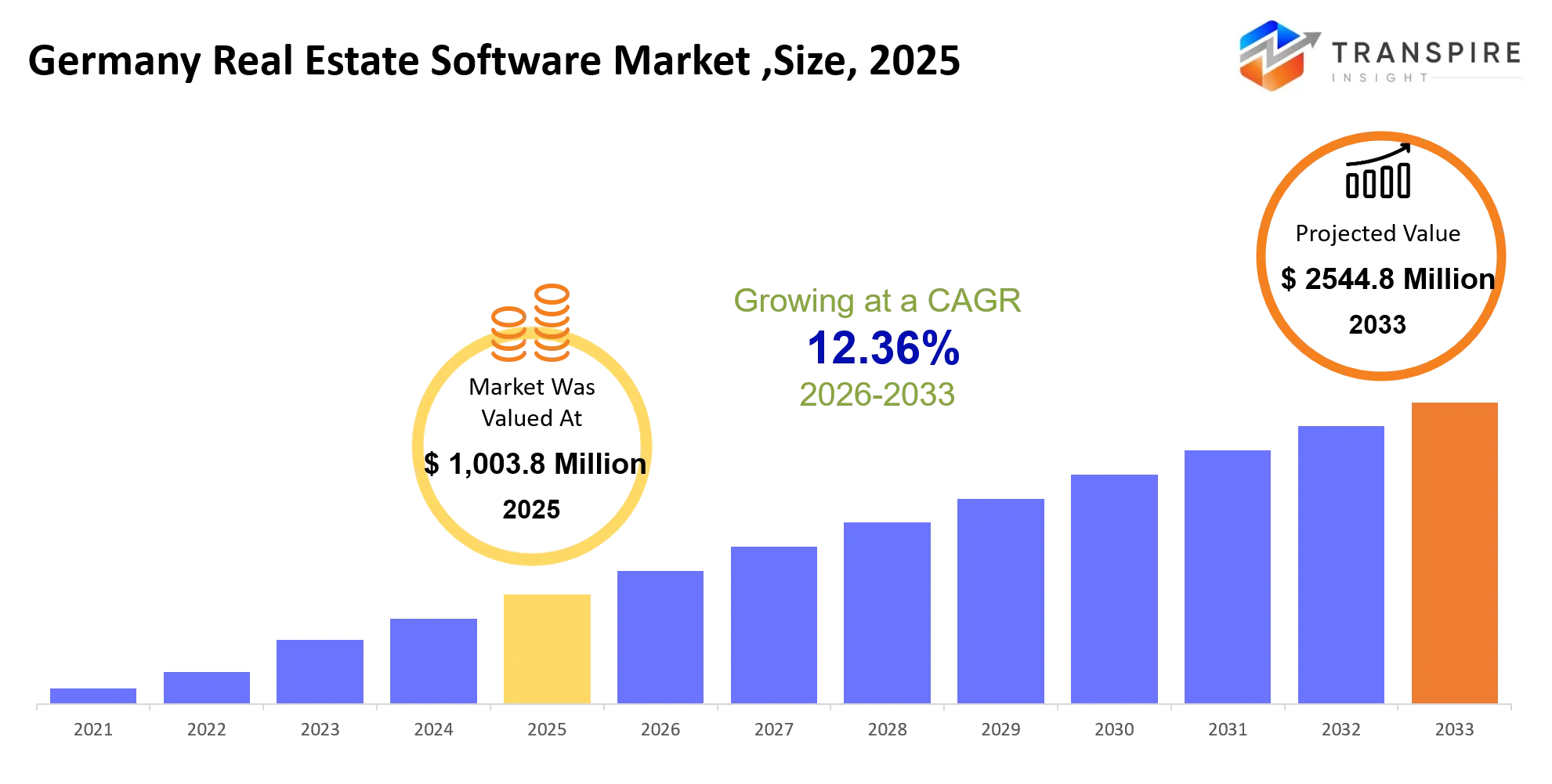
As per Transpire Insight Analysis The Germany Real Estate Software Market size is estimated at USD 1,003.8 Million in 2025 and is anticipated to reach USD 2544.8 Million by 2033, growing at a CAGR of 12.36%from 2026 to 2033.
The Germany Real Estate Software Market seems to help property owners , developers, facility managers and real estate service providers, by making leasing, tenant administration, accounting, upkeep planning and portfolio results feel much more manageable through connected digital platforms. In the last five years the market has sorta moved away from standalone property tools, and instead toward cloud based AI enabled platforms, where financial details and day to day operations and even customer related data sit in one place. Then the rules started getting tighter—like stronger ESG reporting expectations, more formal digital building documentation requirements, and the energy efficiency goals tied to the European Green Deal. So adoption picked up quickly across both commercial and residential property inventories. At the same time, because financing got more expensive after the European inflation cycle, property firms pushed harder on cutting operating costs and improving asset utilization, usually via automation and smart workflows. Altogether this mix of regulatory compliance, operational efficiency, and data led decisions is pulling more enterprise software deployments into the mainstream, and it’s also opening up fresh revenue channels for software vendors supporting Germany’s real estate ecosystem.
Germany Real Estate Software Market Size & Forecast:
- Germany Real Estate Software Market Size 2025: USD 1,003.8 Million
- Expected Market Value 2033: USD 2544.8 Million
- Forecast CAGR: 12.36%
- Key Profile: SAP SE, Yardi Systems, MRI Software, RealPage, Oracle, IBM, Planon, Aareon Group, Microsoft, AppFolio, Entrata, Trimble, Mews Systems, Archibus, CoStar Group
Key Market Insights
- Regional Leadership: Southern Germany basically leads the Germany Real Estate Software Market, with about 38% share in 2025, pushed by big commercial property portfolios and quick technology uptake.
- Regional Growth: Eastern Germany looks like the fastest mover through 2033, mainly because smart city spending and commercial redevelopment efforts are getting stronger over time.
- Solution Segment: Property Management Software stays in front with close to 42% market share in 2025, and Facility Management Software is still the second-largest bucket, while AI-driven analytics platforms are the ones expanding the most.
- Application Insights: Commercial real estate makes up around 58% of deployments, though residential property management is seeing the quickest digital adoption via cloud-based tenant platforms.
- End User Trends: Large enterprises contribute roughly 61% of revenue, while SMEs keep increasing usage through Software-as-a-Service subscriptions, mainly because the setup or implementation costs are lower .
- Competitive Landscape: SAP SE, Yardi Systems, MRI Software, Oracle, Microsoft, and Aareon Group back stronger market positions by using AI-powered workflow automation and integrated ERP capabilities.
- Vendors are also rolling out predictive maintenance, digital leasing, and automated compliance reporting, and this is cutting admin work by about 20–35% across enterprise property portfolios .
- Strategic partnerships between software providers and PropTech companies have helped speed up cloud migration, which allows faster rollout of smart building, as well tenant engagement solutions.
- ESG reporting modules and energy management dashboards have been showing up as standard features since 2022, and it seems tied to tighter sustainability disclosure rules across Europe, at this point everyone is adjusting.
What are the Key Drivers, Restraints, and Opportunities in The Germany Real Estate Software Market?
The biggest growth driver, at least right now is Germany’s faster digital pivot across both commercial and residential real estate, plus stricter ESG rules and building efficiency requirements that keep getting tighter. Property owners are, more and more often, pushing for a more centralized kind of platform , one that ties together leasing, maintenance, accounting, energy monitoring, and compliance updates into one place, not five different tools. At the same time, operational costs are creeping up and financing is less forgiving, so landlords and asset managers are basically forced to automate everyday workflows, get better occupancy insights, and trim down admin spending. In turn, these pressures boost enterprise software spending and keep recurring subscription revenues moving higher.
Still, the major structural headache stays pretty clear: digital infrastructure is fragmented across Germany’s real estate scene. A lot of housing associations and property managers still lean on old ERP setups, spreadsheets, and custom databases , which are hard to stitch into newer cloud platforms. Big migration programs then turn into long journeys, they need meaningful upfront investment, lengthy rollouts, cybersecurity upgrades, and actual training for employees. Because of that, enterprise-wide deployments get delayed and software spending gets postponed, so near term market growth stays capped.
Looking ahead, artificial intelligence, digital twins, and IoT-based smart building control are the next big growth opening. Operators are increasingly funding predictive upkeep , occupancy analytics, automated energy balancing, and digital building passports to lift how well assets perform over time. And on top of that, government-backed sustainability programs, together with smart city activity across Eastern Germany, create better conditions for advanced real estate software vendors to expand.
What Has the Impact of Artificial Intelligence Been on The Germany Real Estate Software Market?
Artificial intelligence is quietly transforming the Germany Real Estate Software Market by automating day to day property operations, helping investors make sharper investment decisions, and in a sense boosting building performance. Newer platforms now use AI to digest lease agreements, automate invoice validation, time maintenance activities, and handle tenant service requests using a more intelligent virtual assistant. Machine learning then goes further, it can examine occupancy patterns, forecast rental income, flag lease renewal risks, and even guess equipment failures before maintenance becomes a bigger problem and disrupts the whole routine. All of this supports property managers in lowering maintenance expenses, raising asset availability, and tuning resource allocation across huge property portfolios, not just single buildings.
There is also the advanced analytics layer, which supports ESG compliance by watching energy consumption, surfacing inefficiencies, and suggesting operational tweaks that cut utility bills and carbon emissions. AI driven valuation models also help investors judge market conditions faster, while computer vision is used for automated property inspections and damage assessments. When these tools connect with IoT sensors, real time monitoring gets better for HVAC systems elevators lighting and security infrastructure. That tends to improve operational efficiency and tenant satisfaction, even when the workload is heavy.
Still, AI adoption is not fully smooth everywhere because the cost of integrating older property management systems with newer cloud architectures can be high. On top of that, inconsistent historical property data and fragmented software environments can weaken model accuracy. So for many real estate organizations, large scale AI implementation becomes more complicated than expected, and the rollout slows down, more than people initially hoped.
Key Market Trends
- Since 2021 cloud deployment kinda overtook the older on-premise setups, and after that SaaS platforms turned into the go-to choice for enterprise property portfolios, not just a “nice to have” thing anymore.
- By 2022, ESG reporting capabilities shifted from optional modules into standard features, mainly because European sustainability regulations got more demanding , and yeah that pushed adoption faster.
- Also AI powered predictive maintenance is spreading across commercial buildings at a steady pace , which helps operators cut down unexpected equipment failures by roughly 20–30%, this part seems pretty consistent.
- SAP SE, Yardi Systems, MRI Software, Oracle, and Microsoft keep expanding their AI, IoT, and ERP integration abilities via deliberate product development and partnerships that are kind of intertwined.
- Property managers are more and more rolling out digital tenant portals, automated leasing workflows, and mobile maintenance apps, and this tends to reduce admin processing time by about 30% , in real operations.
- Even the link between BIM platforms, IoT sensors, and real estate software has sped up, so now real time asset monitoring and lifecycle management can happen across even complicated facilities.
- Commercial property owners increasingly focus on unified data platforms, where accounting , leasing, facilities management and investment analytics all connect in one ecosystem , instead of juggling separate systems.
- Subscription based pricing models have been steadily replacing perpetual software licenses, which improves access for SMEs and also gives vendors predictable recurring revenue, more stability.
- At the same time smart city projects, plus energy efficient building modernization programs, keep creating fresh opportunities for cloud property management and facility optimization platforms to expand.
- And finally cybersecurity and data governance spending is now a core purchase criterion, as enterprises move sensitive property and tenant information into cloud environments, with fewer compromises.
Germany Real Estate Software Market Segmentation
By Deployment
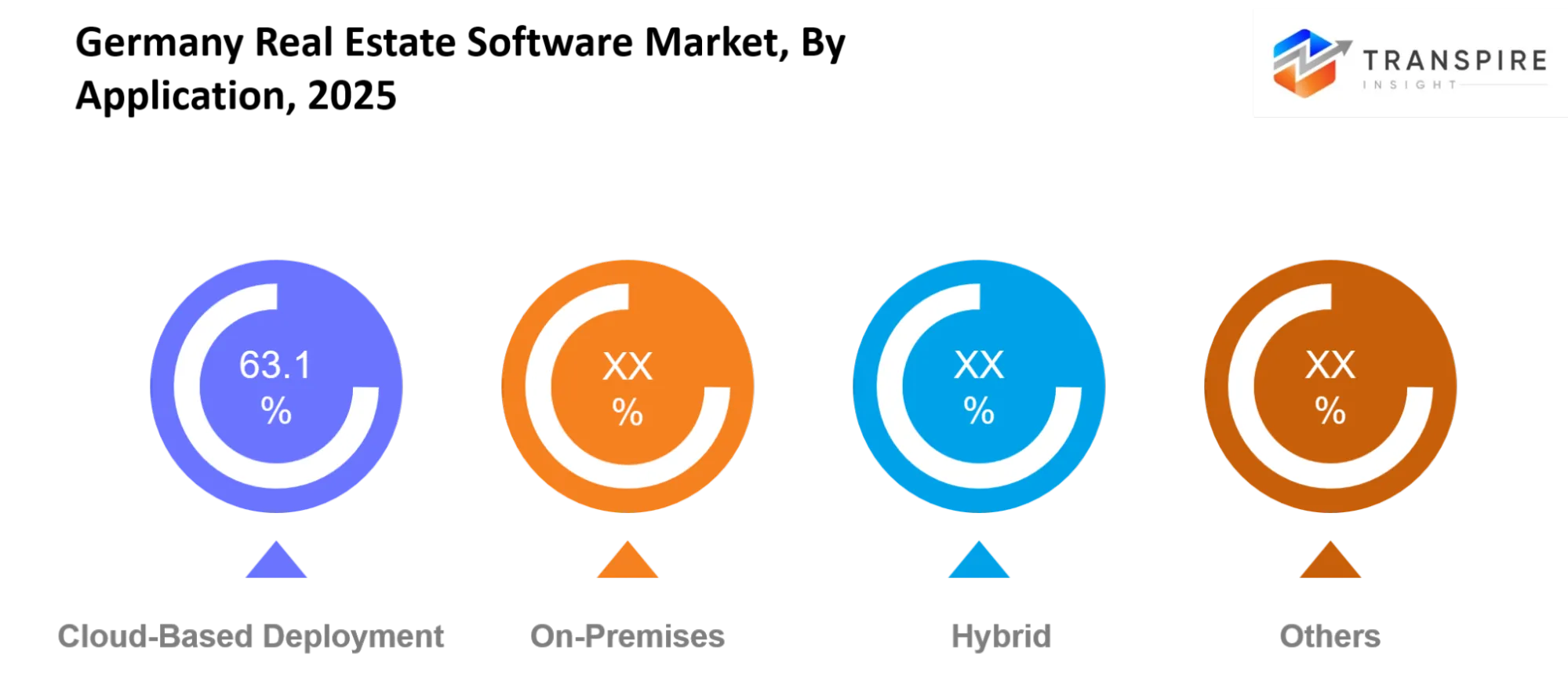
Cloud based solutions help run centralized property operations via remote access, automatic updates and those more flexible subscription models. In general, real estate firms pick cloud platforms to make portfolio management easier, boost collaboration, and lower the need for extra hardware. Since it can be implemented pretty fast, and scaling feels easy, cloud deployment becomes a good fit when property portfolios keep growing. Hybrid work practices, too, seem to encourage wider acceptance of cloud infrastructure across Germany.
On premises deployment is still important though, especially for organizations that want direct control over sensitive business data and their internal infrastructure. A hybrid approach mixes local infrastructure with cloud services, so it kind of balances security with operational flexibility, even for large portfolios. There are also other routes, like customized deployment models, aimed at specialized business settings, or regulatory requirements that don’t fit a standard setup. Every deployment option fits different operational priorities, investment budgets and even specific data management strategies, it depends.
By Software Type
Property Management software, basically holds a leading role by bringing leasing, maintenance, accounting, and tenant communication into one platform, kinda like a single hub. CRM Software then strengthens customer engagement via lead tracking , sales management , and relationship building, even when things move pretty fast. Accounting Software helps improve financial accuracy by automating invoices , payments , budgeting, and tax reporting, with less manual fuss. Facility Management software supports maintenance scheduling , asset monitoring, and day to day building operations for both commercial and residential properties.
Lease Management software makes contract administration feel simpler, it handles renewal tracking and compliance monitoring across a property portfolio, or several portfolios at once. Valuation Software helps investors and financial institutions with property assessments and investment analysis, based on market data not guesses. Brokerage Management platforms refine transaction workflows, commission tracking, and client communication for agencies , and for teams that have a lot going on. Other options include document automation, analytics, energy management, and specialized PropTech applications made for unusual operational needs, like, when standard tools just dont fit.
By Enterprise Size
Large Enterprises end up spending the most on software, not just because they want it but because big property portfolios need kind of integrated digital control across a bunch of business functions at once. Enterprise platforms help keep operations consistent , strengthen financial reporting , manage compliance , and support performance monitoring over both national and regional routes. These centralized systems also back strategic planning and investment choices using advanced analytics, even when the org is already busy. Over time long-term digital transformation efforts keep pushing adoption deeper in this segment.
SMEs are increasingly using subscription based software because cloud platforms tend to lower the upfront cost, and at the same time they boost day to day operational efficiency. Individual Realtors often rely on lightweight digital tools for client management , listings , scheduling , and transaction documentation, without needing heavy infrastructure in the back office. Others , like consultants, valuation firms and niche service providers , may need specialized software functions for their exact workflows. Across the board, organizations of different sizes usually pick solutions based on how complex their operations are, the size of the workforce, and how much investment capacity they actually have.
By End User
Residential Real Estate keeps being a major software user, because property owners somehow keep tenant records, maintenance requests, rental payments , and occupancy all in digital platforms. Commercial Real Estate organizations lean on more advanced solutions for lease administration, portfolio optimization, financial analysis, and regulatory reporting, across office , retail and industrial properties. Property Managers tend to enhance day to day operations with automated workflows, it lowers admin burden a bit and it boosts service quality. These digital platforms also help with faster communication between management teams and tenants, which feels pretty important.
Construction Companies use software to coordinate property details, project documentation , facility handovers, and later lifecycle planning. REITs depend on integrated analytics, financial reporting, and asset performance monitoring so they can back up investment decisions, plus shareholder reporting too. Other participants include government agencies, housing associations , and institutional investors handling all sorts of property assets. In the end that broad range of end users keeps pushing software innovation across many different business needs.
By Application
Sales & Leasing actually is the biggest application in the mix , mostly because digital platforms make it easier to market the property, keep customer engagement going, handle contract prep, and manage the transaction end to end, without the usual friction. Asset Management also matters a lot , it helps with investment planning via portfolio monitoring, performance analysis, maintenance planning, and the financial reporting side, so decisions stay informed. Tenant Management improves day to day communication, service request handling , payment tracking, and lease administration, and yeah it tends to create a smoother customer experience overall. When workflows are integrated it cuts down manual processing a bunch, while operational transparency also goes up , kind of naturally.
Document Management supports organizations in organizing contracts, compliance records, technical documents, and legal files inside secure digital repositories. Financial Reporting is there for budgeting, forecasting, audit preparation, and regulatory compliance, and it does this through automated reporting tools that reduce repeat work. Other areas usually include ESG reporting, predictive maintenance, smart building analytics, and business intelligence applications, which all support long term operational improvement. Continuous digital integration expands the software value across every stage of property ownership and management, even the less obvious ones.
What are the Key Use Cases Driving The Germany Real Estate Software Market?
Property management is still the main use case, because those big commercial and residential portfolios need a centralized control for leasing, maintenance, financial records, and compliance work. In general digital platforms cut down the manual administration stuff while making the operational visibility a lot better, and also service quality for property owners as well as management companies, tends to improve.
Asset management and financial reporting keep getting more traction with commercial real estate firms, REITs, and institutional investors who want deeper portfolio analysis plus more solid regulatory reporting. Construction companies too are using digital platforms for coordinating project documentation building information, and facility handover processes with greater efficiency, overall it feels smoother.
Newer use cases are coming like AI supported property valuation, predictive maintenance for smart buildings, and automated ESG reporting which is aligned with European sustainability requirements. Digital twins along with IoT enabled building monitoring have a strong long term potential as energy efficiency standards keep rising and connected building investments expand across Germany.
|
Report Metrics |
Details |
|
Market size value in 2025 |
USD 1,003.8 Million |
|
Market size value in 2026 |
USD 1,123.5 Million |
|
Revenue forecast in 2033 |
USD 2544.8 Million |
|
Growth rate |
CAGR of 12.36%from 2026 to 2033 |
|
Base year |
2025 |
|
Historical data |
2021 - 2024 |
|
Forecast period |
2026 - 2033 |
|
Report coverage |
Revenue forecast, competitive landscape, growth factors, and trends |
|
Regional scope |
Germany |
|
Key company profiled |
SAP SE, Yardi Systems, MRI Software, RealPage, Oracle, IBM, Planon, Aareon Group, Microsoft, AppFolio, Entrata, Trimble, Mews Systems, Archibus, CoStar Group |
|
Customization scope |
Free report customization (country, regional & segment scope). Avail customized purchase options to meet your exact research needs. |
|
Report Segmentation |
By Deployment (Cloud-Based, On-Premises, Hybrid, Others); By Software Type (Property Management, CRM Software, Accounting Software, Facility Management, Lease Management, Valuation Software, Brokerage Management, Others); By Enterprise Size (Large Enterprises, SMEs, Individual Realtors, Others); By End User (Residential Real Estate, Commercial Real Estate, Property Managers, Construction Companies, REITs, Others); By Application (Sales & Leasing, Asset Management, Tenant Management, Document Management, Financial Reporting, Others) |
Which Regions are Driving The Germany Real Estate Software Market Growth?
Southern Germany keeps sort of leading, with Bavaria and Baden Württemberg showing the biggest gather of enterprise real estate operators, commercial developers and tech driven property companies. The area seems to do well thanks to a reasonably digital business setting, heavy funding into smart building initiatives, plus the fact that enterprise resource planning platforms are pretty much everywhere across commercial real estate portfolios. Big cities like Munich and Stuttgart also carry large corporate head offices, the kind that expect integrated property, lease, and facility management arrangements. And there’s a mature network of software vendors, cloud providers, real estate consultancies, and PropTech startups that keeps backing up Southern Germany's position in real estate software adoption, even when things feel noisy.
Western Germany sits in second place, though the core strength there feels more stable than concentrated. North Rhine Westphalia, Hesse, and Rhineland Palatinate still show dependable demand, mostly because their commercial property mixes are broad, logistics facilities are active, and institutional investors keep choosing longer horizon digital asset management. In contrast to Southern Germany, Western Germany leans more on steady upgrades of what already exists, rather than building new tech clusters from scratch. Solid economic results, ongoing digital compliance programs, and continued spending by property owners make Western Germany a steady source for national real estate software revenue.
Eastern Germany, meanwhile, is emerging as the quickest growing regional market, as both public and private investment picks up, and the modernization of residential and commercial property assets moves faster.
Who are the Key Players in The Germany Real Estate Software Market and How Do They Compete?
In the Germany real estate software market, competition is moderately fragmented, with global enterprise vendors going head to head with more focused property technology providers. Lately the battle seems more about cloud architecture, AI enabled automation, interoperability with enterprise systems, and domain specific functionality, rather than price alone. Many well known players keep their footprint by expanding platforms, and pushing recurring SaaS offerings, while PropTech companies tend to stand out through faster implementation and more specialized property management strengths, kind of like agile but targeted.
SAP SE leans hard on tight connections between enterprise resource planning, finance, procurement, and real estate management. That makes its overall setup quite appealing for big corporations running huge property portfolios. Aareon Group, meanwhile differentiates with software built for the European housing and property management segment, and it keeps widening the scope through acquisitions and AI enabled property management features. MRI Software is more about flexible property management platforms, using configurable workflows, which tends to attract commercial and mixed use operators who don’t want rigid processes.
Oracle also brings cloud infrastructure, database tech, and enterprise analytics together, aiming to support scalable real estate management environments for intricate organizations. Microsoft helps its position by letting property software vendors create AI enabled applications on Azure, and it also ties things in with collaboration via Microsoft 365, plus operational integration through Dynamics 365.
Company List
- SAP SE
- Yardi Systems
- MRI Software
- RealPage
- Oracle
- IBM
- Planon
- Aareon Group
- Microsoft
- AppFolio
- Entrata
- Trimble
- Mews Systems
- Archibus
- CoStar Group
Recent Development News
In May 2026, Aareon Group completed the acquisition of easimo GmbH. The acquisition expanded Aareon's cloud native property management capabilities and enhanced the integration of AI technologies across its software portfolio.https://www.grantthornton.de/en/services/advisory/deal-advisory/unsere-m-a-deals/grant-thornton-advises-aareon-on-the-acquisition-of-easimo/ (Grant Thornton)
In July 2025, Aareon Group introduced AAVA, a suite of AI powered virtual assistants for communication, knowledge management, and ERP processes. The launch strengthened automation capabilities for property management organizations and supported more efficient digital workflows.https://www.aareon.de/presse/aareon-fuehrt-ki-assistenz-aava-ein (Aareon)
What Strategic Insights Define the Future of The Germany Real Estate Software Market?
In the Germany real estate software market thing is moving toward more fully connected digital property ecosystems, where cloud platforms, artificial intelligence, IoT enabled building systems and data driven asset management sort of work in one unified software environment. The demand is going to be driven more and more by operational efficiency, sustainability reporting , and tougher digital compliance needs rather than just plain property administration.
A not so obvious risk is also growing, like more and more dependence on a small group of enterprise cloud platforms. That can push up integration costs, lead to vendor lock in, and also raise cybersecurity exposure for property owners, even when everything looks “normal” on the surface.
At the same time there is an emerging opportunity, for AI powered predictive property operations targeting mid sized residential housing associations, which are still underpenetrated by advanced digital platforms in a lot of places. The firms that lean into open architecture, interoperable APIs , and industry specific AI abilities while also building partnerships with regional property managers, might be positioned better for long term growth from 2026 to 2033.
Germany Real Estate Software Market Report Segmentation
By Deployment
• Cloud-Based
• On-Premises
• Hybrid
• Others
By Software Type
• Property Management
• CRM Software
• Accounting Software
• Facility Management
• Lease Management
• Valuation Software
• Brokerage Management
• Others
By Enterprise Size
• Large Enterprises
• SMEs
• Individual Realtors
• Others
By End User
• Residential Real Estate
• Commercial Real Estate
• Property Managers
• Construction Companies
• REITs
• Others
By Application
• Sales & Leasing
• Asset Management
• Tenant Management
• Document Management
• Financial Reporting
• Others
Frequently Asked Questions
Find quick answers to common questions.
The expected Germany Real Estate Software Market size for the market will be USD 2544.8 Million in 2033.
Key segments for The Germany Real Estate Software Market are By Deployment (Cloud-Based, On-Premises, Hybrid, Others); By Software Type (Property Management, CRM Software, Accounting Software, Facility Management, Lease Management, Valuation Software, Brokerage Management, Others); By Enterprise Size (Large Enterprises, SMEs, Individual Realtors, Others); By End User (Residential Real Estate, Commercial Real Estate, Property Managers, Construction Companies, REITs, Others); By Application (Sales & Leasing, Asset Management, Tenant Management, Document Management, Financial Reporting, Others)
Major Germany Real Estate Software Market players are SAP SE, Yardi Systems, MRI Software, RealPage, Oracle, IBM, Planon, Aareon Group, Microsoft, AppFolio, Entrata, Trimble, Mews Systems, Archibus, CoStar Group
The Germany Real Estate Software Market size is USD 1,003.8 Million in 2025.
The Germany Real Estate Software Market CAGR is 12.36% from 2026 to 2033.
- SAP SE
- Yardi Systems
- MRI Software
- RealPage
- Oracle
- IBM
- Planon
- Aareon Group
- Microsoft
- AppFolio
- Entrata
- Trimble
- Mews Systems
- Archibus
- CoStar Group
About the Authors

Mayur Shinde
I am Mayur Shinde, a Senior Research Analyst at Transpire Insight, specializing in the Automotive & Transportation and Information & Communication Technology (ICT) Industry. My work focuses on analyzing emerging market trends, technological advancements, competitive landscapes, and industry developments to deliver accurate, data-driven insights. I am passionate about transforming complex market information into clear, actionable content that helps businesses, professionals, and decision-makers stay informed and make confident strategic decisions.

Chakradhar Khansole
Chakradhar serves as the Research Director at Transpire Insight, bringing over 8 years of experience in technology, innovation, and strategic market intelligence. He specializes in transforming complex market data into actionable business insights that enable organizations to make informed, growth-oriented decisions. Recognized for his strategic vision and analytical expertise, Chakradhar leads high-impact research initiatives, delivering comprehensive market assessments, competitive intelligence, and forward-looking industry analysis.
Recently Published Reports
-
Apr 2026
3D Optical Profiler Market
3D Optical Profiler Market Size, Share & Analysis Report By Type (Desktop 3D Optical Profiler, and Portable 3D Optical Profiler), By Technology (Confocal Technology, and White Light Interference), By End-Use Industry (Manufacturing, Research Institutions, Automotive, Aerospace and Defense, Medical Devices, and Other), and Geography (North America, Europe, Asia-Pacific, Middle East and Africa, South and Central America), 2021 - 2031
-
Apr 2026
Depth Sensor Market
Depth Sensor Market Size, Share & Analysis Report By Type (Infrared Depth Sensors, Time-of-Flight (ToF) Sensors, Stereo Vision Sensors, Structured Light Sensors, Ultrasonic Depth Sensors), By Application (Automotive, Robotics, Gaming, Consumer Electronics, Industrial Automation, Healthcare, Security & Surveillance, Others), By End Users (Automotive Manufacturers, Consumer Electronics Companies, Healthcare Providers, Industrial Companies, Security Agencies, Gaming Companies, Robotics Companies, Others), and Geography (North America, Europe, Asia-Pacific, Middle East and Africa, South and Central America), 2021 – 2031
-
Apr 2026
Digital Manufacturing Market
Digital Manufacturing Market Size, Share & Analysis Report By Component (Hardware, Software, and Services), By Technology (Robotics, 3D Printing, Internet of Things (IoT), and Others), By Application (Automotive and Transportation, Aerospace and Defense, Consumer Electronics, Industrial Machinery, and Others), By Process Type (Computer-Based Designing, Computer-Based Simulation, Computer 3D Visualization, Analytics, and Others), and Geography (North America, Europe, Asia-Pacific, Middle East and Africa, South and Central America), 2021 – 2031
-
Apr 2026
Digital Visa Services Market
Digital Visa Services Market Size, Share & Analysis Report By Type (Individual Travelers, Group Travelers), By Application (Tourism, Business Travel, Others), and Geography (North America, Europe, Asia-Pacific, Middle East and Africa, South and Central America), 2021 – 2031