
High Performance Computing (HPC) Software Market Summary:
According to Transpire Insights, a detailed research report on the market reflects that the HPC workload management and scheduling software segment dominates the High Performance Computing (HPC) Software Market, supported by increasing demand for efficient resource allocation, AI-HPC workloads, cloud-based clusters, and large-scale scientific computing. NVIDIA Corporation leads the market with approximately (around USD 215.9 billion) in annual revenue and an estimated 9–13% market share, making it a leading contributor to market development, accelerated computing innovation, HPC software optimization, GPU-enabled computing, expanding AI-HPC capabilities, and growth dynamics.
Market Snapshot
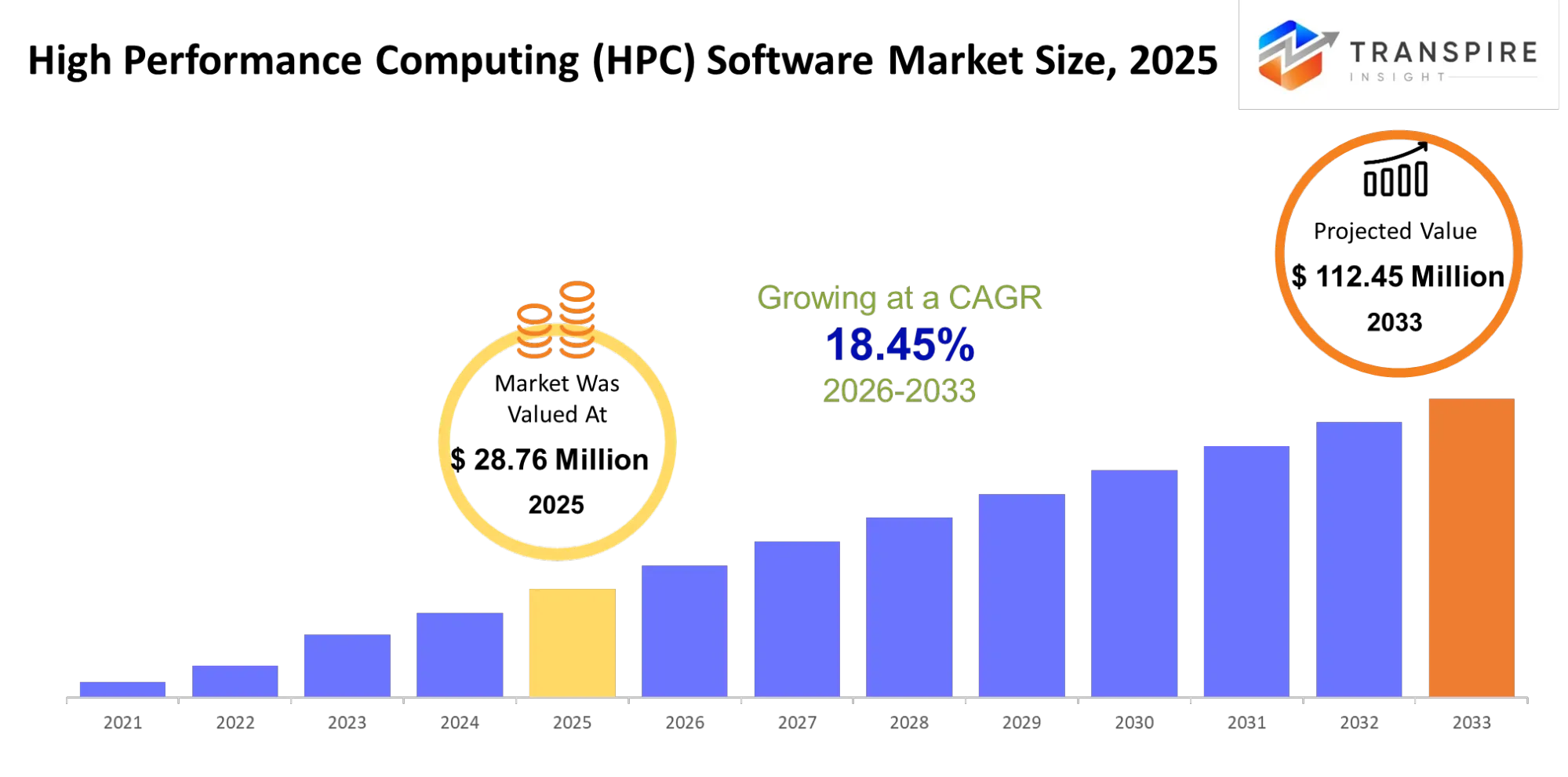
- Market Value (2025): USD 28.76 Billion.
- Expected Market Value (2026): USD 34.37 Billion.
- Estimated Market Value (2033): USD 112.45 Billion.
- Forecast CAGR (2026–2033): 18.45%
- Leading Region in 2025: North America
- Second-largest Region: Europe
- Fastest Growing Region: Asia Pacific
Introduction
The HPC Software Market includes specialized software, operating systems, middleware, analytics software, and database systems built to operate on supercomputers and cluster systems. This software facilitates parallel computing, which divides hefty computational tasks among multiple processors or GPUs simultaneously to solve complex problems in the fields of science, engineering, and finance. High Performance Computing (HPC) Software: This refers to specialized software, operating systems, and middleware that enable different computers in a network to use combined computing resources in their processing. Parallel Processing: A processing technique whereby a complex task is divided into separate smaller tasks to be processed by a multitude of computers/nodes simultaneously. High Performance Computing (HPC) Software Market growth is driven by massive parallel processing, enabling organizations to execute complex computational workloads concurrently at exceptional speeds. Advanced simulation capabilities support high-precision modeling across climate science, genomics, aerospace engineering, computational fluid dynamics, and molecular research. Cloud-based and hybrid HPC software enhances cost-efficient scalability, allowing enterprises to access high-performance computing resources without substantial investments in dedicated supercomputing infrastructure. Accelerated AI innovation further strengthens demand by optimizing GPU clusters, reducing machine learning training times, and improving data analytics performance. These capabilities enhance computational efficiency, operational productivity, research outcomes, and digital transformation across industries, supporting sustained adoption of HPC software globally.
- For instance:-The Worldwide Market for High Performance Computing (HPC) Software Strong regional demand is fueled by growing investments in AI and weather modeling in South Africa, which is a part of the larger Middle East and Africa industry as cloud and hybrid architectures speed adoption.
Market Highlights: -
- North America is expected to grow at a rapid CAGR in the High Performance Computing (HPC) Software Market by holding almost 39% of the share during the forecast period..
- Europe is anticipated to hold almost 22% share of the High Performance Computing (HPC) Software Market over the predicted timeframe.
- Asia Pacific is anticipated to hold almost 19% share of the High Performance Computing (HPC) Software Market over the predicted timeframe.
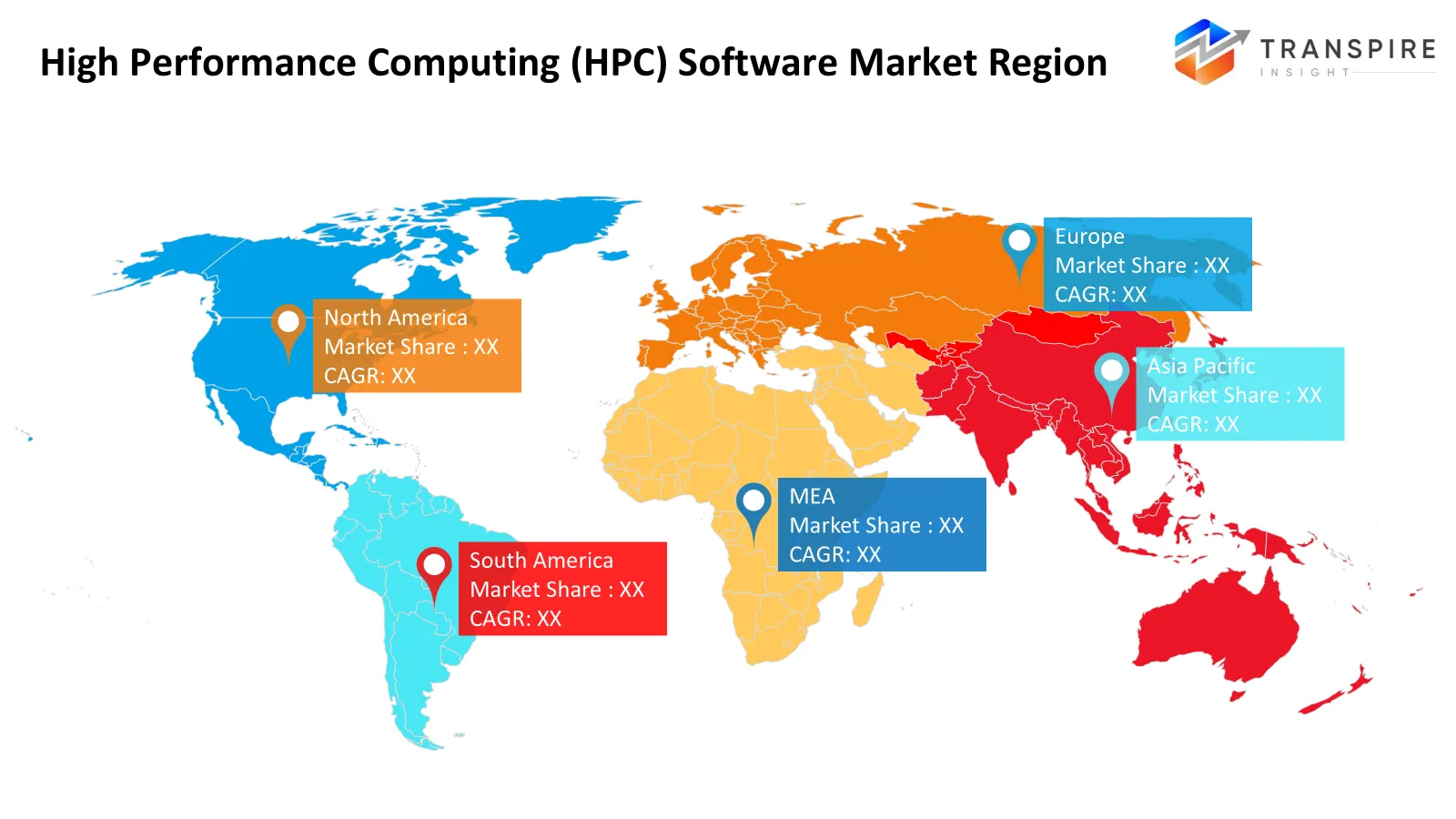
- By component, the Management Software segment dominated the market and holds nearly 28% share in 2025 and is projected to grow at a substantial CAGR during the forecast period.
- By application, the Scientific Research segment dominated the market and holds nearly 30% share in 2025 and is projected to grow at a substantial CAGR during the forecast period.
- By end user, the BFSI segment dominated the market and holds nearly 25% share in 2025 and is projected to grow at a substantial CAGR during the forecast period.
- Government & Defense: Applications of government and defense account for an approximate share of 24.16% of the HPC market demand, driven by aspects such as national security, weather forecasting, scientific exploration, defense simulation, and sovereign AI initiatives. More investment in high-performance computing infrastructure and AI-enabled computing improves the demand for superior HPC software among high-priority workloads, large-scale simulations, real-time analytics, and safe computing environments.
How is Technology Driving Growth in the High Performance Computing (HPC) Software Market?
The High Performance Computing (HPC) Software Market is experiencing evolution through cloud-native and hybrid technologies, which help in accessing advanced computing technology in a flexible and scalable manner without depending on expensive local infrastructure. The combination of artificial intelligence and machine learning has been increasing workload orchestration, automation, optimization, and enhanced analytics in the HPC market. The optimization of heterogeneous hardware helps in efficient management of CPUs, GPUs, and accelerators for highly demanding applications such as genomics, life sciences, aerospace, and engineering simulations. Energy-efficient HPC software is becoming increasingly important as organizations aim at decreasing computational costs, energy usage, and transfer of data.
|
Report Metrics |
Details |
|
Market size value in 2025 |
USD 28.76 Billion |
|
Market size value in 2026 |
USD 34.37 Billion |
|
Revenue forecast in 2033 |
USD 112.45 Billion |
|
Growth rate |
CAGR of 18.45% from 2026 to 2033 |
|
Base year |
2025 |
|
Historical data |
2021 - 2024 |
|
Forecast period |
2026 - 2033 |
|
Report coverage |
Revenue forecast, competitive landscape, growth factors, and trends |
|
Regional scope |
United States; Canada; Mexico; United Kingdom; Germany; France; Italy; Spain; Denmark; Sweden; Norway; China; Japan; India; Australia; South Korea; Thailand; Brazil; Argentina; South Africa; Saudi Arabia; United Arab Emirates |
|
Key company profiled |
Intel, AMD, NVIDIA, IBM, Hewlett Packard Enterprise, Dell Technologies, Lenovo, Atos, Fujitsu, NEC, Cray, Penguin Solutions, Microsoft, AWS, Google Cloud |
|
Customization scope |
Free report customization (country, regional & segment scope). Avail customized purchase options to meet your exact research needs. |
|
Report Segmentation |
By Component (HPC Software, Middleware, Development Tools, Management Software, Monitoring Software, Optimization Software, Analytics Software, Others); By Deployment (On-premise, Cloud-based, Hybrid, HPC-as-a-Service, Multi-cloud, Private Cloud, Public Cloud, Others); By Application (Scientific Research, Engineering, Financial Modeling, Weather Forecasting, AI & Machine Learning, Healthcare, Energy, Others); By End User (BFSI, Healthcare, Government, Academia & Research, Manufacturing, Energy & Utilities, IT & Telecom, Others); By Enterprise Size (Large Enterprises, SMEs, Research Institutes, Government Organizations, Universities, Startups, Others) |
Market Drivers
There is a rising demand for High Performance Computing (HPC) Software. This is due to increasing AI and machine learning workloads such as generative AI and large language models that are now widely available in the industry. The demand for HPC Software is being further stimulated through adoption in medicine and pharmaceutical science primarily because of utilization of computational genomics and gain-of-function modeling. The hybrid and cloud HPC deployment techniques provide improved computing capacity, flexibility, and cost efficiency. The adoption of HPC Software has been enhanced by governmental support in sovereign AI and development of exascale. The market for high-performance computing software has been propelled by rapid innovation, hybrid flexibility, the convergence of simulation techniques, and cost-effectiveness in scalability. AI-based computing systems, such as advanced protein modeling technologies, have played an instrumental role in hastening the process of drug discovery thus accelerating the adoption of high-performance computing systems in life sciences. Hybrid high-performance computing systems are gaining popularity as they integrate performance, security, and latency control of on-premise high-performance computing systems together with the flexibility of using cloud computing technologies. Notably, contemporary high-performance computing systems are beginning to integrate physics-based models with artificial intelligence training and inference, resulting in more productive scientific, engineering, and industrial research processes. Moreover, GPU-optimized cloud services and advanced orchestration services have enabled the development of inexpensive high-performance computing services thus allowing companies to use scalable high-performance computing technologies without incurring huge capital expenditures on high-performance computing infrastructure.
- For Instance: - According to the HPC Software industry Report, the United States leads regional growth in the High Performance Computing (HPC) software industry due to significant federal expenditure in defense, energy, and scientific research, which is fueled by investments in AI and cloud computing.
- Growing investments in AI and hybrid cloud are driving the HPC software market. While Western markets dominate, Russia continues to invest in localized cloud computing and supercomputing for energy and defense, but its integration of external technologies is severely limited by international sanctions and complicated procurement.
Restrain
The High Performance Computing (HPC) Software Market has to deal with huge implementation costs, challenges of parallel programming, and lack of skilled resources. Possible restrictions on exports and international trading as well as localization of data may make it more difficult to launch HPC projects in different countries. Furthermore, HPC workloads executed on the cloud may require considerable payments for data transfer, which adds to the total cost of ownership and slows down implementation.
|
Driver |
Relative Impact on Growth (%) |
Geographic Relevance |
Impact Timeline |
Demand Strength |
Growth Mechanism |
Key Beneficiaries |
Major Constraint |
|
Driver 1: AI-HPC Convergence and Accelerated Computing Adoption |
28% |
North America, Europe, Asia-Pacific |
Short-term |
High |
Accelerates AI workloads across GPU-enabled HPC environments |
HPC software vendors, AI developers, cloud providers |
GPU programming complexity increases software development costs |
|
Driver 2: Exascale Supercomputing and Scientific Simulation Expansion |
23% |
North America, Europe, Asia-Pacific |
Medium-term |
High |
Requires advanced software for extreme-scale simulations |
Supercomputing centers, research institutions, software developers |
Limited exascale expertise slows software optimization |
|
Driver 3: Sovereign AI and Government HPC Investments |
20% |
Europe, North America, Asia-Pacific |
Medium-term |
High |
Government funding expands national HPC software infrastructure |
Government labs, HPC vendors, semiconductor companies |
Large capital requirements constrain smaller market entrants |
|
Driver 4: Cloud HPC and Hybrid Computing Adoption |
16% |
North America, Europe, Asia-Pacific |
Short-term |
High |
Provides scalable HPC resources without infrastructure ownership |
Cloud providers, enterprises, HPC software companies |
Cloud costs rise with sustained intensive workloads |
|
Driver 5: Energy-Efficient HPC and Sustainable Computing Requirements |
13% |
Europe, North America, Asia-Pacific |
Long-term |
Medium |
Optimizes workloads to reduce energy consumption |
Data centers, HPC vendors, enterprises, governments |
Energy-efficient optimization requires specialized software expertise |
Analysis of Prices and Consumer Behaviour
Workload managers/schedulers form the largest segment in terms of HPC Software Market share (comprising 28.41% of total market revenue in 2025 – mostly owing to high demand from sectors such as scientific research, artificial intelligence, engineering simulation, finance, etc.). This is because HPC software that enables efficient workload scheduling, resource management, GPU acceleration, and cluster management will command premium prices compared to their base versions as they feature advanced orchestration capabilities and performance optimization. It is estimated that around 57.12% of the total HPC software revenue was contributed by the cloud deployment of HPC software in 2025. The sales volumes will be high owing to the benefits of scalability, flexible resource allocation, and accessibility associated with cloud HPC environment in case of AI applications, simulations, analytics and research purposes. Large enterprises comprised nearly 64.89% of the total HPC software revenue in 2025 as they were making huge investments in advanced computing infrastructure. The purchasing decision will be based on factors such as performance, scalability, interoperability, security and workload optimization.
|
Investment Factor |
Why It Matters to Investors |
Opportunity |
Investment Implication |
|
AI-HPC Convergence |
AI workloads increasingly require specialized HPC infrastructure and software optimization. |
GPU-accelerated computing, AI libraries, AI workload orchestration |
Attractive near-term technology investment potential |
|
Exascale Computing Expansion |
Scientific, defense, climate, and engineering workloads demand extreme-scale software capabilities. |
Exascale programming, MPI, compilers, schedulers, performance optimization |
Strong medium-term infrastructure software opportunity |
|
Cloud and Hybrid HPC Adoption |
Enterprises seek scalable HPC without exclusively owning expensive infrastructure. |
Cloud HPC orchestration, workload management, hybrid deployment platforms |
Scalable recurring-revenue opportunity for software providers |
|
Engineering Simulation Growth |
Automotive, aerospace, semiconductor, energy, and manufacturing increasingly rely on computational simulation. |
CFD, multiphysics, digital twins, CAE and simulation software |
High-value specialized application opportunity |
|
Energy-Efficient Computing |
Rising HPC power consumption increases demand for workload and resource optimization. |
Energy-aware scheduling, performance optimization, efficient algorithms |
Long-term sustainability-driven technology opportunity |
|
Sovereign HPC Investment |
Governments are expanding domestic AI and supercomputing capabilities for strategic autonomy. |
National HPC platforms, secure software, government research infrastructure |
Long-term regional expansion and institutional opportunity |
Who are the Key Players in the High Performance Computing (HPC) Software Market and how do they compete?
The success of High Performance Computing (HPC) software firms in the international marketplace depends on companies which have specialized in technologies relating to computing, workload management, AI-HPC integration, and scalable software ecosystems development on a level. The approach is not only price-based; it is focused on various aspects like GPU acceleration, cloud-based HPC orchestration, workload scheduling, simulation software, and integrations, which together provide a potential for a continuous product line development. This strategy allows companies to use the latest advances to ensure that their organizational goals related to computational performance, resource efficiency, scalability, and workload optimization will be achieved.
The competitive position of NVIDIA Corporation has been significantly improved thanks to the development of accelerated computing platforms, GPU-optimized libraries, AI-HPC solutions, and computing environments. Besides that, companies are doing their best to improve their market position by creating supercomputing software environments, specialized programming tools, and workload management solutions which can be used for scientific study and engineering..
Top Companies in the High Performance Computing (HPC) Software Market
- Intel
- AMD
- NVIDIA
- IBM
- Hewlett Packard Enterprise
- Dell Technologies
- Lenovo
- Atos
- Fujitsu
- NEC
- Cray
- Penguin Solutions
- Microsoft
- AWS
- Google Cloud
|
Company |
Est. Revenue Share Range |
Key Offerings |
Strategic Positioning |
Geographic Strength |
Technology Focus |
|
NVIDIA Corporation |
9–13% |
NVIDIA HPC SDK, CUDA, CUDA-X Libraries, Nsight Systems |
GPU computing leadership and accelerated HPC ecosystem |
North America, Europe, Asia-Pacific |
GPU acceleration, CUDA, AI-HPC, MPI, heterogeneous computing |
|
Hewlett Packard Enterprise (HPE) |
7–10% |
HPE Cray Programming Environment, Cray Compilers, Slurm integration, HPC management tools |
End-to-end supercomputing platforms with integrated software |
North America, Europe, Asia-Pacific |
Exascale computing, MPI, compilers, performance optimization |
|
IBM Corporation |
5–8% |
IBM Spectrum LSF, Spectrum LSF Suites, workload management, hybrid-cloud HPC |
Enterprise workload orchestration and hybrid-cloud specialization |
North America, Europe, Asia-Pacific |
Workload scheduling, automation, hybrid-cloud HPC |
|
Altair Engineering Inc. |
4–7% |
PBS Professional, Altair HPCWorks, Altair Access, workload management |
HPC workload-management and engineering-computing specialization |
North America, Europe, Asia-Pacific |
HPC scheduling, GPU workloads, cloud orchestration, AI |
|
Ansys, Inc. |
4–6% |
Ansys Fluent, Ansys Mechanical, Ansys LS-DYNA, HPC licensing |
Simulation-led HPC with engineering workload specialization |
North America, Europe, Asia-Pacific |
CFD, FEA, GPU acceleration, MPI, multiphysics simulation |
|
Dassault Systèmes SE |
3–5% |
SIMULIA, 3DEXPERIENCE, PowerFLOW, CST Studio Suite |
Multiphysics simulation and engineering HPC integration |
Europe, North America, Asia-Pacific |
Multiphysics, CFD, electromagnetic simulation, HPC solvers |
|
Siemens AG |
3–5% |
Simcenter, STAR-CCM+, Simcenter Nastran, engineering HPC tools |
Integrated digital engineering and simulation ecosystem |
Europe, North America, Asia-Pacific |
CFD, multiphysics, digital twins, distributed computing |
|
Microsoft Corporation |
2–4% |
Azure CycleCloud, Azure Batch, Azure HPC, HPC orchestration |
Cloud-native HPC scaling and enterprise orchestration |
North America, Europe, Asia-Pacific |
Cloud HPC, autoscaling, orchestration, AI infrastructure |
|
Amazon Web Services, Inc. (AWS) |
2–4% |
AWS ParallelCluster, AWS Batch, HPC software stacks, EFA |
Elastic cloud HPC infrastructure and workload automation |
North America, Europe, Asia-Pacific |
Cloud orchestration, Slurm, EFA, GPU/HPC acceleration |
|
Fujitsu Limited |
1–3% |
HPC software environments, Fujitsu Technical Computing Suite, HPC middleware |
Specialized supercomputing solutions for scientific institutions |
Asia-Pacific, Europe, North America |
Vector computing, HPC middleware, scientific libraries |
Market Segmentation
The High Performance Computing (HPC) Software Market share is divided into five categories: By component, deployment, application, end user and enterprise size.
The Management Software dominated the market, accounting for nearly 28% in 2025 and is expected to rise at a significant CAGR during the forecast period.
The High Performance Computing (HPC) Software Market is segmented by component into HPC Software, Middleware, Development Tools, Management Software, Monitoring Software, Optimization Software, Analytics Software, Others. Among these, the Management Software segment dominated the market, accounting for nearly 28% in 2025 and expected to increase at a significant CAGR during the forecast period. Management software is the leader due to the rising needs of workload scheduling, cluster orchestration, resource optimization, monitoring, and management of HPC infrastructure. The need for complex CPU-GPU configurations, hybrid clouds, and artificial intelligence workloads is driving the need for advanced management software solutions.
The Scientific Research dominated the market, accounting for nearly 30% in 2025, and is expected to rise at a significant CAGR during the forecast period.
The High Performance Computing (HPC) Software Market is segmented by application into Scientific Research, Engineering, Financial Modeling, Weather Forecasting, AI & Machine Learning, Healthcare, Energy, Others. Among these, the Scientific Research segment dominated the market, accounting for nearly 30% in 2025 and expected to increase at a significant CAGR during the forecast period. The Scientific Research category is in the lead because of increased use of High Performance Computing software for complicated calculations, climate research, genomics, new drug discovery, materials research, and physics computations.
The BFSI dominated the market, accounting for nearly 25% in 2025 and is expected to rise at a significant CAGR during the forecast period.
The High Performance Computing (HPC) Software Market is segmented by end user into BFSI, Healthcare, Government, Academia & Research, Manufacturing, Energy & Utilities, IT & Telecom, Others. Among these, the BFSI segment dominated the market, accounting for nearly 25% in 2025 and expected to increase at a significant CAGR during the forecast period. BFSI emerges as the topmost contributor within the High Performance Computing (HPC) Software Market because of the growing usage of high-performance computing for risk analysis, fraud detection, algorithmic trading, portfolio optimization, stress testing, and regulation compliance. BFSI organizations need fast computing power to handle huge amounts of data and complex modeling and make use of AI in decision making.
Regional Segment Analysis of the High Performance Computing (HPC) Software Market:
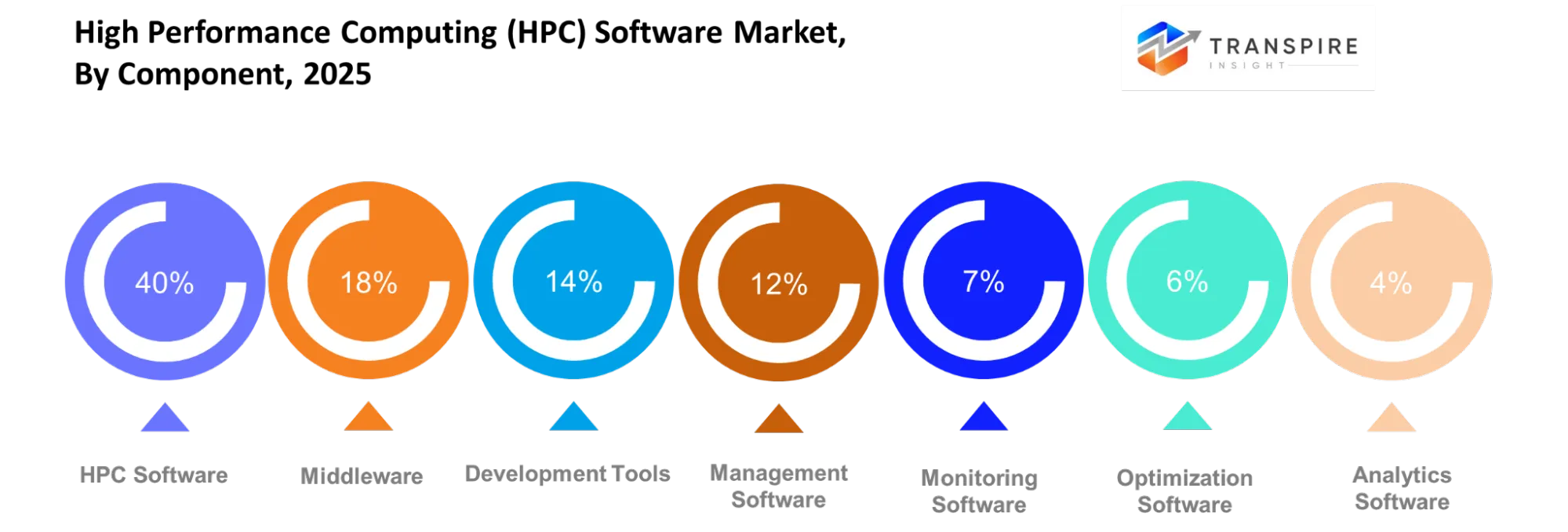
- North America (U.S., Canada, Mexico)
- Europe (Germany, France, U.K., Italy, Spain, Rest of Europe)
- Asia-Pacific (China, Japan, India, Rest of APAC)
- South America (Brazil and the Rest of South America)
- The Middle East and Africa (UAE, South Africa, Rest of MEA)
North America is the fastest-growing region in the High Performance Computing (HPC) Software Market during the period, holding almost39%share.
North America is expected to grow at a rapid CAGR in the High Performance Computing (HPC) Software Market holding almost 39% share during the forecast period. Leadership comes from North America, which has heavy investment in AI infrastructure, cloud HPC, government supercomputing, and strong demand from research, defense, healthcare, and corporations. Leadership also results from its leading technology providers, hyperscalers, and large data-center infrastructure, thus enabling HPC software deployment and innovation.
Europe is expected to grow at a rapid CAGR in theHigh Performance Computing (HPC) Software Market, holding almost22%of the share during the forecast period.
Europe is expected to grow at a rapid CAGR in the High Performance Computing (HPC) Software Market holding almost 22% share during the forecast period. The growth of Europe will be high because of the massive investment in EuroHPC, increased workload for AI and scientific computing, research infrastructure, and adoption of cloud-based HPC software. Countries like Germany, France, and the UK have been improving their supercomputing capabilities in areas such as academics, manufacturing, healthcare, and finance for sustained demand for HPC software solutions.
Asia Pacific is the fastest-growing region in the High Performance Computing (HPC) Software Market during the period, holding almost19%share.
Asia Pacific is the fastest-growing region in the High Performance Computing (HPC) Software Market during the forecast period, holding almost 19% share during the forecast period. The use of high-performance computing software is rapidly increasing in Asia Pacific due to developments in the AI infrastructure, cloud computing, digital industry, and supercomputing through government funding. There are investments by China, India, Japan, and Southeast Asia in AI-enabled data centers and computing technologies, along with increasing demand for simulations, analysis, and research.
Strategies for Market Growth in Non-Leading Regions:
The use of robust, effective, and scalable HPC software solutions in developing countries will be advantageous for research organizations, small-sized enterprises, and technology developers alike. Local installation and integration of HPC software and the creation of local HPC infrastructure and cloud computing centers will minimize dependency on technology imports and decrease the total cost of computing. Establishing strategic ties with local enterprises, research organizations, cloud service providers, universities, governments, and technology suppliers will boost the positions of HPC software vendors in the market. There should be adequate training activities and skills development in the area to improve the understanding of HPC software application, workload control, parallel computation, application improvement, cybersecurity, and system administration. Also, flexible financing options, long-term software license agreements, subscription-based services, and managed HPC arrangements will make HPC software solutions more reasonable and facilitate their use by end users.
Future Market Trends for the High Performance Computing (HPC) Software Market: -
1.Emergence of Hybrid Deployments: Hybrid deployment systems will be increasing at a CAGR of 8.82% due to their combination of on-premises hardware's low latency with the elasticity of cloud computing.
2.Fracking Life Sciences and the Rise of AI: Technologies like AlphaFold3 for predicting proteins are boosting drug discovery applications and thus propelling the rise of life sciences healthcare at a CAGR of 9.55% till 2031.
3.GPU Neoclods and Specialization in Orchestration: GPU-specialized vendors such as CoreWeave and Lambda have competitively priced GPUs, thus generating a higher requirement for specialized HPC software.
4.Leading in the Asia Pacific Region: The Asia Pacific region is leading in the rate of market expansion with a CAGR of 9.06% through the help of sovereign AI and supercomputing programs of the government.
5.Platform as a Service: Tools for platform as a service (PaaS) are increasingly being adopted due to their abstraction of infrastructure and packaging of domain specific tool chains.
Recent Development
- In May 2026: IQM Quantum Computers introduced its HPC Integration Service, which makes it possible for quantum computers to run as Slurm-controlled nodes among CPUs and GPUs, thus enhancing the development of High Performance Computing (HPC) Software Market solutions.
- In June 2026: HPE unveiled Supercomputing Programming Software and also enhanced HPE Slingshot 400 software with multi-tenancy to improve secure workload isolation, multi-vendor HPC systems, and scalable supercomputing infrastructure for sovereign AI research and enterprise applications.
- In July2026: EuroHPC Joint Undertaking rolled out a strategic call for setting up to seven AI Gigafactories in Europe, using AI processors, HPC software, cloud stacks, high-speed connectivity, and energy-efficient data centers to speed up AI workloads in Europe.
This study forecasts revenue at global, regional and country levels from 2020 to 2033. Transpire Insights has segmented the High Performance Computing (HPC) Software Market based on the below-mentioned segments:
High Performance Computing (HPC) Software Market, By Component
- HPC Software
- Middleware
- Development Tools
- Management Software
- Monitoring Software
- Optimization Software
- Analytics Software
- Others
High Performance Computing (HPC) Software Market, By Deployment
- On-premise
- Cloud-based
- Hybrid
- HPC-as-a-Service
- Multi-cloud
- Private Cloud
- Public Cloud
- Others
High Performance Computing (HPC) Software Market, By Application
- Scientific Research
- Engineering
- Financial Modeling
- Weather Forecasting
- AI & Machine Learning
- Healthcare
- Energy
- Others
High Performance Computing (HPC) Software Market, By End User
- BFSI
- Healthcare
- Government
- Academia & Research
- Manufacturing
- Energy & Utilities
- IT & Telecom
- Others
High Performance Computing (HPC) Software Market, By Enterprise Size
- Large Enterprises
- SMEs
- Research Institutes
- Government Organizations
- Universities
- Startups
- Others
High Performance Computing (HPC) Software Market, By Regional Analysis
North America
- United States
- Canada
- Mexico
Europe
- Germany
- United Kingdom
- France
- Spain
- Italy
- Rest of Europe
Asia Pacific
- Japan
- China
- Australia & New Zealand
- South Korea
- India
- Rest of Asia Pacific
South America
- Brazil
- Argentina
- Rest of South America
Middle East & Africa
- Saudi Arabia
- United Arab Emirates
- South Africa
- Rest of the Middle East & Africa
Frequently Asked Questions
Find quick answers to common questions.
The market is projected to grow from USD 28.76 billion in 2025 to USD 112.45 billion by 2033.
Management Software dominates by component, while Scientific Research leads by application, accounting for nearly 28% and 30%, respectively.
North America leads with nearly 39% share supported by strong AI, cloud HPC, research, defense, and supercomputing investments.
AI-HPC convergence, exascale computing, sovereign AI investments, cloud adoption, and energy-efficient computing are major growth drivers.
Key players include NVIDIA, Intel, AMD, HPE, IBM, Microsoft, AWS, Fujitsu, Altair Engineering, Ansys, and Dassault Systèmes.
- Intel
- AMD
- NVIDIA
- IBM
- Hewlett Packard Enterprise
- Dell Technologies
- Lenovo
- Atos
- Fujitsu
- NEC
- Cray
- Penguin Solutions
- Microsoft
- AWS
- Google Cloud
About the Authors

Mayur Shinde
I am Mayur Shinde, a Senior Research Analyst at Transpire Insight, specializing in the Automotive & Transportation and Information & Communication Technology (ICT) Industry. My work focuses on analyzing emerging market trends, technological advancements, competitive landscapes, and industry developments to deliver accurate, data-driven insights. I am passionate about transforming complex market information into clear, actionable content that helps businesses, professionals, and decision-makers stay informed and make confident strategic decisions.

Chakradhar Khansole
Chakradhar serves as the Research Director at Transpire Insight, bringing over 8 years of experience in technology, innovation, and strategic market intelligence. He specializes in transforming complex market data into actionable business insights that enable organizations to make informed, growth-oriented decisions. Recognized for his strategic vision and analytical expertise, Chakradhar leads high-impact research initiatives, delivering comprehensive market assessments, competitive intelligence, and forward-looking industry analysis.
Recently Published Reports
-
Apr 2026
3D Optical Profiler Market
3D Optical Profiler Market Size, Share & Analysis Report By Type (Desktop 3D Optical Profiler, and Portable 3D Optical Profiler), By Technology (Confocal Technology, and White Light Interference), By End-Use Industry (Manufacturing, Research Institutions, Automotive, Aerospace and Defense, Medical Devices, and Other), and Geography (North America, Europe, Asia-Pacific, Middle East and Africa, South and Central America), 2021 - 2031
-
Apr 2026
Depth Sensor Market
Depth Sensor Market Size, Share & Analysis Report By Type (Infrared Depth Sensors, Time-of-Flight (ToF) Sensors, Stereo Vision Sensors, Structured Light Sensors, Ultrasonic Depth Sensors), By Application (Automotive, Robotics, Gaming, Consumer Electronics, Industrial Automation, Healthcare, Security & Surveillance, Others), By End Users (Automotive Manufacturers, Consumer Electronics Companies, Healthcare Providers, Industrial Companies, Security Agencies, Gaming Companies, Robotics Companies, Others), and Geography (North America, Europe, Asia-Pacific, Middle East and Africa, South and Central America), 2021 – 2031
-
Apr 2026
Digital Manufacturing Market
Digital Manufacturing Market Size, Share & Analysis Report By Component (Hardware, Software, and Services), By Technology (Robotics, 3D Printing, Internet of Things (IoT), and Others), By Application (Automotive and Transportation, Aerospace and Defense, Consumer Electronics, Industrial Machinery, and Others), By Process Type (Computer-Based Designing, Computer-Based Simulation, Computer 3D Visualization, Analytics, and Others), and Geography (North America, Europe, Asia-Pacific, Middle East and Africa, South and Central America), 2021 – 2031
-
Apr 2026
Digital Visa Services Market
Digital Visa Services Market Size, Share & Analysis Report By Type (Individual Travelers, Group Travelers), By Application (Tourism, Business Travel, Others), and Geography (North America, Europe, Asia-Pacific, Middle East and Africa, South and Central America), 2021 – 2031