
Germany HDD Equipment Market Summary
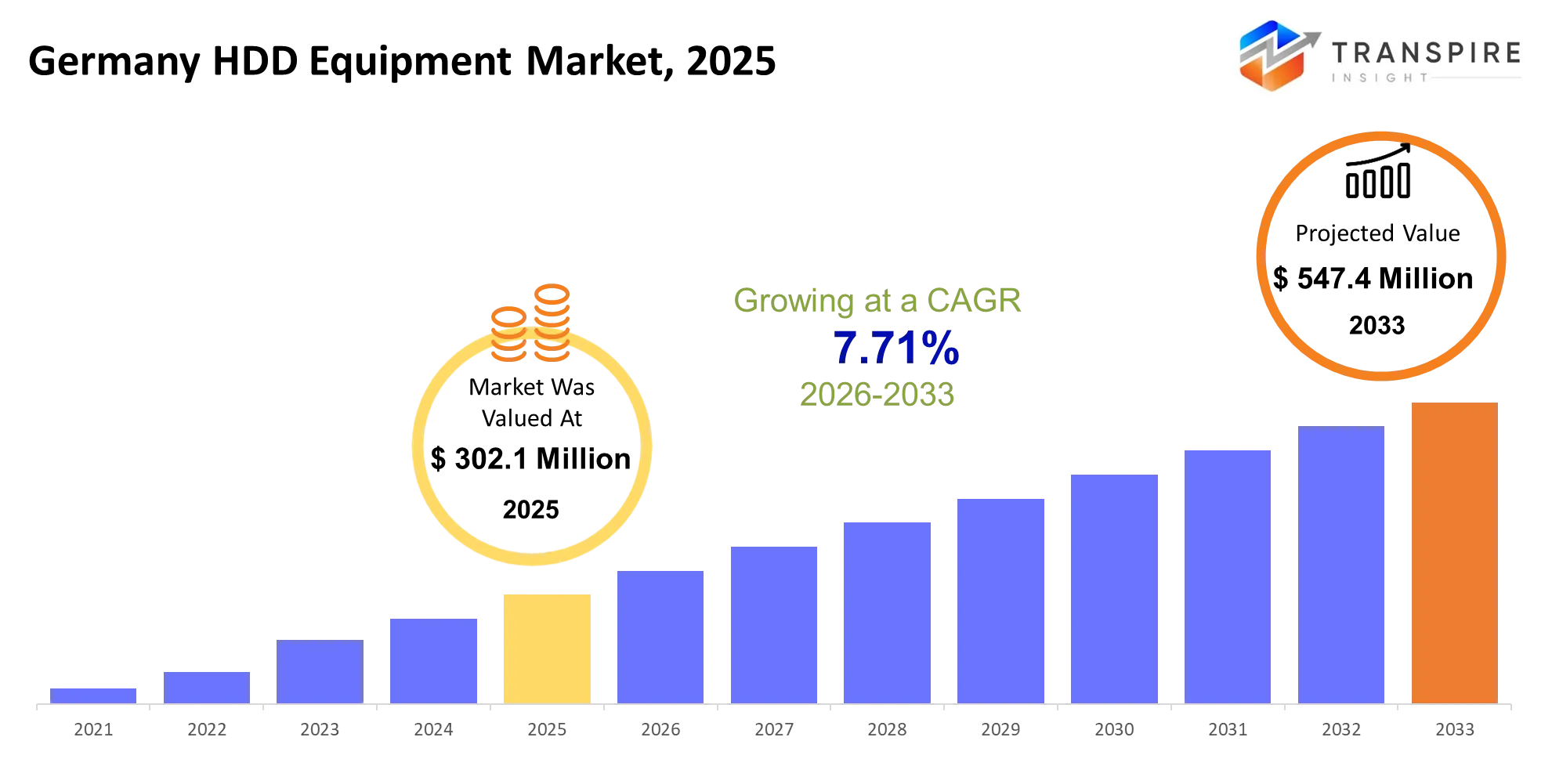
As per Transpire Insight, the Germany HDD Equipment Market size is estimated at USD 302.1 Million in 2025 and is anticipated to reach USD 547.4 Million by 2033, growing at a CAGR of 7.71% from 2026 to 2033.
The Germany HDD equipment market basically helps trenchless building happen because it lets contractors put pipelines, fiber optic cables, power lines and even water networks down beneath roads, railways, and rivers, without having to do all that heavy surface digging. In practice this kind of work cuts the traffic chaos, brings the reinstatement expenses down, and helps shorten the overall schedules, so it feels like a pretty necessary piece of modern infrastructure growth.
In the last five years, things have been moving toward more digitally connected drilling setups. You know, systems with automated guidance, telematics, and precision tracking tech that really boosts drilling accuracy and day to day operational efficiency. And lately, the push for faster broadband rollouts, the modernization of the energy grid, and the ongoing utility replacement programs across Europe, plus the after pandemic infrastructure spending and energy security plans, have really reinforced the need for equipment. Also as contractors start taking on bigger underground projects, with more technical complications, they seem to be leaning harder into advanced HDD equipment. This improves productivity, lowers the chance of operational problems, and also supports long term revenue momentum for both equipment makers and the service providers.
Germany HDD Equipment Market Size & Forecast:
- Germany HDD Equipment Market Size 2025: USD 302.1 Million
- Expected Market Value 2033: USD 547.4 Million
- Forecast CAGR: 7.71%
- Leading region in 2025: Southern Germany
- Fastest Growing region: Eastern Germany
- Key Profile: Vermeer Corporation, Ditch Witch, Herrenknecht, Prime Drilling, American Augers, Barbco, Toro, XCMG, Goodeng Machine, Drillto Trenchless, Akkerman, Tracto-Technik, Melfred Borzall, TT Technologies, Terra AG
Key Market Insights
- Regional Analysis: In Southern Germany, the Germany HDD Equipment Market looks like it’s taking the lead with roughly 36% share in 2025, mostly because of heavy industrial activity and big utility infrastructure spending that just keeps going.
- Regional Growth: Meanwhile Eastern Germany is expected to grow at the quickest pace by 2033 , spurred by broadband rollout efforts, links to renewable energy, and a steady expansion of municipal infrastructure programs, kinda like a cascading momentum effect.
- Segment Analysis: Horizontal directional drilling rigs hold around 42% market share in 2025, whereas tracking systems stay the second-largest category.
- On the other side vacuum excavators are set for the fastest expansion through 2033, due to rising demand for less disruptive excavation methods and related sitework.
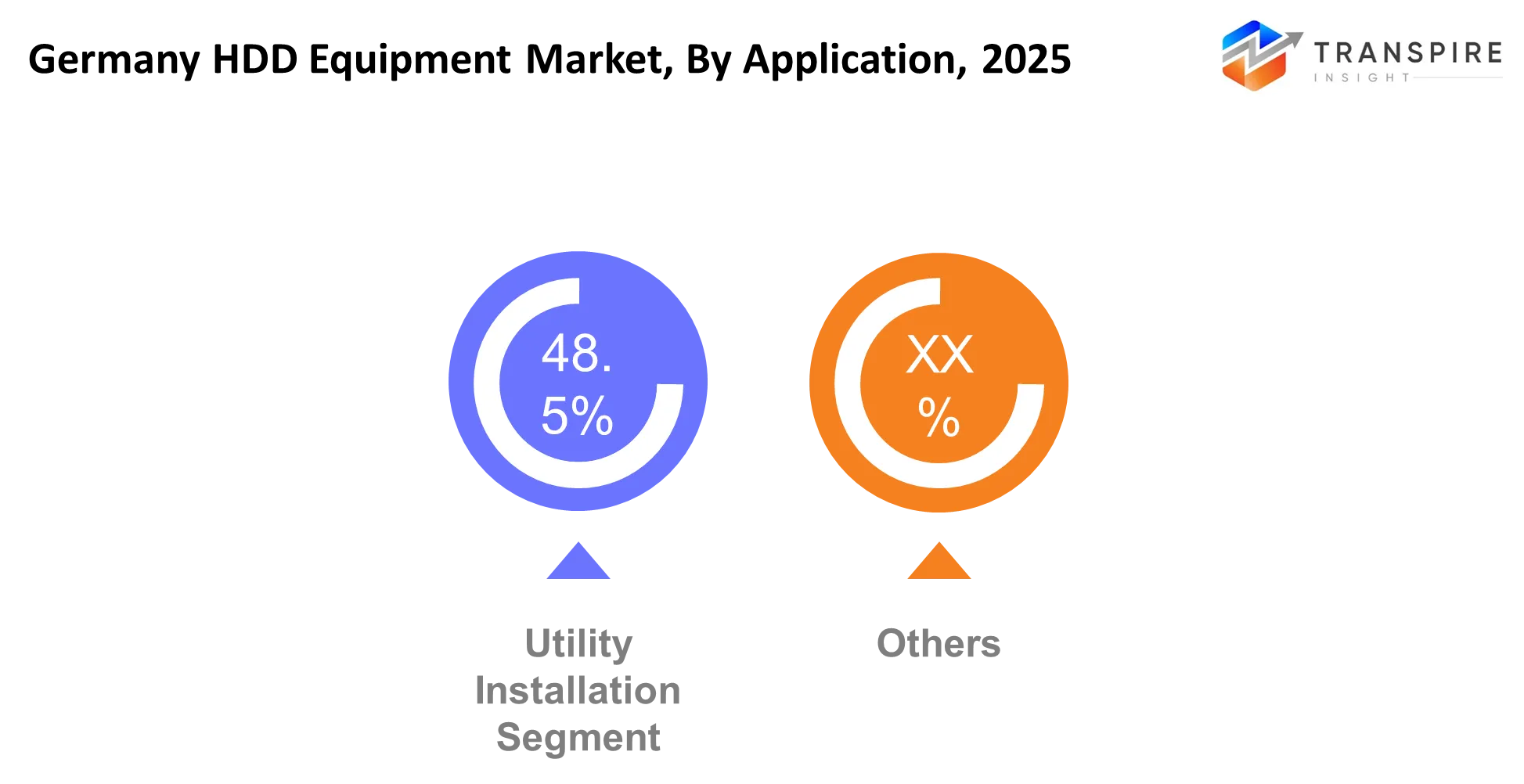
- Application & End User: For applications, utility installation contributes about 39% of total revenue, telecommunications is the fastest-growing use-case though.
- For end users, utility contractors represent over 45% of equipment procurement, acting like the main buyer group for these solutions.
- Competitive Landscape: Key players including Vermeer Corporation, Ditch Witch, Herrenknecht, Prime Drilling, Tracto-Technik, and American Augers continue pushing their market share upward via automated drilling systems, telematics integration, dealer network growth, strategic collaborations , and equipment innovation that feels very purpose-built.
What are the Key Drivers, Restraints, and Opportunities in the Germany HDD Equipment Market?
The main driver behind the Germany HDD Equipment Market seems to be the country’s faster, almost push-to-speed, investment in underground utility infrastructure, especially fiber optic networks, upgrades to the electricity grid, and district heating setups. The federal broadband rollout, together with renewable energy adoption, and those ongoing city-scale utility swap projects, have basically pushed contractors to use more advanced horizontal directional drilling equipment. With that kind of gear, underground assets can be placed with pretty minimal disruption, which in turn boosts equipment utilization levels, and then it makes the replacement cycle feel more urgent. So, fleets get renewed faster, and demand starts leaning toward technologically stronger drilling systems.
On the other side, a big restraint stays the same , namely the heavy upfront capital needed for high-end HDD rigs plus the supporting equipment. There is also a noticeable shortage of experienced drilling operators. Large drilling units need a specialized workforce, regular maintenance routines, and strict compliance with safety rules. And those issues aren’t easy to “fix” quickly, because workforce readiness and equipment financing both sit on long timelines. That’s why smaller contractors often hold back, and fleet modernization gets delayed, sometimes for years.
Still, there is a real opportunity as well. Germany keeps expanding renewable energy infrastructure, and cross-border utility links are also moving forward. New underground transmission routes for offshore wind support, hydrogen pipeline development, and smarter utility networks all require careful trenchless installation techniques. Manufacturers that roll out intelligent drilling systems, with automated steering, digital diagnostics, and even remote fleet oversight, are pretty well positioned. As infrastructure budgets shift toward resilient, low-disruption underground construction methods , the value of smarter HDD solutions should become easier to see, and harder to ignore.
What Has the Impact of Artificial Intelligence Been on the Germany HDD Equipment Market?
Artificial intelligence and some advanced digital technologies are, kinda, reshaping the Germany HDD Equipment Market by making drilling more accurate, boosting equipment dependability, and pushing project administration efficiency. These days modern HDD rigs more and more often blend AI driven navigation software with real-time sensor updates so they can tune drill routes, notice subsurface obstructions, and keep deviations smaller during demanding placements. Machine learning routines look at how the rig is performing, hydraulic pressure, vibration levels, plus engine information to foresee part failures before a real breakdown shows up, which helps contractors plan maintenance early and limit those surprise idle days.
Also, digital fleet management platforms rely on predictive analytics to better use equipment across several construction locations , so project timetables improve and day to day operating expenses tend to fall. AI aided drilling guidance supports bore precision while cutting down on material losses and reducing the need for remedial drilling actions. In practice contractors gain steadier equipment availability, better throughput, and stronger adherence to project requirements especially on big transport, energy, and utility undertakings.
Still, the bigger picture has a catch because adoption is held back by the elevated cost of adding intelligent control layers into existing drilling fleets. Many contractors keep using older equipment that doesn’t really match the newer digital architecture, while uneven underground geological information can lower the reliability of predictive models, meaning AI enabled drilling tech can’t deliver its full operational promise.
Key Market Trends
- The Germany HDD Equipment Market is shifting, kind of like through digital drilling tech, plus utility modernization and a steady stream of infrastructure money that really leans toward trenchless construction methods.
- In response manufacturers are rolling out more automation, telematics, and precision drilling know how, to boost productivity and also to keep project risks at bay a bit more.
- From 2021 on, contractors have pushed up their investment in GPS guided HDD rigs as fiber optic deployment grew across Germany, and that has improved drilling accuracy by more than 20% on those more complex utility jobs.
- Herrenknecht, Prime Drilling, and Tracto-Technik also keep expanding “smart” drilling solutions, with telematics, remote diagnostics, and automated steering, so fleet output gets better, even when the conditions are not so friendly.
- Utility installation projects now account for close to 39% of the equipment demand, which basically mirrors how Germany keeps modernizing electricity, water, and telecommunications infrastructure.
- At the same time equipment makers are adding predictive maintenance systems more often, these cut unexpected machine downtime by about 15% to 25% , and that ends up lowering lifecycle operating costs for contractors.
- Also, hybrid hydraulic control setups are becoming more common. They help raise drilling efficiency while dialing down fuel consumption by roughly 10%, so long-duration projects can run with less overhead, not only faster, but calmer too.
Germany HDD Equipment Market Segmentation
By Equipment Type:
Horizontal Directional Drilling Rigs really are the base layer for trenchless work because the drilling results hinge a lot on what the machine can actually do and how carefully it’s run in practice. Mud Mixing Systems help keep things moving smoothly by making the drilling fluid , that fluid then stabilizes the borehole and helps transport excavated material away from where the drilling tool is going. Drill Pipes, in turn pass along both torque and the drilling force . Reamers then take the earlier pilot path and expand it , up to the needed diameter so the pipeline or cable can be put in place.
Tracking Systems also matter, because they offer continuous subsurface positioning and that tends to improve directional correctness, so the chance of utility strikes during installation goes down. Then you have Vacuum Excavators , which support safer utility exposure before drilling even starts and they lower the odds of accidental contact in crowded job sites. The Accessories set usually includes connectors , tooling parts , replacement components, and supporting equipment, all of which makes the machine work more efficiently and helps extend the overall service life.
Beyond that, some Other equipment is built for specialized drilling conditions where a standard arrangement cannot deliver the required level of performance. In general, each equipment category supports a different phase of underground installation, so contractors can finish projects with better precision and more dependable day to day operation.
By Machine Size:
Mini HDD Rigs work well when there’s not much room to maneuver, so installation can still happen in residential neighborhoods, urban streets, and those tight construction areas where it’s kinda hard to move anything. Medium HDD Rigs fit municipal utility efforts and commercial infrastructure too, especially when drilling distances and pipe diameters aren’t extreme. Large HDD Rigs are for longer bores, plus bigger pipeline runs that show up in transportation, industrial, and energy projects. Heavy-Duty HDD Rigs bring the extra muscle for harsh geological situations and the really major infrastructure builds where you’re drilling deep for a long time.
There are also other machine categories, and they’re meant for specialized job needs that don’t really line up with the usual equipment groupings. In practice, choosing equipment comes down to bore length, ground conditions, pipe diameter, and how complicated the whole project is—more than just one single “performance” number. Contractors often weigh productivity against transportation realities and ongoing operating costs, before they commit to a specific machine size. That wider range of options supports trenchless construction on jobs that vary a lot in scale, and also in technical difficulty.
By Application:
Utility Installation is often seen as the biggest application because underground electricity, water, gas, and communications networks do need dependable installation methods, that really cut down on surface disruption and delays. Oil & Gas Pipelines lean heavily on trenchless drilling for crossings that are environmentally sensitive ,or for places where open excavation just isn’t practical, especially when the site is tight. Telecommunications work uses directional drilling for widening or extending fiber optic networks while traffic keeps moving and restoration costs stay smaller. Water & Sewer Lines tend to benefit from controlled underground installation , so excavation is kept to a minimum in densely populated urban zones where disruption is a major headache.
For Power Transmission, many projects are moving toward underground cable placement to boost reliability and lower exposure to weather related outages. Road Crossings also matter a lot, because they let new infrastructure go beneath highways, rail corridors, and public transport routes without stopping everyday operations. There are other uses too, like industrial facilities, renewable energy projects, and municipal development programs that require precise underground construction, and some teams want that consistency. Overall, the diversity of applications keeps supporting long term equipment utilization across a range of infrastructure sectors, and that helps the whole cycle stay steadier.
By End User:
Construction Companies take up a fairly big portion because infrastructure progress needs reliable drilling gear, for transportation, commercial, and municipal jobs. Utility Contractors handle the underground installs, like electricity, water, wastewater, and gas distribution setups, spread across towns and smaller rural sites, too. Oil & Gas Companies lean on advanced drilling tools for pipeline installation, where environmental safeguards along with operational efficiency are still top priorities. Telecom Operators keep pushing broadband growth by using subterranean fiber deployment, which cuts down ongoing maintenance and helps shield communication networks.
Government Agencies back trenchless construction through funding for public infrastructure modernization, and through utility replacement initiatives. Other end users cover industrial developers, renewable energy contractors, and engineering service providers doing specialized underground construction tasks. Each end-user group then applies directional drilling based on project needs, regulatory standards, and long term infrastructure planning. Ongoing infrastructure spending keeps equipment demand steadier across public as well as private sectors.
By Operation:
Manual Systems stay pretty suitable for smaller projects where experienced operators handle the drilling steps straightaway, using the usual controls and direct hand oversight. Semi-Automatic Systems, in comparison, help keep operations more consistent by mixing automated assistance along with operator supervision during the actual drilling tasks. Fully Automatic Systems take it further, they bring in digital controls, navigation technology, and intelligent monitoring so drilling precision goes up, while manual intervention goes down, quite a bit. In fact advanced automation also tends to support better operational efficiency, especially when the infrastructure is technically demanding.
Then there are other operating systems too, like customized arrangements built for specialized drilling settings or for certain contractor expectations. Digital monitoring keeps getting better, giving real-time operational insight and also maintenance details that matter. Equipment manufacturers keep refining their automation features, which helps improve safety, drilling accuracy and even overall project productivity. And there is operational flexibility, meaning contractors can align the technology level with project complexity, the skill of the workforce, as well as their investment priorities , without rushing anything.
What are the Key Use Cases Driving theGermany HDD Equipment Market?
Utility infrastructure development still counts as the main reason companies move forward with new equipment. When electricity distribution lines are installed underground , along with gas pipelines , drinking water networks and broadband fiber, construction can go ahead without a huge amount of surface excavation. Municipal utility projects and utility contractors end up taking the biggest share of equipment usage, because keeping public services running without interruptions remains a top priority, pretty much always.
On top of that, telecommunications expansion keeps opening more doors, and energy infrastructure work does the same. Telecom operators use trenchless drilling to roll out fiber optic networks across the country. Meanwhile oil and gas businesses lean on directional drilling for pipeline crossings in areas that are more environmentally sensitive, plus for industrial corridor developments where the ground conditions are not always friendly.
More recently, hydrogen pipeline infrastructure and renewable energy transmission projects look like rising use cases with solid long-term momentum. Underground cable placement that supports offshore wind integration and smart grid growth should create additional openings as Germany pushes the energy transition, and keeps investing in durable, resilient infrastructure development.
|
Report Metrics |
Details |
|
Market size value in 2025 |
USD 302.1 Million |
|
Market size value in 2026 |
USD 325.4 Million |
|
Revenue forecast in 2033 |
USD 547.4 Million |
|
Growth rate |
CAGR of 7.71% from 2026 to 2033 |
|
Base year |
2025 |
|
Historical data |
2021 - 2024 |
|
Forecast period |
2026 - 2033 |
|
Report coverage |
Revenue forecast, competitive landscape, growth factors, and trends |
|
Regional scope |
Germany |
|
Key company profiled |
Vermeer Corporation, Ditch Witch, Herrenknecht, Prime Drilling, American Augers, Barbco, Toro, XCMG, Goodeng Machine, Drillto Trenchless, Akkerman, Tracto-Technik, Melfred Borzall, TT Technologies, Terra AG |
|
Customization scope |
Free report customization (country, regional & segment scope). Avail customized purchase options to meet your exact research needs. |
|
Report Segmentation |
By Equipment Type (Horizontal Directional Drilling Rigs, Mud Mixing Systems, Drill Pipes, Reamers, Tracking Systems, Vacuum Excavators, Accessories, Others); By Machine Size (Mini HDD Rigs, Medium HDD Rigs, Large HDD Rigs, Heavy-Duty HDD Rigs, Others); By Application (Utility Installation, Oil & Gas Pipelines, Telecommunications, Water & Sewer Lines, Power Transmission, Road Crossings, Others); By End User (Construction Companies, Utility Contractors, Oil & Gas Companies, Telecom Operators, Government Agencies, Others); By Operation (Manual Systems, Semi-Automatic Systems, Fully Automatic Systems, Others) |
Which Regions are Driving the Germany HDD Equipment Market Growth?
Southern Germany basically leads the market, because Bavaria and Baden-Württemberg have a big bunch of industrial manufacturing, utility engineering firms, and even specialized trenchless technology providers. The ongoing pay in electricity networks, water infrastructure, and the fiber optic rollout helps keep demand steady for advanced horizontal directional drilling equipment across the whole region. There’s also a solid supplier ecosystem , a skilled workforce, equipment distributors and engineering service providers that makes project execution smoother and supports fleet modernization. With long-term infrastructure planning, plus dependable industrial spending, Southern Germany keeps the biggest share of equipment deployment.
Western Germany, instead, brings a steady slice of market revenue mostly through consistent infrastructure renewal, not these fast, aggressive expansions. North Rhine-Westphalia, Hesse, and nearby states stay busy replacing worn underground utility networks while also backing commercial development and municipal modernization work. Because the economy is pretty resilient, public investment looks reliable, and contractors keep moving all year, equipment utilization stays predictable. In comparison with Southern Germany, Western Germany tends to gain more from replacement projects than from big industrial expansion.
Eastern Germany is likely to show the quickest growth in the 2026–2033 window, after broadband deployment ramps up, renewable energy keeps expanding , and electricity transmission upgrades move forward. Newer investments that support digital infrastructure and underground cable installation have pushed more trenchless construction work into developing municipalities.
Who are the Key Players in the Germany HDD Equipment Market and How Do They Compete?
Competition still feels moderately consolidated, but the big players keep showing up mostly by relying on technology, drilling performance, aftermarket service, and dealer support rather than just price, like it’s not even a main lever. Equipment reliability, digital monitoring, operator productivity, and maintenance backing have really moved to the front as infrastructure jobs get bigger and also more technical. European manufacturers seem to win some things simply from being close to local buyers , while North American and Asian companies tend to push their advantage via wide product portfolios, plus distribution networks that keep expanding .
Herrenknecht plays a strong role in large-diameter trenchless infrastructure projects, where engineering know how and customized drilling solutions give them the edge. Prime Drilling is more about high-capacity HDD systems for tough pipeline installations, and they lean on engineering support plus solid project specific technical assistance. Vermeer Corporation differentiates its lineup using integrated digital tech, telematics, high end tooling, and a deep dealer network that offers training, maintenance, and ongoing equipment assistance across Europe, basically end-to-end.
Ditch Witch leans into operator output by using intelligent fleet management, guidance systems, hybrid machines, and virtual training solutions that make equipment usage more efficient. Tracto-Technik takes a different angle, strengthening its market position with compact trenchless equipment made for municipal utility projects and tight urban construction sites, where precision and operational flexibility stay non negotiable.
Company List
- Vermeer Corporation
- Ditch Witch
- Herrenknecht
- Prime Drilling
- American Augers
- Barbco
- Toro
- XCMG
- Goodeng Machine
- Drillto Trenchless
- Akkerman
- Tracto-Technik
- Melfred Borzall
- TT Technologies
- Terra AG
Recent Development News
- In March 2026, Vermeer Corporation launched an optional factory-installed operator cab for the Vermeer D24 horizontal directional drill. The new design improves operator comfort and year-round productivity, strengthening the company's position in utility HDD applications.https://www.vermeer.com/em/news/new-cab-for-vermeer-d24-horizontal-directional-drill-enhances-operator-comfort-and-productivity (Vermeer)
- In December 2025, Vermeer Corporation expanded its partnership with Tecniwell to distribute high-pressure HDD pump packages through its global dealer network. The alliance broadened integrated drilling solutions and enhanced equipment support for HDD contractors.https://www.vermeer.com/em/news/vermeer-and-tecniwell-form-alliance-partnership-for-high-pressure-pump-distribution (Vermeer)
- In December 2025, Vermeer Corporation introduced two new Ultra X3 HDD drill bits, including the 2Thirty and Triple Threat models. The product launch expanded drilling capability in difficult rock formations and improved tooling flexibility for challenging trenchless projects.https://www.vermeer.com/em/news/vermeer-expands-ultra-x3-drilling-system-with-two-new-specialized-hdd-bits (Vermeer)
What Strategic Insights Define the Future of theGermany HDD Equipment Market?
The market is sort of moving toward more intelligent, digitally connected drilling equipment , the kind that mixes automation, telematics, predictive servicing, and precision guidance, with the usual drilling results still in place. This shift is likely to be backed by longer term bets on broadband infrastructure, underground electricity links, connections to renewable generation , and the swap-out of older utility networks. There is also a quieter risk, more like a background issue, in the way the supply chain concentrates for specialized hydraulic parts, electronic controls, and precision drilling tools, because if shortages last too long they can mess up delivery timing and nudge manufacturing prices higher.
At the same time there is a growing chance in hydrogen pipeline development and in cross border energy infrastructure, where big scale trenchless installation will need advanced high capacity drilling systems. Companies and investors should do well if they expand digital service platforms, build stronger regional maintenance coverage, and design equipment tuned for the tougher underground energy and utility projects , projects that really want better output and lower lifecycle operating costs.
Germany HDD Equipment Market Report Segmentation
By Equipment Type
- Horizontal Directional Drilling Rigs
- Mud Mixing Systems
- Drill Pipes
- Reamers
- Tracking Systems
- Vacuum Excavators
- Accessories
- Others
By Machine Size
- Mini HDD Rigs
- Medium HDD Rigs
- Large HDD Rigs
- Heavy-Duty HDD Rigs
- Others
By Application
- Utility Installation
- Oil & Gas Pipelines
- Telecommunications
- Water & Sewer Lines
- Power Transmission
- Road Crossings
- Others
By End User
- Construction Companies
- Utility Contractors
- Oil & Gas Companies
- Telecom Operators
- Government Agencies
- Others
By Operation
- Manual Systems
- Semi-Automatic Systems
- Fully Automatic Systems
- Others
Frequently Asked Questions
Find quick answers to common questions.
The expected Germany HDD Equipment Market size for the market will be USD 547.4 Million in 2033.
Key segments for the Germany HDD Equipment Market are By Equipment Type (Horizontal Directional Drilling Rigs, Mud Mixing Systems, Drill Pipes, Reamers, Tracking Systems, Vacuum Excavators, Accessories, Others); By Machine Size (Mini HDD Rigs, Medium HDD Rigs, Large HDD Rigs, Heavy-Duty HDD Rigs, Others); By Application (Utility Installation, Oil & Gas Pipelines, Telecommunications, Water & Sewer Lines, Power Transmission, Road Crossings, Others); By End User (Construction Companies, Utility Contractors, Oil & Gas Companies, Telecom Operators, Government Agencies, Others); By Operation (Manual Systems, Semi-Automatic Systems, Fully Automatic Systems, Others).
Major Germany HDD Equipment Market players are Vermeer Corporation, Ditch Witch, Herrenknecht, Prime Drilling, American Augers, Barbco, Toro, XCMG, Goodeng Machine, Drillto Trenchless, Akkerman, Tracto-Technik, Melfred Borzall, TT Technologies, Terra AG.
The Germany HDD Equipment Market size is USD 302.1 Million in 2025.
The Germany HDD Equipment Market CAGR is 7.71% from 2026 to 2033.
- Vermeer Corporation
- Ditch Witch
- Herrenknecht
- Prime Drilling
- American Augers
- Barbco
- Toro
- XCMG
- Goodeng Machine
- Drillto Trenchless
- Akkerman
- Tracto-Technik
- Melfred Borzall
- TT Technologies
- Terra AG
About the Authors

Avinash Kumar
I’m Avinash Kumar, a Senior Research Analyst at Transpire Insight, with expertise in the Electronics and Semiconductor and Energy & Power industry. My work focuses on analyzing emerging technologies, market trends, industry developments, and innovation across these sectors. I specialize in transforming complex technical and market insights into clear, research-backed content that helps professionals, businesses, and decision-makers stay informed. Through continuous industry research and data-driven analysis, I strive to deliver accurate, reliable, and practical perspectives on the latest advancements shaping the semiconductor and energy landscape.

Chakradhar Khansole
Chakradhar serves as the Research Director at Transpire Insight, bringing over 8 years of experience in technology, innovation, and strategic market intelligence. He specializes in transforming complex market data into actionable business insights that enable organizations to make informed, growth-oriented decisions. Recognized for his strategic vision and analytical expertise, Chakradhar leads high-impact research initiatives, delivering comprehensive market assessments, competitive intelligence, and forward-looking industry analysis.
Recently Published Reports
-
Apr 2026
Active Power Filter Market
Active Power Filter Market Size, Share & Analysis Report By Type (Shunt Active Power Filters, Series Active Power Filter, Hybrid Active Power Filter), By Application (Harmonics Mitigation, Reactive Power Compensation, Voltage Regulation, Power Factor Correction), By Phase (Single Phase, Three Phase), By End-User Industry (Manufacturing, Healthcare, Commercial, Automotive, Oil and Gas, Others), and Geography (North America, Europe, Asia-Pacific, Middle East and Africa, South and Central America), 2021 - 2031
-
Apr 2026
Electrical Transformer Market
Electrical Transformer Market Size, Share & Analysis Report By Core (Closed, Shell, and Berry), By Insulation (Gas, Oil, Solid, Air, and Other), By Phase (Single, and Three), By Rating (100 MVA to 500 MVA, 501 MVA to 800 MVA, and 801 MVA to 1200 MVA), and Geography (North America, Europe, Asia-Pacific, Middle East and Africa, South and Central America), 2021 – 2031
-
Apr 2026
Hydraulic Piston Pumps Market
Hydraulic Piston Pumps Market Size, Share & Analysis Report By Type (Axial Piston Pumps, Radial Piston Pumps), By Operating Pressure (Low Pressure, Medium Pressure, High Pressure), By Application (Construction, Mining, Agriculture, Automotive, Oil & Gas, Industrial Machinery, Others), By End-User (OEMs, Aftermarket), and Geography (North America, Europe, Asia-Pacific, Middle East and Africa, South and Central America), 2021 – 2031
-
Apr 2026
Laboratory Gas Generators Market
Laboratory Gas Generators Market Size, Share & Analysis Report By Product (Nitrogen Gas Generator, Hydrogen Gas Generator, Zero Air Gas Generator, Purge Gas Generator, TOC Gas Generators, Others), By Application (Gas Chromatography, Liquid Chromatography-mass Spectrometry (LC-MS), Gas Analyzers, Others), By End-user (Life Science, Chemical & Petrochemical, Food & Beverage, Others), and Geography (North America, Europe, Asia-Pacific, Middle East and Africa, South and Central America), 2021 – 2031