

Germany Fly-By-Wire Systems Market Size & Forecast:
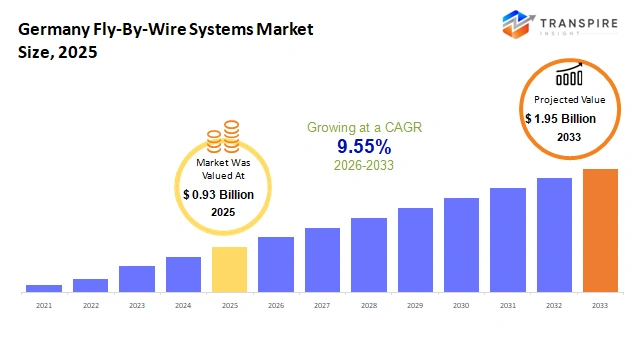
- Germany Fly-By-Wire Systems Market Size 2025: USD 0.93 Billion
- Germany Fly-By-Wire Systems Market Size 2033: USD 1.95 Billion
- Germany Fly-By-Wire Systems Market CAGR: 9.55%
- Germany Fly-By-Wire Systems Market Segments: By Aircraft Type (Commercial Aircraft, Military Aircraft, Business Jets), By Component (Flight Control Computers, Sensors, Actuators, Avionics), By Technology (Analog Fly-By-Wire, Digital Fly-By-Wire), By Application (Flight Control Systems, Throttle Control Systems, Brake Control Systems).
To learn more about this report,  Download Free Sample Report
Germany Fly-By-Wire Systems Market Summary:
The Germany Fly-By-Wire Systems Market size is estimated at USD 0.93 Billion in 2025 and is anticipated to reach USD 1.95 Billion by 2033, growing at a CAGR of 9.55 % from 2026 to 2033. The Germany Fly-By-Wire Systems market is experiencing steady growth because the aviation industry now requires digital flight control systems. Fly-by-wire systems replace traditional mechanical controls with electronic interfaces, which lead to better aircraft operational performance and increased safety and improved response times. The two German commercial and defense aviation sectors are adopting these systems because of the country's strong aerospace manufacturing capabilities and its commitment to technological progress. The market will experience growth in upcoming years because of increasing investments in modern aircraft development and next-generation avionics systems.
Key Market Trends & Insights:
- Digital flight control systems are being adopted by Germany's aviation industry to improve aircraft operational capabilities and ensure passenger safety. The implementation of fly-by-wire systems enables aircraft to achieve lower weight through elimination of cumbersome mechanical parts which results in improved operational performance and enhanced handling abilities.
- Germany operates a comprehensive aerospace manufacturing system which enables the development of new flight control technologies. Research and development programs are currently ongoing to create better fly-by-wire systems which will include more dependable and advanced technological features.
- Airlines and aircraft manufacturers are focusing their efforts on developing technologies which will enhance operational safety while decreasing the workload faced by pilots. The implementation of fly-by-wire systems delivers two critical benefits which include improved flight stability and flight operations monitoring that enhance safety while providing smoother flight experiences.
- Germany's defense sector is making investments to develop new aircraft systems and modernize existing avionics equipment. Military aircraft require fly-by-wire systems which provide essential support for their operational capacity and mission execution capabilities.
- Modern aircraft systems are now using fly-by-wire technology to connect with advanced avionics systems and digital control systems. The system enables enhanced data handling capabilities which results in better flight accuracy and advanced systems for managing aircraft operations.
Germany Fly-By-Wire Systems Market Segmentation
By Aircraft Type
- Commercial Aircraft: The fly-by-wire systems market in Germany contains commercial aircraft as its second-largest business sector. Airlines and aircraft manufacturers use this technology to improve flight safety while decreasing aircraft weight and increasing fuel efficiency. Pilots use fly-by-wire systems to control complex flight tasks which results in dependable and comfortable flying experience for passengers.
- Military Aircraft: German military aircraft depend on fly-by-wire technology to achieve peak maneuverability and exact flight control during their most difficult mission tasks. The combat systems enable pilots to operate high-performance aircraft through advanced combat capabilities. The ongoing improvements in defense aviation create a need for advanced fly-by-wire systems which are essential to modern military operations.
- Business Jets: Business jets are gradually adopting fly-by-wire systems because these systems provide pilots with better control and improve stability during flight operations. The technology enables pilots to operate their aircraft better while they experience reduced work duties during their extended flights. The German market for private aviation services requires advanced technology which drives operators to implement modern digital flight control systems.
To learn more about this report, Download Free Sample Report
By Component
- Flight Control Computers: The fly-by-wire system uses flight control computers as its main processing unit. The system reads pilot instructions and transforms them into electrical signals which control the plane's movement. The German computing development of current technologies enables aircraft systems to achieve better precision and dependable performance while decreasing their operational delays.
- Sensors: Sensors perform an essential function because they track vital aircraft parameters which include speed and altitude and position. The sensors transmit data to the flight control computers which enables the system to execute accurate system modifications. German aerospace innovation is helping develop highly sensitive and reliable sensors for safer flight operations.
- Actuators: The flight control computers create commands which actuators execute. The system uses electronic signals to control the movement of ailerons elevators and rudders through actuator systems. Advanced actuator technology in Germany's aviation sector enhances system response time while providing better control of aircraft operations.
- Avionics: Avionics systems provide the aircraft with integrated systems for communication and navigation and monitoring functions. The system uses avionics to connect its electronic control system with all aircraft operational components. The strong aerospace engineering capabilities of Germany enable the development of advanced avionics systems which improve flight system performance.
By Technology
- Analog Fly-By-Wire:The early development of electronic flight control systems began with analog fly-by-wire systems which functioned as the first flight control systems. The system operates by using analog signals to send pilot commands which control the aircraft's control surfaces. The system operates as a basic electronic control system for older aircraft which still utilize this technology but it provides essential functions which support upcoming advanced systems.
- Digital Fly-By-Wire: Digital fly-by-wire systems represent the modern evolution of flight control technology. The system uses digital signals together with advanced computing technology to achieve more precise processing of pilot inputs. German aircraft manufacturers demonstrate an increasing preference for digital fly-by-wire systems because these systems provide superior safety features and enhanced reliability together with simple compatibility with contemporary avionics systems.
By Application
- Flight Control Systems: Fly-by-wire technology serves its main purpose in flight control systems which operate aircraft by controlling their wing and tail control surfaces. The German aviation industry uses these systems to create stable flight conditions and better handling capabilities which help pilots control aircraft with higher accuracy.
- Throttle Control Systems: Throttle control systems use fly-by-wire technology to regulate engine power electronically. The system enables better engine performance changes while it increases fuel efficiency throughout various flight stages. German aerospace advancements are helping refine these systems for better responsiveness and more efficient aircraft operations.
- Brake Control Systems: Airports implement brake control systems which use fly-by-wire technology to improve safety during landings and ground operations. The system uses electronic signals to operate braking systems with high accuracy which enables drivers to achieve smoother and more controlled stops. The implementation of advanced braking systems in Germany leads to safer aircraft landings while it enhances operational dependability.
Country Insights
Germany demonstrates its significance through its contributions to European aerospace industry development which works with fly-by-wire systems. The country's aviation ecosystem development process requires advanced engineering capabilities and skilled workers to achieve ongoing technological progress in modern flight control systems. The German aviation industry together with research institutions develops digital avionics systems and flight automation technologies which enable the expansion of fly-by-wire systems.
Germany establishes itself as a leading market player through its operations of large aerospace manufacturing centers and its collaborations with global aviation initiatives. The country receives continuous funding for its commercial and military aviation initiatives which require sophisticated flight control technologies that have become vital for modern operations. The aviation industry needs fly-by-wire systems because airlines want to create aircraft that are safer and lighter while consuming less fuel. Germany will maintain its aerospace industry growth through its ongoing dedication to technological progress and development of new aerospace technologies.
Recent Development News
Airbus Orders Urgent Software Fix for Thousands of A320 Jets After Flight Control Issue Source:https://www.reuters.com/business/aerospace-defense/airbus-issues-major-a320-recall-after-flight-control-incident-2025-11-28/
Airbus and Saab Explore Collaboration on Unmanned Fighter Aircraft Technology Source:https://www.reuters.com/business/aerospace-defense/saab-airbus-co-operate-unmanned-fighter-technology-2025-12-05/
|
Report Metrics |
Details |
|
Market size value in 2025 |
USD 0.93 Billion |
|
Market size value in 2026 |
USD 1.03 Billion |
|
Revenue forecast in 2033 |
USD 1.95 Billion |
|
Growth rate |
CAGR of 9.55% from 2026 to 2033 |
|
Base year |
2025 |
|
Historical data |
2021 – 2024 |
|
Forecast period |
2026 – 2033 |
|
Report coverage |
Revenue forecast, competitive landscape, growth factors, and trends |
|
Country scope |
Germany |
|
Key company profiled |
Airbus SE, Honeywell International, BAE Systems, Safran SA, Thales Group, Collins Aerospace, Moog Inc., Liebherr Aerospace, Parker Hannifin, Curtiss-Wright Corporation, Meggitt PLC, Woodward Inc., General Electric Aviation, Elbit Systems, Northrop Grumman. |
|
Customization scope |
Free report customization (country, regional & segment scope). Avail customized purchase options to meet your exact research needs. |
|
Report Segmentation |
By Aircraft Type (Commercial Aircraft, Military Aircraft, Business Jets), By Component (Flight Control Computers, Sensors, Actuators, Avionics), By Technology (Analog Fly-By-Wire, Digital Fly-By-Wire), By Application (Flight Control Systems, Throttle Control Systems, Brake Control Systems). |
Key Germany Fly-By-Wire Systems Company Insights
The Germany Fly-By-Wire Systems market is shaped by companies that focus on advanced aerospace technologies and innovative flight control solutions. The organizations conduct research and development activities to enhance system reliability together with safety and performance capabilities. Many firms are working closely with aircraft manufacturers and aviation technology providers to develop integrated digital flight control platforms. Through their work they aim to develop automatic systems that will decrease pilot operational tasks using advanced electronic systems. The companies in this market segment drive technological development while they strengthen the aerospace capabilities of Germany through their work on modern aircraft and advanced avionics systems.
Company List
- Airbus SE
- Honeywell International
- BAE Systems
- Safran SA
- Thales Group
- Collins Aerospace
- Moog Inc.
- Liebherr Aerospace
- Parker Hannifin
- Curtiss-Wright Corporation
- Meggitt PLC
- Woodward Inc.
- General Electric Aviation
- Elbit Systems
- Northrop Grumman
Germany Fly-By-Wire Systems Market Report Segmentation
By Aircraft Type
- Commercial Aircraft
- Military Aircraft
- Business Jets
By Component
- Flight Control Computers
- Sensors
- Actuators
- Avionics
By Technology
- Analog Fly-By-Wire
- Digital Fly-By-Wire
By Application
- Flight Control Systems
- Throttle Control Systems
- Brake Control Systems
Frequently Asked Questions
Find quick answers to common questions.
The approximate Germany Fly-By-Wire Systems Market size for the market will be USD 1.95 Billion in 2033.
The key segments of the Germany Fly-By-Wire Systems Market are By Aircraft Type (Commercial Aircraft, Military Aircraft, Business Jets), By Component (Flight Control Computers, Sensors, Actuators, Avionics), By Technology (Analog Fly-By-Wire, Digital Fly-By-Wire), By Application (Flight Control Systems, Throttle Control Systems, Brake Control Systems).
Major players in the Germany Fly-By-Wire Systems Market are Airbus SE, Honeywell International, BAE Systems, Safran SA, Thales Group, Collins Aerospace, Moog Inc., Liebherr Aerospace, Parker Hannifin, Curtiss-Wright Corporation.
The current market size of Germany Fly-By-Wire Systems Market is USD 0.93 Billion in 2025.
The Germany Fly-By-Wire Systems Market CAGR is 9.55%.
- Airbus SE
- Honeywell International
- BAE Systems
- Safran SA
- Thales Group
- Collins Aerospace
- Moog Inc.
- Liebherr Aerospace
- Parker Hannifin
- Curtiss-Wright Corporation
- Meggitt PLC
- Woodward Inc.
- General Electric Aviation
- Elbit Systems
- Northrop Grumman
Recently Published Reports
-
Apr 2026
Fiber Optic Faceplates Market
Fiber Optic Faceplates Market Size, Share & Analysis Report By Type (< 300 mm2, 300-350 mm2, and > 350 mm2, By Application (Night Vision, Holographic Imaging, Medical, and Others), and Geography (North America, Europe, Asia-Pacific, Middle East and Africa, South and Central America), 2021 - 2031
-
Apr 2026
High Temperature Superconductors Market
High Temperature Superconductors Market Size, Share & Analysis Report By Type (1G HTS, and 2G HTS), By Application (Power Cable, Fault Current Limiter, and Transformer), and Geography (North America, Europe, Asia-Pacific, Middle East and Africa, South and Central America), 2021 - 2031
-
Apr 2026
Industrial Plugs and Socket Market
Industrial Plugs and Socket Market Size, Share & Analysis Report By Type (Industrial Plugs, Industrial Sockets), By Current (Up to 32 A, 32 to 125 A, Above 125 A), By Protection (Dustproof and Splash Proof, Waterproof, Explosion Proof), By End User (Heavy Industries, Oil and Gas, Chemicals and Pharmaceuticals, Power Generation, Others), and Geography (North America, Europe, Asia-Pacific, Middle East and Africa, South and Central America), 2021 - 2031
-
Jan 2025
InGaAs Avalanche Photodiodes Market
InGaAs Avalanche Photodiodes Market Size, Share & Analysis Report By Type (1100 - 1700 nm, and 1000 - 1600 nm), By Application (Missile Warning System, Muzzle Flash Detection, Wafer Defect Inspection, Laser Rangefinders, and Others), and Geography (North America, Europe, Asia-Pacific, Middle East and Africa, South and Central America), 2021 - 2031