
Germany Digital Accessibility Software Market Summary
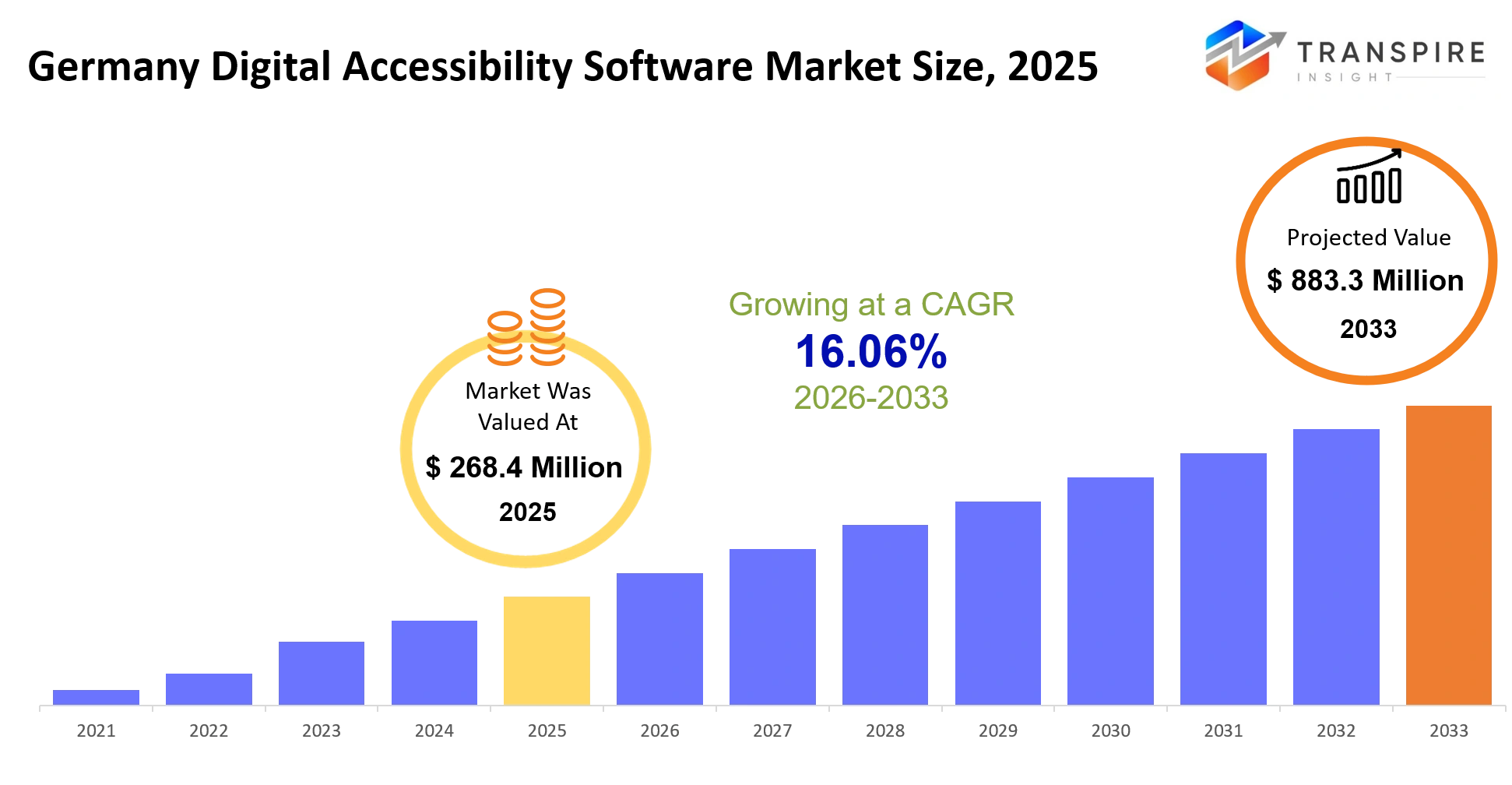
As per Transpire Insight Analysis the Germany Digital Accessibility Software Market size is estimated at USD 268.4 Million in 2025 and is anticipated to reach USD 883.3 Million by 2033, growing at a CAGR of 16.06% from 2026 to 2033.
The Germany Digital Accessibility Software Market helps organizations make websites, mobile apps , digital documents, and even enterprise platforms easier for people with disabilities to use, while still aligning with legal accessibility requirements. In practice, companies, government bodies, healthcare providers, schools and universities, plus retail brands depend on these tools to spot usability barriers, track accessibility health over time, run automated compliance checks, and raise overall user experience across several digital channels. Accessibility software has sort of become a must have in digital transformation, not some optional, box ticking compliance activity.
In the last five years, the market has moved away from one off accessibility audits , and gone toward continuous monitoring powered by cloud platforms and AI assisted testing. The rollout of the European Accessibility Act (EAA), along with tighter enforcement of accessibility rules, boosted enterprise spending across Germany. At the same time, the fast growth of digital public services and online shopping after the COVID-19 pandemic revealed accessibility holes, so many organizations decided to modernize their digital platforms. Put together, regulatory compliance pressure and customer experience goals have increased software adoption, supported recurring subscription income, and pushed vendors to embed accessibility straight into software engineering routines and content management processes, not just in late stage reviews.
Germany Digital Accessibility Software Market Size & Forecast:
- Germany Digital Accessibility Software Market Size 2025: USD 268.4 Million
- Expected Market Value 2033: USD 883.3 Million
- Forecast CAGR: 16.06%
- Key Profile: Level Access, AudioEye, Siteimprove, UserWay, Deque Systems, TPGi, accessiBe, Adobe, Microsoft, IBM, Crownpeak, DubBot, Silktide, EqualWeb, Monsido.
Key Market Insights
- In 2025, Western Germany seems to dominate the Germany Digital Accessibility Software Market, roughly at 44–46% market share , with that push coming from a dense cluster of enterprise headquarters, government offices, and tech providers.
- Meanwhile, Eastern Germany should become the fastest moving regional market during 2026–2033, mainly fueled by public-sector digitization initiatives, larger technology budgets, and the ongoing modernization of school and hospital infrastructure, in a pretty measurable way.
- On the product side, Accessibility Testing Software is still in front, holding about 31% market share in 2025, since many enterprises are trying to automate WCAG compliance checks across the whole software development lifecycle.
- Accessibility Monitoring Tools sit as the second largest segment , and Compliance Management Software is expected to clock the quickest expansion through 2033, as organizations adopt continuous regulatory reporting capabilities—basically, keep up all the time, not just once.
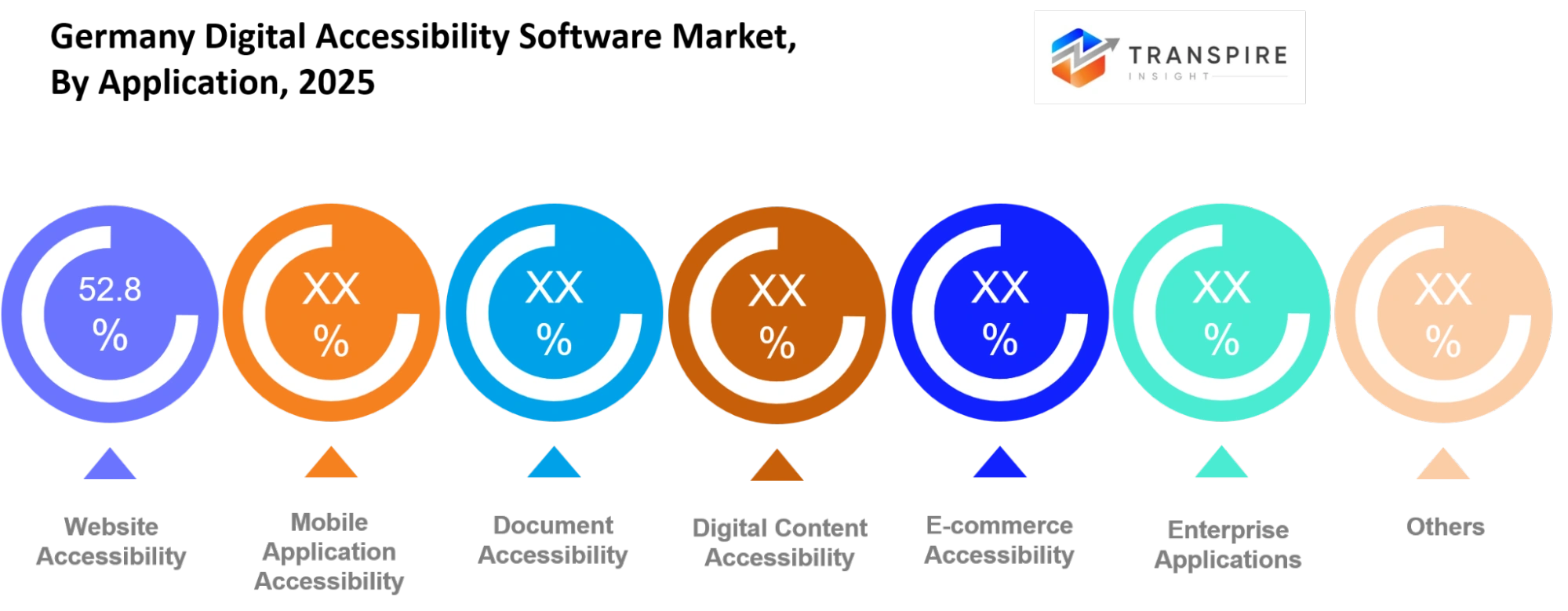
- When you look at applications, Website Accessibility stays the main revenue driver , bringing in nearly 38% of total revenue in 2025. Mobile Application Accessibility is seeing the most momentum though, because mobile-first digital services keep getting bigger.
- By customer type , large enterprises account for around 48% of market revenue , backed by wide digital footprints and enterprise-wide accessibility governance.
- SMEs are getting bigger quick, like the fastest-growing audience bit, partly because cloud-based subscription solutions make it easier to join in , less barrier and all.
- And yea, last but not least, Government , BFSI, and Healthcare still stay the major end-user sectors, because accessibility requirements, secure digital service delivery ,and inclusive citizen involvement keep needing continual compliance handling.
What are the Key Drivers, Restraints, and Opportunities in the Germany Digital Accessibility Software Market?
The strongest force supporting market expansion is basically the implementation of the European Accessibility Act (EAA), which means it pushes many digital products and services to meet standardized accessibility requirements by 2025. This regulatory milestone has, kind of quietly encouraged organizations across Germany to move from occasional compliance audits toward continuous accessibility management and yes it is a real shift. Financial institutions, retailers, healthcare providers,and public sector organizations now increasingly weave accessibility testing into software development and digital content publishing, so they can reduce legal exposure and also expand customer reach in practice.
Still, the most significant barrier remains the complexity of integrating accessibility solutions into legacy IT environments. A lot of organizations run websites, enterprise applications, and document management systems that were built across several years, with different technologies. Retrofitting these platforms often calls for extensive code modifications, manual remediation, accessibility audits,and additional employee training before any software can actually deliver measurable compliance benefits. This structural challenge tends to raise implementation costs, stretch deployment timelines, and postpone purchasing decisions, especially among small and medium-sized enterprises that have limited technical resources and more restricted budgets for digital transformation.
Meanwhile , artificial intelligence is creating the next stage of market expansion by enabling automated accessibility detection, content remediation, and real-time compliance monitoring across huge digital ecosystems. Modern AI models can spot accessibility barriers, suggest code improvements, create alternative image descriptions,and keep watching changing web content with more efficiency than manual reviews ever could.
What Has the Impact of Artificial Intelligence Been on the Germany Digital Accessibility Software Market?
Artificial intelligence is transforming the Germany Digital Accessibility Software Market, mostly by automating accessibility testing, compliance monitoring, and digital content remediation across the full software development lifecycle. Most newer platforms use AI to scan websites, mobile applications, PDFs, and enterprise systems for violations of WCAG and EN 301 549, and then development teams can spot problems earlier, before anything goes live. With automated code recommendations, image alternative text generation, caption creation, and document tagging, a lot of manual review work gets reduced, yet somehow compliance keeps speeding up across broader digital catalogs.
Machine learning then adds a kind of predictive edge by learning recurring accessibility defects that show up in development pipelines. These models can kinda point at high risk components, forecast compliance gaps after software updates, and toss out corrective actions before accessibility troubles spill over to end users. When AI is stitched into DevOps and the CI/CD workflows it backs continuous monitoring, which often improves release quality, reduces remediation costs, and shortens the whole testing cycle. In practice, teams may see faster regulatory compliance, a smoother user experience, stronger development productivity, and more consistent accessibility results across public sites as well as enterprise applications .
Still, there are limits and adoption is not fully smooth. Automated accessibility tools can’t really judge every usability concern, especially things that need human insight like content clarity, navigation logic, reading order, and contextual understanding for screen reader users.
Key Market Trends
- Since 2023 enterprises have kinda shifted away from annual accessibility audits into continuous monitoring platforms, which basically allows real time compliance tracking and cuts remediation time by 30–40% across big digital portfolios.
- After the European Accessibility Act (EAA) rolled out in 2025, organizations across BFSI, retail, healthcare, and government have sped up investment into accessibility software so they can stay regulatory compliant and minimize legal risks, or at least that was the idea.
- The AI-powered capabilities from vendors like Level Access, Deque Systems, Siteimprove, and AudioEye have moved beyond simple issue detection, now they push automated code suggestions , alt-text generation and even more “smart” accessibility reporting.
- Cloud-native deployment has also become the more preferred implementation model since 2022, with enterprises adding accessibility testing right into DevOps and CI/CD pipelines, to boost release quality and shorten development cycles.
- Digital commerce platforms increased accessibility spend too, because online retailers are prioritizing inclusive customer experiences, mobile-first shopping, and compliance for those ever expanding digital product catalogs.
- And honestly accessibility management has gone from IT only initiatives to enterprise-wide governance, where legal, compliance , marketing, and development folks coordinate through centralized reporting dashboards and workflow automation, which sounds nice in theory but works out in practice.
- Meanwhile, large software vendors including Microsoft, Adobe, and IBM strengthened accessibility capabilities inside productivity, content management , and enterprise development ecosystems, so teams rely less on disconnected third-party tools, and the whole workflow feels more continuous.
Germany Digital Accessibility Software Market Segmentation
By Component
Accessibility Testing Software will remain a major component segment as organizations use automated testing platforms to spot website, application, and document accessibility concerns against standards like WCAG and EN 301 549. Accessibility Monitoring Tools will back up ongoing compliance by tracking digital assets after updates, and then discovering fresh accessibility blockers. Screen Reader Software and Accessibility Widgets will help with better digital experiences, for people who have visual, cognitive, or physical disabilities. Compliance Management Software will see wider uptake because enterprises need centralized reporting, audit paperwork, and regulatory follow-up.
Services will keep on supporting rollout , consulting, training, and accessibility audits, especially where organizations have complicated digital environments. Other solutions may cover specialized tools for remediation, testing integrations, plus developer enablement platforms. Big enterprises will continue funding a full accessibility ecosystem, and while SMEs will lean more and more toward software-as-a-service options that trim deployment costs, and lower the technical load.
By Deployment
Cloud-Based deployment will probably hold a big role, like, organizations do seem to prefer scalable accessibility platforms that can handle multiple websites, applications and digital documents, all tied together via a centralized dashboard. Meanwhile On-Premise solutions will keep helping groups that have really strict data security rules, especially government bodies and other regulated industries. Hybrid deployment models will fit enterprises that want both the cloud’s flexibility and also the local, on site infrastructure control.
SaaS solutions should see strong adoption too, since subscription models tend to make automated testing, monitoring, and compliance reporting feel more affordable and easy to access. Private Cloud deployments will draw in organizations that need security controls that are more tailored, while Public Cloud platforms will shine because they’re quicker to set up and usually cheaper to maintain. There are also other deployment options, sort of niche ways, for cases where organizations need a specialized accessibility management environment.
By Application
Website Accessibility looks like the biggest application area, because businesses, government agencies, and service providers put more focus on online platforms that are reachable by everyone. In practice organizations use accessibility software to spot wayfinding or navigation problems, tune up content legibility, enhance screen reader compatibility, and also satisfy regulatory obligations. Mobile Application Accessibility will likely grow too as smartphone based services become the main thing in banking, health care, retail, and public services.
Document Accessibility will pick up momentum when organizations are handling huge streams of digital files, like PDFs, written reports, and learning materials. Digital Content Accessibility supports accessible multimedia, online education assets, and internal enterprise communication spaces. E-commerce Accessibility should expand as online sellers lean into inclusive shopping experiences, and not just “nice to have” compliance. Enterprise Applications are starting to adopt accessibility solutions to make internal software easier to use , while other applications will tackle niche digital accessibility needs that are kind of different from the rest.
By End User
Government organizations are still likely to be one big end-user group , especially since public institutions are facing strict obligations around accessability for citizen-facing websites, applications and other digital services. In the BFSI space, companies will keep adopting accessibility software to maintain more inclusive banking platforms, and to keep online transactions secure, also making customer communication compliant. Healthcare providers will speed up adoption too, mainly because digital health services are expanding, along with patient portals and electronic information systems.
Meanwhile Education institutions are probably going to rely on accessibility solutions for online learning platforms, digital classrooms, and for educational content management. Retail companies will put more money into accessibility tools to make online shopping feel smoother, and so they can reach broader customer groups. IT and Telecom organizations tend to integrate accessibility directly into software products and digital services. Media and Entertainment firms will emphasize accessible streaming, digital publishing, and multimedia content.Other sectors, in general, will adopt accessibility platforms more slowly but steadily, as digital compliance obligations continue to grow.
By Enterprise Size
Large Enterprises will keep taking up a big chunk of the market, because there’s this extensive digital infrastructure stuff, complex software environments, and yeah, compliance requirements that are stronger than in other segments. These orgs really need enterprise grade accessibility platforms that can handle multiple departments , many applications, and global digital assets. Medium Enterprises are going to lean more and more into cloud based accessibility solutions because these platforms offer scalable features, without the kind of infrastructure investment that hits you hard.
Small Enterprises and SMEs should become a meaningful growth area too, mainly since affordable SaaS accessibility platforms lower the technical hurdles and make compliance management feel a lot simpler. Startups may bring in accessibility tools earlier, like in the product development stages, to build inclusive digital products from the start and skip expensive rework later. The other enterprise categories will likely go for specialized accessibility solutions, depending on industry specific needs and their digital service models.
What are the Key Use Cases Driving the Germany Digital Accessibility Software Market?
Website accessibility still feels like the main driver behind adoption. Organizations across government, BFSI, healthcare, and retail sectors are trying to make sure their digital platforms line up with accessibility standards, even when it gets a bit messy. To do that, many businesses rely on automated testing and monitoring, not just once but pretty much continuously, to spot friction points like awkward navigation, screen reader gaps, content structure issues, and problems with how people interact with pages. On top of that, regulatory pressure under the European Accessibility Act has pushed continuous web compliance management higher up the list for teams running customer facing digital services, so it doesn’t end up being a one time effort.
Mobile application accessibility and document accessibility are also getting more attention lately, especially among financial institutions, healthcare providers, and educational organizations. As digital services keep migrating to smartphones and online platforms, they’re paying closer attention to usable experiences across apps and to files too. Banks are working on more inclusive mobile banking journeys, while healthcare providers are tuning patient portals and digital medical information systems so they’re easier to use for a broader range of people.
Some newer use cases are starting to show up as well, like AI powered accessibility remediation, accessibility analytics, and developer focused compliance tools that get plugged into existing software development workflows. These ideas are catching on with technology companies and larger enterprises who want quicker accessibility improvements, automated reporting that doesn’t slow teams down, and scalable compliance management as their digital ecosystems keep expanding.
|
Report Metrics |
Details |
|
Market size value in 2025 |
USD 268.4 Million |
|
Market size value in 2026 |
USD 311.5 Million |
|
Revenue forecast in 2033 |
USD 883.3 Million |
|
Growth rate |
CAGR of 16.06% from 2026 to 2033 |
|
Base year |
2025 |
|
Historical data |
2021 - 2024 |
|
Forecast period |
2026 - 2033 |
|
Report coverage |
Revenue forecast, competitive landscape, growth factors, and trends |
|
Regional scope |
Germany |
|
Key company profiled |
Level Access, AudioEye, Siteimprove, UserWay, Deque Systems, TPGi, accessiBe, Adobe, Microsoft, IBM, Crownpeak, DubBot, Silktide, EqualWeb, Monsido. |
|
Customization scope |
Free report customization (country, regional & segment scope). Avail customized purchase options to meet your exact research needs. |
|
Report Segmentation |
By Component (Accessibility Testing Software, Accessibility Monitoring Tools, Screen Reader Software, Accessibility Widgets, Compliance Management Software, Services, Others); By Deployment (Cloud-Based, On-Premise, Hybrid, SaaS, Private Cloud, Public Cloud, Others); By Application (Website Accessibility, Mobile Application Accessibility, Document Accessibility, Digital Content Accessibility, E-commerce Accessibility, Enterprise Applications, Others); By End User (Government, BFSI, Healthcare, Education, Retail, IT & Telecom, Media & Entertainment, Others); By Enterprise Size (Large Enterprises, Medium Enterprises, Small Enterprises, SMEs, Startups, Others). |
Which Regions are Driving the Germany Digital Accessibility Software Market Growth?
Western Germany right now basically acts as the leading region in the Germany Digital Accessibility Software Market, largely because you have this dense mix of corporate headquarters , government bodies, technology firms, and also regulated industries all in one place. In cities like Frankfurt, Düsseldorf, Cologne, and Stuttgart , there are big operations tied to BFSI, automotive, and enterprise technology, and those teams tend to need more advanced accessibility compliance tools. On top of that , the area has fairly mature digital infrastructure. There is also a higher tendency to adopt cloud based enterprise software, and private plus public organizations keep pushing stronger implementation of accessibility standards , so overall the region stays ahead.
Southern Germany also contributes a lot, mainly due to its technology powered economy, real industrial strength, and the fact that digital transformation keeps getting funded. Bavaria and Baden-Württemberg continue to see strong demand from manufacturing companies, healthcare organizations, research institutions, and tech enterprises that actually need accessible digital systems for both employees and customers. And it’s a bit different from Western Germany, which leans more on corporate and financial services. Here the growth is more driven by innovation hubs, software development efforts, and industrial digitalization programs. With steady enterprise spending and ongoing modernization of business applications, Southern Germany feels like a dependable source for accessibility software revenue.
Eastern Germany is expected to show the fastest growth momentum during the 2026–2033 forecast period, as public sector modernization speeds up and digital public service expansion gains traction. Regional governments, educational institutions, and healthcare providers are investing in accessible digital platforms to improve how services get delivered and to meet changing European regulatory requirements.
Who are the Key Players in the Germany Digital Accessibility Software Market and How Do They Compete?
The Germany Digital Accessibility Software Market stays kind of moderately competitive, where global accessibility specialists and big technology firms push against each other using automation abilities, compliance know-how, integration help, and yes, that enterprise scalability factor. Over time, the fight is moving away from simple accessibility scanning and it’s more like AI assisted testing, continuous monitoring, developer integrations, and centralized governance platforms. Meanwhile, the more established vendors are basically guarding their spot by expanding product lines , while the smaller but specialized providers are picking up momentum by delivering highly focused accessibility options for websites, applications, and digital content management.
Level Access competes by leaning into enterprise accessibility management, and they bring together automated testing tools, expert audits, training programs, and compliance consulting. They sort of stand out with end-to-end accessibility programs aimed at big organizations handling complicated digital ecosystems, the whole maze thing. Deque Systems leans heavily on developer-driven accessibility testing, mainly through platforms like axe, so it can plug into software development workflows. Their advantage is that accessibility checks get embedded early in the development lifecycle, and that helps customers lower the overall remediation costs.
Siteimprove meanwhile pushes forward via website quality management, accessibility monitoring, and content optimization features, all tied into broader digital experience solutions. AudioEye differentiates with AI powered accessibility automation, but then also pairs it with expert remediation services, so it feels tailored for businesses that want scalable compliance backing. Adobe and Microsoft also keep tightening competition by building accessibility features across content creation tools, productivity platforms, and enterprise software ecosystems.
Company List
- Level Access
- AudioEye
- Siteimprove
- UserWay
- Deque Systems
- TPGi
- accessiBe
- Adobe
- Microsoft
- IBM
- Crownpeak
- DubBot
- Silktide
- EqualWeb
- Monsido
Recent Development News
"In September 2025, AudioEye entered a partnership with Creode to expand digital accessibility services across Europe. The collaboration integrated AudioEye’s automated accessibility platform, expert audits, and remediation capabilities into Creode’s digital services, helping financial and enterprise organizations address European Accessibility Act compliance requirements.
Source: https://www.audioeye.com/post/audioeye-announces-partnership-with-creode-to-advance-accessibility-compliance-in-europe/ (AudioEye)."
"In February 2025, Deque Systems launched new AI-driven capabilities for its axe accessibility platform. The product enhancement introduced AI-assisted testing, advanced accessibility rules, intelligent guided testing, and AI-supported developer tools to increase test coverage and reduce manual accessibility testing efforts for software teams.
Source: https://www.deque.com/blog/advancing-ai-for-axe-the-next-leap-in-digital-accessibility/ (Deque Systems)."
"In October 2025, Level Access launched new AI Agents designed to advance automated digital accessibility management. The technology introduced AI-powered capabilities for accessibility workflows, helping organizations improve issue identification, remediation processes, and compliance management across complex digital environments.
Source: https://www.levelaccess.com/news/ (Level Access)."
What Strategic Insights Define the Future of the Germany Digital Accessibility Software Market?
Germany’s Digital Accessibility Software Market is kind of moving, structurally speaking, toward continuous accessibility management, where automated testing , AI-assisted remediation, and built-in compliance tools become usual parts of enterprise digital development. The main driver of that shift is the move away from projects that are mostly regulatory-driven toward ongoing accessibility governance across websites, applications, documents, and other digital platforms. In practice, organizations will more and more prefer integrated solutions that link accessibility monitoring with software development, content management, and enterprise compliance systems, so they don’t have to stitch everything together by hand.
One less-obvious risk is how dependent the market can become on changing accessibility regulations, because if enforcement timelines move, or if implementation ends up uneven across industries, investment decisions could get delayed. Another challenge is that advanced capabilities are getting concentrated among bigger technology providers, which can turn into a real barrier for smaller, specialized vendors
The emerging opportunity is basically AI-powered accessibility agents that can spot issues automatically, rank them by priority, and suggest fixes across complicated digital environments. Market participants should put money into AI integration, platforms that developers can actually use without pain, and strategic partnerships with enterprise software providers , to catch future growth through 2033 and improve their competitive position.
Germany Digital Accessibility Software Market Report Segmentation
By Component
- Accessibility Testing Software
- Accessibility Monitoring Tools
- Screen Reader Software
- Accessibility Widgets
- Compliance Management Software
- Services
- Others
By Deployment
- Cloud-Based
- On-Premise
- Hybrid
- SaaS
- Private Cloud
- Public Cloud
- Others
By Application
- Website Accessibility
- Mobile Application Accessibility
- Document Accessibility
- Digital Content Accessibility
- E-commerce Accessibility
- Enterprise Applications
- Others
By End User
- Government
- BFSI
- Healthcare
- Education
- Retail
- IT & Telecom
- Media & Entertainment
- Others
By Enterprise Size
- Large Enterprises
- Medium Enterprises
- Small Enterprises
- SMEs
- Startups
- Others
Frequently Asked Questions
Find quick answers to common questions.
The expected Germany Digital Accessibility Software Market size for the market will be USD 883.3 Million in 2033.
Key segments for the Germany Digital Accessibility Software Market are By Component (Accessibility Testing Software, Accessibility Monitoring Tools, Screen Reader Software, Accessibility Widgets, Compliance Management Software, Services, Others); By Deployment (Cloud-Based, On-Premise, Hybrid, SaaS, Private Cloud, Public Cloud, Others); By Application (Website Accessibility, Mobile Application Accessibility, Document Accessibility, Digital Content Accessibility, E-commerce Accessibility, Enterprise Applications, Others); By End User (Government, BFSI, Healthcare, Education, Retail, IT & Telecom, Media & Entertainment, Others); By Enterprise Size (Large Enterprises, Medium Enterprises, Small Enterprises, SMEs, Startups, Others).
Major Germany Digital Accessibility Software Market players are Level Access, AudioEye, Siteimprove, UserWay, Deque Systems, TPGi, accessiBe, Adobe, Microsoft, IBM, Crownpeak, DubBot, Silktide, EqualWeb, Monsido.
The Germany Digital Accessibility Software Market size is USD 268.4 Million in 2025.
The Germany Digital Accessibility Software Market CAGR is 16.06% from 2026 to 2033.
- Level Access
- AudioEye
- Siteimprove
- UserWay
- Deque Systems
- TPGi
- accessiBe
- Adobe
- Microsoft
- IBM
- Crownpeak
- DubBot
- Silktide
- EqualWeb
- Monsido
About the Authors

Mayur Shinde
I am Mayur Shinde, a Senior Research Analyst at Transpire Insight, specializing in the Automotive & Transportation and Information & Communication Technology (ICT) Industry. My work focuses on analyzing emerging market trends, technological advancements, competitive landscapes, and industry developments to deliver accurate, data-driven insights. I am passionate about transforming complex market information into clear, actionable content that helps businesses, professionals, and decision-makers stay informed and make confident strategic decisions.

Chakradhar Khansole
Chakradhar serves as the Research Director at Transpire Insight, bringing over 8 years of experience in technology, innovation, and strategic market intelligence. He specializes in transforming complex market data into actionable business insights that enable organizations to make informed, growth-oriented decisions. Recognized for his strategic vision and analytical expertise, Chakradhar leads high-impact research initiatives, delivering comprehensive market assessments, competitive intelligence, and forward-looking industry analysis.
Recently Published Reports
-
Apr 2026
3D Optical Profiler Market
3D Optical Profiler Market Size, Share & Analysis Report By Type (Desktop 3D Optical Profiler, and Portable 3D Optical Profiler), By Technology (Confocal Technology, and White Light Interference), By End-Use Industry (Manufacturing, Research Institutions, Automotive, Aerospace and Defense, Medical Devices, and Other), and Geography (North America, Europe, Asia-Pacific, Middle East and Africa, South and Central America), 2021 - 2031
-
Apr 2026
Depth Sensor Market
Depth Sensor Market Size, Share & Analysis Report By Type (Infrared Depth Sensors, Time-of-Flight (ToF) Sensors, Stereo Vision Sensors, Structured Light Sensors, Ultrasonic Depth Sensors), By Application (Automotive, Robotics, Gaming, Consumer Electronics, Industrial Automation, Healthcare, Security & Surveillance, Others), By End Users (Automotive Manufacturers, Consumer Electronics Companies, Healthcare Providers, Industrial Companies, Security Agencies, Gaming Companies, Robotics Companies, Others), and Geography (North America, Europe, Asia-Pacific, Middle East and Africa, South and Central America), 2021 – 2031
-
Apr 2026
Digital Manufacturing Market
Digital Manufacturing Market Size, Share & Analysis Report By Component (Hardware, Software, and Services), By Technology (Robotics, 3D Printing, Internet of Things (IoT), and Others), By Application (Automotive and Transportation, Aerospace and Defense, Consumer Electronics, Industrial Machinery, and Others), By Process Type (Computer-Based Designing, Computer-Based Simulation, Computer 3D Visualization, Analytics, and Others), and Geography (North America, Europe, Asia-Pacific, Middle East and Africa, South and Central America), 2021 – 2031
-
Apr 2026
Digital Visa Services Market
Digital Visa Services Market Size, Share & Analysis Report By Type (Individual Travelers, Group Travelers), By Application (Tourism, Business Travel, Others), and Geography (North America, Europe, Asia-Pacific, Middle East and Africa, South and Central America), 2021 – 2031