

Germany Business Valuation Service Market Summary
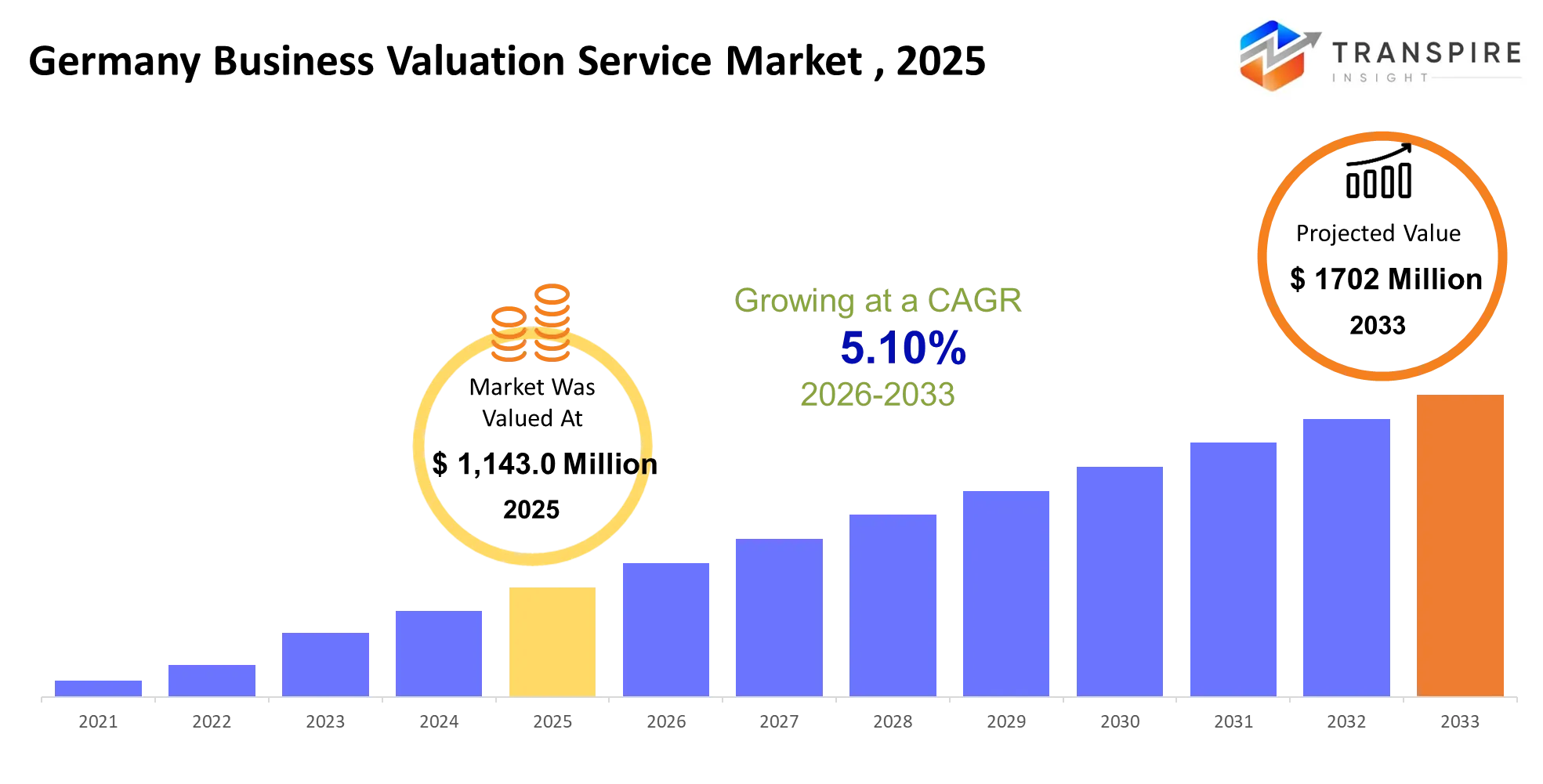
As per Transpire Insight Analysis the Germany Business Valuation Service Market size is estimated at USD 1,143.0 Million in 2025 and is anticipated to reach USD 1702 Million by 2033, growing at a CAGR of 5.10%from 2026 to 2033.
Germany's Business Valuation Service Market, plays a pretty critical role in aiding companies, investors, lenders and also legal institutions to pin down what the businesses are really worth economically , especially when it comes to mergers , acquisitions, restructuring, taxation, litigation, financial reporting and succession planning. When valuation is done well it helps decision making feel less foggy, it also improves transaction transparency , across Germany industrial, technology, healthcare and manufacturing environments. Over the last five years, you can see a noticeable move away from the classic valuation approaches, toward more data-driven digital valuation platforms that bring in real time financial analytics and scenario modeling, almost like a continuous pulse. This shift got a lot faster after the COVID-19 pandemic, since earnings got disrupted and then a wave of restructuring showed up, plus private equity deals, and even cross-border acquisitions. Since deal complexity keeps growing and regulatory scrutiny does not really relax, many organizations start working with specialist valuation firms much earlier in the deal process. In the end this supports more recurring advisory revenue, while also growing the appetite for industry focused valuation know how and for technology enabled financial assessment services.
Germany Business Valuation Service Market Size & Forecast:
- Germany Business Valuation Service Market Size 2025: USD 1,143.0 Million
- Expected Market Value 2033: USD 1702 Million
- Forecast CAGR: 5.10%
- Leading region in 2025:Southern Germany
- Fastest Growing region:Eastern Germany
- Key Profile: Deloitte, PwC, EY, KPMG, BDO, Grant Thornton, RSM International, Duff & Phelps (Kroll), Houlihan Lokey, Alvarez & Marsal, Baker Tilly, Crowe, CBIZ, FTI Consulting, Mercer Capital
Key Market Insights
- Southern Germany is basically dominating the Germany Business Valuation Service Market, with an estimated 36% share in 2025—mainly because Bavaria has so many automotive, industrial, and technology companies. It’s like, the regional engine stays strong.
- Eastern Germany should end up showing the fastest growth all the way through 2033, kind of pushed forward by startup funding, renewable energy initiatives, and innovation clusters that keep getting bigger, and more connected.
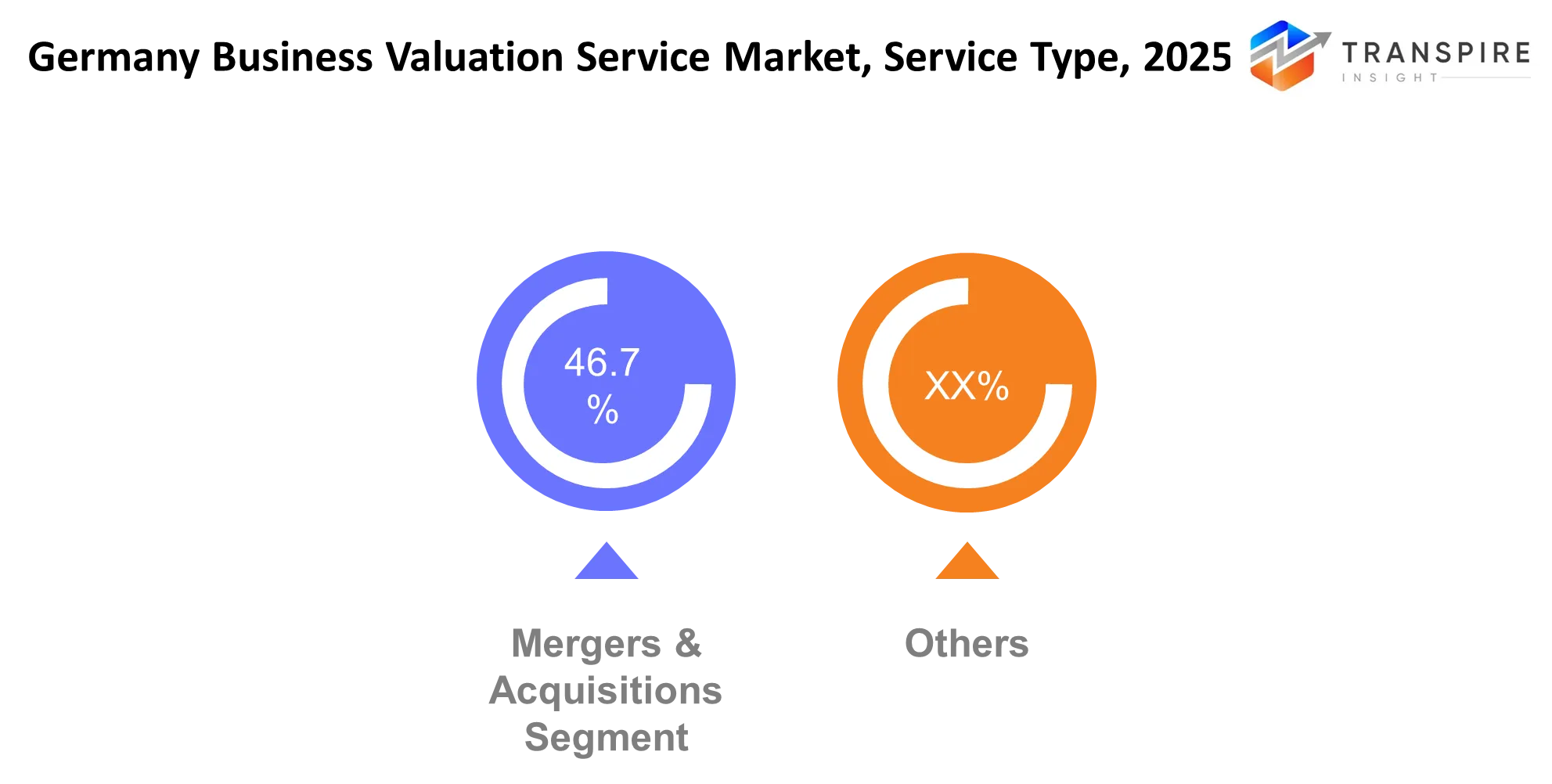
- When it comes to what clients actually buy, Mergers & acquisitions valuation leads the service side with around 39% market share, and that lines up with the ongoing corporate consolidation happening across manufacturing and technology.
- Financial reporting and tax valuation comes next as the second biggest segment, at nearly 28%, and it’s supported by IFRS compliance plus the usual regulatory reporting expectations.
- Litigation and dispute valuation is forecast to grow fastest through 2033, since commercial arbitration and shareholder disagreements are becoming more and more complicated.
- By company size, large enterprises make up about 58% of engagements, while mid-sized companies are quickly ramping up their use of external advisory support, more than before.
- On the application side, private equity and corporate finance is still the front runner, taking roughly 35% market share, backed by active investment deals.
- Firms like Deloitte, PwC, EY, KPMG, Kroll, and Houlihan Lokey keep reinforcing their positions using AI-enabled valuation platforms, sector-focused advisory groups, and cross-border transaction know-how.
- The better players are also rolling in cloud analytics, automated financial modeling, and ESG valuation frameworks, which shorten project timelines by something like 20–30% vs the older manual workflows.
- And strategic partnerships with technology providers, plus deeper expansion into Germany’s Mittelstand advisory ecosystem, are helping keep clients longer and grow recurring consulting income.
What are the Key Drivers, Restraints, and Opportunities in theGermany Business Valuation Service Market?
Driver: The strongest growth catalyst is, sort of the continued expansion of mergers, acquisitions, private equity investments and also corporate restructuring across Germany’s industrial economy. There has been higher interest in strategic acquisitions after supply chain re alignment and post pandemic business restructuring, which has noticeably raised the number of valuation engagements. Meanwhile, tighter financial reporting rules, tougher tax compliance requirements, and independent fairness opinions mean companies must get professional valuation services. So these moves create more recurring revenue opportunities for advisory firms while also stretching demand for sector specific valuation know how.
Restraint: A big structural problem is that there is a shortage of experienced valuation professionals who can judge increasingly complicated businesses. Especially the ones with intangible assets, intellectual property, ESG related risks, and digital business models. Developing that expertise takes years, of financial, legal, and industry experience, which makes workforce expansion hard. Even smaller advisory firms run into expensive hurdles too, like high investment costs for advanced valuation software and data platforms. Because of that, project timelines stretch out, service costs climb, and overall market penetration becomes limited among smaller enterprises.
Opportunity: Artificial intelligence along with advanced financial analytics and ESG centered valuation methodologies are likely to drive the next phase of market expansion. German companies are more often including sustainability performance, climate related risks, and digital assets directly in corporate valuations. Investing in AI supported financial modeling lets advisory firms work through bigger datasets, test various deal scenarios, and improve consistency in valuation work.
What Has the Impact of Artificial Intelligence Been on theGermany Business Valuation Service Market?
Artificial intelligence and advanced analytics have, if anything, improved business valuation services across Germany quite a lot in terms of efficiency and accuracy. Advisory firms now use AI to automate the extracting of financial statements, normalize past accounting records, spot unusual patterns , and draft preliminary valuation models within hours not days. Then machine learning algorithms chew through comparable transactions, industry multiples, macroeconomic signals, and the company’s own financial results to help keep valuation outputs more consistent. Predictive analytics also lets consultants forecast future cash flows, weigh operational risks, and run several economic storylines at once, so investors can judge acquisition opportunities with more confidence. At the same time cloud based collaboration tools and robotic process automation have shortened the engagement length, cut down on manual processing, and made audit documentation cleaner, while still supporting compliance with the changing rules for financial reporting standards.
AI powered forecasting moreover supports strategic planning, for example by highlighting revenue trends, estimating market volatility, and gauging what happens if interest rates move or if regulatory policies shift. These options, in practice, raise the quality of decisions for mergers and acquisitions, restructuring, and investment deals. Still, the broader uptake is slowed by high implementation costs, strict data privacy obligations, and the fact that standardized financial datasets are not always available for privately held companies. Because of that, human expertise stays really necessary for interpreting qualitative factors, checking whether assumptions hold, and making sure professional judgment is applied in complicated valuation cases.
Key Market Trends
- Between 2021 and 2025, AI-assisted financial modeling managed to shave off a bout 25% of the manual valuation prep time , which in turn helped projects move faster across the major advisory firms and well, you know, keeps everything on schedule a bit better.
- After 2022, ESG valuation frameworks started getting stitched into everyday work, with Deloitte, EY, and PwC rolling out sustainability-linked valuation approaches for corporate deals more and more.
- In the meantime cross-border M&A advisory also tilted toward tech, healthcare, and renewable energy sectors, basically mirroring how investment attention in Germany’s industrial economy was changing, bit by bit, rather than staying put.
- Cloud-based collaboration platforms have been replacing spreadsheet-driven workflows more often, allowing valuation teams to boost productivity somewhere around 20–30% and still keep engagements secure even when remote , which is kind of the big deal.
- From 2023 to 2026 , private equity firms leaned harder on valuation specialists who actually know the industry, especially when the target is digital operations or companies heavy on intellectual property and that kind of intangible asset stuff.
- Financial reporting reforms nudged companies toward automated valuation documentation, so audits and regulatory reviews across listed companies felt more consistent and less scattered, overall.
- Advisory firms also started partnering more frequently with fintech and analytics providers to improve predictive modeling abilities , and to speed up those more complicated transaction assessments.
- The competition, meanwhile, moved away from pure pricing and toward tech differentiation, with Kroll, Houlihan Lokey, Deloitte, PwC, and KPMG putting money into AI-driven valuation platforms plus sector knowledge.
- Mid-sized German enterprises increasingly outsourced independent valuations as succession planning and shareholder restructuring picked up across the Mittelstand, so the demand wasn’t just theoretical.
- And now clients seem to want scenario-focused valuation models that actually include inflation , geopolitical risk, and interest rate sensitivity, so advanced analytics becomes the competitive edge, almost like a default expectation.
Germany Business Valuation Service Market Segmentation
By Service Type
Business valuation stays kind of the base of advisory work, because a dependable company valuation helps support mergers, acquisitions, financing, and even succession planning, plus those strategic business calls that come up all the time. After that, financial due diligence usually comes next, by reviewing records, spotting risks, and confirming how the business is really performing, before someone moves forward on an investment or acquisition. Asset valuation meanwhile is centered on physical things like real property, machinery, equipment, and inventory, to get a fair market value that makes sense across industrial and commercial markets. Intangible asset valuation then looks at patents, trademarks, software, customer relationships, and intellectual property, the stuff that can add real, meaningful business value even when it does not show up on a balance sheet right away.
Litigation support is also used for valuation analysis in commercial disputes, disagreements among shareholders, and court proceedings, especially when an independent financial assessment is expected. Fairness opinions give boards and investors a clearer view of whether the deal terms represent reasonable financial value, before the transaction gets locked in on major corporate matters. Other offerings often include insolvency advisory, tax related valuation, purchase price allocation, and restructuring assistance, all of which can reinforce financial decision making across a mix of industries.
By Enterprise Size
Large enterprises tend to represent the biggest share of valuation assignments because corporate takeovers, cross-border investments, financial reporting, and restructuring efforts need that detailed financial review, and well… it’s usually not optional. Medium enterprises often end up in need of valuation services when they’re pushing growth initiatives, handling ownership shifts, raising capital, or building strategic alliances, really. Small enterprises meanwhile increasingly use professional valuation support as they approach outside investors, lenders, or even for succession planning kinds of tasks, and that adds up. Startup businesses usually require valuation services so they can set an enterprise value before funding rounds start, and before the equity discussions get serious.
Meanwhile, the continuing growth of venture investment keeps fueling valuation engagements with innovative technology firms and early-stage businesses. Family-owned companies also lean on valuation experts during ownership transitions and estate planning. And then, other kinds of organizations, like cooperatives and nonprofit entities, bring in valuation specialists for financial disclosure, compliance related needs, and strategic plan support.
By Industry
BFSI shows up as a big, real source of valuation work, mostly because banks, insurers, and investment firms are constantly measuring business value while doing acquisitions, doing portfolio reviews, and handling regulatory reporting. Manufacturing also creates heavy demand through plant takeovers, equipment appraisal, and industrial re-structuring type initiatives. IT and software players tend to ask for a more specialized valuation approach, one that actually understands digital assets, intellectual property, and that recurring revenue pattern. Healthcare orgs in turn rely on valuation backing for hospital purchases, pharma investments, and med-technology deal activity.
Retail enterprises usually pursue valuation when they are scaling franchises, switching ownership, and running brand appraisal exercises. Energy and utilities companies typically need financial assessment for infrastructure spends, renewable projects, and regulated asset transfers. Then there are the remaining sectors, like logistics, telecom, education, and professional services, which keep growing valuation involvement as investment transactions turn out to be more niche and more particular each year.
By Application
Mergers and acquisitions still come out as the main application, because the success of each deal actually leans on accurate company valuation, before negotiations, and then again during final agreements. Taxation supports compliance in transfer pricing matters, inheritance planning, and corporate tax obligations through independent valuation reports, which makes it less “guessy” in practice. Financial reporting calls for periodic valuations, for impairment checks , purchase price allocation, and for staying aligned with accounting compliance under recognized reporting standards. Investment analysis also helps institutional investors and corporate buyers, when they are judging acquisition targets, plus long-term returns over time.
Bankruptcy and restructuring mandates are another big use, where creditors, administrators, and business owners need to pin down asset values during financial recovery or insolvency proceedings. Legal disputes tend to lean on independent valuation evidence, to untangle shareholder conflicts, commercial litigation, and contractual disagreements. Other uses include insurance claims, strategic planning, employee stock ownership plans, and internal corporate performance assessments, which people use for steering decisions.
By End User
Corporates are probably the biggest end user group because business expansion, restructuring, acquisitions and financial reporting all keep making new valuation demands, like nonstop in practice. Private equity firms lean on detailed valuation analysis before they invest, later during portfolio oversight and, of course, when they need a clean exit that actually works. Venture capital firms look at startup promise by using financial modeling plus growth projections before they even decide to place the investment capital. Government agencies often commission valuation services for taxation, privatization, public asset stewardship, and regulatory compliance type activities.
Financial institutions also want independent valuation reports when they’re approving loans, checking collateral, backing mergers, and dealing with investment portfolios. Other end users include law firms, accounting practices, family offices, nonprofit organizations, and institutional investors who want an objective financial assessment for strategic reasons as well as regulatory purposes.
What are the Key Use Cases Driving theGermany Business Valuation Service Market?
Corporate mergers and acquisitions pretty much take the biggest portion of valuation assignments, because buyers sellers and even the financial advisors all want an independent review before the deal is signed or maybe even before the transaction is fully completed. In practice manufacturing, automotive, industrial engineering and technology companies often run these valuation exercises to help with bargaining, financing decisions, plus regulatory reporting, while trying to keep the transaction risk low.
Meanwhile financial reporting and taxation keeps growing, especially across listed companies, financial institutions, and healthcare orgs. Since accounting standards ask for regular valuation of assets and entire business units, valuations become more routine over time. Private equity funds ,and venture capital backers as well, depend on valuation services to track how portfolios are doing, to back fundraising efforts, and to figure out exit paths later.
Newer use cases are showing up too, like valuation of intellectual property, software platforms, artificial intelligence enterprises ,and renewable energy assets. ESG-linked valuation frameworks are also getting noticeable traction, alongside digital asset assessments. That is partly because sustainability reporting, climate-related investments, and these tech-driven business models are becoming more important across Germany corporate landscape, not only for big groups but also for mid sized players.
|
Report Metrics |
Details |
|
Market size value in 2025 |
USD 1,143.0 Million |
|
Market size value in 2026 |
USD 1,200.0 Million |
|
Revenue forecast in 2033 |
USD 1702 Million |
|
Growth rate |
CAGR of 5.10%from 2026 to 2033 |
|
Base year |
2025 |
|
Historical data |
2021 - 2024 |
|
Forecast period |
2026 - 2033 |
|
Report coverage |
Revenue forecast, competitive landscape, growth factors, and trends |
|
Regional scope |
Germany |
|
Key company profiled |
Deloitte, PwC, EY, KPMG, BDO, Grant Thornton, RSM International, Duff & Phelps (Kroll), Houlihan Lokey, Alvarez & Marsal, Baker Tilly, Crowe, CBIZ, FTI Consulting, Mercer Capital |
|
Customization scope |
Free report customization (country, regional & segment scope). Avail customized purchase options to meet your exact research needs. |
|
Report Segmentation |
By Service Type (Business Valuation, Financial Due Diligence, Asset Valuation, Intangible Asset Valuation, Litigation Support, Fairness Opinions, Others); By Enterprise Size (Large Enterprises, Medium Enterprises, Small Enterprises, Startups, Others); By Industry (BFSI, Manufacturing, IT & Software, Healthcare, Retail, Energy & Utilities, Others); By Application (Mergers & Acquisitions, Taxation, Financial Reporting, Investment Analysis, Bankruptcy & Restructuring, Legal Disputes, Others); By End User (Corporates, Private Equity Firms, Venture Capital Firms, Government Agencies, Financial Institutions, Others) |
Which Regions are Driving theGermany Business Valuation Service Market Growth?
Southern Germany, especially Bavaria and Baden-Württemberg, has the largest slice of the market, because that region kind of holds most of Germanys automotive base along with industrial production, engineering strengths and technology headquarters. There is also this strong corporate ecosystem, which keeps feeding a steady flow of mergers, acquisitions, rearranging projects, and financial reporting work, and that stuff tends to call for independent valuation services. When you add stable corporate governance rules, well-developed financial institutions and active private equity players, it really locks in the requirement for solid valuation advisory. Big international consulting brands and niche financial advisors keep regional offices nearby, so you get this well knit professional web that supports long-term market leadership.
Western Germany, including North Rhine-Westphalia and Hesse, adds a fairly steady share thanks to mixed industries, international banking, and Frankfurt being Germany's main financial hub. Compared with Southern Germany where industrial deals lead the conversation, this area leans more on financial services, cross border investments, and capital market operations, which then translates into more regular valuation engagements. There are also strong expectations around regulatory compliance plus recurring financial reporting duties, so demand stays more predictable even when the overall economy wobbles. Corporate headquarters, institutional investors, and multinational companies continue supporting relatively stable advisory revenue, even if deal activity moves up and down.
Eastern Germany is expected to show the quickest growth across the 2026–2033 period, driven by semiconductor production, renewable energy funding, and technology startups spreading across Saxony, Saxony-Anhalt, and Thuringia.
Who are the Key Players in theGermany Business Valuation Service Market and How Do They Compete?
Competition is still pretty moderately consolidated, in the sense that the biggest global advisory houses take on the more complex cross border work, while the more specialized valuation firms are leaning on sector know how and a more transaction heavy style of advising. What tends to decide who wins isn’t really pricing only, but rather service quality, a clear industry focus, digital valuation platforms, and the ability to tap into wider international financial networks. At the same time the larger firms keep pushing ahead with AI assisted valuation models and more integrated due diligence capabilities, whereas the smaller boutique advisory players often try to stand out with more customized services and faster project execution, somehow it feels a bit more nimble.
So for Deloitte, PwC, and EY the pattern is to blend valuation with tax, audit, strategy, plus transaction advisory. Deloitte has expanded legal technology use and AI enabled workflows specifically within M&A advisory, to squeeze more transaction efficiency out of the process. PwC leans into integrated financial reporting and regulatory advisory, mainly for multinational corporations. EY meanwhile is doubling down on technology, industrial, and private equity transactions, it uses sector specific valuation methodologies that are supported by its strategy and transactions practice, sort of end to end.
Kroll stays more focused on independent valuation, restructuring, disputes, and risk advisory rather than broad audit services, which makes it appealing for engagements that are complicated and conflict sensitive. Houlihan Lokey tends to specialize in mid market and larger corporate transactions, and it offers detailed fairness opinions and restructuring expertise that typically attracts investment banks and private equity firms. Alvarez & Marsal differentiates through operational restructuring and performance improvement services, these include valuation alongside turnaround execution, which can create extra value during distressed transactions and corporate transformations, even when timelines are tight.
Company List
- Deloitte
• PwC
• EY
• KPMG - • BDO
• Grant Thornton
• RSM International
• Duff & Phelps (Kroll)
• Houlihan Lokey
• Alvarez & Marsal
• Baker Tilly
• Crowe
• CBIZ
• FTI Consulting
• Mercer Capital
Recent Development News
In April 2026, EY released its EY-Parthenon German Tech M&A Study 2025. The report highlighted a 28% increase in German technology M&A deal value during 2025, reinforcing demand for business valuation and transaction advisory services.https://www.ey.com/de_de/newsroom/2026/04/ey-parthenon-german-tech-m-a-study-2025 (EY).
In May 2026, Deloitte Legal presented its M&A Update 2026 webcast, highlighting expanded use of AI, legal technology, and advanced deal structuring in German transaction advisory. The initiative supports more efficient valuation and due diligence processes for corporate clients.https://www.deloittelegal.de/dl/en/services/legal/perspectives/m-a-update-2026.html (Deloitte).
In March 2026, Kroll published its Tax Insights Q1 2026 report introducing updated approaches for AI data center valuation and technology-driven tax appraisal. The publication strengthened Kroll's position in advanced valuation methodologies for emerging digital infrastructure assets.https://www.kroll.com/en/reports/tax/kroll-tax-insights-q1-2026 (Kroll).
What Strategic Insights Define the Future of theGermany Business Valuation Service Market?
The market seems to be shifting toward technology-enabled, data-heavy valuation that is backed by artificial intelligence, predictive analytics, and ESG-oriented financial review. Corporate deals are getting more complicated, because intangible assets , digital business models, and sustainability drivers make up a bigger slice of enterprise value. There’s also a more quiet risk, the kind that people don’t notice right away , the growing gap in seasoned valuation practitioners who can confirm increasingly advanced AI-created outputs while still satisfying changing regulatory demands.
At the same time, valuing artificial intelligence companies, renewable energy assets, and intellectual property is turning into a fresh opening, though it is still not fully used. Advisory firms that put money into in-house analytics platforms, bring in sector-specific talent, and build real ESG valuation know-how will probably be positioned to win higher-value mandates. For new entrants, it’s smart to focus on niche expertise and digital delivery methods, rather than mainly racing on price, so they can differentiate more cleanly in Germany’s sharpening, more specialized advisory environment.
Germany Business Valuation Service Market Report Segmentation
By Service Type
• Business Valuation
• Financial Due Diligence
• Asset Valuation
• Intangible Asset Valuation
• Litigation Support
• Fairness Opinions
• Others
By Enterprise Size
• Large Enterprises
• Medium Enterprises
• Small Enterprises
• Startups
• Others
By Industry
• BFSI
• Manufacturing
• IT & Software
• Healthcare
• Retail
• Energy & Utilities
• Others
By Application
• Mergers & Acquisitions
• Taxation
• Financial Reporting
• Investment Analysis
• Bankruptcy & Restructuring
• Legal Disputes
• Others
By End User
• Corporates
• Private Equity Firms
• Venture Capital Firms
• Government Agencies
• Financial Institutions
• Others
Frequently Asked Questions
Find quick answers to common questions.
The expected Germany Business Valuation Service Market size for the market will be USD 1702 Million in 2033.
Key segments for theGermany Business Valuation Service Market are By Service Type (Business Valuation, Financial Due Diligence, Asset Valuation, Intangible Asset Valuation, Litigation Support, Fairness Opinions, Others); By Enterprise Size (Large Enterprises, Medium Enterprises, Small Enterprises, Startups, Others); By Industry (BFSI, Manufacturing, IT & Software, Healthcare, Retail, Energy & Utilities, Others); By Application (Mergers & Acquisitions, Taxation, Financial Reporting, Investment Analysis, Bankruptcy & Restructuring, Legal Disputes, Others); By End User (Corporates, Private Equity Firms, Venture Capital Firms, Government Agencies, Financial Institutions, Others)
Major Germany Business Valuation Service Market players are Deloitte, PwC, EY, KPMG, BDO, Grant Thornton, RSM International, Duff & Phelps (Kroll), Houlihan Lokey, Alvarez & Marsal, Baker Tilly, Crowe, CBIZ, FTI Consulting, Mercer Capital
The Germany Business Valuation Service Market size is USD 1,143.0 Million in 2025.
The Germany Business Valuation Service Market CAGR is 5.10% from 2026 to 2033.
- Deloitte
• PwC
• EY
• KPMG
• BDO
• Grant Thornton
• RSM International
• Duff & Phelps (Kroll)
• Houlihan Lokey
• Alvarez & Marsal
• Baker Tilly
• Crowe
• CBIZ
• FTI Consulting
• Mercer Capital
About the Authors

Mayur Shinde
I am Mayur Shinde, a Senior Research Analyst at Transpire Insight, specializing in the Automotive & Transportation and Information & Communication Technology (ICT) Industry. My work focuses on analyzing emerging market trends, technological advancements, competitive landscapes, and industry developments to deliver accurate, data-driven insights. I am passionate about transforming complex market information into clear, actionable content that helps businesses, professionals, and decision-makers stay informed and make confident strategic decisions.

Chakradhar Khansole
Chakradhar serves as the Research Director at Transpire Insight, bringing over 8 years of experience in technology, innovation, and strategic market intelligence. He specializes in transforming complex market data into actionable business insights that enable organizations to make informed, growth-oriented decisions. Recognized for his strategic vision and analytical expertise, Chakradhar leads high-impact research initiatives, delivering comprehensive market assessments, competitive intelligence, and forward-looking industry analysis.
Recently Published Reports
-
Apr 2026
3D Optical Profiler Market
3D Optical Profiler Market Size, Share & Analysis Report By Type (Desktop 3D Optical Profiler, and Portable 3D Optical Profiler), By Technology (Confocal Technology, and White Light Interference), By End-Use Industry (Manufacturing, Research Institutions, Automotive, Aerospace and Defense, Medical Devices, and Other), and Geography (North America, Europe, Asia-Pacific, Middle East and Africa, South and Central America), 2021 - 2031
-
Apr 2026
Depth Sensor Market
Depth Sensor Market Size, Share & Analysis Report By Type (Infrared Depth Sensors, Time-of-Flight (ToF) Sensors, Stereo Vision Sensors, Structured Light Sensors, Ultrasonic Depth Sensors), By Application (Automotive, Robotics, Gaming, Consumer Electronics, Industrial Automation, Healthcare, Security & Surveillance, Others), By End Users (Automotive Manufacturers, Consumer Electronics Companies, Healthcare Providers, Industrial Companies, Security Agencies, Gaming Companies, Robotics Companies, Others), and Geography (North America, Europe, Asia-Pacific, Middle East and Africa, South and Central America), 2021 – 2031
-
Apr 2026
Digital Manufacturing Market
Digital Manufacturing Market Size, Share & Analysis Report By Component (Hardware, Software, and Services), By Technology (Robotics, 3D Printing, Internet of Things (IoT), and Others), By Application (Automotive and Transportation, Aerospace and Defense, Consumer Electronics, Industrial Machinery, and Others), By Process Type (Computer-Based Designing, Computer-Based Simulation, Computer 3D Visualization, Analytics, and Others), and Geography (North America, Europe, Asia-Pacific, Middle East and Africa, South and Central America), 2021 – 2031
-
Apr 2026
Digital Visa Services Market
Digital Visa Services Market Size, Share & Analysis Report By Type (Individual Travelers, Group Travelers), By Application (Tourism, Business Travel, Others), and Geography (North America, Europe, Asia-Pacific, Middle East and Africa, South and Central America), 2021 – 2031