
Germany Battery Market Size & Forecast:
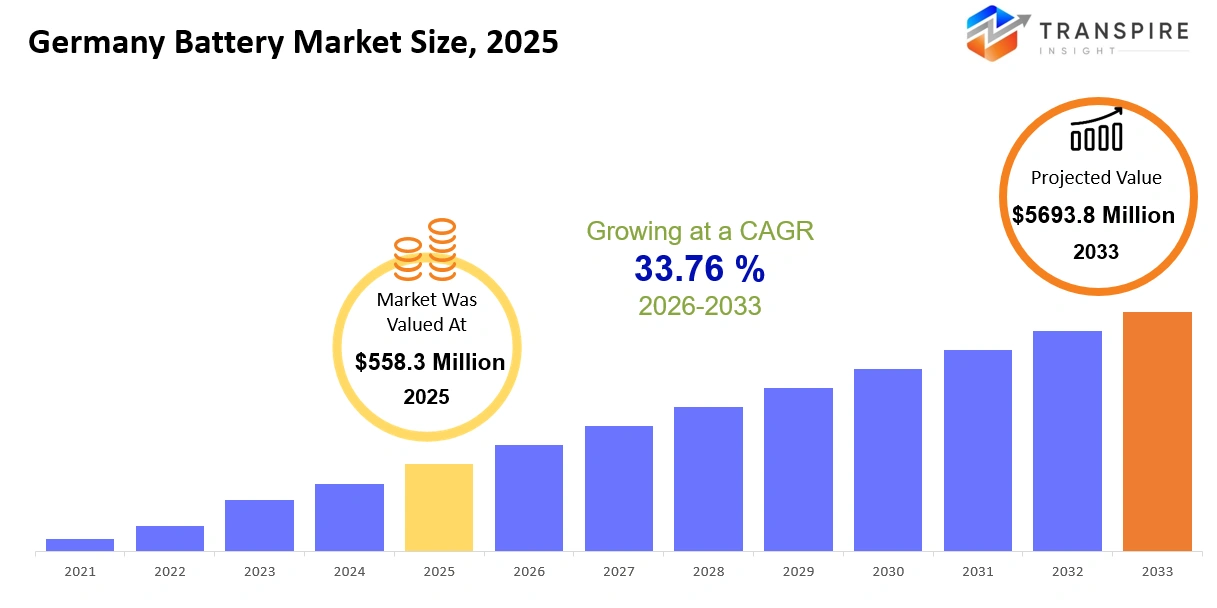
- Germany Battery Market Size 2025: USD 558.3 Million
- Germany Battery Market Size 2033: USD 5693.8 Million
- Germany Battery Market CAGR: 33.76%
- Germany Battery Market Segments: By Battery Type (Lithium-Ion Batteries, Lead-Acid Batteries, Nickel-Based Batteries, Solid-State Batteries), By Application (Automotive, Consumer Electronics, Energy Storage Systems, Industrial), By End User (Automotive Manufacturers, Electronics Companies, Utilities)
To learn more about this report,  Download Free Sample Report
Germany Battery Market Summary:
The Germany Battery Market size is estimated at USD 558.3 Million in 2025 and is anticipated to reach USD 5693.8 Million by 2033, growing at a CAGR of 33.76 % from 2026 to 2033. Germany's battery market experiences rapid growth because electric vehicle demand and renewable energy storage need and grid flexibility requirements create strong market demand. The total battery market contains an estimated value of about USD 8.6 billion for 2024 but will exceed double that value by 2032 when lithium-ion technologies become the market leaders and electrification policies drive their use in mobility and energy industries. Germany demonstrates its commitment to clean energy through substantial funding for stationary storage systems and residential batteries and grid-scale installations which support its EV battery production operations that enhance its status as a major European automotive manufacturing center. The market maintains its upward trajectory because recycling and advanced technologies work together with regulations and industry initiatives to support growth despite the existing problems of high deployment costs and grid integration challenges.
Key Market Trends & Insights:
- The growth of Germany battery market is being driven by increasing electric vehicle adoption which creates demand for advanced battery systems and high-performance lithium-ion batteries used in automotive manufacturing and gigafactory construction.
- The importance of battery energy storage systems has grown because they enable renewable energy integration while providing grid operators with flexible solutions which support Germany's energy transition.
- Investors have shown interest in advanced battery technologies which include solid-state batteries and LFP battery variants and fast-charging chemical systems. However, the development of these technologies faces challenges from two main factors: limitations in raw material availability and competition between different supply chain networks.
- The battery market receives support from government EV incentives and renewable energy infrastructure funding while private investment in storage facilities helps the sector grow. However, regulatory requirements and grid integration processes create obstacles for the industry.
Germany Battery Market Segmentation
By Battery Type
Lithium-Ion Batteries- Germany's battery market sees lithium-ion batteries as the dominant technology because of their ability to store more energy and their extended operational lifespan and their lightweight construction. The technology finds applications in electric vehicles, consumer electronics, and renewable energy storage solutions.
Lead-Acid Batteries- Lead-acid batteries continue to find applications in Germany through their use in automotive starter batteries, backup power systems and industrial equipment. The technology maintains market demand because it offers affordable pricing and established recycling systems, and dependable performance, which compete with lithium-ion solutions.
Nickel-Based Batteries- Lead-acid batteries continue to find applications in Germany through their use in automotive starter batteries and backup power systems and industrial equipment. The technology maintains market demand because it offers affordable pricing and established recycling systems and dependable performance, which compete with lithium-ion solutions.
Solid-State Batteries- Solid-state batteries function as a developing technology that operates within the German battery industry. The technology provides superior energy capacity and safer operation, together with quick charging capabilities, which lead automotive companies and research organizations to invest in it.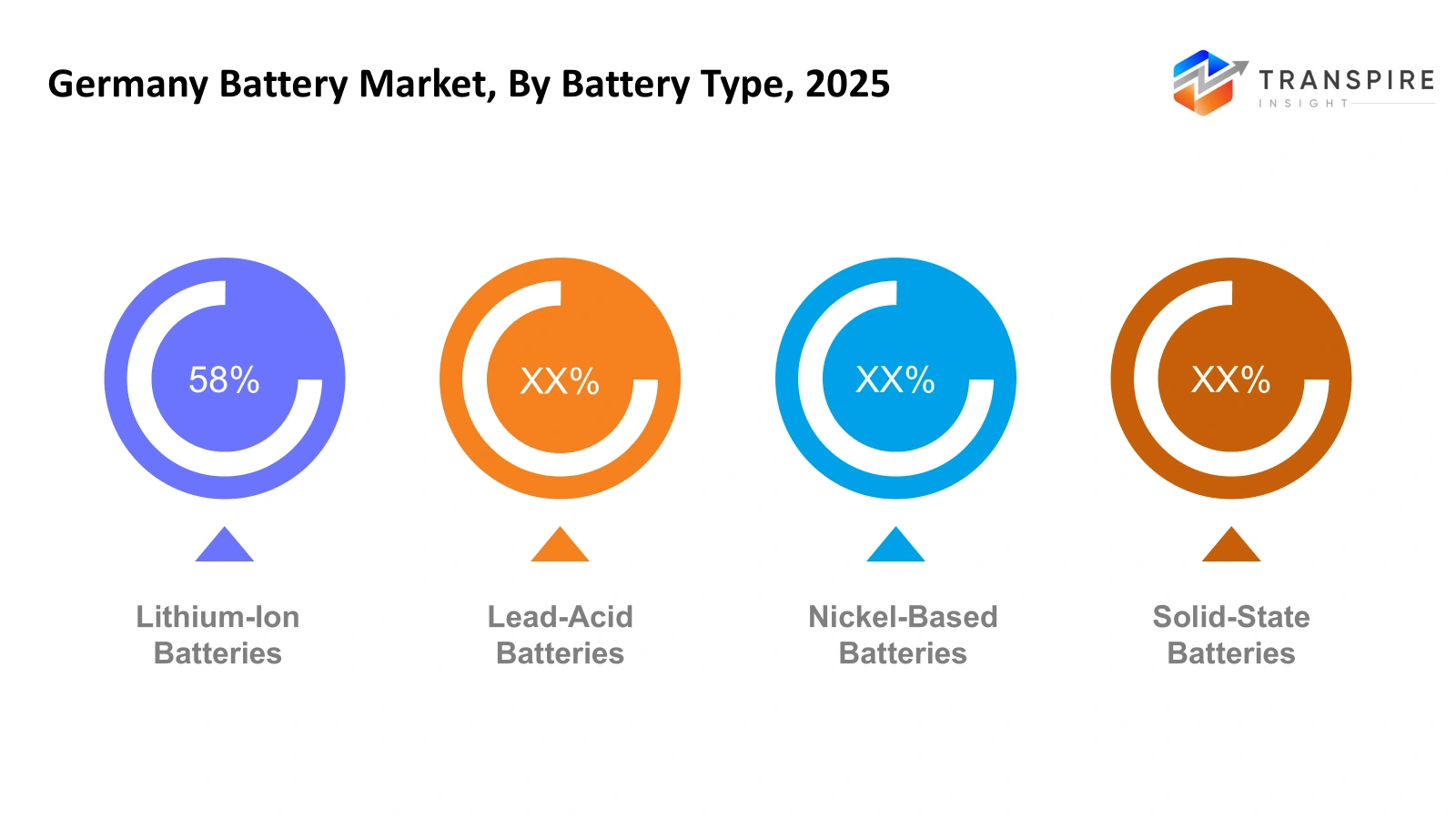
To learn more about this report, Download Free Sample Report
By Application
Automotive- The automotive sector represents the largest application segment in Germany's battery market because of electric vehicle adoption and government incentives for transportation electrification together with the development of electric vehicle battery production facilities.
Consumer Electronics- Consumer electronics applications include smartphones, laptops, wearables, and portable devices. The rising need for compact batteries with high capacity together with increasing digitalization requirements, drives the adoption of advanced lithium-ion battery technologies.
Energy Storage Systems- Germany currently experiences growth in energy storage systems because its renewable energy capacity continues to expand. The batteries provide power supply stabilization by storing excess solar and wind energy, which helps maintain grid reliability while advancing energy transition objectives.
Industrial- Industrial batteries get used in three applications which include backup power systems, material-handling equipment and robotics and automation systems. German industries are increasingly adopting advanced battery technologies to improve operational efficiency and ensure reliable energy supply.
By End User
Automotive Manufacturers- The automotive manufacturers in Germany consume most of the country's battery supply because they quickly produce electric vehicles. The companies invest their resources in developing battery technology and building gigafactories while establishing partnerships to ensure their supply chain needs and improve the performance of electric vehicles.
Electronics Companies- The electronics industry needs advanced battery technology which can power both consumer products and smart devices and Internet-of-Things devices. The increasing need for portable electronic devices and Internet-of-Things products drives higher battery usage throughout the electronics sector in Germany.
Utilities- Utilities use large-scale battery storage systems to help integrate renewable energy sources and handle peak electricity demand while they maintain stability in power grids. This development turns utilities into major consumers of energy storage systems throughout Germany's developing energy storage market.
Country Insights
The German battery market is experiencing strong growth, driven by demand for electric vehicles and energy storage systems, which will drive market value expansion through 2032. The market growth establishes Germany as a key European battery market because the country demonstrates substantial investment and battery adoption throughout its territory.
Germany aims to expand its EV battery production facilities through advanced manufacturing operations which will achieve major development targets before 2030. The country plans to develop domestic production facilities and gigafactory projects which will help create its own local supply networks for battery systems used in electric vehicles. The organization needs to fulfill its sustainability goals which will help enhance its industrial competition with other businesses in the nation.
Germany experiences rapid growth of battery storage systems which now operate at residential commercial, and utility scales across the country. The systems enable renewable energy sources to supply power while providing grid operators with more operational control which helps achieve energy transition objectives because renewables now generate most of the electrical power.
The battery market receives support from policy frameworks and investment patterns which include strategies for renewable energy integration and financial backing of storage facilities. The partnerships between public and private institutions, together with private companies' interest in storage projects show that they believe in future market demand, yet the main obstacles are linked to building infrastructure and establishing grid access points.
Recent Development News
- Germany's battery storage industry maintains its robust expansion through the installation of 6.57 GWh of new capacity which pushes total capacity to approximately 24 GWh. The two companies reached an agreement which involves TotalEnergies and AllianzGI establishing a €500 million battery storage agreement that will provide 800 MW of capacity.
- The German government develops its bidirectional EV charging framework through draft regulations which enhance vehicle-to-grid technology. The domestic electric vehicle market demonstrates strong battery electric vehicle and plug-in hybrid vehicle growth which increases battery requirements
|
Report Metrics |
Details |
|
Market size value in 2025 |
USD 558.3 Million |
|
Market size value in 2026 |
USD 742.8 Million |
|
Revenue forecast in 2033 |
USD 5693.8 Million |
|
Growth rate |
CAGR of 33.76 % from 2026 to 2033 |
|
Base year |
2025 |
|
Historical data |
2021 – 2024 |
|
Forecast period |
2026 – 2033 |
|
Report coverage |
Revenue forecast, competitive landscape, growth factors, and trends |
|
Country scope |
Germany |
|
Key company profiled |
Tesla Inc., Panasonic Corporation, LG Energy Solution, Samsung SDI, CATL, BYD Company, Northvolt AB, Varta AG, SK On, Envision AESC, GS Yuasa Corporation, Saft Groupe, Amara Raja Energy, Toshiba Corporation, Hitachi Energy. |
|
Customization scope |
Free report customization (country, regional & segment scope). Avail customized purchase options to meet your exact research needs. |
|
Report Segmentation |
Battery Type (Lithium-Ion Batteries, Lead-Acid Batteries, Nickel-Based Batteries, Solid-State Batteries), By Application (Automotive, Consumer Electronics, Energy Storage Systems, Industrial), By End User (Automotive Manufacturers, Electronics Companies, Utilities) |
Key Germany Battery Market Company Insights
Germany's battery market is experiencing rapid growth because electric vehicle adoption and renewable energy storage requirements and government backing all drive its expansion. Germany's position as a leading force in Europe's energy transition process receives reinforcement through increasing gigafactory investments and the prevailing use of lithium-ion batteries and the development of advanced battery technologies.
Company List
- Tesla Inc.
- Panasonic Corporation
- LG Energy Solution
- Samsung SDI
- CATL
- BYD Company
- Northvolt AB
- Varta AG
- SK On
- Envision AESC
- GS Yuasa Corporation
- Saft Groupe
- Amara Raja Energy
- Toshiba Corporation
- Hitachi Energy
Germany Battery Market Report Segmentation
By Battery Type
- Lithium-Ion Batteries
- Lead-Acid Batteries
- Nickel-Based Batteries
- Solid-State Batteries
By Application
- Automotive
- Consumer Electronics
- Energy Storage Systems
- Industrial
By End User
- Automotive Manufacturers
- Electronics Companies
- Utilities
Frequently Asked Questions
Find quick answers to common questions.
The approximate Germany Battery Market size for the market will be USD 5693.8 Million in 2033.
Key segments for the Germany Battery Market By Battery Type (Lithium-Ion Batteries, Lead-Acid Batteries, Nickel-Based Batteries, Solid-State Batteries), By Application (Automotive, Consumer Electronics, Energy Storage Systems, Industrial), By End User (Automotive Manufacturers, Electronics Companies, Utilities)
Major players in the Germany Battery Market are Tesla Inc., Panasonic Corporation, LG Energy Solution, Samsung SDI, CATL, BYD Company, Northvolt AB, Varta AG, SK On, Envision AESC, GS Yuasa Corporation, Saft Groupe, Amara Raja Energy, Toshiba Corporation, Hitachi Energy.
The Germany Battery Market size is USD 558.3 Million in 2025.
The Germany Battery Market CAGR is 33.76%.
- Tesla Inc.
- Panasonic Corporation
- LG Energy Solution
- Samsung SDI
- CATL
- BYD Company
- Northvolt AB
- Varta AG
- SK On
- Envision AESC
- GS Yuasa Corporation
- Saft Groupe
- Amara Raja Energy
- Toshiba Corporation
- Hitachi Energy
Recently Published Reports
-
Apr 2026
Fiber Optic Faceplates Market
Fiber Optic Faceplates Market Size, Share & Analysis Report By Type (< 300 mm2, 300-350 mm2, and > 350 mm2, By Application (Night Vision, Holographic Imaging, Medical, and Others), and Geography (North America, Europe, Asia-Pacific, Middle East and Africa, South and Central America), 2021 - 2031
-
Apr 2026
High Temperature Superconductors Market
High Temperature Superconductors Market Size, Share & Analysis Report By Type (1G HTS, and 2G HTS), By Application (Power Cable, Fault Current Limiter, and Transformer), and Geography (North America, Europe, Asia-Pacific, Middle East and Africa, South and Central America), 2021 - 2031
-
Apr 2026
Industrial Plugs and Socket Market
Industrial Plugs and Socket Market Size, Share & Analysis Report By Type (Industrial Plugs, Industrial Sockets), By Current (Up to 32 A, 32 to 125 A, Above 125 A), By Protection (Dustproof and Splash Proof, Waterproof, Explosion Proof), By End User (Heavy Industries, Oil and Gas, Chemicals and Pharmaceuticals, Power Generation, Others), and Geography (North America, Europe, Asia-Pacific, Middle East and Africa, South and Central America), 2021 - 2031
-
Apr 2026
InGaAs Avalanche Photodiodes Market
InGaAs Avalanche Photodiodes Market Size, Share & Analysis Report By Type (1100 - 1700 nm, and 1000 - 1600 nm), By Application (Missile Warning System, Muzzle Flash Detection, Wafer Defect Inspection, Laser Rangefinders, and Others), and Geography (North America, Europe, Asia-Pacific, Middle East and Africa, South and Central America), 2021 - 2031