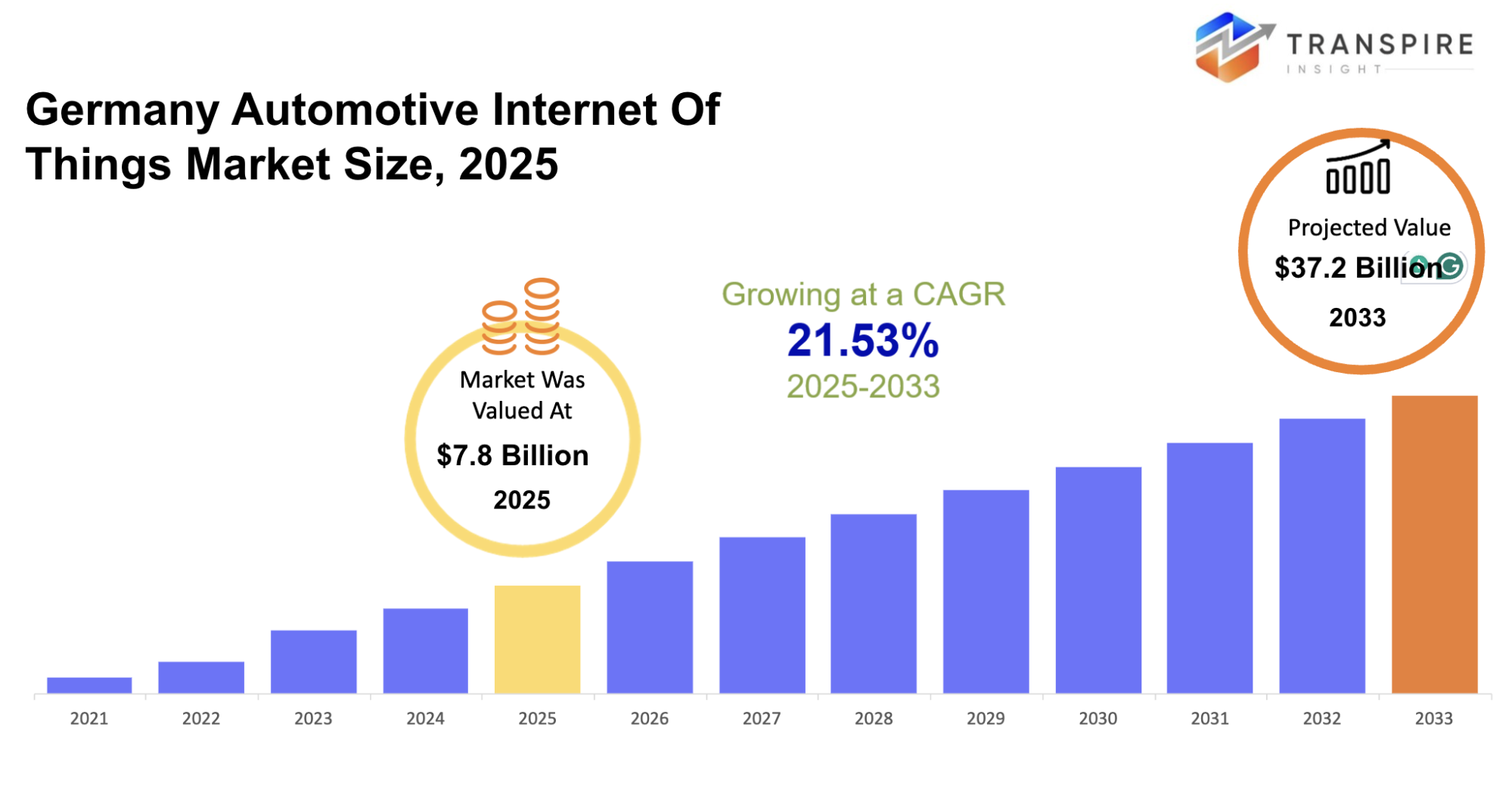
Germany Automotive Internet Of Things Market Size & Forecast:
- Germany Automotive Internet Of Things Market Size 2025: USD 7.8 Billion
- Germany Automotive Internet Of Things Market Size 2033: USD 37.2 USD Billion
- Germany Automotive Internet Of Things Market CAGR: 21.53%
- Germany Automotive Internet Of Things Market Segments: ByComponent (Hardware, Software, Services), By Connectivity (Embedded, Tethered, Integrated), By Application (Infotainment, Fleet Management, Predictive Maintenance, Vehicle Security, ADAS, Traffic Management) By End User (Original Equipment Manufacturers (OEMs), Aftermarket).
To learn more about this report,  Download Free Sample Report
Germany Automotive Internet Of Things Market Summary:
The Germany Automotive Internet of Things Market size is estimated at USD7.8 USD Billion in 2025 and is anticipated to reach USD 37.2 Billion by 2033, growing at a CAGR of 21.53% from 2026 to 2033. The Germany Automotive Internet Of Things Market within the country’s automotive technology industry will continue to draw attention as carmakers, telecom firms, and sensor developers push vehicles toward constant connectivity. Demand from German drivers for predictive maintenance, remote diagnostics, and seamless smartphone control has already nudged manufacturers to embed more data modules inside everyday vehicles. Stricter European data security rules and software update standards will shape how platforms are designed while 5G corridors along autobahns will support faster machine communication. Over the next few years suppliers will likely shift from isolated hardware sales to service contracts built on data.
Key Market Trends & Insights:
- The German automotive internet of things market experiences significant growth because connected vehicle technology continues to expand throughout the country. Automotive manufacturers invest in digital systems that establish connections between their vehicles and cloud platforms, traffic networks, and service centers. The system operates through ongoing data transfer which enables both predictive maintenance and navigation updates and remote diagnostic capabilities. The automotive engineering companies and software developers in the country demonstrate strong collaboration which results in continuous development of vehicle connectivity solutions.
- The automotive industry creates sophisticated data platforms which enable the collection and analysis of vehicle data obtained through onboard systems and sensors. Data analysis enables safer driving and effective performance assessment and improved fleet operational efficiency. The expansion of Germany's digital infrastructure enables greater data exchange capabilities between vehicles and their control systems. The German automotive internet of things market shows increasing investments in cloud technology and vehicle communication systems according to country insights.
- Automakers and fleet operators today depend on predictive maintenance systems which utilize connected sensors to monitor their equipment. The system enables operators to identify potential equipment failures through its capacity to monitor engine performance and battery status and mechanical system conditions. The monitoring system decreases maintenance expenses while enhancing commercial fleet operational productivity. The German automotive internet of things market develops reliable predictive maintenance systems because the country possesses strong engineering expertise according to country insights.
- Development of smart mobility infrastructure: German cities and their public transportation systems continue to create intelligent mobility solutions through their ongoing development work. The system enables vehicles to communicate with traffic control centers and city infrastructure which leads to improved traffic management and safer road conditions. The combination of smart parking systems and traffic signal connections creates better transportation flow through urban areas. The study shows that both government and business sectors in Germany invest heavily in digital mobility infrastructure development which drives growth in the automotive internet of things market.
- Development of self driving vehicle support technology: German automobile companies research technologies that create automated driving systems and driver assistance systems for their vehicles. The system uses connected sensors and vehicle communication modules and digital monitoring platforms to ensure safe vehicle operation. The research programs and automotive partnerships work together to create advanced smart vehicle technologies. The analysis reveals that Germany's engineering expertise and technology funding will drive future development of its automotive internet of things market.
Germany Automotive Internet Of Things Market Segmentation
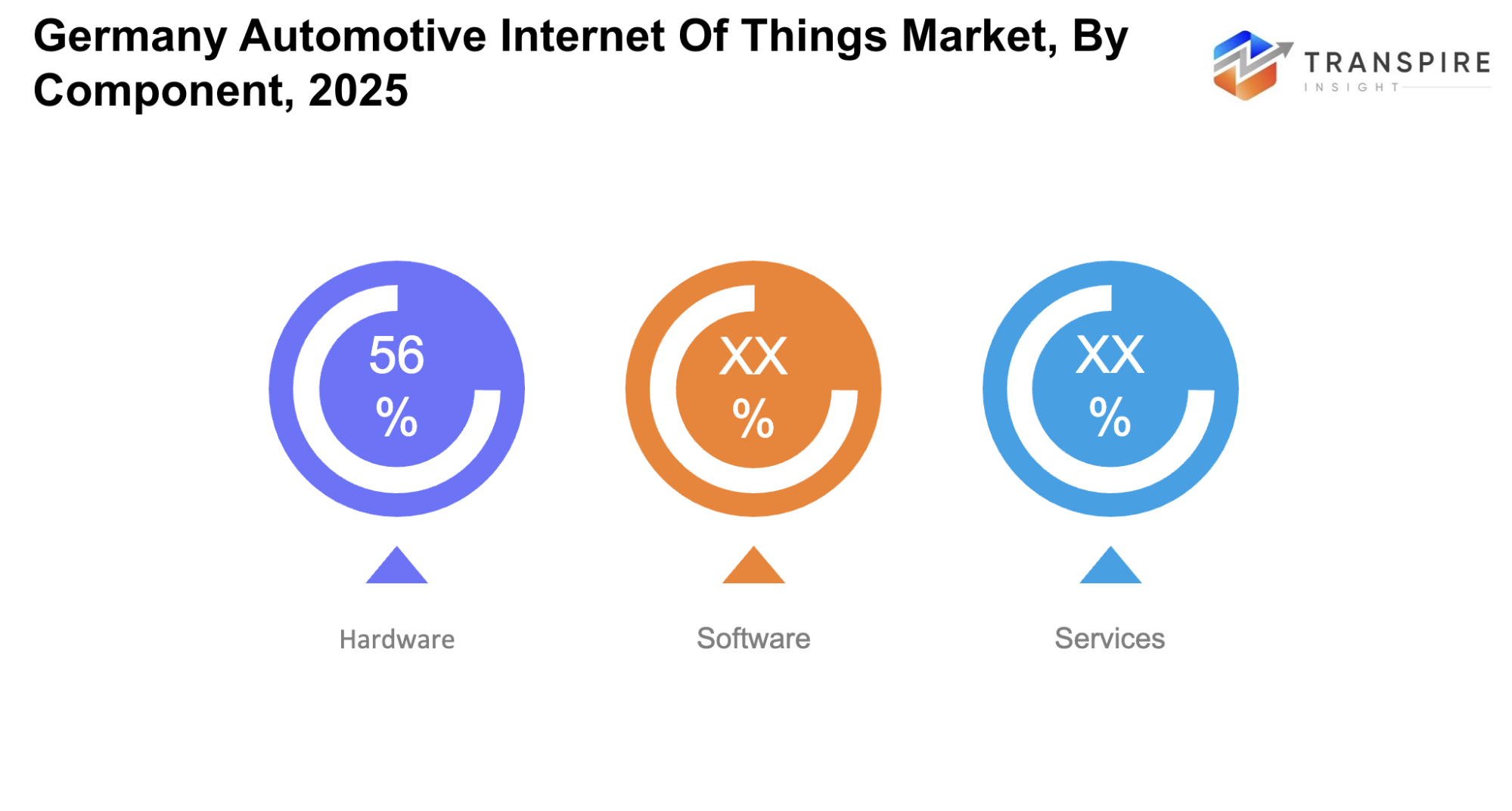
By Component:
- Hardware: The system requires hardware components which include sensors and control units and communication chips and connectivity modules that engineers use to build connected vehicle systems which will collect data from their operations.
- Software: The software controls all system operations by handling data processing and digital control tasks between vehicle components and outside systems.
- Services: The services provide assistance with system installation and data monitoring and software updates and maintenance tasks which ensure that connected vehicles operate at peak performance while maintaining their operational stability.
To learn more about this report, Download Free Sample Report
By Connectivity:
- Embedded: The term embedded connectivity describes communication modules which vehicle manufacturers install as permanent network connections for their systems to provide navigation and system maintenance and diagnostic purposes.
- Tethered: Tetheredconnectivity uses external devices such as smartphones to create network access for vehicle systems.
- Integrated: Integrated connectivity connects vehicle internal systems to cloud services and digital infrastructure which allows vehicles to exchange data with other systems.
By Application:
- Infotainment systems: Infotainment systems provide drivers and passengers with navigation tools and media access and digital communication features.
- Fleet Management: Germany Automotive Internet Of Things Market Segmentation: By Application (Fleet Management): Fleet management systems use connected technology to monitor vehicle location, routes, and operational performance. The systems use sensors and communication modules to gather vehicle information which will assist with route planning and maintenance tracking to enhance transportation management in the German automotive internet of things market.
- Predictive maintenance: Vehicle data examination helps predictive maintenance find potential mechanical issues.
- Vehicle security: Vehicle security systems monitor access and protect vehicle systems.
- ADAS: Advanced Driver Assistance Systems use digital vehicle monitoring and automated response systems to improve safety during driving. The system uses sensors, cameras, and radar units to gather road and vehicle data, which supports lane keeping, collision alerts, adaptive cruise control, and parking assistance. Data processing systems analyze traffic movement, vehicle speed, and surrounding objects to support driver awareness and faster response to road conditions. German automotive manufacturers develop connected technologies together with ADAS systems to enhance vehicle safety and driving support systems and external network communications, which will drive development across the German automotive internet of things market.
- Traffic Management:Traffic management applications use connected vehicle data and digital infrastructure to improve road movement and reduce congestion. The system collects data about vehicle movement and roadway conditions and traffic signal status from its sensors and communication systems and vehicle data networks. Traffic pattern analysis through data platforms will enhance vehicle-traffic control system coordination. The combination of smart traffic signals and connected road infrastructure and real-time navigation updates enables efficient vehicle management throughout cities and highways. Germany will achieve broader adoption of connected vehicle data for traffic management through its ongoing investment in intelligent transport infrastructure which connects to the automotive internet of things market.
By End User:
- Original Equipment Manufacturers (OEMs): Integrated vehicle production processes at Original Equipment Manufacturers (OEMs) require the installation of connected technology which enables digital vehicle functions and vehicle communication systems. The vehicle system uses sensors and connectivity modules and data control systems to send its operational data to cloud platforms and infrastructure networks. The German manufacturing plants focus on engineering accuracy and digital vehicle capabilities which enable the installation of connected systems that support navigation tracking and safety systems and remote diagnostic functions and system updates. The automotive industry in Germany uses production methods which combine technology partnerships with connected mobility solution providers to advance their automotive internet of things technologies.
- Aftermarket:Germany Automotive Internet Of Things Market Segmentation: The Aftermarket segment of the market shows which vehicle components and digital solutions Aftermarket providers offer to vehicle owners and fleet operators who want to install these products after they buy their vehicles. The vehicle communication system expands through the use of telematics units and tracking modules and diagnostic tools and connectivity accessories. Service providers will also provide installation services and system maintenance and data monitoring solutions which enable vehicle owners to enhance their vehicle performance tracking and operational management capabilities. The German automotive internet of things market sees increased adoption of connected devices because fleet transportation services expand and vehicle monitoring technology becomes more popular through aftermarket distribution networks.
Country Insights
The expansion of intelligent transportation systems will create a need for vehicle communication networks which will enhance traffic management and road safety. The digital signals together with connected traffic monitoring equipment and vehicle-to-infrastructure systems will enhance transportation efficiency on main road networks. The ongoing development of intelligent transport systems will create new business opportunities for the Germany automotive internet of things market. The implementation of predictive vehicle maintenance systems which use IoT technology will enable organizations to track engine performance and battery status and component deterioration in real time. The identification of mechanical problems in their early stages enables organizations to achieve lower maintenance expenses while enhancing vehicle operational dependability. The Germany Automotive Internet Of Things Market country insight presents Government mobility programs and smart transport initiatives in Germany which create a testing ground for connected vehicle technologies while automotive research centers and industrial partnerships enable the development of advanced diagnostic and vehicle monitoring systems.
Growth of intelligent transportation infrastructure will encourage connected vehicle communication systems that improve traffic management and road safety. Digital signals, connected traffic monitoring equipment, and vehicle-to-infrastructure communication systems will support transportation efficiency across major road networks. Continuous development of smart transport systems will strengthen opportunities connected with the Germany automotive internet of things market. Adoption of predictive vehicle maintenance systems supported by IoT technology will also allow continuous monitoring of engine performance, battery condition, and component wear. Early detection of mechanical issues helps reduce maintenance cost and improve operational reliability for vehicles. Germany Automotive Internet Of Things Market country insight: Government mobility programs and smart transport initiatives across Germany support testing and deployment of connected vehicle technologies, while automotive research centers and industrial partnerships support development of advanced diagnostic and vehicle monitoring systems.
The development of self-driving and driver-assisted technologies will need Internet of Things connections which link their sensors and software systems and telecommunication networks together. The exchange of information between vehicles and their digital surroundings enhances both road awareness and the ability of automated systems to drive. The ongoing advancements in sensor technology and cloud computing and vehicle communication systems will drive the future development of the Germany automotive internet of things market. Automotive companies and technology firms continue to fund research projects which enhance vehicle intelligence and safety during operations. The Automotive Internet Of Things Market in Germany shows strong potential for growth because the country has advanced automotive engineering capabilities which enable it to develop automated mobility solutions and connected vehicle systems.
|
Report Metrics |
Details |
|
Market size value in 2025 |
USD7.8 Billion |
|
Market size value in 2026 |
USD9.5 Billion |
|
Revenue forecast in 2033 |
USD37.2 Billion |
|
Growth rate |
CAGR of 21.53% from 2026 to 2033 |
|
Base year |
2025 |
|
Historical data |
2021 – 2024 |
|
Forecast period |
2026 – 2033 |
|
Report coverage |
Revenue forecast, competitive landscape, growth factors, and trends |
|
Country scope |
Germany |
|
Key company profiled |
Robert Bosch GmbH, Continental AG, Siemens AG, Intel Corporation, NXP Semiconductors, Cisco Systems, Microsoft Corporation, IBM Corporation, Google LLC, AT&T Inc., Harman International, Infineon Technologies, TomTom NV, Qualcomm Technologies, Huawei Technologies. |
|
Customization scope |
Free report customization (country, regional & segment scope). Avail customized purchase options to meet your exact research needs. |
|
Report Segmentation |
ByComponent (Hardware, Software, Services), By Connectivity (Embedded, Tethered, Integrated), By Application (Infotainment, Fleet Management, Predictive Maintenance, Vehicle Security, ADAS, Traffic Management) By End User (Original Equipment Manufacturers (OEMs), Aftermarket). |
Key Germany Automotive Internet Of Things Market Insights
Germany has established a powerful automotive manufacturing sector which derives its strength from modern engineering practices and extensive manufacturing facilities. The increasing adoption of sensors together with telematics and vehicle communication systems enables better safety monitoring and operational tracking. The growing popularity of connected vehicle services together with digital mobility solutions will drive development in the German automotive internet of things market.
Connected vehicle technology adoption receives backing from government transport initiatives and industry partnerships. Intelligent traffic systems together with vehicle communication networks enable data transfer between vehicles and road infrastructure. Automotive manufacturers will achieve better growth in the German automotive internet of things market through their partnerships with technology companies which will generate new ideas.
Company List
- Robert Bosch GmbH
- Continental AG
- Siemens AG
- Intel Corporation
- NXP Semiconductors
- Cisco Systems
- Microsoft Corporation
- IBM Corporation
- Google LLC
- AT&T Inc.
- Harman International
- Infineon Technologies
- TomTom NV
- Qualcomm Technologies
- Huawei Technologies
Germany Automotive Internet Of Things Market Segmentation
By Component
- Hardware
- Software
- Services
By Connectivity
- Embedded
- Tethered
- Integrated
By Application
- Infotainment
- Fleet Management
- Predictive Maintenance
- Vehicle Security
- ADAS
- Traffic Management
By End User
- Original Equipment Manufacturers (OEMs)
- Aftermarket
Frequently Asked Questions
Find quick answers to common questions.
The approximate Germany Automotive Internet Of Things Market size for the market will be USD 37.2 Billion in 2033.
Key segments for the Germany Automotive Internet Of Things Market are By Component (Hardware, Software, Services), By Connectivity (Embedded, Tethered, Integrated), By Application (Infotainment, Fleet Management, Predictive Maintenance, Vehicle Security, ADAS, Traffic Management) By End User (Original Equipment Manufacturers (OEMs), Aftermarket).
Major Germany Automotive Internet Of Things Market players are Robert Bosch GmbH, Continental AG, Siemens AG, Intel Corporation, NXP Semiconductors, Cisco Systems, Microsoft Corporation, IBM Corporation, Google LLC, AT&T Inc., Harman International, Infineon Technologies, TomTom NV, Qualcomm Technologies, Huawei Technologies.
The Germany Automotive Internet Of Things Market size is USD 7.8 Billion in 2025.
The Germany Automotive Internet Of Things Market CAGR is 21.53%.
- Robert Bosch GmbH
- Continental AG
- Siemens AG
- Intel Corporation
- NXP Semiconductors
- Cisco Systems
- Microsoft Corporation
- IBM Corporation
- Google LLC
- AT&T Inc.
- Harman International
- Infineon Technologies
- TomTom NV
- Qualcomm Technologies
- Huawei Technologies
Recently Published Reports
-
Dec 2024
ATV & UTV Market
ATV & UTV Market Size, Share & Analysis Report By Type (ATV, and UTV), By Variants (Less Than 400 CC, 400 CC To 800 CC, and More Than 800 CC), and Geography (North America, Europe, Asia-Pacific, Middle East and Africa, South and Central America), 2021 - 2031
-
Jan 2025
Automotive Central Gateway Module Market
Automotive Central Gateway Module Market Size, Share & Analysis Report By Type (Ethernet Central Gateway Module, CAN Central Gateway Module, LIN Central Gateway Module, and FlexRay), By Application (Powertrain Control, Body Control, Infotainment System, Advanced Driver Assistance Systems (ADAS), and Others), By End User (Passenger Vehicles, and Commercial Vehicles), and Geography (North America, Europe, Asia-Pacific, Middle East and Africa, South and Central America), 2021 - 2031
-
Jan 2025
Automotive Engine Oil Filter Market
Automotive Engine Oil Filter Market Size, Share & Analysis Report By Filter Type (Fuel Filter, Engine Oil Filter, Hydraulic Oil Filter, and Others), By Filter Media (Cellulose, Synthetic, and Micro), By Sales Channel (OEMs, and Aftermarket), By Vehicle Type (Passenger Cars, Light Commercial Vehicles, Heavy Duty Trucks, Buses and Coaches, and Off-road Vehicles), and Geography (North America, Europe, Asia-Pacific, Middle East and Africa, South and Central America), 2021 - 2031
-
Jan 2025
Automotive Parts Aluminium Die Casting Market
Automotive Parts Aluminium Die Casting Market Size, Share & Analysis Report By Production Process (Pressure Die Casting, Vacuum Die Casting, Squeeze Die Casting, Gravity Die Casting), By Application (Body Parts, Engine Parts, Transmission Parts, Battery And Related Components, Other Application Types), and Geography (North America, Europe, Asia-Pacific, Middle East and Africa, South and Central America), 2021 - 2031
Our Clients