
Germany AI Orchestration Market Summary
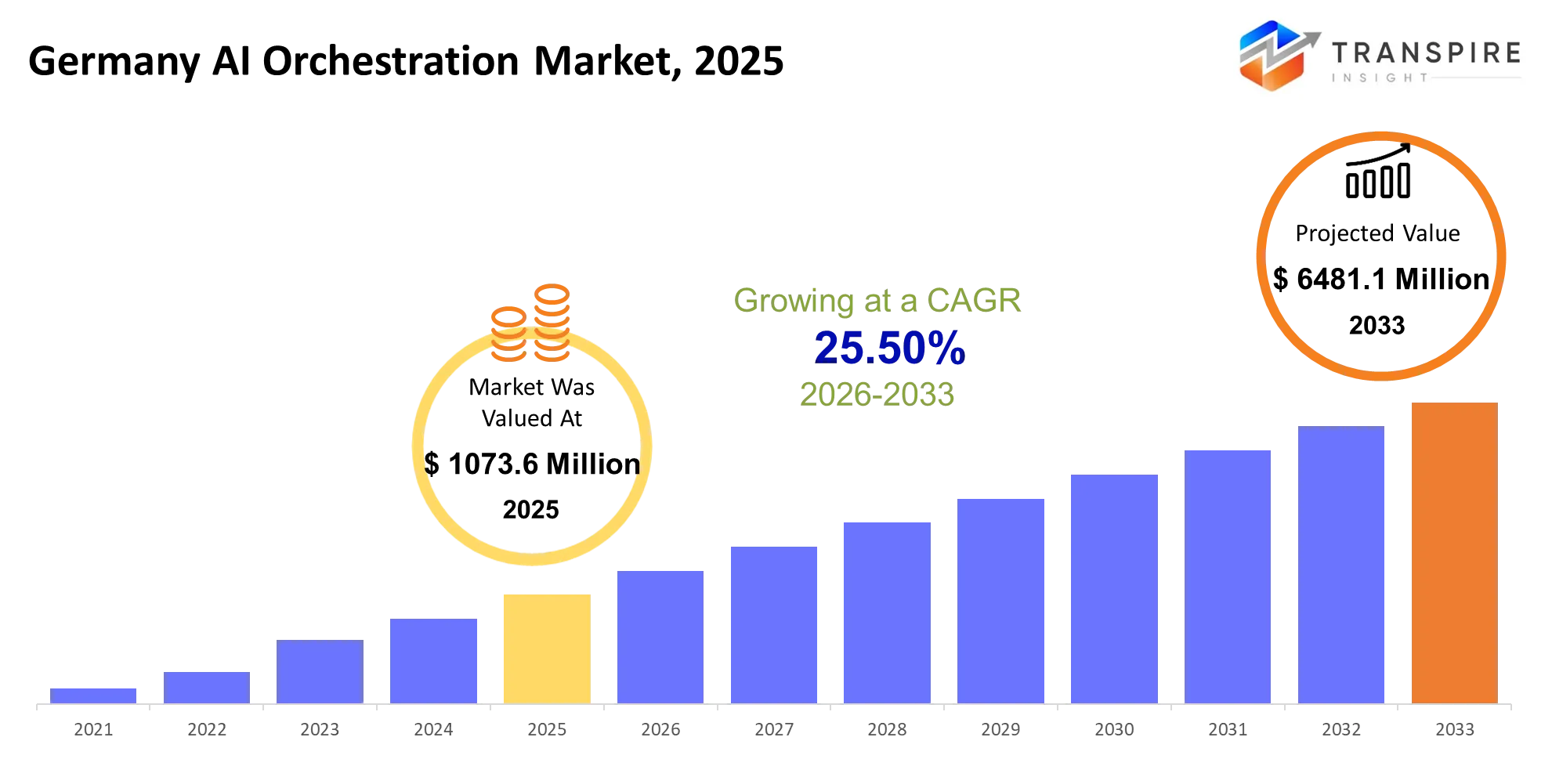
As per Transpire Insight Analysis The Germany AI Orchestration Market size is estimated at USD 1073.6 Million in 2025 and is anticipated to reach USD 6481.1 Million by 2033, growing at a CAGR of 25.50% from 2026 to 2033.
The Germany AI Orchestration Market helps enterprises “make things happen” by coordinating AI agents, models, business applications, data sources, and automated workflows, so that complicated tasks can get from decision into execution with less manual follow up. In real life, orchestration platforms link together systems like ERP, CRM, cloud infrastructure, analytics and enterprise data, while also setting rules for which AI agent does which job. Over the past three to five years Germany has kind of moved on from isolated AI pilots, into more integrated, workflow driven deployments. Bitkom said 36% of German companies were already using AI in 2025, up from 20% the year before, and that’s a pretty noticeable jump. On top of that, the EU AI Act is nudging firms to beef up governance, documentation, risk controls and ongoing oversight, so orchestration has become harder to ignore. As a result, investment in orchestration is accelerating because enterprises need AI that can work across older systems, yet still stay controlled and auditable. SAP’s Joule Agents are one example of this direction, coordinating agents across business workflows, and aiming for reductions of as much as 75% in multi step workflow time.
Germany AI Orchestration Market Size & Forecast:
- Germany AI Orchestration Market Size 2025: USD 1073.6 Million
- Expected Market Value 2033: USD 6481.1 Million
- Forecast CAGR: 25.50%
- Leading region in 2025: Western Germany
- Fastest Growing region: Southern Germany
- Key Profile: Microsoft, Google Cloud, Amazon Web Services (AWS), IBM, Oracle Corporation, SAP SE, ServiceNow, Red Hat, VMware, Databricks, NVIDIA, Cisco Systems, UiPath, Automation Anywhere, BMC Software
Key Market Insights
- AI adoption apparently accelerated sharply: 36% of German companies used AI in 2025 versus 20% in 2024, which quietly expands the addressable market for orchestration platforms.
- Agentic workflows are kinda replacing isolated tools: SAP’s Joule coordinates specialized agents, and it targets up to 75% less time on multi-step workflows.
- Enterprise orchestration is now driving the whole adoption curve: big manufacturers, financial institutions, healthcare groups, and logistics companies are increasingly linking AI with ERP, CRM, analytics, and operational systems.
- Governance is turning into a buying requirement, too: EU AI Act requirements are pushing enterprises toward platforms that have permissions, monitoring , auditability, model controls, and also human oversight.
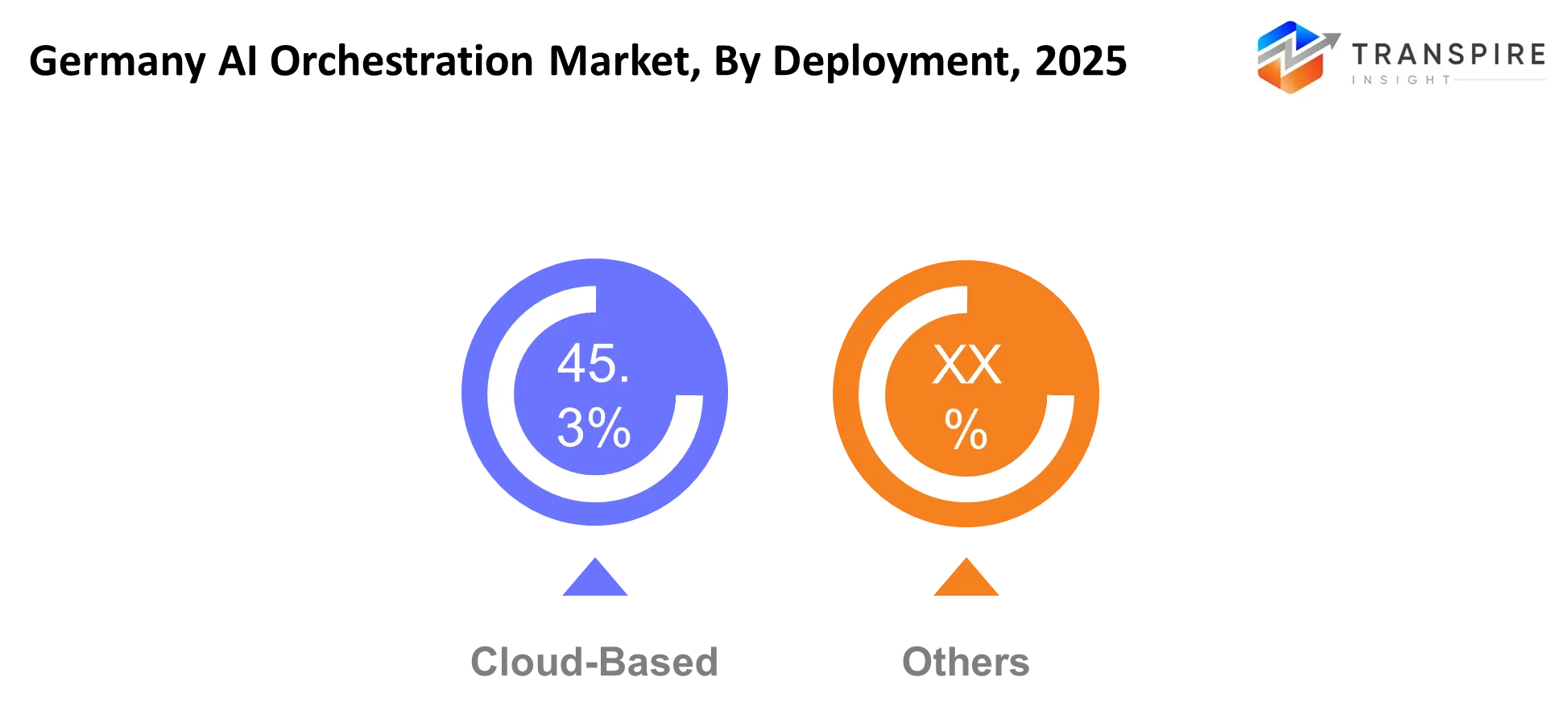
- Cloud-based orchestration keeps leading deployment: Microsoft Azure, AWS, Google Cloud, and IBM are increasingly positioning AI infrastructure around agent coordination, data integration security and enterprise-scale automation.
- SAP SE is sorta strengthening its position through Joule Agents and Joule Assistants, they coordinate specialized AI agents by using business process context, like that.
- Microsoft is also leveraging Azure, Copilot, and enterprise AI tooling, to connect agents with business applications data, and cloud infrastructure too.
- Meanwhile Amazon Web Services is expanding enterprise AI infrastructure as well as agent development capabilities, positioning cloud orchestration as a core layer for scalable deployments, in a kind of “platform first” way, honestly.
What are the Key Drivers, Restraints, and Opportunities in The Germany AI Orchestration Market?
Driver: The strongest growth driver is that shift from AI experimentation to operational deployment, in real life. Bitkom found that AI usage among German companies went from 20% in 2024 up to 36% in 2025 , and while another 47% were discussing, or planning AI use. As deployments spread across departments, enterprises really need a control layer that can link models, agents, applications, data and workflows. That changes orchestration from some optional development thing into actual infrastructure for enterprise AI operations, at scale.
Restraint: Legacy IT architecture is still the main structural barrier. German enterprises frequently run complex ERP, manufacturing, database, and cloud environments that weren’t designed for autonomous AI agents. To connect these systems you need APIs, identity controls, data governance, testing, and human-approval mechanisms. The integration work then climbs, and implementation costs rise, deployment cycles also get longer. On top of that, legal uncertainty stays relevant too, with 64% of surveyed German companies describing themselves as AI laggards in early 2025, and they cite regulatory plus data-protection concerns , as the reason.
Opportunity: Multi-agent enterprise automation is the clearest next-stage opportunity. SAP is already framing assistants to coordinate specialized agents across business workflows , with its platform claiming up to 75% reductions in time spent on multi-step processes. Similar setups could connect finance, procurement, supply chain, customer service, and IT operations, creating new recurring software and integration revenue .
What Has the Impact of Artificial Intelligence Been on The Germany AI Orchestration Market?
Artificial intelligence has kinda shifted how enterprise orchestration works, away from those rule-based workflow automations toward systems that can interpret goals, pick the right tools, coordinate specialized agents, and then carry out multi step processes. In Germany, companies are using these capabilities more and more across finance, procurement, customer operations, IT service management, manufacturing, and supply-chain workflows. SAPs Joule platform sort of shows where things are heading, because it coordinates Joule Agents and other assistants based on business roles, plus the surrounding process context. SAP also claims that its approach can cut down the time spent on complicated multi-step workflows, by as much as 75% .
Machine learning together with generative AI also helps orchestration platforms route tasks toward the appropriate models, based on things like cost, accuracy, latency, or business context. This ends up supporting more efficient use of enterprise AI infrastructure since companies can mix proprietary models with commercial foundation models, APIs, databases, and automation tools instead of betting on a single model for every single task. And you see the shift raising the importance of governance, like access control, continuous monitoring, audit trails, and human approval gates.
Still though, integration stays the big limitation. Legacy enterprise systems, fragmented data , uneven APIs, and strict security requirements can make production deployment costly and slow down delivery. German businesses also keep running into uncertainty about AI regulation and data protection, which can pause or postpone autonomous execution in sensitive workflows.
Key Market Trends
- AI adoption went up, kinda fast from 20% to 36% from 2024 into 2025, and it looks like enterprise budgets started leaning more toward AI infrastructure that actually runs the show in production.
- SAP also moved past the whole standalone assistant thing , toward coordinated agents, aiming for as much as 75% less time on multi step workflows with Joule, which honestly sounds like a big deal.
- Enterprise buyers are paying a lot more attention to governance now. It’s partly because the EU AI Act is being rolled out so documentation, monitoring, and oversight are becoming real day to day operational needs, not just paperwork.
- For manufacturers, the pattern is similar: they’re drifting away from isolated AI pilots, and toward connected workflows that reach across production, engineering, procurement, quality, and supply chain operations.
- At the same time, cloud providers are pushing agentic AI into regular enterprise platforms. They’re connecting models with applications, data stores, APIs, and automated actions so it feels less like a demo.
- In Germany specifically, enterprises seem to prefer a more controlled AI deployment, since data sovereignty and regulatory constraints make unrestricted external model usage harder to justify.
- AI orchestration is also changing. Instead of one agent doing everything like a lone digital worker, we’re seeing multi agent architectures that split a complicated process among specialized digital workers.
- Hybrid deployment is getting more weight too, because regulated industries have to balance cloud scalability with private infrastructure, sensitive data, and the kind of operational control that keeps leadership comfortable.
- Meanwhile, technology vendors aren’t only competing on model quality. They’re stressing interoperability, governance, observability, security, and how well everything integrates with the existing enterprise software stack.
- And finally, AI investment is shifting away from pure experimentation toward productivity results you can measure, so workflow automation, and process cycle reductions have become key buying signals.
Germany AI Orchestration Market Segmentation
By Component:
Software is basically the core piece here , it helps with model coordination, agent management, workflow execution, data connectivity, and even enterprise automation. Then we have AI Platforms which give the whole development and deployment environment, whereas Automation Tools are there for the repetitive business stuff, kind of the routine operations. Workflow Management ties together several tasks across finance, operations, IT, and customer processes, and Monitoring Solutions do the whole thing around performance tracking, usage analysis, security checks, plus operational control.
At the services layer it gets more practical for German enterprises. Services help strengthen implementation across those organizations. Consulting works on strategy, architecture, governance, and technology selection, and Integration Services link orchestration software with ERP, CRM, databases, cloud systems, and also those legacy applications that still run somewhere. Managed Services provide ongoing administration, monitoring, maintenance, and optimization. And for the remainder , Others covers supporting tools and those specialized service offerings, which might sound small but they matter in day to day operations.
By Deployment:
Cloud based deployment helps with scalable AI workloads without having to put a lot into local infrastructure investment. The Public Cloud gives you flexibility in computing capacity, and the Private Cloud keeps stricter data control and security requirements in mind. Then SaaS and Hosted models make it easier to use orchestration capabilities, mostly through a subscription style delivery model. With Multi-Cloud deployment you can run workloads across several providers, and Edge AI moves some selected processing capabilities nearer to operational systems so response times improve
On-Premise deployment is still around and relevant, especially when organizations have strict data, security, or compliance needs. Hybrid deployment connects private infrastructure with cloud resources and it supports gradual modernization of legacy systems, step by step. Edge AI is also used in manufacturing and operational environments where low latency processing matters a lot. Others covers specialized deployment models, designed around enterprise infrastructure needs, depending on what the organization is aiming for.
By Technology:
Machine Learning kinda supports prediction, classification, recommendation, and automated decision processes , while Generative AI enables content creation, reasoning, and task assistance. Natural Language Processing handles document analysis, conversational interfaces and language based workflows. Deep Learning takes care of complex data patterns, whereas Robotic Process Automation automates structured digital tasks. Intelligent Automation kinda mixes automation with AI based decision capabilities
Predictive Analytics backs up forecasting and operational planning, while AI Governance provides access controls, model monitoring, risk management, documentation, and compliance processes. AI Agents are a rapidly evolving technology area, supporting task planning, tool selection, and multi step workflow execution. Others includes emerging techniques supporting specialized enterprise AI applications
By Application:
Workflow Automation is one of those main application areas because orchestration ties together multiple applications, different data sources, models, and a bunch of automated tasks into some kind of coordinated business processes, kinda like a single chain. IT Operations leans on orchestration for incident handling, system monitoring service management and automated remediation, even when things get messy. Customer Service can take advantage too for conversational agents, case routing, knowledge retrieval, and then response generation. Business Process Management also connects AI capabilities with finance, procurement, human resources, and administrative workflows, all in one go.
Then you have DevOps that uses orchestration for code workflows, testing, deployment, and infrastructure management, while Data Analytics supports automated data preparation and insight generation, so the system can keep moving. Cybersecurity applications coordinate threat detection, investigation, and response activities. Supply Chain Management supports forecasting and operational coordination, and Healthcare Operations applies AI orchestration to administrative and clinical support workflows. Others covers specialized enterprise applications, sorta niche stuff that doesn’t fit neatly.
By End User:
IT and Telecom organizations are key users because big technology environments want automated service handling, heavy data processing, constant security monitoring, and application coordination, in practice it’s not just “run things”, it’s a whole flow. BFSI institutions, for example, use orchestration across customer care, fraud detection, document handling, compliance checks, and financial operations. In Healthcare, teams lean on AI coordination for paperwork-like workflows, scheduling, documentation upkeep, and data analysis, which can be pretty procedural. Retail companies then apply orchestration across customer engagement, inventory planning, marketing activities, and order management, more or less end to end.
Manufacturing is also one of those strong growth areas, especially since German industrial companies need coordination across production, engineering, procurement, quality, and supply chain systems. Government organizations can use orchestration for citizen services, document preparation, analytics, and administrative processes. Energy and Utilities supports grid operations and asset management, while Media & Entertainment supports content pipelines and audience workflows. Transportation and Logistics relies on orchestration for planning, tracking, customer messaging, and operational coordination, while Others is meant to cover extra industry users that don’t fit the main buckets.
What are the Key Use Cases Driving The Germany AI Orchestration Market?
Workflow automation is a pretty strong use case, because enterprise processes quite often stretch across ERP systems, databases, customer platforms, approvals, and even several AI models at once. In practice AI orchestration kind of coordinates how tasks get carried out, across finance, procurement, human resources, IT service management, and the everyday administrative operations. When it comes to Large German enterprises, the benefit tends to show up as shorter process cycles , less manual handling, and more control over those complicated workflows.
IT Operations and Business Process Management are also growing pretty fast across IT & Telecom, BFSI, and manufacturing orgs. Here AI orchestration helps with incident classification, service ticket routing, automated remediation, document processing, compliance workflows, and operational reporting. In manufacturing the same orchestration can be linked with production planning, quality processes, procurement, and supply chain activities, which is often where a lot of the latency sneaks in.
On the horizon you can see emerging applications like multi-agent cybersecurity operations, plus autonomous decision support inside enterprises. AI Agents can coordinate threat investigation, retrieve relevant data, run policy checks, and handle escalation processes too, while regulated industries may use governed agents for financial compliance and healthcare administration. The EU AI Act requirements will likely push demand even more for controlled, traceable, and monitored AI workflows, rather than the loose kind of automation that everyone regrets later.
|
Report Metrics |
Details |
|
Market size value in 2025 |
USD 1073.6 Million |
|
Market size value in 2026 |
USD 1281.1 Million |
|
Revenue forecast in 2033 |
USD 6481.1 Million |
|
Growth rate |
CAGR of 25.50% from 2026 to 2033 |
|
Base year |
2025 |
|
Historical data |
2021 - 2024 |
|
Forecast period |
2026 - 2033 |
|
Report coverage |
Revenue forecast, competitive landscape, growth factors, and trends |
|
Regional scope |
Germany |
|
Key company profiled |
Microsoft, Google Cloud, Amazon Web Services (AWS), IBM, Oracle Corporation, SAP SE, ServiceNow, Red Hat, VMware, Databricks, NVIDIA, Cisco Systems, UiPath, Automation Anywhere, BMC Software |
|
Customization scope |
Free report customization (country, regional & segment scope). Avail customized purchase options to meet your exact research needs. |
|
Report Segmentation |
By Component (Software, Services, AI Platforms, Consulting, Integration Services, Managed Services, Automation Tools, Workflow Management, Monitoring Solutions, Others); By Deployment (Cloud-Based, On-Premise, Hybrid, Private Cloud, Public Cloud, Multi-Cloud, Edge AI, SaaS, Hosted, Others); By Technology (Machine Learning, Generative AI, Natural Language Processing, Deep Learning, Robotic Process Automation, Intelligent Automation, Predictive Analytics, AI Governance, AI Agents, Others); By Application (Workflow Automation, IT Operations, Customer Service, Business Process Management, DevOps, Data Analytics, Cybersecurity, Supply Chain Management, Healthcare Operations, Others); By End User (IT & Telecom, BFSI, Healthcare, Retail, Manufacturing, Government, Energy & Utilities, Media & Entertainment, Transportation & Logistics, Others) |
Which Regions are Driving The Germany AI Orchestration Market Growth?
Western Germany is currently in the strongest position, more or less due to how large enterprises, industrial companies, tech providers, and corporate headquarters cluster across North Rhine-Westphalia, Hesse, and nearby business hubs. Frankfurt also adds weight to the regional system, not only as a big financial center but as a cloud infrastructure hub too. From there, established enterprise IT spending helps companies actually adopt AI platforms and workflow automation, not just test around. Because the business networks are dense and the digital infrastructure is quite mature, Western Germany is a solid starting point for deployment, consulting, integration and managed services .
Southern Germany looks like a different kind of growth engine. Bavaria and Baden-Württemberg get a lot of their momentum from automotive, engineering, electronics, and advanced manufacturing. Major manufacturers are moving AI from experiments into production planning, engineering, procurement, quality management, and supply chain operations. Corporate spending on industrial digitization stays relatively stable, even when single tech initiatives have longer review and approval cycles . This kind of industrial focus gives Southern Germany a durable contribution to enterprise orchestration revenue , and it doesn’t depend mainly on financial institutions or public sector adoption.
Eastern Germany, on the other hand, feels like the faster-growth angle , since technology investment, digital infrastructure build-out, and industrial modernization are creating fresh openings for AI deployment. Berlin offers a strong startup and software ecosystem, while regional support for semiconductor work, manufacturing initiatives, and tech projects is steadily expanding the potential customer base .
Who are the Key Players in The Germany AI Orchestration Market and How Do They Compete?
Competition is getting more and more about technology integration, not just how good a standalone model is. Microsoft, Google Cloud, AWS, IBM, SAP, and a bunch of other big providers, are basically stacking AI agents on top of cloud infrastructure, enterprise apps, data platforms, security, and governance. And the edge is not only the model itself, it’s more like who ends up controlling more layers in the whole enterprise technology stack, so there is less glue code, less integration effort and production deployment feels easier especially for large German organizations.
Microsoft is pushing hard with Azure and with agent-to-agent style coordination, between Microsoft 365 Copilot and SAP Joule. That setup lets AI systems sort of coordinate work across different enterprise applications. SAP SE, in turn, gets a lot from the deep ERP link, so Joule can tap into business processes and enterprise data without too much friction. Amazon Web Services is going after the SAP installed base through its AWS for SAP MCP Server, and with that agents can interact with SAP finance, procurement, logistics, and supply-chain processes while security and observability stay in place.
IBM is leaning on hybrid-cloud orchestration, governance, and its consulting strengths. In 2026, IBM expanded watsonx Orchestrate and also added features for coordinating agents across workflows, tools, and foundation models. Google Cloud is going up against that with its Gemini Enterprise Agent Platform, which blends agent development, deployment, scaling, governance, and optimization in one package.
Overall, these moves turn the whole race toward interoperability, enterprise security, clean data access, and the practical ability to move AI agents from “cool pilot” stages into controlled production environments.
Company List
- Microsoft
- Google Cloud
- Amazon Web Services (AWS)
- IBM
- Oracle Corporation
- SAP SE
- ServiceNow
- Red Hat
- VMware
- Databricks
- NVIDIA
- Cisco Systems
- UiPath
- Automation Anywhere
- BMC Software
Recent Development News
- "In April 2026, Google Cloud launched the new Gemini Enterprise platform. The platform combines AI models, agent development, deployment, orchestration, and governance to support complex multi-step enterprise workflows and strengthen Google's position in production-grade agentic AI.https://cloud.google.com/blog/products/ai-machine-learning/the-new-gemini-enterprise-one-platform-for-agent-development ([Google Cloud])."
- "In May 2026, Amazon Web Services announced general availability of the AWS for SAP MCP Server on Amazon Bedrock AgentCore. The technology connects AI agents securely with SAP ERP processes and data, supporting finance, procurement, logistics, and supply-chain automation for enterprise customers.https://aws.amazon.com/about-aws/whats-new/2026/05/aws-sap-mcp-amazon-bedrock/ ([Amazon Web Services])."
- "In May 2026, IBM achieved the SAP Business AI Operations certificate. The certification validates IBM's governance, security, and delivery capabilities for operating Business AI across complex SAP environments, strengthening IBM's position in enterprise AI implementation and management.https://www.ibm.com/new/announcements/ibm-achieves-sap-business-ai-operations-certificate ([IBM])."
What Strategic Insights Define the Future of The Germany AI Orchestration Market?
The market is kinda shifting, more or less structurally, toward an enterprise AI control layer, where agents, foundation models, apps, data , and automated workflows kind of run through coordinated infrastructure. The main push is not just higher AI usage, but the fact that AI systems must become reliable enough for production processes, especially when sensitive enterprise data is involved and when financial or operational decisions have to be made. There’s also a less obvious risk, sort of quiet, like platform concentration , because leaning on a small handful of cloud and model providers can quietly reduce negotiating power , and switching orchestration environments later becomes expensive and messy.
Meanwhile there’s a real chance in governed multi-agent systems that can work across SAP, Microsoft, AWS, and mixed, hybrid enterprise setups without locking customers into one single technology stack. If market participants want to win, they should emphasize interoperability, open protocols, solid identity controls, auditability , and the ability to deploy in hybrid modes. With that kind of positioning you can capture enterprise budgets while also lowering exposure to model substitution and vendor concentration during the 2026–2033 period.
Germany AI Orchestration Market Report Segmentation
By Component
- Software
- Services
- AI Platforms
- Consulting
- Integration Services
- Managed Services
- Automation Tools
- Workflow Management
- Monitoring Solutions
- Others
By Deployment
- Cloud-Based
- On-Premise
- Hybrid
- Private Cloud
- Public Cloud
- Multi-Cloud
- Edge AI
- SaaS
- Hosted
- Others
By Technology
- Machine Learning
- Generative AI
- Natural Language Processing
- Deep Learning
- Robotic Process Automation
- Intelligent Automation
- Predictive Analytics
- AI Governance
- AI Agents
- Others
By Application
- Workflow Automation
- IT Operations
- Customer Service
- Business Process Management
- DevOps
- Data Analytics
- Cybersecurity
- Supply Chain Management
- Healthcare Operations
- Others
By End User
- IT & Telecom
- BFSI
- Healthcare
- Retail
- Manufacturing
- Government
- Energy & Utilities
- Media & Entertainment
- Transportation & Logistics
- Others
Frequently Asked Questions
Find quick answers to common questions.
The expected Germany AI Orchestration Market size for the market will be USD 6481.1 Million in 2033.
Key segments for The Germany AI Orchestration Market are By Component (Software, Services, AI Platforms, Consulting, Integration Services, Managed Services, Automation Tools, Workflow Management, Monitoring Solutions, Others); By Deployment (Cloud-Based, On-Premise, Hybrid, Private Cloud, Public Cloud, Multi-Cloud, Edge AI, SaaS, Hosted, Others); By Technology (Machine Learning, Generative AI, Natural Language Processing, Deep Learning, Robotic Process Automation, Intelligent Automation, Predictive Analytics, AI Governance, AI Agents, Others); By Application (Workflow Automation, IT Operations, Customer Service, Business Process Management, DevOps, Data Analytics, Cybersecurity, Supply Chain Management, Healthcare Operations, Others); By End User (IT & Telecom, BFSI, Healthcare, Retail, Manufacturing, Government, Energy & Utilities, Media & Entertainment, Transportation & Logistics, Others).
Major Germany AI Orchestration Market players are Microsoft, Google Cloud, Amazon Web Services (AWS), IBM, Oracle Corporation, SAP SE, ServiceNow, Red Hat, VMware, Databricks, NVIDIA, Cisco Systems, UiPath, Automation Anywhere, BMC Software.
The Germany AI Orchestration Market size is USD 1073.6 Million in 2025.
The Germany AI Orchestration Market CAGR is 25.50% from 2026 to 2033.
- Microsoft
- Google Cloud
- Amazon Web Services (AWS)
- IBM
- Oracle Corporation
- SAP SE
- ServiceNow
- Red Hat
- VMware
- Databricks
- NVIDIA
- Cisco Systems
- UiPath
- Automation Anywhere
- BMC Software
About the Authors

Mayur Shinde
I am Mayur Shinde, a Senior Research Analyst at Transpire Insight, specializing in the Automotive & Transportation and Information & Communication Technology (ICT) Industry. My work focuses on analyzing emerging market trends, technological advancements, competitive landscapes, and industry developments to deliver accurate, data-driven insights. I am passionate about transforming complex market information into clear, actionable content that helps businesses, professionals, and decision-makers stay informed and make confident strategic decisions.

Chakradhar Khansole
Chakradhar serves as the Research Director at Transpire Insight, bringing over 8 years of experience in technology, innovation, and strategic market intelligence. He specializes in transforming complex market data into actionable business insights that enable organizations to make informed, growth-oriented decisions. Recognized for his strategic vision and analytical expertise, Chakradhar leads high-impact research initiatives, delivering comprehensive market assessments, competitive intelligence, and forward-looking industry analysis.
Recently Published Reports
-
Apr 2026
3D Optical Profiler Market
3D Optical Profiler Market Size, Share & Analysis Report By Type (Desktop 3D Optical Profiler, and Portable 3D Optical Profiler), By Technology (Confocal Technology, and White Light Interference), By End-Use Industry (Manufacturing, Research Institutions, Automotive, Aerospace and Defense, Medical Devices, and Other), and Geography (North America, Europe, Asia-Pacific, Middle East and Africa, South and Central America), 2021 - 2031
-
Apr 2026
Depth Sensor Market
Depth Sensor Market Size, Share & Analysis Report By Type (Infrared Depth Sensors, Time-of-Flight (ToF) Sensors, Stereo Vision Sensors, Structured Light Sensors, Ultrasonic Depth Sensors), By Application (Automotive, Robotics, Gaming, Consumer Electronics, Industrial Automation, Healthcare, Security & Surveillance, Others), By End Users (Automotive Manufacturers, Consumer Electronics Companies, Healthcare Providers, Industrial Companies, Security Agencies, Gaming Companies, Robotics Companies, Others), and Geography (North America, Europe, Asia-Pacific, Middle East and Africa, South and Central America), 2021 – 2031
-
Apr 2026
Digital Manufacturing Market
Digital Manufacturing Market Size, Share & Analysis Report By Component (Hardware, Software, and Services), By Technology (Robotics, 3D Printing, Internet of Things (IoT), and Others), By Application (Automotive and Transportation, Aerospace and Defense, Consumer Electronics, Industrial Machinery, and Others), By Process Type (Computer-Based Designing, Computer-Based Simulation, Computer 3D Visualization, Analytics, and Others), and Geography (North America, Europe, Asia-Pacific, Middle East and Africa, South and Central America), 2021 – 2031
-
Apr 2026
Digital Visa Services Market
Digital Visa Services Market Size, Share & Analysis Report By Type (Individual Travelers, Group Travelers), By Application (Tourism, Business Travel, Others), and Geography (North America, Europe, Asia-Pacific, Middle East and Africa, South and Central America), 2021 – 2031