Germany AI in Microscopy Market Size & Forecast:
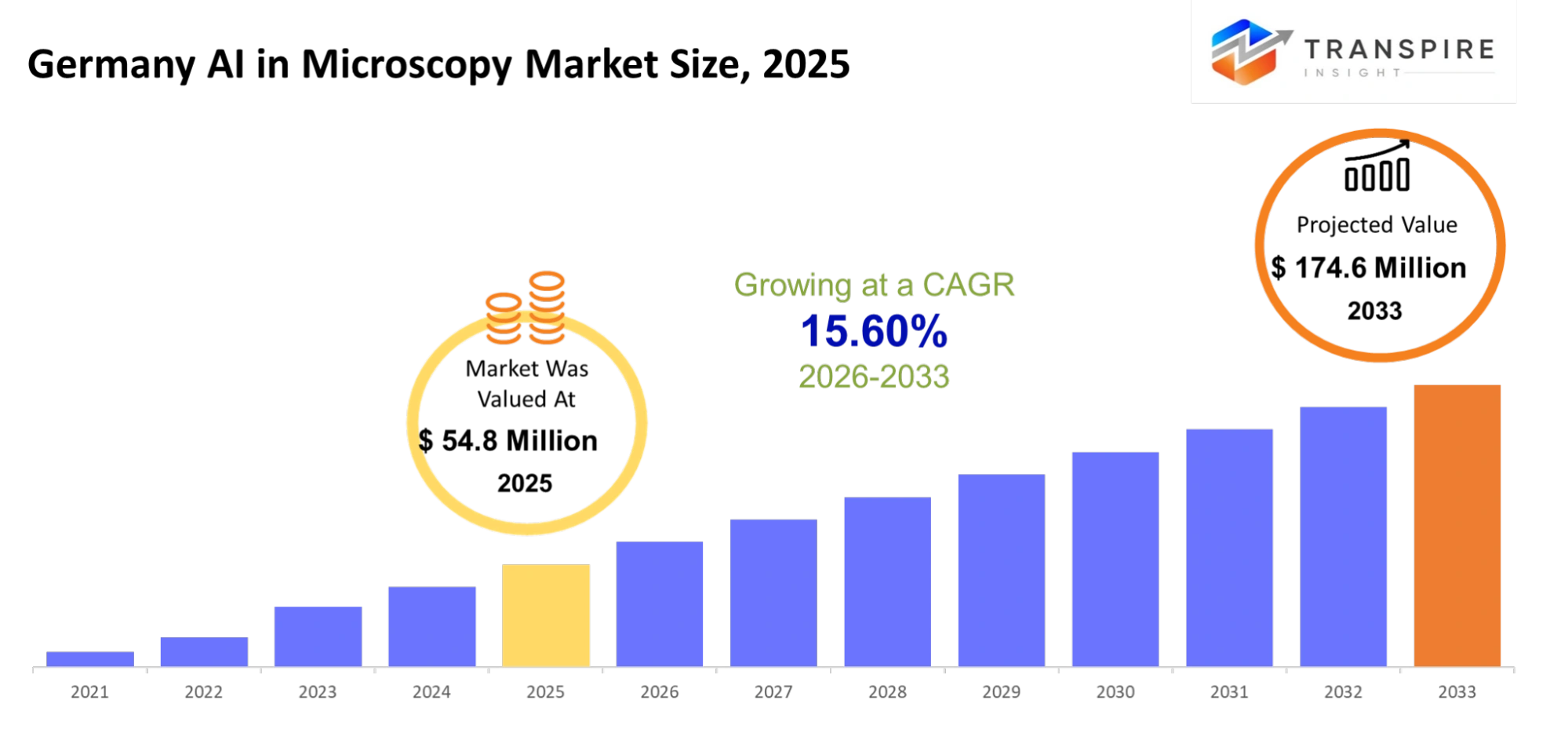
- Germany AI in Microscopy Market Size 2025: USD 54.8 Million
- Germany AI in Microscopy Market Size 2033: USD 174.6 Million
- Germany AI in Microscopy Market CAGR: 15.60%
- Germany AI in Microscopy Market Segments: ByComponent (Hardware, Software, Services), By Application (Life Sciences, Material Sciences, Nanotechnology), By End User (Research institutes, Hospitals, Pharmaceutical Companies)
To learn more about this report,  Download Free Sample Report
Germany AI in Microscopy Market Summary:
The Germany AI in Microscopy Market size is estimated at USD 54.8 Million in 2025 and is anticipated to reach USD 174.6 Million by 2033, growing at a CAGR of 15.60% from 2026 to 2033.
Germany will be a unique case in terms of AI in microscopy due to a push towards data-driven imaging. Research organizations and drug development companies will increasingly use ai for image interpretation to accelerate experiments and minimize bias. The need for pathology labs will prompt vendors to incorporate machine learning algorithms that emphasize cell anomalies in real-time. German universities and biotech companies will likely use devices that connect microscopes to cloud-based analysis tools for remote collaboration and dataset comparison. in addition, European data protection regulations and medical device regulations will influence software validation, promoting transparent algorithms.
Key Market Trends & insights:
There is no doubt that artificial intelligence will continually change laboratory imaging in Germany. Scientists will increasingly use artificial intelligence-based microscopy equipment to interpret cell structures without constant supervision. The testing will allow them to analyze extensive image data more efficiently which results in better biomedical research outcomes and drug development projects in Germany.
German hospitals and diagnostic labs will use artificial intelligence-based microscopy equipment to help doctors during tissue analysis. The equipment will help doctors identify unusual cell patterns and potential markers of diseases in a few seconds. Although doctors will still be in charge, artificial intelligence will greatly help them in their daily activities.
Another trend will be evident with the partnership between German universities, biotech companies, and microscope technology providers. This will push the boundaries of developing learning software for microscopes. The software will learn from prior tests because increasing data volume will enhance algorithm performance. Researchers will use this method to identify minute alterations in the composition of biological materials.
AI-based microscopy systems will see increased adoption and development in Germany and Europe because regulatory standards will determine their implementation. Organizations will concentrate on creating algorithms that are understandable while maintaining traceable data processing methods and achieving superior cybersecurity standards.
Germany AI in Microscopy Market Segmentation
By Component
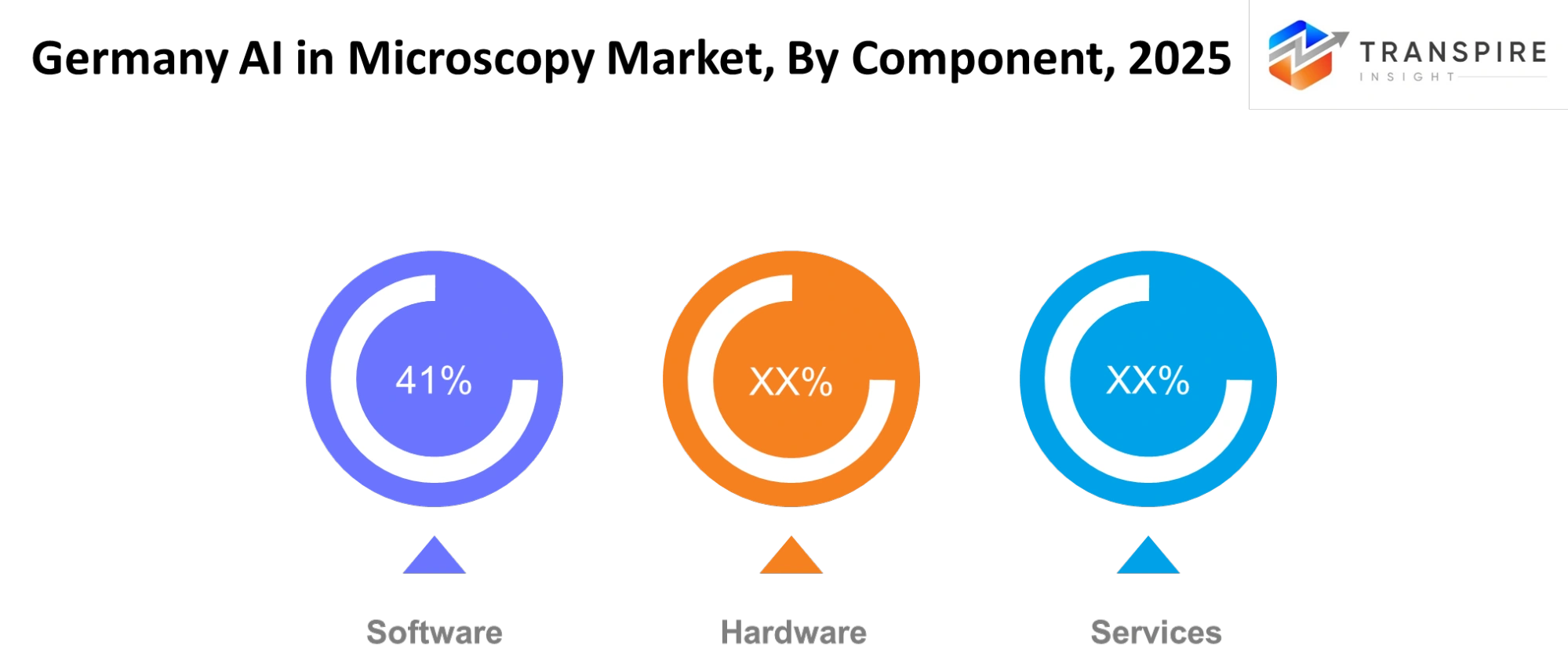
Hardware- The advanced hardware for microscopes will contain AI-ready processors and high-definition sensors and scanning stages. The German laboratories will start using intelligent microscopes which possess the capability to capture images of complex biological and material structures together with data transfer capabilities for analysis.
Software- AI-based software for microscopes will include capabilities for image classification, pattern recognition, and anomaly detection. The German researchers will start using intelligent algorithms to analyze microscope images which will lead to increased discoveries and enhanced diagnostic precision in laboratory investigations.
Services- Intelligent microscopes will require specialized service providers who can deliver integration and training and support services. The German laboratories will require consulting services to create customized analysis solutions for their existing laboratory systems.
To learn more about this report, Download Free Sample Report
By Application
Life Sciences- German laboratories for life sciences will use intelligent microscopes to study how cells behave and how diseases progress and how molecules interact with each other. The intelligent analysis capabilities will help scientists quickly interpret images from microscopes to identify biological patterns, along with conducting large-scale biomedical investigations.
Material Sciences- Scientists will use AI-assisted microscopy in their material science research to study microstructures and crystalline structures and defects that appear on the surface of materials. German engineering laboratories will use computerized image analysis to improve their material characterization process and their quality control methods and their advanced manufacturing research work.
Nanotechnology- Researchers will use AI-assisted microscopy in their nanotechnology studies to detect nanoscale patterns and changes in structural designs. German research laboratories will use intelligent microscopes for their nanotechnology studies and semiconductor research and development of new electronics and energy technologies.
By End User
Research institutes- German research laboratories will establish themselves as major users of AI-powered microscopy systems which will become one of their primary research tools. Scientists will utilize computerized image analysis to process large volumes of data generated during experiments. This technology will enable scientists to conduct research more efficiently in biological and nanotechnology and interdisciplinary scientific fields.
Hospitals- Hospitals will adopt AI-assisted microscopy to support pathology and diagnostic imaging services. The detection of abnormal structures will aid medical professionals during disease screening.
Pharmaceutical Companies- Pharmaceutical companies in Germany will make use of AI-integrated microscopes for the process of drug discovery and development. This will help the researchers to analyze the response of the treatment process and conduct various tests.
Country insights
Germany will also remain at the forefront of scientific imaging due to its research facilities and expertise in optical engineering. Universities and technical institutions will also seek to explore intelligent microscopy platforms, especially in biological and materials science research. Public research funding initiatives will also support research institutions using data-driven imaging platforms for complex research experiments.
Academic partnerships between universities, technology companies, and biomedical research centers will also enhance the development of intelligent microscopy analysis. Research centers in cities such as Berlin, Munich, and Heidelberg will also promote research in artificial intelligence, digital imaging, and molecular science to better understand complex biological and material structures.
Germany’s healthcare system will gradually integrate AI-assisted technology in microscopy systems within pathology laboratories. Hospitals will look to digital imaging technologies that can support pathologists in cellular analysis through intelligent microscopy systems. This will ensure effective management of increasing diagnostic demands with high accuracy, traceability, and security in handling patients’ information.
Industrial R&D centers and pharmaceutical companies in Germany will increasingly utilize intelligent microscopy systems in conducting experiments and in drug development studies. This will enable researchers to analyze large amounts of microscopic information with high accuracy in controlled environments.
Recent Development News
Breakthrough in Autonomous Laboratory Imaging- Scientists from a collaborative project involving German research institutions were part of a team that developed a laboratory AI agent capable of autonomously operating a complex microscope, planning and executing experiments without direct human control. This milestone was reported as part of work published in Nature Communications, demonstrating a clear shift toward automated imaging workflows in advanced microscopy settings.
Google Opens AI Research Center in Berlin- A new AI research facility recently opened in Berlin, focusing on computational biology and the use of advanced AI methods to study individual cell variations. Researchers there are expected to apply machine learning and intelligent imaging tools to deepen understanding of cellular processes, supporting future innovation in microscope-based analysis and data interpretation across life-science laboratories.
|
Report Metrics |
Details |
|
Market size value in 2025 |
USD 54.8 Million |
|
Market size value in 2026 |
USD 63.3 Million |
|
Revenue forecast in 2033 |
USD 174.6 Million |
|
Growth rate |
CAGR of 15.60% from 2026 to 2033 |
|
Base year |
2025 |
|
Historical data |
2021 – 2024 |
|
Forecast period |
2026 – 2033 |
|
Report coverage |
Revenue forecast, competitive landscape, growth factors, and trends |
|
Country scope |
Germany |
|
Key company profiled |
Carl Zeiss AG, Leica Microsystems, Olympus Corporation, Nikon Corporation, Thermo Fisher Scientific, Hitachi High-Tech, JEOL Ltd., Bruker Corporation, Keyence Corporation, Danaher Corporation, Oxford instruments, TESCAN Group, Digital Surf, Gatan inc., Nanolive SA. |
|
Customization scope |
Free report customization (country, regional & segment scope). Avail customized purchase options to meet your exact research needs. |
|
Report Segmentation |
By Component (Hardware, Software, Services), By Application (Life Sciences, Material Sciences, Nanotechnology), By End User (Research institutes, Hospitals, Pharmaceutical Companies) |
Key Germany AI in Microscopy Market Company insights
The Germany AI in microscopy market operates through advanced optics manufacturers and imaging technology providers together with AI-enabled software solution companies. The ecosystem exists because German life sciences facilities and Industry 4.0 infrastructure create strong connections between microscope hardware and AI-based image analysis software and digital pathology platforms.
The company ZEISS operates as a worldwide leader in optical and imaging technologies through its advanced light electron and X-ray microscopy systems for AI-enabled microscopy applications. The company develops AI-based image analysis systems together with automation workflows and high-throughput imaging platforms which the company uses for life sciences research materials testing and clinical diagnostics purposes.
Company List
- Carl Zeiss AG
- Leica Microsystems
- Olympus Corporation
- Nikon Corporation
- Thermo Fisher Scientific
- Hitachi High-Tech
- JEOL Ltd.
- Bruker Corporation
- Keyence Corporation
- Danaher Corporation
- Oxford instruments
- TESCAN Group
- Digital Surf
- Gatan inc.
- Nanolive SA
Germany AI in Microscopy Market Report Segmentation
By Component
- Hardware
- Software
- Services
By Application
- Life Sciences
- Material Sciences
- Nanotechnology
By End User
- Research institutes
- Hospitals
- Pharmaceutical Companies
Frequently Asked Questions
Find quick answers to common questions.
The approximate Germany AI in Microscopy Market size for the market will be USD 174.6 Million in 2033.
Key segments for the Germany AI in Microscopy Market By Component (Hardware, Software, Services), By Application (Life Sciences, Material Sciences, Nanotechnology), By End User (Research institutes, Hospitals, Pharmaceutical Companies).
Major players in the Germany AI in Microscopy Market are Carl Zeiss AG, Leica Microsystems, Olympus Corporation, Nikon Corporation, Thermo Fisher Scientific, Hitachi High-Tech, JEOL Ltd., Bruker Corporation, Keyence Corporation, Danaher Corporation, Oxford instruments, TESCAN Group, Digital Surf, Gatan inc., Nanolive SA.
The Germany AI in Microscopy Market size is USD 54.8 Million in 2025.
The Germany AI in Microscopy Market CAGR is 15.60%.
- Carl Zeiss AG
- Leica Microsystems
- Olympus Corporation
- Nikon Corporation
- Thermo Fisher Scientific
- Hitachi High-Tech
- JEOL Ltd.
- Bruker Corporation
- Keyence Corporation
- Danaher Corporation
- Oxford instruments
- TESCAN Group
- Digital Surf
- Gatan inc.
- Nanolive SA
Recently Published Reports
-
Apr 2026
AI in Diabetic Retinopathy Market
AI in Diabetic Retinopathy Market Size, Share & Analysis Report By Type (Screening AI Systems, Diagnostic AI Systems, and Predictive AI Models), By Application Segment (Hospitals, Ophthalmology Clinics, Diagnostic Centers, and Research and Development), and Geography (North America, Europe, Asia-Pacific, Middle East and Africa, South and Central America), 2021 - 2031
-
Apr 2026
Psychometric Tests Market
Psychometric Tests Market Size, Share & Analysis Report By Type (Personality Tests, Ability/Aptitude Tests, Skill/Knowledge Tests, and Others), By Application (Talent Acquisition and Talent Management), and Geography (North America, Europe, Asia-Pacific, Middle East and Africa, South and Central America), 2021 – 2031
-
Apr 2026
Rare Biological Sample Collection Market
Rare Biological Sample Collection Market Size, Share & Analysis Report By Type (Isolation Kits & Reagent, Blood Collection Tubes, and Others), By Application (Oncology, Transcriptomics, Pharmacogenomics, and Others), and Geography (North America, Europe, Asia-Pacific, Middle East and Africa, South and Central America), 2021 – 2031
-
Apr 2026
Patient Lift Pendant Market
Patient Lift Pendant Market By Product Type (Wired Pendants, Wireless, Programmable), By Operation Type(Manual, Electric), By End-Users (Healthcare Professionals, Patients), By Application (Hospitals, Homecare, Rehabilitation Centers, Others), By Industry Analysis, Size, Share, Growth, Trends, and Forecasts 2021-2033
Our Clients
.jpg)