

Fresh Strawberry Market Summary:
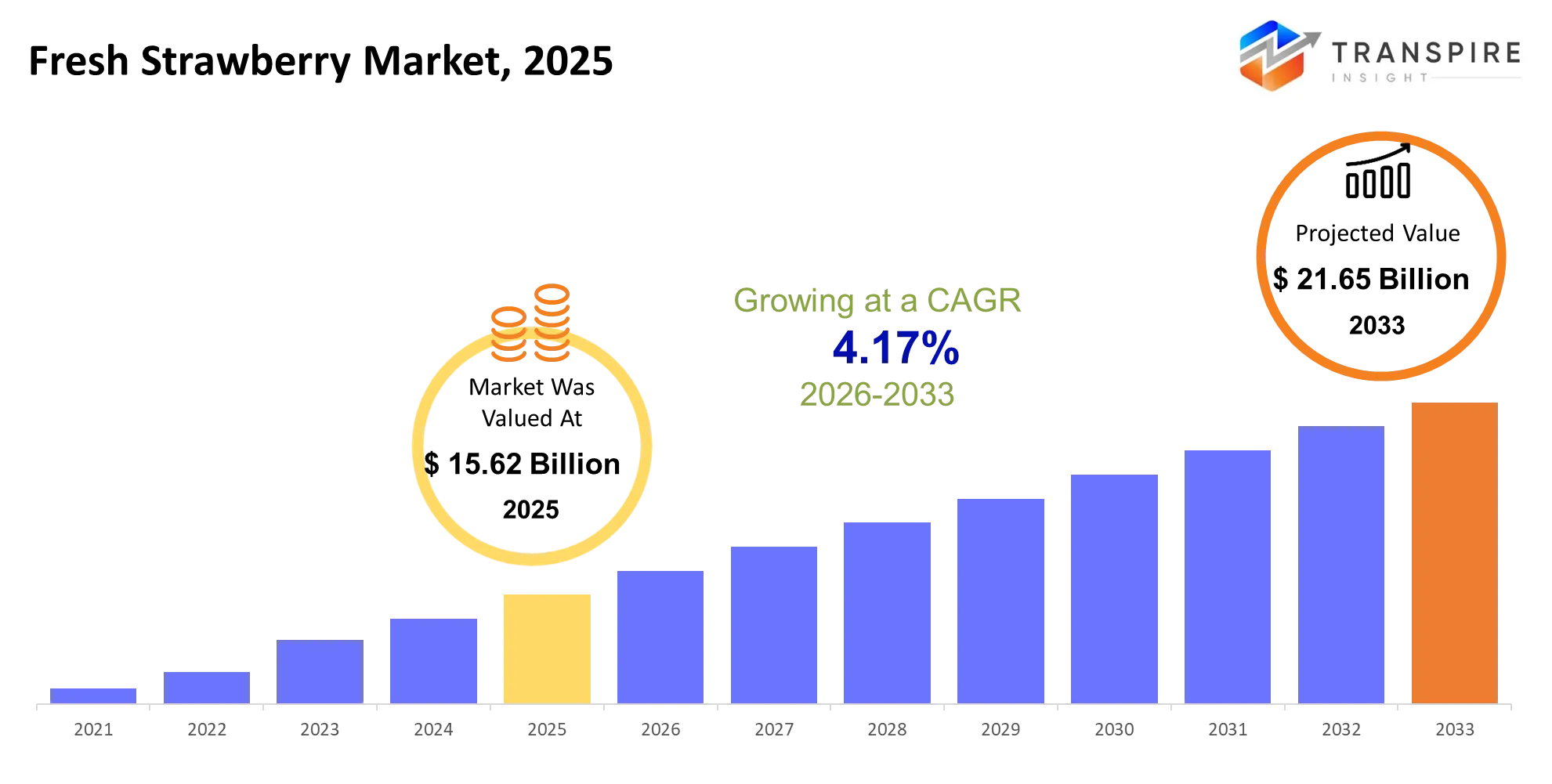
As per the Transpire Insight, The Fresh Strawberry Market size is estimated at USD 15.62 billion in 2025 and is anticipated to reach USD 21.65 billion by 2033, growing at a CAGR of 4.17% from 2026 to 2033.
The fresh strawberry market is moving away from the classical arrival-with-sell mentality towards a newly emerging controlled, quality-managed supply chain. In the last three to five years, growers, packers and retailers have ramped up their commitment to protected cultivation, precise monitoring, improved cold-chain management and packaging to slow deterioration. One structural change is the move towards data-led postharvest management where imaging, sensors and predictive models are progressively guiding grading, store stocking and dispatch decisions. One low-hanging fruit in the meantime is the industry's ongoing vulnerability to rapid softening, mould and quality loss from harvest to retail, at which even small shelf-life gains have commercial value. The latest 2026 research shows that modified-atmosphere packaging can extend strawberry shelf-life to 16 days and Teagasc pilot technology to 26 days. This will open markets to the far corners of the world, lower reject and markdown rates, and transform more of the harvested volume into saleable revenue.
Fresh Strawberry Market Size & Forecast:
- Market Size 2025: USD 15.62 Billion
- Expected Market Value (2033): USD 21.65 Billion
- Forecast CAGR (2026-2033): 4.17%
- Leading Region in 2025: North America
- Fastest Growing Region: Europe
- Key Company Profiles: Driscoll's, Naturipe Farms, California Giant Berry Farms, Wish Farms, Berry Gardens, Reiter Affiliated Companies, Good Farms, Mastronardi Produce, Oishii Farm, Dole, Fresh Del Monte, Sun Belle, Giumarra Companies, Costa Group, Agroberries.
Key Fresh Strawberry Market Insights:
Moving from volume-driven production to shelf-life, consistency, and traceability, technology is now directly becoming a margin lever. The trend of using protected cultivation, AI inspection, and advanced packaging is growing in order to minimise waste and maximise commercial reach.
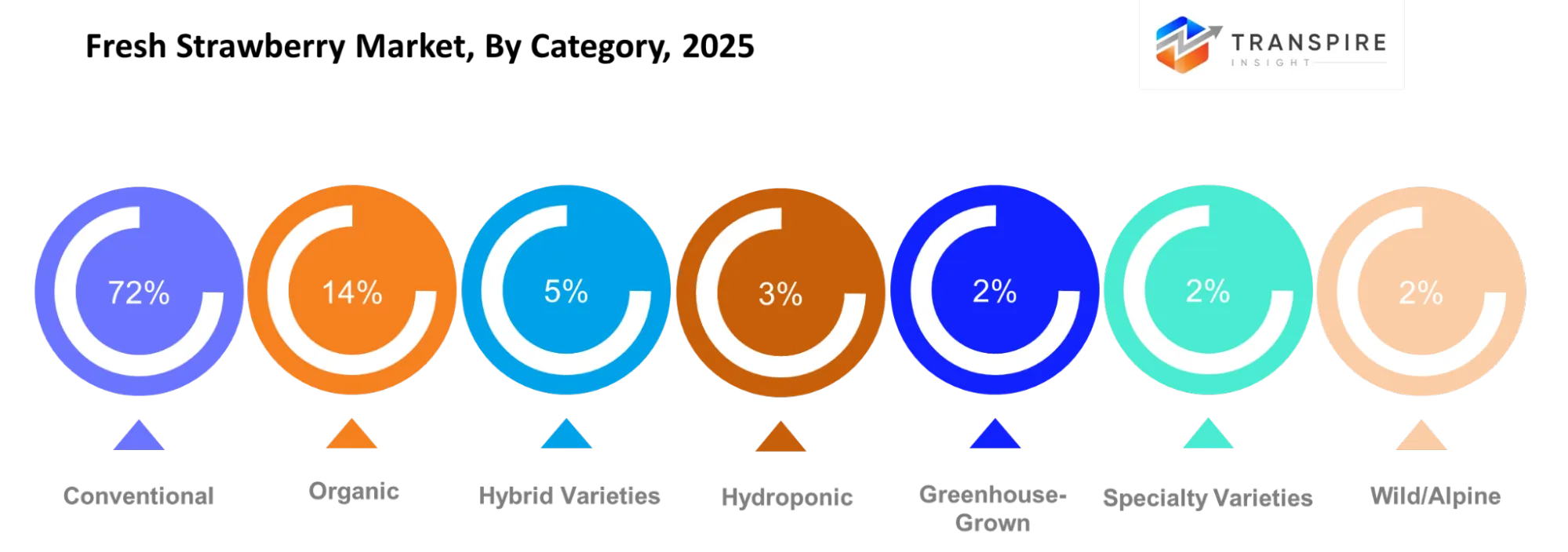
- Conventional berries maintain 72.00% market share, while Driscoll's leverages AI-powered crop and pricing insights, driven by retailers' demand for quality uniformity.
- Organic strawberries make up 14.00%, while Naturipe Farms continues to grow its residue reduction initiatives as consumers are increasingly interested in how the fruit is produced.
- Hydroponic supply accounts for 3.00%, and Oishii's indoor model is in response to the demand for locally grown, pesticide-free premium fruit.
- The berries grown in greenhouses have a 2.00% content; protected cultivation is used to ensure stability of production in case of adverse weather conditions, as is the case for Mastronardi Produce.
- Specialty varieties account for 1.50%, and specialty varieties are differentiated by branded flavor profiles as premium snacking becomes more popular.
- Wild and alpine berries make up 1.00%, and Berry Gardens specialize in niche culinary uses with unique flavor and origin.
- Other formats make up 1.50% while retailers look for counter-seasonal continuity as Sun Belle widens sourcing networks.
- Organic production is expected to grow by 6.24% CAGR; California Giant Berry Farms continues to innovate with varietal resilience in a climate-changing landscape.
- The partnership between Plenty and Driscoll's is powered by AI and aims to leverage more than 10 million data points each day, as the company moves toward all-year-round controlled supply.
What are the Key Drivers, Restraints, and Opportunities in the Fresh Strawberry Market?
Driver:
Retailers and foodservice buyers increasingly require reliable strawberry availability beyond the traditional local harvest window. This has been triggered by year-round supermarket assortments, rapid grocery delivery, and demand from premium snacking, bakery, dairy, and beverage brands that cannot tolerate seasonal supply gaps. Day-neutral and ever-bearing genetics, protected cultivation, and cross-hemisphere sourcing extend marketing windows, allowing suppliers to sell more weeks per year and negotiate supply programs rather than spot-market volumes. The result is higher revenue per hectare, improved packhouse utilisation, and greater adoption of premium clamshell and ready-to-eat formats.
Restraint:
Fresh strawberries remain unusually vulnerable to weather, labor availability, and post-harvest losses. Their soft texture and short shelf life make harvesting, grading, cooling, and transport time-critical. This persists structurally because fruit must often be hand-picked at maturity, while cold-chain failures or rain-related quality damage can rapidly reduce saleable volumes. Labor shortages and rising wage costs further pressure field-grown production.
Opportunity:
The clearest opportunity is combining preservation with precision production. AI-based maturity, disease, and damage detection can improve harvest timing and sorting, while smart packaging can continuously protect quality. Teagasc’s PMA-MAP pilot, which extended strawberry shelf life to 26 days, illustrates how recyclable or biodegradable packaging combined with optimized gas conditions could reduce waste and make longer-distance distribution more viable. This supports revenue and reduces write-offs.
What Has the Impact of Artificial Intelligence Been on the Fresh Strawberry Market?
AI is transforming fresh fruit production from traditional visual inspection-based approaches to tools for predictive management of the crop and quality. AI-enabled prediction models combine images from cameras, sensor data, weather, and crop history to estimate yield, detect diseases or pests, predict maturity, and support decisions on the optimal harvest date. A systematic review (2026) identified yield prediction, quality assessment, harvesting automation, and identification of diseases, pests, weeds, and damage as the main AI use cases in strawberries.
In post-harvest, computer vision can be used to classify maturities, to detect diseases and damage, and to help automate systems to grade fruit more consistently and to deliver batches to the right destination, based on quality. Predictive analytics can support irrigation, planning of labour, harvest schedule, and dispatch decisions to avoid unnecessary delays and resource use. All these developments improve operational efficiency and allow growers to start acting proactively before losses occur due to visible deterioration. However, high costs for cameras, sensors, robotics, and software integration limit adoption, and the performance of models may differ across cultivars, lighting, and field conditions. Better datasets, calibration at farm level, and interoperability between applications are therefore required.
In January 2026, SAP announced a multi-year strategic technology partnership with Syngenta to embed artificial intelligence at the core of its enterprise operations. This collaboration accelerates data analytics across manufacturing, supply chains, and grower-facing agricultural services to better manage variable field conditions and optimize resource allocation.
Key Fresh Strawberry Market Trends:
The market is shifting from expansion of volume to retention of quality, precision production, and longer selling windows. Increasingly, technology is being applied to protect margins in ways that do not lead to higher yields.
- In recent years, protected cultivation has moved from the niche to more controlled year-round production, minimising the impact of weather variability.
- Manual grading is moving towards computer vision: AI for grading fruit's maturity, disease and defects before it reaches packing lines.
- Packaging is moving away from the "clamshell" approach to "modified-atmosphere" systems that control gases, moisture and decay.
- Shelf-life consistency has become more important to retailers, and growers are being encouraged to choose cultivars and handling practices for transportability as well as flavour.
- Organic production is taking a step beyond the premium label to better control of inputs and traceability, making documented farm practices more important.
- Controlled processing is becoming significant because it can convert delicate fruit into a more valuable convenience product, such as fresh-cut and ready-to-eat.
- With online grocery and direct-to-consumer distribution, consumers are setting new expectations, and arrival condition is more important than harvest appearance.
- Sustainability is moving towards tangible loss reduction, packaging made of reusable materials, and reduced dependency on refrigeration.
Fresh Strawberry Market Segmentation
Type:
June-Bearing strawberries retain a strong commercial position because concentrated harvesting supports efficient labour utilisation, predictable supply planning and streamlined field operations. Ever-Bearing and Day-Neutral varieties extend production windows, helping growers reduce seasonal supply gaps and improve retailer availability. Hybrid Varieties, representing 5.00%, support breeding-led differentiation through improved firmness, flavour, disease tolerance and transport performance. Wild, Alpine and Speciality Varieties serve smaller premium niches where distinctive taste, appearance and origin can command higher prices. Future varietal development is expected to prioritise climate resilience, shelf life and consistent quality alongside consumer-focused attributes.
Category:
Conventional strawberries dominate at 72.00%, reflecting established cultivation economics, extensive grower networks and broad retail availability. Organic strawberries are positioned for faster expansion at a 6.24% CAGR, supported by premium positioning and stricter input-management practices, while the supplied mix assigns Organic 14.00%, Hydroponic 3.00%, Greenhouse-Grown 2.00%, Speciality Varieties 1.50%, Wild/Alpine 1.00% and Others 1.50%. These categories create opportunities for controlled cultivation, traceability, resource efficiency and differentiated pricing, particularly as retailers place greater emphasis on sustainable sourcing and consistent quality.
Form:
Fresh Whole remains commercially central because retailers prioritise visual quality, firmness and freshness. Fresh Cut, Packaged, Pre-Washed and Ready-to-Eat formats are gaining relevance as convenience becomes more important in household and foodservice purchasing. Clamshell packaging remains widely used because it protects delicate fruit during handling and transportation, while Bulk formats support processors, wholesalers and foodservice buyers. Packaging innovation is increasingly focused on moisture control, ventilation, and modified atmospheres, helping reduce spoilage and extend the commercial selling window.
Application:
Direct Consumption remains the primary outlet because strawberries are widely purchased as fresh fruit and incorporated into everyday meals. Dairy, Bakery, Confectionery, Beverages and Desserts create additional demand by using strawberries in yoghurts, fillings, toppings, beverages and premium desserts. Foodservice provides another important outlet through restaurants, cafés and institutional catering, while Cosmetics & Personal Care represents a smaller speciality application. Processors can also redirect visually imperfect fruit into sauces, purées and ingredients, improving overall crop utilisation.
Distribution Channel:
Supermarkets & Hypermarkets remain critical because their established cold-chain infrastructure supports large-volume strawberry sales and consistent quality control. Convenience Stores provide access to frequent, smaller purchases, while Farmers Markets and Speciality Stores strengthen local and premium positioning. Online Retail is expanding the importance of reliable packaging and delivery conditions because consumers increasingly expect fruit to arrive in saleable condition. Foodservice Suppliers and Wholesale Markets facilitate bulk movement, while Direct-to-Consumer channels allow growers to capture greater value through local sourcing and subscription-style models.
What are the Key Use Cases Driving the Fresh Strawberry Market?
Direct consumption leads the market, supported by the Conventional category’s 72.00% share and Fresh Whole formats. Supermarkets and convenience retailers prioritise firmness, appearance, and shelf life, encouraging improved cooling, clamshells, and modified-atmosphere packaging.
Expanding applications include dairy, bakery, confectionery, beverages, desserts, and foodservice, where strawberries provide flavour, colour, and premium appeal. Fresh-cut, packaged, and ready-to-eat formats increase convenience while helping processors monetise fruit unsuitable for premium whole-fruit sale.
Emerging opportunities centre on waste reduction and value-added processing. Advanced coatings, active packaging, and shelf-stable products can extend freshness and create off-season revenue channels. In 2026, UBC researchers developed an edible seaweed-based coating that kept strawberries fresh for at least four days at room temperature, potentially reducing spoilage and cold-chain dependence.
|
Report Metrics |
Details |
|
Market size value in 2025 |
USD 15.62 Billion |
|
Market size value in 2026 |
USD 21.65 Billion |
|
Revenue forecast in 2033 |
USD 21.65 Billion |
|
Growth rate |
CAGR of 4.17% from 2026 to 2033 |
|
Base year |
2025 |
|
Historical data |
2021 - 2024 |
|
Forecast period |
2026 - 2033 |
|
Report coverage |
Revenue forecast, competitive landscape, growth factors, and trends |
|
Regional scope |
United States; Canada; Mexico; United Kingdom; Germany; France; Italy; Spain; Denmark; Sweden; Norway; China; Japan; India; Australia; South Korea; Thailand; Brazil; Argentina; South Africa; Saudi Arabia; United Arab Emirates |
|
Key companies profiled |
Driscoll's, Naturipe Farms, California Giant Berry Farms, Wish Farms, Berry Gardens, Reiter Affiliated Companies, Good Farms, Mastronardi Produce, Oishii Farm, Dole, Fresh Del Monte, Sun Belle, Giumarra Companies, Costa Group, Agroberries |
|
Customization scope |
Free report customisation (country, regional & segment scope). Available customised purchase options to meet your exact research needs. |
|
Report Segmentation |
Type (June-Bearing, Ever-Bearing, Day-Neutral, Hybrid Varieties, Wild Strawberries, Alpine Strawberries, Specialty Varieties, Others); Category (Conventional, Organic, Sustainable, Hydroponic, Greenhouse-Grown, Locally Grown, Premium, Others); Form (Fresh Whole, Fresh Cut, Packaged, Pre-Washed, Clamshell, Bulk, Ready-to-Eat, Others); Application (Direct Consumption, Dairy, Bakery, Confectionery, Beverages, Desserts, Foodservice, Cosmetics & Personal Care); Distribution Channel (Supermarkets & Hypermarkets, Convenience Stores, Farmers Markets, Online Retail, Specialty Stores, Foodservice Suppliers, Wholesale Markets, Direct-to-Consumer). |
Which Regions are Driving the Fresh Strawberry Market Growth?
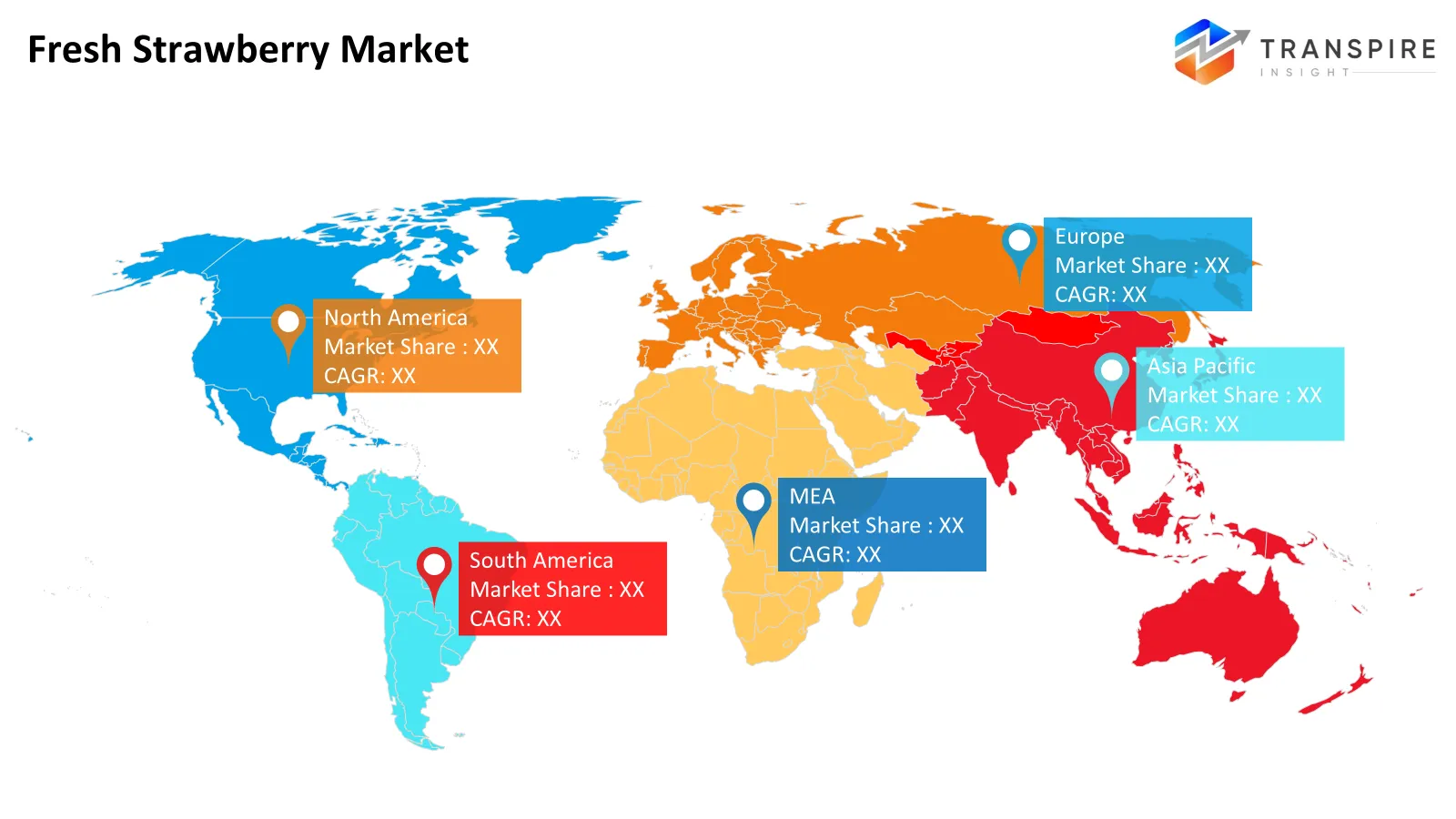
North America is the largest fresh strawberry market in the world with a market share of 37.71%. Market growth in North America is supported by extensive supermarket programs, boutique berry brands, and sophisticated cold chains. The northern scope of California, its deep nursery system, and border connections to Mexico support a stable, long-season supply. Along with premium retail merchandising, e-grocery ordering and international investments in protected cultivation are a long-term net benefit for North America, with various Northern Key Market examples including Plenty's Victorian vertical farm, which is designed to deliver more than four million pounds of Driscoll's strawberries annually.
In May 2026, Oishii secured $150 million in Series C financing. This capital injection supports the expansion of its automated indoor vertical strawberry farms and broadens year-round retail availability of pesticide-free produce.
Asia-Pacific accounts for a 24.00% share; its demand base is more varied and includes premium urban retail, gift culture, foodservice, and domestic sources. Japan, South Korea, China, and Australia strengthen the distribution of higher-value varieties, greenhouse-grown production, and branding associated with quality. Unlike North American networks of branded suppliers, growth in Asia Pacific will rely much more heavily on localized sources of supply and the consumer's readiness to pay for appearance, flavour, and novelty. Controlled-environment farms and digital agriculture provide stability where land, heat, and volatility caused by the monsoon constrain open-field yields.
In January 2026, the Department of Agriculture, in partnership with the Korea International Cooperation Agency, officially launched the construction of smart greenhouse facilities in Aklan. This initiative establishes a climate-resilient, high-efficiency production system aimed at boosting regional supplies of high-value crops.
https://www.icpen.org/news/1444
Europe is the fastest-growing regional market, forecast to grow at a 5.4% compound annual growth rate through 2028, supported by healthy demand for certified, traceable, sustainably-sourced berries. Its 27.00% share is supported by greenhouse production in northern markets and the substantial import volume from major supplying countries such as Spain and the Netherlands. Recent changes to regulations have affected import requirements; strawberries are now a low risk for certain EU demand items, which has resulted in a relaxation of documentary and physical-check requirements for those items. While this can serve to broaden sourcing options, quality, food safety, and phytosanitary requirements will continue to favor highly compliant suppliers.
In June 2026, Fall Creek Farm & Nursery completed the acquisition of Italy-based Berryplant and its breeding arm Berrytech, shifting its focus beyond blueberries to incorporate raspberry and blackberry genetics into its European production portfolio.
https://uk.finance.yahoo.com/news/europe-commercial-greenhouse-forecast-company-102900098.html
Who are the Key Players in the Fresh Strawberry Market, and how do they compete?
The berry industry competition is in intellectual property of genetics, season-long consistent supply, superior branding, and quality control from farm to consumer. Driscoll's approach is to invest in breeding, variety development, grower support, digital forecasting, and supply-chain applications powered by artificial intelligence-not to compete on price. Its work with Plenty combines its proprietary berry genetics with vertical farming technology that can produce more than 4 million pounds a year for a local, stable supply.
Joining the ranks of farming companies innovating with berry teams, company groups including Naturipe Farms, California Giant Berry Farms, Wish Farms, Berry Gardens, Reiter Affiliated Companies, Good Farms, Sun Belle, and Agroberries also work with grower partnerships, seasonal sourcing, branded packaging, and cultivar programs to reach retail and foodservice customers. California Giant is placing more emphasis on resilience via new varieties and responsible AI. Mastronardi Produce and Oishii Farm highlight controlled environment production, local availability, consistency, and quality. Dole, Fresh Del Monte, Giumarra Companies, Costa Group, and produce distributors serve the category with Logistics, category-management expertise, and strong retailer relationships. Their portfolio strategy often involves combining strawberries with other fresh produce products, broadening sourcing footprints, and reducing reliance on a single harvest region.
Key Players are:
- Driscoll's
- Naturipe Farms
- California Giant Berry Farms
- Wish Farms
- Berry Gardens
- Reiter Affiliated Companies
- Good Farms
- Mastronardi Produce
- Oishii Farm
- Dole
- Fresh Del Monte
- Sun Belle
- Giumarra Companies
- Costa Group
- Agroberries
Recent Development News
- In September 2026, Wish Farms partnered with Clarifresh to deploy AI-powered quality management and automated strawberry defect detection. The technology reduced quality inspection time by 70% and produce rejections by up to 50%, supporting more consistent fresh strawberry quality and lower supply-chain waste. https://www.bluebookservices.com/wish-farms-partners-with-clarifresh-to-transform-berry-quality-control-with-ai/
- In June 2026, LiVA Biotechnology partnered with Dyson Farming to launch a commercial-scale pilot of its prebiotic bio-protection technology for British strawberries. The pilot is designed to maintain strawberry quality across the supply chain, reduce markdowns and food waste, and improve grower returns. https://www.liva.ag/insight/how-liva-and-dyson-farming-are-keeping-british-strawberries-premium
- In January 2026, Bayer launched Baya Solara, the first commercial greenhouse strawberry variety under its De Ruiter brand. This product launch expands the enterprise's high-value horticultural footprint and introduces advanced, disease-resistant solutions optimised specifically for protected-culture environments. https://www.bayer.com/media/en-us/bayer-to-launch-innovative-strawberry-variety/
What Strategic Insights Define the Future of the Fresh Strawberry Market?
The market is moving towards a two-tier system as high-throughput, efficient conventional berries used for mass retail and higher-priced, technology-enabled berries that address year-round local, organic or better-flavour aspirations. A concern is that heavy reliance on protected cropping could increase exposure to energy costs, capital costs, and technology while reducing weather-related risk. The new opportunity is not just about indoor farming, but integrating proprietary genetics with real-time crop data, automated harvest, and demand projection. Artificial intelligence can help refine yield projections and suggest pest-management solutions that are compliant with market standards, reducing rejected loads and helping retailers' promotional planning. Suppliers should be focusing on premium combinations of flavour, firmness, and climate adjustment, investing in selecting before tying output to packhouse-to-retailer demand planning. Those who can provide buyers with consistent eating quality, traceable provenance and weekly supply will get more value than those competing on mere harvest volumes.
Key Segmentations are:
Type
- June-Bearing
- Ever-Bearing
- Day-Neutral
- Hybrid Varieties
- Wild Strawberries
- Alpine Strawberries
- Specialty Varieties
- Others
Category
- Conventional
- Organic
- Sustainable
- Hydroponic
- Greenhouse-Grown
- Locally Grown
- Premium
- Others
Form
- Fresh Whole
- Fresh Cut
- Packaged
- Pre-Washed
- Clamshell
- Bulk
- Ready-to-Eat
- Others
Application
- Direct Consumption
- Dairy
- Bakery
- Confectionery
- Beverages
- Desserts
- Foodservice
- Cosmetics & Personal Care
Distribution Channel
- Supermarkets & Hypermarkets
- Convenience Stores
- Farmers Markets
- Online Retail
- Specialty Stores
- Foodservice Suppliers
- Wholesale Markets
- Direct-to-Consumer
By Regional Analysis
North America
- US
- Canada
- Mexico
Europe
- Germany
- UK
- France
- Italy
- Spain
- Russia
- Rest of Europe
Asia Pacific
- China
- Japan
- India
- South Korea
- Australia
- Rest of Asia Pacific
South America
- Brazil
- Argentina
- Rest of South America
Middle East & Africa
- UAE
- Saudi Arabia
- Qatar
- South Africa
- Rest of the Middle East & Africa
Frequently Asked Questions
Find quick answers to common questions.
The fresh strawberry market size was valued at USD 15.62 billion in 2025 and is poised to reach USD 21.65 billion by 2033, expanding at a 4.17% CAGR.
Key segments for the fresh strawberry market are Type (June-Bearing, Ever-Bearing, Day-Neutral, Hybrid Varieties, Wild Strawberries, Alpine Strawberries, Specialty Varieties, Others); Category (Conventional, Organic, Sustainable, Hydroponic, Greenhouse-Grown, Locally Grown, Premium, Others); Form (Fresh Whole, Fresh Cut, Packaged, Pre-Washed, Clamshell, Bulk, Ready-to-Eat, Others); Application (Direct Consumption, Dairy, Bakery, Confectionery, Beverages, Desserts, Foodservice, Cosmetics & Personal Care); Distribution Channel (Supermarkets & Hypermarkets, Convenience Stores, Farmers Markets, Online Retail, Specialty Stores, Foodservice Suppliers, Wholesale Markets, Direct-to-Consumer).
Growth is primarily driven by expansion of protected cultivation, improved cold-chain and postharvest technologies, AI-enabled crop monitoring and sorting, longer shelf-life packaging, premium and organic production, and wider distribution through supermarkets, online retail, and foodservice channels.
The fresh strawberry market is led by major manufacturers, including Driscoll's, Naturipe Farms, California Giant Berry Farms, Wish Farms, Berry Gardens, Reiter Affiliated Companies, Good Farms, Mastronardi Produce, Oishii Farm, Dole, Fresh Del Monte, Sun Belle, Giumarra Companies, Costa Group, Agroberries.
North America holds 37.71% of the fresh strawberry market, supported by advanced breeding programs, large-scale commercial cultivation, established cold-chain infrastructure, sophisticated packing operations, strong supermarket networks, and investment in automation and protected production.
Commercial opportunities include AI-enabled cultivation, protected farming, intelligent packaging, organic and premium varieties, shelf-life extension technologies, waste-reduction solutions, and expansion of controlled-environment production in Asia-Pacific and Europe.
- Driscoll's
- Naturipe Farms
- California Giant Berry Farms
- Wish Farms
- Berry Gardens
- Reiter Affiliated Companies
- Good Farms
- Mastronardi Produce
- Oishii Farm
- Dole
- Fresh Del Monte
- Sun Belle
- Giumarra Companies
- Costa Group
- Agroberries
About the Authors

Chetan Dhatrak
I’m Chetan Dhatrak, a Senior Research Analyst at Transpire Insight, specializing in the Consumer Goods, Foods and Beverages industry. I focus on analyzing market trends, consumer behavior, competitive landscapes, and industry developments to deliver accurate, data-driven insights. My research at Transpire Insight is built on credible sources and in-depth analysis, helping businesses and readers better understand market dynamics, emerging opportunities, and evolving consumer preferences. I’m committed to creating reliable, well-researched content that supports informed decision-making and reflects the latest developments in the consumer goods and food & beverage sectors.

Chakradhar Khansole
Chakradhar serves as the Research Director at Transpire Insight, bringing over 8 years of experience in technology, innovation, and strategic market intelligence. He specializes in transforming complex market data into actionable business insights that enable organizations to make informed, growth-oriented decisions. Recognized for his strategic vision and analytical expertise, Chakradhar leads high-impact research initiatives, delivering comprehensive market assessments, competitive intelligence, and forward-looking industry analysis.
Recently Published Reports
-
Apr 2026
Baby Infant Formula Market
Baby Infant Formula Market Size, Share & Analysis Report By ype (Infant Milk, Follow On Milk, Specialty Baby Milk, Growing-Up Milk), By Ingredient (Carbohydrate, Fat, Protein, Minerals, Vitamins, and Others), By Product Form (Powder, Liquid, and Ready-to-feed), By Distribution Channels (Supermarket/Hypermarket, Specialty Store, Pharmacies, Online Retail, and Others), and Geography (North America, Europe, Asia-Pacific, Middle East and Africa, South and Central America), 2021 - 2031
-
Apr 2026
Edible Insects for Animal Feed Market
Edible Insects for Animal Feed Market Size, Share & Analysis Report By Type (Insect Powder, Insect Meal, Insect Bar, Insect Paste, Insect Oil, and Others), By Insect Type (Beetles, Cricket, Caterpillar, Hymenoptera, Orthoptera, Tree Bugs, and Others), By Application (Livestock, Pet Food, and Aquaculture), By Livestock Type (Poultry, Swine, and Others), and Geography (North America, Europe, Asia-Pacific, Middle East and Africa, South and Central America), 2021 - 2031
-
Apr 2026
Food Industry Disinfection and Bacterial Control Market
Food Industry Disinfection and Bacterial Control Market Size, Share & Analysis Report By Type (Chemical Disinfectants, Physical Disinfectants, and Biocides and Antimicrobials), By Application (Food Processing Equipment Surface Disinfection, Food Preparation Areas Surface Disinfection, Storage Areas Surface Disinfection, Anti-microbial Coatings Food Preservation, and Preservative Solutions Food Preservation), By End User (Meat and Poultry Processing, Dairy Processing, Seafood Processing, Bakery and Confectionery, Restaurants and Commercial Kitchens, and Food Service Providers), By Sales Channel (Online, Offline), and Geography (North America, Europe, Asia-Pacific, Middle East and Africa, South and Central America), 2021 - 2031
-
May 2026
Freeze Dried Food Market
Freeze Dried Food Market Size, Share & Analysis Report By Product Type (Fruits, Vegetables, Freeze-Dried Dairy Products, Freeze-Dried Meat and Seafood, Freeze-Dried Pet Food, and Prepared Meal), By Nature (Organic, and Conventional), By Form (Powdered, Granules, and Diced), By End Use (Breakfast Cereals, Dairy Products, Bakery & Confectionery, Nutritional Bars & Supplements, Powdered Beverages, Snacks, and Retail (Household)), and Geography (North America, Europe, Asia-Pacific, Middle East and Africa, South and Central America), 2021 - 2031