
France Smart Fabrics Market Size & Forecast:
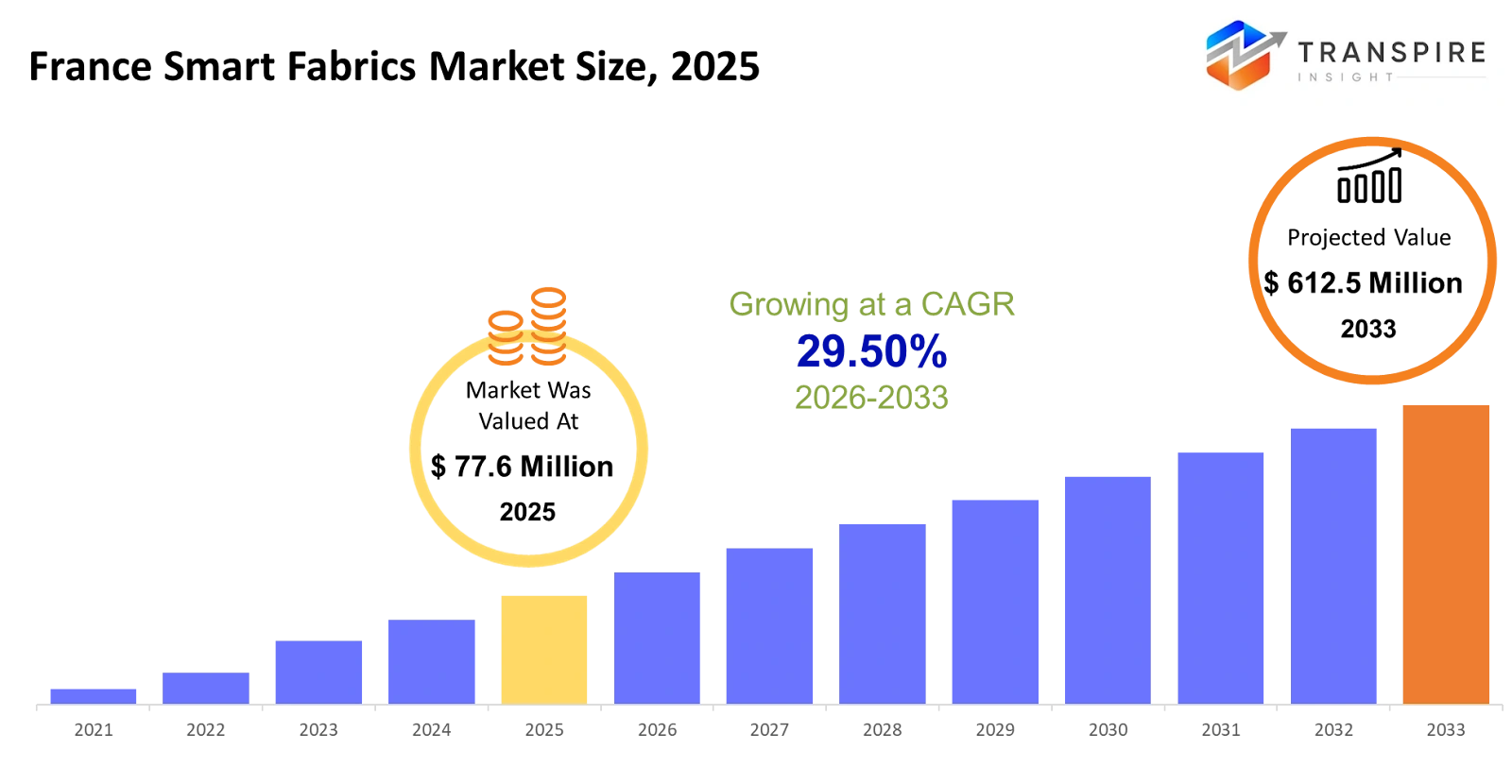
- France Smart Fabrics Market Size 2025: USD 77.6 Million
- France Smart Fabrics Market Size 2033: USD 612.5 Million
- France Smart Fabrics Market CAGR:29.50%
- France Smart Fabrics Market Segments by Product Type (Passive Smart Fabrics, Active Smart Fabrics, Ultra-Smart Fabrics), by Application (Sports & Fitness, Healthcare, Defense, Fashion & Entertainment).
To learn more about this report,  Download Free Sample Report
France Smart Fabrics Market Summary:
TheFrance Smart Fabrics Market size was estimated at USD 77.6 Millionin 2025 and is anticipated to reach USD 612.5 Million by 2033, growing at a CAGR of 29.50% from 2026 to 2033.
The france smart fabrics market sits within the wider textile innovation and advanced materials industry. The future of clothing and fabric design will progress from traditional comfort and style toward functional design. The French fashion industry combines its historical craftsmanship with its current research on technical textiles to create fabrics that incorporate sensing and temperature control and data interaction capabilities. The evolution of garment design will start from this transformation which affects all stages of garment creation and usage. The research groups and engineering labs throughout the nation will continue their partnership with textile manufacturers. The clothing industry will use these new developments to create healthcare garments and protective workwear and sports apparel and mobility-related textiles needed for transport interiors. The france smart fabrics market will grow from this blend of fashion heritage and applied science. Designers will work with electronics specialists and material scientists to create responsive fabrics that designers will use in everyday applications. French consumers will develop interest in garments that provide comfort while they secretly track their health and environmental impact. The concept of clothing that measures body signals and adapts to climate changes will transition from experimental status to becoming a standard feature in upcoming product lines developed through innovation-based textile clusters.
The future progress of the field will depend on the technological advancements that will emerge during its development. The French research initiatives that study conductive yarns and flexible sensors and washable electronic components will advance fabric development to achieve better real-world performance. The research activities of universities and technical institutes will continue until they find ways to integrate microelectronics into fibers which maintain their original softness and durability. Textile manufacturers will experiment with methods to produce garments that remain lightweight while requiring minimal maintenance. The product development process will be affected by regulatory sustainability requirements and material safety regulations which govern product environmental sustainability through their complete lifecycle. French environmental regulations will motivate businesses to evaluate their product recyclability and energy consumption during manufacturing and the environmental consequences of electronic materials used in textile production. People will demand more detailed information about how products are made and where they come from. The increasing public understanding of health and fitness tracking and personal comfort will lead to consumer demand for clothing which provides them basic support through its design rather than through complicated technological features. The demand for products will steer design development towards solutions which combine user-friendly functionality with fashion design elements. The France smart fabrics market will develop through laboratory research and design practices and government regulations which will convert experimental textiles into functional materials used in daily life.
Key Market Trends & Insights:
- The France Smart Fabrics Market maintains its interest in advanced textile technology because connected sportswear technology gains more popularity among consumers. Research labs and sports brands develop fabrics which can detect human body temperature and physical movements and perspiration rates. Wider use of sensor-based materials results from their application in athletic training programs and fitness tracking systems and professional sports training.
- French medical facilities and textile manufacturers develop fabric systems which enable health monitoring while delivering comfort to patients. Hospitals and rehabilitation centers show interest in smart garments which monitor heart rate and breathing and body temperature. The need for advanced medical textiles increases because of growing elderly populations and the emergence of remote health monitoring technologies.
- The development of digital device-compatible fabrics arises from electronic engineers and textile manufacturers who work together. Clothing uses conductive fibers and flexible circuits and washable sensors to connect with mobile applications and monitoring platforms. French research groups support projects which integrate textile engineering with microelectronics and wireless communication technology.
- The French military programs and industrial safety departments invest in intelligent protective textiles through their funding of research work. The combination of heat-resistant materials with chemical sensing fibers and fabrics that track physical stress enables better protection for soldiers and firefighters and workers in dangerous conditions. The government funding of innovation programs continues to drive research efforts toward development of functional protective clothing.
- Environmental awareness drives researchers to investigate recyclable fibers and energy-efficient manufacturing methods for developing smart textiles. French textile laboratories focus their research on biodegradable conductive yarns and environmentally friendly coating methods. Smart material research supports sustainable production objectives which direct new textile innovation paths and responsible manufacturing practices for technical fabric manufacturers.
France Smart Fabrics Market Segmentation
By Product Type :
- Passive Smart Fabrics: Passive smart fabrics hold sensing ability without direct response or energy generation. Textile structures contain conductive yarns, temperature-sensitive fibers, or moisture-responsive layers that register environmental change. Within the France Smart Fabrics Market, passive variants gain attention in athletic garments and industrial wear because simple design supports durability, easy manufacturing processes, and stable performance during long-term usage.
- Active Smart Fabrics: Active smart fabrics combine sensing capacity with reaction capability through integrated electronics or responsive materials. Fabric structures detect heat, pressure, or motion and then produce measurable responses such as thermal adjustment or signal transmission. Demand in the France Smart Fabrics Market grows steadily as wearable technology companies and textile innovators invest in performance clothing and medical monitoring garments.
- Ultra-Smart Fabrics: Ultra-smart fabrics represent advanced textile engineering in which sensing, reaction, and adaptation occur within a single material system. Embedded microprocessors, communication modules, and energy components enable fabric surfaces to process information and automatically adjust functions. Research institutions and technology laboratories in France continue exploring the ultra-smart fabric's potential for interactive clothing and intelligent protective equipment.
By Application Type :
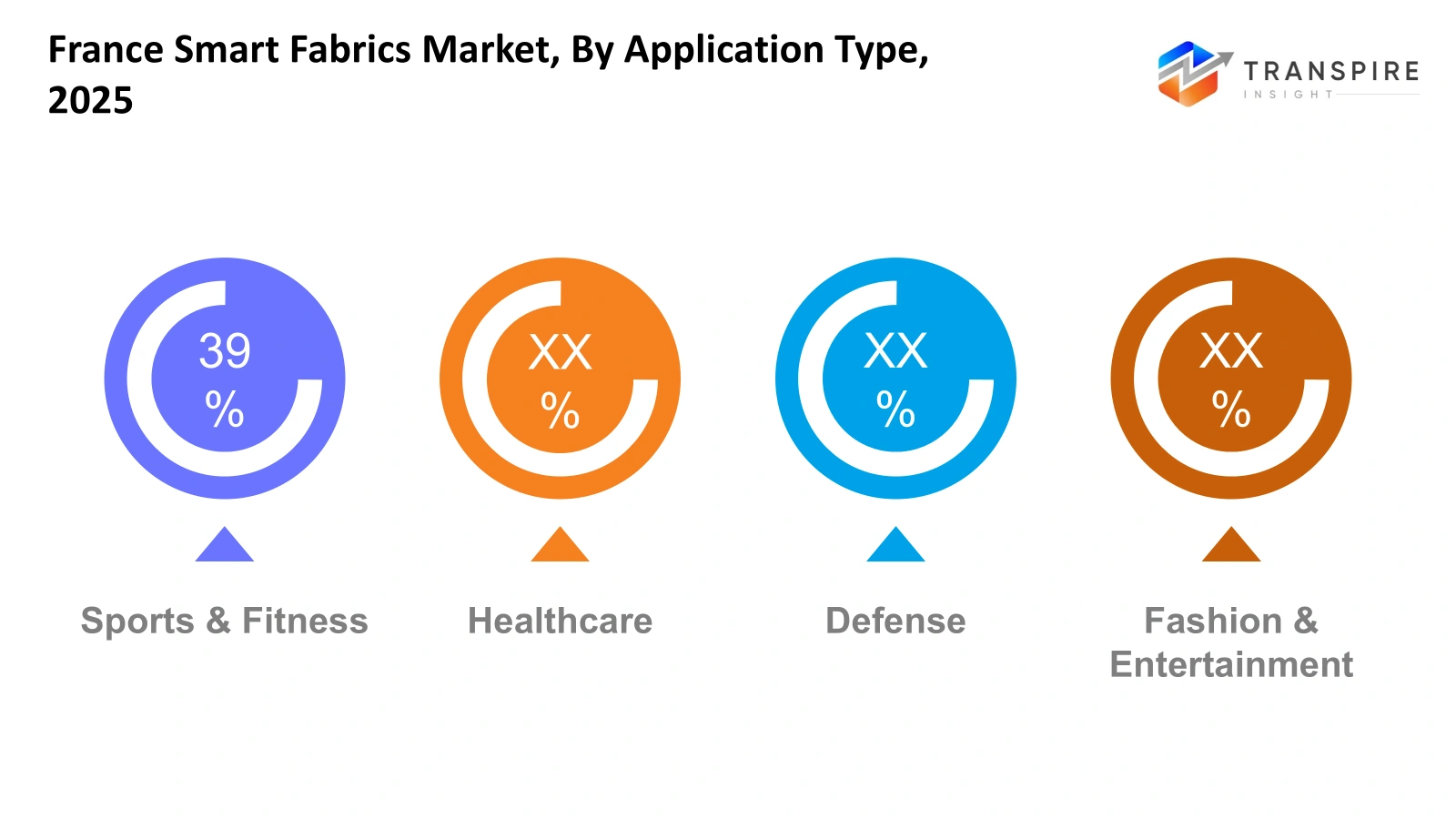
- Sports & Fitness: Sports and fitness applications drive strong interest in advanced textile innovation. Athletic brands explore garments with biometric tracking, muscle activity monitoring, and temperature control features. Growing consumer interest in performance improvement encourages integration of intelligent fabrics in training apparel, smart compression wear, and connected sportswear designed for professional athletes and active lifestyle communities.
- Healthcare: Healthcare institutions examine smart textile solutions for patient monitoring, rehabilitation support, and elderly care. Medical garments equipped with sensors record heart activity, breathing patterns, and body movement without bulky equipment. Hospitals and health technology developers consider fabric-based monitoring systems valuable for long-term observation, home care programs, and improved comfort during medical supervision.
- Defense, Fashion & Entertainment: Defense organizations evaluate intelligent fabrics for protective uniforms capable of detecting environmental hazards, chemical exposure, or body stress levels. Fashion designers and entertainment producers also experiment with illuminated textiles, motion-responsive costumes, and stage garments containing electronic elements. Creative industries combine technology and textile design to produce visually interactive clothing concepts.
To learn more about this report, Download Free Sample Report
Country Insights
- The advanced textile research and design capabilities of France reach their peak through its established manufacturing networks, fashion schools and technical research facilities. The demand for connected clothing, performance wear, and health-monitoring textiles continues to grow as consumer interest in these products rises. The Smart Fabrics Market in France is experiencing steady growth due to advances in conductive fibre technology and the development of sensor-equipped clothing.
- French people established their first textile craft tradition, which merged with contemporary engineering methods. Research centres, together with design schools and specialized manufacturers create fabrics that enable electronic functions and heat management and biometric measurement. The partnership between these two organisations develops new technologies for developing technical clothing which people use during sports activities and medical treatments and hazardous work operations.
- The market for intelligent textiles expands because of the increasing popularity of wearable technology. Sports brands and medical device manufacturers and fashion designers study fabrics that monitor body signals while providing heat management and comfort enhancement. The hospitals and rehabilitation facilities express interest in clothing which enables patient monitoring and recovery processes without requiring large medical equipment.
- The industrial growth receives support from government research programs and the establishment of textile producer partnerships with universities. The textile clusters in Auvergne-Rhône-Alpes and Hauts-de-France concentrate on developing advanced fiber processing techniques and testing intelligent materials. The initiatives create new production capabilities while establishing sustainable development for the France Smart Fabrics Market.
Recent Development News
France advances textile innovation with 3D printing on fabrics
French textile specialist Serge Haouzi has been experimenting with advanced textile finishing technologies, including a Stratasys system capable of directly printing 3D patterns and textures onto fabrics. The technology allows designers to embed structural elements into garments, opening possibilities for functional smart textiles in fashion and technical apparel.
Northern France innovation hubs expand development of smart technical textiles
Industrial textile laboratories in northern France have demonstrated advanced knitting and weaving systems designed for wearable electronics and protective smart textiles. These facilities test fabrics for sportswear, civil protection, and defense applications.
|
Report Metrics |
Details |
|
Market size value in 2025 |
USD 77.6 Million |
|
Market size value in 2026 |
USD 100.3 Million |
|
Revenue forecast in 2033 |
USD 612.5 Million |
|
Growth rate |
CAGR of 29.50% from 2026 to 2033 |
|
Base year |
2025 |
|
Historical data |
2021 - 2024 |
|
Forecast period |
2026 - 2033 |
|
Report coverage |
Revenue forecast, competitive landscape, growth factors, and trends |
|
Country scope |
France |
|
Key company profiled |
DuPont de Nemours Inc., Textronics Inc., Sensoria Inc., Adidas AG, Nike Inc., Under Armour Inc., Google LLC, Samsung Electronics Co. Ltd., AIQ Smart Clothing Inc., Myant Inc., Hexoskin Inc., Toray Industries Inc., Koninklijke Ten Cate BV, Interactive Wear AG, Ohmatex ApS. |
|
Customization scope |
Free report customization (country, regional & segment scope). Avail customized purchase options to meet your exact research needs. |
|
Report Segmentation |
By Product Type (Passive Smart Fabrics, Active Smart Fabrics, Ultra-Smart Fabrics), By Application (Sports & Fitness, Healthcare, Defense, Fashion & Entertainment) |
Key France Smart Fabrics Company Insights
- DuPont has established itself as a major player in the France Smart Fabrics Market through its long-standing expertise in advanced materials. The research programs study conductive fibers and protective textiles and temperature-responsive materials. The company tests its products through partnerships with European textile manufacturers, while its materials science investments lead to the creation of fabrics that meet safety standards and industrial requirements for durability and performance.
- Toray Industries maintains a strong presence in technical textile development linked with European demand for intelligent materials. The project focuses on three areas which include fiber engineering and lightweight textile structures and sensor-compatible materials development. The organization collaborates with apparel manufacturers and research institutes to advance wearable technology and sports clothing and medical monitoring garments designed for daily wear.
- Schoeller Textil AG receives recognition for producing high-performance textiles that find application in outdoor apparel, protective equipment, and advanced clothing products. Research activity emphasizes breathable fabrics, temperature control layers, and functional coatings. European clothing brands need durable materials which provide increased comfort and adaptability, so they conduct ongoing testing of smart textile finishes.
- The company develops its products through smart socks, fitness clothing and medical monitoring fabric technology. The company partners with healthcare institutions and sports technology companies to promote connected fabrics which track human movement and pressure distribution and active body movement.
- Hexoskin produces biometric clothing which functions in sports research and health monitoring and scientific studies. The clothing items use fabric sensors to track heart rate and breathing patterns and physical activity metrics. The ongoing development of washable electronic textiles together with user-friendly clothing designs will enable more professionals to use smart clothing during their training and medical monitoring activities.
France Smart Fabrics Market Companies:
- DuPont de Nemours Inc.
- Textronics Inc.
- Sensoria Inc.
- Adidas AG
- Nike Inc.
- Under Armour Inc.
- Google LLC
- Samsung Electronics Co. Ltd.
- AIQ Smart Clothing Inc.
- Myant Inc.
- Hexoskin Inc.
- Toray Industries Inc.
- Koninklijke Ten Cate BV
- Interactive Wear AG
- Ohmatex ApS
France Smart Fabrics Market Segmentation
By Product Type
- Passive Smart Fabrics
- Active Smart Fabrics
- Ultra-Smart Fabrics
By Application
- Sports & Fitness
- Healthcare
- Defense
- Fashion & Entertainment
Frequently Asked Questions
Find quick answers to common questions.
The approximate France Smart Fabrics Market size for the market will be USD 612.5 Million in 2033.
Key segments for the France Smart Fabrics Market are by Product Type (Passive Smart Fabrics, Active Smart Fabrics, Ultra-Smart Fabrics), by Application (Sports & Fitness, Healthcare, Defense, Fashion & Entertainment).
Major France Smart Fabrics Market players are DuPont de Nemours Inc., Textronics Inc., Sensoria Inc., Adidas AG, Nike Inc., Under Armour Inc., Google LLC, Samsung Electronics Co. Ltd., AIQ Smart Clothing Inc., Myant Inc., Hexoskin Inc., Toray Industries Inc., Koninklijke Ten Cate BV, Interactive Wear AG, Ohmatex ApS.
The France Smart Fabrics Market size is USD 77.6 Million in 2025.
The France Smart Fabrics Market CAGR is 29.50%.
- DuPont de Nemours Inc.
- Textronics Inc.
- Sensoria Inc.
- Adidas AG
- Nike Inc.
- Under Armour Inc.
- Google LLC
- Samsung Electronics Co. Ltd.
- AIQ Smart Clothing Inc.
- Myant Inc.
- Hexoskin Inc.
- Toray Industries Inc.
- Koninklijke Ten Cate BV
- Interactive Wear AG
- Ohmatex ApS
Recently Published Reports
-
Apr 2026
Bottled Water Market
Bottled Water Market Size, Share & Analysis Report By Product Type (Still Bottled Water, Carbonated Bottled Water, Functional Bottled Water, and Others), By Packaging (PET, Cans, and Others), By Sales Channel (Supermarkets/Hypermarkets, Convenience Stores/Drug Stores, Grocery Stores/Club Stores, Foodservice, and Others) and Geography (North America, Europe, Asia-Pacific, Middle East and Africa, South and Central America), 2021 - 2032
-
Apr 2026
Color Cosmetic Packaging Market
Color Cosmetic Packaging Market Size, Share & Analysis Report By Application (Mascara Packaging, Liquid Packaging, and Liquid Face), By Type (Tubes & Bottles, Pens & Markers, Compacts & Containers, and Droppers & Pumps), and Geography (North America, Europe, Asia-Pacific, Middle East and Africa, South and Central America), 2021 - 2031
-
Apr 2026
External Microphone For Camera Market
External Microphone For Camera Market Size, Share & Analysis Report By Type (Shotgun Microphone, Lavalier Microphone, and Others), By Application (Digital Camera, Professional Video Camera, and Others), and Geography (North America, Europe, Asia-Pacific, Middle East and Africa, South and Central America), 2021 - 2031
-
Apr 2026
Foot Orthotic Insoles Market
Foot Orthotic Insoles Market Size, Share & Analysis Report By Type (Pre-fabricated, and Custom-made), By Material (Thermoplastic, Composite Carbon Fiber, and Others), By Distribution Channel (Drug Stores, Hospitals & Clinics, and Others), and Geography (North America, Europe, Asia-Pacific, Middle East and Africa, South and Central America), 2021 - 2031