

France Shrimp Market Size & Forecast:
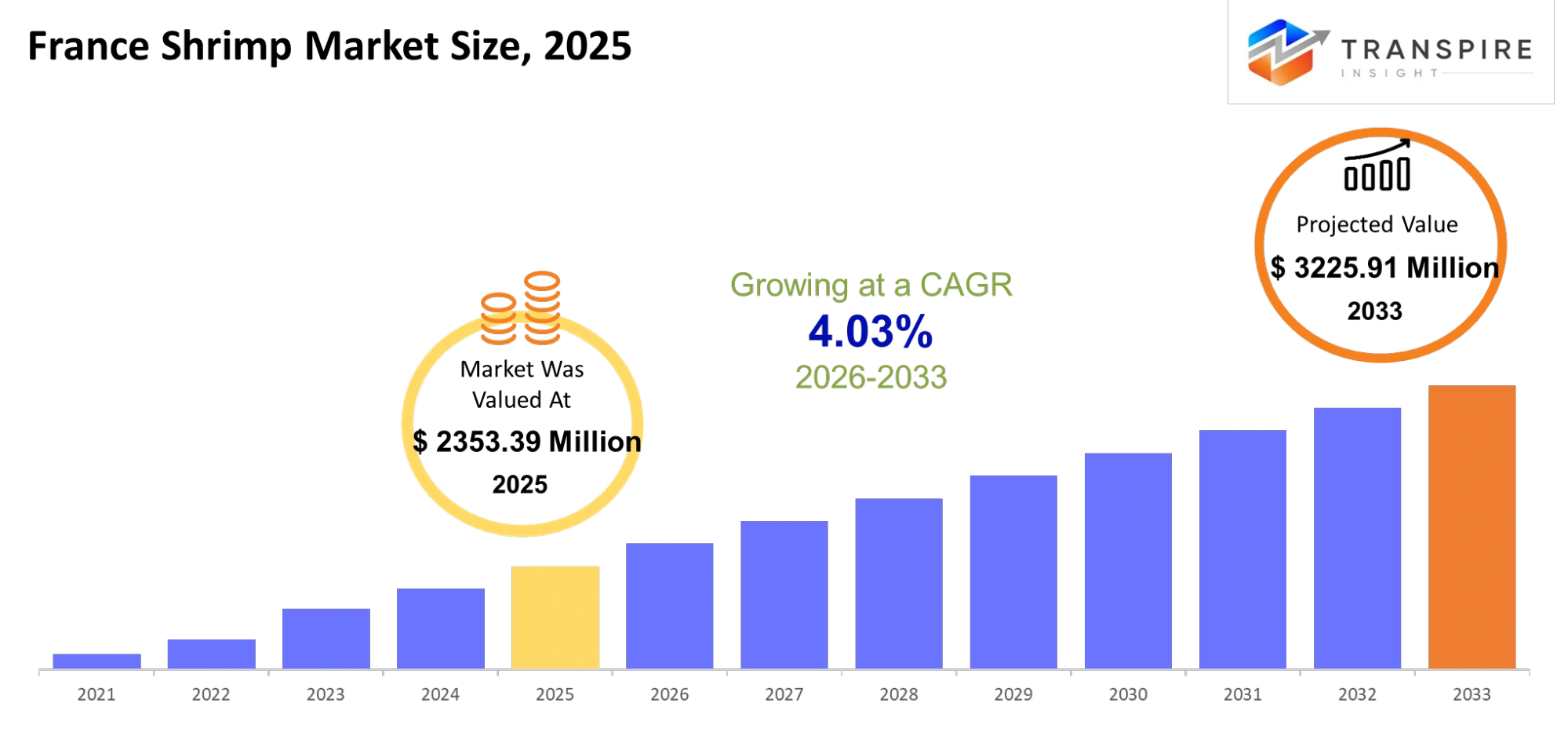
- France Shrimp Market Size 2025: USD 2353.39 Million
- France Shrimp Market Size 2033: USD 3225.91 Million
- France Shrimp Market CAGR: 4.03%
- France Shrimp Market Segments:By Type (Fresh Shrimp, Frozen Shrimp, Processed Shrimp, Others); By Application (Household Consumption, Food Service, Retail, Export, Others); By End-User (Consumers, Restaurants, Retailers, Food Industry, Exporters, Others); By Distribution (Supermarkets, Wet Markets, Online, Others)
To learn more about this report,  Download Free Sample Report
France Shrimp Market Summary
The France Shrimp Market was valued at USD 2353.39 Million in 2025. It is forecast to reach USD 3225.91 Million by 2033. That is a CAGR of 7.57% over the period.
The France Shrimp Market functions as an essential seafood distribution system which links together coastal aquaculture facilities, international trade routes, food manufacturing operations, and restaurant and retail customer needs. The system operates as a reliable source of shrimp supply which enables restaurants and supermarkets and seafood distributors to obtain shrimp products while maintaining their processing facilities and cold storage network operations.
The market has undergone structural changes in the last three to five years because certified sustainable sourcing and traceable supply chains have become standard requirements which EU seafood import regulations and retailer sustainability practices demand. Supply chain interruptions that occurred during global shipping delays showed France's dependence on imported frozen shrimp which resulted in companies increasing their sourcing operations from Ecuador and India. Suppliers have shifted toward aquaculture production and controlled farming methods because traditional fishing grounds face climate-related stress.
The new requirements create a demand for dependable shrimp products which come from farms and have authentic traceable sources that drive food wholesalers and foodservice vendors to change their buying methods.
Key Market Insights
- The market share of Île-de-France reaches 38 to 42 percent in 2025 because of its extensive restaurant network and its seafood distribution centers which handle imported seafood.
- The coastal aquaculture logistics and cold-chain development of Occitanie make it the most rapidly developing region between 2025 and 2033.
- The France Shrimp Market in Provence-Alpes-Côte d'Azur shows consistent demand which arises from seafood consumption driven by tourism activities.
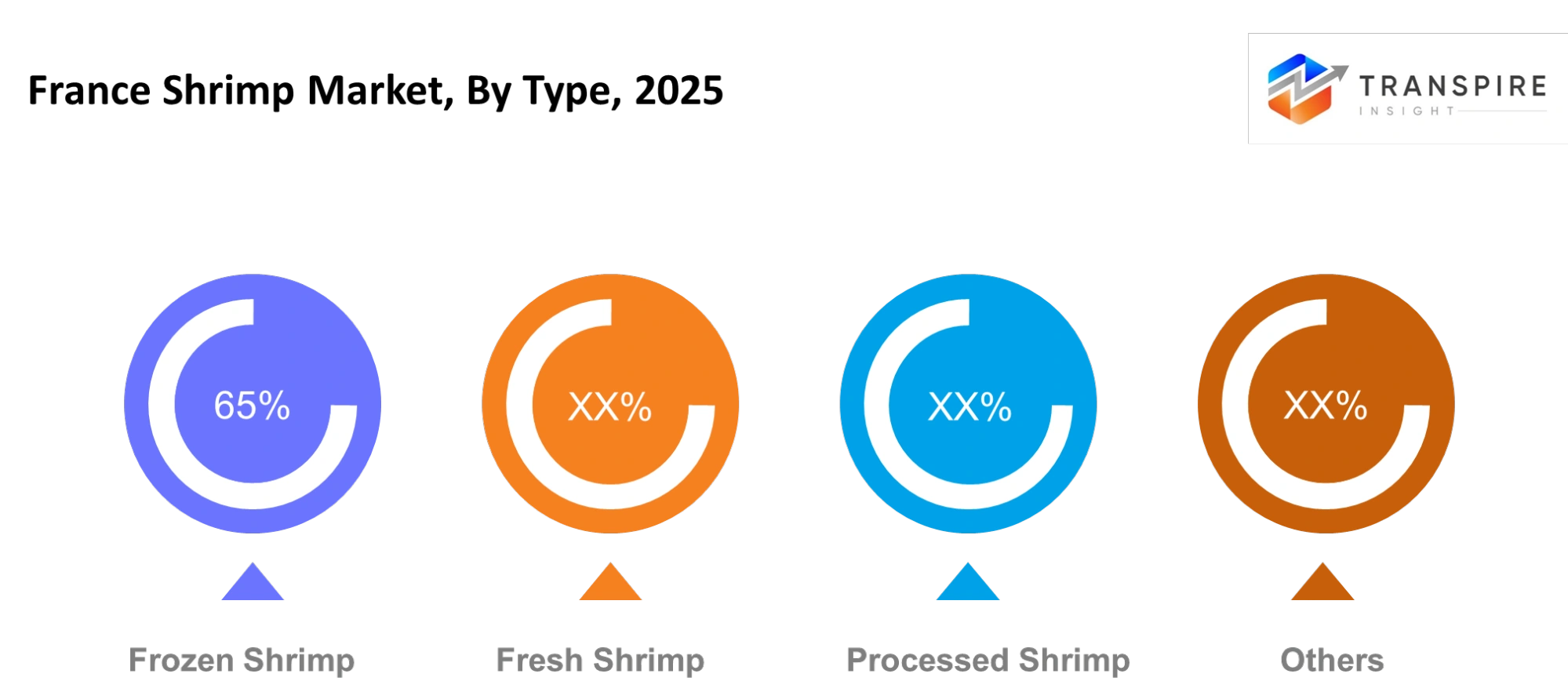
- The market for frozen shrimp reaches 55 percent in 2025 because of its extended shelf life and need for imported products.
- The second-largest market share in fresh shrimp Business operations and premium retail and high-end hospitality Business operations provide the main supply source.
- The market for farmed shrimp in France shows sustained growth until 2033 because of the industry's commitment to sustainable sourcing solutions.
- Foodservice applications account for about 48% share, driven by restaurants, hotels, and catering demand.
- The retail packaged seafood market experiences its fastest expansion because more people buy seafood at home and online seafood sales through e-commerce platforms increase.
- The HoReCa (Hotels Restaurants Catering) market segment holds about 50% market share in 2025 which makes it the leading force for market demand.
- The premium seafood products that urban French consumers choose to buy become the main driver for growth in household consumption.
- The main companies operating in France Shrimp Market include Thai Union Group and Royal Greenland and Maruha Nichiro and Mowi ASA and Leroy Seafood Group.
- Companies adopt sustainable sourcing certification programs and traceability technologies to establish compliance with European Union regulations.
- Aquaculture supply chain organizations achieve better financial management through strategic expansions which also decrease their need for imported materials.
- The company uses partnerships with foodservice distributors to strengthen its presence in high-volume hospitality business operations.
- The implementation of new technologies in cold-chain logistics systems helps to maintain product freshness while boosting shipping efficiency for export activities.
What are the Key Drivers, Restraints, and Opportunities in the France Shrimp Market?
The France Shrimp Market experiences its primary growth because EU seafood import regulations have become stricter while the market demands traceable and certified aquaculture supply chains. Retailers and foodservice operators now require verified origin documentation and sustainability certification, which has accelerated procurement from structured farming systems in countries such as Ecuador, India, and Vietnam. The regulatory pressure creates a situation where companies must establish long-term contracts with certified exporters instead of depending on informal supply sources. The market now experiences revenue growth through suppliers who provide steady product delivery and maintain cold-chain standards and compliance documentation which boosts market stability and institutional buying trust.
The most significant restraint is France’s structural dependency on imported shrimp, which exposes the market to global shipping volatility and price fluctuations in international aquaculture output. The country faces a permanent dependency problem because its domestic shrimp farming capacity remains restricted by both climatic factors and expensive operational expenses.
The European production zones will experience major growth through the implementation of advanced recirculating aquaculture systems (RAS) with sustainable seafood farming technologies. Pilot projects in southern France and nearby Mediterranean supply corridors demonstrate improved yield efficiency
What Has the Impact of Artificial Intelligence Been on the France Shrimp Market?
Artificial intelligence is transforming operational efficiency in the France Shrimp Market through its implementation in vessel-related seafood transportation and processing operations and refrigeration system monitoring activities. Shipping and distribution operators are increasingly deploying AI-enabled control systems to optimize routing, monitor refrigeration conditions, and manage compliance with EU maritime emission standards. The scrubber performance systems together with exhaust gas cleaning technology use machine learning models to process sensor data during patrolling operations, which enables vessels to meet regulatory limits while decreasing the need for human control.
The use of predictive analytics has grown because AI models now enable predictions about when equipment will wear out and how much fuel different refrigerated transport fleets will use and what maintenance activities they will require. The system has enhanced cold-chain vessel operation time while decreasing unexpected maintenance needs, which ensures reliable shrimp supply shipments to French ports and distribution centers. The operators observe improvements in both fuel consumption efficiency and accuracy of compliance records after they combine AI technologies with their IoT tracking systems.
Limited at-sea real-time connectivity prevents ships from transmitting data which is essential for machine learning systems to function continuously. Mid-sized logistics operators face high integration costs for AI platforms which prevents them from implementing these systems throughout their operations. The French Shrimp Market ecosystem suffers from limited model accuracy because there is a lack of high-quality maritime training datasets, which prevent complete optimization under different ocean and weather conditions.
Key Market Trends
- The European Union implemented seafood compliance regulations in 2023 which led importers to select certified suppliers.
- This change affected the entire France Shrimp Market ecosystem by modifying their supplier selection methods.
- France started to import more shrimp from Ecuador and India after the 2022 supply chain disruptions which helped them decrease their dependence on their regular Asian shrimp suppliers.
- Retailers shifted in 2024 toward fully traceable shrimp labeling which led to the implementation of blockchain-based supply verification systems throughout their distribution networks.
- The foodservice industry has increased its frozen shrimp consumption between 12 and 15 percent since 2023 because of better cold-chain systems and improved storage capacity.
- Controlled European trials after 2023 demonstrated that European aquaculture facilities could successfully expand shrimp production from aquaculture sources.
- The seafood industry adopted digital cold-chain monitoring systems at a high rate after 2022 which enabled companies to monitor seafood temperatures in real time and cut down on product spoilage.
- In 2024 there was an increase in sustainable certification requests because major buyers such as Carrefour imposed stricter procurement rules for verified shrimp products.
- Seafood processing facilities have increased their automation levels which enables them to sort products more accurately while reducing their need for human workers in mid-sized processing facilities.
- The hospitality industry in France shifted its shrimp procurement methods after 2023 which led to price stability through bulk frozen procurement agreements.
- The implementation of AI-based demand forecasting tools in 2025 helped distributors to manage their inventory needs while preventing excess stock situations.
France Shrimp Market Segmentation
By Type
Fresh shrimp maintains its status as a premium product which occupies a middle position within the French shrimp market, which exists primarily in coastal areas and affluent urban neighborhoods that people are willing to spend more for better quality and texture. The supply of this segment remains restricted because domestic fishing operations provide insufficient shrimp and the product decays more quickly than frozen products. Air-freighted or short-cycle logistics serve as the main operational focus for importers, which leads to higher expenses while preventing them from entering larger markets.
The premium hospitality sector and fine-dining restaurants drive growth in this segment because they value fresh products more than they value their operational costs. The summer months bring about higher short-term consumption because seasonal tourism patterns create increased demand in coastal regions of France. The distribution network faces major limitations because cold-chain systems fail to operate in areas that exist beyond major port facilities.
To learn more about this report, Download Free Sample Report
By Application
The France Shrimp Market experiences growth through household consumption which now accounts for a rising portion of total market demand. The mid-income household market now enjoys better access to supermarkets which have increased their operational reach.
The dietary pattern shifts toward protein-rich seafood alternatives which support market growth. The retail consumption rate has increased because digital grocery platforms and home delivery services are now used more frequently by customers. The frozen product segment maintains its price stability which has led to higher adoption rates among families.
The market for this segment will grow slowly because customers now prefer high-quality dining options which they can enjoy at home. The market for packaged shrimp meal kits and pre-seasoned shrimp products will experience growth. Retailers will concentrate their efforts on developing new packaging solutions that provide greater convenience to customers.
By End-User
The France Shrimp Market experiences consumer growth because retail outlets expand and more people consume seafood products at home. Urban middle-income households make up the primary target market for this product. The market experiences expansion because customers demand easy-to-use frozen shrimp products and better access to frozen shrimp products. People who want to maintain their health now choose seafood instead of red meat products. The retail sector will develop new products and digital grocery shopping will grow to drive this segment forward.
Restaurants constitute the biggest end-user segment because they order large quantities of seafood products for their menus. Both fine dining establishments and casual restaurant chains make important contributions to the market. Demand comes from the recovery of hospitality and tourism services and the establishment of premium seafood products. The restaurant industry has expanded its use of shrimp through menu diversification which applies to different culinary traditions.
By Distribution
Supermarkets control the French shrimp market because they have established retail networks throughout the country and their cold-chain systems operate at uniform standards and they maintain steady supplies of frozen and processed shrimp products. Large chains such as Carrefour and E.Leclerc have expanded private-label seafood offerings, which has strengthened shelf visibility and consumer trust. The channel achieves its advantages through established procurement procedures that maintain constant market rates while meeting European Union requirements for product traceability.
Supermarkets experience their current growth because customers now prefer packaged seafood products which come with certification after the introduction of new labeling regulations in the past few years. Consumers show a growing preference for hygienic products that come in ready-to-store packages instead of buying from traditional open-market systems. The combination of loyalty programs and digital retail analytics has enabled businesses to improve their shrimp sales strategies
What are the Key Use Cases Driving the France Shrimp Market?
Food service remains the core use case driving the France Shrimp Market, with restaurants, hotels, and catering operators accounting for the highest volume consumption. Restaurants use shrimp in their grilled dishes and seafood platters and fusion menus because it provides them with consistent texture and quick cooking times and they can use it in both upscale and casual dining settings. This trend is strengthened by tourism-based demand and the use of standardized bulk procurement contracts.
Supermarkets and food manufacturers have started to expand retail consumption and processed food applications by using shrimp to create ready-to-cook meals and frozen packs and convenience seafood products. Home cooking in urban households has shifted toward packaged shrimp products while food processors use packaged shrimp to create salads and pasta dishes and frozen meal kits which customers find convenient.
High-protein seafood products designed for fitness consumers and premium health-focused diets create new use cases in the market. Standardized shrimp-based meals are now being used in corporate and airline institutional catering operations because of enhanced cold-chain logistics and better regulatory compliance systems.
|
Report Metrics |
Details |
|
Market size value in 2025 |
USD 2353.39 Million |
|
Market size value in 2026 |
USD 2446.27 Million |
|
Revenue forecast in 2033 |
USD 3225.91 Million |
|
Growth rate |
CAGR of 4.32% from 2026 to 2033 |
|
Base year |
2025 |
|
Historical data |
2021 - 2024 |
|
Forecast period |
2026 - 2033 |
|
Report coverage |
Revenue forecast, competitive landscape, growth factors, and trends |
|
Regional scope |
France |
|
Key company profiled |
Thai Union, Maruha Nichiro, Nippon Suisan, Clearwater Seafoods, Cooke Aquaculture, Seafresh Group, Devi Seafoods, Apex Frozen Foods, Avanti Feeds, Charoen Pokphand, Pescanova, High Liner Foods, Mowi, Dongwon, Ocean Garden . |
|
Customization scope |
Free report customization (country, regional & segment scope). Avail customized purchase options to meet your exact research needs. |
|
Report Segmentation |
By Type (Fresh Shrimp, Frozen Shrimp, Processed Shrimp, Others); By Application (Household Consumption, Food Service, Retail, Export, Others); By End-User (Consumers, Restaurants, Retailers, Food Industry, Exporters, Others); By Distribution (Supermarkets, Wet Markets, Online, Others) |
Which Regions are Driving the France Shrimp Market Growth?
The France Shrimp Market designates Île-de-France as its top region because the area contains both import distributors and large-scale foodservice buyers who operate from its advanced logistics infrastructure which connects to Paris. The region enables efficient shrimp distribution throughout the nation through its advanced cold-chain systems which connect to main European trade routes. The market maintains steady demand because hospitality chains and institutional caterers and high-end retail stores exist in strong numbers. The region requires food suppliers to create centralized compliance centers because authorities enforce strict food safety and traceability regulations. The system that combines these elements maintains constant product flow while generating consistent income throughout both retail and foodservice operations.
Provence-Alpes-Côte d'Azur functions as a stable and enduring contributor to the coastal economy which drives seafood consumption through its tourist industry. The Mediterranean coastal region of this area depends on local hospitality businesses for its seafood supply unlike Île-de-France which depends on centralized importing from various sources. The summer tourism season creates regular patterns of increased shrimp demand which restaurants and hotels experience during this time. The port facilities at Marseille enable the city to handle moderate import volumes while distributing goods to nearby areas. The region achieves steady market presence through its ongoing economic activities and investment in hospitality development projects.
Occitanie leads all French regions in shrimp market expansion because of its recent investments which modernized ports and developed aquaculture logistics and food processing facilities in Toulouse and Montpellier. The region requires both enhanced cold-storage capacity and improved storage facilities.
Who are the Key Players in the France Shrimp Market and How Do They Compete?
The France Shrimp Market demonstrates moderate market fragmentation because international seafood exporters and vertically integrated aquaculture companies and local distributors compete in all aspects of the business from importing to processing to distributing their products. The competition between businesses exists because frozen shrimp contracts create a need for buyers from retail and foodservice to choose between two main factors which are price efficiency and supply reliability.
Thai Union and Charoen Pokphand compete through large-scale aquaculture integration and cost leadership, leveraging extensive farming networks in Southeast Asia to supply consistent volumes at competitive prices. The company maintains its competitive edge through complete production control which extends from feed manufacturing to export transportation. The two companies are expanding their operations through distribution partnerships with European distributors which will enable them to improve their last-mile distribution network and ensure regulatory compliance.
Mowi uses sustainability-focused branding and certified seafood production as its main differentiating factor from competitors while targeting premium customers who require certified sustainable seafood products. The company plans to expand its operations through improvements in European distribution networks and development of advanced processing facilities. Avanti Feeds and Apex Frozen Foods compete to improve their export operations from India by providing bulk buyers with high-volume frozen shrimp products. These companies are expanding their production capacity while they modernize their processing facilities to handle increased output.
Company List
- Thai Union
- Maruha Nichiro
- Nippon Suisan
- Clearwater Seafoods
- Cooke Aquaculture
- Seafresh Group
- Devi Seafoods
- Apex Frozen Foods
- Avanti Feeds
- Charoen Pokphand
- Pescanova
- High Liner Foods
- Mowi
- Dongwon
- Ocean Garden
Recent Development News
In April 2026, official trade data confirmed that France imported 137,137 metric tons of shrimp in 2025, the highest level in a decade. Frozen warm-water shrimp accounted for the majority of imports, reinforcing France’s role as a key EU consumption and redistribution hub. This surge was driven by strong foodservice recovery and stable retail demand across the country.
https://www.seafoodnews.com
What Strategic Insights Define the Future of the France Shrimp Market?
The France Shrimp Market is currently establishing a supply system which requires compliance and traceability through its procurement processes. The market will experience this shift during the next five to seven years because EU import regulations will become stricter and retailers will establish standardized practices which will result in fewer suppliers who meet technical compliance requirements.
The main hidden danger exists because supply chains depend on a small number of countries which include Ecuador and India. This situation creates risks because of climate events and disease outbreaks in aquaculture and new tariff policies which affect prices in France. The market will experience increased price fluctuations because the market depends on demand which will lead to greater customer demand.
The opportunity exists because Southern Europe is starting to develop recirculating aquaculture systems which enable controlled shrimp farming pilots to reduce their need to import products while satisfying their sustainability requirements.
Market participants need to focus their investments on traceability technology and establish multiple sourcing partnerships which will help them decrease their operational risks. This approach will enable them to access high-margin certified shrimp segments.
France Shrimp Market Report Segmentation
By Type
- Fresh Shrimp
- Frozen Shrimp
- Processed Shrimp
- Others
By Application
- Household Consumption
- Food Service
- Retail
- Export
- Others
By End-User
- Consumers
- Restaurants
- Retailers
- Food Industry
- Exporters
- Others
By Distribution
- Supermarkets
- Wet Markets
- Online
- Others
Frequently Asked Questions
Find quick answers to common questions.
The confirmed 2033 market size figure is USD 3225.91 Million.
Key segments for the France Shrimp Market are By Type (Fresh Shrimp, Frozen Shrimp, Processed Shrimp, Others); By Application (Household Consumption, Food Service, Retail, Export, Others); By End-User (Consumers, Restaurants, Retailers, Food Industry, Exporters, Others); By Distribution (Supermarkets, Wet Markets, Online, Others).
Major France Shrimp Market players are Thai Union, Maruha Nichiro, Nippon Suisan, Clearwater Seafoods, Cooke Aquaculture, Seafresh Group, Devi Seafoods, Apex Frozen Foods, Avanti Feeds, Charoen Pokphand, Pescanova, High Liner Foods, Mowi, Dongwon, Ocean Garden.
The France Shrimp Market size is USD 2353.39 Million in 2025.
The France Shrimp Market CAGR is 4.03% from 2026 to 2033.
- Thai Union
- Maruha Nichiro
- Nippon Suisan
- Clearwater Seafoods
- Cooke Aquaculture
- Seafresh Group
- Devi Seafoods
- Apex Frozen Foods
- Avanti Feeds
- Charoen Pokphand
- Pescanova
- High Liner Foods
- Mowi
- Dongwon
- Ocean Garden
Recently Published Reports
-
Apr 2026
Baby Infant Formula Market
Baby Infant Formula Market Size, Share & Analysis Report By ype (Infant Milk, Follow On Milk, Specialty Baby Milk, Growing-Up Milk), By Ingredient (Carbohydrate, Fat, Protein, Minerals, Vitamins, and Others), By Product Form (Powder, Liquid, and Ready-to-feed), By Distribution Channels (Supermarket/Hypermarket, Specialty Store, Pharmacies, Online Retail, and Others), and Geography (North America, Europe, Asia-Pacific, Middle East and Africa, South and Central America), 2021 - 2031
-
Apr 2026
Edible Insects for Animal Feed Market
Edible Insects for Animal Feed Market Size, Share & Analysis Report By Type (Insect Powder, Insect Meal, Insect Bar, Insect Paste, Insect Oil, and Others), By Insect Type (Beetles, Cricket, Caterpillar, Hymenoptera, Orthoptera, Tree Bugs, and Others), By Application (Livestock, Pet Food, and Aquaculture), By Livestock Type (Poultry, Swine, and Others), and Geography (North America, Europe, Asia-Pacific, Middle East and Africa, South and Central America), 2021 - 2031
-
Apr 2026
Food Industry Disinfection and Bacterial Control Market
Food Industry Disinfection and Bacterial Control Market Size, Share & Analysis Report By Type (Chemical Disinfectants, Physical Disinfectants, and Biocides and Antimicrobials), By Application (Food Processing Equipment Surface Disinfection, Food Preparation Areas Surface Disinfection, Storage Areas Surface Disinfection, Anti-microbial Coatings Food Preservation, and Preservative Solutions Food Preservation), By End User (Meat and Poultry Processing, Dairy Processing, Seafood Processing, Bakery and Confectionery, Restaurants and Commercial Kitchens, and Food Service Providers), By Sales Channel (Online, Offline), and Geography (North America, Europe, Asia-Pacific, Middle East and Africa, South and Central America), 2021 - 2031
-
Apr 2026
Freeze Dried Food Market
Freeze Dried Food Market Size, Share & Analysis Report By Product Type (Fruits, Vegetables, Freeze-Dried Dairy Products, Freeze-Dried Meat and Seafood, Freeze-Dried Pet Food, and Prepared Meal), By Nature (Organic, and Conventional), By Form (Powdered, Granules, and Diced), By End Use (Breakfast Cereals, Dairy Products, Bakery & Confectionery, Nutritional Bars & Supplements, Powdered Beverages, Snacks, and Retail (Household)), and Geography (North America, Europe, Asia-Pacific, Middle East and Africa, South and Central America), 2021 - 2031