
France Patient Administration System Market Size & Forecast:
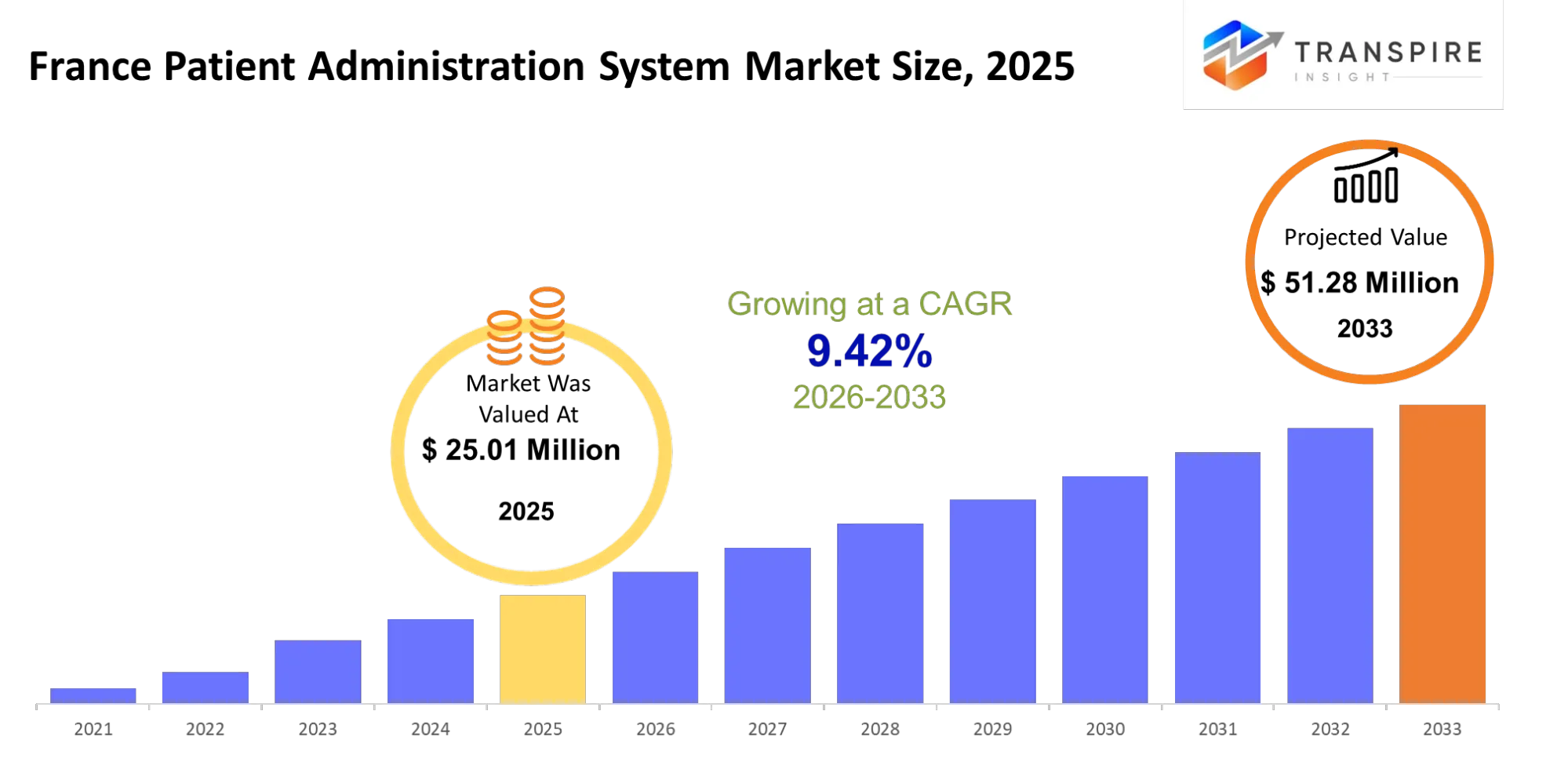
- France Patient Administration System Market Size 2025: USD 25.01 Million
- France Patient Administration System Market Size 2033: USD 51.28 Million
- France Patient Administration System Market CAGR: 9.42%
- France Patient Administration System Market Segments: By Type (Standalone Systems, Integrated Systems, Cloud-based Systems, Others); By Application (Patient Registration, Scheduling, Billing, Medical Records, Others); By End-User (Hospitals, Clinics, Healthcare Providers, Others); By Deployment (Cloud, On-premise, Hybrid, Others)
To learn more about this report,  Download Free Sample Report
France Patient Administration System Market Summary
The France Patient Administration System Market was valued at USD 25.01 Million in 2025. It is forecast to reach USD 51.28 Million by 2033. That is a CAGR of 9.42% over the period.
The France Patient Administration System Market serves as the essential framework which hospitals and clinics and healthcare networks use to control patient movement and appointment scheduling and hospital admissions and billing processes and medical record management in their complex patient care systems. The systems create better administrative processes which help organizations manage their patient growth while meeting national healthcare requirements. The market has evolved during the past five years from using standalone hospital administration software to adopting integrated digital health systems which operate through electronic health records and telehealth platforms and reimbursement systems.
Digital healthcare modernization in France gained faster progress after the COVID-19 pandemic because hospitals now focus on developing systems which enable remote patient scheduling and patient monitoring and centralized health information sharing. Healthcare providers changed their purchasing patterns because government-backed digital health investments and interoperability requirements forced them to upgrade their existing systems. The transition process creates new opportunities for software vendors to generate recurring revenue while mid-sized healthcare providers adopt new systems to replace their existing disjointed administrative operations.
Key Market Insights
- The healthcare networks of Northern France maintained their market share of approximately 34% during 2025 because multiple-specialty hospitals operated in greater numbers and digital infrastructure development projects took place.
- Southern France is expected to become the fastest-growing market which will continue until 2033 because the region receives funding for healthcare modernization and private clinics are expanding their operations.
- The cloud-based patient administration platforms achieved market leadership in 2025 with more than 46% of revenue because hospitals selected administrative systems which provided both scalability and remote access capabilities.
- The integrated patient management software solution became the second-largest market segment because healthcare organizations used it to unify their billing and admissions and patient communication processes.
- The segment of administrative automation which uses AI technology will experience the highest growth rate between 2026 and 2033 with particular emphasis on appointment scheduling and claims validation.
- The hospital applications sector generated approximately 58% of total revenue for the France Patient Administration System Market because public healthcare organizations implemented extensive digital transformation initiatives.
- The increase in outpatient treatment at ambulatory care centers has resulted in faster implementation of automated patient intake systems by healthcare providers.
- The large hospital sector continued to dominate as the main end-user market in 2025 because hospitals accelerated their infrastructure upgrades which had been delayed by the pandemic.
- Private healthcare organizations need to invest in software solutions which will help them maintain patient engagement while decreasing wait times and enhancing reimbursement operations.
- The number of strategic partnerships between software vendors and regional hospital networks increased after 2022 because healthcare providers needed systems for centralized patient administration and compliance management.
What are the Key Drivers, Restraints, and Opportunities in the France Patient Administration System Market?
The French healthcare sector now implements central digital patient management systems which drive growth in the France Patient Administration System Market. Public hospitals together with private medical facilities encounter operational challenges due to increasing outpatient numbers and complex reimbursement systems and new regulations for patient data sharing. COVID-19 revealed that hospital systems operated through separate administrative processes which needed to be fixed. Healthcare providers invested in complete systems for scheduling and admissions and billing which let them process patients faster because of decreased manual work. Hospitals transition from their old systems through software subscription agreements and system integration services and ongoing maintenance payments which provide vendors with stable income streams.
Public hospitals still face their most difficult challenge because they need to connect their old healthcare IT systems with current systems for their entire operations. French healthcare organizations still maintain separate databases together with outdated administrative systems which lack the capacity to support interoperability standards. The process of system replacement or upgrading demands extensive financial resources, requires employees to go through training, and causes temporary disruption to business operations. The existence of structural barriers at smaller hospitals and regional clinics leads to slower adoption rates which postpone their software buying process and result in lost revenue for software companies.
AI-enabled patient flow management systems and predictive administrative tools create a new business opportunity. Healthcare providers are increasingly exploring intelligent scheduling systems that reduce appointment no-shows, automate claims processing, and forecast patient admission peaks.
What Has the Impact of Artificial Intelligence Been on the France Patient Administration System Market?
The combination of artificial intelligence and advanced digital technologies brings new changes to patient administration systems in French hospitals because these technologies enable hospitals to streamline their administrative work through automated systems that handle their peak operational demands. Healthcare providers increasingly deploy AI-powered scheduling engines to optimize appointment allocation, reduce patient waiting times, and automate cancellations or rescheduling processes. Machine learning models improve the billing validation process together with insurance claims management because they detect coding mistakes before submission which enables hospitals to decrease reimbursement delays and cut down on administrative tasks.
Hospitals use predictive analytics to assist their capacity planning operations. AI systems use previous patient admission records together with emergency department data and seasonal healthcare demand patterns to predict both patient volume and workforce needs. The tools enable healthcare organizations to achieve better bed utilization while decreasing their operational bottlenecks that occur during times of maximum patient treatment. Natural language processing technology helps integrated healthcare networks improve the efficiency of their patient registration processes together with their administrative documentation tasks.
The technologies enable healthcare organizations to expedite their patient onboarding process while decreasing their need for administrative work and achieving better compliance report results. The healthcare industry faces challenges with AI implementation because hospitals maintain separate legacy systems which create problems for data sharing between their different operational networks. The smaller healthcare facilities face major challenges because they need advanced technical skills and must handle expensive system integration expenses to implement advanced AI administrative systems.
Key Market Trends
- French hospitals began to adopt cloud-based systems for remote patient management after they stopped using their traditional on-site administrative systems which they had operated since 2021.
- Public healthcare organizations enhanced their capability to exchange information after the national digital health funding program started funding electronic patient data integration initiatives throughout France.
- Hospitals began using AI-powered scheduling systems after 2023 because they wanted to decrease both patient no-show rates and administrative processing times.
- Healthcare networks with multiple hospitals developed consolidated systems for managing patient information because it helped them achieve better billing processes and operational performance.
- Healthcare organizations dedicated more funding for security measures after ransomware attacks demonstrated that their existing hospital management systems were vulnerable to cyber threats.
- Between 2022 and 2025 private clinics implemented automatic systems for patient intake because they experienced increasing outpatient treatment demand at their urban medical facilities.
- Dedalus Group and Oracle Health used AI-based workflow automation and software development for interoperability enhancement to gain competitive advantages in their market.
- Healthcare organizations started to use mobile communication platforms which link to their administrative systems because it helps them achieve better patient appointment confirmation rates and online interaction with patients.
- Mid-sized healthcare organizations preferred subscription software pricing models because it allowed them to decrease their initial costs for needed infrastructure.
- Regional healthcare alliances created shared digital administration systems to enable all participating facilities to complete patient registration and billing and compliance reporting for their operational processes.
France Patient Administration System Market Segmentation
By Type
The market remains controlled by integrated systems because large hospitals and regional healthcare networks prefer their combined system which offers patient registration and scheduling and billing and medical records functions through a single operational framework. Healthcare providers continue to adopt interconnected administrative systems because public healthcare modernization initiatives and interoperability standards make existing disjointed software systems obsolete. Integrated platforms enable better operational tracking for healthcare organizations while eliminating unnecessary patient information duplication, which boosts their purchasing capabilities.
Independent healthcare facilities and small clinics use standalone systems because they need affordable solutions which require less effort to handle their daily operations. The healthcare data exchange standards of today limit healthcare organizations to two standardized methods because they lack sufficient organizational capacity to manage both systems. The healthcare industry is adopting cloud-based systems at an increasing rate because healthcare providers need to access systems from any location while choosing subscription pricing and fast implementation without spending on major infrastructure. Digital healthcare workflows now use AI-based modular administration platforms and specialized outpatient management software which together form an emerging category known as "others." Technology providers will concentrate on developing automation interoperability and cybersecurity solutions for all system types during the upcoming forecast period.
By Application
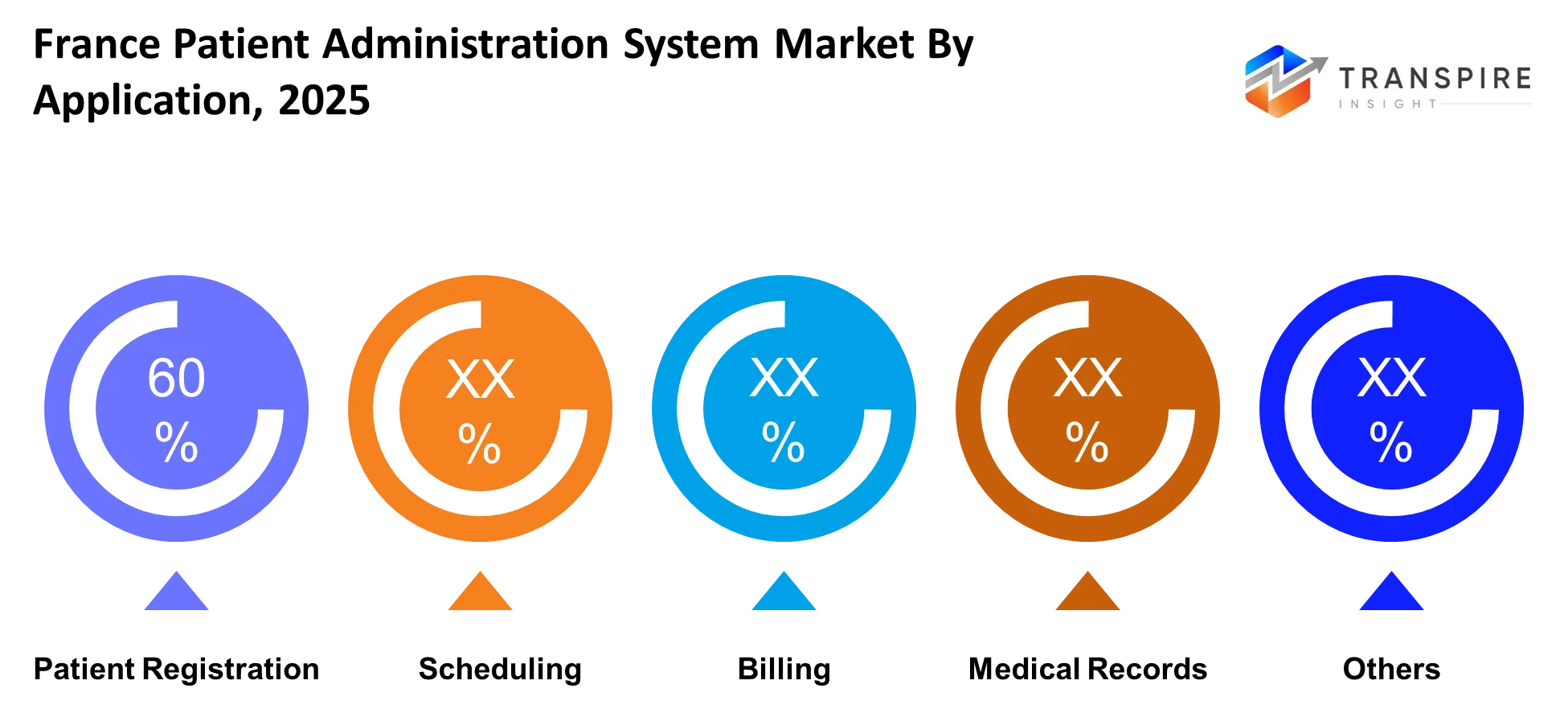
The patient registration process holds the top market position because healthcare facilities require efficient methods to complete patient admissions while verifying identities and maintaining operational precision during their high-capacity medical treatments. Digital registration systems help large hospitals and outpatient networks achieve faster patient processing times while they enhance reimbursement systems and fulfill regulatory compliance obligations. The increasing connection between registration systems and electronic health record systems establishes a permanent funding requirement for all healthcare organizations.
Hospitals and clinics are adopting scheduling applications because they help organizations manage physician schedules while decreasing appointment no-show rates and boosting patient processing efficiency. The billing systems market represents a vital growth area because healthcare reimbursement procedures become more complicated within both public and private healthcare systems. Healthcare providers are increasing their medical record management operations because they want to centralize patient data for better care continuity and operational efficiency. The others category, which includes patient communication tools, telehealth coordination systems, and automated claims validation platforms, will experience steady growth during the forecast period because healthcare administration becomes more digitally interconnected and data-driven.
To learn more about this report, Download Free Sample Report
By End-User
Your training data extends until the month of October in the year 2023. Hospital networks maintain their primary market power because they need to handle intricate patient admission processes which include multiple steps such as verifying insurance and managing patient information across different hospital departments. Public hospitals and university medical centers continue investing heavily in digital administration infrastructure to improve operational efficiency and comply with national healthcare modernization initiatives. The sector experiences increasing demand for advanced administration platforms because high patient volumes and complex reimbursement systems create greater operational requirements.
Clinics represent an expanding end-user category as outpatient treatment volumes continue increasing across urban and regional healthcare environments. The subscription-based deployment model enables smaller healthcare facilities to adopt cloud-based patient administration systems because it minimizes their need for initial technology expenditure. Healthcare providers, including diagnostic centers and specialty treatment networks, are also strengthening adoption to improve appointment coordination and patient engagement capabilities. Rehabilitation centers elderly care facilities and ambulatory surgical centers which make up the "others" category are increasing their spending on administrative automation because they find operational benefits from implementing these systems. Future market development is expected to favor end-users that integrate AI-assisted scheduling, digital communication tools, and predictive workflow management capabilities into healthcare administration strategies.
By Deployment
Organizations in the healthcare sector maintain their preference for cloud deployment because it provides them with better scalability options, remote system access, reduced infrastructure maintenance expenses, and quicker software development times. Cloud-based administration systems enable multiple healthcare facilities to interoperate, which has become essential for regional healthcare networks and organizations that operate multiple sites. The subscription-based pricing models make digital modernization affordable for mid-sized clinics and outpatient healthcare providers who want to update their systems without needing to spend large amounts of money on new technology.
Healthcare institutions with strict needs for data security and infrastructure management and workflow customization use on-premise deployment to deliver healthcare services. The system needs more maintenance work, which leads to higher costs and takes longer to implement updates, therefore reducing its ability to grow over time when compared to cloud-based systems. Many healthcare organizations use hybrid deployment models because they want to move from their old systems to cloud-based healthcare systems while keeping their current operations running smoothly. The "others" category which includes edge-based healthcare data processing and decentralized administrative platforms currently exists as a niche market but has developed potential applications in specialized healthcare settings. The upcoming period will see deployment strategies concentrate their efforts on developing cybersecurity protection, implementing AI technology, and creating systems that can work together flexibly.
What are the Key Use Cases Driving the France Patient Administration System Market?
The France Patient Administration System Market exists because hospitals need to handle patient registration and appointment scheduling. Public hospitals and their multi-specialty healthcare partners use these platforms to control admission processes. The application generates high demand because French healthcare providers need to decrease administrative wait times while staying within national healthcare data standards.
Outpatient clinics and ambulatory care centers now use digital intake systems and automated reimbursement processing tools for their secondary use cases. Private healthcare networks use integrated patient communication systems which enable appointment reminders and teleconsultation coordination and digital payment processing.
Healthcare organizations are creating new use cases through AI systems which help optimize patient flow and predict future hospital admissions. Multiple healthcare systems are testing intelligent scheduling platforms which predict peak treatment demand and automatically distribute resources in regional healthcare modernization programs and digitally linked hospital systems.
|
Report Metrics |
Details |
|
Market size value in 2025 |
USD 25.01 Million |
|
Market size value in 2026 |
USD 27.31 Million |
|
Revenue forecast in 2033 |
USD 51.28 Million |
|
Growth rate |
CAGR of 9.42% from 2026 to 2033 |
|
Base year |
2025 |
|
Historical data |
2021 - 2024 |
|
Forecast period |
2026 - 2033 |
|
Report coverage |
Revenue forecast, competitive landscape, growth factors, and trends |
|
Regional scope |
France |
|
Key company profiled |
Cerner, Epic Systems, Allscripts, McKesson, GE Healthcare, Siemens Healthineers, IBM, Oracle, SAP, Philips, Athenahealth, eClinicalWorks, NextGen Healthcare, Meditech, Infor |
|
Customization scope |
Free report customization (country, regional & segment scope). Avail customized purchase options to meet your exact research needs. |
|
Report Segmentation |
By Type (Standalone Systems, Integrated Systems, Cloud-based Systems, Others); By Application (Patient Registration, Scheduling, Billing, Medical Records, Others); By End-User (Hospitals, Clinics, Healthcare Providers, Others); By Deployment (Cloud, On-premise, Hybrid, Others) |
Which Regions are Driving the France Patient Administration System Market Growth?
The northern part of France serves as the primary market area because it has multiple university hospitals and extensive healthcare networks and state-of-the-art digital medical facilities. The public healthcare system of Paris and its neighboring cities started to enhance their patient administration systems after the pandemic revealed their existing system flaws. The area experiences increased IT expenditures and better system interoperability because its main hospital systems implement advanced technological solutions. The healthcare software vendors and cloud service providers and medical research organizations maintain their market dominance through their existing established network of operations.
Western France serves as a stable market region because healthcare organizations in the area choose to improve their operations through extended time periods instead of immediate infrastructure changes. Hospitals and private clinics in the region make ongoing investments to develop patient scheduling systems and billing automation tools and administrative processes which will make healthcare services more accessible to residents in smaller cities. The region experiences growth through gradual digital technology implementation which differs from the hospital consolidation processes that drive development in Northern France. The regional healthcare system establishes a system for purchasing which generates consistent income streams for software companies through its recurring revenue structure.
The healthcare market in Southern France is growing faster than any other region because local health authorities are implementing digital transformation initiatives throughout their expanding outpatient network. The recent establishment of cloud-based healthcare systems and telemedicine services has generated a demand for centralized patient management systems.
Who are the Key Players in the France Patient Administration System Market and How Do They Compete?
The France Patient Administration System Market operates with a moderate level of market consolidation because companies in the industry compete by testing their ability to connect different systems through their cloud-based services and their capacity to create automated systems and their commitment to building permanent relationships with healthcare networks. The market for healthcare software in large enterprises remains protected by major providers who use their integrated platforms to unite scheduling and billing with patient communication and electronic health record capabilities. The healthcare IT market faces competition from specialized companies which provide outpatient care and mid-sized healthcare providers with administrative automation tools that use artificial intelligence and faster deployment systems.
Oracle strengthens its market position through integrated cloud-based healthcare administration solutions which operate on the Oracle Health infrastructure. The company creates a unique market position through its combination of interoperability tools with AI-driven workflow automation and enterprise-level data management systems. Oracle maintains its drive to expand its healthcare network through partnerships that enable system integration and through its projects to automate patient intake procedures.
Epic Systems competes through its unified healthcare workflow platforms which enable large hospital systems to manage their complex patient flow operations. The system achieves its advantage through dependable implementation processes and high clinician adoption rates together with its capability to connect administrative functions and clinical operations. The company develops its AI-driven scheduling system which handles billing tasks and workflow automation across its complete healthcare system.
Siemens Healthineers establishes its market identity through its development of unified healthcare workflow systems which combine patient administration functions with diagnostic imaging and hospital operational processes.
Company List
- Cerner
- Epic Systems
- Allscripts
- McKesson
- GE Healthcare
- Siemens Healthineers
- IBM
- Oracle
- SAP
- Philips
- Athenahealth
- eClinicalWorks
- NextGen Healthcare
- Meditech
- Infor
Recent Development News
In April 2026, Oracle Health achieved CMS Aligned Network status and launched a digital patient check-in solution integrated with CLEAR1 identity verification. The initiative reduced manual paperwork and improved interoperability across healthcare administration systems and patient data workflows.http://www.oracle.com
In December 2024, Siemens Healthineers entered a strategic collaboration agreement with Assistance Publique-Hôpitaux de Paris (AP-HP). The partnership expanded joint healthcare innovation, digital infrastructure modernization, and integrated patient management capabilities across France’s largest public hospital network.http://www.siemens-healthineers.com
What Strategic Insights Define the Future of the France Patient Administration System Market?
The France Patient Administration System Market is heading toward AI-based healthcare systems which link all healthcare functions through centralized cloud systems. Hospital operations face increasing demands to decrease administrative expenses while optimizing care for elderly patients and complying with enhanced healthcare data sharing regulations. The healthcare industry faces a hidden danger because organizations depend too much on a few main enterprise software vendors, which will drive up costs and limit smaller healthcare facilities' operational options.
The healthcare industry offers major prospective benefits through predictive patient flow management platforms which work with telehealth services and regional outpatient care systems in digitalizing their healthcare networks. Market participants should prioritize interoperability-focused partnerships and modular cloud deployment strategies that allow healthcare providers to modernize legacy systems gradually without disrupting operational continuity.
France Patient Administration System Market Report Segmentation
By Type
- Standalone Systems
- Integrated Systems
- Cloud-based Systems
- Others
By Application
- Patient Registration
- Scheduling
- Billing
- Medical Records
- Others
By End-User
- Hospitals
- Clinics
- Healthcare Providers
- Others
By Deployment
- Cloud
- On-premise
- Hybrid
- Others
Frequently Asked Questions
Find quick answers to common questions.
The confirmed 2033 market size figure in USD 51.28 Million.
Key segments for the France Patient Administration System Market are By Type (Standalone Systems, Integrated Systems, Cloud-based Systems, Others); By Application (Patient Registration, Scheduling, Billing, Medical Records, Others); By End-User (Hospitals, Clinics, Healthcare Providers, Others); By Deployment (Cloud, On-premise, Hybrid, Others).
Major France Patient Administration System Market players are Cerner, Epic Systems, Allscripts, McKesson, GE Healthcare, Siemens Healthineers, IBM, Oracle, SAP, Philips, Athenahealth, eClinicalWorks, NextGen Healthcare, Meditech, Infor.
The France Patient Administration System Market size is USD 25.01 Million in 2025.
The France Patient Administration System Market CAGR is 9.42% from 2026 to 2033.
- Cerner
- Epic Systems
- Allscripts
- McKesson
- GE Healthcare
- Siemens Healthineers
- IBM
- Oracle
- SAP
- Philips
- Athenahealth
- eClinicalWorks
- NextGen Healthcare
- Meditech
- Infor
Recently Published Reports
-
Apr 2026
AI in Diabetic Retinopathy Market
AI in Diabetic Retinopathy Market Size, Share & Analysis Report By Type (Screening AI Systems, Diagnostic AI Systems, and Predictive AI Models), By Application Segment (Hospitals, Ophthalmology Clinics, Diagnostic Centers, and Research and Development), and Geography (North America, Europe, Asia-Pacific, Middle East and Africa, South and Central America), 2021 - 2031
-
Apr 2026
Psychometric Tests Market
Psychometric Tests Market Size, Share & Analysis Report By Type (Personality Tests, Ability/Aptitude Tests, Skill/Knowledge Tests, and Others), By Application (Talent Acquisition and Talent Management), and Geography (North America, Europe, Asia-Pacific, Middle East and Africa, South and Central America), 2021 – 2031
-
Apr 2026
Rare Biological Sample Collection Market
Rare Biological Sample Collection Market Size, Share & Analysis Report By Type (Isolation Kits & Reagent, Blood Collection Tubes, and Others), By Application (Oncology, Transcriptomics, Pharmacogenomics, and Others), and Geography (North America, Europe, Asia-Pacific, Middle East and Africa, South and Central America), 2021 – 2031
-
Apr 2026
Patient Lift Pendant Market
Patient Lift Pendant Market By Product Type (Wired Pendants, Wireless, Programmable), By Operation Type(Manual, Electric), By End-Users (Healthcare Professionals, Patients), By Application (Hospitals, Homecare, Rehabilitation Centers, Others), By Industry Analysis, Size, Share, Growth, Trends, and Forecasts 2021-2033
Our Clients
.jpg)