
France Nonwoven Filter Media Market Size & Forecast:
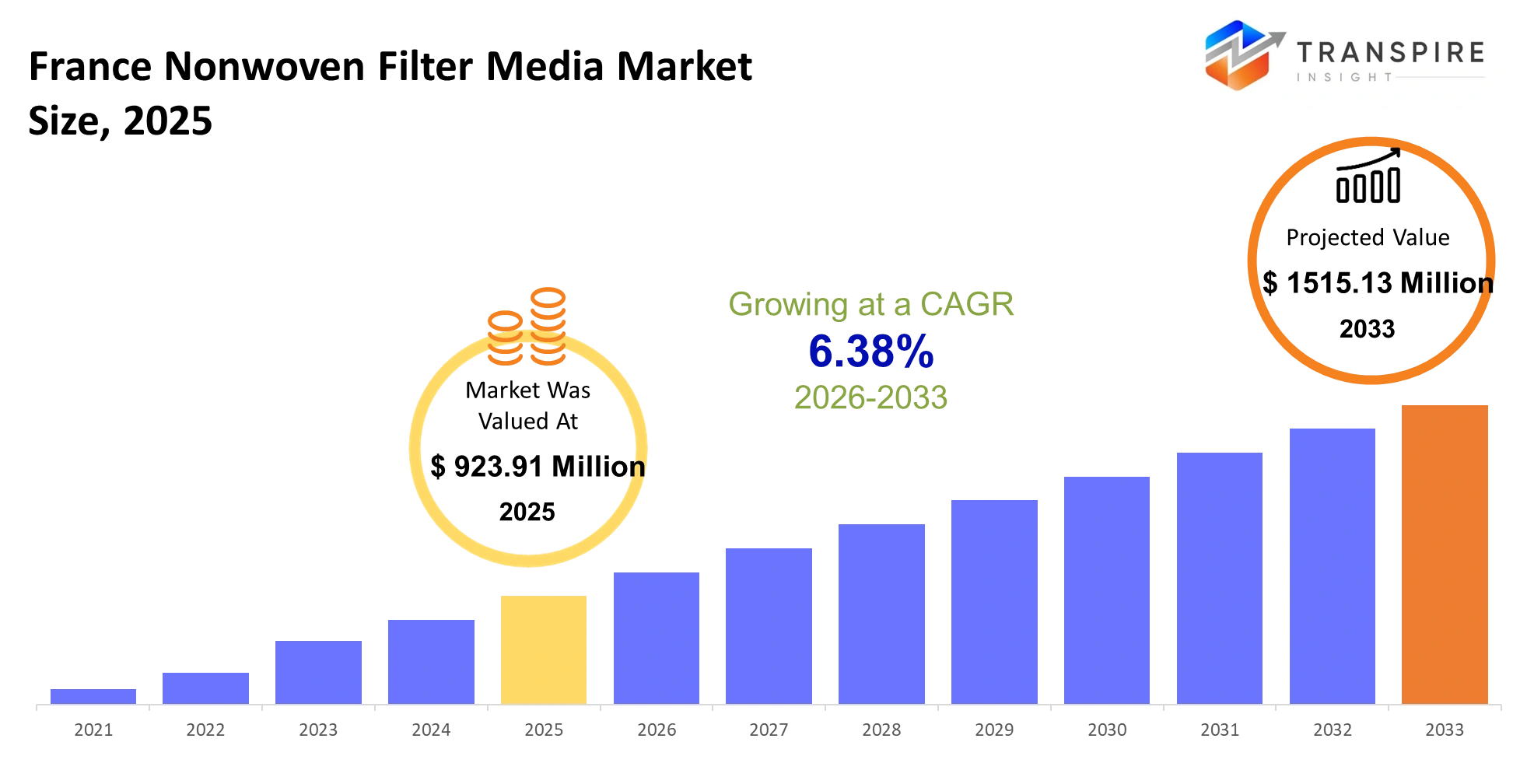
- France Nonwoven Filter Media Market Size 2025: USD 923.91 Million
- France Nonwoven Filter Media Market Size 2033: USD 1515.13 Million
- France Nonwoven Filter Media Market CAGR: 6.38%
- France Nonwoven Filter Media Market Segments: By Type (Spunbond, Meltblown, Needle-punched, Others); By Application (Air Filtration, Liquid Filtration, Automotive, Healthcare, Industrial Filtration, Others); By End-User (Automotive Industry, Healthcare Sector, Industrial Firms, HVAC, Water Treatment, Others); By Material (Polypropylene, Polyester, Glass Fiber, Others)
To learn more about this report,  Download Free Sample Report
France Nonwoven Filter Media Market Summary
The France Nonwoven Filter Media Market was valued at USD 923.91 Million in 2025. It is forecast to reach USD 1515.13 Million by 2033. That is a CAGR of 6.38% over the period.
The France nonwoven filter media market operates as a vital component which maintains industrial operations through its ability to capture particles and contaminants and microorganisms across various uses including air purification and water treatment and manufacturing filtration. These materials find extensive application in pharmaceutical and food processing and automotive and energy sectors because their filtration capabilities determine both product excellence and operational safety.
The market has undergone structural changes during the last three years because European Union countries implemented stricter environmental and emissions standards which increased demand for sustainable high-performance filter media. Industries have responded to the more stringent air and water quality standards by replacing their old filtration systems with modern equipment. The market has increased its use of advanced nonwoven materials which deliver improved efficiency and extended product life. The regulatory framework has led companies to invest in premium filtration systems which result in business growth and supply chain improvements through ongoing innovation.
Key Market Insights
- The Nonwoven Filter Media Market in Northern France will reach its peak size in 2025 when the region achieves 38% market share because of its strong industrial base and established automotive industry.
- The rapid growth of Southern France will continue until 2033 because the area builds new water treatment facilities and people need more filtration systems to handle climate changes.
- Spunbond nonwoven media leads with about 42% market share in 2025 because of its durable and cost-effective characteristics while meltblown media follows as the second-largest segment which people value for its ability to filter both air and water.
- The second-largest market share belongs to Meltblown nonwoven media because it delivers exceptional filtration performance for both air and water purification systems.
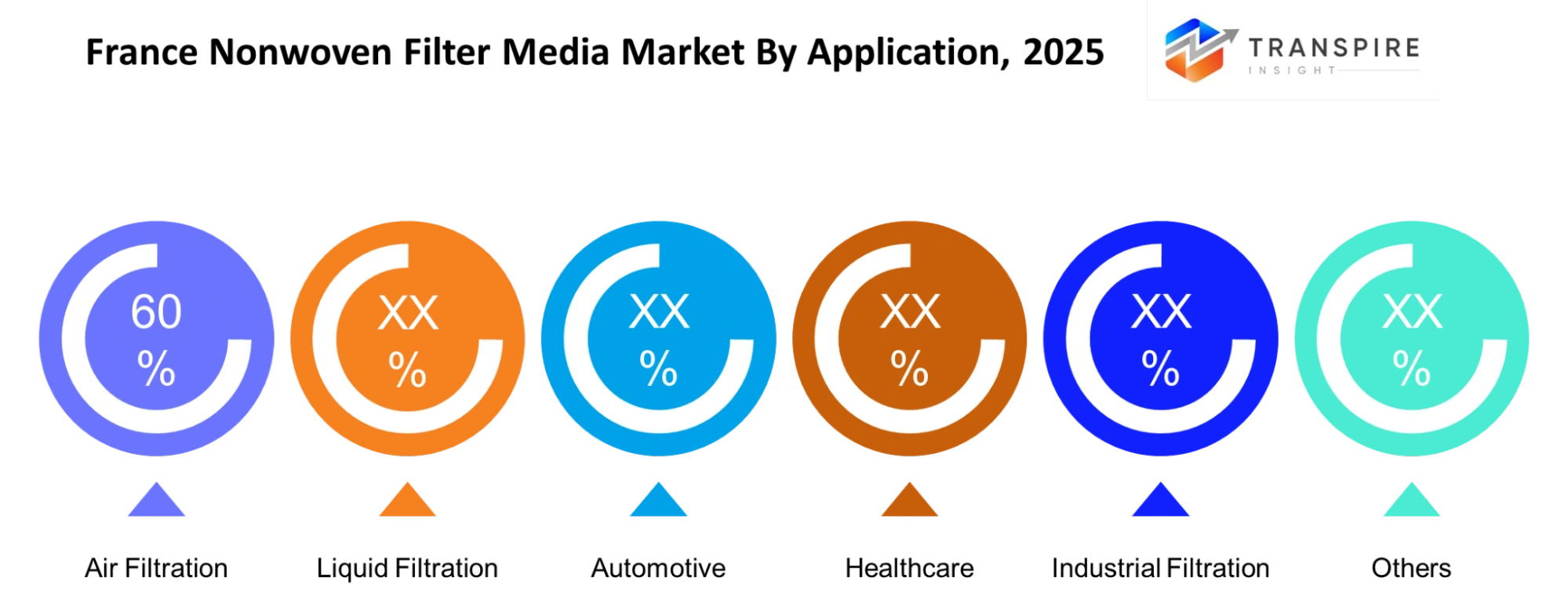
- The France Nonwoven Filter Media Market sees air filtration as its main application which accounts for about 46% market share in 2025 because industries need to follow strict emission control regulations.
- The demand for water and wastewater filtration systems sees its highest growth rate because regulatory bodies require municipal and industrial facilities to build new treatment plants.
- The industrial manufacturing sector constitutes the main end-user segment in the market because it holds more than 40% market share with its filtration systems that determine production quality and equipment durability.
- The end-user category that shows the fastest growth for sterile filtration systems and strict compliance needs belongs to the pharmaceuticals and healthcare sector.
- The company develops customized filtration systems through its strategic partnerships with industrial and municipal clients which lead to long-term supply agreements.
- The company uses its regional expansion across Europe to create distribution networks while decreasing supply chain risks which emerged after the pandemic.
- Companies use product innovation that develops recyclable and biodegradable products to meet sustainability requirements while securing a competitive market position.
What are the Key Drivers, Restraints, and Opportunities in the France Nonwoven Filter Media Market?
The France Nonwoven Filter Media Market experienced its most significant growth because stricter European Union air and water quality regulations became the market's main driving force. The 2020 industrial emissions and wastewater discharge policies required manufacturers to upgrade their outdated filtration systems with high-efficiency nonwoven media. The company experiences revenue growth because customers who previously bought its products now return to purchase more expensive items. Advanced nonwoven materials now serve as essential components because pharmaceuticals, food processing and automotive industries need precision-grade filtration to meet their compliance requirements. Suppliers achieve financial advantages through both volume growth and premium prices that depend on their performance standards.
The industry faces a persistent challenge because raw material costs especially for polypropylene and polyester fibers create a fundamental problem. The inputs depend on petrochemical supply chains which currently experience disruption from geopolitical tensions and energy price fluctuations. Manufacturers face challenges because they must manage raw material price changes without affecting their profit margins while they also need to discover new materials that maintain their product quality. End users experience delayed purchasing processes because of this restriction which also decreases their budgeted revenue from recurring contracts. The restricted bargaining power of smaller companies creates additional challenges because it stops them from expanding their production capacity and funding research and development projects.
Nanofiber technology introduces a powerful future development prospect through its application to nonwoven filter media materials. Nanofiber layers create high-performance air and liquid filtration systems through their capability to capture particles while allowing optimal airflow performance.
What Has the Impact of Artificial Intelligence Been on the France Nonwoven Filter Media Market?
Artificial intelligence is transforming the design, monitoring, and maintenance processes of filtration systems that use nonwoven media in industrial settings throughout France. Manufacturers use AI-based process control systems in production to achieve real-time optimization of fiber distribution and bonding temperature and material consistency. The level of automation which the system provides results in two benefits for production because it decreases defect rates and increases throughput which leads to decreased unit costs and greater product dependability. AI-based sensors in end-use applications which include air handling units and water treatment plants track pressure differentials and flow rates and particulate capture efficiency throughout their operation.
The systems adjust their operating parameters automatically to achieve peak filtration efficiency while extending the operational life of their filter media. Machine learning models enable predictive maintenance by studying past performance records which detect early indicators of system blockage and equipment deterioration. Operators can schedule system replacements which will occur before equipment failure, thus achieving better operational efficiency because unplanned downtime decreases by measurable amounts. AI technology enables continuous system monitoring and audit readiness for pharmaceutical companies which must comply with strict regulations because it ensures their filtration systems maintain required regulatory standards.
The adoption process faces a major obstacle because organizations need to pay for expensive system integration work while their data systems remain disorganized and not interconnected. The implementation of artificial intelligence in many legacy filtration systems remains impossible because these systems do not have digital interfaces, which results in slow adoption despite their demonstrated efficiency improvements.
Key Market Trends
- The EU emission and wastewater directives which started in 2020 have required more than 60 percent of industrial facilities to update their filtration systems through the use of highly efficient nonwoven materials.
- Since 2021 manufacturers have transitioned from using single-layer materials to building multi-layer composite structures which achieve 30 percent better filtration performance in essential operational scenarios.
- Between 2022 and 2025 companies began demanding longer-lasting filter media because they wanted to decrease lifecycle costs instead of taking advantage of initial procurement cost savings.
- After 2021 organizations experienced significant growth in digital monitoring capabilities which smart filtration systems delivered through their real-time performance tracking functions that decreased maintenance downtime for industrial facilities.
- The 2022 supply chain disruptions forced companies to establish production facilities in Europe which helped them decrease their need for imported polypropylene while achieving more predictable delivery schedules.
- Freudenberg Group and Ahlstrom joined other top companies in increasing their research and development spending by 15 percent since 2021 to support their work on nanofiber development and advanced air filtration research.
- After 2023 industrial buyers started using customized filtration solutions because standardized products could not fulfill their requirements for performance and regulatory compliance.
- Water treatment applications became strategically important for industrial operations after 2022 because of stricter discharge regulations which increased demand for specialized nonwoven media that can endure higher levels of chemical exposure.
- Manufacturers developed recyclable and low-emission filter media products to meet sustainability requirements which resulted in procurement decisions that affected the automotive and food processing industries.
France Nonwoven Filter Media Market Segmentation
By Type
Dermal fillers maintain their dominant position in the France bioregenerative aesthetic injectable market through their extensive clinical use in facial volume restoration and contour correction procedures. Patients at both premium and mid-tier clinics experience stronger confidence because high practitioner familiarity with standardized treatment protocols leads to predictable outcomes. The market established its leadership position because elective procedures do not require reimbursement and clinics can adjust their prices while providing continuous services.
The future of dermal fillers shows stability because product development continues and hybrid products which combine volumizing and regenerative features generate customer demand. The manufacturers will develop products which last longer and offer better biocompatibility while these two factors will maintain market demand and compete with rising regenerative product alternatives.
By Application
Anti-aging treatments represent the primary application area because urban residents maintain demand for facial rejuvenation and maintenance procedures. Dermatology clinics need these services because their business model depends on treating patients who return for multiple visits. Major cities in France experience continuous demand because people value both their appearance and their professional image.
The upcoming trends show that anti-aging procedures will keep growing because injectable technology innovations will increase treatment safety and provide precise medical outcomes. Clinics will start using customized treatment protocols which will mix various injectables to boost patient aesthetic results and contentment throughout time.
To learn more about this report, Download Free Sample Report
By End-User
The industrial sector maintains its position as the primary market for nonwoven filter media, which manufacturers use in their production processes and energy generation operations and chemical processing activities. Filtration acts as an essential operational need because it determines equipment reliability and product quality and organizations need to meet regulatory standards. The segment maintains stable demand because customers require replacement parts while their systems operate continuously throughout the day.
The industrial automation industry requires improved filtration systems to meet new environmental regulations which serve as the primary factor driving its future expansion. Companies will implement advanced systems that include monitoring technologies because they require improved high-performance media and need to establish long-term relationships with their suppliers.
By Material
The material industry segment receives its primary market share through polypropylene which provides cost-effectiveness and chemical protection and multi-purpose usage for both air and liquid filtration systems. The material has gained widespread use because it enables easy manufacturing through various nonwoven production methods. The company maintains its market dominance because of its strong ability to supply products.
The market will continue to experience strong demand however sustainability requirements will drive changes in material development. Producers will create polypropylene products that meet recycling standards while reducing emissions to comply with environmental regulations and fulfill customer demands.
Polyester holds the second-largest share of the market because it offers superior temperature resistance and mechanical durability when compared to polypropylene. Industrial and automotive filtration applications create steady demand because these industries need materials that provide additional strength and stability. The higher expenses of the product become acceptable when its benefits match specific application needs.
What are the Key Use Cases Driving the France Nonwoven Filter Media Market?
The primary application of industrial air filtration systems exists because manufacturing plants and power plants and chemical processing facilities need to comply with their emission control obligations. The nonwoven filter media functions to capture fine particulates while achieving European air quality standards, which subsequently impacts operational continuity and regulatory approval processes.
Municipal utilities and industrial firms expand their operations through water and wastewater treatment as an essential secondary use case. Nonwoven media helps facilities to remove suspended solids and contaminants, which enables them to comply with increasingly strict discharge regulations. The implementation of automotive cabin air filtration systems has grown in popularity because manufacturers require these systems to safeguard passenger air quality while complying with established regulations.
The new use cases involve specialized healthcare filtration systems for sterile medical spaces and high-efficiency HVAC systems which operate in smart building environments. The rising use of cleanroom technologies together with intelligent ventilation systems generates demand for advanced nonwoven filtration products that include integrated sensors.
|
Report Metrics |
Details |
|
Market size value in 2025 |
USD 923.91 Million |
|
Market size value in 2026 |
USD 982.89 Million |
|
Revenue forecast in 2033 |
USD 1515.13 Million |
|
Growth rate |
CAGR of 6.38% from 2026 to 2033 |
|
Base year |
2025 |
|
Historical data |
2021 - 2024 |
|
Forecast period |
2026 - 2033 |
|
Report coverage |
Revenue forecast, competitive landscape, growth factors, and trends |
|
Regional scope |
France |
|
Key company profiled |
Berry Global, Freudenberg, Ahlstrom-Munksjo, Johns Manville, DuPont, Toray, Kimberly-Clark, Fitesa, Glatfelter, Hollingsworth & Vose, Lydall, Fibertex, Avgol, Sandler, TWE Group |
|
Customization scope |
Free report customization (country, regional & segment scope). Avail customized purchase options to meet your exact research needs. |
|
Report Segmentation |
By Type (Spunbond, Meltblown, Needle-punched, Others); By Application (Air Filtration, Liquid Filtration, Automotive, Healthcare, Industrial Filtration, Others); By End-User (Automotive Industry, Healthcare Sector, Industrial Firms, HVAC, Water Treatment, Others); By Material (Polypropylene, Polyester, Glass Fiber, Others) |
Which Regions are Driving the France Nonwoven Filter Media Market Growth?
The market expansion in Northern France occurs because of its multiple industrial centers which contain manufacturing facilities and automotive plants and chemical production centers. The European Union regulations which control air emissions and industrial waste disposal require facilities to implement advanced filtration technologies. Nonwoven media can be distributed efficiently because of established supplier networks and the organization's close location to major transportation routes. The industrial ecosystem maintains demand by operating continuously which helps businesses establish long-term partnerships with suppliers.
The industrial base of Eastern France maintains economic stability through its combination of local manufacturing operations and international trade with Germany and Switzerland. This region maintains better development than the leading region because it receives continuous regulatory implementation and predictable funding during its industrial development phase. High-performance filtration solutions remain in constant demand because pharmaceutical and precision manufacturing industries maintain a strong presence in the market. The business generates secure revenue streams because its filtration contracts extend over many years with filtration providers.
The water treatment sector in Southern France experiences rapid growth because of recent water treatment system investments and the effects of climate change on environmental resources. The municipal and industrial filtration systems have undergone upgrades because of the rising temperatures and water scarcity issues which began in 2022. The growth of urban infrastructure together with development for tourism purposes has resulted in higher requirements for advanced HVAC filtration systems. The development path creates openings for new market players who will introduce specialized media products which meet the requirements of changing environmental conditions and infrastructure development.
Who are the Key Players in the France Nonwoven Filter Media Market and How Do They Compete?
The competitive landscape displays a semi-consolidated structure which exists because global material science companies control most of the market while regional converters and niche specialists compete through their ability to customize products and deliver products faster than their competitors. The main competitive factor between companies exists in their technology performance and their engineering capabilities which match specific application needs of their products. Industrial and healthcare buyers now consider filtration efficiency and lifecycle costs and regulatory compliance as their most important product selection criteria which benefits companies that possess advanced research and development resources. The new companies entering the market face obstacles which stem from certification requirements and process expertise demands which enable established companies to maintain their market positions through innovative product development and extended contractual agreements.
Freudenberg uses its advanced engineering skills in multilayer nonwoven structures to compete in the market while maintaining its established partnerships with automotive and HVAC original equipment manufacturers. Freudenberg achieves its application-specific product development through continuous investment in high-performance filtration media and system integration capabilities. Ahlstrom-Munksjo specializes in developing specialty fiber-based materials which include liquid filtration products and life sciences materials that pharmaceutical and laboratory customers need. The company increases its attractiveness to environmentally regulated industries through its strategic development of sustainable fiber technologies.
DuPont uses advanced material science technology to create filtration systems that provide high efficiency and chemical resistance and durability for industrial and healthcare use. The company establishes its distinct market position through its proprietary technologies and its worldwide distribution network which enables it to serve large clients.
Company List
- Berry Global
- Freudenberg
- Ahlstrom-Munksjo
- Johns Manville
- DuPont
- Toray
- Kimberly-Clark
- Fitesa
- Glatfelter
- Hollingsworth & Vose
- Lydall
- Fibertex
- Avgol
- Sandler
- TWE Group
Recent Development News
In April 2026, Ahlstrom announced material support for a breakthrough dried urine test for chlamydia and gonorrhea. This innovation highlights the company’s expansion into high-value life sciences filtration applications, strengthening its advanced fiber-based filtration portfolio.https://www.ahlstrom.com
In December 2025, Ahlstrom launched Flow2Save™ filtration media designed to improve air quality and reduce energy consumption in HVAC systems. This product strengthens its position in energy-efficient filtration solutions and supports demand for high-performance nonwoven media in building systems.https://www.ahlstrom.com
What Strategic Insights Define the Future of the France Nonwoven Filter Media Market?
The market now moves toward high-performance filtration systems which meet specific application requirements because customers base their purchase choices on product efficiency and product longevity and product compliance with regulations instead of product pricing. The current trend exists because emission standards have become more stringent while industrial discharge rules have become stricter and automated monitoring systems require their monitoring equipment to function at all times.
The market will develop during the upcoming five to seven years through value creation from advanced multilayer systems and nanofiber-based solutions which provide extended operational periods and dependable filtration capabilities. A less visible risk exists because companies depend on raw materials which rely heavily on petroleum-based products especially polypropylene. Production costs will face disruption through supply fluctuations or regulatory restrictions which will force companies to turn to better filtration alternatives.
Smart filtration systems which include sensor-based monitoring systems now present a new business opportunity for HVAC systems and industrial facilities which operate across southern France. Companies should develop hybrid media systems which include digital performance monitoring to create product differentiation through efficient operation across their product lifecycle.
France Nonwoven Filter Media Market Report Segmentation
By Type
- Spunbond
- Meltblown
- Needle-punched
- Others
By Application
- Air Filtration
- Liquid Filtration
- Automotive
- Healthcare
- Industrial Filtration
- Others
By End-User
- Automotive Industry
- Healthcare Sector
- Industrial Firms
- HVAC
- Water Treatment
- Others
By Material
- Polypropylene
- Polyester
- Glass Fiber
- Others
Frequently Asked Questions
Find quick answers to common questions.
The confirmed 2033 market size figure in USD 1515.13 Million.
Key segments for the France Nonwoven Filter Media Market are By Type (Spunbond, Meltblown, Needle-punched, Others); By Application (Air Filtration, Liquid Filtration, Automotive, Healthcare, Industrial Filtration, Others); By End-User (Automotive Industry, Healthcare Sector, Industrial Firms, HVAC, Water Treatment, Others); By Material (Polypropylene, Polyester, Glass Fiber, Others).
Major France Nonwoven Filter Media Market players are Berry Global, Freudenberg, Ahlstrom-Munksjo, Johns Manville, DuPont, Toray, Kimberly-Clark, Fitesa, Glatfelter, Hollingsworth & Vose, Lydall, Fibertex, Avgol, Sandler, TWE Group.
The France Nonwoven Filter Media Market size is USD 923.91 Million in 2025.
The France Nonwoven Filter Media Market CAGR is 6.38% from 2026 to 2033.
- Berry Global
- Freudenberg
- Ahlstrom-Munksjo
- Johns Manville
- DuPont
- Toray
- Kimberly-Clark
- Fitesa
- Glatfelter
- Hollingsworth & Vose
- Lydall
- Fibertex
- Avgol
- Sandler
- TWE Group
Recently Published Reports
-
Apr 2026
ATV & UTV Market
ATV & UTV Market Size, Share & Analysis Report By Type (ATV, and UTV), By Variants (Less Than 400 CC, 400 CC To 800 CC, and More Than 800 CC), and Geography (North America, Europe, Asia-Pacific, Middle East and Africa, South and Central America), 2021 - 2031
-
Apr 2026
Automotive Central Gateway Module Market
Automotive Central Gateway Module Market Size, Share & Analysis Report By Type (Ethernet Central Gateway Module, CAN Central Gateway Module, LIN Central Gateway Module, and FlexRay), By Application (Powertrain Control, Body Control, Infotainment System, Advanced Driver Assistance Systems (ADAS), and Others), By End User (Passenger Vehicles, and Commercial Vehicles), and Geography (North America, Europe, Asia-Pacific, Middle East and Africa, South and Central America), 2021 - 2031
-
Apr 2026
Automotive Engine Oil Filter Market
Automotive Engine Oil Filter Market Size, Share & Analysis Report By Filter Type (Fuel Filter, Engine Oil Filter, Hydraulic Oil Filter, and Others), By Filter Media (Cellulose, Synthetic, and Micro), By Sales Channel (OEMs, and Aftermarket), By Vehicle Type (Passenger Cars, Light Commercial Vehicles, Heavy Duty Trucks, Buses and Coaches, and Off-road Vehicles), and Geography (North America, Europe, Asia-Pacific, Middle East and Africa, South and Central America), 2021 - 2031
-
Apr 2026
Automotive Parts Aluminium Die Casting Market
Automotive Parts Aluminium Die Casting Market Size, Share & Analysis Report By Production Process (Pressure Die Casting, Vacuum Die Casting, Squeeze Die Casting, Gravity Die Casting), By Application (Body Parts, Engine Parts, Transmission Parts, Battery And Related Components, Other Application Types), and Geography (North America, Europe, Asia-Pacific, Middle East and Africa, South and Central America), 2021 - 2031
Our Clients