
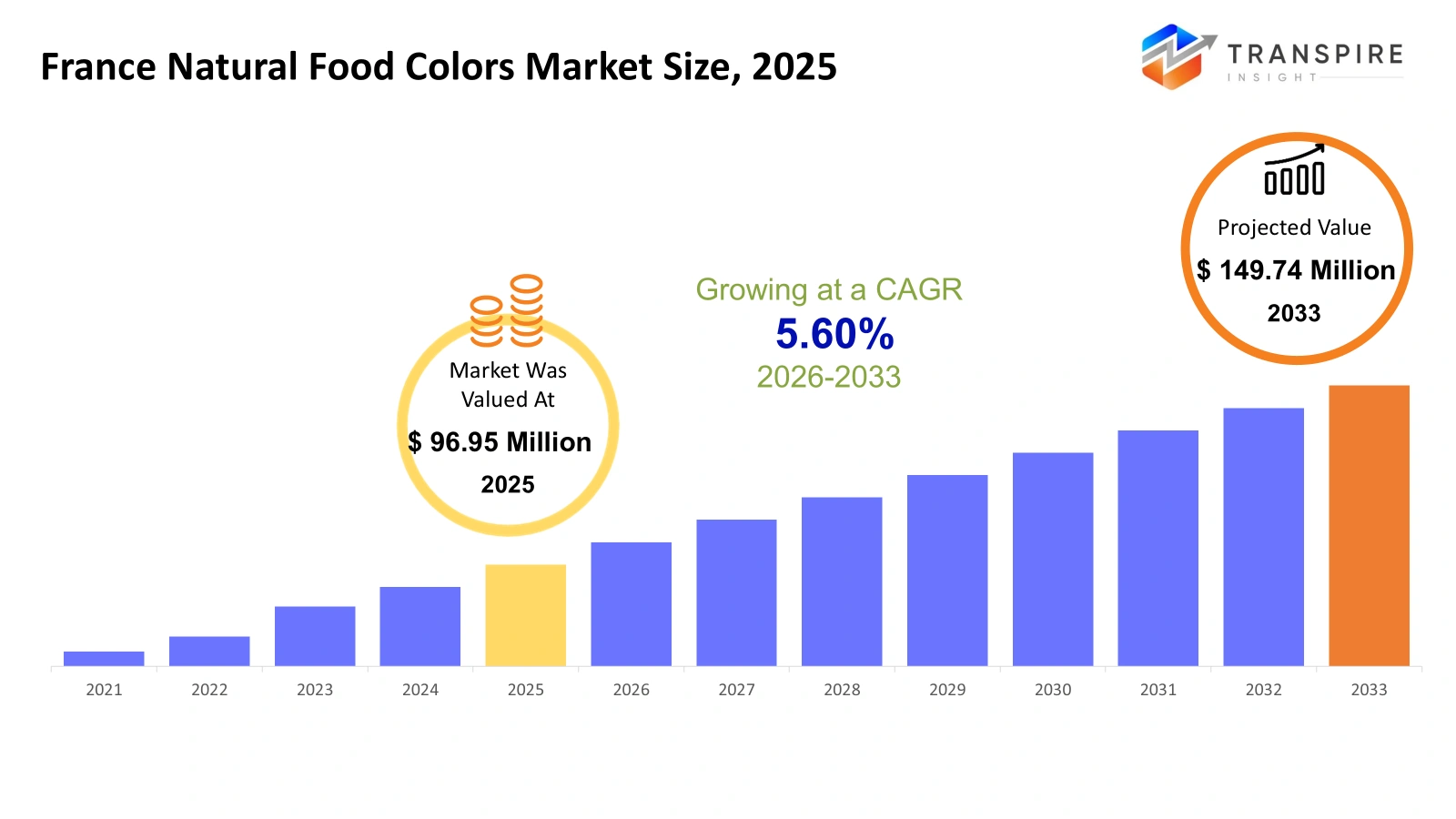
France Natural Food Colors Market Size & Forecast:
- France Natural Food Colors Market Size 2025: USD 96.95 Million
- France Natural Food Colors Market Size 2033: USD 149.74 Million
- France Natural Food Colors Market CAGR: 5.60%
- France Natural Food Colors Market Segments: By Source (Plant-based Colors, Animal-based Colors, Mineral-based Colors),By Application (Beverages, Confectionery, Dairy Products, Bakery Products)
To learn more about this report,  Download Free Sample Report
France Natural Food Colors Market Summary:
France Natural Food Colors Market size was estimated at USD 96.95 Millionin 2025 and is anticipated to reach USD 149.74 Million by 2033, growing at a CAGR of 5.60% from 2026 to 2033.
France's natural food colors market operates within the country’s processed food and beverage industry, where visual appeal, ingredient transparency, and product safety will continue to influence how manufacturers design and present their offerings. Food producers across bakery, confectionery, dairy, beverages, and ready meals will increasingly favor pigments derived from fruits, vegetables, algae, and botanical sources as shoppers pay closer attention to ingredient lists and artificial additives. French households will show a stronger preference for products made with recognizable and minimally processed components, encouraging brands to reformulate legacy recipes without altering taste or texture. Central to packaging strategies, clean-label positioning will remain essential as manufacturers develop plant-based color alternatives which maintain their color through heat treatment and storage variation and light exposure. As packaged foods become more premium, companies will need to use authentic visual elements because customers prefer authentic visual elements to detect product quality and freshness and natural sourcing, which prevents them from using bright synthetic colors.
The development of new extraction and stabilization technologies will create new production standards to help ingredient developers achieve better pigment concentration and longer shelf life and wider food compatibility. The development of microencapsulation technology together with fermentation-based coloring solutions will create new application opportunities while enabling producers to achieve product consistency during large-scale production. The European Food Safety Authority together with Agence nationale de sécurité sanitaire de l'alimentation will provide regulatory guidance which will determine acceptable formulation methods and labeling standards and safety evaluation procedures, thus requiring companies to direct their research funding toward meeting compliance standards. Corporations will direct their sourcing activities according to sustainability requirements, which will lead them to establish partnerships with agricultural suppliers who implement traceable methods and environmentally sustainable practices. The growing presence of private labels and artisanal food brands in retail will increase customer demand for unique color solutions and specific application products, which will foster closer cooperation between ingredient suppliers and food processors throughout all product categories in France.
Key Market Trends & Insights:
- The food manufacturing industry in France experiences increasing demand for transparent ingredient sourcing practices. Consumers show stronger interest in plant-based coloring solutions derived from fruits, vegetables, algae, and spices. Food processors now prefer to use natural ingredients that customers can recognize instead of synthetic additives which people who make health-conscious purchases prefer.
- People who live in busy urban areas need to buy packaged meals and ready-to-eat snacks and instant beverages. Manufacturers need to find natural pigments which maintain their visual appeal under mass production conditions. Advanced extraction methods enable manufacturers to achieve color consistency and heat resistance which extends product shelf life across multiple bakery and dairy and confectionery and beverage products.
- European food safety regulations mandate businesses to use permitted natural coloring materials instead of synthetic chemical dyes. Companies that follow labeling transparency rules and additive regulations can build stronger consumer trust while enhancing their brand reputation. The government-operated quality certification system prompts manufacturers to use botanical pigment solutions which offer safer options for their large-scale production processes.
- Food technology advances continuously enhance pigment retention and solubility while improving resistance against light and temperature changes. Microencapsulation and emulsification techniques improve performance of complex formulations. Ingredient suppliers invest research funding to develop natural shades which maintain their vibrant appearance for extended periods while being used in various culinary applications without changing their flavor profiles.
- The environmental awareness of people creates procurement strategies which extend throughout their entire ingredient supply chain operations. Food brands use biodegradable processing methods and responsibly cultivated raw materials as their top priority for research. Sustainable farming partnerships provide traceable botanical input sources while simultaneously decreasing their environmental footprint. Ethical production standards together with sustainable supplier partnerships enable businesses to better their market standing while building long-term supplier connections.
France Natural Food Colors Market Segmentation
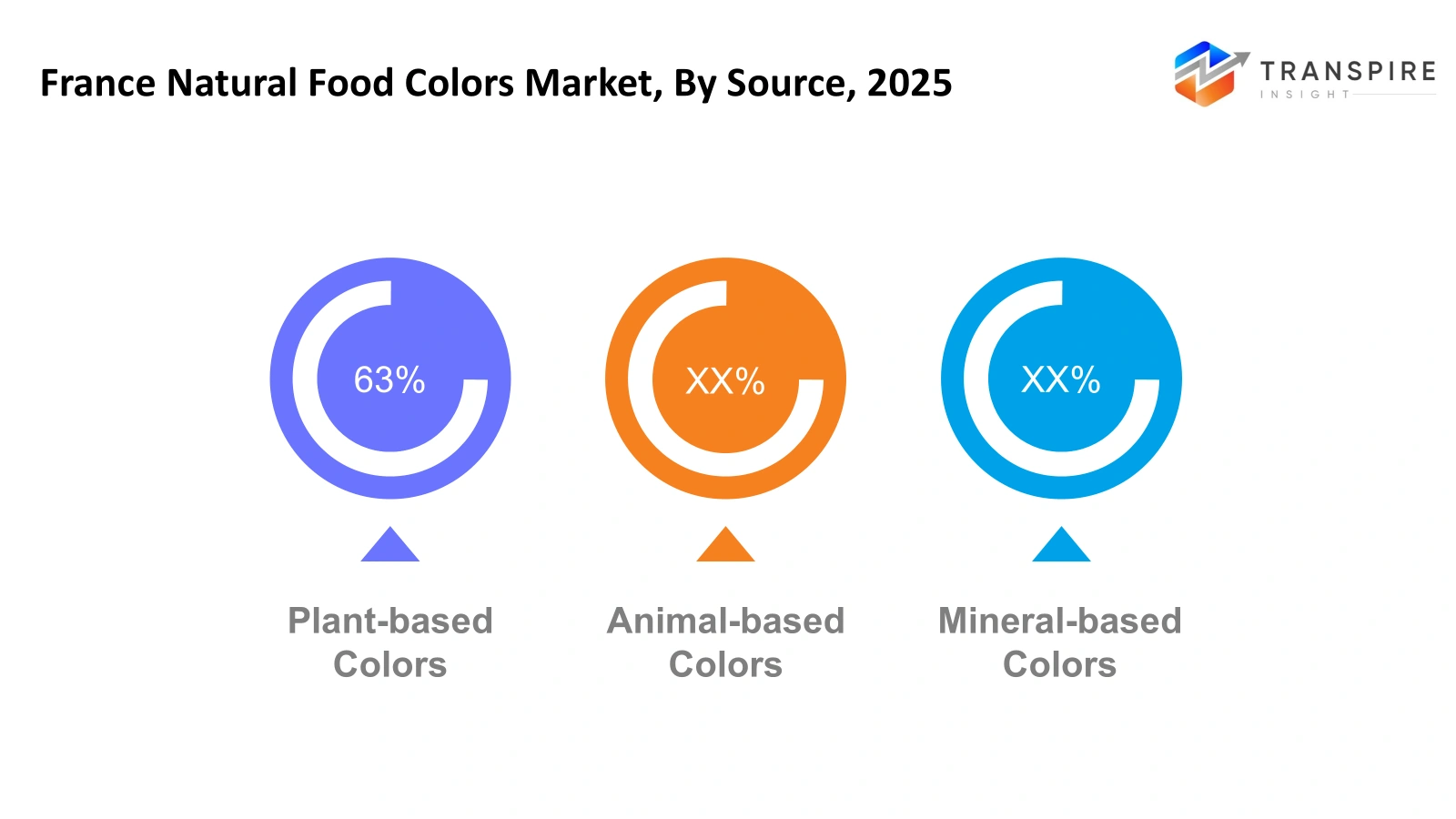
By Source –
- Plant-based Colors: The market for natural food colors in France demonstrates strong demand for plant-based pigments which manufacturers produce from fruits and vegetables and herbs and algae. The beetroot and spirulina and paprika and turmeric and grape skin extracts produce constant color results for food manufacturing. Manufacturing companies will adopt botanical color solutions because clean-label products and vegan options and safety perceptions drive their product transformations.
- Animal-based Colors: The France Natural Food Colors Market uses animal-based colors through carmine which comes from cochineal insects for restricted yet constant application. These colors produce bright red and pink tones which manufacturers use in confectionery and dairy toppings and decorative food products. Demand exists due to regulatory clarity and traditional applications but vegan trends will limit market growth.
- Mineral-based Colors: The France Natural Food Colors Market uses mineral pigments which come from natural earth materials that include iron oxides and calcium carbonate. The colors produce muted and stable tones which fulfill requirements for bakery coatings and confectionery shells and decorative surfaces. The product maintains its usefulness in processed food production because it possesses high heat resistance and extended shelf life.
To learn more about this report, Download Free Sample Report
By Application –
- Beverages: France Natural Food Colors Market finds major application in beverages which include fruit drinks and flavored water and energy drinks and alcoholic products. Natural pigments increase visual appeal while meeting clean-label design requirements. Plant-derived anthocyanins and carotenoids and chlorophyll extracts will see increased usage because of their ability to maintain stability across different pH and light environments.
- Confectionery: France Natural Food Colors Market supplies natural food colors to confectionery products which include gummies and hard candies and chewing gums and coated chocolates. Bright and attractive shades influence consumer purchase decisions, especially among younger buyers. Manufacturers will start using natural dye replacements instead of synthetic dyes because they need to meet regulatory requirements and provide product ingredient information.
- Dairy Products: The France Natural Food Colors Market provides natural food colors to yogurt and flavored milk and ice cream and dessert preparations which require soft attractive colors for better presentation. Product positioning needs to use natural carotenoids and annatto and fruit concentrates to attract health-focused consumers. The demand for dairy products will increase because dairy brands use simple ingredients and natural sourcing to promote their products.
- Bakery Products: The France Natural Food Colors Market provides natural food colors to bakery products which include cakes and pastries and frostings and fillings and decorative icings. Natural pigments with heat stability maintain consistent color during baking. The expansion of artisanal bakeries and the rising popularity of premium desserts and the increasing consumer demand for visually unique products will lead to a higher adoption rate of natural coloring alternatives.
Country Insights
- Food and beverage manufacturers across regions of France show strong preference for plant-based color solutions which they derive from fruits, vegetables, algae, and spices. Urban consumers who prefer clean-label products drive companies to replace synthetic additives with natural ingredients in dairy and bakery and confectionery and beverage products. The industry implements new technology through precise safety evaluations which help them achieve their goals at major processing plants.
- Artisanal producers choose their color ingredients based on local culinary traditions while berry extracts and beet concentrates and paprika oleoresin and saffron infusions remain popular. Premium product positioning in gourmet retail chains encourages visually appealing formulations created through natural pigments. Export-oriented brands require stable shades which maintain their color during heat processing and storage and transportation.
- The France Natural Food Colors Market benefits from advanced food technology infrastructure and established agricultural supply chains and research partnerships between ingredient developers and universities. The company achieves better product stability and extended shelf life through its investment in microencapsulation technology and fermentation-derived pigment development. Sustainable sourcing programs and traceable raw materials strengthen consumer confidence and long-term industry growth.
Recent Development News
Givaudan’s natural blue food color nears EU approval
Givaudan’s innovative natural acid-stable blue color (based on microalgae) has received positive feedback from the European Food Safety Authority (EFSA), a key regulatory step toward commercialization across the EU food market.
FDA approves three new natural food color additives
The U.S. FDA permitted the use of three food color additives (including blue from algae and butterfly pea flower extract) sourced from natural materials — reflecting global shifts toward natural colors that also influence EU ingredient strategies.
|
Report Metrics |
Details |
|
Market size value in 2025 |
USD 96.95 Million |
|
Market size value in 2026 |
USD 102.28 Million |
|
Revenue forecast in 2033 |
USD 149.74 Million |
|
Growth rate |
CAGR of 5.60% from 2026 to 2033 |
|
Base year |
2025 |
|
Historical data |
2021 - 2024 |
|
Forecast period |
2026 - 2033 |
|
Report coverage |
Revenue forecast, competitive landscape, growth factors, and trends |
|
Country scope |
France |
|
Key company profiled |
Givaudan, DSM-Firmenich, Chr. Hansen, Sensient Technologies, Naturex, DDW The Color House, Roha Dyechem, Kalsec, Archer Daniels Midland, Döhler Group, Symrise, LycoRed, BASF, Ingredion, Tate & Lyle. |
|
Customization scope |
Free report customization (country, regional & segment scope). Avail customized purchase options to meet your exact research needs. |
|
Report Segmentation |
By Source (Plant-based Colors, Animal-based Colors, Mineral-based Colors), By Application (Beverages, Confectionery, Dairy Products, Bakery Products) |
Key France Natural Food Colors Company Insights
- France Natural Food Colors Market shows strong emphasis on research-driven product development. Leading manufacturers will invest in plant-derived pigments sourced from spirulina, beetroot, turmeric, and paprika to meet clean-label standards. The continuous enhancement of color stability and heat resistance together with shelf performance improvements establishes a competitive advantage for bakery and beverage and dairy product uses.
- French Natural Food Colors Market uses clean ingredient product standards as the foundation for corporate business operations. Companies will highlight absence of synthetic additives, artificial preservatives, and chemical solvents to satisfy rising consumer preference for transparent formulations. European food safety certification standards enable food manufacturers to enhance their brand trustworthiness while health-oriented food producers prefer their products.
- Environmental responsibility influences operational decisions in France Natural Food Colors Market. Major producers will adopt sustainable agriculture partnerships, eco-friendly extraction techniques, and waste reduction systems to lower environmental impact. Ethical sourcing programs enable traceability while they help businesses maintain access to essential raw materials during times of agricultural disruption caused by climate change.
France Natural Food Colors Market Companies:
- Givaudan
- DSM-Firmenich
- Chr. Hansen
- Sensient Technologies
- Naturex
- DDW The Color House
- Roha Dyechem
- Kalsec
- Archer Daniels Midland
- Döhler Group
- Symrise
- LycoRed
- BASF
- Ingredion
- Tate & Lyle.
France Natural Food Colors Market Segmentation
By Source
- Plant-based Colors
- Animal-based Colors
- Mineral-based Colors
By Application
- Beverages
- Confectionery
- Dairy Products
- Bakery Products
Frequently Asked Questions
Find quick answers to common questions.
The Approximate France Natural Food Colors Market size for the Market will be USD 149.74 Million in 2033.
Key Segments for the France Natural Food Colors Market are By Source (Plant-based Colors, Animal-based Colors, Mineral-based Colors),By Application (Beverages, Confectionery, Dairy Products, Bakery Products).
Major France Natural Food Colors Market Players are Givaudan, DSM-Firmenich, Chr. Hansen, Sensient Technologies, Naturex, DDW The Color House, Roha Dyechem, Kalsec, Archer Daniels Midland, Döhler Group, Symrise, LycoRed, BASF, Ingredion, Tate & Lyle.
The Current France Natural Food Colors Market size is USD 96.95 Million in 2025.
The France Natural Food Colors Market CAGR is 5.60%.
- Givaudan
- DSM-Firmenich
- Chr. Hansen
- Sensient Technologies
- Naturex
- DDW The Color House
- Roha Dyechem
- Kalsec
- Archer Daniels Midland
- Döhler Group
- Symrise
- LycoRed
- BASF
- Ingredion
- Tate & Lyle.
Recently Published Reports
-
Apr 2026
Baby Infant Formula Market
Baby Infant Formula Market Size, Share & Analysis Report By ype (Infant Milk, Follow On Milk, Specialty Baby Milk, Growing-Up Milk), By Ingredient (Carbohydrate, Fat, Protein, Minerals, Vitamins, and Others), By Product Form (Powder, Liquid, and Ready-to-feed), By Distribution Channels (Supermarket/Hypermarket, Specialty Store, Pharmacies, Online Retail, and Others), and Geography (North America, Europe, Asia-Pacific, Middle East and Africa, South and Central America), 2021 - 2031
-
Apr 2026
Edible Insects for Animal Feed Market
Edible Insects for Animal Feed Market Size, Share & Analysis Report By Type (Insect Powder, Insect Meal, Insect Bar, Insect Paste, Insect Oil, and Others), By Insect Type (Beetles, Cricket, Caterpillar, Hymenoptera, Orthoptera, Tree Bugs, and Others), By Application (Livestock, Pet Food, and Aquaculture), By Livestock Type (Poultry, Swine, and Others), and Geography (North America, Europe, Asia-Pacific, Middle East and Africa, South and Central America), 2021 - 2031
-
Apr 2026
Food Industry Disinfection and Bacterial Control Market
Food Industry Disinfection and Bacterial Control Market Size, Share & Analysis Report By Type (Chemical Disinfectants, Physical Disinfectants, and Biocides and Antimicrobials), By Application (Food Processing Equipment Surface Disinfection, Food Preparation Areas Surface Disinfection, Storage Areas Surface Disinfection, Anti-microbial Coatings Food Preservation, and Preservative Solutions Food Preservation), By End User (Meat and Poultry Processing, Dairy Processing, Seafood Processing, Bakery and Confectionery, Restaurants and Commercial Kitchens, and Food Service Providers), By Sales Channel (Online, Offline), and Geography (North America, Europe, Asia-Pacific, Middle East and Africa, South and Central America), 2021 - 2031
-
Apr 2026
Freeze Dried Food Market
Freeze Dried Food Market Size, Share & Analysis Report By Product Type (Fruits, Vegetables, Freeze-Dried Dairy Products, Freeze-Dried Meat and Seafood, Freeze-Dried Pet Food, and Prepared Meal), By Nature (Organic, and Conventional), By Form (Powdered, Granules, and Diced), By End Use (Breakfast Cereals, Dairy Products, Bakery & Confectionery, Nutritional Bars & Supplements, Powdered Beverages, Snacks, and Retail (Household)), and Geography (North America, Europe, Asia-Pacific, Middle East and Africa, South and Central America), 2021 - 2031