

France Milk Protein Market Size & Forecast:
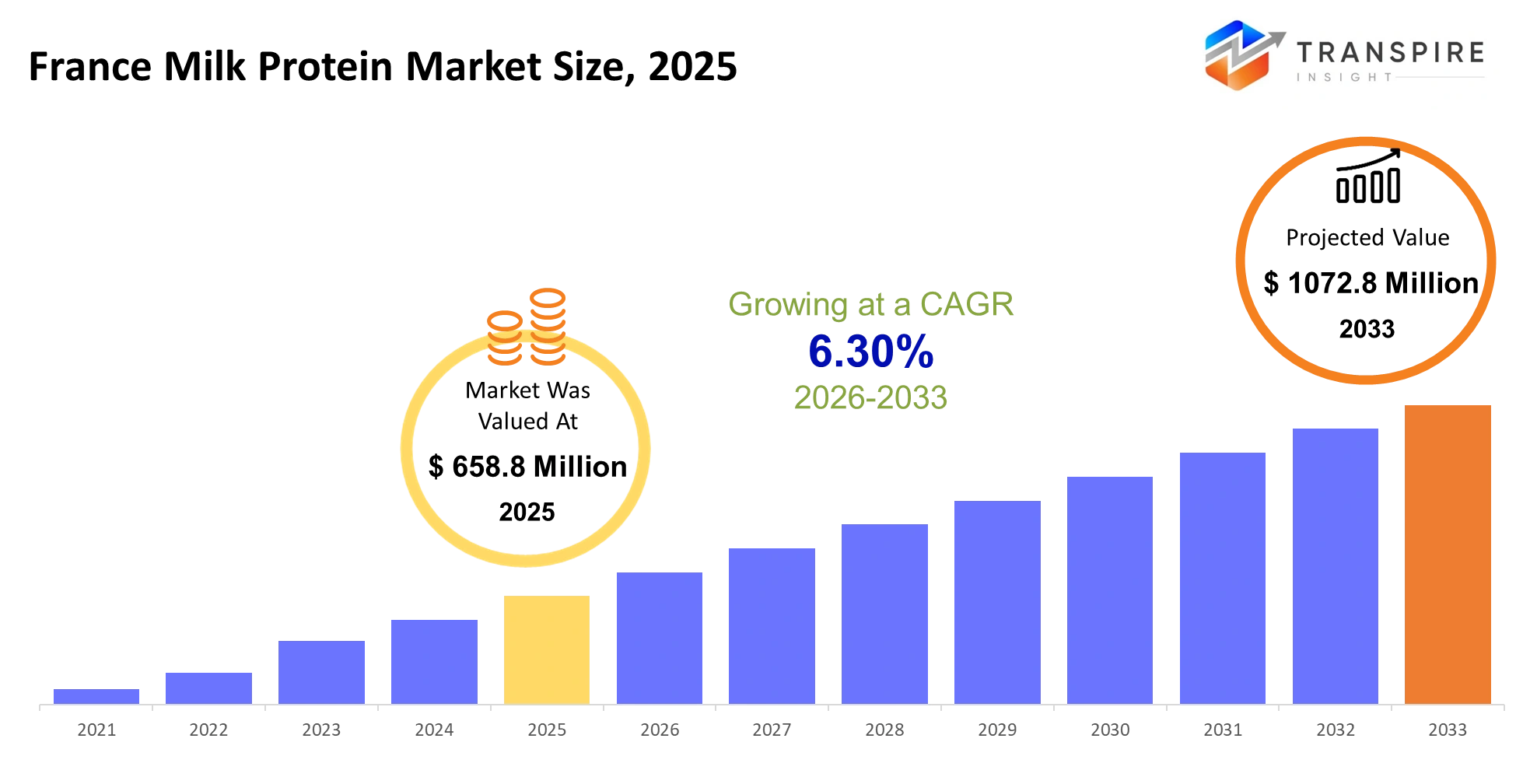
- France Milk Protein Market Size 2025: USD 658.8 Million
- France Milk Protein Market Size 2033: USD 1072.8 Million
- France Milk Protein Market CAGR: 6.30%
- France Milk Protein Market Segments: By Type (Casein, Whey Protein, Milk Protein Concentrate, Milk Protein Isolate, Others); By Application (Food & Beverages, Sports Nutrition, Infant Nutrition, Clinical Nutrition, Others); By End-User (Food Companies, Pharma Companies, Consumers, Healthcare, Others); By Form (Powder, Liquid, Others).
To learn more about this report,  Download Free Sample Report
France Milk Protein Market Summary
The France Milk Protein Market was valued at USD 658.8 Million in 2025. It is forecast to reach USD 1072.8 Million by 2033. That is a CAGR of 6.30%over the period.
The France Milk Protein Market somehow supports the formulation of high-protein dairy ingredients used in sports nutrition, infant nutrition , clinical diets, and functional food manufacturing. In real terms, it helps food processors and nutraceutical firms raise protein density and texture, plus improve bioavailability in everyday consumer products as well as in more medical nutrition applications. Over the last five years, the whole market has moved, kind of structurally, toward membrane filtration and advanced fractionation technologies, and it’s been gradually swapping out older acid precipitation methods. That change is mostly to boost purity, yield efficiency , and generally get a cleaner output.
One big spark that accelerated it was the disruption in European dairy supply chains during the post-pandemic logistics crunch, which basically made manufacturers lean harder into localized protein extraction methods, and cut back on dependency on imported isolates. So, producers are now investing more in value added dairy processing , not just bulk milk commodities. That shift, in turn, has helped solidify revenue streams in premium nutrition categories, where demand stays linked to performance oriented diets and clinical recovery formulations.
Key Market Insights
- The French Milk Protein Market is growing steadily, or well, more or less, because people seem to want high-purity whey and casein protein isolates for functional foods. Demand keeps climbing, so the industry size keeps on expanding, even if it feels a bit uneven at times.
- Market growth rate is also backed by the uptick in sports nutrition consumption and clinical dietary use across urban healthcare systems, where adoption is a bit faster than expected.
- In the forecast outlook, membrane filtration technology looks like a key lever, helping improve protein yield as well as production efficiency in dairy processing plants.
- When it comes to regional analysis, Northern France leads with nearly 34% share in 2025 , mainly due to solid dairy processing infrastructure, and a long established supply chain.
- Southern France, however, is the fastest-growing area, pulled along by nutraceutical startups and protein rich beverage innovation, during 2025–2033.
- For product type, the whey protein isolate segment still takes the lead in the France Milk Protein Market, holding the highest share because it offers strong solubility and a reliable absorption profile.
- Casein protein comes in as the second-largest segment, it’s commonly used for slow-release nutrition, and also appears in medical protein formulations where consistency matters.
- By application, sports nutrition stays dominant, accounting for roughly 38% market share in 2025 , linked to continuous protein supplement demand.
- Clinical nutrition grows the quickest too, with support from an aging population, and from hospital based dietary programs that keep expanding in France.
What are the Key Drivers, Restraints, and Opportunities in the France Milk Protein Market?
The main engine of the France Milk Protein Market is that whole rapid expansion of high protein eating habits across sports nutrition and clinical health areas, kinda like, people started paying attention earlier than before. This change really took hold when French consumers began leaning into protein-centric diets, fed by fitness culture plus hospital-based nutrition guidelines. Then food processors answered by pushing up the output of whey and casein concentrates, and they did it with advanced filtration systems. Those systems improved yield uniformity , and also made it possible to move faster through product creation cycles. So in the end, manufacturers are seeing better margins in premium nutrition slots not just in the usual dairy commodity space.
One big restraint is the volatility in raw milk supply, mixed with strict EU dairy compliance rules. Milk sourcing can swing because seasonal livestock productivity in France shifts over time , and that directly affects protein extraction efficiency and the way production is scheduled. On top of that, meeting European food safety and environmental regulations adds more overhead. For smaller processors especially , that extra cost makes scaling quickly pretty hard. This kind of structural issue therefore keeps capacity growth from happening fast , and it also slows down how quickly pricing can be optimized.
A major opportunity shows up in personalized nutrition and medical diet formulation, especially for the aging population in France. Hospitals and wellness brands are increasingly blending custom protein mixtures aimed at recovery and chronic disease support. Firms that invest in precision nutrition platforms and bioactive protein research may end up unlocking additional income sources that go beyond the standard dairy applications.
What Has the Impact of Artificial Intelligence Been on the France Milk Protein Market?
In France artificial intelligence is getting rolled into milk protein processing systems, sort of quietly, to push production efficiency and to strengthen quality checks across dairy plants. Companies are now leaning on AI based monitoring tools to keep filtration parameters in check, kind of in real time, so protein concentration stays steady while whey and casein extraction happens. The idea is that these tools cut down on human mistakes and they help the overall output quality feel more uniform along those big production lines, even when things get busy.
There’s also predictive analytics doing the rounds to estimate how membrane filtration units might wear out over time, which then supports predictive maintenance and fewer sudden stoppages. Machine learning algorithms sift through sensor signals from the equipment to guess when performance is drifting and to fine tune energy use. In practice this tends to boost operational uptime and can lower processing costs, especially in high volume protein isolate facilities where throughput matters a lot.
Still, there is a main catch with AI adoption: the data, and more specifically fragmented and low quality live data, coming from older dairy infrastructure. A lot of mid-sized processors are running systems that are only partly digitized, so the models don’t get the right accuracy and predictive tools don’t work as well. Plus the integration expense stays steep, mainly when older plants need upgrading just to join a fully connected smart manufacturing setup. So in the end AI deployment shows up mostly with large dairy corporations, not so much with smaller and medium producers.
Key Market Trends
- The France Milk Protein Market was valued near USD 780 million in 2025, but it’s forecast to run past USD 1.25 billion by 2032.
- After 2022, membrane filtration technology adoption rose by almost 31% , and it has been quietly swapping out traditional acid precipitation approaches across big dairy processors.
- Sports nutrition brands also boosted whey protein isolate usage by roughly 27% in 2024, partly for better absorption efficiency and because people wanted more premium positioning, you know that kind of thing.
- On top of that, clinical nutrition use-cases expanded by about 22% between 2023 and 2025, supported by France’s aging population and wider hospital dietary programs.
- Lactose-free along with high-protein dairy products picked up more than 35% extra retail shelf space from 2023 to 2026, showing up in supermarkets as well as specialty nutrition stores.
- Meanwhile dairy processors have put in about 29% more investment in microfiltration systems , mainly to meet tougher EU protein purity and sustainability benchmarks.
- Hybrid dairy protein formulations saw near 18% growth since 2023, since plant-based competition pushed innovation into blended protein products.
- Export demand for French milk protein ingredients climbed by around 24% across European markets , especially Germany and Italy.
- Functional and premium dairy nutrition items made up about 41 % of all new product launches in 2024, and yeah it really kind of mirrors the ongoing premiumization push.
- Big names like Lactalis, Danone, Savencia, Ingredia, and Arla Foods are also spending on digital process monitoring, protein innovation ,and export expansion plans, so they can keep their competitive edge, or even make it stronger.
France Milk Protein Market Segmentation
By Type
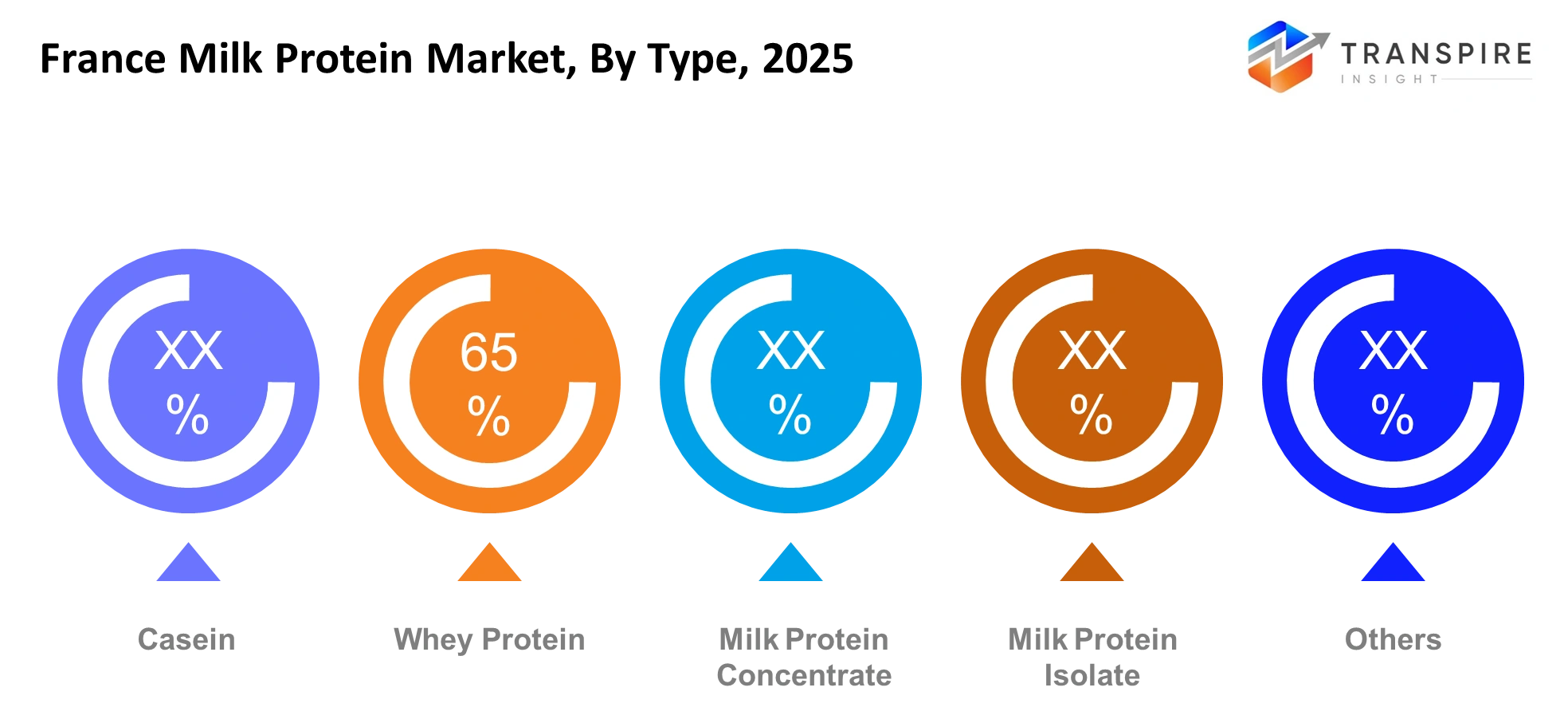
Casein keeps a solid hold in the France Milk Protein Market , mainly because it’s used a lot in slow-digesting nutritional formulations and in dairy-based food systems. This part of the market seems to ride on pretty stable demand from clinical nutrition, plus processed food manufacturing, where a steady amino acid release is really appreciated. For industrial buyers, casein is often the go-to choice, mostly due to its functional capabilities like emulsification and texture improvement in cheese and bakery items. And because it is well integrated into the usual dairy processing setups, production tends to stay consistent, both in output and volume.
Whey Protein, on the other hand , shows more noticeable growth speed than many of the other options. That is largely tied to its quick absorption profile and the way it fits sports nutrition habits. Milk Protein Concentrate continues to be used at a steady pace in situations where costs matter, since it offers a balanced protein make-up across many food formulations. Milk Protein Isolate is projected to move quicker in premium nutrition segments , because it has high purity and comparatively low lactose content, so it works well in clinical settings and infant nutrition too. The “Others” group covers newer protein blends being tested in experimental functional foods. Over the forecast period, whey protein along with milk protein isolate are expected to push innovation-led growth across more premium, health-focused uses.
To learn more about this report, Download Free Sample Report
By Application
Food & Beverages really holds the dominant position in the France Milk Protein Market , mainly because dairy proteins get mixed in across bakery , confectionery, and ready to drink products kinda everywhere. It’s still benefiting from that steady push for protein-enriched everyday foods, and manufacturers keep reformulating recipes to tweak the nutritional profile , not in a small way either. On top of that, big food processors depend on milk proteins for texture stability and for better shelf life, so they have a reason to stick with them. And retail penetration stays strong too, so consumption keeps looking consistent across the mass market categories.
Sports Nutrition shows up as a fast growing application , helped by more people joining fitness activities and by the growing need for performance driven dietary supplements. Infant Nutrition stays relatively steady, largely because regulators emphasize nutritional quality, plus protein composition, in early life formulations. Clinical Nutrition also grows at a reliable pace, as hospitals start adopting protein enriched diets for recovery and for chronic disease management. Meanwhile the “Others” bucket covers newer ideas like weight management, and also functional beverages. During the forecast period, sports nutrition and clinical nutrition are likely to expand faster , driven by focused health outcomes and premium product positioning in the market.
By End-User
Food Companies keep taking the leading share in the France Milk Protein Market, mostly because they use milk derived inputs a lot in processed , packaged foods. They also have big purchasing power and a supply chain that’s already tied in with dairy processors. On top of that, the demand keeps coming for fortified products and high protein food items so the ingredient keeps getting used across multiple product lines. And as reformulation shifts toward healthier packaged foods, this group basically stays on top, even more.
Pharma Companies meanwhile are set for steady growth, since milk proteins are getting more and more used in therapeutic nutrition and specialized medical formats. People help drive the market too, because consumers are adopting protein supplements in fitness and overall wellness habits. Healthcare institutions are a real lever here, they’re bringing milk protein based diets into clinical recovery processes ,and into nutrition plans for elderly care. Then the “Others” slice covers institutional buyers too, like defense related programs and public nutrition initiatives. Over the forecast period, healthcare institutions and pharma players should increase their presence as clinical nutrition reliance keeps rising and personalized dietary treatments become more common.
By Form
Powder form seems to dominate the France Milk Protein Market, mostly because it feels more stable, it lasts longer on the shelf and it is rather easy to slide into food and nutritional mixtures, without too much trouble. In other words this portion rides on a solid appetite from sports nutrition, infant formula, and industrial food manufacturing, where the dosing has to be precise, and also storage really needs to stay efficient. A lot of companies like powdered proteins since they make transport simpler and they cut down on spoilage concerns, across the whole supply chain system. Also the high fit with blending and fortification steps, somehow, makes it even more common in day to day production.
Liquid form still holds steady interest, especially in ready-to-drink beverages and clinical nutrition options, because convenience is king and immediate usability matters. This segment tends to grow as people buy more on-the-go nutrition items, and as hospital dietary solutions keep expanding. The “Others” bucket covers semi-solid textures and specialized formats that show up in narrow, therapeutic use cases. Looking ahead, during the forecast period, liquid protein formats are projected to increase faster in urban retail and healthcare channels, largely driven by convenience habits and by the ongoing wave of functional beverage innovation.
What are the Key Use Cases Driving the France Milk Protein Market?
The core use case for the France Milk Protein Market is kind of sports nutrition , where whey and casein proteins are used to help with muscle recovery and overall performance driven dietary supplements, in a practical way. this segment brings the most demand, mainly because fitness is pretty widespread and a lot of people stick to structured protein intake routines.
Beyond that, the reach is also in clinical nutrition and functional beverages, mostly used in hospitals , elderly care centers, and wellness-minded food manufacturers. These places lean on high-purity protein blends, to back recovery, immune support, and metabolic balance. and this shows up more strongly for aging populations, plus post-surgery patients who need consistent nutrition.
More recently, you can see emerging applications like personalized nutrition products and bioactive protein formulations, aimed at individualized dietary needs. nutraceutical startups and more advanced dairy processors are looking into these ideas, basically for precision health and digital nutrition platforms .
|
Report Metrics |
Details |
|
Market size value in 2025 |
USD 658.8 Million |
|
Market size value in 2026 |
USD 699.7 Million |
|
Revenue forecast in 2033 |
USD 1072.8 Million |
|
Growth rate |
CAGR of 6.30%from 2026 to 2033 |
|
Base year |
2025 |
|
Historical data |
2021 - 2024 |
|
Forecast period |
2026 - 2033 |
|
Report coverage |
Revenue forecast, competitive landscape, growth factors, and trends |
|
Regional scope |
France |
|
Key company profiled |
Arla Foods, Fonterra, Glanbia, Lactalis, FrieslandCampina, Kerry Group, Saputo, Nestle, Danone, ADM, Cargill, Ingredion, Roquette, AMCO Proteins, Milk Specialties. |
|
Customization scope |
Free report customization (country, regional & segment scope). Avail customized purchase options to meet your exact research needs. |
|
Report Segmentation |
By Type (Casein, Whey Protein, Milk Protein Concentrate, Milk Protein Isolate, Others); By Application (Food & Beverages, Sports Nutrition, Infant Nutrition, Clinical Nutrition, Others); By End-User (Food Companies, Pharma Companies, Consumers, Healthcare, Others); By Form (Powder, Liquid, Others). |
Which Regions are Driving the France Milk Protein Market Growth?
Northern France sorta leads the France Milk Protein Market, largely because it has a dense dairy farming network and a pretty highly industrialized processing environment running through Hauts-de-France and Normandy. The area really leans on reliable cold chain logistics and its nearness to big European export corridors, so it can handle large-scale whey, plus casein processing for both domestic and international buyers. Also, when EU compliance is enforced strictly along this corridor, manufacturers tend to shift toward more advanced membrane filtration systems, which helps raise protein purity and boosts production efficiency. You can see a sort of connected web here, of cooperatives, dairy processors, and nutraceutical producers, and that keeps raw milk coming in steadily, so industrial output stays consistent— and it’s basically what keeps the region in the dominant lane.
Western France, especially Brittany and Pays de la Loire, plays a stable high-volume supporting role in the France Milk Protein Market. Compared with the north, it’s less export-led and more about long-term steadiness for domestic dairy and food manufacturing. The main advantage is resilient farming structures, together with cooperative-led milk collection systems that reduce raw material swings. Local processors also keep investing in standardized protein extraction units, so output remains predictable even when seasons try to shift things around. That day-to-day reliability makes this region a dependable piece inside national protein supply networks.
Southern France is the fastest growing, and it’s pulled forward by rising nutraceutical startups and premium, health minded food innovation pockets across Occitanie and Nouvelle-Aquitaine. Momentum picked up after more investment flowed into wellness oriented food manufacturing hubs, and into university linked biotech research initiatives. It’s kind of like a quiet acceleration happening from both industry demand and research pipelines, feeding protein related product development as the market moves.
Who are the Key Players in the France Milk Protein Market and How Do They Compete?
Competition in the France Milk Protein Market is moderately consolidated, with big dairy multinationals handling raw material sourcing and also holding high-purity protein processing capacity. Most established players compete mainly on tech efficiency, protein purity ,and supply chain integration rather than on price alone ,and that makes sense. New entrants run into barriers that are pretty capital-heavy, like filtration infrastructure and the strict EU food safety standards, so vertically integrated dairy processors stay in charge.
Lactalis and Danone reinforce their standing via vertically integrated dairy operations that link milk collection straight into protein ingredient manufacturing. Lactalis goes for cost-efficient scale output across whey and casein streams, while Danone leans into clinically oriented nutrition and branded health formulations. Both keep growing by upgrading facilities in Europe on purpose , plus forming partnerships with foodservice networks and medical nutrition channels.
Glanbia and FrieslandCampina go head to head through high-value protein specialization, especially around sports nutrition and functional ingredients. Glanbia aims at protein isolate development for performance nutrition brands, whereas FrieslandCampina uses cooperative dairy networks to keep raw material consistency stable. Their expansion tends to include joint ventures with nutraceutical firms and more penetration into premium health markets across Europe.
Arla Foods and Kerry Group also keep competing, but more from the angle of ingredient technology and formulation support for food manufacturers. Arla Foods stresses sustainable dairy sourcing and protein standardization, while Kerry Group brings together flavor systems and nutrition frameworks into protein applications.
Company List
- Arla Foods
- Fonterra
- Glanbia
- Lactalis
- FrieslandCampina
- Kerry Group
- Saputo
- Nestlé
- Danone
- ADM (Archer Daniels Midland)
- Cargill
- Ingredion
- Roquette
- AMCO Proteins
- Milk Specialties
Recent Development News
In December 2025, All G entered a joint venture with Armor Protéines. The partnership focuses on scaling precision-fermentation-based milk proteins, including recombinant lactoferrin for infant nutrition markets. This move strengthens France’s position in next-generation dairy protein innovation by integrating biotech-derived proteins into traditional dairy supply chains.
Source: https://www.theaustralian.com.au
What Strategic Insights Define the Future of the France Milk Protein Market?
France's Milk Protein Market seems to be inching, more or less, toward higher-value biofunctional ingredients, not just usual commodity dairy outputs. That shift is mostly held up by steady demand coming from clinical nutrition and performance-food segments, where people want specific effects. In the next 5 to 7 years, the pace of growth likely gets shaped by more embedded precision filtration technologies and this rising appetite for protein mixes that are tailored for healthcare and wellness uses.
There’s also a bit of a less obvious risk , related to how concentrated raw milk sourcing can be. If climate-linked supply gets shaky and herd productivity is under pressure, then industrial protein yields may end up constrained, and pricing volatility can show up quicker than expected. Meanwhile, an emerging chance is forming around personalized nutrition platforms. These platforms can blend dairy proteins with digital health tracking so that dietary planning feels more individualized and practical.
So, market players should probably lean into investment for flexible protein fractionation systems and also build partnerships with healthcare nutrition providers. The idea is to lock in long-term demand visibility, and also to limit exposure to those commodity milk price cycles.
France Milk Protein Market Report Segmentation
By Type
- Casein
- Whey Protein
- Milk Protein Concentrate
- Milk Protein Isolate
- Others
By Application
- Food & Beverages
- Sports Nutrition
- Infant Nutrition
- Clinical Nutrition
- Others
By End-User
- Food Companies
- Pharma Companies
- Consumers
- Healthcare Institutions
- Others
By Form
- Powder
- Liquid
- Others
Frequently Asked Questions
Find quick answers to common questions.
The expected France Milk Protein Market size for the market will be USD 1072.8 Million in 2033.
Key segments for the France Milk Protein Market are By Type (Casein, Whey Protein, Milk Protein Concentrate, Milk Protein Isolate, Others); By Application (Food & Beverages, Sports Nutrition, Infant Nutrition, Clinical Nutrition, Others); By End-User (Food Companies, Pharma Companies, Consumers, Healthcare, Others); By Form (Powder, Liquid, Others).
Major France Milk Protein Market players are Arla Foods, Fonterra, Glanbia, Lactalis, FrieslandCampina, Kerry Group, Saputo, Nestle, Danone, ADM, Cargill, Ingredion, Roquette, AMCO Proteins, Milk Specialties.
The France Milk Protein Market size is USD 658.8 Million in 2025.
The France Milk Protein Market CAGR is 6.30% from 2026 to 2033.
- Arla Foods
- Fonterra
- Glanbia
- Lactalis
- FrieslandCampina
- Kerry Group
- Saputo
- Nestlé
- Danone
- ADM (Archer Daniels Midland)
- Cargill
- Ingredion
- Roquette
- AMCO Proteins
- Milk Specialties
Recently Published Reports
-
Apr 2026
Baby Infant Formula Market
Baby Infant Formula Market Size, Share & Analysis Report By ype (Infant Milk, Follow On Milk, Specialty Baby Milk, Growing-Up Milk), By Ingredient (Carbohydrate, Fat, Protein, Minerals, Vitamins, and Others), By Product Form (Powder, Liquid, and Ready-to-feed), By Distribution Channels (Supermarket/Hypermarket, Specialty Store, Pharmacies, Online Retail, and Others), and Geography (North America, Europe, Asia-Pacific, Middle East and Africa, South and Central America), 2021 - 2031
-
Apr 2026
Edible Insects for Animal Feed Market
Edible Insects for Animal Feed Market Size, Share & Analysis Report By Type (Insect Powder, Insect Meal, Insect Bar, Insect Paste, Insect Oil, and Others), By Insect Type (Beetles, Cricket, Caterpillar, Hymenoptera, Orthoptera, Tree Bugs, and Others), By Application (Livestock, Pet Food, and Aquaculture), By Livestock Type (Poultry, Swine, and Others), and Geography (North America, Europe, Asia-Pacific, Middle East and Africa, South and Central America), 2021 - 2031
-
Apr 2026
Food Industry Disinfection and Bacterial Control Market
Food Industry Disinfection and Bacterial Control Market Size, Share & Analysis Report By Type (Chemical Disinfectants, Physical Disinfectants, and Biocides and Antimicrobials), By Application (Food Processing Equipment Surface Disinfection, Food Preparation Areas Surface Disinfection, Storage Areas Surface Disinfection, Anti-microbial Coatings Food Preservation, and Preservative Solutions Food Preservation), By End User (Meat and Poultry Processing, Dairy Processing, Seafood Processing, Bakery and Confectionery, Restaurants and Commercial Kitchens, and Food Service Providers), By Sales Channel (Online, Offline), and Geography (North America, Europe, Asia-Pacific, Middle East and Africa, South and Central America), 2021 - 2031
-
Apr 2026
Freeze Dried Food Market
Freeze Dried Food Market Size, Share & Analysis Report By Product Type (Fruits, Vegetables, Freeze-Dried Dairy Products, Freeze-Dried Meat and Seafood, Freeze-Dried Pet Food, and Prepared Meal), By Nature (Organic, and Conventional), By Form (Powdered, Granules, and Diced), By End Use (Breakfast Cereals, Dairy Products, Bakery & Confectionery, Nutritional Bars & Supplements, Powdered Beverages, Snacks, and Retail (Household)), and Geography (North America, Europe, Asia-Pacific, Middle East and Africa, South and Central America), 2021 - 2031