
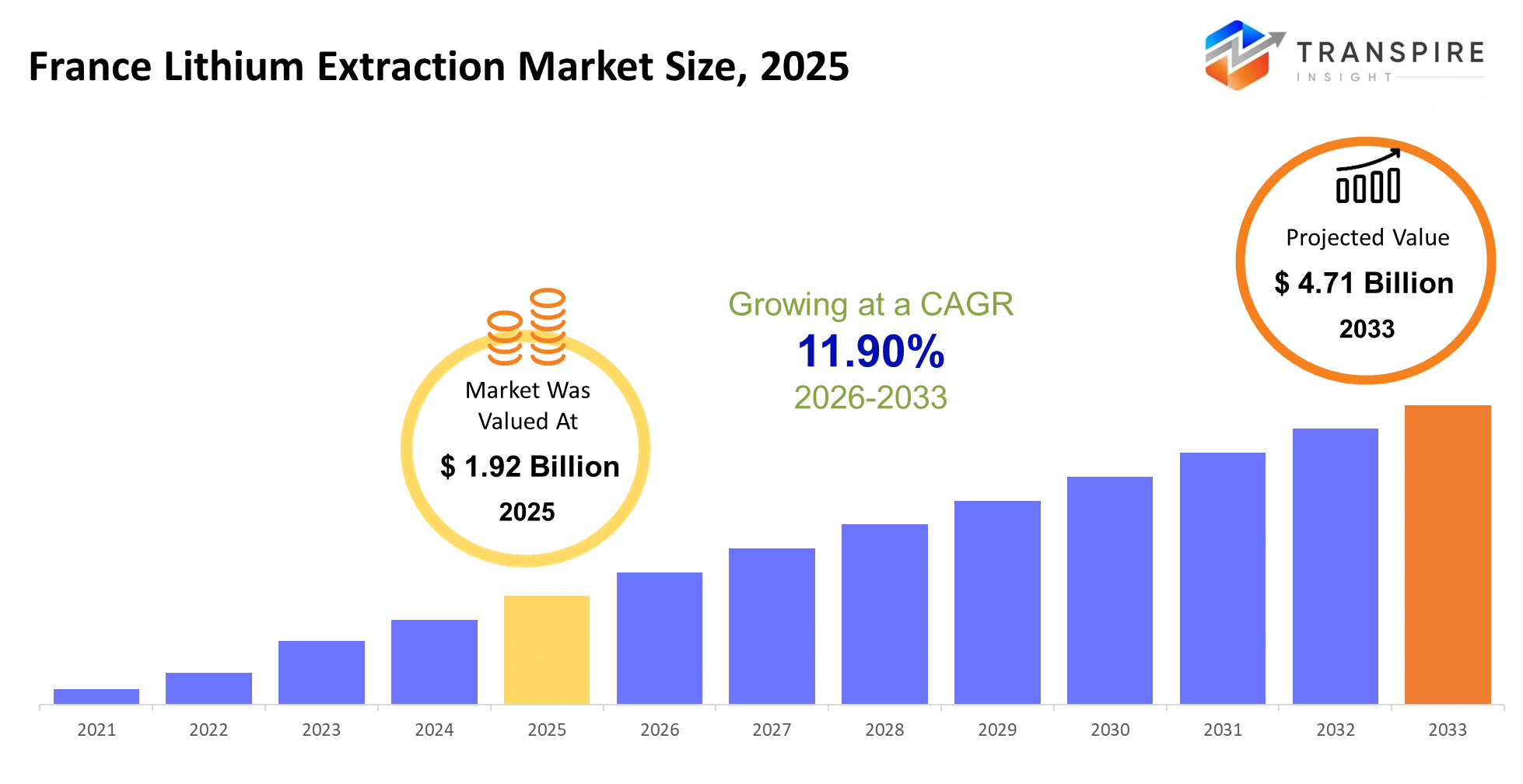
France Lithium Extraction Market Size & Forecast:
- France Lithium Extraction Market Size 2025: USD 1.92 Billion
- France Lithium Extraction Market Size 2033: USD 4.71 Billion
- France Lithium Extraction Market CAGR: 11.90%
- France Lithium Extraction Market Segments: By Type (Brine Extraction, Hard Rock Mining, Clay Extraction, Others); By Application (Batteries, Glass & Ceramics, Lubricants, Others); By End-User (Automotive, Electronics, Energy Storage, Others); By Method (Evaporation, Direct Lithium Extraction, Others).
To learn more about this report,  Download Free Sample Report
France Lithium Extraction Market Summary
The France Lithium Extraction Market was valued at USD 1.92 Billion in 2025. It is forecast to reach USD 4.71 Billion by 2033. That is a CAGR of 11.90% over the period.
The France lithium extraction market takes on a kind of critical job for battery-grade lithium that gets used in electric vehicles, grid-scale energy storage, and industrial electronics making. Really, the sector helps lower Europe dependence on imported raw materials by building domestic plus regional lithium supply chains, so that they can support battery gigafactories and automotive production links. Over the last five years things have been moving away from the usual hard-rock sourcing and more toward direct lithium extraction methods , and also geothermal lithium recovery initiatives that are often described as using less water, with better recovery efficiency.
That shift got even faster after the European energy crisis, and especially after supply shocks tied to the Russia-Ukraine conflict showed weak points in global mineral sourcing. Since then, France has grown its support for strategic mineral independence, mostly through industrial funding schemes and streamlined permitting for critical raw material projects. And as battery makers expand local production capacity, lithium extraction investments are turning into long-term supply agreements, infrastructure growth, and stronger capital inflows across the wider domestic mining as well as processing ecosystem.
Key Market Insights
- In 2025, northern and eastern France basically racked up over 42% of market activity, since it is close enough to battery manufacturing and those industrial infrastructure clusters, more or less.
- Geothermal lithium extraction then showed up as the fastest growing technology segment after 2022, with the story usually tied to lower environmental impact, and also less reliance on freshwater, which sounds kinda important.
- Direct lithium extraction systems picked up noticeable share too as recovery rates pushed past 80% in pilot scale commercial projects across Europe.
- For the product side, battery grade lithium carbonate stayed in front as the leading product segment, helped by long term procurement agreements with European EV makers.
- Lithium hydroxide production also expanded quickly from 2023 to 2025, mainly because high nickel battery chemistries started gaining traction in premium electric vehicles.
- On the demand side, automotive applications were the top driver, taking more than 55% share in 2025, due to those aggressive EV production targets across the European Union.
- For applications, grid scale energy storage became the quickest moving segment, because France sped up renewable integration and kept launching electricity storage deployment projects.
- The end user picture was led by large industrial manufacturers and battery cell producers, largely driven by supply security worries, and the desire to diversify contracts.
- Lastly, strategic partnerships between mining operators and battery producers seemed to accelerate regional growth, while also strengthening downstream processing capabilities inside France and in nearby EU markets.
What are the Key Drivers, Restraints, and Opportunities in the France Lithium Extraction Market?
The main thing shaping the France lithium extraction market is basically Europe’s push for battery supply chain sovereignty, yeah. The European Union’s Critical Raw Materials Act together with France’s industrial decarbonization strategy kicked off a sort of wave of investments in domestic lithium sourcing after 2022, and that matters. Automotive manufacturers more and more wanted long-term lithium supply agreements, to cut down exposure to what they call volatile overseas procurement channels. That change directly bumped up project financing, it also sped exploration activity a bit, and then it made geothermal lithium extraction initiatives in France look more commercially viable than before. And since battery gigafactories are expanding across Europe, local lithium production is now economically strategic rather than something optional.
Still, though, the biggest restraint is this kind of structural complexity around permitting, environmental approvals, and commercial scale processing infrastructure, you know. Lithium extraction projects often take years for geological validation, environmental assessment and community consultation, before production even starts. On top of that, France has limitations that relate to refining capacity and specialized chemical processing know how. Those things end up stretching market entry timelines, and they can suppress near term revenue realization for the developers, even if downstream demand keeps staying strong from EV and battery manufacturers.
Meanwhile, a more notable opportunity is showing up through geothermal lithium recovery in the Upper Rhine Valley, and nearby European energy corridors. Some companies are linking renewable geothermal power generation with direct lithium extraction technologies , so they can build sort of lower carbon supply chains. This approach cuts down operational emissions while also raising resource efficiency, which is attractive for automotive manufacturers trying to lock in low emission battery sourcing agreements.
What Has the Impact of Artificial Intelligence Been on the France Lithium Extraction Market?
Artificial intelligence plus newer digital systems are slowly reshaping lithium extraction work in France, mainly by making mineral recovery feel more efficient, process stability less fragile, and overall asset reliability better. In practice, mining operators and geothermal lithium teams are using AI based analytics more and more, sort of to watch the brine chemistry, tune the extraction cycles, and run process control automation in real time, without so much human lag. Machine learning models pull together geological information and day to day operational signals, then they help with lithium concentration forecasting, and they also try to cut down processing variability across different extraction sites.
At the same time, predictive maintenance platforms are becoming more common in refining as well as extraction facilities. They watch vibration behavior, pressure swings, and equipment temperature trends to flag potential failures before an operational shutdown actually happens. Because of that operators are often seeing higher equipment uptime, less expensive maintenance work, and a steadier production rhythm. On top of that, AI-assisted optimization tools are improving how energy is used during evaporation, filtration, and lithium conversion steps, which helps producers manage electricity expenses as well as environmental compliance goals, more carefully.
Digital twins and simulation tools are also showing up, and they can make pilot testing for direct lithium extraction technologies move faster, which tends to shrink development timeframes for later commercial scale. Still, AI adoption has a big rough edge, it’s mostly integration costs along with limited historical operational datasets. Many lithium efforts in France are still in pilot, or early commercial mode, so the amount of reliable training material is not enough for very precise predictive modeling and broad automation at scale.
Key Market Trends
- In 2022, French developers really started to push harder on geothermal lithium recovery initiatives, so the industry could ease off imported spodumene and South American brine stuff.
- In several pilot runs, direct lithium extraction technologies took over from the older evaporation-first models, mostly because the recovery cycles feel quicker, and also the water footprint stays smaller.
- After the supply chain disruptions that showed procurement weak spots during 2022, and 2023, European battery manufacturers moved to sign multi-year lithium sourcing agreements more and more.
- A bunch of industrial investors also redirected money toward low-emission extraction efforts, because automotive OEMs got stricter about carbon accounting for battery material sourcing.
- Lithium hydroxide processing capacity grew at a pace that outstripped carbonate production, once high-performance EV battery chemistries started gaining solid commercial momentum across Europe, in a sort of uneven but steady way.
- From after 2023, partnerships between mining firms and energy companies increased, not just for revenue reasons but to link geothermal infrastructure with lithium recovery capabilities.
- French regulators then reinforced support for critical mineral independence through streamlined industrial funding, and also by speeding up policies for strategic resource development, even if some timelines looked a bit messy on paper.
- Exploration activity got louder across eastern France, because geological surveys pointed to lithium-bearing geothermal brine resources that could actually make sense commercially.
- More and more companies rolled out AI-driven process optimization tools to raise recovery yields and cut down operational downtime inside pilot facilities.
- Between 2024 and 2026, the competition changed direction, it moved away from simply owning the resources toward downstream refining, and battery-grade processing strengths.
France Lithium Extraction Market Segmentation
By Type
Brine extraction still seems to have the leading market position because geothermal lithium resources in eastern France enable lower-emission recovery processes and fit pretty well with Europe’s decarbonization targets. Industrial developers keep prioritizing brine-based extraction since direct lithium extraction technologies tend to raise recovery efficiency while also cutting land and water intensity compared with conventional mining operations, a lot of people notice this. Strong government support for geothermal energy integration has also boosted commercial interest in this lane across strategic battery supply corridors. In parallel technology providers are moving toward advanced filtration and selective adsorption systems, mostly so they can improve lithium purity and trim operational costs in commercial-scale projects.
Hard rock mining maintains a notable share too, mostly because central France hosts lithium-bearing mineral deposits that are considered commercially viable and helpful for long-term domestic resource security. Mining operators like this segment for its proven extraction processes and fairly predictable resource assessment models, even if processing intensity and infrastructure needs are higher. Clay extraction and other alternative sources are still more on the earlier side of commercial development since technical complexity can be a lot and processing costs rise when lithium separation efficiency is the constraint. Over the forecast period, investment activity is expected to concentrate on hybrid extraction technologies and on environmentally optimized processing setups, designed to improve economic feasibility across more non-traditional lithium resources.
By Application
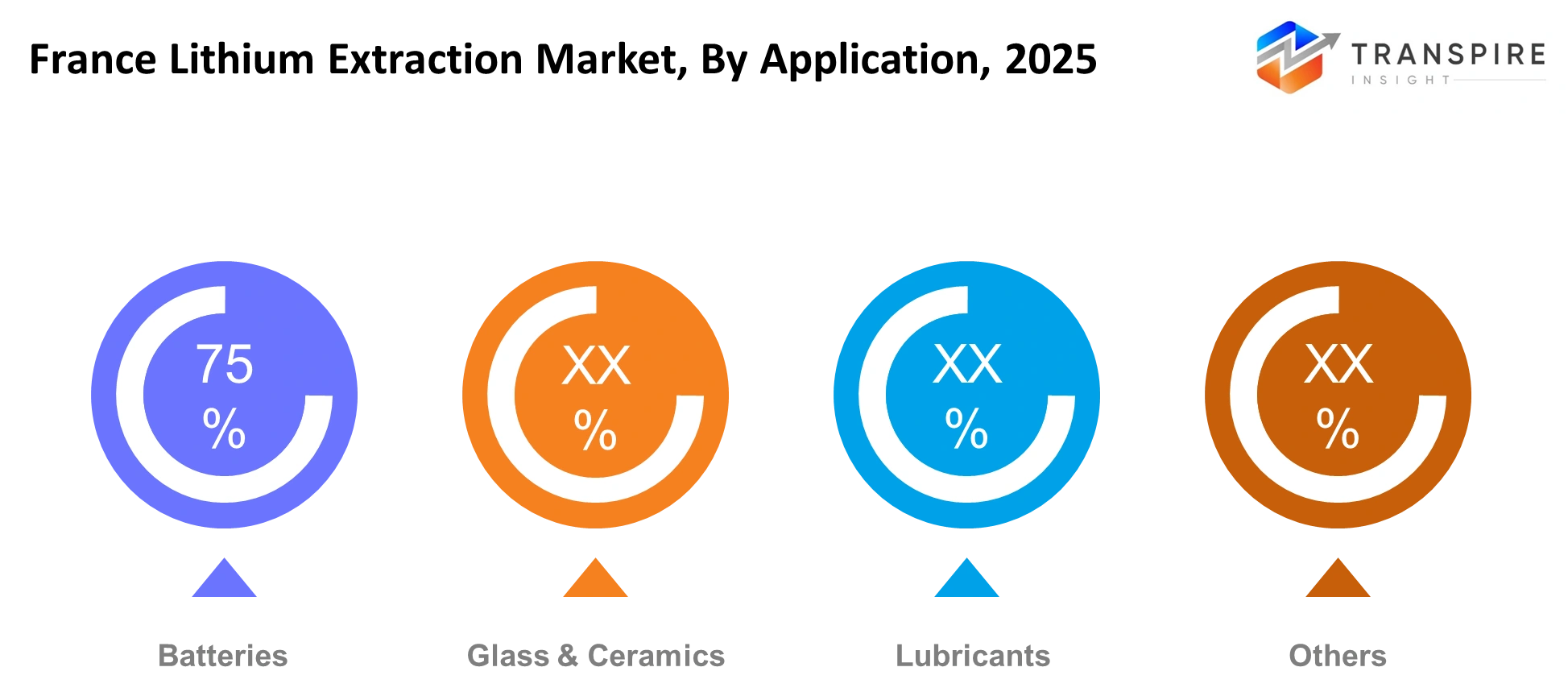
Battery manufacturing kind of dominates the application segment, because electric vehicle production plus energy storage deployments really do need huge volumes of battery grade lithium hydroxide and lithium carbonate. European automotive manufacturers keep locking in regional lithium supply agreements, to cut down exposure to overseas raw material volatility, and to back up more localized battery production capacity. The whole gigafactory expansion thing across France and nearby European markets has definitely sped up procurement for refined lithium compounds that fit advanced lithium ion chemistries. Going forward, growth is expected to drive more investment into high purity lithium processing technologies able to support next generation solid state, and also high density battery systems, kinda like end-to-end performance improvements.
Glass and ceramics still keep a pretty stable market position because lithium compounds boost thermal resistance, durability, and even production efficiency across niche industrial materials. Lubricants and a few other industrial applications also keep moderate demand, mostly linked to lithium grease used in automotive, aerospace, and heavy machinery operations. Those areas see slower expansion than battery related applications, since industrial substitution risks and recycling practices sometimes curb raw lithium consumption growth. Product manufacturers are likely to favor specialty grade lithium compounds plus tailored industrial formulations, since downstream users want performance optimization for high temperature manufacturing environments.
To learn more about this report, Download Free Sample Report
By End-User
Automotive companies show up as the dominant end-user slice, mostly because electric vehicle manufacturing is still the main pull behind European lithium procurement plans. Vehicle makers are leaning more and more toward domestic, or at least regional lithium sourcing, to back up battery supply chain resilience and to match the ever tightening carbon reporting rules. Long run purchasing arrangements between mining operators, refiners and automotive groups keep getting more serious, which in turn sustains investment confidence across lithium extraction and processing facilities. Going forward, the market direction looks like it will move toward stronger vertical integration—between automakers and raw material suppliers—since rivalry is increasing around battery material security and locally built production ecosystems.
Electronics manufacturers keep a fairly stable market share, because lithium-ion batteries are still a must for consumer electronics, industrial automation systems, and portable power uses. Energy storage operators are emerging as one of the quickest growing end-user groups, thanks to the spread of renewable electricity and the need for grid stabilization across France. Other industrial users, such as aerospace firms and specialty chemical producers, are also examining lithium-based solutions for newer mobility concepts and energy management systems. Over the forecast period, energy storage deployments are projected to generate meaningful demand for high-cycle battery materials and longer duration lithium supply agreements that are tied to renewable infrastructure projects.
By Method
Evaporation based extraction methods keep a solid market presence, largely because the usual lithium recovery systems are still commercially proved and pretty familiar in day to day global supply chains. Some operators keep choosing evaporation, mostly for lower short-term processing complexity and because the industrial workflows are well known. Still, there are environmental limits tied to water use, land intensity, and the recovery cycles that take longer, and these are making wider uptake harder, especially in European markets that care about sustainability performance. Investors and project developers are expected to dial down their reliance on these older evaporation style systems as regulatory pressure on resource efficiency keeps rising during the forecast period.
Direct lithium extraction, meanwhile, shows up as the fastest growing method segment, since newer adsorption, ion exchange, and membrane technologies are getting better at lifting lithium recovery rates while also shrinking production timelines. In France , geothermal lithium projects are increasingly leaning on direct extraction systems to help with lower emission processing and operations that can scale commercially, even when industrial zones are pretty constrained. This segment also has a better fit with European environmental requirements and the automotive sector carbon reduction targets. Technology developers are expected to push faster commercial rollout of modular extraction platforms, digital monitoring systems, and AI assisted process optimization tools—these are meant to improve operational efficiency, and also raise lithium purity levels.
What are the Key Use Cases Driving the France Lithium Extraction Market?
In France the big dominant use case for lithium extraction is still mostly battery production for electric vehicles, you know the whole thing, the automotive side. Car makers need a steady supply of battery-grade lithium hydroxide and carbonate to keep regional EV assembly running and to support battery gigafactory operations , especially once those factories start scaling up. In practice this kind of application pulls the biggest slice of demand, because supply security has turned into this strategic matter for European vehicle production networks.
Then there are the adjacent applications that are kind of growing alongside it, like grid-scale energy storage, and also industrial power backup systems. Renewable energy operators are more and more deploying lithium-ion storage infrastructure, to help level out solar and wind generation capacity when output swings. At the same time consumer electronics manufacturers and industrial automation equipment teams are also buying processed lithium compounds for compact energy storage solutions, instead of using older chemistries.
More emerging use cases are showing up too, like aerospace electrification and localized energy storage for smart industrial sites. France’s more advanced manufacturing sector is looking at lithium-based storage technologies for high-efficiency mobility platforms and decentralized energy resilience projects. That exploration could mean additional long term opportunities for domestic extraction and refining companies, even if it’s not fully mainstream yet, or it’s happening in stages.
|
Report Metrics |
Details |
|
Market size value in 2025 |
USD 1.92 Billion |
|
Market size value in 2026 |
USD 2.14 Billion |
|
Revenue forecast in 2033 |
USD 4.71 Billion |
|
Growth rate |
CAGR of 11.90% from 2026 to 2033 |
|
Base year |
2025 |
|
Historical data |
2021 - 2024 |
|
Forecast period |
2026 - 2033 |
|
Report coverage |
Revenue forecast, competitive landscape, growth factors, and trends |
|
Regional scope |
France |
|
Key company profiled |
Albemarle, SQM, Ganfeng Lithium, Tianqi Lithium, Livent, Orocobre, Pilbara Minerals, Lithium Americas, Jiangxi Ganfeng, CATL, BYD, POSCO, Rio Tinto, Vale, Eramet. |
|
Customization scope |
Free report customization (country, regional & segment scope). Avail customized purchase options to meet your exact research needs. |
|
Report Segmentation |
By Type (Brine Extraction, Hard Rock Mining, Clay Extraction, Others); By Application (Batteries, Glass & Ceramics, Lubricants, Others); By End-User (Automotive, Electronics, Energy Storage, Others); By Method (Evaporation, Direct Lithium Extraction, Others). |
Which Regions are Driving the France Lithium Extraction Market Growth?
Eastern France is kind of leading the France lithium extraction market right now mainly because it has a lot of geothermal lithium resources , plus a pretty tight fit with the European battery manufacturing corridor. Alsace has also surfaced as a strategic pivot, because players like Eramet and nearby energy operators are stitching geothermal infrastructure with direct lithium extraction technologies, it feels coordinated. The area does well thanks to cross-border logistics links to Germany and the broader European automotive supply chains, which tends to make downstream processing economics better and helps the battery material circulation move faster.
Central France shows up as the second most meaningful regional contributor, and here the driver is more hard-rock lithium development, rather than geothermal extraction. The Allier region has picked up real steam with the Emili lithium project led by Imerys, and that project leans into long-term domestic supply resilience for electric vehicle battery production. But unlike the eastern cluster, this region’s growth depends more on mining modernization, rail-connected mineral transport, and how well it integrates with industrial processing facilities, so it’s a different rhythm.
Northern France, meanwhile, is growing the fastest regional market, mostly due to the quick expansion of the battery ecosystem and newer industrial localization steps that were announced after 2024. Battery gigafactory investment around major logistics routes pushed the demand for regionally sourced lithium chemicals and for additional refining capacity. More recently, regulatory reforms aimed at cutting permitting timeframes for strategic industrial projects boosted investor confidence across northern industrial districts. Between 2026 and 2033, that momentum is expected to open solid entry openings for technology suppliers refining companies and infrastructure investors looking for exposure to Europe’s more localized battery raw material
Who are the Key Players in the France Lithium Extraction Market and How Do They Compete?
Competition in the France lithium extraction market still feels pretty moderately concentrated, with a blend of global mining companies, battery supply chain specialists, and some regional technology developers all trying to land the right strategic spot. Lately, things are shifting not so much toward owning the resource outright, more toward technology efficiency, tighter downstream integration, and low carbon production capabilities. The older mining firms are holding the line with long term supply agreements, and the newer crowd seems to push harder on direct lithium extraction systems plus geothermal recovery approaches, which are basically meant to cut environmental intensity a bit, especially around brine and related impacts. In practice, competitive edge depends more on recovery efficiency, refining capability and proximity to the European battery manufacturing ecosystems than on extraction scale alone, which sounds obvious but is still how it plays out.
Eramet stands out with its proprietary direct lithium extraction process, it manages high recovery rates while lowering brine usage and water consumption, at least that’s the claim, and it seems to fit their positioning. They are also extending activity via the Ageli geothermal lithium project in Alsace, and by ramping up lithium carbonate production capacity that’s connected to European battery supply chains. Imerys, meanwhile, leans on its vertically integrated Emili project in central France, where mining, processing, and rail based logistics infrastructure get bundled together, in order to secure localized supply for European EV manufacturers.
Rio Tinto is more centered on large scale critical mineral integration and advanced processing know-how, trying to strengthen its European battery materials footprint in a more systematic way. SQM leans on long term lithium refining know-how and global supply reliability, mainly to keep strategic partnerships with battery manufacturers that operate across Europe.
Company List
- Albemarle
- SQM
- Ganfeng Lithium
- Tianqi Lithium
- Livent
- Orocobre
- Pilbara Minerals
- Lithium Americas
- Jiangxi Ganfeng
- CATL
- BYD
- POSCO
- Rio Tinto
- Vale
- Eramet
Recent Development News
In February 2026, Eramet announced a €500 million capital increase alongside operational expansion plans for its lithium business. The funding initiative supports lithium production scale-up and strengthens the company’s position in Europe’s strategic battery materials market despite broader mining sector volatility.
Source: http://www.reuters.com
In May 2025, Eramet confirmed continued development of its Ageli geothermal lithium partnership with Électricité de Strasbourg in Alsace. The project targets production of 15 kilotons of lithium carbonate annually by 2031 and supports France’s strategy for low-carbon domestic battery material sourcing.
Source: http://www.eramet.com
What Strategic Insights Define the Future of the France Lithium Extraction Market?
In France, the lithium extraction market is basically drifting, slowly but surely, toward localized low carbon pathways and vertically integrated supply chains that help Europe keep its battery manufacturing independence. In the next five to seven years, geothermal lithium recovery plus direct lithium extraction tech is probably going to alter the competitive scene, because regulators and auto manufacturers are putting more weight on carbon intensity, and also on supply reliability at the same time. Still, there is a quieter kind of risk showing up too, around how concentrated the projects are, and how much permitting depends on a few choke points. A small set of big, large scale projects already represents a big portion of what people expect from domestic supply, so if there are delays, or pushback from environmental groups , or financing problems, France’s long term production targets could get disrupted in a pretty outsized way.
At the same time, there’s a real opportunity forming around tying lithium extraction with renewable power and industrial heat networks especially in geothermal areas like Alsace. Businesses that manage extraction, refining, and energy production inside one industrial ecosystem could end up with cheaper running costs and a sturdier ESG story. Market participants should start lining up downstream refining collaborations and long-term battery supply arrangements early, before European procurement rivalry tightens further after 2028.
France Lithium Extraction Market Report Segmentation
By Type
- Brine Extraction
- Hard Rock Mining
- Clay Extraction
- Others
By Application
- Batteries
- Glass & Ceramics
- Lubricants
- Others
By End-User
- Automotive
- Electronics
- Energy Storage
- Others
By Method
- Evaporation
- Direct Lithium Extraction
- Others
Frequently Asked Questions
Find quick answers to common questions.
The approximate France Lithium Extraction Market size for the market will be USD 4.71 Billion in 2033.
Key segments for the France Lithium Extraction Market are By Type (Brine Extraction, Hard Rock Mining, Clay Extraction, Others); By Application (Batteries, Glass & Ceramics, Lubricants, Others); By End-User (Automotive, Electronics, Energy Storage, Others); By Method (Evaporation, Direct Lithium Extraction, Others).
Major France Lithium Extraction Market players are Albemarle, SQM, Ganfeng Lithium, Tianqi Lithium, Livent, Orocobre, Pilbara Minerals, Lithium Americas, Jiangxi Ganfeng, CATL, BYD, POSCO, Rio Tinto, Vale, Eramet.
The France Lithium Extraction Market size is USD 1.92 Billion in 2025.
The France Lithium Extraction Market CAGR is 11.90% from 2026 to 2033.
- Albemarle
- SQM
- Ganfeng Lithium
- Tianqi Lithium
- Livent
- Orocobre
- Pilbara Minerals
- Lithium Americas
- Jiangxi Ganfeng
- CATL
- BYD
- POSCO
- Rio Tinto
- Vale
- Eramet
Recently Published Reports
-
Apr 2026
Healthcare Polymer Packaging Market
Healthcare Polymer Packaging Market Size, Share & Analysis Report By Packaging Type (Syringes, IV Bottles and Pouches, Clamshells, Blisters, Bottles & Jars, Containers, Tubes, IV Parental Packaging, Others), By Type (Regulated, Non-regulated), By Polymer Type (LDPE (Low-Density Polyethylene), HDPE (High-Density Polyethylene), Homo-polymer (Homo), Random Copolymer (Random), Block Copolymer (Block), PET, Polystyrene, Polyvinyl Chloride, Polyamide/EVOH, Others), and Geography (North America, Europe, Asia-Pacific, Middle East and Africa, South and Central America), 2021 - 2031
-
Apr 2026
Hydrophilic Tape (Waterstop) Market
Hydrophilic Tape (Waterstop) Market Size, Share & Analysis Report By Type (Bentonite-Based Hydrophilic Tape, Rubber-Based Hydrophilic Tape), By Application (Residential Buildings, Commercial Buildings, Infrastructure Projects), and Geography (North America, Europe, Asia-Pacific, Middle East and Africa, South and Central America), 2021 - 2031
-
Apr 2026
Metalens Market
Metalens Market Size, Share & Analysis Report By Type (Visible Light Metalens, and Infrared Metalens), By Application (Consumer Electronics, Automotive Electronics, Industrial, Medical, and Others), and Geography (North America, Europe, Asia-Pacific, Middle East and Africa, South and Central America), 2021 - 2031
-
Apr 2026
PBT Resin Market
PBT Resin Market Size, Share & Analysis Report By Type (Reinforced PBT Resin, Unreinforced PBT Resin), By Processing Method (Injection Molding, Extrusion, Blow Molding, Others), By End-User (Automotive, Electrical & Electronics, Consumer Appliances, Industrial Machinery, Medical Devices, Packaging, Others), and Geography (North America, Europe, Asia-Pacific, Middle East and Africa, South and Central America), 2021 - 2031