
France Hydrolyzed Vegetable Proteins Market Size & Forecast:
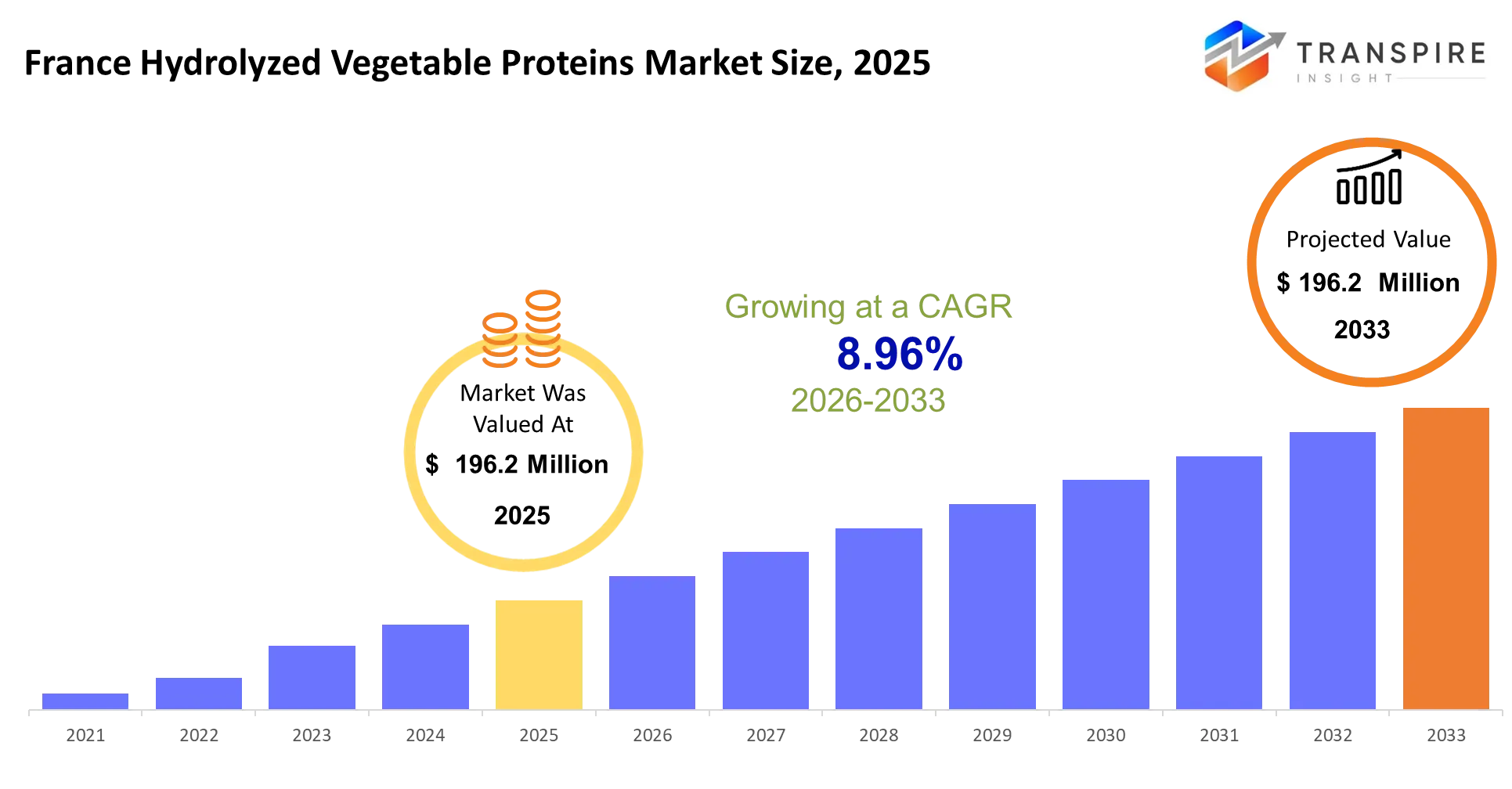
- France Hydrolyzed Vegetable Proteins Market Size 2025: USD 196.2 Million
- France Hydrolyzed Vegetable Proteins Market Size 2033: USD 196.2 Million
- France Hydrolyzed Vegetable Proteins Market CAGR: 8.96%
- France Hydrolyzed Vegetable Proteins Market Segments: By Type (Soy Protein, Wheat Protein, Corn Protein, Others); By Application (Food & Beverages, Animal Feed, Pharmaceuticals, Cosmetics, Others); By End-User (Food Industry, Feed Industry, Pharma Companies, Cosmetic Industry, Others); By Form (Liquid, Powder, Paste, Others)
To learn more about this report,  Download Free Sample Report
France Hydrolyzed Vegetable Proteins Market Summary
The France Hydrolyzed Vegetable Proteins Market was valued at USD 196.2 Million in 2025. It is forecast to reach USD 196.2 Million by 2033. That is a CAGR of 8.96% over the period.
French food manufacturers use hydrolyzed vegetable proteins to create more intense flavors and maintain consistent taste and to substitute animal-based flavoring ingredients in their processed food products. The products get used in various applications including soups and snacks and ready meals and sauces and plant-based products which require manufacturers to create stable umami flavors that can be produced in large quantities. Food processors now avoid animal-based additives because of rising prices and new clean-label standards which European retailers have introduced.
The primary structural change in the industry has occurred because large food brands require companies to develop plant-based product formulations. European manufacturers had to change their raw material procurement methods to include wheat and soy and corn protein sources because of supply chain issues which occurred after the pandemic. The new process decreased the need for external flavoring materials which resulted in a complete transformation of how companies acquire their flavoring components. Industrial food production efficiency and formulation stability have become the main factors driving demand because they now surpass the need for traditional ingredient replacement.
Key Market Insights
- Northern France holds ~34% share of the France Hydrolyzed Vegetable Proteins Market due to strong processed food manufacturing clusters.
- Southern France is the fastest-growing region (2025–2033) supported by plant-based food startups and export-oriented food processing units.
- Soy protein hydrolysates dominate the France Hydrolyzed Vegetable Proteins Market with highest industrial adoption in flavor systems.
- Wheat protein hydrolysates rank second due to cost efficiency and strong availability in European agricultural supply chains.
- Corn protein hydrolysates are the fastest-growing segment from 2025–2033 driven by alternative protein innovation demand.
- Food & Beverages segment leads with ~58% share in the France Hydrolyzed Vegetable Proteins Market due to processed food dependency.
- The industry is recognizing animal feed applications as a new solution which provides cost-effective amino acid enrichment for industrial use.
- The food industry remains the dominant end-user with a significant share driven by large-scale processed food manufacturers in France.
- Hydrolyzed proteins which cosmetic companies use for skin-conditioning formulations represent the fastest-growing end-user segment.
- European companies are expanding their operations through three main strategies which include enzymatic hydrolysis innovation and plant-based protein partnerships and regional manufacturing expansion.
- Strategic advantage is being built through clean-label product development, cost-efficient protein processing technologies, and supply chain localization across France and EU markets.
What are the Key Drivers, Restraints, and Opportunities in the France Hydrolyzed Vegetable Proteins Market?
The principal factor that drives growth in France's Hydrolyzed Vegetable Proteins Market exists because processed food manufacturing now requires plant-based flavor systems which maintain their cost efficiency and plant-based flavor systems. French food companies have reformulated their products to decrease their dependence on animal-based flavoring agents because of both price fluctuations and the requirement to maintain clean-label product transparency. The production process now requires more hydrolyzed vegetable proteins because these proteins deliver both umami flavor and operational stability throughout all production processes. Companies that produce packaged food products experience higher efficiency through ingredient adoption which results in more revenue streams that benefit their suppliers.
The main constraint exists because regional production facilities lack the ability to expand their enzymatic hydrolysis processes which produce high-quality results. The many mid-sized manufacturers' dependence on imported intermediates causes them to face supply chain disruptions and rising energy expenses. The existing dependency system prevents fast price adjustments and creates delays in complete production capacity development. The market expansion process faces partial limits within cost-sensitive food segments which experience tight profit margins and restricted ability to change product types.
European food technology development creates major business prospects through precision fermentation and enzyme engineering platform growth which will especially benefit France. Startups in Paris and Lyon are developing targeted hydrolysis techniques that improve amino acid yield efficiency while reducing processing waste. The technologies will enable production cost reductions which will create new production possibilities for pharmaceuticals and high-protein functional foods if the technologies achieve successful scaling. The technologies will expand market potential beyond traditional food processing.
What Has the Impact of Artificial Intelligence Been on the France Hydrolyzed Vegetable Proteins Market?
The France Hydrolyzed Vegetable Proteins Market experienced growth through artificial intelligence which enhanced industrial protein processing by making production processes more efficient while maintaining product quality and standardized production methods. Food manufacturers use AI-driven process optimization systems to manage enzymatic hydrolysis temperature and pH level and reaction timing which helps them achieve consistent product yields while decreasing differences between production batches. Machine learning models allow manufacturers to forecast raw material performance which helps them create optimal protein blending methods for wheat soy and corn before starting production.
Predictive analytics tools improve supply chain planning by predicting processed food manufacturing ingredient requirements which helps companies decrease inventory waste while enhancing their purchasing efficiency. AI monitoring systems at large facilities have successfully increased operational uptime by detecting equipment problems during their initial stages which leads to less production downtime.
The need to develop real-world industrial biochemical reaction models and high integration expenses create obstacles which prevent organizations from adopting new technologies. The digital systems which mid-tier producers need to implement advanced AI technologies are not present in their operations. The France Hydrolyzed Vegetable Proteins Market faces automation challenges because the data quality in fermentation and hydrolysis operations varies which affects model precision.
Key Market Trends
- European Union clean-label regulations required processed food products to adopt hydrolyzed vegetable protein which led to its increased usage during 2025.
- French food production facilities now use plant-based hydrolysates instead of animal-derived additives for their hydrogenated vegetable proteins market.
- French ingredient manufacturers achieved higher yield efficiency through enzyme-based hydrolysis technologies which decreased their processing time during 2024 and 2025.
- Food processors chose soy-based hydrolysates because they needed to maintain stable amino acid composition in their packaged food products.
- The food manufacturing sector in France began to rely more on domestic protein sources because supply chain interruptions during 2022 and 2023 disrupted operations.
- Food manufacturers used hybrid protein blends which combined wheat and corn sources to achieve their cost optimization goals.
- Kerry Group and Roquette expanded their research and development spending to develop clean-label flavor enhancement technologies which they planned to market in Europe.
- Between 2023 and 2026 the demand for hydrolyzed proteins in plant-based meat alternatives experienced substantial growth.
- Automation technology in protein processing facilities created more consistent results while achieving lower production variations throughout large-scale manufacturing operations.
- French businesses began to replace artificial flavor enhancers with natural hydrolyzed vegetable protein systems because of stricter regulations on artificial flavor enhancers.
France Hydrolyzed Vegetable Proteins Market Segmentation
By Type
The Type segmentation for the France Hydrolyzed Vegetable Proteins Market shows soy protein as its leading segment because of its ability to enhance flavors and maintain amino acid balance. Food processors in France use soy-based hydrolysates as their main ingredient because these products deliver consistent umami flavor in processed foods and sauces and savory snacks. The wheat protein market follows closely behind because European wheat supplies remain stable and large food manufacturing operations benefit from its cost advantages. Corn protein maintains a moderate position because it serves specialized formulations that require both allergen diversification and cost optimization.
The segment experiences growth because industrial demand for standardized flavor bases drives companies toward plant-based formulation systems. Enzymatic processing improvements have strengthened yield efficiency across soy and wheat sources, reducing production variability. Manufacturers are adopting corn-based hydrolysates because they want to decrease dependency on specific raw material sources. The rising demand for clean-label and plant-based food systems during 2023 to 2032 will drive manufacturers to create hybrid protein blends which will lead to ingredient developers investing in hydrolysis technologies that enhance taste accuracy and financial efficiency.
By Application
The France Hydrolyzed Vegetable Proteins Market shows food and beverage application segments as its main market segment because hydrolyzed proteins serve as essential components which improve flavor stability of processed foods and convenience foods. Industrial food producers depend on these ingredients to maintain consistent taste profiles across soups, sauces, ready-to-eat meals, and snack products. Animal feed applications hold a secondary position, supported by the need for cost-effective protein enrichment in livestock nutrition. The use of functional and bioactive proteins in pharmaceuticals and cosmetics creates a niche market which experiences steady growth.
The segment experiences growth because processed food consumption patterns in France continue to expand while food manufacturing needs to produce consistent flavors for mass production. Food manufacturers are reformulating products to reduce artificial additives, which strengthens reliance on plant-derived hydrolysates. Feed applications are gaining traction because feed cost optimization needs to be balanced with nutritional efficiency requirements. The food and beverage industry will maintain its dominant position throughout the forecast period, while cosmetic and pharmaceutical applications will grow because research on bioactive proteins advances and new functional applications become available.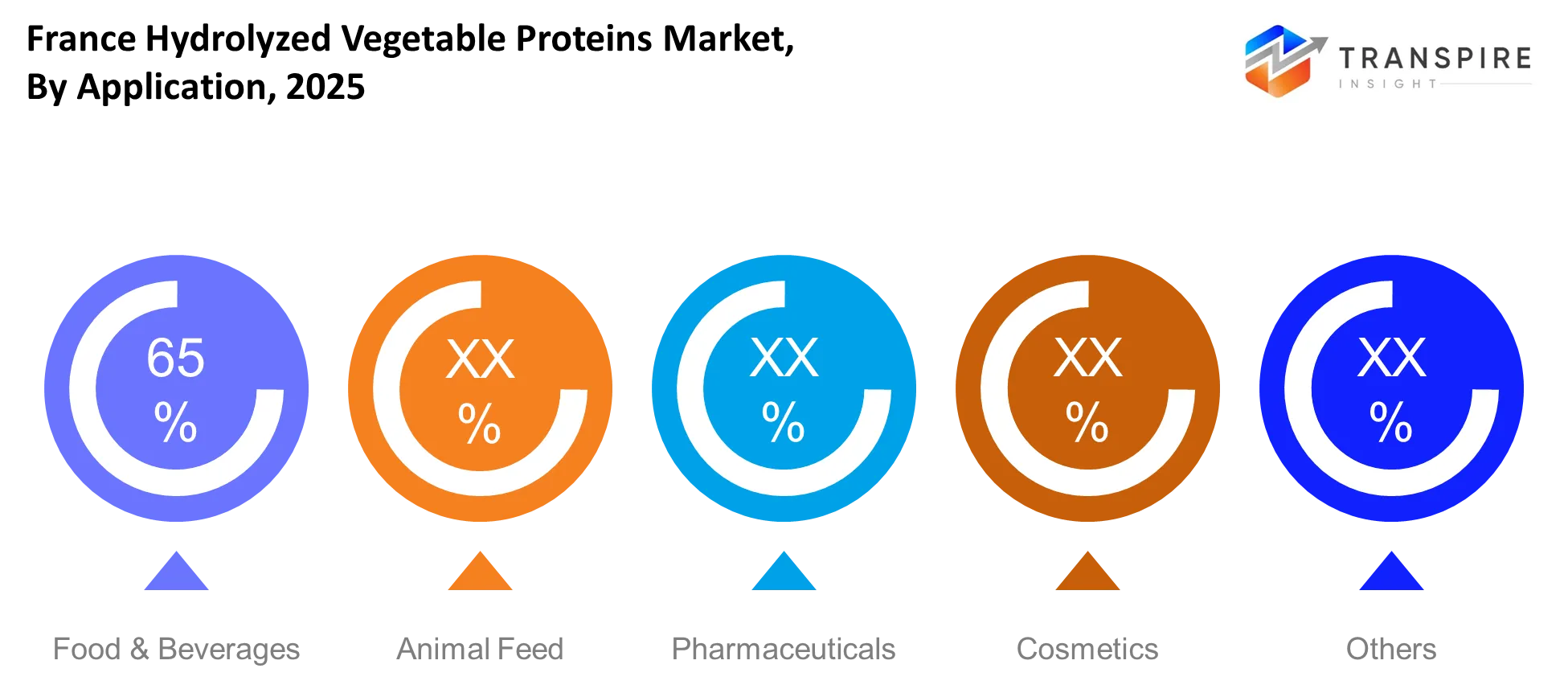
To learn more about this report, Download Free Sample Report
By End-User
The End-User segmentation in the France Hydrolyzed Vegetable Proteins Market is led by the food industry, which accounts for the largest share due to its extensive use of hydrolyzed proteins in industrial food processing. Food manufacturers with large operations require these ingredients to achieve consistent flavor results which match the standards of their high-volume production processes. The feed industry represents a significant secondary segment, using hydrolyzed proteins for amino acid enrichment in animal nutrition systems. Pharma and cosmetic companies occupy smaller but expanding positions within specialized formulation areas.
Stable and cost-effective flavor systems drive industrial-scale growth for packaged and processed food products. Food manufacturers are increasingly prioritizing plant-based and clean-label formulations, which strengthens dependency on hydrolyzed vegetable proteins. The feed industry is adopting new practices because livestock productivity and feed cost efficiency have become more important. The food industry will continue to dominate the market during the forecast period while both pharmaceutical and cosmetic products will experience gradual growth through research into biofunctional protein uses and dermatological product development.
By Form
The Form segmentation in the France Hydrolyzed Vegetable Proteins Market is led by powder form, which dominates due to ease of storage, transportation efficiency, and suitability for large-scale industrial blending. Dry food mixes and seasoning systems and processed food manufacturing lines can easily incorporate powdered hydrolysates into their operations. Liquid forms hold a strong secondary position, particularly in industrial sauces, soups, and ready-to-use flavor systems where rapid solubility is required. Paste and other specialized forms remain limited to niche applications with specific formulation needs.
The segment experiences growth because food manufacturing requires industrial efficiency and needs systems that handle ingredients at scale. Powder form benefits from long shelf stability and cost-effective logistics, making it the preferred choice for large food processors. Liquid forms are expanding due to increasing demand for instant-use formulations in convenience food production. During the forecasting period powder-based hydrolysates will maintain their market dominance while liquid variants will increase their presence in high-speed food processing environments that require quick integration and even flavor distribution.
What are the Key Use Cases Driving the France Hydrolyzed Vegetable Proteins Market?
The France Hydrolyzed Vegetable Proteins Market uses food and beverage processing as its primary application because of its production needs for savory products which include soups and sauces and seasonings and ready-to-eat meals. Food production companies use hydrolyzed vegetable proteins because they provide a reliable umami taste while decreasing their need for animal-based flavoring products. The demand exists because standardized recipes drive mass production processes and businesses need consistent flavor profiles to maintain their products throughout extensive distribution networks used in retail and food service.
The use cases for hydrolyzed proteins in animal feed formulation and cosmetic applications are growing in adjacent industries. Feed manufacturers use hydrolyzed proteins to improve amino acid availability in livestock nutrition, supporting productivity and cost efficiency. Cosmetic companies use these proteins in their skincare and haircare products because they provide conditioning effects and moisture retention abilities which match clean-label ingredient standards.
Pharmaceutical-grade protein hydrolysates and functional nutrition products represent emerging application areas. Pharmaceutical companies are exploring bioactive peptides for therapeutic and nutraceutical formulations, while sports nutrition brands are testing plant-based protein hydrolysates for high-performance dietary supplements.
|
Report Metrics |
Details |
|
Market size value in 2025 |
USD 192.2 Million |
|
Market size value in 2026 |
USD 107.6 Million |
|
Revenue forecast in 2033 |
USD 196.2 Million |
|
Growth rate |
CAGR of 8.96% from 2026 to 2033 |
|
Base year |
2025 |
|
Historical data |
2021 - 2024 |
|
Forecast period |
2026 - 2033 |
|
Report coverage |
Revenue forecast, competitive landscape, growth factors, and trends |
|
Regional scope |
United States; Canada; Mexico; United Kingdom; Germany; France; Italy; Spain; Denmark; Sweden; Norway; China; Japan; India; Australia; South Korea; Thailand; Brazil; Argentina; South Africa; Saudi Arabia; United Arab Emirates |
|
Key company profiled |
Ajinomoto, Cargill, Kerry Group, Tate & Lyle, DSM, Archer Daniels Midland, Ingredion, Roquette, BASF, Givaudan, Sensient, Nestle, Danone, Fufeng Group, Angel Yeast |
|
Customization scope |
Free report customization (country, regional & segment scope). Avail customized purchase options to meet your exact research needs. |
|
Report Segmentation |
By Type (Soy Protein, Wheat Protein, Corn Protein, Others); By Application (Food & Beverages, Animal Feed, Pharmaceuticals, Cosmetics, Others); By End-User (Food Industry, Feed Industry, Pharma Companies, Cosmetic Industry, Others); By Form (Liquid, Powder, Paste, Others) |
Which Regions are Driving the France Hydrolyzed Vegetable Proteins Market Growth?
The France Hydrolyzed Vegetable Proteins Market bases its leading market position on Northern France because this region contains many agro-processing plants and large food manufacturing facilities. The area gains from its immediate access to grain supply routes and its existing industrial zones that produce continuous hydrolysis products derived from soy and wheat and corn. The company achieves effective material distribution through its network of ports and inland transportation systems which connect to both domestic and international markets.The integrated system creates stable demand from both packaged food producers and seasoning manufacturers who need its services.
Île-de-France serves as a distinct economic system which operates through corporate facilities instead of manufacturing activities. The area contains essential food research centers which multinational ingredient companies use to direct their product research processes. Large food companies maintain demand stability through their central procurement systems and ongoing product reformulation initiatives. The region serves as the main center for strategic development work and the creation of high-value products while northern areas focus on production activities.
The southern region of France experiences its most rapid growth because plant-based food startups and high-end culinary processing facilities are expanding quickly. The recent funding of food innovation centers and export-oriented agricultural food clusters has improved hydrolyzed vegetable protein usage throughout the industry. The regional growth receives support from tourism which boosts food service requirements and the area specializes in clean-label product offerings. The present market situation creates excellent possibilities for companies to enter the market by developing special product formulas and varied manufacturing techniques.
Who are the Key Players in the France Hydrolyzed Vegetable Proteins Market and How Do They Compete?
The France Hydrolyzed Vegetable Proteins Market bases its leading market position on Northern France because this region contains many agro-processing plants and large food manufacturing facilities. The area gains from its immediate access to grain supply routes and its existing industrial zones that produce continuous hydrolysis products derived from soy and wheat and corn. The company achieves effective material distribution through its network of ports and inland transportation systems which connect to both domestic and international markets.The integrated system creates stable demand from both packaged food producers and seasoning manufacturers who need its services.
Île-de-France serves as a distinct economic system which operates through corporate facilities instead of manufacturing activities. The area contains essential food research centers which multinational ingredient companies use to direct their product research processes. Large food companies maintain demand stability through their central procurement systems and ongoing product reformulation initiatives. The region serves as the main center for strategic development work and the creation of high-value products while northern areas focus on production activities.
The southern region of France experiences its most rapid growth because plant-based food startups and high-end culinary processing facilities are expanding quickly. The recent funding of food innovation centers and export-oriented agricultural food clusters has improved hydrolyzed vegetable protein usage throughout the industry. The regional growth receives support from tourism which boosts food service requirements and the area specializes in clean-label product offerings. The present market situation creates excellent possibilities for companies to enter the market by developing special product formulas and varied manufacturing techniques.
Company List
Ajinomoto
Cargill
Kerry Group
Tate & Lyle
DSM
Archer Daniels Midland
Ingredion
Roquette
BASF
Givaudan
Sensient
Nestlé
Danone
Fufeng Group
Angel Yeast
Recent Development News
By February 2026, Roquette launched NUTRALYS® Pea 850F, a clean-tasting pea protein isolate designed to improve flavor neutrality in plant-based and processed food formulations. The development strengthens ingredient flexibility for manufacturers in France’s hydrolyzed vegetable proteins ecosystem by reducing off-notes and improving formulation efficiency in savory applications.https://www.roquette.com
What Strategic Insights Define the Future of the France Hydrolyzed Vegetable Proteins Market?
The France Hydrolyzed Vegetable Proteins Market is currently evolving towards its future state which will utilize equipment that operates with maximum efficiency through plant-based ingredient systems. The next five to seven years will see enzymatic processing innovation and localized protein sourcing become the main factors which determine market competitiveness while traditional raw material access declines in importance. The food manufacturing networks will generate higher value for market participants who establish links between their formulation technology and supply chain management capabilities.
The manufacturing sector faces a hidden risk which arises from its reliance on a restricted range of agricultural inputs that include soy and wheat because this dependency creates two risks which stem from agricultural crop fluctuations and European Union changes to agricultural regulations. The situation could create pressure on profit margins while also causing disruptions to the stability of ongoing product deliveries. The development of precision fermentation-based hydrolysates represents a new opportunity which helps improve yield reliability while decreasing production waste. Companies should develop their enzyme engineering skills and digital formulation systems to create unique products which will help them avoid the impacts of material price changes.
France Hydrolyzed Vegetable Proteins Market Report Segmentation
By Type
Soy Protein
Wheat Protein
Corn Protein
Others
By Application
Food & Beverages
Animal Feed
Pharmaceuticals
Cosmetics
Others
By End-User
Food Industry
Feed Industry
Pharma Companies
Cosmetic Industry
Others
By Form
Liquid
Powder
Paste
Others
Frequently Asked Questions
Find quick answers to common questions.
The Confirmed 2033 Market size figure is USD 196.2 Million.
Key Segments for the France Hydrolyzed Vegetable Proteins Market are By Type (Soy Protein, Wheat Protein, Corn Protein, Others); By Application (Food & Beverages, Animal Feed, Pharmaceuticals, Cosmetics, Others); By End-User (Food Industry, Feed Industry, Pharma Companies, Cosmetic Industry, Others); By Form (Liquid, Powder, Paste, Others).
Major France Hydrolyzed Vegetable Proteins Market Players are Ajinomoto, Cargill, Kerry Group, Tate & Lyle, DSM, Archer Daniels Midland, Ingredion, Roquette, BASF, Givaudan, Sensient, Nestle, Danone, Fufeng Group, Angel Yeast .
The France Hydrolyzed Vegetable Proteins Market size is USD 196.2 Million in 2025.
The France Hydrolyzed Vegetable Proteins Market CAGR is 8.96% from 2026 to 2033.
Ajinomoto
Cargill
Kerry Group
Tate & Lyle
DSM
Archer Daniels Midland
Ingredion
Roquette
BASF
Givaudan
Sensient
Nestlé
Danone
Fufeng Group
Angel Yeast
Recently Published Reports
-
Apr 2026
Baby Infant Formula Market
Baby Infant Formula Market Size, Share & Analysis Report By ype (Infant Milk, Follow On Milk, Specialty Baby Milk, Growing-Up Milk), By Ingredient (Carbohydrate, Fat, Protein, Minerals, Vitamins, and Others), By Product Form (Powder, Liquid, and Ready-to-feed), By Distribution Channels (Supermarket/Hypermarket, Specialty Store, Pharmacies, Online Retail, and Others), and Geography (North America, Europe, Asia-Pacific, Middle East and Africa, South and Central America), 2021 - 2031
-
Apr 2026
Edible Insects for Animal Feed Market
Edible Insects for Animal Feed Market Size, Share & Analysis Report By Type (Insect Powder, Insect Meal, Insect Bar, Insect Paste, Insect Oil, and Others), By Insect Type (Beetles, Cricket, Caterpillar, Hymenoptera, Orthoptera, Tree Bugs, and Others), By Application (Livestock, Pet Food, and Aquaculture), By Livestock Type (Poultry, Swine, and Others), and Geography (North America, Europe, Asia-Pacific, Middle East and Africa, South and Central America), 2021 - 2031
-
Apr 2026
Food Industry Disinfection and Bacterial Control Market
Food Industry Disinfection and Bacterial Control Market Size, Share & Analysis Report By Type (Chemical Disinfectants, Physical Disinfectants, and Biocides and Antimicrobials), By Application (Food Processing Equipment Surface Disinfection, Food Preparation Areas Surface Disinfection, Storage Areas Surface Disinfection, Anti-microbial Coatings Food Preservation, and Preservative Solutions Food Preservation), By End User (Meat and Poultry Processing, Dairy Processing, Seafood Processing, Bakery and Confectionery, Restaurants and Commercial Kitchens, and Food Service Providers), By Sales Channel (Online, Offline), and Geography (North America, Europe, Asia-Pacific, Middle East and Africa, South and Central America), 2021 - 2031
-
Apr 2026
Freeze Dried Food Market
Freeze Dried Food Market Size, Share & Analysis Report By Product Type (Fruits, Vegetables, Freeze-Dried Dairy Products, Freeze-Dried Meat and Seafood, Freeze-Dried Pet Food, and Prepared Meal), By Nature (Organic, and Conventional), By Form (Powdered, Granules, and Diced), By End Use (Breakfast Cereals, Dairy Products, Bakery & Confectionery, Nutritional Bars & Supplements, Powdered Beverages, Snacks, and Retail (Household)), and Geography (North America, Europe, Asia-Pacific, Middle East and Africa, South and Central America), 2021 - 2031