
France Graph Technology Market Size & Forecast:
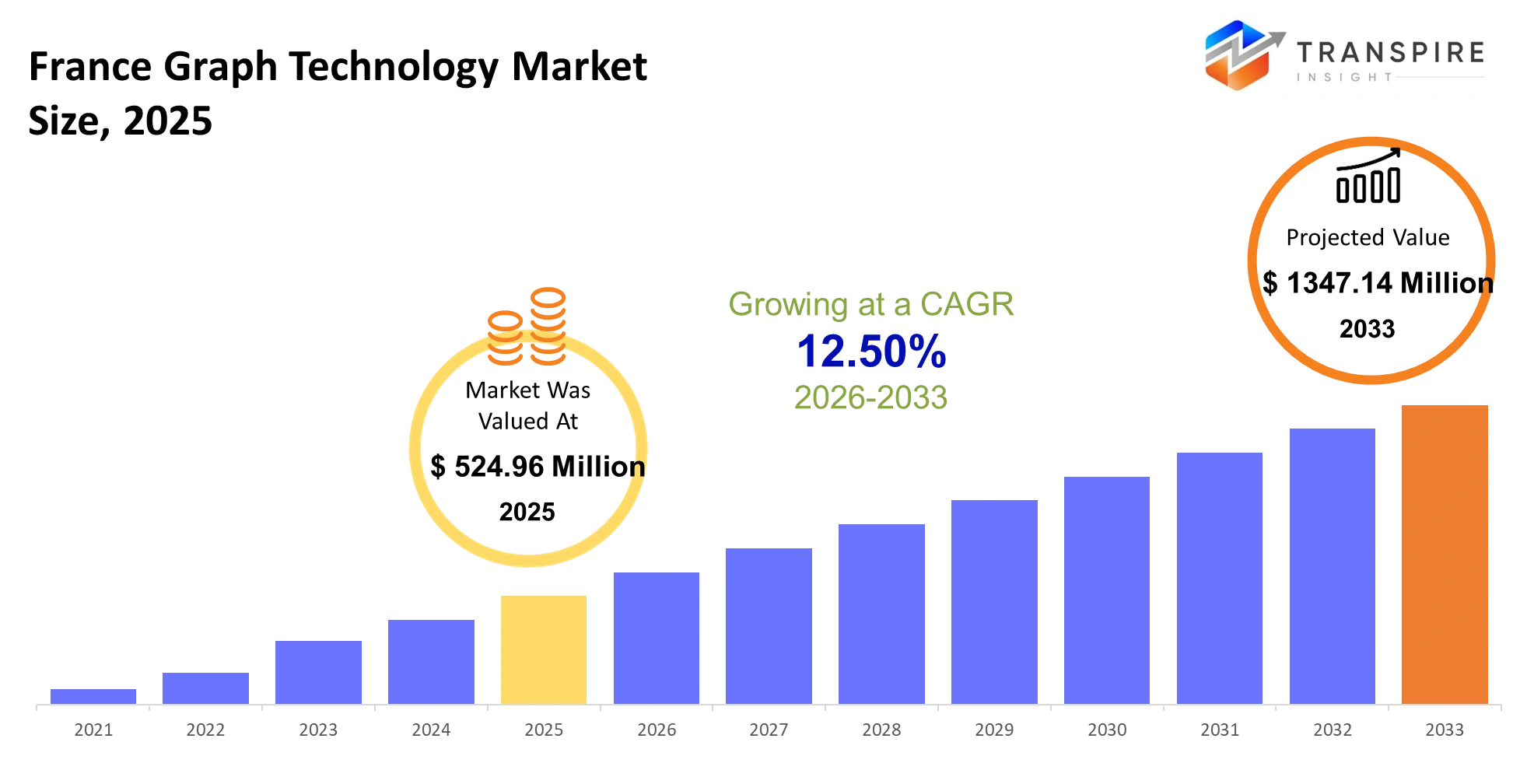
- France Graph Technology Market Size 2025: USD 524.96 Million
- France Graph Technology Market Size 2033: USD 1347.14 Million
- France Graph Technology Market CAGR: 12.50%
- France Graph Technology Market Segments: By Type (Graph Databases, Graph Analytics, Graph Processing Engines, Others); By Application (Fraud Detection, Recommendation Engines, Network Analysis, Risk Management, Others); By End-User (BFSI, IT & Telecom, Healthcare, Retail, Government, Others); By Deployment (Cloud, On-premise, Hybrid, Others)
To learn more about this report,  Download Free Sample Report
France Graph Technology Market Summary
The France Graph Technology Market was valued at USD 524.96 Million in 2025. It is forecast to reach USD 1347.14 Million by 2033. That is a CAGR of 12.50% over the period.
The France Graph Technology Market serves a vital function by enabling businesses to handle, display, and study highly connected data which serves various industries including cybersecurity and financial services and telecommunications and logistics and industrial automation. Organizations use graph technologies to uncover hidden relationships and detect fraud patterns and optimize supply chains and enhance real-time decision-making because traditional relational databases cannot handle their complex data needs. The market has progressed from testing analytics systems during the past five years to active business deployments which utilize cloud-based graph databases and AI-powered knowledge systems.
French companies had to upgrade their data systems because digital sovereignty efforts throughout Europe and GDPR data protection regulations created a need for better data tracking and understandable analytics systems. Companies invested more in graph-based visibility solutions because supply chain interruptions during the post-pandemic recovery period showed the faults in their separate business systems. Organizations that need better situational awareness and quick business insights are using graph technology which results in increased software costs and consulting income and extended partnerships for platform implementation.
Key Market Insights
- The France Graph Technology Market gained strong momentum after 2022 because enterprises began using graph databases to manage complex relationships and conduct AI-based research.
- The Île-de-France region and Paris produced 38 percent of the market share because it contained numerous financial institutions and made digital infrastructure investments.
- The digitalization of industrial processes and implementation of advanced manufacturing technologies will help Western France become the fastest-growing regional center until 2033.
- The France Graph Technology Market 2025 saw graph database platforms control more than 46 percent of market revenue because businesses needed to examine data from multiple sources in real time.
- The second-largest segment of graph analytics software remained active because cybersecurity and fraud detection solutions grew in popularity among banking and telecom companies.
- The market for graph technology solutions that operate through cloud-based systems will experience its highest growth rate until 2033 because these systems offer affordable infrastructure and AI systems that can expand with business needs.
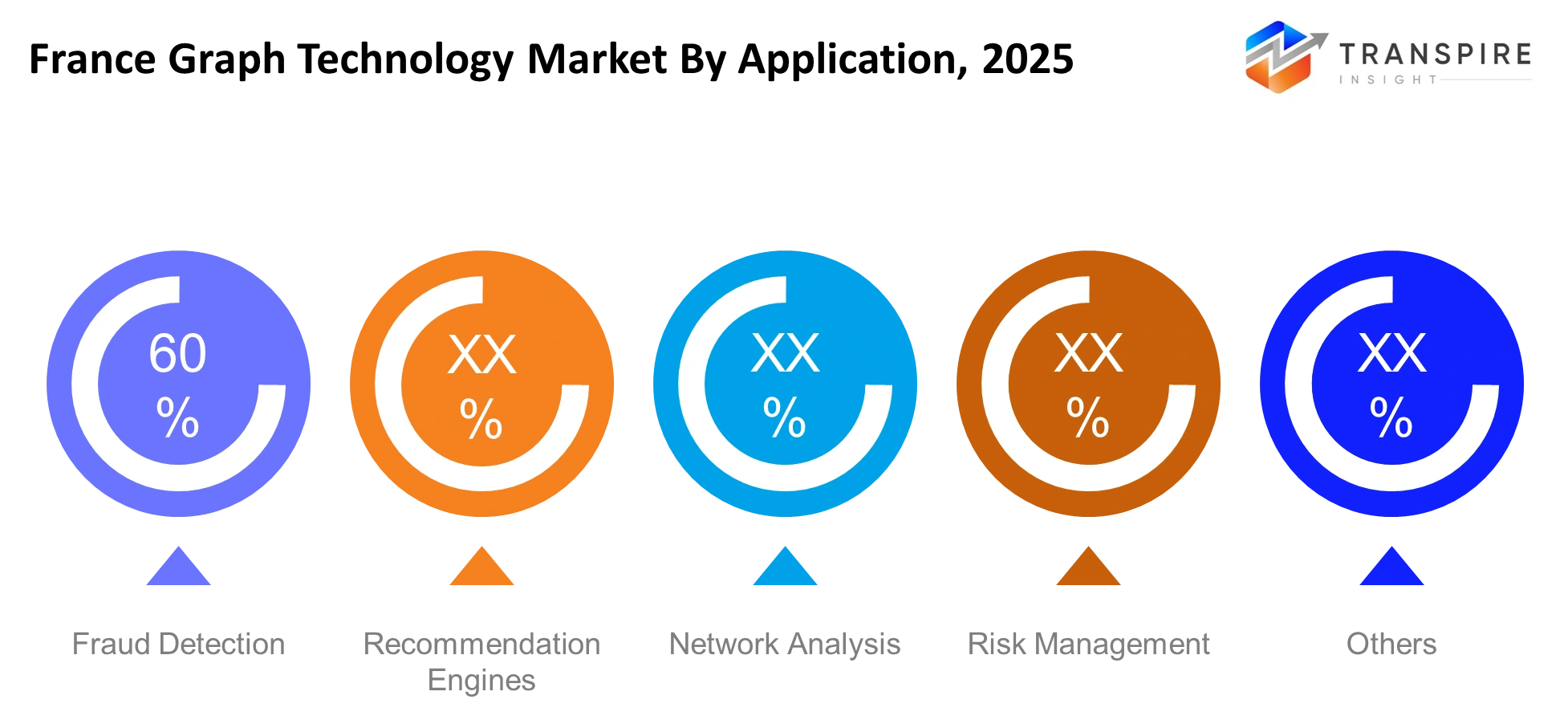
- Fraud detection and risk intelligence represented the leading application segment with nearly 31% share, particularly among French banking and insurance firms.
- The healthcare and retail sectors identified knowledge graph deployment for generative AI applications as their most rapidly expanding use case after 2023.
- Organizations with large operations maintained control over their end-user segments because they spent substantial amounts on predictive analytics and customer intelligence solutions and integrated operational systems.
- The subscription-based pricing model of graph-powered SaaS platforms is driving mid-sized businesses to adopt these platforms because it simplifies implementation and eliminates the need for initial technology costs.
- French technology vendors are now directing their research efforts toward creating AI systems that can be explained and developing fast data analytics solutions and hybrid cloud graph systems.
What are the Key Drivers, Restraints, and Opportunities in the France Graph Technology Market?
The France Graph Technology Market experiences its main growth because businesses increasingly adopt artificial intelligence for their operational decision-making processes. The French banking and telecommunications industries and logistics companies need advanced contextual analytics systems which can analyze connections between their vast data networks. Enterprises choose graph-based systems because traditional relational databases struggle to manage their ever-changing connections between data elements. The adoption of generative AI and knowledge graph frameworks since 2023 further strengthened this transition because AI systems require structured contextual relationships to improve accuracy and explainability. The shift resulted in increased spending on enterprise software and higher rates of cloud migration and extended contracts for analytics platforms.
The most significant limitation involves the complex nature of graph data integration which creates challenges for existing enterprise systems. Many French organizations still operate fragmented IT environments built on relational infrastructure developed over decades. The process of system migration needs experts who understand graph modeling and it requires extended periods for system implementation and complete system testing through which the two systems will work together. The lack of qualified graph database engineers in Europe results in delays for system implementation which reduces potential revenue from software licensing.
Manufacturing and energy sectors present a significant opportunity through their implementation of industrial digital twins and their utilization of smart infrastructure analytics. France’s manufacturing and energy sectors are investing heavily in connected operational intelligence platforms capable of mapping machine relationships, predictive maintenance patterns, and supply chain dependencies. The growth of Industry 4.0 programs together with government AI initiatives creates an environment that supports graph-based operational systems.
What Has the Impact of Artificial Intelligence Been on the France Graph Technology Market?
The France Graph Technology Market has undergone major changes because artificial intelligence enables businesses to process their interconnected datasets and handle difficult analytical tasks. Financial institutions use AI-enabled graph analytics to identify fraud rings, suspicious transaction patterns, and hidden financial relationships in real time. Telecom providers use machine learning models to enhance their network performance through graph architectures while predicting equipment failures and studying customer behavior without needing manual intervention. Security teams use graph-based AI systems in cybersecurity to track attack paths throughout corporate networks, which enables them to find security breaches more quickly than they would with standard monitoring systems.
Predictive analytics capabilities have achieved substantial enhancements. The combination of machine learning algorithms and graph databases enables organizations to predict equipment failures and supply chain disruptions and customer churn through their analysis of behavioral data based on established relationships. The organization achieves operational uptime improvements through these capabilities while decreasing false-positive alerts and enhancing decision-making accuracy throughout industrial and commercial settings. Organizations that use AI-powered graph platforms experience better resource management through shorter investigation durations and enhanced operational performance.
The practical aspects of AI implementation create challenges for organizations. Organizations with disconnected data systems encounter significant technical and financial difficulties when they attempt to connect graph intelligence technology with their existing enterprise systems. The majority of organizations experience difficulties because they cannot access sufficient high-quality connected datasets, which are essential for training accurate graph-based AI models, leading to deployment difficulties and reduced prediction accuracy in real-world situations.
Key Market Trends
- The French business sector started to use graph databases as their primary tool for relationship analysis because these systems provided faster access to relationship data and better suited their needs for fraud detection procedures.
- The banking and healthcare and retail sectors adopted generative AI together with knowledge graph technology throughout 2023 and 2024 which caused an increase in knowledge graph implementation.
- Enterprise organizations started to prefer cloud-based graph processing platforms because hybrid infrastructure systems decreased both deployment durations and operational expenses.
- Cybersecurity vendors used graph analytics to enhance their threat detection systems which resulted in better attack path understanding and faster incident resolution.
- Financial institutions started to use graph technology for anti-money laundering systems after 2021 because EU compliance needs required more detailed data processing.
- Industrial companies implemented graph technology for their digital twin modeling applications which enabled them to perform predictive maintenance and operational dependency assessment throughout their manufacturing networks.
- Technology providers increased partnerships with AI firms to develop explainable analytics platforms for regulated industries including finance and healthcare.
- Open-source graph frameworks expanded adoption among mid-sized enterprises by lowering software licensing barriers and improving deployment flexibility.
- The French business sector started to use sovereign cloud graph infrastructure as their main focus after European data governance and digital autonomy issues became more pressing.
- Vendors used low-latency analytics engines together with GPU-accelerated processing and scalable knowledge graph architectures to improve their market position in enterprise AI applications.
France Graph Technology Market Segmentation
By Type
The market position of graph databases remains dominant because businesses need rapid access to their networked data which financial services and cybersecurity and enterprise AI systems require. Large organizations use graph databases to detect fraud and map customer relationships and create knowledge graphs because relational databases cannot handle their dynamic relationship needs. Telecom operators and logistics providers who need predictive insights and immediate operational information now adopt graph analytics solutions as their primary commercial solution. Enterprises use graph processing engines to manage extensive network simulations and AI-based graph processing in their high-volume computing environments.
Enterprise AI implementation grows the segment while regulated industries adopt contextual analytics at an increasing rate. Future market development will encourage investment in cloud-native graph architectures, vector search integration, and explainable AI frameworks that improve enterprise automation and decision intelligence capabilities. Product developers will increasingly focus on scalable low-latency processing systems while investors prioritize platforms supporting hybrid analytics and real-time data orchestration.
By Application
The banking and insurance industries together with payment platforms use graph technologies to identify hidden links between transactions and detect suspicious behavior which generates maximum commercial value through fraud detection. Retail and streaming platforms expand their recommendation engines because connected customer data enables them to deliver better personalized content which results in higher customer retention rates. The demand for network analysis applications remains strong because telecom and cybersecurity providers need to monitor their digital networks in real time. The regulatory compliance systems of organizations today require unified operational intelligence systems which drive risk management platforms to gain more users.
The segment experiences growth because European businesses now require AI-enabled decision-making systems while also implementing stricter financial compliance controls. The market will develop through the introduction of autonomous threat intelligence systems together with predictive behavioral analytics and generative AI knowledge graphs to enhance forecasting accuracy and operational resilience within enterprises. Platforms that enable users to perform graph reasoning combined with machine learning and real-time analytics automation will become the main focus for buyers.
To learn more about this report, Download Free Sample Report
By End-User
The BFSI sector maintains its leading market position because financial institutions depend on their interconnected transactional data to require sophisticated fraud detection and anti-money laundering systems and risk assessment technologies. IT and telecom companies maintain their commitment to expanding network optimization and cybersecurity monitoring and customer relationship intelligence applications throughout their organizations. Healthcare organizations increasingly deploy graph technologies for their clinical research and drug interaction analysis and genomic relationship mapping projects. The retail and government sectors show continuous growth in their expenditures on graph-based operational intelligence and citizen data management systems.
The segment expands because enterprises rapidly adopt digital technologies while regulated industries require systems that provide transparent AI explanations. The upcoming development will establish better integration between graph intelligence systems and sovereign cloud solutions which will specifically benefit public sector and healthcare operations. Technology providers will likely develop industry-specific graph solutions that improve regulatory compliance, operational transparency, and predictive analytics performance across enterprise environments.
By Deployment
Cloud deployment leads the market because enterprises require scalable graph analytics environments which can handle AI workloads and process data in real time while supporting their distributed operations. Subscription-based deployment models help mid-sized enterprises that need connected data platforms because the models decrease infrastructure expenses and make system integration easier. On-premise deployment remains essential for financial institutions and government organizations which need to maintain strict data sovereignty and security measures. Hybrid deployment models become more popular because enterprises need to combine their private infrastructure protections with their cloud-based analytical capabilities.
Segment growth is driven by increasing cloud migration activity and enterprise demand for scalable AI-ready analytics environments. Future market expansion will create opportunities for stronger funding of hybrid cloud orchestration systems and multi-cloud interoperability solutions and edge-based graph processing systems used in industrial applications. Buyers will increasingly favor deployment models that support sovereign data compliance and provide lower latency performance together with seamless integration into enterprise AI ecosystems.
What are the Key Use Cases Driving the France Graph Technology Market?
The primary application of graph technology in France focuses on two areas which include fraud detection and financial risk assessment. Graph databases enable banks and insurance providers and payment platforms to discover concealed transaction links and detect suspicious account activity and track money laundering operations in real time. The application generates the highest demand because organizations need to handle large financial datasets which require quick responsive systems that relational databases cannot provide.
Telecom companies and retail businesses have started to implement graph analytics systems for customer research and network performance enhancement which goes beyond their financial use. Telecom operators use connected data models to improve service reliability and detect infrastructure anomalies which helps them provide better customer service. Retailers use knowledge graphs for their recommendation systems and inventory management processes while telecom operators use them to improve service delivery.
Organizations use cloud analytics platforms to implement graph-based artificial intelligence systems which create advanced analytical capabilities. Industrial digital twins and AI agent memory systems are currently developing as new technology applications. Graph-based operational mapping allows manufacturing companies to evaluate machine dependencies and supply chain disruptions. Healthcare organizations use graph intelligence to support drug discovery and patient relationship analysis especially in precision medicine and genomic research environments.
|
Report Metrics |
Details |
|
Market size value in 2025 |
USD 524.96 Million |
|
Market size value in 2026 |
USD 590.57 Million |
|
Revenue forecast in 2033 |
USD 1347.14 Million |
|
Growth rate |
CAGR of 12.50% from 2026 to 2033 |
|
Base year |
2025 |
|
Historical data |
2021 - 2024 |
|
Forecast period |
2026 - 2033 |
|
Report coverage |
Revenue forecast, competitive landscape, growth factors, and trends |
|
Regional scope |
France |
|
Key company profiled |
Neo4j, TigerGraph, Amazon, Microsoft, Google, IBM, Oracle, SAP, Teradata, DataStax, ArangoDB, Redis Labs, Stardog, Oracle Labs, Cambridge Intelligence |
|
Customization scope |
Free report customization (country, regional & segment scope). Avail customized purchase options to meet your exact research needs. |
|
Report Segmentation |
By Type (Graph Databases, Graph Analytics, Graph Processing Engines, Others); By Application (Fraud Detection, Recommendation Engines, Network Analysis, Risk Management, Others); By End-User (BFSI, IT & Telecom, Healthcare, Retail, Government, Others); By Deployment (Cloud, On-premise, Hybrid, Others) |
Which Regions are Driving the France Graph Technology Market Growth?
The France Graph Technology Market shows Île-de-France as its leading region because this area contains the highest number of financial institutions and international technology companies and artificial intelligence research facilities. Paris-based companies continue to make substantial investments in graph analytics for their fraud detection and cybersecurity and enterprise intelligence functions. The area possesses excellent digital infrastructure combined with comprehensive cloud technology implementation and access to dedicated data engineering professionals. The region achieves market dominance through its government-supported AI programs and its research institutions that work together with private technology enterprises.
The second largest regional contributor in Auvergne-Rhône-Alpes shows different growth patterns from Paris because its industrial development drives its expansion instead of its financial industry. Manufacturing companies and logistics businesses in the Lyon metropolitan area now implement graph technology to achieve visibility throughout their supply chains and develop systems for predicting maintenance needs. The region's market shows consistent growth because its industrial base remains strong and companies continue to invest in smart factory technology upgrades. Local enterprises use operational efficiency and infrastructure optimization as their main focus instead of developing systems for handling transactions that occur frequently throughout the day.
The aerospace sector and defense industry and advanced engineering analytics sector make Occitanie the fastest developing regional market in the current time period. The region has experienced increased technology investments since 2024 which support aerospace supply chain resilience and connected manufacturing systems and this has resulted in faster adoption of graph database technology. The innovation ecosystems in Toulouse now develop their engineering simulation and cybersecurity and operational intelligence systems by using graph-powered AI platforms.
Who are the Key Players in the France Graph Technology Market and How Do They Compete?
The France Graph Technology Market maintains its competitive structure through major enterprise software companies and dedicated graph database vendors who control most of the market. The primary basis for competition between companies depends on their technological advancements and AI integration abilities which extend beyond standard pricing methods. Established cloud providers are defending enterprise accounts through integrated analytics ecosystems, while specialized graph technology firms are disrupting the market with high-performance query engines and AI-ready architectures. The current competitive environment benefits organizations that can merge their graph analytics, vector search and generative AI infrastructure into single business solutions.
Through its graph intelligence solutions Neo4j provides businesses with capabilities that enable explainable AI, fraud detection and enterprise-wide connection analysis. The company strengthened its European enterprise presence through strategic AI ecosystem collaborations and expanded partnerships with cloud providers including Google Cloud in 2026. TigerGraph competes through its graph processing system which uses parallel processing to deliver rapid analytics performance on extensive operational datasets. Its Savanna cloud-native platform and hybrid vector search capabilities improved positioning in AI-driven enterprise deployments.
Microsoft and Amazon Web Services use their comprehensive cloud platforms to provide businesses with direct access to graph analytics which they can use in their AI and data management procedures. Their business advantage exists because they possess the ability to grow their operations and they have established enterprise relationships and they offer AI tools that work together. IBM focuses on regulated industries by combining graph analytics with explainable AI and governance frameworks suited for financial and healthcare applications.
Company List
- Neo4j
- TigerGraph
- Amazon
- Microsoft
- IBM
- Oracle
- SAP
- Teradata
- DataStax
- ArangoDB
- Redis Labs
- Stardog
- Oracle Labs
- Cambridge Intelligence
Recent Development News
In April 2026, Neo4j entered a strategic partnership with Materna Information & Communications SE. The collaboration expanded graph intelligence and explainable AI capabilities for regulated enterprise environments across Europe.https://tinyurl.com
In July 2025, TigerGraph secured strategic investment from Cuadrilla Capital to accelerate enterprise AI infrastructure innovation. The funding strengthened development of graph database technologies supporting fraud detection and real-time analytics platforms.https://tinyurl.com
What Strategic Insights Define the Future of the France Graph Technology Market?
The French graph technology market is evolving towards AI-driven enterprise intelligence systems which utilize graph databases as fundamental elements for contextual analysis and security measures and instantaneous decision-making capabilities. The strongest force behind this transition is the growing requirement for explainable AI models capable of understanding relationships across fragmented enterprise datasets. The next seven years will see graph intelligence reach its peak development through its integration with vector search and cloud-native analytics and sovereign AI infrastructure projects which are being established throughout Europe.
There exists a hidden danger because organizations are becoming more reliant on both hyperscale cloud environments and proprietary graph database systems. The concentration will result in vendor lock-in difficulties which will restrict system compatibility and raise expenses for businesses that handle regulated data. Industrial digital twins and graph-powered AI agents create new business prospects which are particularly valuable for aerospace and manufacturing and energy analytics fields.
Market participants should choose graph platforms that support interface compatibility with multiple systems while delivering advanced AI functionalities and specialized solutions for different industry sectors. The combination of explainable analytics with low-latency processing and sovereign data compliance frameworks will establish a stronger market advantage for vendors who implement this solution.
France Graph Technology Market Report Segmentation
By Type
- Graph Databases
- Graph Analytics
- Graph Processing Engines
- Others
By Application
- Fraud Detection
- Recommendation Engines
- Network Analysis
- Risk Management
- Others
By End-User
- BFSI
- IT & Telecom
- Healthcare
- Retail
- Government
- Others
By Deployment
- Cloud
- On-premise
- Hybrid
- Others
Frequently Asked Questions
Find quick answers to common questions.
The confirmed 2033 market size figure in USD 1347.14 Million.
Key segments for the France Graph Technology Market are By Type (Graph Databases, Graph Analytics, Graph Processing Engines, Others); By Application (Fraud Detection, Recommendation Engines, Network Analysis, Risk Management, Others); By End-User (BFSI, IT & Telecom, Healthcare, Retail, Government, Others); By Deployment (Cloud, On-premise, Hybrid, Others).
Major France Graph Technology Market players are Neo4j, TigerGraph, Amazon, Microsoft, Google, IBM, Oracle, SAP, Teradata, DataStax, ArangoDB, Redis Labs, Stardog, Oracle Labs, Cambridge Intelligence.
The France Graph Technology Market size is USD 524.96 Million in 2025.
The France Graph Technology Market CAGR is 12.50% from 2026 to 2033.
- Neo4j
- TigerGraph
- Amazon
- Microsoft
- IBM
- Oracle
- SAP
- Teradata
- DataStax
- ArangoDB
- Redis Labs
- Stardog
- Oracle Labs
- Cambridge Intelligence
Recently Published Reports
-
Apr 2026
3D Optical Profiler Market
3D Optical Profiler Market Size, Share & Analysis Report By Type (Desktop 3D Optical Profiler, and Portable 3D Optical Profiler), By Technology (Confocal Technology, and White Light Interference), By End-Use Industry (Manufacturing, Research Institutions, Automotive, Aerospace and Defense, Medical Devices, and Other), and Geography (North America, Europe, Asia-Pacific, Middle East and Africa, South and Central America), 2021 - 2031
-
Apr 2026
Depth Sensor Market
Depth Sensor Market Size, Share & Analysis Report By Type (Infrared Depth Sensors, Time-of-Flight (ToF) Sensors, Stereo Vision Sensors, Structured Light Sensors, Ultrasonic Depth Sensors), By Application (Automotive, Robotics, Gaming, Consumer Electronics, Industrial Automation, Healthcare, Security & Surveillance, Others), By End Users (Automotive Manufacturers, Consumer Electronics Companies, Healthcare Providers, Industrial Companies, Security Agencies, Gaming Companies, Robotics Companies, Others), and Geography (North America, Europe, Asia-Pacific, Middle East and Africa, South and Central America), 2021 – 2031
-
Apr 2026
Digital Manufacturing Market
Digital Manufacturing Market Size, Share & Analysis Report By Component (Hardware, Software, and Services), By Technology (Robotics, 3D Printing, Internet of Things (IoT), and Others), By Application (Automotive and Transportation, Aerospace and Defense, Consumer Electronics, Industrial Machinery, and Others), By Process Type (Computer-Based Designing, Computer-Based Simulation, Computer 3D Visualization, Analytics, and Others), and Geography (North America, Europe, Asia-Pacific, Middle East and Africa, South and Central America), 2021 – 2031
-
Apr 2026
Digital Visa Services Market
Digital Visa Services Market Size, Share & Analysis Report By Type (Individual Travelers, Group Travelers), By Application (Tourism, Business Travel, Others), and Geography (North America, Europe, Asia-Pacific, Middle East and Africa, South and Central America), 2021 – 2031