

France Golf Simulator Market Size & Forecast:
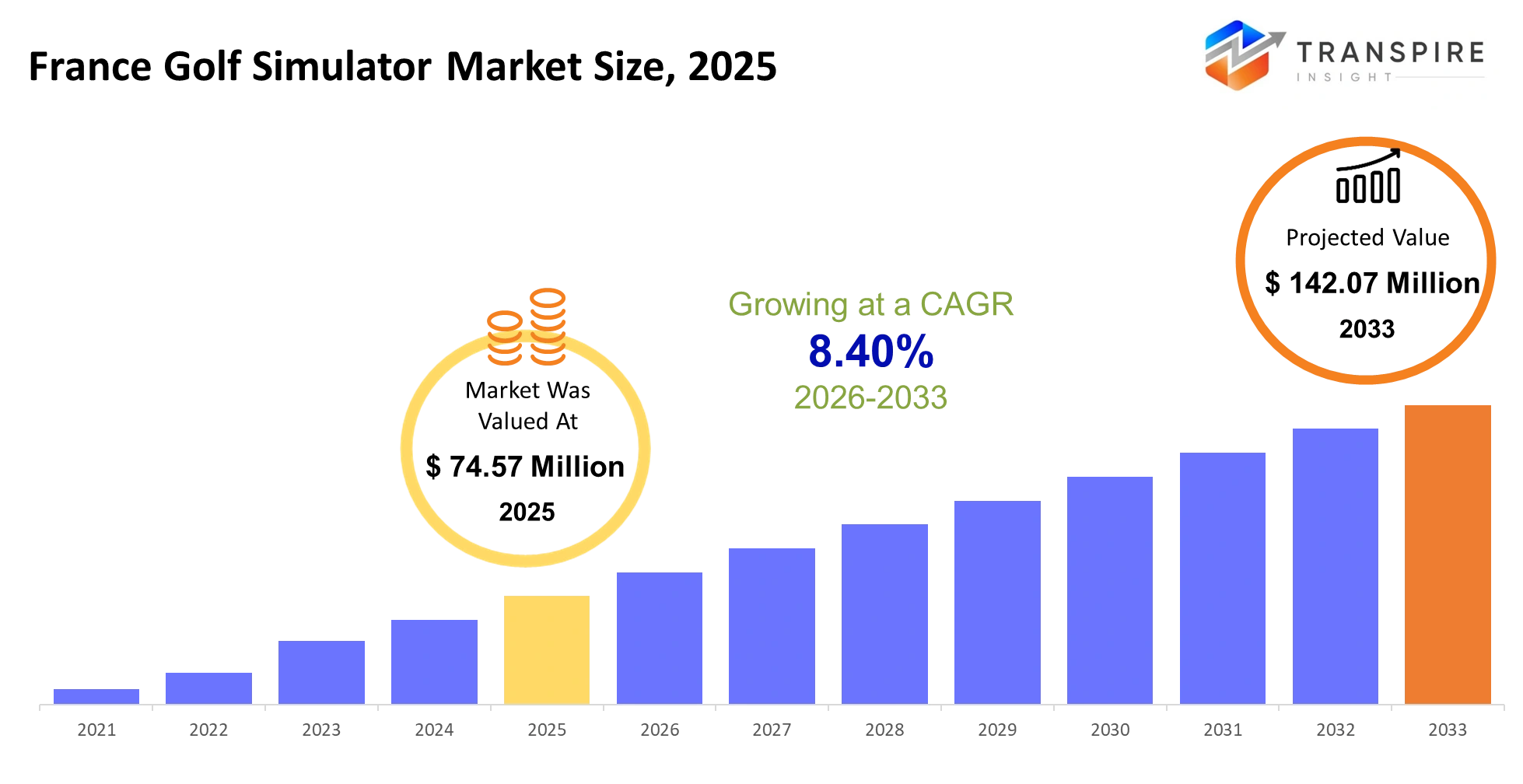
- France Golf Simulator Market Size 2025: USD 74.57 Million
- France Golf Simulator Market Size 2033: USD 142.07 Million
- France Golf Simulator Market CAGR: 8.40%
- France Golf Simulator Market Segments: By Type (Full Swing Simulators, Portable Simulators, VR Simulators, Others); By Application (Professional Training, Entertainment, Commercial Use, Others); By End-User (Golf Clubs, Training Centers, Individuals, Entertainment Venues, Others); By Technology (Radar-based, Camera-based, Infrared, Others).
To learn more about this report,  Download Free Sample Report
France Golf Simulator Market Summary
The France Golf Simulator Market was valued at USD 74.57 Million in 2025. It is forecast to reach USD 142.07 Million by 2033. That is a CAGR of 8.40% over the period.
The France Golf Simulator Market serves a practical function which enables golf clubs and sports training centers and hotels and urban entertainment venues to provide golf services throughout the year without needing outdoor space or weather conditions. The systems use launch monitors together with projection technology and swing analytics and immersive software to enable professional coaching and recreational gaming and commercial sports entertainment. Simulators function as an affordable solution which allows urban areas with limited land space to access golf facilities while generating continuous income for businesses.
The market has evolved during the past five years from hardware-based simulator installations toward performance ecosystems which use AI technology and cloud analytics and multiplayer gaming systems. Indoor sports facilities became more popular during COVID-19 because people wanted safer places to exercise and golf clubs needed new ways to make money when outdoor options became unavailable. The number of commercial installations increased throughout the hospitality industry and retail leisure sector and corporate wellness facilities. The combination of improved simulator accuracy and reduced installation costs enables operators to achieve better customer retention rates and longer usage durations which result in increased equipment sales and software subscriptions and service revenues.
Key Market Insights
- The 2025 market study shows Northern France holding almost 38% market share because it contains numerous high-end golf clubs and sports academies and hotel development projects.
- The southern region of France will become the quickest developing market between now and 2033 because of its luxury resort developments and expansion of tourism-related recreational facilities.
- The France Golf Simulator Market is primarily controlled by full swing simulator systems which hold more than 46% market share because commercial establishments choose to use systems which deliver engaging multiplayer functions and precise analytical results.
- The second biggest market share belongs to portable and compact simulator systems because home users started using space-saving indoor golf systems after the year 2021.
- The growth of AI-powered simulator platforms will occur at the fastest speed until 2033 because coaching centers use these platforms to obtain instant swing analysis and forecast shot trajectories.
- The golf academy sector uses motion-tracking systems to optimize performance which generated 41 percent of total industry revenue in 2025.
- The entertainment-based simulator lounges have become the top-growing application area because young consumers prefer social gaming activities which come with dining and drinking options.
- The sports centers and hotel operators create the largest customer segment which holds almost 50% market share in 2025.
- The fastest-growing customer group includes residential users who are wealthy and spend on home sports equipment which connects to health and wellness systems.
- Companies are forming partnerships with hotels and fitness centers and high-end entertainment locations to establish ongoing software subscription services and extended system support agreements.
What are the Key Drivers, Restraints, and Opportunities in the France Golf Simulator Market?
The France Golf Simulator Market experiences its main growth because sports analytics technology now integrates with indoor entertainment business models. Golf clubs and training academies use launch monitors together with high-speed cameras and AI-based swing analysis systems to provide players with measurable performance improvements. Operators started developing new revenue sources because pandemic-era disruptions forced them to move their businesses beyond seasonal outdoor operations. Commercial venues discovered that simulator installations could generate hourly usage fees, coaching subscriptions, food-and-beverage sales, and corporate event bookings within a single indoor facility. The development of better ball-tracking sensors and 4K projection systems led to more realistic simulators which attracted both professional golfers and recreational users resulting in higher installation rates and software licensing revenue.
The primary obstacle remains the expensive initial investment necessary to obtain high-end golf simulator equipment. Commercial-grade installations require various components including dedicated indoor spaces and advanced projection systems and specialized flooring materials and routine calibration maintenance. The system creates an organizational hindrance which impacts smaller golf clubs and independent recreational facilities and residential users. Simulator accuracy requires advanced sensing technologies and high-precision engineering which results in prices that remain costly for customers. Many mid-sized operators postpone their technology adoption because it restricts their business growth while decreasing short-term income generation.
The French experiential hospitality industry together with its mixed-use entertainment sector provides golf simulators as a valuable opportunity for business development. Luxury hotels and sports bars together with urban leisure chains now pursue interactive customer experiences which lead to extended customer visits and increased revenue. AI-based coaching systems together with multiplayer gaming platforms provide businesses with continuous revenue streams through their membership programs and digital subscription services. Companies that develop cloud-linked simulator systems together with their small-scale modular systems will achieve strong business growth in urban commercial spaces where traditional golf facilities do not exist.
What Has the Impact of Artificial Intelligence Been on the France Golf Simulator Market?
The France Golf Simulator Market transforms from its hardware-based origins through the implementation of artificial intelligence and advanced digital technologies which create a performance analysis network. The latest simulator systems incorporate artificial intelligence-based motion tracking together with computer vision and machine learning technologies to perform automatic swing measurements and shot detection and player achievement evaluation. The TrackMan and Foresight Sports systems operate thousands of swing parameters in real time, enabling coaches and athletes to access instant information about launch angle and ball speed and club path and spin rate without any manual work.
Commercial simulator venues experience operational efficiency growth through their use of predictive analytics. Machine learning models help optimize equipment maintenance schedules by identifying calibration deviations and sensor wear before failures occur, reducing downtime and improving customer session availability. AI-enabled personalization systems help businesses retain customers by suggesting practice schedules and challenge levels and multiplayer activities according to how players have interacted with the system in the past. The simulator providers experience increased customer engagement through these features which also generate higher recurring software subscription revenues.
Commercial spaces now show measurable operational enhancements. The AI-powered simulator systems enable operators to deliver better services to their customers because these systems increase shot accuracy and decrease the need for recalibration and simplify coaching processes.
Key Market Trends
- The golf entertainment lounges in Paris and Lyon which opened after 2021 expanded their simulator networks to draw in younger customers who want to play interactive social sports activities.
- After 2022 golf academies started using AI swing analysis tools because they wanted to develop player skills through precise measurements and individual coaching solutions.
- The period between 2023 and 2025 saw hospitality operators use golf simulators at luxury hotels and resorts to create new year-round entertainment options for their guests.
- Commercial buyers showed a preference for simulator systems that use cloud technology to enable multiplayer matches and remote coaching and subscription-based analytics features.
- Simulation companies developed better launch monitor accuracy after 2020 by using radar tracking and infrared imaging and machine learning techniques to calibrate shots.
- The demand for compact residential golf simulator systems increased when affluent households started to invest in indoor recreation and home wellness solutions due to remote work trends.
- French golf clubs started to collaborate with technology providers because they wanted to create new revenue streams that would complement their traditional membership and seasonal outdoor course business operations.
- Operators created entertainment-focused installations which combined simulators with food and drinks and esports-style competitions at a faster rate than traditional training centers.
- European distributors developed regional expansion plans between 2022 and 2025 by providing software interfaces that were customized for local needs together with technical support for customers after their purchases.
- Hardware specifications no longer served as the main element for competitive differentiation because AI coaching accuracy and immersive graphics quality and digital community engagement capabilities became more important.
France Golf Simulator Market Segmentation
By Type
The market remains under the control of full swing simulators because commercial golf facilities and professional training centers and high-end indoor athletic venues choose operational systems that deliver realistic gaming experiences together with precise ball tracking capabilities. The system functions as a professional coaching tool because it offers advanced projection technology and authentic golf course simulation and complete analytical functions which businesses use for their entertainment operations. The high costs of installation prevent smaller facilities from using the system yet the strong membership and hourly booking revenue streams continue to drive investments in major French cities.
Portable simulators represent a fast-expanding segment because residential buyers and small training facilities seek lower-cost and space-efficient golf technology solutions. The installation of portable systems requires minimal space while their users need only follow straightforward procedures for setup. The entertainment industry now uses VR simulators because operators want to attract young customers who prefer interactive sports games instead of traditional golf training. Manufacturers continue to develop the "others" category which includes hybrid and modular simulation systems through their testing of AI-based gameplay and motion-tracking devices and subscription software systems. The forecast period will see innovation concentrate on three areas which include compact hardware integration and wireless connectivity and better simulation realism.
By Application
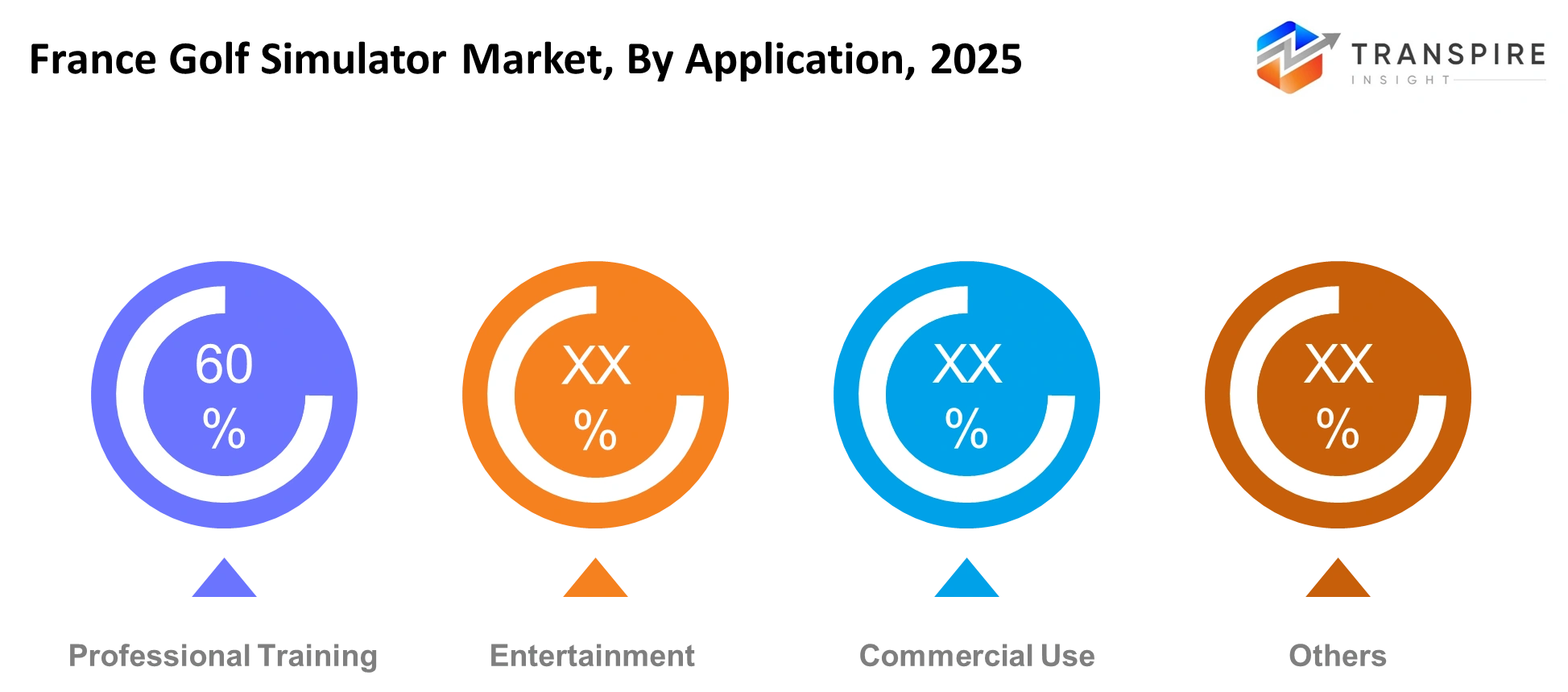
Professional training holds the leading market position because golf academies, coaching centers, and competitive players rely on simulator platforms for year-round swing analysis and performance optimization. Instructors use high-speed cameras together with launch monitors and real-time analytics tools to demonstrate player improvement because they need to track progress regardless of outdoor conditions and course accessibility. Professional coaching environments maintain high demand for premium simulator systems which offer advanced tracking accuracy and complete data analysis functions.
The fastest-growing market segment for entertainment applications emerges because sports bars and leisure centers and hospitality venues now use golf simulators to create social gaming spaces. The commercial market for simulator systems is steadily growing because hotels and corporate wellness centers and mixed-use entertainment venues recognize these systems as profitable customer attractions which boost visitor time spent on their premises. Educational institutions together with event-based installations make up a growing segment in the "others" category as experiential sports technology becomes accessible through non-traditional golf environments. The upcoming forecast period will show a change in application demand toward multiplayer gaming ecosystems and AI-personalized coaching subscriptions and digital tournament experiences that provide performance analytics together with recreational activities.
To learn more about this report, Download Free Sample Report
By End-User
Golf clubs account for the largest market share because established clubs increasingly use simulator systems to extend member engagement beyond seasonal outdoor play. Indoor golf technology enables clubs to produce ongoing revenue streams through their coaching programs and winter training activities and simulator-based competitions while their facilities achieve higher usage rates throughout the entire year. The clubs maintain strong bonds with their premium technology suppliers which helps them secure ongoing system improvements and extended maintenance contracts.
Training centers represent a rapidly growing segment because performance-focused coaching facilities require advanced analytics tools to differentiate instruction quality and attract competitive players. High-income households are expanding simulator adoption through their purchase of connected fitness and recreational technology for home use. Entertainment venues continue expanding installations because simulator-based social gaming aligns with changing leisure preferences among younger urban consumers. The "others" category which includes hotels and corporate recreation spaces will begin to rise in popularity because operators want to create year-round experiential attractions that will boost customer loyalty and additional revenue. Future market expansion will likely encourage suppliers to develop scalable subscription models and compact installation formats tailored to both commercial and residential buyers.
By Technology
The market position of radar-based systems remains dominant because professional training facilities and premium simulator operators choose these systems for their ability to track ball flights with high accuracy and to maintain tracking performance from outdoor to indoor settings. The systems demonstrate their best performance in advanced coaching environments which require precise tracking of launch angle and spin rate and trajectory measurement to achieve training objectives. The higher pricing models of this product line restrict access for smaller businesses yet elite golf academies and commercial entertainment facilities that provide their customers with premium services continue to show growing interest in this product.
The camera-based systems currently dominate the market because they deliver exceptional analytical results while requiring less effort to set up and operate at lower expenses. Infrared technologies are becoming more common in indoor spaces which have space constraints that need fast sensor installation and quick response times. The market for "others" now includes hybrid sensor fusion systems and AI-powered tracking technologies which track their expansion as manufacturers work to achieve better simulation precision and real-time game response systems. The period of technology competition during the forecast timeline will focus on improving data-processing speed and developing AI-based coaching systems and cloud-based analysis tools which enable customized player training and remote performance assessment.
What are the Key Use Cases Driving the France Golf Simulator Market?
The primary reason people use simulators in France comes from their need to create professional coaching systems together with player performance evaluation methods. Year-round instruction at golf academies and premium clubs and indoor training centers depends on launch monitors and swing analytics platforms which enable them to provide teaching throughout all weather conditions. Coaches and competitive players demand accurate ball-tracking data and swing diagnostics and virtual course simulation technology which creates the largest usage demand for this application because it helps them build consistency and training efficiency.
Hospitality and commercial entertainment venues currently experience rapid growth in their expansion of applications that operate next to their main functions. Sports bars and hotels and indoor leisure chains currently install multiplayer simulator bays which help them attract younger customers who want to experience social sports activities together with dining options and corporate events. Affluent households now use residential installations because they want to create connected fitness and recreation spaces that operate with home systems instead of needing personal golf equipment.
Virtual golf tournaments and remote coaching systems together with AI-based practice subscription services represent new application development. Technology providers are currently developing mixed-reality golf experiences which combine simulator games with motion tracking wearables and cloud-based performance metrics during the upcoming forecast period.
|
Report Metrics |
Details |
|
Market size value in 2025 |
USD 74.57 Million |
|
Market size value in 2026 |
USD 80.76 Million |
|
Revenue forecast in 2033 |
USD 142.07 Million |
|
Growth rate |
CAGR of 8.40% from 2026 to 2033 |
|
Base year |
2025 |
|
Historical data |
2021 - 2024 |
|
Forecast period |
2026 - 2033 |
|
Report coverage |
Revenue forecast, competitive landscape, growth factors, and trends |
|
Regional scope |
France |
|
Key company profiled |
TrackMan, Foresight Sports, SkyTrak, Full Swing Golf, TruGolf, OptiShot, Uneekor, Garmin, AboutGolf, Golfzon, Rapsodo, FlightScope, ProTee, HD Golf, SwingLogic. |
|
Customization scope |
Free report customization (country, regional & segment scope). Avail customized purchase options to meet your exact research needs. |
|
Report Segmentation |
By Type (Full Swing Simulators, Portable Simulators, VR Simulators, Others); By Application (Professional Training, Entertainment, Commercial Use, Others); By End-User (Golf Clubs, Training Centers, Individuals, Entertainment Venues, Others); By Technology (Radar-based, Camera-based, Infrared, Others). |
Which Regions are Driving the France Golf Simulator Market Growth?
The France Golf Simulator Market is currently led by Northern France because the region has both urban population density and high-quality sports facilities and financial power to support business growth. The area around Paris contains multiple indoor golf lounges and corporate entertainment centers which attract high-income residents who want to purchase advanced simulator systems. Established golf academies and technology distributors in the region provide installation and calibration and after-sales support services which benefit the local golf industry. Operators in this mature ecosystem can use simulator platforms to generate revenue through memberships and coaching subscriptions and hospitality partnerships more efficiently than operators in other regions.
Western France serves as the second largest regional contributor because its development pattern varies from the northern region. The region achieves its growth through its steady tourism business and its golf resorts and its people who spend money on leisure activities at its coastal resorts. Hotels and resort operators increasingly use simulator installations to extend golf-related guest engagement beyond seasonal outdoor play. The region provides a dependable revenue source for simulator manufacturers and service providers because it maintains stable investment conditions while attracting repeat tourist visits.
The market in Southern France is developing into its fastest-growing stage because luxury hospitality and mixed-use entertainment venues and experiential sports infrastructure are drawing more financial backing. The new demand for immersive golf technologies in Marseille and Nice has emerged from the recent expansion of premium resorts and indoor leisure complexes which took place throughout these cities.
Who are the Key Players in the France Golf Simulator Market and How Do They Compete?
The France Golf Simulator Market shows moderate market fragmentation because global technology companies compete with specialized simulator software companies and launch monitor manufacturers. The primary basis of competition has shifted away from hardware alone toward analytics accuracy, immersive graphics, software ecosystems, and commercial service capabilities. Established brands defend market share through training platforms that combine multiple systems with golf club partnerships, while new market entrants focus on residential areas and mid-priced commercial installations by offering affordable systems and subscription software.
TrackMan establishes its identity through a system that uses radar technology to track objects with high precision, which enables cloud-based analytics and establishes partnerships with professional golf organizations that enhance its brand reputation among top athletes and commercial golf facilities. The company developed its ecosystem through simulator software upgrades and integration partnerships that it announced at the 2026 PGA Show, which allowed operators to create more realistic indoor golf experiences. Foresight Sports competes through its advanced photometric launch monitoring system and its adaptable software which helps indoor golf facilities achieve lower expenses throughout their operational lifetime. Independent simulator venues that want to customize their setups use its systems because they allow users to connect multiple systems together.
Full Swing Golf focuses on premium commercial and luxury residential installations by combining cinematic simulation environments with high-end enclosure systems and professional sports partnerships. Golfzon establishes its unique position by offering simulator experiences that focus on entertainment and multiplayer gaming options which customers enjoy at urban indoor golf lounges.
Company List
- TrackMan
- Foresight Sports
- SkyTrak
- Full Swing Golf
- TruGolf
- OptiShot
- Uneekor
- Garmin
- AboutGolf
- Golfzon
- Rapsodo
- FlightScope
- ProTee
- HD Golf
- SwingLogic
Recent Development News
In June 2025, ZinCo completed Environmental Product Declaration verification for most of its green roof product portfolio. The certification improved transparency for lifecycle environmental assessment and strengthened ZinCo’s position in ESG-focused construction projects.
Source Link:http://www.zinco-greenroof.co.uk
In February 2025, Sempergreen expanded its biodiverse green roof solutions for European commercial construction projects. The expansion supported demand for urban heat reduction and stormwater management systems across sustainability-focused infrastructure developments.
Source Link:https://www.sempergreen.com
What Strategic Insights Define the Future of the France Golf Simulator Market?
The France Golf Simulator Market is advancing toward connected indoor sports ecosystems which use AI for coaching and provide immersive entertainment and subscription-based digital content. The transition exists because operators want to create year-round experiential leisure activities which operate better than existing outdoor golf systems in urban spaces that lack golf facilities. The next five to seven years will witness value creation transition from hardware sales to software sales and analytics sales and membership-based service sales.
The small group of premium technology providers who control launch monitor software ecosystems and data integration standards create a hidden risk which organizations increasingly depend on. The concentration of resources will raise operating expenses for simulator venues while decreasing their ability to work with multiple systems. Compact modular simulator systems which hospitality chains and residential real estate projects and mixed-use entertainment spaces require are creating new opportunities for development in the market.
Market participants should form partnerships with hospitality operators and cloud software developers because this approach will help them grow their business more effectively than competing through simulator hardware specifications. Companies that establish scalable service ecosystems which generate digital revenue streams will achieve higher customer retention rates and better profit margins over time.
France Golf Simulator Market Report Segmentation
By Type
- Full Swing Simulators
- Portable Simulators
- VR Simulators
- Others
By Application
- Professional Training
- Entertainment
- Commercial Use
- Others
By End-User
- Golf Clubs
- Training Centers
- Individuals
- Entertainment Venues
- Others
By Technology
- Radar-based
- Camera-based
- Infrared
- Others
Frequently Asked Questions
Find quick answers to common questions.
The confirmed 2033 market size figure in USD 142.07 Million.
Key segments for the France Golf Simulator Market are By Type (Full Swing Simulators, Portable Simulators, VR Simulators, Others); By Application (Professional Training, Entertainment, Commercial Use, Others); By End-User (Golf Clubs, Training Centers, Individuals, Entertainment Venues, Others); By Technology (Radar-based, Camera-based, Infrared, Others).
Major France Golf Simulator Market players are TrackMan, Foresight Sports, SkyTrak, Full Swing Golf, TruGolf, OptiShot, Uneekor, Garmin, AboutGolf, Golfzon, Rapsodo, FlightScope, ProTee, HD Golf, SwingLogic.
The France Golf Simulator Market size is USD 74.57 Million in 2025.
The France Golf Simulator Market CAGR is 8.40% from 2026 to 2033.
- TrackMan
- Foresight Sports
- SkyTrak
- Full Swing Golf
- TruGolf
- OptiShot
- Uneekor
- Garmin
- AboutGolf
- Golfzon
- Rapsodo
- FlightScope
- ProTee
- HD Golf
- SwingLogic
Recently Published Reports
-
Apr 2026
Bottled Water Market
Bottled Water Market Size, Share & Analysis Report By Product Type (Still Bottled Water, Carbonated Bottled Water, Functional Bottled Water, and Others), By Packaging (PET, Cans, and Others), By Sales Channel (Supermarkets/Hypermarkets, Convenience Stores/Drug Stores, Grocery Stores/Club Stores, Foodservice, and Others) and Geography (North America, Europe, Asia-Pacific, Middle East and Africa, South and Central America), 2021 - 2032
-
Apr 2026
Color Cosmetic Packaging Market
Color Cosmetic Packaging Market Size, Share & Analysis Report By Application (Mascara Packaging, Liquid Packaging, and Liquid Face), By Type (Tubes & Bottles, Pens & Markers, Compacts & Containers, and Droppers & Pumps), and Geography (North America, Europe, Asia-Pacific, Middle East and Africa, South and Central America), 2021 - 2031
-
Apr 2026
External Microphone For Camera Market
External Microphone For Camera Market Size, Share & Analysis Report By Type (Shotgun Microphone, Lavalier Microphone, and Others), By Application (Digital Camera, Professional Video Camera, and Others), and Geography (North America, Europe, Asia-Pacific, Middle East and Africa, South and Central America), 2021 - 2031
-
Apr 2026
Foot Orthotic Insoles Market
Foot Orthotic Insoles Market Size, Share & Analysis Report By Type (Pre-fabricated, and Custom-made), By Material (Thermoplastic, Composite Carbon Fiber, and Others), By Distribution Channel (Drug Stores, Hospitals & Clinics, and Others), and Geography (North America, Europe, Asia-Pacific, Middle East and Africa, South and Central America), 2021 - 2031