
France Geotechnical Engineering Market Size & Forecast:
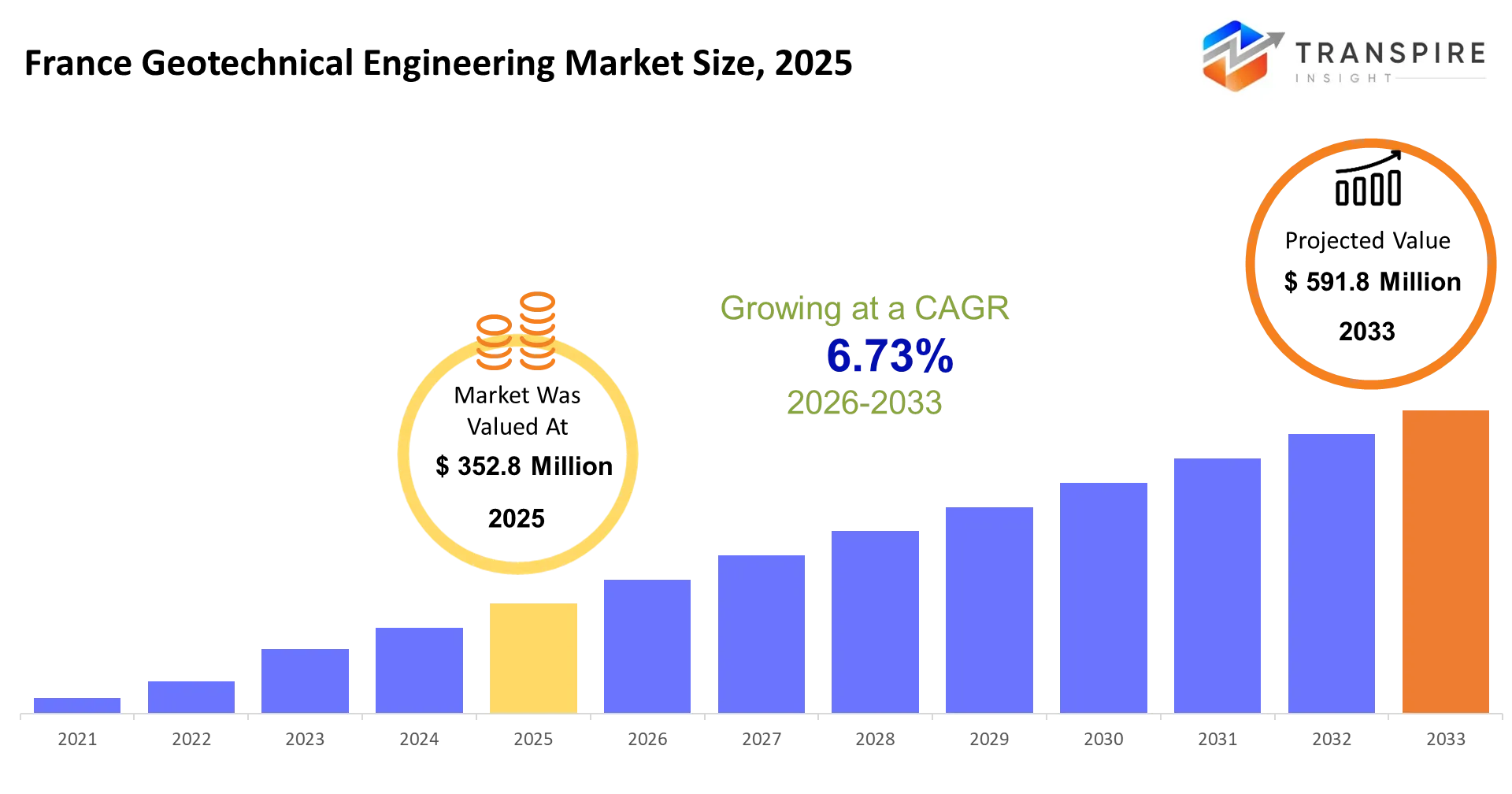
- France Geotechnical Engineering Market Size 2025: USD 352.8 Million
- France Geotechnical Engineering Market Size 2033: USD 591.8 Million
- France Geotechnical Engineering Market CAGR: 6.73%
- France Geotechnical Engineering Market Segments: By Type (Site Investigation, Soil Testing, Foundation Engineering, Ground Improvement, Others); By Application (Construction, Infrastructure, Mining, Oil & Gas, Environmental Engineering, Others); By End-User (Construction Companies, Government, Mining Firms, Oil & Gas Companies, Infrastructure Developers, Others); By Service (Consulting, Design, Testing, Monitoring, Others)
To learn more about this report,  Download Free Sample Report
France Geotechnical Engineering Market Summary
The France Geotechnical Engineering Market was valued at USD 352.8 Million in 2025. It is forecast to reach USD 591.8 Million by 2033. That is a CAGR of 6.73% over the period.
The France geotechnical engineering market uses soil and subsurface condition analysis to support construction safety through testing which evaluates foundation and tunnel and port and transport infrastructure building material requirements. The sector has adopted digital site investigation methods during the past three to five years through its use of BIM and remote sensing and advanced geophysical modeling, which enhances precision and decreases expensive fieldwork uncertainty.
The combination of stricter EU climate resilience requirements with major infrastructure projects, including urban transit expansions and coastal protection initiatives, has created a requirement for earlier, more comprehensive ground risk assessments during project planning, which began after supply chain issues revealed hidden costs. The market shift has created new buying patterns for contractors and engineering firms, who now seek complete geotechnical solutions that combine data analysis with field testing, which enables faster project approvals and decreases design changes while improving project results in civil and maritime construction.
Key Market Insights
- The Geotechnical Engineering Market in France is dominated by Île-de-France which holds the largest market share because of its urban infrastructure and upcoming 2025 metro expansion projects.
- The Southern coastal regions will experience their most rapid development because of increasing demand for flood defense systems and coastal stabilization and climate resilience engineering until 2033.
- The industrial zones of Lyon and Marseille maintain continuous growth due to the development of logistics infrastructure and ongoing port modernization efforts throughout France.
- The France Geotechnical Engineering Market grants its highest market share to geotechnical investigation services which scientists require for pre-construction risk evaluation work.
- The laboratory soil testing segment stands as the second largest market segment which helps engineers design foundations for both civil and industrial construction projects.
- The geophysical surveying services segment grows at the fastest rate because companies are implementing digital subsurface mapping and 3D modeling technologies between 2025 and 2033.
- The France Geotechnical Engineering Market sees its main activities focused on transportation infrastructure which includes projects for rail expansion and highway construction and urban metro system development.
- The underground mobility development and subway system expansion projects in major French cities make tunnel engineering the most rapidly developing application sector.
- Climate adaptation initiatives and the necessity for maritime infrastructure development are driving the rapid growth of ports and coastal engineering.
- The France Geotechnical Engineering Market identifies construction and civil engineering companies as its main customer segment.
- Public agencies that manage government infrastructure projects represent the most rapidly expanding customer group because of their investments in building resilient infrastructure systems.
- Geotechnical services have become increasingly popular among energy and utilities companies for their use in wind farms and pipelines and underground utility installations.
What are the Key Drivers, Restraints, and Opportunities in the France Geotechnical Engineering Market?
The France Geotechnical Engineering Market exists because of two main factors which include infrastructure development projects and climate-resistant building requirements. The need for advanced subsurface investigation work has grown because government-sponsored transportation projects now include metro system extensions and high-speed rail systems and coastal defense construction projects. The European Union security standards together with environmental protection regulations which commenced enforcement in recent years necessitated geotechnical risk assessment to become an essential first step for all infrastructure projects. Civil engineering companies now use soil analysis together with digital ground modeling throughout their whole project operations which enables them to achieve better project approval results and higher operational revenue for their design and consulting services.
The France Geotechnical Engineering Market faces a major obstacle because deep site investigations require substantial financial resources and extended time periods to complete their work which proves especially difficult for intricate urban environments and coastal sites. The need for geotechnical work requires physical drilling operations together with field sampling and laboratory verification which digital tools cannot fully substitute. The engineering requirements create project delays together with increased initial costs which result in decision-making hold-ups during private sector projects while they restrict smaller contractors from entering the market.
AI-enabled geotechnical modeling together with real-time subsurface data integration creates a new business opportunity which companies can pursue. Fugro and Bureau Veritas now use sensor-based monitoring systems together with predictive soil behavior analytics for their foundation design work because these tools help them reduce the design uncertainty. The demand for precise seabed mapping systems which France needs to support its growing offshore wind energy and coastal development initiatives creates a new business development opportunity which will drive economic expansion.
What Has the Impact of Artificial Intelligence Been on the France Geotechnical Engineering Market?
The France Geotechnical Engineering Market undergoes transformation through artificial intelligence because it enhances the methods of subsurface data acquisition and analysis and application during infrastructure development. Engineering firms are increasingly using machine learning models to automate soil classification from drilling logs and satellite imagery and geophysical survey data which reduces manual interpretation time while achieving better results during initial site evaluations. AI-driven geotechnical platforms enable real-time risk detection for large tunneling and rail projects by monitoring ground instability patterns while using advanced excavation methods to enhance safety and decrease redesigning processes.
Predictive analytics is also becoming central to the France Geotechnical Engineering Market with algorithms used to forecast ground settlement behavior, slope stability risks and foundation performance under varying load conditions. These models help contractors reduce uncertainty in design decisions and improve cost forecasting accuracy especially in complex urban environments like metro expansions. AI-enabled BIM integration helps civil design teams and subsurface engineering teams work together better which results in faster project execution and less need for rework.
The implementation of the system faces two main obstacles which include a shortage of reliable geological databases and the expensive process of adapting artificial intelligence solutions to current geotechnical operations. Soil variability across regions also reduces model accuracy which needs ongoing field data calibration for proper functioning. The market is moving toward data-driven geotechnical engineering which will impact large infrastructure and transportation projects by reducing risks that result in cost savings and faster project approvals.
Key Market Trends
- The adoption of AI-driven soil analysis technology experienced substantial growth after 2023, which resulted in quicker analysis times for major French infrastructure projects.
- BIM-based geotechnical workflows at Vinci and Egis established new methods for managing design work and drilling operations and construction work.
- The European Union climate resilience regulations established new requirements for geotechnical studies to begin before urban transportation and coastal development projects.
- Digital geophysical surveying methods became the dominant approach for both geophysical surveying and field research work in 40% of major projects, which enhanced their ability to detect subsurface features while decreasing the need for corrections.
- The French offshore wind industry expansion created a greater demand for seabed geotechnical mapping, particularly in Atlantic coastal development areas that have existed since 2024.
- Bureau Veritas and Fugro expanded their budget for monitoring systems that use sensors to improve tracking of ground stability in areas with high risk.
- The infrastructure contractors developed a new approach for soil testing that uses predictive modeling to enhance project planning while decreasing the occurrence of unanticipated foundation problems.
- The construction equipment supply chain interruptions from 2021 to 2023 resulted in construction companies outsourcing geotechnical work to local providers while they developed their domestic geotechnical capabilities.
- The urban metro system expansion projects in Paris created a higher need for specialized tunnel geotechnical studies and tools that predict deformation risks.
France Geotechnical Engineering Market Segmentation
By Type
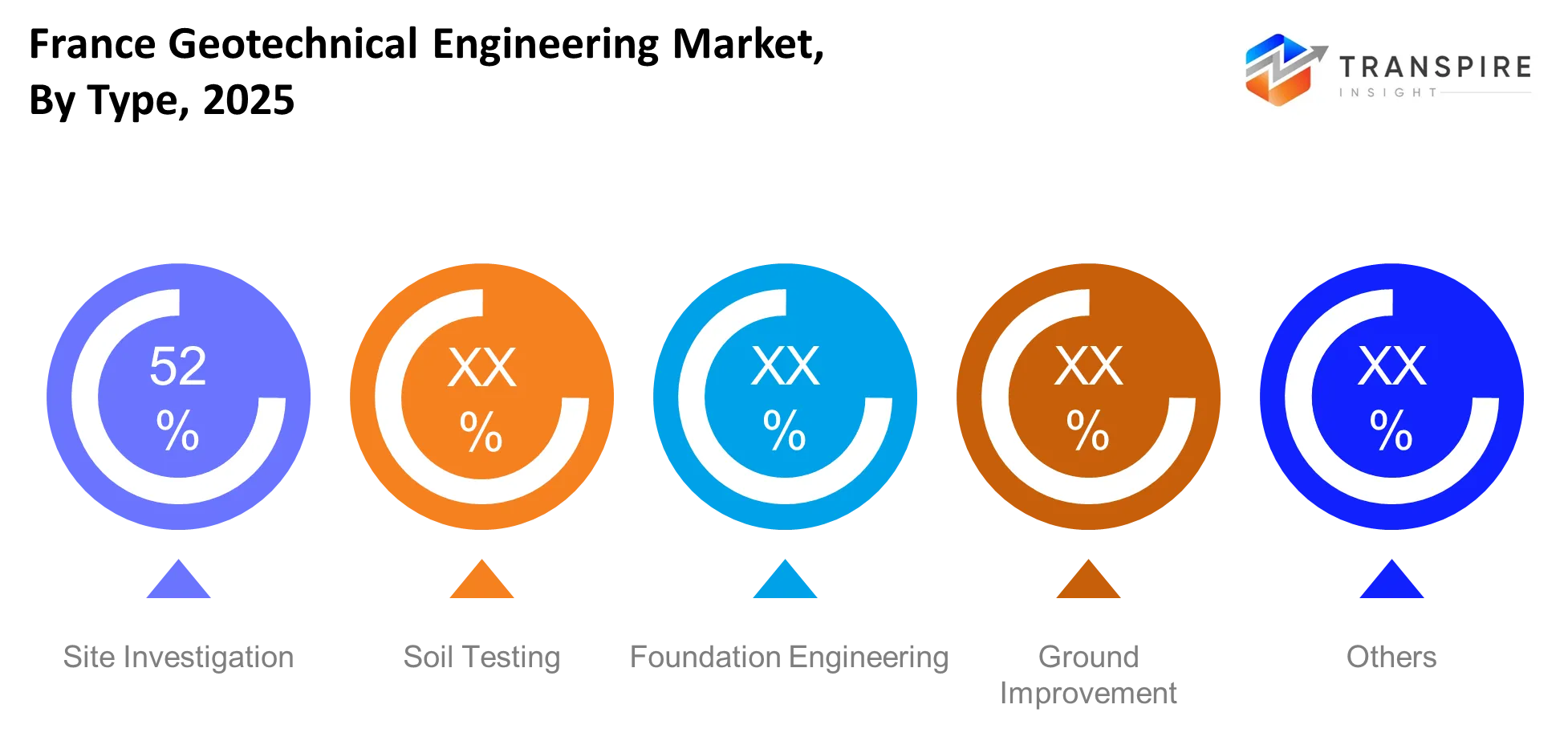
- The France Geotechnical Engineering Market base depends on Site Investigation because it shows how soil will perform before construction works start. Public projects need risk assessment from their beginning because of new infrastructure safety regulations which became effective after 2022 which establish this requirement. Engineering companies use advanced drilling techniques together with geophysical mapping methods and digital logging systems to achieve better project results while decreasing uncertainties. The segment proves necessary for both urban development projects and construction work which requires extensive infrastructure systems.
- The growing need for Soil Testing and Foundation Engineering services results from more complicated high-rise and underground construction work across France. Soil testing laboratories now use automated equipment and AI-assisted analysis to improve consistency and turnaround time. Foundation engineering has evolved toward deep foundation systems and vibration-resistant designs, especially in metro and rail projects. The advancements provide structural protection while extending the useful life of assets throughout their operational period.
To learn more about this report, Download Free Sample Report
By Application
- The France Geotechnical Engineering Market experiences its highest application demand because construction activities continue to develop both residential and commercial buildings. The sector increasingly applies geotechnical assessments during initial design stages to decrease chances of structural failures. Urban redevelopment projects in cities like Paris and Lyon have further increased reliance on soil analysis and foundation planning. The new approach has resulted in better construction safety outcomes and decreased project expenses.
- The Infrastructure and Mining sectors are experiencing continuous growth because major transport and resource extraction initiatives are being developed. Detailed subsurface examination is necessary for infrastructure development projects which include rail and highway expansion to achieve enduring structural integrity. Mining companies are implementing geotechnical monitoring systems as a means to protect slope stability and ensure operational safety. The Environmental Engineering field is expanding because new soil contamination regulations and land rehabilitation requirements have been enacted.
By End-User
- The two main customer segments that drive demand for the French geotechnical engineering market are construction companies and government agencies. Construction firms depend on geotechnical insights to reduce design risks and improve project execution efficiency. Government agencies drive demand through public infrastructure programs, including transport and flood defense systems. Their investments ensure steady market activity across large-scale civil projects.
- Mining companies and infrastructure developers now use advanced geotechnical services to enhance their operational performance. Infrastructure developers need to conduct deep soil analysis for their work on transportation networks and urban utilities. Mining companies use real-time monitoring systems to track and control geological instability hazards. Oil and gas companies use geotechnical services to assess pipeline security and offshore facility safety.
By Service
- The French Geotechnical Engineering Market uses consulting and design services to create strategic plans for its initial project development. Consulting firms provide feasibility assessments, risk analysis, and regulatory compliance guidance. Design services integrate geotechnical data into structural engineering models to improve project precision. Rising infrastructure complexity has made this integration process essential for engineers.
- Testing and Monitoring Services are expanding rapidly due to increased demand for real-time performance tracking. Testing services ensure soil and material quality before construction begins, reducing long-term failure risks. Monitoring services track ground movement and structural stability during construction through sensors and digital systems which operate throughout the construction period and following project completion. These services are essential for high-risk infrastructure such as tunnels and coastal projects.
What are the Key Use Cases Driving the France Geotechnical Engineering Market?
Pre-construction site investigation for urban construction and infrastructure projects stands as the primary application method in the France Geotechnical Engineering Market. Developers use subsurface analysis to determine soil stability and groundwater conditions and load-bearing capacity before they start foundation work. The construction use case generates maximum demand because it minimizes structural failure probabilities while it guarantees adherence to French and EU construction safety regulations.
The current infrastructure applications extend to tunnel building for metro and rail systems and foundation construction for tall commercial buildings. Transport expansion projects in Paris and Lyon depend on advanced soil testing and ground modeling techniques which both city infrastructure developers and government agencies employ. Mining operations implement geotechnical assessments to enhance slope stability and operational safety at their extraction sites.
The current use cases explore real-time geotechnical monitoring through IoT-enabled sensors and offshore seabed assessment for wind energy facilities. France extends its renewable energy infrastructure and coastal resilience initiatives which leads to an increasing adoption of these applications. Geotechnical engineering will evolve into a continuous ground condition management system that uses real-time data instead of periodic testing methods.
|
Report Metrics |
Details |
|
Market size value in 2025 |
USD 352.8 Million |
|
Market size value in 2026 |
USD 375.2 Million |
|
Revenue forecast in 2033 |
USD 591.8 Million |
|
Growth rate |
CAGR of 6.73% from 2026 to 2033 |
|
Base year |
2025 |
|
Historical data |
2021 - 2024 |
|
Forecast period |
2026 - 2033 |
|
Report coverage |
Revenue forecast, competitive landscape, growth factors, and trends |
|
Regional scope |
United States; Canada; Mexico; United Kingdom; Germany; France; Italy; Spain; Denmark; Sweden; Norway; China; Japan; India; Australia; South Korea; Thailand; Brazil; Argentina; South Africa; Saudi Arabia; United Arab Emirates |
|
Key company profiled |
AECOM, Jacobs, WSP, Arup, Vinci, Bouygues, SNC-Lavalin, Fugro, Keller Group, Golder Associates, Ramboll, Stantec, HDR, Tetra Tech, Atkins |
|
Customization scope |
Free report customization (country, regional & segment scope). Avail customized purchase options to meet your exact research needs. |
|
Report Segmentation |
By Type (Site Investigation, Soil Testing, Foundation Engineering, Ground Improvement, Others); By Application (Construction, Infrastructure, Mining, Oil & Gas, Environmental Engineering, Others); By End-User (Construction Companies, Government, Mining Firms, Oil & Gas Companies, Infrastructure Developers, Others); By Service (Consulting, Design, Testing, Monitoring, Others) |
Which Regions are Driving the France Geotechnical Engineering Market Growth?
Île-de-France operates as the primary center for France Geotechnical Engineering Market because it contains numerous major urban development and transportation projects. The Paris metropolitan area requires ongoing work to expand its metro system while redeveloping commercial areas and upgrading underground utilities which necessitates extensive subsurface investigations. Construction safety regulations which authorities enforce strictly together with high population density areas require more frequent geotechnical assessments. The region maintains a sustainable demand for its engineering consultancies and testing laboratories and public infrastructure agencies which constitute its established ecosystem.
Auvergne-Rhône-Alpes serves as a dedicated market contributor through its industrial base and transport networks which shape the region's operations because of its stable industrial infrastructure. The region develops through industrial growth which occurs along its manufacturing corridors and highway maintenance functions and alpine infrastructure development. Engineering demand remains steady because infrastructure developers and mining operations in nearby regions continue to invest in their projects. The region’s balanced economic structure ensures predictable geotechnical service uptake across both public and private projects.
Provence-Alpes-Côte d’Azur operates as the most rapidly expanding area through its support of coastal protection activities and development of offshore facilities. Recent investments in flood defense systems and maritime port upgrades have significantly increased demand for soil stabilization and seabed analysis. Climate adaptation pressures along the Mediterranean coastline have accelerated government-backed engineering initiatives since 2023. This region offers investors and market entrants substantial long-term possibilities because of its association with climate resilience and renewable energy-based coastal development.
Who are the Key Players in the France Geotechnical Engineering Market and How Do They Compete?
The France Geotechnical Engineering Market shows moderate market concentration because international engineering firms and dedicated geotechnical companies and domestic infrastructure companies all participate in the market. The main competitive factor for the market lies in organizations' ability to develop subsurface models and meet European Union construction standards and provide complete design and monitoring solutions. Large infrastructure owners increasingly prefer firms that combine geotechnical investigation, digital engineering, and construction advisory in a single workflow, pushing competition beyond price toward technology and end-to-end service delivery.
The companies Fugro and Keller Group provide specialized geotechnical engineering services together with their advanced ground investigation technologies to compete against each other. Fugro uses data-driven seabed and soil analysis systems which rely on remote sensing and real-time monitoring to provide support for offshore wind and transport infrastructure projects. Keller Group develops ground improvement solutions which include piling and soil stabilization to establish itself as an expert in high-risk urban construction methods. The companies expand their operations through strategic partnerships with contractors and energy developers to achieve success in climate-resilient infrastructure projects.
French infrastructure companies Vinci and Bouygues use integrated construction systems to obtain internal geotechnical work for their major projects. Vinci strengthens its advantage by embedding geotechnical engineering within its transport and civil works divisions, ensuring control over design and execution phases. Bouygues specializes in large urban redevelopment and tunnel construction projects, which require specialized consultants to conduct soil studies. Global fi
Company List
- Jacobs
- Arup
- Bouygues
- SNC-Lavalin
- Keller Group
- Golder Associates
- Ramboll
- Stantec
- HDR
- Tetra Tech
- Atkins
Recent Development News
In March 2026, VINCI Construction secured new river infrastructure and urban civil engineering contracts in France, integrating geotechnical assessment into large-scale hydraulic and transport projects. These projects strengthen demand for advanced soil investigation and foundation engineering in climate-adaptive infrastructure development. https://vinci-construction.com
In February 2026, VINCI Construction was awarded a contract to renovate a waste treatment plant near Paris, requiring detailed geotechnical analysis for foundation reinforcement and environmental compliance upgrades. This reflects increasing integration of geotechnical services in urban infrastructure modernization and sustainability-driven engineering projects.
https://vinci-construction.com
What Strategic Insights Define the Future of the France Geotechnical Engineering Market?
The France Geotechnical Engineering Market is currently implementing a modern engineering system which uses digital technology together with risk assessment methods to create infrastructure projects which incorporate subsurface data throughout their entire development process. The upcoming 5 to 7 years will drive business growth through the requirement of climate adaptation solutions combined with new underground transportation systems and coastal protection projects which need continuous monitoring and data-based ground modeling methods instead of traditional site investigations.
The increasing need for advanced digital geotechnical systems creates a hidden danger because these platforms leave technical expertise with only a select few engineering firms that operate worldwide. The situation restricts the ability of different companies to compete which puts public infrastructure projects at risk of becoming dependent on specific vendors while dealing with compatibility issues between their data systems.
Real-time geotechnical monitoring has emerged as a new opportunity which offshore wind projects and coastal defense systems can use to expand their operations across France's Mediterranean and Atlantic regions. The applications of these systems have just begun to develop but they are becoming increasingly important because climate-related infrastructure projects are growing in number. The companies which establish sensor networks together with predictive ground behavior analytics from the beginning will secure enduring contracts which connect to their resilience engineering initiatives.Market players need to develop hybrid abilities which merge standard field exploration methods with AI-driven geospatial analysis capabilities because this approach enables them to deliver complete geotechnical solutions throughout project lifecycles instead of providing limited services.
France Geotechnical Engineering Market Report Segmentation
By Type
- Site Investigation
- Soil Testing
- Foundation Engineering
- Ground Improvement
- Others
By Application
- Construction
- Infrastructure
- Mining
- Oil & Gas
- Environmental Engineering
- Others
By End-User
- Construction Companies
- Government
- Mining Firms
- Oil & Gas Companies
- Infrastructure Developers
- Others
By Service
- Consulting
- Design
- Testing
- Monitoring
- Others
Frequently Asked Questions
Find quick answers to common questions.
The Confirmed 2033 Market size figure is USD 591.8 Million.
Key segments for the France Geotechnical Engineering Market are By Type (Site Investigation, Soil Testing, Foundation Engineering, Ground Improvement, Others); By Application (Construction, Infrastructure, Mining, Oil & Gas, Environmental Engineering, Others); By End-User (Construction Companies, Government, Mining Firms, Oil & Gas Companies, Infrastructure Developers, Others); By Service (Consulting, Design, Testing, Monitoring, Others).
Major France Geotechnical Engineering Market Players are AECOM, Jacobs, WSP, Arup, Vinci, Bouygues, SNC-Lavalin, Fugro, Keller Group, Golder Associates, Ramboll, Stantec, HDR, Tetra Tech, Atkins.
The Current France Geotechnical Engineering Market size is USD 352.8 Million in 2025.
The France Geotechnical Engineering Market CAGR is 6.73% from 2026 to 2033.
- AECOM
- Jacobs
- WSP
- Arup
- Vinci
- Bouygues
- SNC-Lavalin
- Fugro
- Keller Group
- Golder Associates
- Ramboll
- Stantec
- HDR
- Tetra Tech
- Atkins
Recently Published Reports
-
Apr 2026
Handling and Lifting Equipment Market
Handling and Lifting Equipment Market Size, Share & Analysis Report By Product (Cranes and Hoists, Forklifts, Conveyor Systems, Aerial Work Platforms, Others), By Application (E-Commerce, Automotive and Railway, Food and Beverages, Aviation, Others), and Geography (North America, Europe, Asia-Pacific, Middle East and Africa, South and Central America), 2021 - 2031
-
Apr 2026
HVAC Equipment Market
HVAC Equipment Market Size, Share & Analysis Report By Heating Equipment Type (Boilers and Furnaces, Heat Pumps, and Unitary Heaters), By Ventilation Equipment (Air Handling Units, Humidifiers and Dehumidifiers, Air Filters, and Fan Coiling Units), By Air Conditioning Equipment (Unitary Air Conditioners, Room Air Conditioners, Packaged Terminal Air Conditioners, and Chillers), By End User (Commercial, Residential, Industrial, and others), and Geography (North America, Europe, Asia-Pacific, Middle East and Africa, South and Central America), 2021 – 2031
-
Apr 2026
Refrigeration Valves Market
Refrigeration Valves Market Size, Share & Analysis Report By Type (Solenoid Valves, Expansion Valves, Check Valves, Service Valves, Others), By Application (Commercial Refrigeration, Industrial Refrigeration, Transport Refrigeration, Residential Refrigeration, Air Conditioning Systems), By End User (Food and Beverage Industry, Pharmaceutical Industry, HVAC Industry, Chemical Industry, Others), and Geography (North America, Europe, Asia-Pacific, Middle East and Africa, South and Central America), 2021 – 2031
-
Apr 2026
E-Commerce Packaging Materials Market
E-Commerce Packaging Materials Market By Material Type (Corrugated Boxes, Paper & Paperboard, Foam & Cushioning Materials, Plastic Packaging, Flexible Packaging, Protective Packaging, Others), By Product(Primary Packaging, Secondary Packaging, Tertiary Packaging), By Packaging Function (Protective Packaging, Branding & Presentation Packaging, Transit & Logistic Packaging, Sustainable Packaging, Tamper Evidence Packaging), By End-User (Retail & Consumer Goods, Electronic Appliances, Food & Beverages, Healthcare & Pharmaceutical, Fashion & Apparel, Home & Furnishing, Others); By Industry Analysis, Size, Share, Growth, Trends, and Forecasts 2021-2033