
France Ethylene Propylene Diene Monomer Market Size & Forecast:
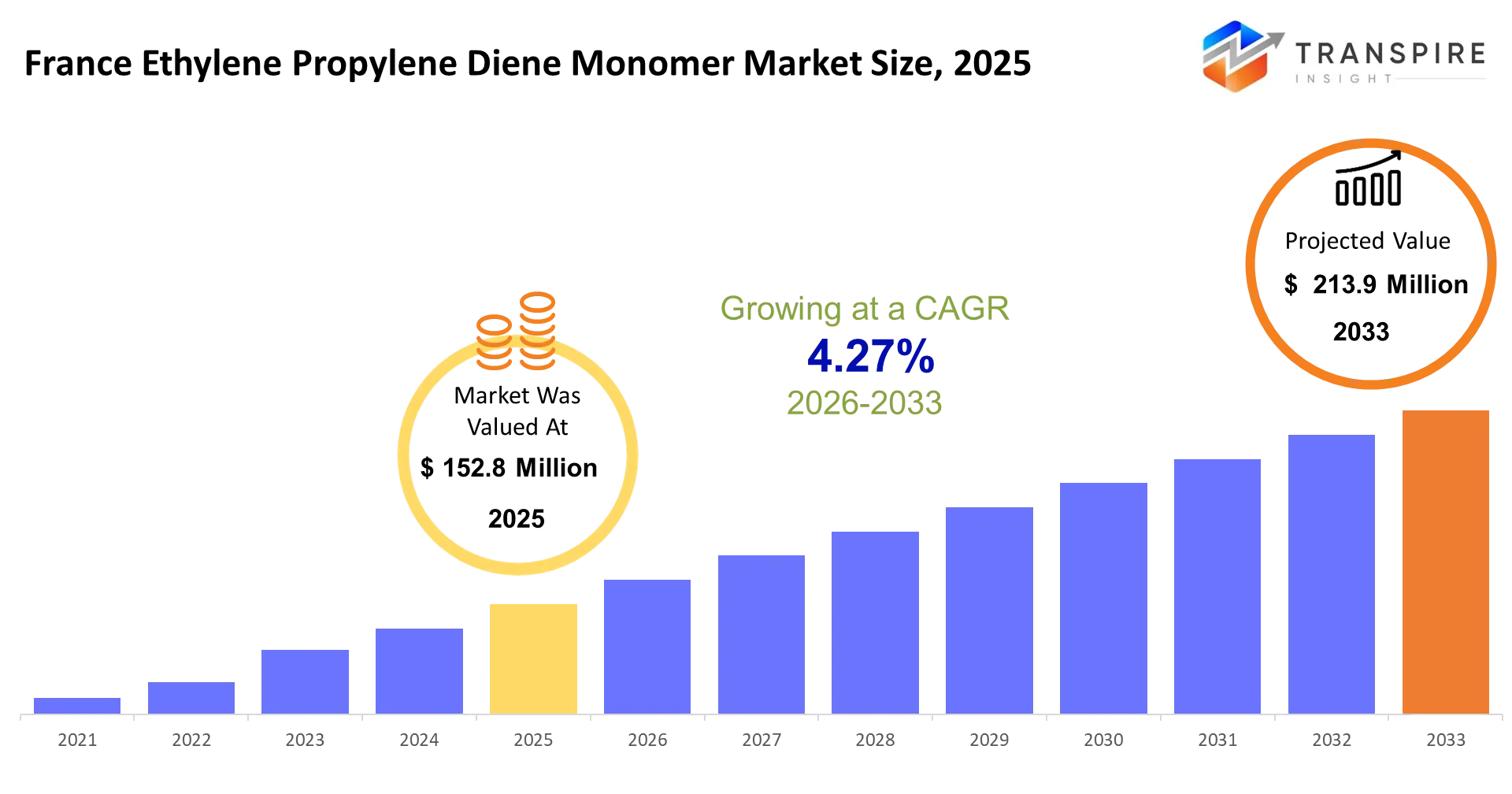
- France Ethylene Propylene Diene Monomer Market Size 2025: USD 152.8 Million
- France Ethylene Propylene Diene Monomer Market Size 2033: USD 213.9 Million
- France Ethylene Propylene Diene Monomer Market CAGR: 4.27%
- France Ethylene Propylene Diene Monomer Market Segments: By Type (General Grade EPDM, Specialty Grade EPDM, Others); By Application (Automotive, Construction, Electrical Insulation, Industrial Applications, Others); By End-User (Automotive Industry, Construction Companies, Electrical Industry, Industrial Sector, Others); By Form (Solid, Liquid, Others)
To learn more about this report,  Download Free Sample Report
France Ethylene Propylene Diene Monomer Market Summary
The France Ethylene Propylene Diene Monomer Market was valued at USD 152.8 Million in 2025. It is forecast to reach USD 213.9 Million by 2033. That is a CAGR of 4.27% over the period.
The industrial and manufacturing sector of France uses Ethylene Propylene Diene Monomer (EPDM) because it functions as a dependable material which protects against heat and moisture and chemical exposure through its sealing and insulation and waterproofing capabilities. The material has applications in multiple industries because it provides essential protection for automotive door seals and roofing membranes and cable insulation and industrial gaskets which prevents leakage and energy loss and equipment failure. The use of EPDM enables businesses to extend their product life cycles while decreasing maintenance needs and achieving durability compliance across different industrial sectors.
The market has established a new structural pattern during the last three to five years which favors elastomers that deliver high performance while meeting sustainability requirements. The European environmental regulations and lifecycle performance requirements have forced manufacturers to abandon traditional rubber compounds and choose advanced EPDM materials which provide extended product life and partial recycling capabilities. Customers now evaluate material costs based on their total value which includes compliance requirements and product longevity instead of evaluating initial expenses.
The market environment experienced a fundamental change because supply chain breakdowns and petrochemical price fluctuations occurred from 2021 to 2023. Changes in ethylene and propylene feedstock availability required manufacturers and end users to develop new methods for obtaining supplies. Companies implemented various strategies which included establishing long-term supply partnerships and expanding their supplier networks and increasing their inventory levels. The company established pay-as-you-go procurement methods which allowed them to decrease inventory expenses while maintaining steady customer requirements for EPDM products.
Key Market Insights
- The France Ethylene Propylene Diene Monomer Market remains primarily controlled by Northern and industrial areas which account for 45% market share because of their automotive and manufacturing industries.
- The Southern region of France experiences its fastest growth period until 2030 because of infrastructure improvements and renewable energy projects that need long-lasting sealing products.
- The automotive sector uses EPDM materials to produce weather seals and EV insulation systems which will account for nearly 50% market share in 2025.
- The construction sector uses construction-grade EPDM in roofing membranes and waterproofing systems for commercial building projects.
- The market for specialty EPDM compounds shows the fastest growth rate because industrial and electrical insulation markets need advanced solutions which will expand until 2033.
- Automotive applications account for more than 48% of market share because EV production and enhanced vehicle component durability standards drive demand.
- The renewable energy sector develops as a new application area which is expanding particularly in solar panel sealing and wind turbine insulation systems.
- The France Ethylene Propylene Diene Monomer Market operates under the control of automotive manufacturers who need sealing and insulation products to meet their ongoing market requirements.
- The construction and infrastructure sectors experience fast expansion because of modernization initiatives and their need for durable materials.
- Companies have established more strategic alliances since 2022 to control raw material price changes while ensuring they will receive essential supplies.
- Businesses can achieve cost savings through regional expansion because it enables them to establish production sites which decrease expenses and enhance their shipping operations.
- The company obtains a competitive edge through its polymer technology investments which lead to improved product durability and flexibility and extended product lifecycle benefits.
What are the Key Drivers, Restraints, and Opportunities in the France Ethylene Propylene Diene Monomer Market?
Electric vehicle growth combined with new standards for building space are driving the situation forward for a reason. The EU emission regulations together with national electrification targets, which began enforcement after 2020, created this transformation. The EV industry needs better sealing and insulation materials because they need to handle thermal loads while safeguarding their sensitive components which leads to increased EPDM usage for each vehicle. The construction industry now prefers EPDM as their roofing and sealing material because building codes require buildings to have extended lifespan and reduced energy consumption. The organization experiences revenue growth because these factors require additional material usage while they keep their long-term contracts.
The main structural constraint occurs because the organization relies on petrochemical feedstocks which include both ethylene and propylene. The manufacturing industry faces unpredictable expenses because global crude oil price changes and geopolitical conflicts create price swings which affect production costs. The structural challenge exists because it requires stabilization through global energy markets, which cannot be achieved in a short time frame. The price increases result in producers experiencing margin pressure, while end-users suspend their purchasing activities until prices decrease, which leads to a temporary drop in demand.
The development of bio-based and recyclable EPDM materials represents an important opportunity for growth. European policy frameworks increasingly support circular materials which allow companies that invest in sustainable elastomers to achieve competitive advantages in the market. Automotive OEMs show interest in pilot projects that use bio-feedstock EPDM production for their initial testing. The scaling of these technologies will enable new market opportunities which allow companies to charge higher prices for their products.
What Has the Impact of Artificial Intelligence Been on the France Ethylene Propylene Diene Monomer Market?
The production process of EPDM and its operational capabilities throughout France are being transformed by artificial intelligence together with advanced digital technologies. The manufacturing process uses AI-based control systems to manage polymerization, which drives continuous changes in temperature and pressure and catalyst material, resulting in less material waste and better product batch quality. The automation systems monitor equipment status through real-time tracking, which enables predictive maintenance to optimize operational efficiency and extend the lifespan of facilities.
Developers apply machine learning algorithms to develop models that predict how materials perform when environmental factors change. The predictive algorithms work through simulating EPDM performance under extended UV radiation and temperature variation to help manufacturers develop better long-lasting products. AI technology helps automotive systems and other downstream applications optimize their performance by analyzing seal degradation patterns to determine when replacement should occur, which enhances reliability while decreasing maintenance expenses.
The technologies streamline operations through their ability to reduce defects while they enhance supply chain management through accurate demand prediction. The adoption process faces a critical obstacle because organizations need to spend extensive resources for system integration while they face difficulties in acquiring high-quality industrial data. Many existing production facilities from previous decades do not possess the essential digital infrastructure which enables them to utilize AI technologies, which hinders the adoption process that provides evident advantages.
Key Market Trends
- Since 2021 automotive manufacturers have increased their EPDM material usage per vehicle because electric vehicles require special insulation and sealing solutions that create greater challenges for their manufacturing procedures.
- Businesses created strategic supplier contracts which lasted through 2022 supply interruptions because they needed to establish stable procurement processes through multiple delivery options.
- The construction sector adopted high-durability roofing systems after 2020 which led to increased use of EPDM membranes in commercial building projects.
- Between 2023 and 2025 manufacturers introduced recyclable EPDM grades to meet EU circular economy requirements while minimizing their environmental compliance obligations.
- Specialty EPDM compounds became popular because industrial applications needed materials that could withstand extreme heat and chemical exposure.
- French manufacturers achieved better delivery times through regional production localization which decreased their need for imported materials after 2022.
- Polymer processing digitalization developed slowly while AI-based quality control systems enhanced production efficiency and decreased defect rates.
- French renewable energy projects created a rising demand for EPDM materials used in solar and wind sealing and insulation applications.
- Companies developed new competitive strategies that focused on product differentiation through their investments in advanced elastomer development and performance testing capabilities.
France Ethylene Propylene Diene Monomer Market Segmentation
By Type
The different grades of EPDM which are displayed through type-based segmentation demonstrate how various industrial performance requirements match specific grades of EPDM throughout France. The automotive seals and roofing membranes together with standard industrial components represent the highest volume applications which use general grade EPDM because the material provides both cost efficiency and reliable performance. The processing capabilities of the material lead to its widespread adoption because it works well with current manufacturing methods which enable manufacturers to produce products at the same level without doing significant system changes. The second-largest market segment for specialty grade EPDM exists because advanced applications need plastics which deliver exceptional protection against heat and chemical and environmental damage throughout electric vehicle and high-performance infrastructure applications. The category of "others" maintains a smaller size which provides materials for niche markets that need special material combinations.
The growth patterns across these types differ based on performance expectations and regulatory pressures. The basic industries keep their demand for general grade EPDM which results in constant market growth while specialty grade EPDM gains more market share because of industrial demands for more durable products which last longer. The usage of materials which require testing under extreme conditions has become necessary because of stricter European regulations. The manufacturing industry will develop sustainable materials together with new compounds which will create future growth for alternative grade materials. Suppliers are expected to direct their investments toward new formulations and recyclable products during the forecast period, which will change product development processes while promoting the use of valuable materials throughout different sectors.
By Application
Application-based segmentation shows how EPDM functions across different industrial sectors while automotive applications serve as the main segment because they use EPDM for sealing insulation and vibration control systems. The requirement to maintain vehicle durability and operational capabilities when drivers experience different environmental conditions creates high demand. Construction applications represent the second-largest segment, where EPDM is widely used in roofing membranes, waterproofing systems, and structural sealing due to its long service life and resistance to weathering. Electrical insulation and industrial applications follow, each contributing steady demand through specialized use cases such as cable protection and machinery components, while the “others” category includes emerging and niche applications.
Industrial needs demonstrate growth patterns that differ across various applications. Automotive applications are expanding due to electrification which increases the need for advanced sealing and thermal management materials. Construction applications continue to grow as infrastructure projects prioritize long-lasting and energy-efficient materials. The industrial and electrical fields have started to use solutions that improve maintenance and operational efficiency because reliability affects performance results. Manufacturers will need to create specialized EPDM compounds for particular applications because the number of applications will increase over time. This shift will encourage deeper integration with end-user systems and create opportunities for solution providers to deliver higher-value, application-specific products.
By End-User
The demand for EPDM products in France tracks industrial consumption patterns according to the end-user market division. The automotive industry holds the leading position because it continuously uses EPDM materials for sealing systems and hoses and insulation components that must withstand extreme temperature and environmental conditions. The construction sector ranks as the second largest market because EPDM materials find extensive application in roofing membranes and waterproofing systems and structural sealing applications that require long-lasting performance to cut maintenance expenses. The electrical industry and industrial sector create uniform market demand through their use of cable insulation and machine parts while the other category includes small and new industrial sectors with distinct needs.
Different end-user groups show distinct growth patterns which result from changes within their respective industries.The automotive industry is expanding because vehicle electrification needs extra materials for thermal management systems and component protection systems. The construction sector benefits from improved infrastructure development and building code standards which require construction methods to be both energy-efficient and long-lasting. The electrical sector grows from grid expansion and renewable energy system integration while industrial operations expand through automation and equipment upgrades. Suppliers will develop specific solutions to meet user requirements during the forecast period because this approach will enable them to achieve complete system integration and maintain extended supply partnerships.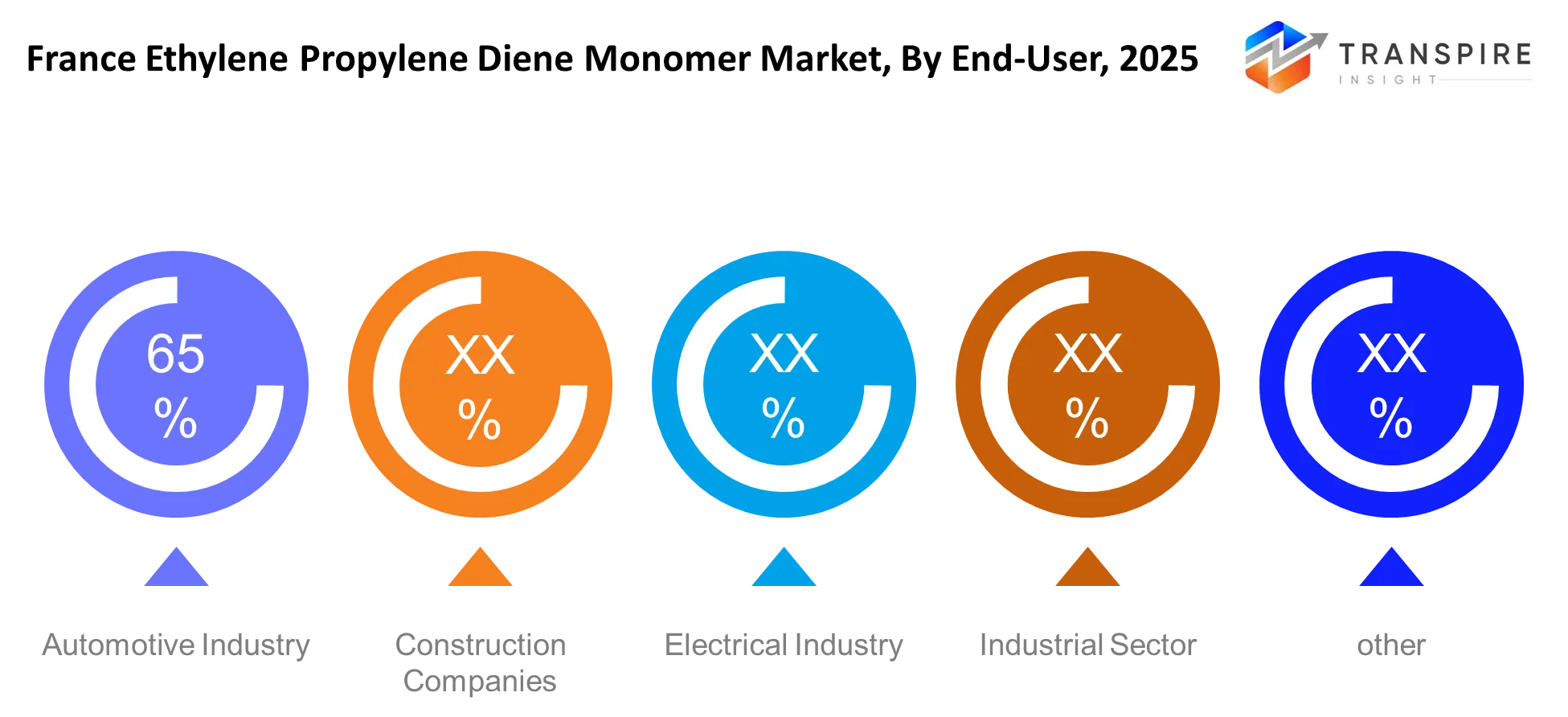
To learn more about this report, Download Free Sample Report
By Form
The research examines how different industries process and use EPDM through their respective application methods. The solid form of EPDM shows multiple applications because it can be used in extrusion and molding and fabrication processes. Manufacturers choose solid EPDM because it connects with their production systems while providing solutions for automotive and building industry needs. The liquid form constitutes a minor segment of the market which plays an essential role in providing coatings and adhesives and sealants that require both flexible and simple application abilities. The "others" category contains less frequently used and hybridized materials which were created for specific industrial applications.
The growth trajectory of each form depends on processing requirements and application efficiency. Solid EPDM maintains its market position because various industries demand its use and manufacturers can produce it in bulk. Liquid EPDM has started to gain popularity because construction and protective coating industries need faster methods to apply coatings and better coatings to cover surfaces. New processing technologies will make it possible to create unique use cases which will drive forward the smaller market section of alternative forms. The material performance improvements and application efficiency enhancements which manufacturers plan to undertake will lead to wider product usage while creating chances to develop unique products.
What are the Key Use Cases Driving the France Ethylene Propylene Diene Monomer Market?
The primary application of EPDM in France exists through its use in automotive sealing systems. Vehicle manufacturers depend on EPDM to construct door seals and window channels and under-hood components because EPDM provides both flexible and durable performance under heat and vibration and weather conditions. Electric vehicle production further increases material usage because battery systems and electronic components need dependable insulation and moisture protection and temperature control.
The construction and infrastructure industries show consistent growth through roofing membranes and waterproofing systems which construction companies use. EPDM provides long-lasting performance for commercial buildings and public infrastructure because it meets building regulations which require sustainable materials and energy-efficient solutions. The electrical insulation of power cables and connectors now sees increased adoption because grid modernization projects advance.
New use cases have developed for renewable energy systems which include solar panel sealing and wind turbine insulation because these materials must endure extended environmental exposure. EPDM has started to find applications in high-performance sealing solutions for advanced industrial equipment, which has opened new possibilities for developing specialized materials.
|
Report Metrics |
Details |
|
Market size value in 2025 |
USD 152.8 Million |
|
Market size value in 2026 |
USD 159.6 Million |
|
Revenue forecast in 2033 |
USD 213.9 Million |
|
Growth rate |
CAGR of 4.27% from 2026 to 2033 |
|
Base year |
2025 |
|
Historical data |
2021 - 2024 |
|
Forecast period |
2026 - 2033 |
|
Report coverage |
Revenue forecast, competitive landscape, growth factors, and trends |
|
Regional scope |
United States; Canada; Mexico; United Kingdom; Germany; France; Italy; Spain; Denmark; Sweden; Norway; China; Japan; India; Australia; South Korea; Thailand; Brazil; Argentina; South Africa; Saudi Arabia; United Arab Emirates |
|
Key company profiled |
Dow, ExxonMobil, LANXESS, Mitsui Chemicals, Kumho Petrochemical, Versalis, JSR Corporation, Sumitomo Chemical, SK Global Chemical, PetroChina, LG Chem, SIBUR, ARLANXEO, Eni, Lion Elastomers eavy Industries Co. Ltd., Kohler Co., Scania AB. |
|
Customization scope |
Free report customization (country, regional & segment scope). Avail customized purchase options to meet your exact research needs. |
|
Report Segmentation |
By Type (General Grade EPDM, Specialty Grade EPDM, Others); By Application (Automotive, Construction, Electrical Insulation, Industrial Applications, Others); By End-User (Automotive Industry, Construction Companies, Electrical Industry, Industrial Sector, Others); By Form (Solid, Liquid, Others) |
Which Regions are Driving the France Ethylene Propylene Diene Monomer Market Growth?
The northern and northeastern industrial belt leads market growth due to its concentration of automotive manufacturing and heavy industry. The EU material durability standards require strong enforcement which forces manufacturers to use long-lasting elastomers in their vehicle and infrastructure products. The system enables uninterrupted product flow because customers can access essential materials and services through their close linkage to major assembly plants and their combined supply network. The industry maintains steady demand through its network of chemical distributors and Tier-1 suppliers and OEMs which enables them to create new products.
Western France functions as a permanent second area because construction and infrastructure activities compare more favorably to automotive manufacturing operations. The region establishes its identity through reliance on public infrastructure development and urban development instead of following industrial production patterns. Building regulations which mandate energy efficiency and durability requirements create ongoing demand for EPDM materials used in roofing and waterproofing applications. The region maintains constant market revenue contributions which enable full operational capacity throughout all manufacturing periods.
Southern France experiences its most rapid growth because of developing renewable energy resources and building coastal infrastructure. Demand for high-performance sealing materials has increased because of the investments made in solar parks and wind installations and climate-resilient construction. The national energy transition policy framework has expedited project approval processes and material adoption trends since 2022. The market growth creates significant entry possibilities for suppliers who provide both advanced EPDM solutions and specific application-based products until 2033.
Who are the Key Players in the France Ethylene Propylene Diene Monomer Market and How Do They Compete?
The market maintains a state of moderate consolidation because international chemical manufacturers control a substantial portion of the market. The companies in this sector compete through product performance and formulation technology and supply reliability instead of using price as their primary competitive strategy. The existing market leaders maintain their market share by establishing long-term agreements and creating complete value networks while sustainable elastomer innovations provide them with fresh ways to differentiate themselves.
Dow develops its competitive strength through its superior material science capabilities while developing high-performance elastomers which support electric vehicle systems and long-lasting infrastructure. ExxonMobil achieves control over feedstock supply through its upstream integration system because this method leads to improved cost efficiency and consistent product quality across large-scale operations. LANXESS develops its presence in high-performance market segments by creating specialty rubber products which meet strict industrial and automotive requirements. ARLANXEO uses its synthetic rubber knowledge and strategic partnerships to expand its market presence throughout Europe.
Mitsui Chemicals develops advanced elastomers which target specific applications that require high thermal and chemical resistance capabilities. Versalis establishes its presence in Europe through its existing operations while it directs resources toward sustainable material development projects that meet emerging regulatory standards. The companies grow their operations through capacity expansion and collaborative agreements and new product development which enables them to stay ahead of competitors while meeting changing industrial requirements.
Company List
- Dow
- ExxonMobil
- LANXESS
- Mitsui Chemicals
- Kumho Petrochemical
- Versalis
- JSR Corporation
- Sumitomo Chemical
- SK Global Chemical
- PetroChina
- LG Chem
- SIBUR
- ARLANXEO
- Eni
- Lion Elastomers
Recent Development News
In March 2026, LANXESS announced expansion of its specialty elastomer production capacity in Europe. The investment supports rising demand from automotive and industrial sectors and strengthens regional supply reliability.https://lanxess.com
What Strategic Insights Define the Future of the France Ethylene Propylene Diene Monomer Market?
The market is moving toward high-performance sustainable elastomers because both regulatory requirements and industrial needs are driving this transformation. Automotive electrification and stricter construction standards are pushing manufacturers to prioritize materials that deliver longer service life thermal stability and compliance with evolving EU norms. The shift has two effects for key applications because it requires more materials while advanced EPDM grades provide greater value than before. The upcoming growth period will depend on how products perform beyond their standard capabilities instead of relying solely on increased product volume.
The ongoing usage of petrochemical feedstocks which include ethylene and propylene represents a hidden danger for the company. Producers experience disrupted cost structures because of price fluctuations which link to global energy markets. The structural constraint affects procurement strategies because end users tend to delay their purchases until they feel certain about future market conditions. Price-sensitive fields will find difficulties in adopting products because of ongoing price fluctuations which will also generate inconsistent earnings throughout the entire value chain.
Bio-based and partially recyclable EPDM materials development presents a new opportunity which supports Europe’s circular economy objectives. Early-stage investments in sustainable elastomer technologies are gaining traction among automotive OEMs and infrastructure developers seeking compliant and future-ready materials. The solutions will generate premium pricing and enter new applications from their current state of development toward commercial use.
France Ethylene Propylene Diene Monomer Market Report Segmentation
By Type
- General Grade EPDM
- Specialty Grade EPDM
- Others
By Application
- Automotive
- Construction
- Electrical Insulation
- Industrial Applications
- Others
By End-User
- Automotive Industry
- Construction Companies
- Electrical Industry
- Industrial Sector
- Others
By Form
- Solid
- Liquid
- Others
Frequently Asked Questions
Find quick answers to common questions.
The Confirmed 2033 Market size figure is USD 213.9 Million.
Key Segments for the France Ethylene Propylene Diene Monomer Market are By Type (General Grade EPDM, Specialty Grade EPDM, Others); By Application (Automotive, Construction, Electrical Insulation, Industrial Applications, Others); By End-User (Automotive Industry, Construction Companies, Electrical Industry, Industrial Sector, Others); By Form (Solid, Liquid, Others).
Major France Ethylene Propylene Diene Monomer Market Players are Dow, ExxonMobil, LANXESS, Mitsui Chemicals, Kumho Petrochemical, Versalis, JSR Corporation, Sumitomo Chemical, SK Global Chemical, PetroChina, LG Chem, SIBUR, ARLANXEO, Eni, Lion Elastomers.
The Current France Ethylene Propylene Diene Monomer Market size is USD 152.8 Million in 2025.
The France Ethylene Propylene Diene Monomer Market CAGR is 4.27% from 2026 to 2033.
- Dow
- ExxonMobil
- LANXESS
- Mitsui Chemicals
- Kumho Petrochemical
- Versalis
- JSR Corporation
- Sumitomo Chemical
- SK Global Chemical
- PetroChina
- LG Chem
- SIBUR
- ARLANXEO
- Eni
- Lion Elastomers
Recently Published Reports
-
Apr 2026
Healthcare Polymer Packaging Market
Healthcare Polymer Packaging Market Size, Share & Analysis Report By Packaging Type (Syringes, IV Bottles and Pouches, Clamshells, Blisters, Bottles & Jars, Containers, Tubes, IV Parental Packaging, Others), By Type (Regulated, Non-regulated), By Polymer Type (LDPE (Low-Density Polyethylene), HDPE (High-Density Polyethylene), Homo-polymer (Homo), Random Copolymer (Random), Block Copolymer (Block), PET, Polystyrene, Polyvinyl Chloride, Polyamide/EVOH, Others), and Geography (North America, Europe, Asia-Pacific, Middle East and Africa, South and Central America), 2021 - 2031
-
Apr 2026
Hydrophilic Tape (Waterstop) Market
Hydrophilic Tape (Waterstop) Market Size, Share & Analysis Report By Type (Bentonite-Based Hydrophilic Tape, Rubber-Based Hydrophilic Tape), By Application (Residential Buildings, Commercial Buildings, Infrastructure Projects), and Geography (North America, Europe, Asia-Pacific, Middle East and Africa, South and Central America), 2021 - 2031
-
Apr 2026
Metalens Market
Metalens Market Size, Share & Analysis Report By Type (Visible Light Metalens, and Infrared Metalens), By Application (Consumer Electronics, Automotive Electronics, Industrial, Medical, and Others), and Geography (North America, Europe, Asia-Pacific, Middle East and Africa, South and Central America), 2021 - 2031
-
Apr 2026
PBT Resin Market
PBT Resin Market Size, Share & Analysis Report By Type (Reinforced PBT Resin, Unreinforced PBT Resin), By Processing Method (Injection Molding, Extrusion, Blow Molding, Others), By End-User (Automotive, Electrical & Electronics, Consumer Appliances, Industrial Machinery, Medical Devices, Packaging, Others), and Geography (North America, Europe, Asia-Pacific, Middle East and Africa, South and Central America), 2021 - 2031