

France Conformity Assessment Market Size & Forecast:
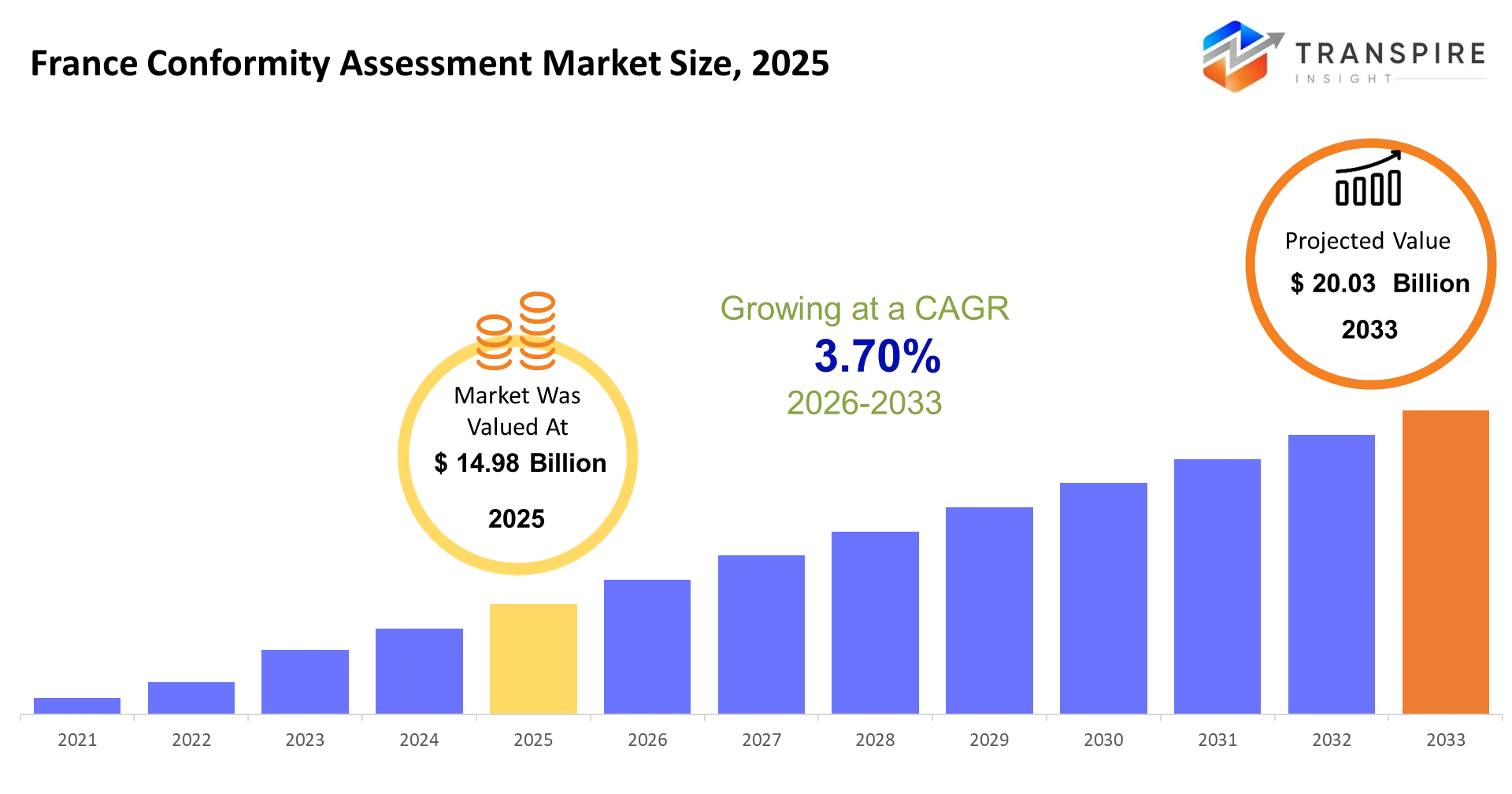
- France Conformity Assessment Market Size 2025: USD 14.98 Billion
- France Conformity Assessment Market Size 2033: USD 20.03 Billion
- France Conformity Assessment Market CAGR: 3.70%
- France Conformity Assessment Market Segments: By Type (Testing, Inspection, Certification, Others); By Application (Product Compliance, Quality Assurance, Safety Testing, Environmental Compliance, Others); By End-User (Manufacturers, Government, Industrial Sector, Healthcare Sector, Others); By Service (In-house, Outsourced, Others)
To learn more about this report,  Download Free Sample Report
France Conformity Assessment Market Summary
The France Conformity Assessment Market was valued at USD 14.98 Billion in 2025. It is forecast to reach USD 20.03 Billion by 2033. That is a CAGR of 3.70% over the period.
French conformity assessment services assess products and systems and industrial processes to verify their compliance with European Union safety standards and environmental requirements and quality control standards before they are released into the market or exported to other countries. The market operates as an essential verification system which aerospace and automotive and energy and industrial equipment manufacturers use to obtain certification that controls their access to international markets and their ability to export products. The sector has transitioned its compliance verification processes from manual inspection methods to digital systems during the past three to five years because of linked manufacturing systems and their requirement for instant documentation.
The European Union has tightened its sustainability and carbon reporting requirements which now require organizations to assess product compliance throughout their complete lifecycle instead of just verifying product safety. Post-pandemic supply chain disruptions showed that certification processes had bottlenecks which created an urgent need for faster certification methods that use digital technology and remote access. The growing demand for accredited third-party bodies has boosted recurring service revenue and compliance outsourcing operations in various industries.
Key Market Insights
- The French Conformity Assessment Market experiences growth because European Union regulations become unified and businesses need to obtain certifications for their international supply chain operations.
- Digital conformity tools now support 30% faster certification cycles when compared to traditional assessment systems which use manual inspection methods.
- The implementation of EU Green Deal regulations in 2022 led to significant growth in sustainability-related compliance audits across manufacturing and energy industries.
- The aerospace and automotive sectors together control approximately 35% of the French Conformity Assessment Market.
- Industrial equipment compliance testing remains the second-largest segment because companies need to satisfy safety standards and export certification requirements.
- The environmental compliance assessment market grows at the fastest rate because businesses face increasing pressure to comply with carbon regulations until 2030.
- The manufacturing sector leads all users in technology adoption because businesses need to conduct multiple regulatory inspections and they depend on international trade.
- The energy and utilities sector becomes the fastest-growing customer segment because of their need for renewable energy solutions and their obligation to conduct emissions compliance audits.
- Bureau Veritas, SGS, DEKRA, Applus+, Intertek, and TÜV SÜD use digital certification platforms to improve their position in the market.
- The company seeks to expand its operations by implementing AI-powered inspection systems and remote auditing capabilities and establishing EU regulatory partnerships.
What are the Key Drivers, Restraints, and Opportunities in the France Conformity Assessment Market?
The France Conformity Assessment Market exists because EU regulatory frameworks for product safety and environmental sustainability and industrial emissions control have tightened their enforcement. Automotive and energy sector manufacturers need certification that continues throughout their operations because any violation of regulations will prevent them from entering new markets and exporting their products. Organizations now depend on certified external assessment agencies because the current regulations require them to maintain compliance through ongoing revenue-generating services instead of completing one-time assessments.
The primary limitation exists because EU member states require organizations to handle their operational and administrative tasks which come from multiple certification standards that need to be followed. Companies face documentation requirements that differ between testing standards which exist in various jurisdictions and this issue leads to product launch delays and higher costs for small and mid-sized manufacturers who do not have regulatory compliance teams. The current situation of structural complexity cannot be solved rapidly because EU member states have established their own national enforcement methods for EU-aligned rules.
Organizations have a significant opportunity to expand their digital conformity ecosystems through the implementation of blockchain-based certification tracking systems and automated audit trails. These systems enable supply chains to operate more efficiently by decreasing redundant processes and establishing better visibility throughout all operations. French aerospace manufacturers are adopting digital twin-based compliance validation systems because this technology allows them to obtain real-time certification updates while they produce their products. Tech-enabled assessment providers will experience increased service demand because this shift will lead to faster approval processes.
What Has the Impact of Artificial Intelligence Been on the France Conformity Assessment Market?
Artificial intelligence is revolutionizing conformity assessment service delivery in France through its ability to enhance inspection precision and decrease operator workload while establishing systems for forecasting compliance verification. AI-powered systems now handle document verification and design specification non-conformity detection and audit preparation tasks in industrial and aerospace certification workflows, which results in shorter certification processes.
The use of machine learning models has grown in predictive compliance monitoring because organizations now utilize historical inspection data to predict upcoming regulatory violations and equipment malfunctions. AI-driven analytics in manufacturing environments work to optimize production parameters, which helps organizations maintain continuous compliance with safety and environmental regulations while decreasing rework and non-compliance penalties. These systems enhance operational efficiency through their ability to improve audit scheduling processes and decrease unnecessary testing procedures.
The implementation of AI technology encounters challenges because different industries have developed inconsistent data standardization practices and because legacy certification systems require expensive integration solutions. The actual inspection process requires organizations to work with incomplete or unstructured datasets, which decreases model performance and prevents organizations from achieving full automation in their complex industrial evaluations. The distributed supply chain system experiences connectivity issues, which hinder real-time data transmission, particularly for smaller certification bodies that function beyond major industrial centers.
Key Market Trends
- Digital certification adoption in French industrial compliance providers increased by almost 40% because of EU regulatory enforcement activities since 2022.
- The aerospace and automotive industries experienced a decline in traditional manual inspection methods because automated audit platforms decreased certification cycle times.
- The manufacturing certification processes for sustainability compliance reporting received expansion after the EU carbon neutrality requirements became effective in 2023.
- The demand for remote auditing services increased substantially after 2024 because supply chain disruptions created needs for cross-border certification.
- Bureau Veritas and SGS developed AI-powered inspection systems to enhance their capability of verifying compliance in real time.
- The energy transition projects showed a significant rise in demand for environmental certification especially during the process of approving renewable energy infrastructure projects.
- The year 2025 saw the introduction of blockchain-based traceability systems which enhanced transparency for industrial conformity documentation.
- Small and medium-sized enterprises increasingly hire external experts for compliance work because certification processes have grown more complicated and European Union regulatory rules contain multiple requirements.
- The aerospace industry adopted continuous certification systems which operate without the need for scheduled inspections.
- The implementation of digital twin technology emerged as a fundamental breakthrough that enabled manufacturing facilities to monitor their compliance status through advanced systems.
France Conformity Assessment Market Segmentation
By Type
The testing process establishes its highest value through its function as the primary method which businesses need to use for verifying product safety and performance standards before their products reach the market. Industries like automotive and aerospace and electronics show high adoption rates because companies need to obtain regulatory approval through their complete laboratory and field testing results. Testing remains in constant demand because all product categories that enter regulated markets require mandatory testing which businesses must execute as a basic compliance requirement.
The inspection services market expands steadily because more companies need to monitor their production processes and verify their supply chain operations. The EU manufacturing standards have become stricter, which requires manufacturers to perform continuous monitoring that exceeds traditional final-stage checks of their products. The certification process remains important because it serves as the last step for export-oriented manufacturers who need EU-wide compliance recognition to obtain final approval.
Testing will remain the primary testing method because inspection services will experience greater expansion through digital monitoring systems. Certification services will develop into automated validation systems which will shorten processing times and increase dependency on certified third-party validation organizations.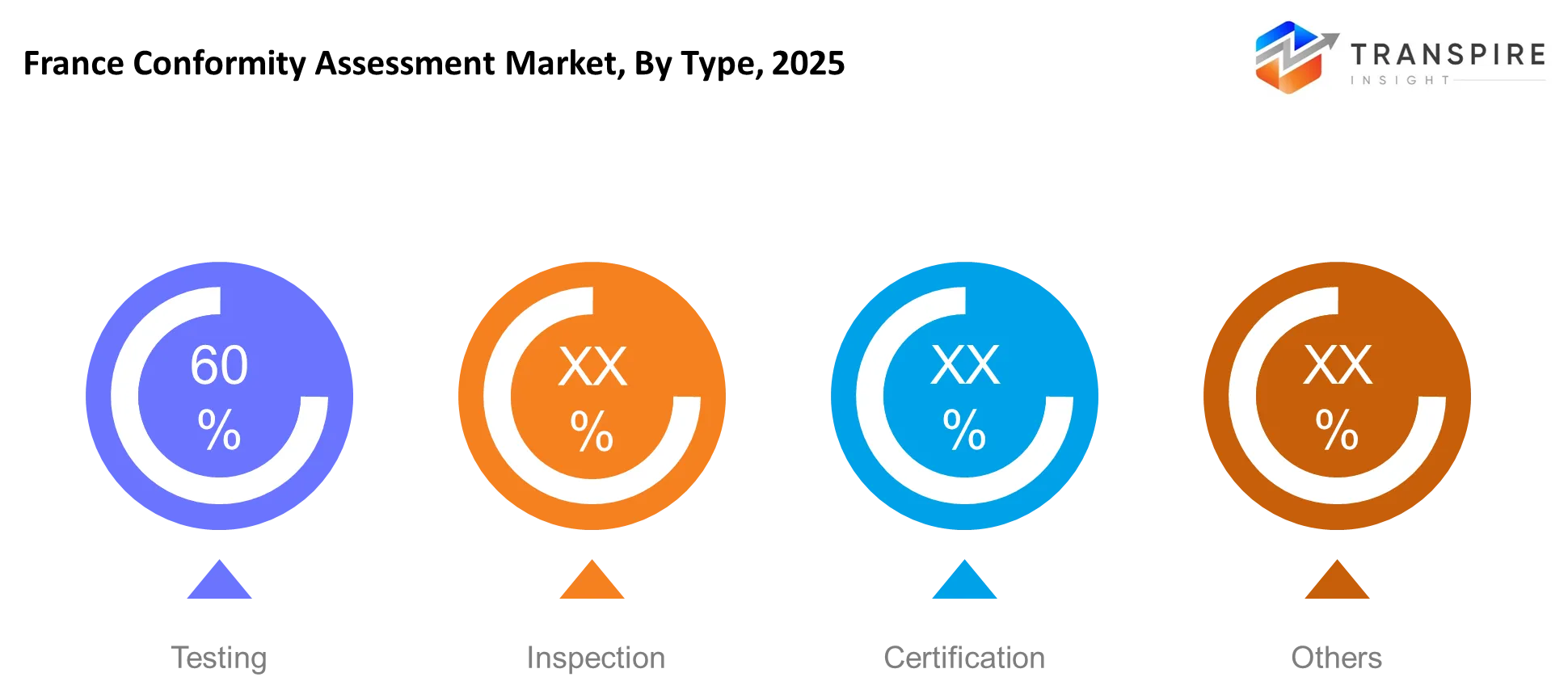
To learn more about this report, Download Free Sample Report
By Application
The Application segment for product compliance exists because European Union market regulations create strict requirements for all industrial goods which need to comply with these rules. The automotive and machinery industries rely on compliance validation for their market entry because it helps them avoid all penalties which would result from noncompliance with regulations. The segment achieves strong market strength because all product types need to obtain basic regulatory approval before they can be sold.
Manufacturers increase their quality assurance efforts because they now conduct conformity checks during the early stages of the production process. Safety testing operations experience strong growth because workplaces now prioritize safety standards and consumer protection laws require compliance. The manufacturing sector shows a growing need for environmental compliance because the European Union has introduced more stringent carbon and sustainability reporting requirements.
The need for environmental compliance solutions will increase most rapidly because industrial facilities that emit large quantities of emissions face growing regulatory demands. Product compliance will continue to maintain its current state while organizations develop digital-first certification processes which will operate through automated systems. Buyers and service providers will increasingly integrate compliance checks into real-time production systems.
By End-User
The End-User segment belongs to manufacturers who need to comply with certification standards for both their manufacturing and export operations. Automotive manufacturers and aerospace manufacturers and electronics manufacturers use conformity assessments to achieve compliance with EU requirements and international standards. The industry requires testing services with inspection services and certification services because of this ongoing need.
Government usage remains steady because regulatory bodies implement compliance frameworks while they perform independent safety audits and environmental assessments. Industrial sector adoption grows through infrastructure modernization projects and energy transition initiatives and the adoption of automation technologies in production environments. Healthcare sector demand increases because medical device safety regulations and clinical equipment validation requirements become more stringent.
The industrial sector will experience its strongest growth rate because companies implement decarbonization initiatives while they adopt smart factory technologies. The manufacturing sector will drive market demand while healthcare sector demand will grow at a steady pace because of increasing regulatory requirements. Service providers will increasingly tailor solutions by industry-specific compliance needs.
By Service
Outsourced services dominate the Service segment as companies increasingly rely on accredited third-party organizations for regulatory compliance validation. The European Union certification standards establish complex verification systems which need unbiased testing that has global acknowledgment. Organizations that outsource their work experience lower expenses for internal compliance and faster times to receive market authorization.
Large organizations with their own compliance testing facilities need in-house services because of their existing capabilities especially in the aerospace and defense sectors. The high operational costs together with complicated regulatory requirements create obstacles that prevent organizations from developing internal certification capabilities. The others category includes hybrid models that use both internal checks and external validation methods.
The demand for outsourced services will grow because regulatory authorities are developing more advanced technical requirements which need data analysis. In-house models will persist in high-security industries but will integrate more digital tools to improve efficiency. Organizations will use hybrid compliance systems as their primary model because it enables them to maintain certification credibility while controlling their expenses.
What are the Key Use Cases Driving the France Conformity Assessment Market?
The main application for the France Conformity Assessment Market serves industrial product certification which aerospace and automotive manufacturers need to verify their components meet EU safety and performance requirements before they can use their products in the market. The highest demand results from compliance requirements which organizations need to meet for their products to receive production permits and export permissions while they manage responsibilities throughout complex supply networks.
The renewable energy infrastructure and industrial equipment validation processes have started to develop additional use cases which serve as secondary applications. Wind turbine systems and battery storage units and factory automation machinery require multiple stages of conformity assessment. Energy operators and large-scale industrial end-users increasingly need to verify conformity because they need to track their operations across international supply networks.
Digital conformity verification for software-enabled industrial systems and real-time compliance tracking in smart factories represent emerging applications. The development of these technologies proceeds at a slow pace because they currently exist in the developing stage. Manufacturers need these technologies because they are moving toward environments which require connected production and continuous monitoring of regulatory compliance.
|
Report Metrics |
Details |
|
Market size value in 2025 |
USD 14.98 Billion |
|
Market size value in 2026 |
USD 15.53 Billion |
|
Revenue forecast in 2033 |
USD 20.03 Billion |
|
Growth rate |
CAGR of 3.70% from 2026 to 2033 |
|
Base year |
2025 |
|
Historical data |
2021 - 2024 |
|
Forecast period |
2026 - 2033 |
|
Report coverage |
Revenue forecast, competitive landscape, growth factors, and trends |
|
Regional scope |
France |
|
Key company profiled |
SGS, Bureau Veritas, Intertek, TÜV SÜD, TÜV Rheinland, UL Solutions, DNV, Eurofins, Applus+, Dekra, Element Materials, ALS Limited, Mistras Group, Lloyd’s Register, Exova |
|
Customization scope |
Free report customization (country, regional & segment scope). Avail customized purchase options to meet your exact research needs. |
|
Report Segmentation |
By Type (Testing, Inspection, Certification, Others); By Application (Product Compliance, Quality Assurance, Safety Testing, Environmental Compliance, Others); By End-User (Manufacturers, Government, Industrial Sector, Healthcare Sector, Others); By Service (In-house, Outsourced, Others) |
Which Regions are Driving the France Conformity Assessment Market Growth?
Your training dataset contains information which extends until the month of October in the year 2023. France operates its conformity assessment system from its concentrated industrial base which exists in Île-de-France and Auvergne-Rhône-Alpes. The aerospace and automotive and engineering sectors of these regions need ongoing certification because they produce goods for domestic markets and European Union markets. The combination of national authorities enforcing regulations together with organizations meeting European Union conformity requirements creates a strong market need for their services. The industrial corridors of this area contain advanced testing laboratories which operate accredited certification bodies to form a comprehensive compliance system that enables organizations to conduct high-volume assessments.
The southern industrial and port-connected regions, particularly Provence-Alpes-Côte d’Azur, contribute steadily through maritime, logistics, and energy-linked compliance activities. This region requires port-driven inspections and ship equipment certification and energy infrastructure validation because it lacks major industrial centers. The region sustains its growth through stable maritime trade operations and ongoing financial support from shipping companies and logistics providers. The organization works as a stable revenue source for certification activities which operate at lower levels of innovation than other industry hubs.
Hauts-de-France experiences its highest growth rate because of industrial modernization and cross-border logistics expansion which developed from Northern European trade routes. The development of green hydrogen projects and port electrification projects and rail-connected freight systems has created a growing need for environmental assessments and technical conformity assessments. The upcoming certification providers waste no opportunity to expand their business footprint with sustainability-focused infrastructure validation services which will become available from 2026 to 2033.
Who are the Key Players in the France Conformity Assessment Market and How Do They Compete?
The France Conformity Assessment Market possesses moderate consolidation because multiple global certification authorities control valuable industrial and regulatory contracts while specialized testing companies work in specific compliance areas. The main factor that drives competition between companies depends on their technical accreditation strength which establishes their digital certification abilities and their specialized knowledge in aerospace and automotive and energy system fields. The existing companies in the market use digital transformation to enhance their market position while mid-sized companies battle through creating specialized services that provide quicker delivery times.
SGS provides cost-effective certification services across multiple industries while its extensive international laboratory network enables quicker international compliance assessments. Bureau Veritas uses its extensive knowledge about maritime and energy certification to develop AI-powered inspection systems and digital audit technologies.
TÜV SÜD uses its trustworthy engineering validation services for automotive safety systems as its main competitive advantage while developing partnerships to obtain electric mobility certification. DNV provides distinct certification services for maritime and energy transition sectors which include emissions and green fuel compliance frameworks. Intertek increases its market share by providing fast product testing services and developing digital solutions for supply chain security throughout its manufacturing facilities.
Company List
- SGS
- Bureau Veritas
- Intertek
- TÜV SÜD
- TÜV Rheinland
- UL Solutions
- DNV
- Eurofins
- Applus+
- DEKRA
- Element Materials Technology
- ALS Limited
- MISTRAS Group
- Lloyd’s Register
- Exova
Recent Development News
In February 2026, Bureau Veritas announced a partnership with Schneider Electric to develop digital compliance solutions for industrial energy systems. The collaboration focuses on integrating real-time certification tracking into smart grid infrastructure and improving regulatory transparency.https://www.bureauveritas.com
In January 2026, SGS launched an AI-powered remote inspection platform for manufacturing compliance audits. The system reduces on-site inspection requirements and accelerates certification timelines for industrial clients.https://www.sgs.com
What Strategic Insights Define the Future of the France Conformity Assessment Market?
The France Conformity Assessment Market is structurally moving toward continuous, digitally enabled compliance ecosystems rather than periodic certification models. The EU sustainability regulations have become more stringent while industrial systems now require real-time verification for their interconnected components.
The world certification system faces an undisclosed danger because organizations now depend on a few major certification bodies which creates a risk of supply shortages and cost increases when demand for certification exceeds their available resources. The existing regulatory fragmentation between EU member states continues to produce operational delays which hinder the establishment of unified standards across borders.
The implementation of AI-powered predictive compliance systems in industrial manufacturing and energy infrastructure operations presents manufacturers with a new opportunity to validate their compliance requirements before undergoing physical certification assessments. Organizations that adopt digital assurance systems and cross-industry certification solutions at an early stage will achieve maximum success in generating ongoing revenue streams as compliance processes become continuous requirements.
France Conformity Assessment Market Report Segmentation
By Type
Testing
Inspection
Certification
Others
By Application
Product Compliance
Quality Assurance
Safety Testing
Environmental Compliance
Others
By End-User
Manufacturers
Government
Industrial Sector
Healthcare Sector
Others
By Service
In-house
Outsourced
Others
Frequently Asked Questions
Find quick answers to common questions.
The Confirmed 2033 market size figure in USD 20.03 Billion.
Key Segments for the France Conformity Assessment Market are By Type (Testing, Inspection, Certification, Others); By Application (Product Compliance, Quality Assurance, Safety Testing, Environmental Compliance, Others); By End-User (Manufacturers, Government, Industrial Sector, Healthcare Sector, Others); By Service (In-house, Outsourced, Others).
Major France Conformity Assessment Market players are SGS, Bureau Veritas, Intertek, TÜV SÜD, TÜV Rheinland, UL Solutions, DNV, Eurofins, Applus+, Dekra, Element Materials, ALS Limited, Mistras Group, Lloyd’s Register, Exova.
The Current France Conformity Assessment Market size is USD 14.98 Billion in 2025.
The France Conformity Assessment Market CAGR is 3.70% from 2026 to 2033.
- SGS
- Bureau Veritas
- Intertek
- TÜV SÜD
- TÜV Rheinland
- UL Solutions
- DNV
- Eurofins
- Applus+
- DEKRA
- Element Materials Technology
- ALS Limited
- MISTRAS Group
- Lloyd’s Register
- Exova
Recently Published Reports
-
Apr 2026
Handling and Lifting Equipment Market
Handling and Lifting Equipment Market Size, Share & Analysis Report By Product (Cranes and Hoists, Forklifts, Conveyor Systems, Aerial Work Platforms, Others), By Application (E-Commerce, Automotive and Railway, Food and Beverages, Aviation, Others), and Geography (North America, Europe, Asia-Pacific, Middle East and Africa, South and Central America), 2021 - 2031
-
Apr 2026
HVAC Equipment Market
HVAC Equipment Market Size, Share & Analysis Report By Heating Equipment Type (Boilers and Furnaces, Heat Pumps, and Unitary Heaters), By Ventilation Equipment (Air Handling Units, Humidifiers and Dehumidifiers, Air Filters, and Fan Coiling Units), By Air Conditioning Equipment (Unitary Air Conditioners, Room Air Conditioners, Packaged Terminal Air Conditioners, and Chillers), By End User (Commercial, Residential, Industrial, and others), and Geography (North America, Europe, Asia-Pacific, Middle East and Africa, South and Central America), 2021 – 2031
-
Apr 2026
Refrigeration Valves Market
Refrigeration Valves Market Size, Share & Analysis Report By Type (Solenoid Valves, Expansion Valves, Check Valves, Service Valves, Others), By Application (Commercial Refrigeration, Industrial Refrigeration, Transport Refrigeration, Residential Refrigeration, Air Conditioning Systems), By End User (Food and Beverage Industry, Pharmaceutical Industry, HVAC Industry, Chemical Industry, Others), and Geography (North America, Europe, Asia-Pacific, Middle East and Africa, South and Central America), 2021 – 2031
-
Apr 2026
E-Commerce Packaging Materials Market
E-Commerce Packaging Materials Market By Material Type (Corrugated Boxes, Paper & Paperboard, Foam & Cushioning Materials, Plastic Packaging, Flexible Packaging, Protective Packaging, Others), By Product(Primary Packaging, Secondary Packaging, Tertiary Packaging), By Packaging Function (Protective Packaging, Branding & Presentation Packaging, Transit & Logistic Packaging, Sustainable Packaging, Tamper Evidence Packaging), By End-User (Retail & Consumer Goods, Electronic Appliances, Food & Beverages, Healthcare & Pharmaceutical, Fashion & Apparel, Home & Furnishing, Others); By Industry Analysis, Size, Share, Growth, Trends, and Forecasts 2021-2033