

Food Processing Machinery Market Summary:
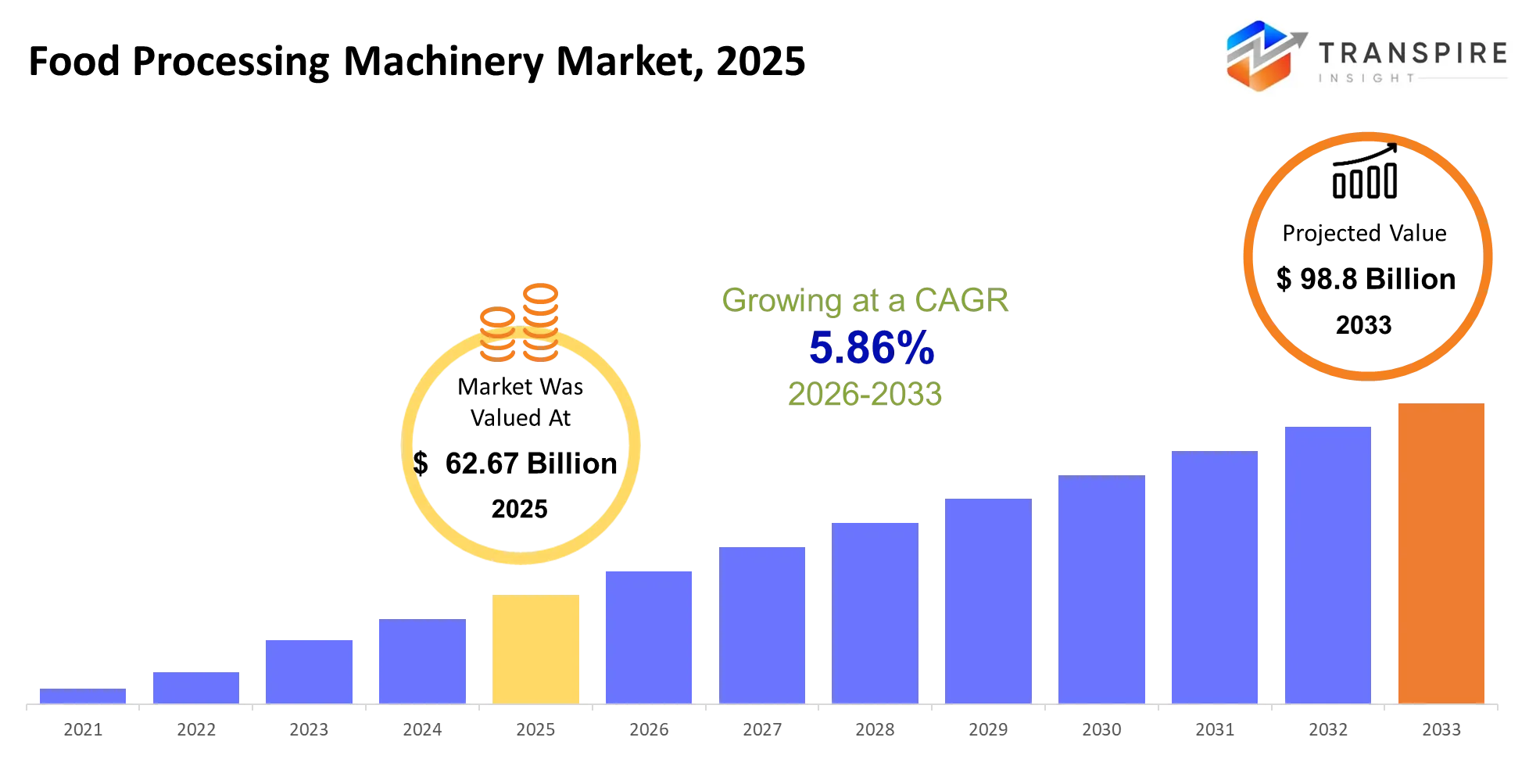
As per Transpire Insight Analysis, the Food Processing Machinery Market size is estimated at USD 62.67 billion in 2025 and is anticipated to reach USD 98.8 billion by 2033, growing at a CAGR of 5.86% from 2026 to 2033.
The food processing machinery market supports food makers in turning materials from farms and animals into safe, reliable and ready-to-sell products. It includes tools used for processing, heating, shaping, moving, packaging and other steps in making food. In the past three to five years, makers have been moving more and more away from old-style machines toward automated, connected and data-driven systems. A big change has been adding controls, sensors, robots and artificial intelligence to production lines. This helps makers make more while losing less material and having fewer unexpected breaks in work. At the same time, stricter food safety rules and new tastes from customers have led to more money being spent on cleaner and more adaptable machines. As making food becomes more complex, the need for machines that can handle products, keep quality steady and work with less human help is growing. This is helping the market keep growing.
Food Processing Machinery Market Size & Forecast:
- Market Size 2025: USD 62.67 Billion
- Expected Market Value (2033): USD 98.8 Billion
- Forecast CAGR (2026–2033): 5.86%
- Leading Region in 2025: Asia-Pacific
- Fastest Growing Region: Europe
- Key Company Profiles: Bühler AG, Tetra Laval, GEA Group AG, JBT Marel, Krones AG, The Middleby Corporation, Alfa Laval, SPX FLOW, TNA Solutions, BAADER Group, Marel, Heat and Control, FENCO Food Machinery, Foodmate, MULTIVAC
Key Market Insights:
The market is gradually moving away from traditional machinery to connected and automated production, where producers emphasise efficiency, cleanliness, adaptability, and cost reduction.
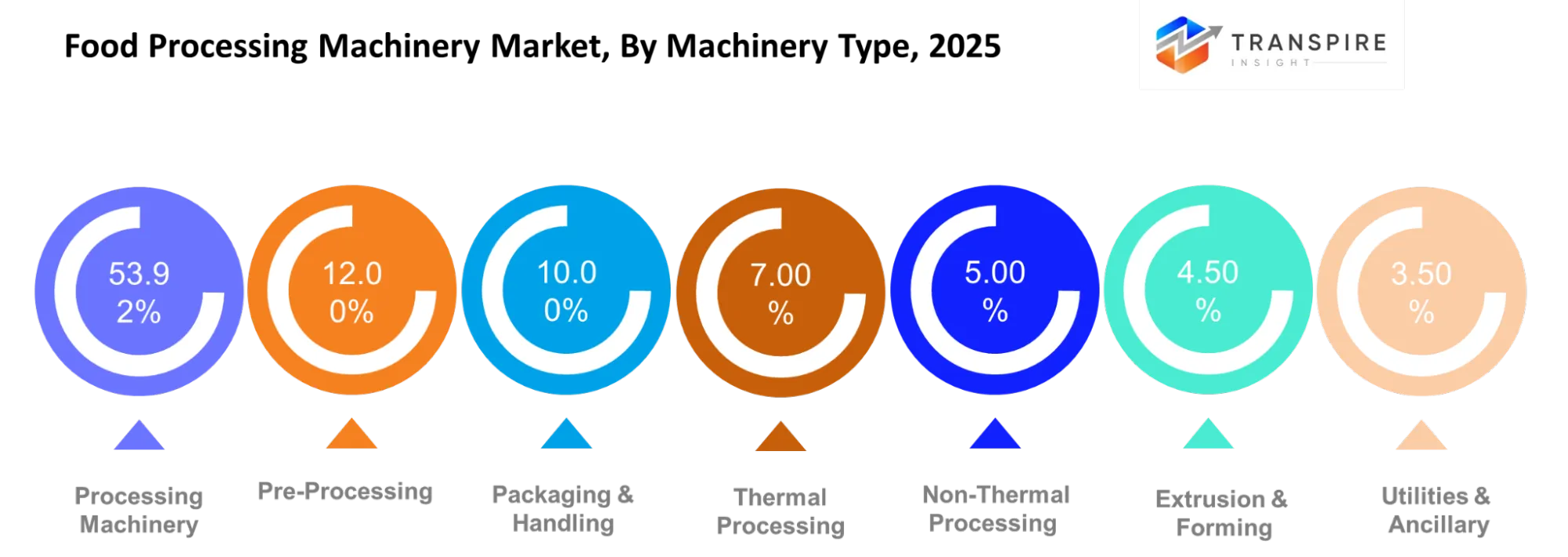
- The Processing Machinery constitutes 53.92%, which is made possible through investments in production equipment that is efficient and automated.
- The segment of Pre-Processing Machinery makes up 12.00%, with technology in raw material processing and handling being automated.
- Packaging & Handling contributes 10.00%, thanks to packaging systems in addition to better production efficiency.
- Thermal Processing makes up 7.00%, owing to manufacturers adopting equipment with good temperature control.
- Non-Thermal Processing has a share of 5.00%, due to the quality and safety of food through technological advancement.
- Extrusion & Forming constitutes 4.50%, with a growing trend for snacks, meat alternatives, and shaped foods.
What are the Key Drivers, Restraints, and Opportunities in the Food Processing Machinery Market?
Drivers
Automation is a key growth driver because food producers face the challenge of producing more products with equal quality but less labour. The shift from manual production to automated equipment is pushing food producers to upgrade to machines with better controls and monitoring capabilities. Modern machines have better capabilities of monitoring operational parameters, which will help the food producers notice the deviation in processes before becoming a bigger problem for them.
Restraints
The high start-up cost continues to be a major drawback, especially for smaller and medium-sized food manufacturers. The sophisticated automated, robotic, and interconnected technology requires financial investments not just for the equipment itself, but also for installation costs, software costs, integration costs, training costs, and maintenance costs. In addition, existing manufacturing facilities might have trouble integrating their new equipment into their current manufacturing processes.
Opportunities
Opportunities in intelligent automation, modular machinery, predictive maintenance, and flexible assembly lines. Machinery that can handle various types of products by capturing real-time information on their operations can help manufacturers cater to the demand for smaller production runs and quicker changeovers. Opportunities are also arising in the Asia Pacific region, where the capability of producing food is increasing. Investing in connected processing machinery can support manufacturers in this region to improve their efficiency and produce safe food.
What Has the Impact of artificial intelligence on the Food Processing Machinery Market?
AI is revolutionising food processing machinery through the development of equipment that will not just operate on an automated basis but will also be capable of analysing information obtained from the process for improved operations. Through AI-enabled machinery, it is possible to analyse information obtained through sensors, cameras, production lines, and machine controls for the detection of abnormalities in the operation of the equipment and improve the efficiency of the manufacturing process. In the context of processing plants, computer vision can enable product inspection through the identification of differences in size, shape, colour, or defects of the product, whereas machine learning will help in optimising process parameters. The prediction ability of AI is also gaining significance through the analysis of machine performance to detect patterns that show degradation in equipment and provide early warning signals for maintenance to take place and avoid machine failure. Energy efficiency, raw material usage, production speed and product quality can also be optimised using AI. There are some challenges in implementing AI-enabled machinery, including the costs involved in implementation through installation of sensors, software development and the need for qualified personnel, among others.
Instance
In August 2026, GEA extended its food processing portfolio with AI-driven products that are capable of optimising machine parameters and processes to increase efficiency, enhance product quality, and decrease food and resource wastage.https://www.gea.com/en/products/digital-solutions/
Key Market Trends:
The food processing equipment industry is evolving towards more connected, adaptable, and smart manufacturing systems. Rather than concentrating solely on the speed of machines, they are now concentrating on the efficiency of the manufacturing process as well as cleanliness and adaptability.
- Integration of machinery is becoming more prevalent, as manufacturers are moving away from stand-alone machinery to systems that provide information on operation across production lines.
- The automation trend is developing past mere process control, as producers tend to utilize robotics, machine vision, and intelligent monitoring to cut down on repetitive tasks performed manually.
- Predictive maintenance is becoming more prominent, with maintenance methods moving from reactive repairs to early detection of machinery-performance problems.
- Flexibility of machinery is becoming more important, as the food industry requires flexibility to allow for variation in products manufactured, as well as quicker changeovers.
- Design of machinery for hygienic cleaning is more of a buying criterion, especially when it allows for cleaning and contributes to food safety standards.
- Efficiency in energy consumption is affecting equipment design, making manufacturers focus on thermal efficiency and motor efficiency.
Food Processing Machinery Market Segmentation
By Machinery Type
The Processing Machinery constitutes 53.92% of total machines, which is the highest in the machinery type list and has been made possible due to its central importance in processing the raw material into finished or semi-finished food products. The Pre-Processing Machinery has 12.00% share with support from equipment needed in preparing and handling the raw material before the actual process of production takes place. Packaging & Handling constitutes a 10.00% share of total machines, which has been made possible due to the need to package and handle processed foods. Thermal Processing has 7.00% and Non-Thermal Processing has 5.00%.
By Automation Level
the market consists of Manual, Semi-Automatic, Fully Automatic, Smart & AI-Enabled, Robotic, IoT Connected, Vision Guided, and others. The manual machine remains useful where minimal investments and operator control are still relevant. The semi-automatic and fully automatic machines are being increasingly utilised in cases where the need for increased productivity becomes relevant to the manufacturer. The Smart & AI-enabled machines have the highest CAGR of 7.24% in terms of adoption of intelligent monitoring and automated decision support systems. Robotic, IoT-connected, and vision-guided machines become increasingly relevant due to better traceability and handling.
By Application
the market consists of Bakery & Confectionery, Meat/Seafood & Meat Alternative, Dairy & Dairy Alternative, Beverages, Fruits/Vegetables & Nuts, Ready Meals & Meal Kits, Snacks, and others. Machines for bakery and confectionery producers must be equipped for accurate mixing, formation, baking, and finishing. Meat and seafood producers are increasingly investing in equipment that enhances hygiene, handling, cutting, and production consistency, and producers of meat alternatives require machines for the processing of meat alternatives. The machines for dairy and beverage producers should provide reliability and high throughput, and fruits, vegetables, nuts, ready meals, and snacks require flexible machines.
By Operation Mode
the market is segmented into Batch Processing, Continuous Processing, Hybrid Processing, Inline Processing, Flexible Processing, High-Speed Processing, Low-Temperature Processing, and Others. Batch Processing continues to be valuable in scenarios where producers have several types of products or product types in batches. Continuous Processing is beneficial for higher volume operations that require continuous production for long durations. In addition to this, hybrid and flexible processing systems are more flexible in scenarios where the product mix varies. Inline Processing helps with coordinated production processes, whereas High-Speed Processing is used for maximising the production output. Low-Temperature Processing is needed by producers who need better control over their product characteristics in their processing.
By Equipment Function
The market comprises Mixing, Cutting & Slicing, Extrusion, Baking & Cooking, Drying & Dehydration, Freezing, Filling & Depositing, and Others. Mixing equipment is helpful for even formulation and preparation purposes. Cutting & Slicing systems increase consistency and production in products where portions play an important role. Extrusion systems are important for snacks, meat alternatives, and formed products. Baking and cooking systems continue to be important for bakery, prepared foods, and other processed food applications.
By End User
the market includes Food Manufacturers, Beverage Producers, Meat Processors, Dairy Producers, Bakery Producers, Snack Manufacturers, Contract Food Processors, and Others. High-volume automation and production line integration is preferred by big food manufacturers. Beverage and dairy producers have the need for reliable continuous machines, which will be able to maintain their quality in large-scale production. Meat processors need machines that will provide hygienic production, effective handling, and process control, whereas bakery and snack producers require flexible machinery. Contract Food Processors also demand adaptable equipment due to their ability to produce several types of products for various consumers.
What are the Key Use Cases Driving the Food Processing Machinery Market?
Processing Equipment is used in primary processing operations that include mixing, cutting, cooking, shaping, extruding, and other transformation functions. Such equipment allows manufacturers to achieve consistent production while lowering the reliance on human intervention. Growing application areas cover baking, beverages, dairy, meat & seafood, snacks, fruit & vegetables, and ready meals. Food producers in these areas are utilising automated equipment in order to increase production volumes while retaining consistent quality. New applications are becoming more connected with the concept of smart factories, inspection by AI, predictive maintenance, robotics, and IoT-enabled equipment. These technologies make it possible for processors to monitor equipment performance and optimise operations.
|
Report Metrics |
Details |
|
Market size value in 2025 |
USD 62.67 Billion |
|
Market size value in 2026 |
USD66.34 Billion |
|
Revenue forecast in 2033 |
USD 98.8 Billion |
|
Growth rate |
CAGR of 5.86% from 2026 to 2033 |
|
Base year |
2025 |
|
Historical data |
2021 - 2024 |
|
Forecast period |
2026 - 2033 |
|
Report coverage |
Revenue forecast, competitive landscape, growth factors, and trends |
|
Regional scope |
United States; Canada; Mexico; United Kingdom; Germany; France; Italy; Spain; Denmark; Sweden; Norway; China; Japan; India; Australia; South Korea; Thailand; Brazil; Argentina; South Africa; Saudi Arabia; United Arab Emirates |
|
Key company profiled |
Bühler AG, Tetra Laval, GEA Group AG, JBT Marel, Krones AG, The Middleby Corporation, Alfa Laval, SPX FLOW, TNA Solutions, BAADER Group, Marel, Heat and Control, FENCO Food Machinery, Foodmate, MULTIVAC |
|
Customization scope |
Free report customization (country, regional & segment scope). Avail customized purchase options to meet your exact research needs. |
|
Report Segmentation |
Machinery Type (Processing Machinery, Pre-Processing Machinery, Packaging & Handling, Thermal Processing, Non-Thermal Processing, Extrusion & Forming, Utilities & Ancillary Systems, Others); Automation Level (Manual, Semi-Automatic, Fully Automatic, Smart & AI-Enabled, Robotic, IoT-Connected, Vision-Guided, Others); Application (Bakery & Confectionery, Meat/Seafood & Meat-Alternative, Dairy & Dairy-Alternative, Beverages, Fruits/Vegetables & Nuts, Ready Meals & Meal Kits, Snacks, Others); Operation Mode (Batch Processing, Continuous Processing, Hybrid Processing, Inline Processing, Flexible Processing, High-Speed Processing, Low-Temperature Processing, Others); Equipment Function (Mixing, Cutting & Slicing, Extrusion, Baking & Cooking, Drying & Dehydration, Freezing, Filling & Depositing, Others); End User (Food Manufacturers, Beverage Producers, Meat Processors, Dairy Producers, Bakery Producers, Snack Manufacturers, Contract Food Processors, Others) |
Which Regions are Driving the Food Processing Machinery Market Growth?
North America
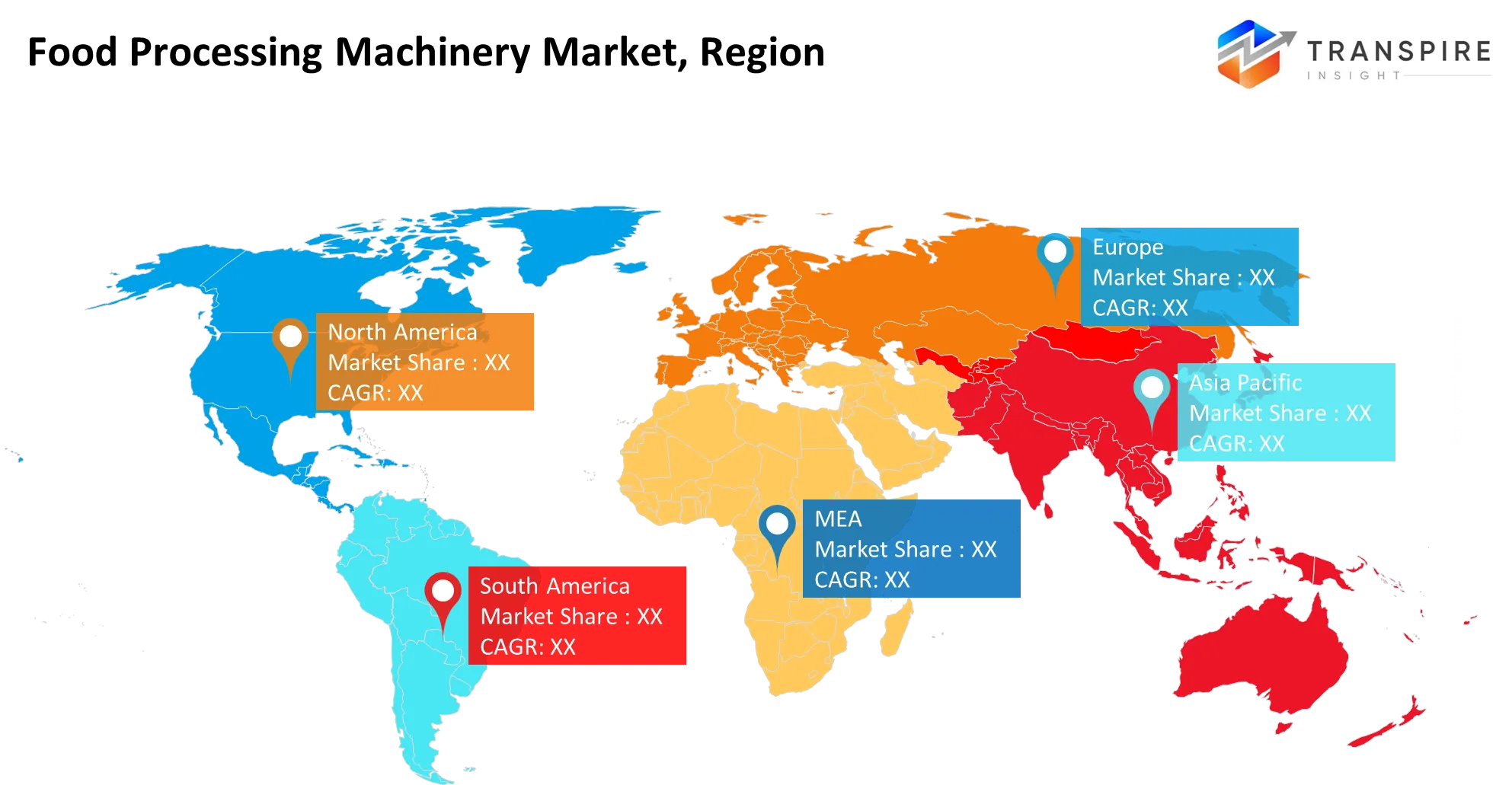
North America holds 23.00% of the world food processing machinery market and features an already established food manufacturing sector. The region has a significant number of food and beverage manufacturers that constantly invest in automation, food processing and production equipment. Focus on food safety and control ensures the constant need for replacement of existing equipment as well as technology upgrades. The region also has a well-established service provider network enabling manufacturers to implement innovative processing and automation technologies.
In September 2026, Syntegon launched its neXt intelligent packaging systems architecture in the North American region at PACK EXPO International 2026 in Chicago. The company also launched two innovative machine platforms for food flow wrapping and topload cartoning, namely, HFX and TRX. This move signifies the ongoing trend of automated and digitally connected food processing and packaging machines used by manufacturers in the North American region.https://www.syntegon.com/press/the-future-of-food-packaging-with-next-at-pack-expo-international-2026
Europe
Europe holds 27.00% of the market and sustains its significant position due to an already established food manufacturing sector and its focus on efficient equipment and food safety. Manufacturers in Europe show more and more interest in digital technologies, hygienic design of machinery, automation and resource-efficient manufacturing. Europe is the fastest-growing regional market at 4.8% CAGR. It provides new opportunities for manufacturers of next-generation machinery in the region.
In May 2026,GEA introduced the PowerPak 5000 thermoformer machine during interpack, Germany, which provides flexibility in formats along with automation technology to food manufacturers.https://www.gea.com/es/news/trade-press/2026/powerpak-5000-thermoformer-launch/
Asia-Pacific
Asia-Pacific is the largest regional market with a share of 38.21%, due to the growing capabilities of food processing, the large number of consumers, and investments made in manufacturing equipment. Asia-Pacific consists of countries that are leading manufacturers of processed foods, where producers tend to implement automation and modernised equipment to enhance efficiency in production. Growth in industrialisation and expansion of organised food processing are driving the shift from traditional equipment to advanced equipment.
In March 2026, Tetra Pak established a new Product Development Centre in Thailand, which includes a pilot processing plant and helps food & beverage companies develop new productshttps://www.foodprocessing.com.au/content/the-food-plant/news/tetra-pak-opens-new-product-development-centre-in-thailand-1675511187
Who are the Key Players in the Food Processing Machinery Market and how do they compete?
The competition in the international market for food processing machinery is influenced by the technology capabilities, machine reliability, customizability, services, and the ability to supply integrated production solutions. The rivalry takes place not only through the equipment of individual machines but also through production lines and digital solutions, automation and after-sales support services. Bühler, Tetra Pak, GEA, Heat and Control, and other special-purpose suppliers expand their portfolios of products for various applications of processing. Bühler pays a lot of attention to innovations in processing systems, digital solutions, food safety, and technologies. Its strategy is aimed at innovations in the production of processing systems and the development of competencies in particular areas such as plant-based proteins. Specialisation and expansion of the portfolio of products are the strategies used by some other firms. Heat and Control expands its range of processing and handling solutions through the acquisition of Fabcon Food Systems. OctoFrost expands its range of processing solutions through the acquisition of HiTec Food Systems.
Food Processing Machinery Market companies
- Bühler AG
- Tetra Laval
- GEA Group AG
- JBT Marel
- Krones AG
- The Middleby Corporation
- Alfa Laval
- SPX FLOW
- TNA Solutions
- BAADER Group
- Marel
- Heat and Control
- FENCO Food Machinery
- Foodmate
- MULTIVAC
Recent Development News
In June 2025, Heat and Control acquired Fabcon Food Systems Ltd, allowing it to offer customised processing and handling solutions. According to the company, the acquisition would enhance its solutions in applications such as snacks, French fries, and protein processing.https://www.heatandcontrol.com/news/heat-and-control-announces-acquisition-fabcon-food-systems-ltd
In January 2026, Bühler's acquisition of endeco came into effect, enhancing Bühler's protein business through a previously existing collaboration in plant-based protein processing and plant engineering.https://www.buhlergroup.com//en/media/media-releases/endeco.html
What Strategic Insights Define the Future of the Food Processing Machinery Market?
Future developments within the food processing machinery market will be characterised by a trend towards interconnected processing, inspection, handling, and packaging equipment within the system of an integrated production line. It will be focused not only on increasing the speed of the machines but also on increasing the efficiency of the equipment, decreasing waste, saving energy, and maintaining the uniform quality of products. Smart and AI-equipped machinery will most probably gain importance due to the need for predictive maintenance and automated inspection. An understated threat is represented by the technological complexity of integration that might lead to higher implementation expenses as well as difficulties of integrating modern equipment into outdated production facilities due to the lack of data and control system standardisation.An emerging opportunity is the development of flexible machinery capable of processing several products and providing short production batches. Opportunities for the supply of innovative machinery in the Asia-Pacific region are especially high due to the area. From a strategic perspective, equipment manufacturers should develop their equipment through digital services, predictive features, after-sales support, and flexibility of configuration.
Machinery Type
- Processing Machinery
- Pre-Processing Machinery
- Packaging & Handling
- Thermal Processing
- Non-Thermal Processing
- Extrusion & Forming
- Utilities & Ancillary Systems
- Others
Automation Level
- Manual
- Semi-Automatic
- Fully Automatic
- Smart & AI-Enabled
- Robotic
- IoT-Connected
- Vision-Guided
- Others
Application
- Bakery & Confectionery
- Meat/Seafood & Meat-Alternative
- Dairy & Dairy-Alternative
- Beverages
- Fruits/Vegetables & Nuts
- Ready Meals & Meal Kits
- Snacks
- Others
Operation Mode
- Batch Processing
- Continuous Processing
- Hybrid Processing
- Inline Processing
- Flexible Processing
- High-Speed Processing
- Low-Temperature Processing
- Others
Equipment Function
- Mixing
- Cutting & Slicing
- Extrusion
- Baking & Cooking
- Drying & Dehydration
- Freezing
- Filling & Depositing
- Others
End User
- Food Manufacturers
- Beverage Producers
- Meat Processors
- Dairy Producers
- Bakery Producers
- Snack Manufacturers
- Contract Food Processors
- Others
By Regional Analysis
North America
- US
- Canada
- Mexico
Europe
- Germany
- UK
- France
- Italy
- Spain
- Russia
- Rest of Europe
Asia Pacific
- China
- Japan
- India
- South Korea
- Australia
- Rest of Asia Pacific
South America
- Brazil
- Argentina
- Rest of South America
Middle East & Africa
- UAE
- Saudi Arabia
- Qatar
- South Africa
- Rest of the Middle East & Africa
Frequently Asked Questions
Find quick answers to common questions.
The food processing machinery market size was valued at USD 62.67 Billion in 2025 and is poised to reach USD 98.8 Billion by 2033, expanding at a 5.86% CAGR.
Key segments for the food processing machinery market are Machinery Type (Processing Machinery, Pre-Processing Machinery, Packaging & Handling, Thermal Processing, Non-Thermal Processing, Extrusion & Forming, Utilities & Ancillary Systems, Others); Automation Level (Manual, Semi-Automatic, Fully Automatic, Smart & AI-Enabled, Robotic, IoT-Connected, Vision-Guided, Others); Application (Bakery & Confectionery, Meat/Seafood & Meat-Alternative, Dairy & Dairy-Alternative, Beverages, Fruits/Vegetables & Nuts, Ready Meals & Meal Kits, Snacks, Others); Operation Mode (Batch Processing, Continuous Processing, Hybrid Processing, Inline Processing, Flexible Processing, High-Speed Processing, Low-Temperature Processing, Others); Equipment Function (Mixing, Cutting & Slicing, Extrusion, Baking & Cooking, Drying & Dehydration, Freezing, Filling & Depositing, Others); End User (Food Manufacturers, Beverage Producers, Meat Processors, Dairy Producers, Bakery Producers, Snack Manufacturers, Contract Food Processors, Others)
Growth is primarily driven by increasing demand for processed foods, automation in the food processing industry, development of food processing industries, and increased demand for high-capacity machines.
The market is led by major manufacturers including Bühler AG, Tetra Laval, GEA Group AG, JBT Marel, Krones AG, The Middleby Corporation, Alfa Laval, SPX FLOW, TNA Solutions, BAADER Group, Marel, Heat and Control, FENCO Food Machinery, Foodmate, MULTIVAC
The Asia-Pacific region represents 38.21% of the food processing machinery market, backed by food production increases, processed food demand, growing automation, and investment in processing plants.
Business opportunities are automation, energy efficiency in machinery, growth in food processing industries in developing countries, and an increasing need for intelligent and artificial intelligence-based processing machines.
- Bühler AG
- Tetra Laval
- GEA Group AG
- JBT Marel
- Krones AG
- The Middleby Corporation
- Alfa Laval
- SPX FLOW
- TNA Solutions
- BAADER Group
- Marel
- Heat and Control
- FENCO Food Machinery
- Foodmate
- MULTIVAC
About the Authors

Chetan Dhatrak
I’m Chetan Dhatrak, a Senior Research Analyst at Transpire Insight, specializing in the Consumer Goods, Foods and Beverages industry. I focus on analyzing market trends, consumer behavior, competitive landscapes, and industry developments to deliver accurate, data-driven insights. My research at Transpire Insight is built on credible sources and in-depth analysis, helping businesses and readers better understand market dynamics, emerging opportunities, and evolving consumer preferences. I’m committed to creating reliable, well-researched content that supports informed decision-making and reflects the latest developments in the consumer goods and food & beverage sectors.

Chakradhar Khansole
Chakradhar serves as the Research Director at Transpire Insight, bringing over 8 years of experience in technology, innovation, and strategic market intelligence. He specializes in transforming complex market data into actionable business insights that enable organizations to make informed, growth-oriented decisions. Recognized for his strategic vision and analytical expertise, Chakradhar leads high-impact research initiatives, delivering comprehensive market assessments, competitive intelligence, and forward-looking industry analysis.
Recently Published Reports
-
Apr 2026
Baby Infant Formula Market
Baby Infant Formula Market Size, Share & Analysis Report By ype (Infant Milk, Follow On Milk, Specialty Baby Milk, Growing-Up Milk), By Ingredient (Carbohydrate, Fat, Protein, Minerals, Vitamins, and Others), By Product Form (Powder, Liquid, and Ready-to-feed), By Distribution Channels (Supermarket/Hypermarket, Specialty Store, Pharmacies, Online Retail, and Others), and Geography (North America, Europe, Asia-Pacific, Middle East and Africa, South and Central America), 2021 - 2031
-
Apr 2026
Edible Insects for Animal Feed Market
Edible Insects for Animal Feed Market Size, Share & Analysis Report By Type (Insect Powder, Insect Meal, Insect Bar, Insect Paste, Insect Oil, and Others), By Insect Type (Beetles, Cricket, Caterpillar, Hymenoptera, Orthoptera, Tree Bugs, and Others), By Application (Livestock, Pet Food, and Aquaculture), By Livestock Type (Poultry, Swine, and Others), and Geography (North America, Europe, Asia-Pacific, Middle East and Africa, South and Central America), 2021 - 2031
-
Apr 2026
Food Industry Disinfection and Bacterial Control Market
Food Industry Disinfection and Bacterial Control Market Size, Share & Analysis Report By Type (Chemical Disinfectants, Physical Disinfectants, and Biocides and Antimicrobials), By Application (Food Processing Equipment Surface Disinfection, Food Preparation Areas Surface Disinfection, Storage Areas Surface Disinfection, Anti-microbial Coatings Food Preservation, and Preservative Solutions Food Preservation), By End User (Meat and Poultry Processing, Dairy Processing, Seafood Processing, Bakery and Confectionery, Restaurants and Commercial Kitchens, and Food Service Providers), By Sales Channel (Online, Offline), and Geography (North America, Europe, Asia-Pacific, Middle East and Africa, South and Central America), 2021 - 2031
-
May 2026
Freeze Dried Food Market
Freeze Dried Food Market Size, Share & Analysis Report By Product Type (Fruits, Vegetables, Freeze-Dried Dairy Products, Freeze-Dried Meat and Seafood, Freeze-Dried Pet Food, and Prepared Meal), By Nature (Organic, and Conventional), By Form (Powdered, Granules, and Diced), By End Use (Breakfast Cereals, Dairy Products, Bakery & Confectionery, Nutritional Bars & Supplements, Powdered Beverages, Snacks, and Retail (Household)), and Geography (North America, Europe, Asia-Pacific, Middle East and Africa, South and Central America), 2021 - 2031