

Food-grade Industrial Gases Market Summary:
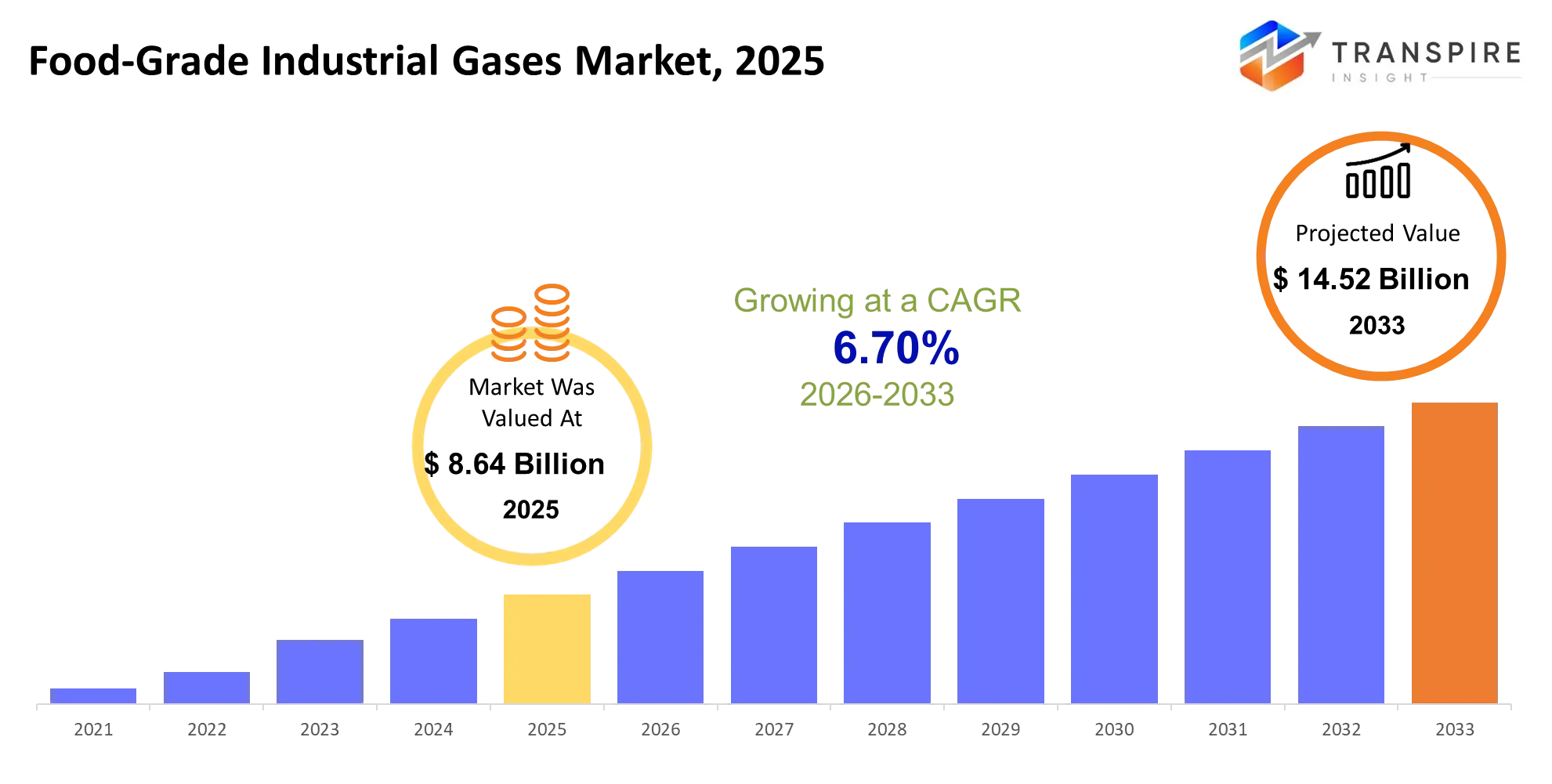
As per the Transpire Insight, The Food-grade Industrial Gases Market size is estimated at USD 8.64 billion in 2025 and is anticipated to reach USD 14.52 billion by 2033, growing at a CAGR of 6.70% from 2026 to 2033.
The food-grade industrial gases market is key to preservation, packaging, chilling, carbonation, and controlled processing by supplying gases for quality maintenance across the entire supply chain. For 3-5 years, the shift from cylinder and bulk supplies to on-site generation, gas recovery, and application-specific mixtures has gained momentum in processors' supply chains, especially where supply reliability and carbon efficiency matter. One key industry structural shift is the installation of nitrogen generation and recovered carbon dioxide at food processing plants for on-site supply, offering less reliance on bulk deliveries and cylinders and signifying a move away from the commodity-centric mindset of tank, tube, and bulk supply to pure oxygen and air.
This shift has been spurred by tighter food-grade carbon dioxide supplies and the pursuit of lower transport emissions and production losses for an ensured supply near the line while maintaining purity and consumption. Recent carbon dioxide utilisation projects introduce value from captured streams as gas management and circularity take hold.
Food-grade Industrial Gases Market Size & Forecast:
- Market Size 2025: USD 8.64 Billion
- Expected Market Value (2033): USD 14.52 Billion
- Forecast CAGR (2026-2033): 6.70%
- Leading Region in 2025: North America
- Fastest Growing Region: Asia-Pacific
- Key Company Profiles: Linde, Air Liquide, Air Products, Messer, Taiyo Nippon Sanso, SOL Group, Nippon Gases, Gulf Cryo, Coregas, Air Water, Matheson, INOX Air Products, Ellenbarrie Industrial Gases, Gulf Cryo, Sicgil Industrial Gases.
Key Food-grade Industrial Gases Market Insights:
Food-grade gases are being sold more and more not as commodities but as solutions to shelf life, throughput and supply security. The focus of competitive advantage is moving to certified purity, application engineering, digital monitoring, and resilient low-carbon sourcing.
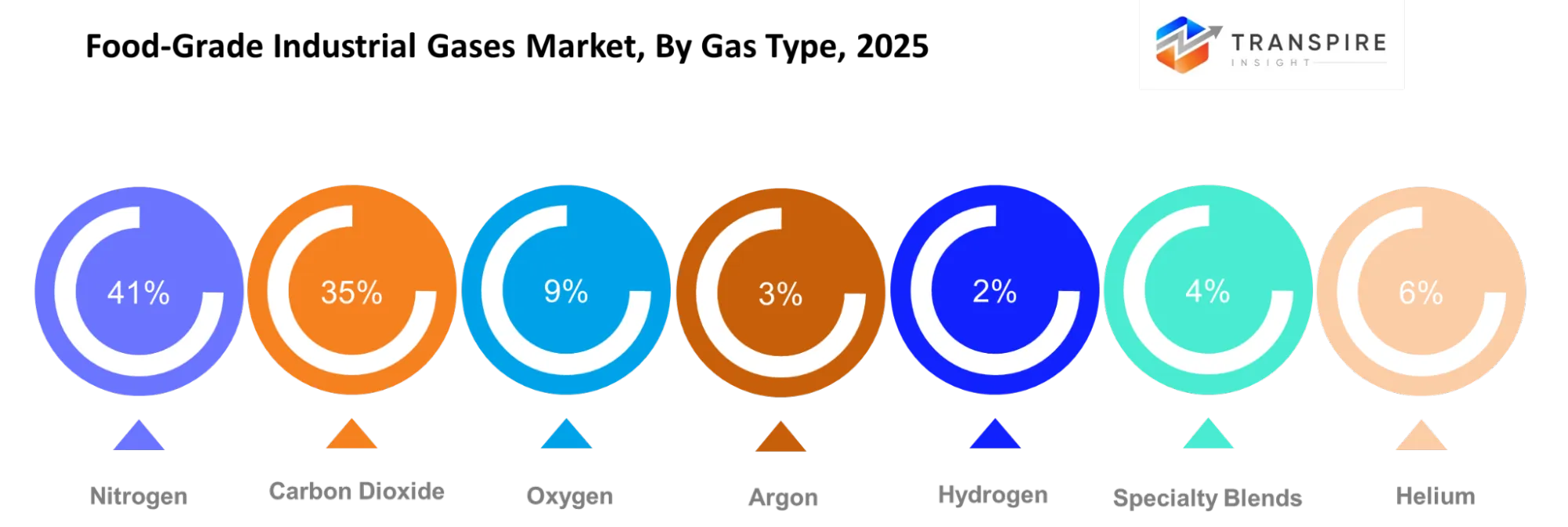
- Nitrogen's 41.3% contribution is driving Linde's on-site and bulk-supply model as processors become more automated when filling MAP and removing oxygen.
- Air Liquide's biogenic-CO₂ offer is being led by carbon dioxide at 35.0% as buyers diversify following shortages of fertilisers.
- Oxygen's 9.0% concentration allows for customised produce storage blends, and Messer is expanding its application-specific Gourmet MAP solutions.
- For speciality blends, the digitally controlled gas recipes are preferred in seafood, bakery and premium ready-meal packaging at 4.0%.
- Argon's niche of 3.5% allows oxidation-sensitive processing, driving higher-margin, traceable packaged-gas services.
- The 2.5% share of hydrogen is still niche and needs improved hydrogen purity assurance and safety-oriented distribution systems.
- The relatively low concentration of 1.2% of helium in the atmosphere allows for selective management of supply, with users focusing on critical applications such as analytical and niche process uses.
- The other gases account for 3.5% and allow regional suppliers to stand out with their cylinders, microbulk, and rapid-response logistics.
- With Nitrogen-based MAP and preservation's 7.3% growth forecast, the use of sensors for seal inspection and gas-mix verification is accelerating.
What are the Key Drivers, Restraints, and Opportunities in the Food-grade Industrial Gases Market?
Driver:
Food processors are under pressure to reduce spoilage, preserve sensory quality, and maintain shelf life across longer retail and e-commerce distribution networks. The expansion of chilled convenience meals, protein products, fresh-cut produce, frozen foods, and premium packaged snacks has increased the use of nitrogen flushing, MAP, cryogenic freezing, and controlled-atmosphere storage. This is not merely volume-led demand: retailers and processors adopt gas-based preservation because extending saleable life reduces markdowns, returns, and food waste while improving inventory planning. Nitrogen-based MAP and preservation applications are expected to expand at a 7.3% rate, reflecting this higher-value shift.
Restraint:
Food-grade CO₂ remains structurally vulnerable because much of the supply is generated as a by-product of ammonia, fertilizer, ethanol, and chemical production rather than dedicated food-gas facilities. Energy shocks, planned maintenance, and fertiliser-plant closures can therefore restrict supply regardless of food-sector demand. Europe’s 2022 gas-price crisis caused ammonia output cuts and CO₂ shortages, placing breweries, meat processors, and packaging lines under pressure.
Opportunity:
Decentralized gas systems can reduce supply exposure by placing generation, recovery, and monitoring closer to food-production sites. On-site nitrogen generators reduce dependence on delivered bulk gas, while CO₂ recovery from fermentation and biogenic streams creates alternative local supply. Digital cylinder monitoring and compact microbulk units improve inventory visibility, prevent stockouts, and support smaller processors. The strongest investment potential lies in expanding Asian cold-chain networks and regional beverage bottling clusters, where supply reliability often outweighs the lowest delivered-gas price.
What Has the Impact of Artificial Intelligence Been on the Food-grade Industrial Gases Market?
AI is allowing food-grade gas facilities to evolve from time-based controls to a data-driven optimisation system. In nitrogen generation, a nitrogen-smart AI-powered monitoring system can combine compressor load, pressure, purity, and flow data to more precisely match generation to packaging line needs, reducing over-generation and waste. AI-enabled predictive models can alert operators to abnormal pressure trends, poor compressor health, membrane or PSA system loss in efficiency, and storage issues before downtime occurs.
At packaging lines, machine data can be cross-referenced with consumption and seal-performance measurements to spot excessive flushing or unstable conditions in the atmosphere. In carbon dioxide, demand associated with beverage filling, chilling, and dry-ice production can be predicted to optimise replenishment and inventory management. For the industrial food sector, digital twins are emerging for carbon dioxide use, as revealed in the EU project FERM4FOOD that plans to deploy digital-twin and techno-economic assessment models on a demonstration platform. Perhaps the largest bottleneck for food processing where gas is concerned is that most AI technologies depend on robust, continuous sensor data integration with gas, refrigeration, and packaging controls, which may be difficult to implement cost-effectively in a small facility.
In February 2026, Atlas Copco Compressors launched its new LC N2 nitrogen generation system designed for on-site point-of-use purity and efficiency control. This system provides enhanced real-time measurement capabilities that assist high-tolerance packaging and fabrication environments in minimising waste.
https://www.theengineer.co.uk/content/category/the-engineer?itemsPerPage=15&page=60
Key Food-grade Industrial Gases Market Trends:
A transition is taking place in the market from a single gas purchase provider to a single provider of generation, recovery, purity control and monitoring. The reliability of supply, traceability, and gas efficiency are no longer just secondary considerations for processors in their food-grade gas solution selection, but are becoming top priorities.
- The use of on-site nitrogen has shifted from backup to strategic to gain control of packaging-gas availability and logistics by processors.
- The recovered CO₂ is becoming more and more popular as fermentation, biogas, and other appropriate streams are cleaned and used instead of bought-in inputs.
- MAP is moving towards a more data-driven approach where gases are matched to the respiration of the product, moisture, temperature and distribution.
- Suppliers are moving towards application engineering and assisting trials, commissioning and atmosphere design beyond simply competing on gas volumes.
- Food plants are combining gas systems with purity, pressure and leak monitoring to bolster safety and process continuity.
- Dry ice is moving beyond cooling, and processors are turning to it for temperature control and logistics applications that are limited by traditional refrigeration.
- Medium-scale processors who are looking for supply without large bulk-liquid systems are becoming more relevant with microbulk and on-site systems.
- Carbon-efficiency targets are driving food processing clusters to source, recover, and adopt short delivery routes and low-loss storage.
Food-grade Industrial Gases Market Segmentation
Gas Type:
Nitrogen 41.3% is used for modified atmosphere packaging, blanketing, inerting, and product protection. Carbon Dioxide 35.0% is used for carbonation, preservation, and cooling. Oxygen 9.0% is used for selective controlled-atmosphere requirements and processing needs. Argon 3.5% is used for specialised uses, including atmosphere control, blanketing and inerting, and process support. Hydrogen 2.5% is used for specialised uses in injection-moulding and tech-cleaning. Specialty Gas Blends 4.0% are used to meet requirements for a mixture of gases. Helium 1.2% is used for specialised uses in process support. Others 3.5% are used for specialised uses in atmosphere control and process support. Nitrogen-based MAP and preservation growth is 7.3%CAGR as processors refine atmosphere control.
Application:
MAP, carbonation, freezing and chilling remain core uses, while blanketing, dry ice production and controlled-atmosphere storage extend gas applications into processing and logistics. MAP increasingly relies on precise gas ratios to manage oxidation, respiration and package integrity across different food categories. Carbonation continues supporting beverage production, while cryogenic gases improve rapid freezing and temperature control. Future adoption will favour integrated systems that connect gas dosing, monitoring and storage conditions, improving traceability, process consistency and supply reliability across processing facilities.
End Use:
Beverages, meat, poultry and seafood, dairy and frozen products, bakery and confectionery, fruits and vegetables, convenience foods and processed foods require different gas strategies. Beverage manufacturers rely heavily on carbon dioxide for carbonation and nitrogen for blanketing and product protection. Meat and seafood processors emphasise controlled atmospheres that slow oxidation and microbial deterioration, while fruits and vegetables require respiration-sensitive environments. Future systems will increasingly tailor gas mixtures to individual product characteristics, distribution duration and storage requirements.
Supply Mode:
Bulk liquid and cylinder delivery remain established channels, particularly for large processors and facilities with predictable consumption. However, on-site generation is gaining relevance where nitrogen requirements are continuous and transport reliability is a concern. Microbulk systems offer an intermediate model between cylinders and bulk tanks, while pipeline delivery suits tightly integrated production clusters. Dry ice and cryogenic supply remain important for temperature-sensitive logistics and rapid freezing. Future infrastructure decisions will increasingly prioritise utilisation rates, energy efficiency, site constraints and delivered-gas economics.
Gas Function:
Preservation, cooling, carbonation, packaging, inerting, freezing, processing and transportation increasingly operate as interconnected functions rather than isolated applications. Nitrogen can simultaneously support packaging, blanketing and preservation, while carbon dioxide contributes to carbonation, cooling and controlled atmospheres. Cryogenic gases connect freezing with transportation and cold-chain performance. This overlap is increasing the value of application engineering, because processors need optimised gas composition, pressure, temperature and flow rather than simply selecting individual gases. Suppliers are therefore bundling gases with equipment, monitoring, maintenance and technical support.
What are the Key Use Cases Driving the Food-grade Industrial Gases Market?
Nitrogen-led packaging is the core use case, reflecting its 41.3% gas-type share. In modified-atmosphere packaging, nitrogen displaces oxygen, limits oxidation, protects pack structure, and supports tailored nitrogen/CO₂ mixes for meat, seafood, dairy, bakery, snacks, and prepared foods. The result is a longer usable shelf life and fewer distribution losses.
Expanding uses include beverage carbonation, cryogenic freezing, chilling, dry ice, blanketing, and controlled-atmosphere storage. CO₂ supports carbonation, cooling, and preservation, while nitrogen enables pressure transfer and inert filling. On-site nitrogen and microbulk systems improve supply reliability for processors.
Emerging uses include purified captured CO₂ reuse, precision-fermentation inputs, and sensor-led gas monitoring. Digital twins and predictive controls can link gas consumption to process conditions, reducing waste while maintaining food-grade compliance.
|
Report Metrics |
Details |
|
Market size value in 2025 |
USD 8.64 Billion |
|
Market size value in 2026 |
USD 9.22 Billion |
|
Revenue forecast in 2033 |
USD 14.52 Billion |
|
Growth rate |
CAGR of 6.70% from 2026 to 2033 |
|
Base year |
2025 |
|
Historical data |
2021 - 2024 |
|
Forecast period |
2026 - 2033 |
|
Report coverage |
Revenue forecast, competitive landscape, growth factors, and trends |
|
Regional scope |
United States; Canada; Mexico; United Kingdom; Germany; France; Italy; Spain; Denmark; Sweden; Norway; China; Japan; India; Australia; South Korea; Thailand; Brazil; Argentina; South Africa; Saudi Arabia; United Arab Emirates |
|
Key companies profiled |
Linde, Air Liquide, Air Products, Messer, Taiyo Nippon Sanso, SOL Group, Nippon Gases, Gulf Cryo, Coregas, Air Water, Matheson, INOX Air Products, Ellenbarrie Industrial Gases, Gulf Cryo, Sicgil Industrial Gases. |
|
Customization scope |
Free report customisation (country, regional & segment scope). Available customised purchase options to meet your exact research needs. |
|
Report Segmentation |
Gas Type (Nitrogen, Carbon Dioxide, Oxygen, Argon, Hydrogen, Specialty Gas Blends, Helium, Others); Application (Modified Atmosphere Packaging, Carbonation, Freezing & Chilling, Blanketing & Inerting, Dry Ice Production, Food Processing & Preservation, Controlled Atmosphere Storage, Others); End Use (Beverages, Meat Poultry & Seafood, Dairy & Frozen Products, Bakery & Confectionery, Fruits & Vegetables, Convenience Foods, Processed Foods, Others); Supply Mode (Bulk Liquid, Cylinder Packaged, On-Site Generation, Microbulk, Pipeline, Dry Ice, Cryogenic Supply, Others); Gas Function (Preservation, Cooling, Carbonation, Packaging, Inerting, Freezing, Processing, Transportation). |
Which Regions are Driving the Food-grade Industrial Gases Market Growth?
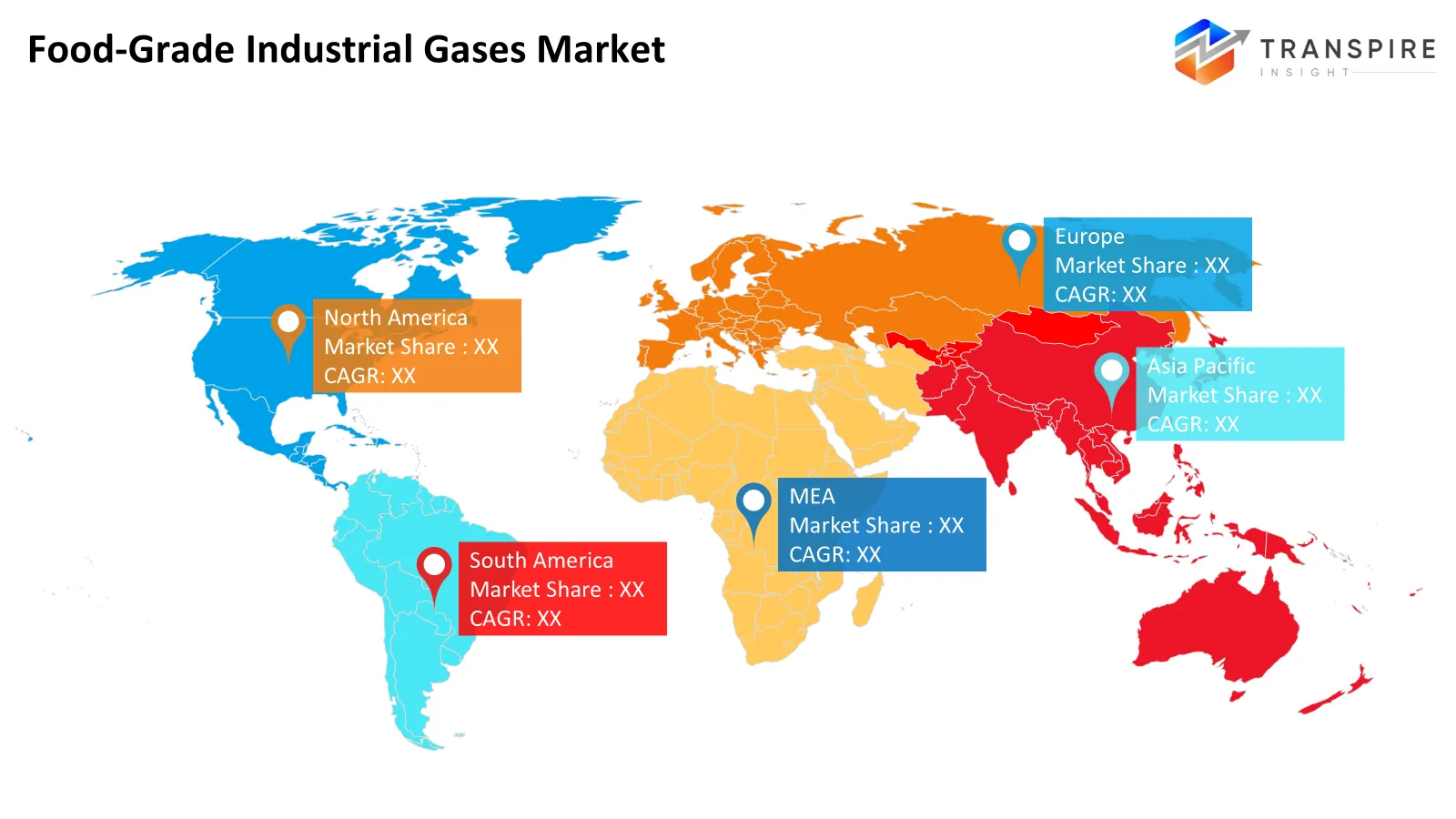
North America has the largest market share at 32.0% and a high number of established facilities in the packaged food, beverage, protein processing, and cold-chain ecosystem. The dominance of North America is due to the proliferation of MAP, cryogenic freezing, carbonation, and food safety systems in national supply chains. A sophisticated bulk-liquid network, beverage-grade cylinder stock and in-plant nitrogen capabilities drive the execution of the solution for the large processors and regional players. The industry is differentiating suppliers' focus from volume to application trials, remote process monitoring, and supply reliability.
In January 2026, Control Devices completed its acquisition of Sherwood Valve to bolster technical gas and flow-control manufacturing capabilities. This transaction strengthens the supply chain infrastructure supporting North American industrial and speciality gas applications.
https://www.gasworld.com/topics/finance/acquisitions/
Europe accounts for 25.0% of the market, supported by higher levels of food processing, more stringent traceability requirements and high adoption of larger packaging formats. Relative to North America, Europe is more exposed to the risk of CO2 supply outages, as a large percentage of supplies are derived from ammonia and fertiliser production. As a result of this exposure, beverage and food companies have been investigating alternative supply sources, sourcing from a wider number of suppliers, or depending on recovered and biogenic carbon dioxide. Europe's stability is based on supply chain restructuring, meteorological drivers and the cost of decarbonised gas, more than on demand growth.
In May 2026, Beroe partnered with industry experts to assess procurement vulnerabilities as a severe carbon dioxide supply shortage threatened Europe's beer and beverage sectors.
Asia-Pacific holds 29.0% of the market share and is the fastest-growing region at 6.4% CAGR. The regional demand profile has been radically transformed by expanding consumption of food in towns and cities, organised retail, penetration of frozen foods, export-led seafood processing, and improved refrigeration infrastructure. Unlike North America, where there is a high replacement market, the Asia-Pacific region has greenfield scope for microbulk supply, modular nitrogen generation, and new MAP lines. The best areas of potential growth in the future are where suppliers can bundle technical support with their local distribution, while the patchy reliability of existing gas supplies affects developing clusters of food processors.
In January 2026, Air Liquide finalised the acquisition of DIG Airgas. This transaction significantly strengthens the company's local industrial gas presence and distribution infrastructure across the Asia-Pacific region, improving supply chain reliability for high-purity carrier and processing gases.
Who are the Key Players in the Food-grade Industrial Gases Market, and how do they compete?
Competition is fractured among gases majors, regional specialist food-quality gas suppliers, and local gas users of food processors, beverage bottlers, and cold chains. Competition is based less on gas listing price and more on application performance, purity certification, supply flexibility, and disruption-resilience during CO2 crisis events. Linde, supported by its integrated supply options from cylinders to bulk liquid to on-site generation, and specialised food-gas blends, competes on application diversity and supply-system flexibility to expand to multinational processors as well as many smaller packaged-food facilities.
Air Liquide is positioning on low-carbon-premium differentiation from biogenic carbon dioxide by capturing low-carbon options from renewable and biological feedstocks for freezing and food preservation. Air Products offers Freshline food-preservation systems, biogenic CO2 cryogenic freezing pilots, and wired-and-wireless measurement devices for real-time data collection and decision support. Messer specialises in Gourmet MAP blends and bespoke packaging design and implementation solutions; Taiyo Nippon Sanso and Air Water play through Asian broad footprint plus food processing knowledge, while SOL Group, Nippon Gases, Gulf Cryo, Coregas, Matheson, INOX Air Products, Ellenbarrie Industrial Gases and Sicgil play through regional logistics, cylinders, microbubbles, local expertise and customer proximity.
Key Players are:
- Linde
- Air Liquide
- Air Products
- Messer
- Taiyo Nippon Sanso
- SOL Group
- Nippon Gases
- Gulf Cryo
- Coregas
- Air Water
- Matheson
- INOX Air Products
- Ellenbarrie Industrial Gases
- Gulf Cryo
- Sicgil Industrial Gases
Recent Development News
- In July 2026, Messer executed strategic acquisitions across Southeast Asia by acquiring the WKS Group and Wipco in Malaysia and Singapore, alongside a definitive agreement to purchase Kobewel. This expansion directly scales up the corporation's regional distribution and merchant cylinder infrastructure, providing food and beverage processors with greater local access to secure, high-purity food-grade nitrogen and carbon dioxide networks. https://newsroom.messergroup.com/messer-announces-strategic-acquisitions-in-singapore-and-malaysia-to-strengthen-presence-in-southeast-asia-industrial-gases-market/
- In June 2026, Linde LienHwa, a joint venture of Linde plc, launched a specialised portfolio of rapid freezing liquid nitrogen solutions at the Foodtech Taipei exhibition in Taiwan. This regional rollout introduces advanced cryogenic temperature control equipment specifically engineered to preserve food texture, prevent degradation, and structurally extend the shelf life of highly sensitive prepared foods and alternative proteins across Asian manufacturing hubs. https://www.gasworld.com/story/linde-joint-venture-to-showcase-cryo-solutions-at-taiwan-food-tech-event/2252786.article/
What Strategic Insights Define the Future of the Food-grade Industrial Gases Market?
The industry is moving towards integrated gas ecosystems, where generation, purification, storage, monitoring, and application equipment are managed as one single ecosystem. Transactional supply will lose significance over time, and technical services, equipment and recurrent contracts will increase in value.
A potential downside risk lies in the centralisation of sources of carbon monoxide. Relying on a few industrial and fermentation sources can lead to regional shortfalls when the upstream assets are shut down or if production economics change. This is why companies should prepare by developing more diversified sourcing and recovery capabilities, instead of solely depending on classical merchant supply. The most promising near-term opportunity lies in low-carbon and recovered food-grade carbon monoxide from a geographically concentrated feedstock of breweries, biogas and food processing clusters, which Air Liquide has long been focusing on by converting biogenic carbon monoxide into a food-grade liquid product. Suppliers can consider investing in regional recovery assets, on-site generation, digitalisation and application engineering, whilst end-users should consider contracts aligned with gas security as well as efficiency and traceability.
Key Segmentations are:
Gas Type
- Nitrogen
- Carbon Dioxide
- Oxygen
- Argon
- Hydrogen
- Specialty Gas Blends
- Helium
- Others
Application
- Modified Atmosphere Packaging
- Carbonation
- Freezing & Chilling
- Blanketing & Inerting
- Dry Ice Production
- Food Processing & Preservation
- Controlled Atmosphere Storage
- Others
End Use
- Beverages
- Meat, Poultry & Seafood
- Dairy & Frozen Products
- Bakery & Confectionery
- Fruits & Vegetables
- Convenience Foods
- Processed Foods
- Others
Supply Mode
- Bulk Liquid
- Cylinder Packaged
- On-Site Generation
- Microbulk
- Pipeline
- Dry Ice
- Cryogenic Supply
- Others
Gas Function
- Preservation
- Cooling
- Carbonation
- Packaging
- Inerting
- Freezing
- Processing
- Transportation
By Regional Analysis
North America
- US
- Canada
- Mexico
Europe
- Germany
- UK
- France
- Italy
- Spain
- Russia
- Rest of Europe
Asia Pacific
- China
- Japan
- India
- South Korea
- Australia
- Rest of Asia Pacific
South America
- Brazil
- Argentina
- Rest of South America
Middle East & Africa
- UAE
- Saudi Arabia
- Qatar
- South Africa
- Rest of the Middle East & Africa
Frequently Asked Questions
Find quick answers to common questions.
The food-grade industrial gases market size was valued at USD 8.64 billion in 2025 and is poised to reach USD 14.52 billion by 2033, expanding at a 6.70% CAGR.
Key segments for the Keyword are Gas Type (Nitrogen, Carbon Dioxide, Oxygen, Argon, Hydrogen, Specialty Gas Blends, Helium, Others); Application (Modified Atmosphere Packaging, Carbonation, Freezing & Chilling, Blanketing & Inerting, Dry Ice Production, Food Processing & Preservation, Controlled Atmosphere Storage, Others); End Use (Beverages, Meat Poultry & Seafood, Dairy & Frozen Products, Bakery & Confectionery, Fruits & Vegetables, Convenience Foods, Processed Foods, Others); Supply Mode (Bulk Liquid, Cylinder Packaged, On-Site Generation, Microbulk, Pipeline, Dry Ice, Cryogenic Supply, Others); Gas Function (Preservation, Cooling, Carbonation, Packaging, Inerting, Freezing, Processing, Transportation).
Growth is primarily driven by the adoption of modified atmosphere packaging, demand for reliable nitrogen and carbon dioxide supply, expansion of cold-chain and cryogenic processing, on-site gas generation, and investment in recovered and food-grade CO₂ systems.
The food-grade industrial gases market is led by major manufacturers, including Linde, Air Liquide, Air Products, Messer, Taiyo Nippon Sanso, SOL Group, Nippon Gases, Gulf Cryo, Coregas, Air Water, Matheson, INOX Air Products, Ellenbarrie Industrial Gases, and Sicgil Industrial Gases.
North America, holding 32.0% of the market, influences market dynamics through its mature food-processing base, established bulk-gas infrastructure, advanced cold-chain networks, strong food-safety practices, and investment in CO₂ recovery and purification technologies.
Commercial opportunities include recovered food-grade CO₂, on-site nitrogen generation, digital gas monitoring, microbulk systems, and integrated gas solutions for food-processing clusters.
- Linde
- Air Liquide
- Air Products
- Messer
- Taiyo Nippon Sanso
- SOL Group
- Nippon Gases
- Gulf Cryo
- Coregas
- Air Water
- Matheson
- INOX Air Products
- Ellenbarrie Industrial Gases
- Gulf Cryo
- Sicgil Industrial Gases
About the Authors

Pankaj Ghogare Patil
I am Pankaj Ghogare Patil, a Senior Research Analyst at Transpire Insight, specializing in the Pharmaceutical, Chemicals & Materials, Healthcare IT, and Biotechnology industry. My expertise lies in conducting comprehensive market research, analyzing industry trends, evaluating competitive landscapes, and translating complex data into actionable insights. At Transpire Insight, I closely follow emerging technologies, regulatory developments, and market innovations to create accurate, well-researched, and informative content that helps businesses and professionals make informed decisions. I am committed to producing credible, evidence-based articles that reflect industry best practices while making technical topics accessible and valuable for a broad audience.

Chakradhar Khansole
Chakradhar serves as the Research Director at Transpire Insight, bringing over 8 years of experience in technology, innovation, and strategic market intelligence. He specializes in transforming complex market data into actionable business insights that enable organizations to make informed, growth-oriented decisions. Recognized for his strategic vision and analytical expertise, Chakradhar leads high-impact research initiatives, delivering comprehensive market assessments, competitive intelligence, and forward-looking industry analysis.
Recently Published Reports
-
May 2026
Healthcare Polymer Packaging Market
Healthcare Polymer Packaging Market Size, Share & Analysis Report By Packaging Type (Syringes, IV Bottles and Pouches, Clamshells, Blisters, Bottles & Jars, Containers, Tubes, IV Parental Packaging, Others), By Type (Regulated, Non-regulated), By Polymer Type (LDPE (Low-Density Polyethylene), HDPE (High-Density Polyethylene), Homo-polymer (Homo), Random Copolymer (Random), Block Copolymer (Block), PET, Polystyrene, Polyvinyl Chloride, Polyamide/EVOH, Others), and Geography (North America, Europe, Asia-Pacific, Middle East and Africa, South and Central America), 2021 - 2031
-
Apr 2026
Hydrophilic Tape (Waterstop) Market
Hydrophilic Tape (Waterstop) Market Size, Share & Analysis Report By Type (Bentonite-Based Hydrophilic Tape, Rubber-Based Hydrophilic Tape), By Application (Residential Buildings, Commercial Buildings, Infrastructure Projects), and Geography (North America, Europe, Asia-Pacific, Middle East and Africa, South and Central America), 2021 - 2031
-
Apr 2026
Metalens Market
Metalens Market Size, Share & Analysis Report By Type (Visible Light Metalens, and Infrared Metalens), By Application (Consumer Electronics, Automotive Electronics, Industrial, Medical, and Others), and Geography (North America, Europe, Asia-Pacific, Middle East and Africa, South and Central America), 2021 - 2031
-
Apr 2026
PBT Resin Market
PBT Resin Market Size, Share & Analysis Report By Type (Reinforced PBT Resin, Unreinforced PBT Resin), By Processing Method (Injection Molding, Extrusion, Blow Molding, Others), By End-User (Automotive, Electrical & Electronics, Consumer Appliances, Industrial Machinery, Medical Devices, Packaging, Others), and Geography (North America, Europe, Asia-Pacific, Middle East and Africa, South and Central America), 2021 - 2031