

Food Flavor Market Summary:
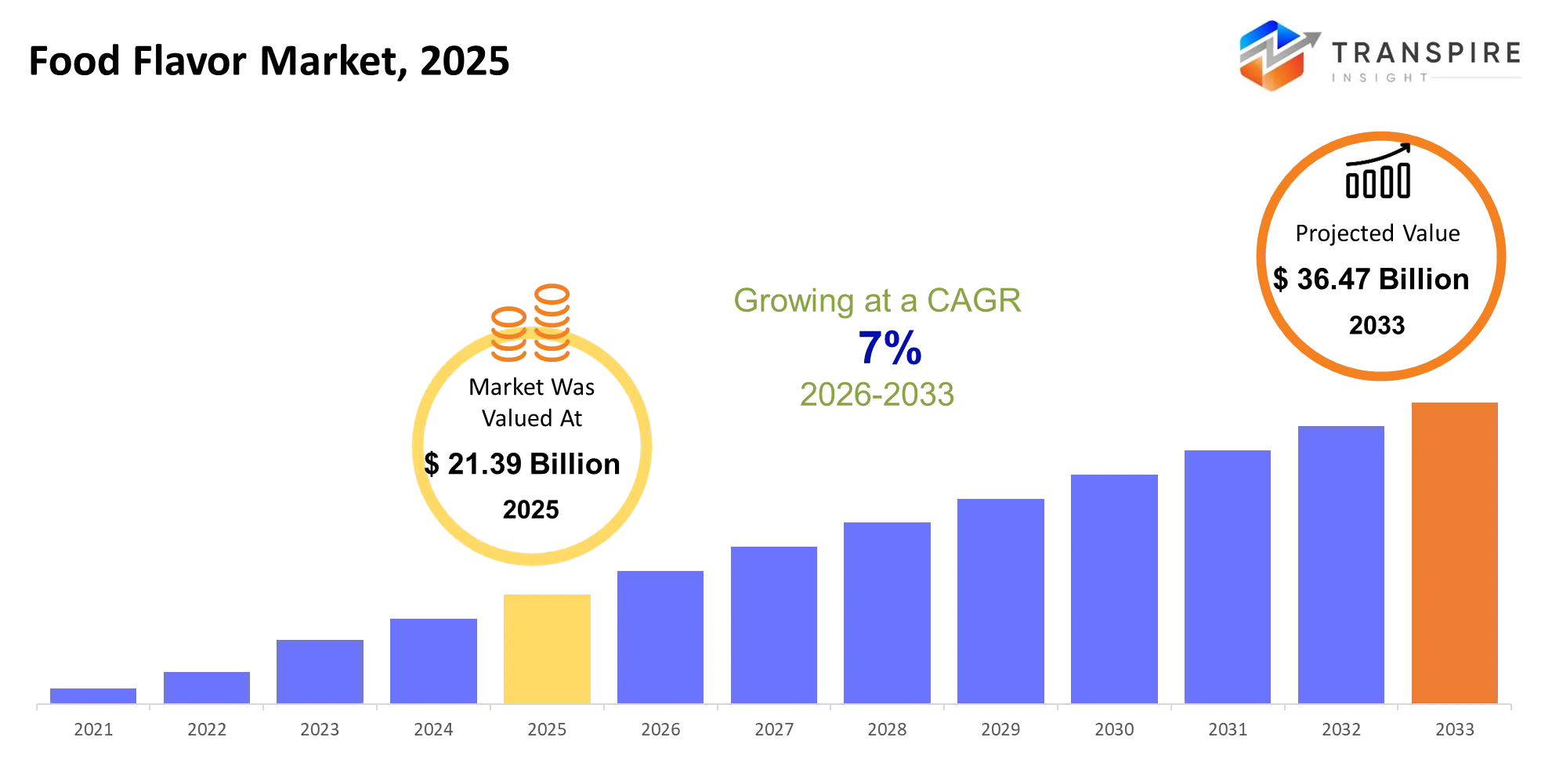
As per the Transpire Insight, The Food Flavour Market size is estimated at USD 21.39 billion in 2025 and is anticipated to reach USD 36.47 billion by 2033, growing at a CAGR of 7% from 2026 to 2033.
The food flavour market is helping manufacturers develop packaged foods, beverages, snacks and convenience foods that are unique, consistent and discriminating in every batch. Ingredient suppliers are now primarily focused on reformulation, sensory optimisation, and product differentiation rather than on simply providing ingredients. In the last three to five years, there has been a steady movement toward natural ingredients, customised flavour profiles, and faster digital product development in the market. One profound structural change is that AI-assisted formulation is now being combined with the art of the traditional flavorist to help companies make new combinations faster. For instance, a real-life catalyst is the growth of alternative-protein products that need to satisfy meat-appearing sensory profiles without any animal-based ingredients. The DSM-Firmenich natural beef flavour is a new ingredient developed by AI. Market development takes a different commercial route: changing consumer preferences lead to shortened product life cycles and provide opportunities for manufacturers to bring differentiated products to market more frequently. The flavour house benefits from multiple formulation projects, from sales of specific ingredients, and from technical expertise. Developing natural flavours creates opportunities for premium positioning; regulation and traceability increasingly influence suppliers' choices.
Food Flavor Market Size & Forecast:
- Market Size 2025: USD 21.39 Billion
- Expected Market Value (2033): USD 36.47 Billion
- Forecast CAGR (2026–2033): 7%
- Leading Region in 2025: Asia Pacific
- Fastest Growing Region: Latin America
- Key Company Profiles: Givaudan, Firmenich, IFF, Symrise, Kerry Group, Sensient Technologies, Mane, Takasago International, Robertet, Bell Flavours & Fragrances, Synergy Flavours, ADM, Döhler, T. Hasegawa, Flavorchem.
Key Food Flavour Market Insights:
Moving from standardised taste ingredients to data-driven, customised flavour solutions that help with product differentiation in the market. It's more and more about pairing natural ingredients with formulation know-how, regional consumer knowledge and advanced technologies to achieve competitive advantage.
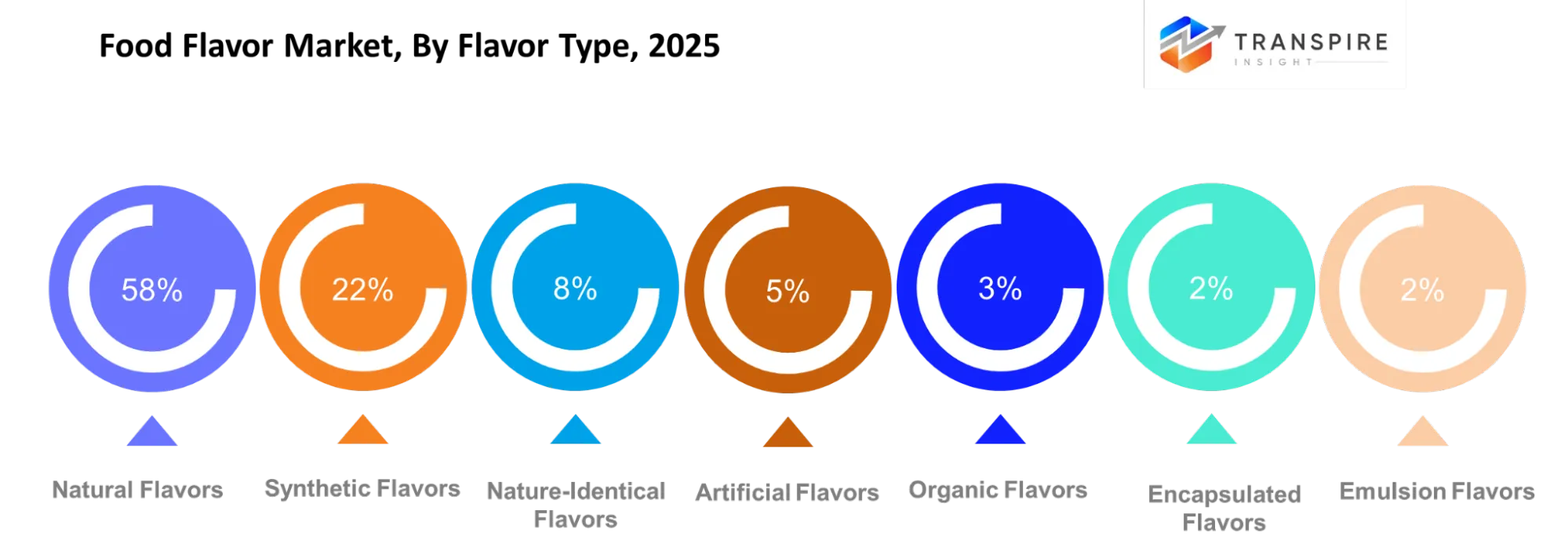
- The flavour-type mix consists of 58.3% natural flavours, while Givaudan's ATOM platform creates regional vanilla profiles based on consumer and formulation data.
- Savoury and snacks is the fastest-growing application at a 10.2% CAGR; Kerry’s Smart Taste platform combines biofermentation and AI to solve reformulation challenges.
- The demand in Asia Pacific accounts for 34.9% of the market; dsm-firmenich increased its capacity in India in August 2025 to localize innovation and production.
- North America makes up 27.5%, and FDA initiatives for mandatory GRAS notices are encouraging suppliers to provide more safety information.
- Europe accounts for 24.0%, while Symrise expanded its Alternative Smoke Taste Solutions in response to EU smoke-flavouring regulations.
- Packaged food expansion in Latin America is drawing in sweet, tropical and spicy notes, and the region accounts for 8.0%.
- Middle East & Africa has a share of 5.6%, and Kerry has established innovation centres in Dubai, Egypt and Rwanda to enable co-development in the region.
- Enzymatic and bio-based ingredient technologies are being further developed thanks to the collaboration between IFF and BASF, with 22.0% of synthetic flavours.
- Encapsulated flavours account for 2.2%, and Kerry's encapsulation platform boosts stability in dairy drinks and shelf-stable foods.
What are the Key Drivers, Restraints, and Opportunities in the Food Flavour Market?
Driver:
Health-led reformulation, Sugar taxes, sodium-reduction guidance, and front-of-pack labelling are pushing food and beverage companies to remove sugar and salt without losing palatability. This has converted flavour suppliers from ingredient vendors into taste-recovery partners. Givaudan’s ATOM platform, for example, helped create a cheese-snack recipe with 33% less salt while maintaining taste, while dsm-firmenich’s TasteGEM and ModulaSENSE systems address sweetness, mouthfeel, and bitterness in reduced-sugar products. The commercial effect is higher-value flavour systems, longer formulation contracts, and faster adoption in beverages, dairy, snacks, and sauces.
Restraint:
Natural flavours remain exposed to crop yields, seasonality, extraction costs, and logistics; natural systems can cost 30% to 60% more than nature-identical alternatives. This persists because agricultural supply cannot be standardised as easily as synthetic molecules, while mass-market categories remain price sensitive. At the same time, companies must navigate differing FDA, EFSA, China GB 2760, and other national requirements, slowing launches and raising compliance costs.
Opportunity:
AI-assisted flavour discovery, biotechnology, and encapsulation offer opportunities to improve ingredient performance while reducing development inefficiencies. Investment in automated production and specialised innovation centres can support customised formulations and more reliable manufacturing. Emerging opportunities include plant-based foods, functional beverages, and Asian savoury applications. India’s expanding snack innovation, including fusion profiles and regionally familiar flavours, provides a commercially relevant example of localised product development.
Driver Impact Analysis – Food Flavour Market
|
Driver |
Relative Impact on Growth (%) |
Geographic Relevance |
Impact Timeline |
Demand Strength |
Growth Mechanism |
Key Beneficiaries |
Major Constraint |
|
Rising demand for natural and clean-label flavours |
28% |
North America, Europe, Asia-Pacific |
Medium-term (2–4 years) |
High |
Accelerates natural flavour reformulation across packaged foods and beverages |
Natural flavour producers; ingredient suppliers; food manufacturers |
High extraction costs; limited natural ingredient availability |
|
Expansion of processed, convenience, and ready-to-eat foods |
24% |
Asia-Pacific, North America, Latin America |
Medium-term (2–4 years) |
High |
Increases flavour demand across snacks, instant meals, sauces, and packaged foods |
Flavour manufacturers; food processors; convenience food brands |
Raw material volatility; price-sensitive consumers |
|
Beverage innovation and functional flavour applications |
20% |
North America, Asia-Pacific, Europe |
Short-term (≤2 years) |
High |
Supports flavoured water, functional drinks, RTD beverages, and low-sugar formulations |
Beverage flavour suppliers; functional ingredient companies; beverage brands |
Flavour stability challenges; formulation complexity |
|
Premiumisation and demand for authentic, global, and regional tastes |
16% |
Asia-Pacific, Europe, North America |
Short-term (≤2 years) |
High |
Encourages exotic flavours, ethnic profiles, and premium product differentiation |
Specialty flavour houses; foodservice suppliers; premium food brands |
Changing preferences; limited regional ingredient sourcing |
|
AI-enabled flavour development, biotechnology, and sustainable sourcing |
12% |
Europe, North America, Asia-Pacific |
Long-term (≥4 years) |
Medium |
Improves flavour discovery, fermentation-derived ingredients, and sustainable production |
Biotechnology firms; flavour innovators; ingredient manufacturers |
High R&D investment; regulatory approval complexity |
|
Total |
100% |
Global |
— |
— |
— |
— |
— |
What Has the Impact of Artificial Intelligence Been on the Food Flavour Market?
AI is also revolutionising the new product development process and replacing traditional trial and error with a high-tech, data-based approach. For example, Givaudan's ATOM platform can improve the interactions of ingredient combinations by taking into account consumer preferences, costs, regulations, and natural-label limits. And DSM-Firmenich used an AI-driven rule-based model to create a natural grilled-beef flavour for plant-based meats.
In automation and optimisation, AI can narrow down large formulation spaces before bench trials, thereby minimising the number of experimental runs and reducing development time. Givaudan's ATOM, for instance, led to a 33% salt reduction in a cheese snack recipe and a 28% reduction in sugar in ketchup. AI also offers demand sensing and sensory modelling, helping to predict acceptance based on consumer response, regional flavour trends, ingredient access, and cross-modality effects before commercial scale-up. On a more operational level, AI can help detect shelf-life and food-safety risks or optimise fermentation conditions when used with IoT sensor feedback, while also enhancing quality control. While promising, it still demands flavorists and sensory panels for review, regulatory scrutiny, and physical scale-up, and proprietary models, lab connectivity, and expense could create barriers for small and medium-sized companies.
In September 2026, dsm-firmenich partnered with AI company Boltz PBC to integrate proprietary biomolecular foundation models into its flavour and scent ingredient-discovery process.
Key Food Flavour Market Trends:
The innovation of flavour is changing from just being an enhancement of taste into a product development strategy. Manufacturers are making more and more use of familiarity, cultural authenticity, wellness positioning, and technological precision.
- In both the European and North American retail landscape, clean label reformulation from premium positioning is now expected to become a baseline requirement.
- A need for sugar and salt reduction is driving a demand for modulators that recreate the “sweetness timing”, “saltiness” perception, “mouthfeel” and “aftertaste” balance.
- Labour-intensive trial-and-error formulation is being superseded by predictive formulation using AI.AI-based formulation is taking over some of the trial-and-error formulation methodology.
- The ability to produce natural flavour molecules through precision fermentation is a new pathway to supply security for low-abundance or climate-sensitive natural flavours.
- The demand for savoury, meaty, and dairy flavours that help to mask beany, bitter, and metallic off-notes is growing in the plant protein sector.
- Smoke flavourings and synthetic additives are being increasingly subjected to regulatory oversight and increasingly supplanted by approved systems based on natural or fermentation-derived smoke.
- Traceability, organic certification and verification of absence of GMOs are moving away from marketing claims to becoming procurement conditions.
- Flavour houses are embracing co-creation processes, with digital solutions creating formulations for local tastes and brand customers.
Food Flavour Market Segmentation
Flavor Type:
Natural flavors dominate the food flavor market, accounting for 58.3%, supported by clean-label preferences and ingredient-conscious product development. Synthetic flavors represent 22.0%, benefiting from cost efficiency, consistency, and formulation stability. Nature-identical flavors hold 8.0%, offering standardized sensory profiles with characteristics resembling natural ingredients. Artificial flavors account for 5.0%, while organic flavors contribute 3.0%, serving premium and certification-focused product categories. Encapsulated flavors represent 2.2%, supporting controlled release and improved protection during processing. Emulsion flavors account for 1.5%, enabling effective incorporation into complex formulations. These categories address diverse performance, cost, and sensory requirements.
Product:
Single flavours provide flexibility for flavour houses and manufacturers, enabling precise formulation adjustments across diverse food applications. However, flavour blends are gaining traction because they simplify formulation complexity and deliver consistent, differentiated taste profiles. Citrus, berry, tropical fruit, vanilla, and chocolate remain core flavour platforms. Their commercial value increasingly depends on origin-specific characteristics, sustainable sourcing, and AI-optimized combinations that support product differentiation, sensory consistency, and evolving consumer preferences across regional markets.
Application:
Beverages remain the leading application for food flavours, supported by demand for functional drinks, flavoured water, and innovative beverage formulations. Bakery, dairy, confectionery, snacks, sauces and dressings, and processed foods represent additional demand centres. Savoury and snacks are the fastest-growing application, recording a 10.2% CAGR, driven by protein-rich snacks, spicy flavour formats, and sodium-reduction requirements. Manufacturers increasingly prioritise flavour systems that preserve sensory appeal while supporting healthier product reformulation and convenient consumption.
Form:
Liquid flavours dominate because they offer blending flexibility, efficient incorporation, and suitability across beverages and liquid food formulations. Powdered and spray-dried formats remain important for dry mixes, seasonings, and shelf-stable products. Paste, emulsion, encapsulated, and oleoresin formats are gaining relevance where concentrated delivery, heat resistance, improved shelf stability, or controlled flavour release is essential. Form selection increasingly reflects processing conditions, storage requirements, application compatibility, and the need to maintain consistent sensory performance throughout manufacturing.
Source:
Fruit, spice, herb, and vegetable ingredients underpin demand for natural flavour solutions, reflecting manufacturers’ interest in recognizable ingredients and distinctive sensory profiles. Dairy and meat-derived sources remain important for authentic savoury, creamy, and broth-like characteristics across processed foods and snacks. Synthetic sources continue to support large-scale production through predictable composition, consistency, and cost efficiency. Flavour developers increasingly balance natural-origin preferences with sourcing reliability, regulatory compliance, formulation performance, and the technical requirements of specific food applications.
End User:
Food and beverage manufacturers represent the largest end-user group, purchasing flavour systems for beverages, packaged foods, snacks, and processed products. Dairy producers, bakery manufacturers, confectionery companies, flavour houses, and foodservice operators also contribute to demand. These buyers increasingly seek customised, application-ready solutions that address processing conditions, sensory expectations, shelf-life requirements, and reformulation objectives. Suppliers are strengthening technical collaboration and application-specific development capabilities to help customers accelerate product launches, maintain taste consistency, and differentiate offerings in competitive food categories.
What are the Key Use Cases Driving the Food Flavour Market?
The core use case is taste recovery in beverages, dairy, bakery, and snacks. As manufacturers reduce sugar, salt, or artificial ingredients, natural flavours already account for 58.3% of the flavour-type market and are used to restore sweetness, freshness, mouthfeel, and overall product identity.
Expansion is strongest in savoury and snacks, growing at a 10.2% CAGR. Flavour systems now deliver heat, umami, smokiness, cheese notes, and seasoning complexity in protein snacks, ready meals, sauces, and plant-based foods, where sodium reduction and clean labels would otherwise weaken consumer appeal.
Emerging use cases include AI-created flavour profiles for alternative proteins, fermentation-derived dairy and vanilla notes, and encapsulated flavours for functional beverages and supplements. These applications link flavour suppliers directly to biotechnology, health positioning, and premium product differentiation.
|
Report Metrics |
Details |
|
Market size value in 2025 |
USD 21.39 Billion |
|
Market size value in 2026 |
USD 22.66 Billion |
|
Revenue forecast in 2033 |
USD 36.47 Billion |
|
Growth rate |
CAGR of 7% from 2026 to 2033 |
|
Base year |
2025 |
|
Historical data |
2021 - 2024 |
|
Forecast period |
2026 - 2033 |
|
Report coverage |
Revenue forecast, competitive landscape, growth factors, and trends |
|
Regional scope |
United States; Canada; Mexico; United Kingdom; Germany; France; Italy; Spain; Denmark; Sweden; Norway; China; Japan; India; Australia; South Korea; Thailand; Brazil; Argentina; South Africa; Saudi Arabia; United Arab Emirates |
|
Key companies profiled |
Givaudan, Firmenich, IFF, Symrise, Kerry Group, Sensient Technologies, Mane, Takasago International, Robertet, Bell Flavors & Fragrances, Synergy Flavors, ADM, Döhler, T. Hasegawa, Flavorchem |
|
Customization scope |
Free report customization (country, regional & segment scope). Available customized purchase options to meet your exact research needs. |
|
Report Segmentation |
Flavor Type (Natural Flavors, Synthetic Flavors, Nature-Identical Flavors, Artificial Flavors, Organic Flavors, Encapsulated Flavors, Emulsion Flavors); Product (Single Flavors, Flavor Blends, Citrus, Berry, Tropical Fruit, Vanilla, Chocolate); Application (Beverages, Bakery, Dairy, Confectionery, Snacks, Sauces & Dressings, Processed Foods); Form (Liquid, Powder, Paste, Emulsion, Spray-Dried, Encapsulated, Oleoresin); Source (Fruit, Vegetable, Spice, Herb, Dairy, Meat, Synthetic); End User (Food Manufacturers, Beverage Manufacturers, Dairy Producers, Bakery Producers, Confectionery Companies, Flavor Houses, Foodservice) |
Which Regions are Driving the Food Flavour Market Growth?
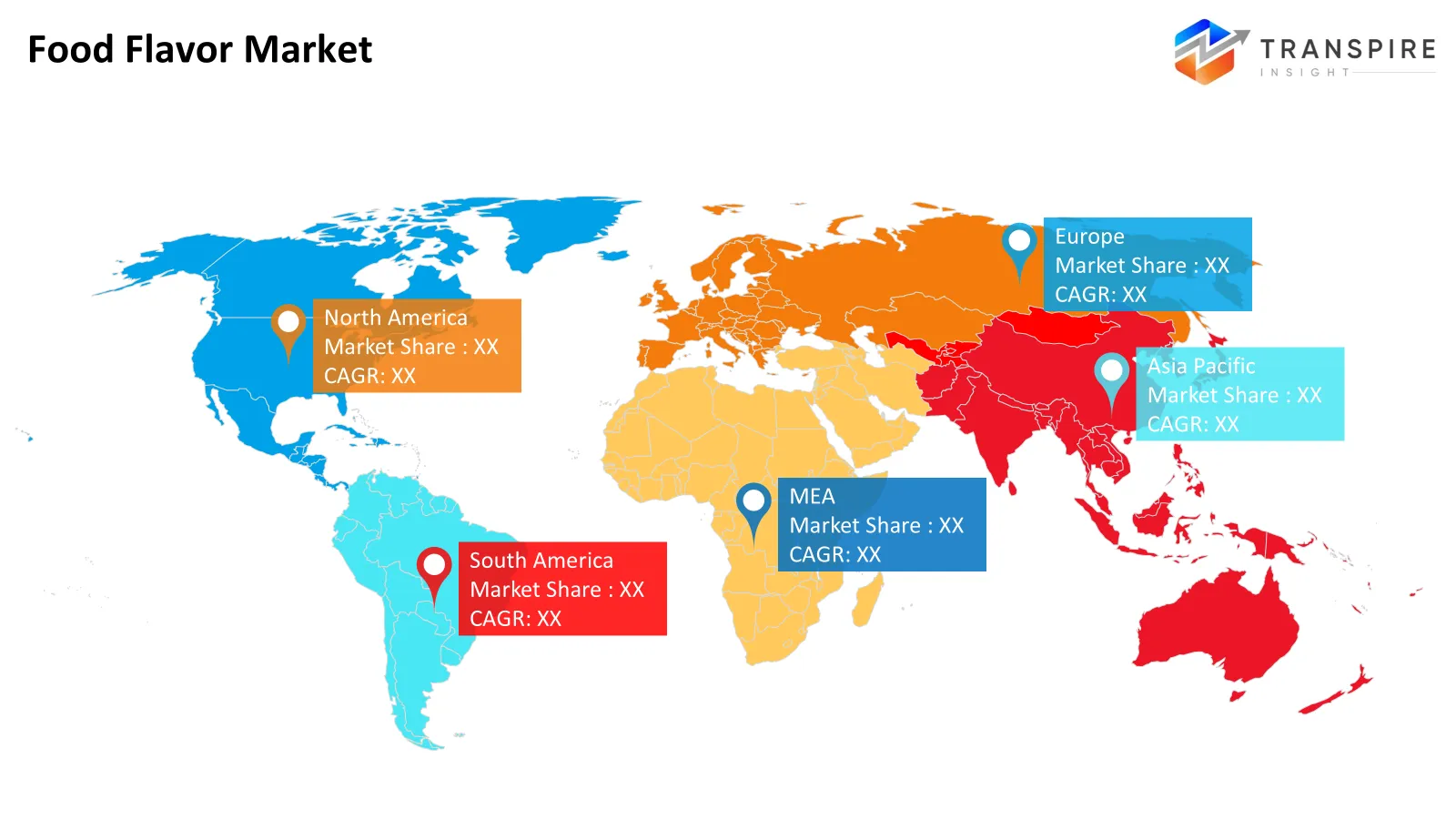
Asia Pacific accounts for 34.9% of world demand. The region's advantage stems from its enormous packaged-food and beverage manufacturing base, its growing modern-trade channel, and the fast-evolving taste preferences of its cities. Local flavour development near production sources is one reason that brands can adjust the levels of sweetness, spice, fruit, and savoury tones to fit each country's people. Industry support from food manufacturing policies, a cold chain infrastructure, and rising intakes of convenience foods underpin demand. Companies are building more manufacturing capacity in the region instead of exporting Western recipes.
In October 2026, Nestlé held a groundbreaking ceremony to build a new THB 23 billion (~US$680 million) House of NESCAFÉ coffee manufacturing facility in Samut Prakan, Thailand.
Europe, with a market share of 24.0%, drives growth on the basis of the depth of regulation, premiumization and clean-label leadership, rather than on volume. While the Asia Pacific manufacturing base is broad, Europe's growth is reformulation-driven. The industry's efforts to replace artificial ingredients and smoke-derived flavour systems are gathering pace. As a direct consequence of the European Union flavouring strategy and new substance authorisations, the ability to meet ingredient compliance requirements is a key commercial strength. All of this leads to sustained demand for natural ingredients, taste modifiers and traceability in the supply chains of dairy, bakery, beverage and premium snack categories.
In January 2026, the European Union officially updated its food flavouring framework by publishing Commission Regulations (EU) 2026/172 and (EU) 2026/175, which added two new compliant flavour-modulating substances (hesperetin dihydrochalcone and an ethyl ester derivative) to the EU's authorised list.
https://food.chemlinked.com/news/food-news/EU-food-flavouring-regulatory-updates-in-2026
Latin America at 8.0% is the fastest-growing region in the data set. North America totals 27.5%, and the Middle East and Africa total 5.6%. The region's growth opportunities are supported by the growth of urbanisation, modern trade, and the regional desire for more local food products, as well as its vast tropical fruit resources and its flavour profile. Tropical fruits and flavour profiles are well suited to developing natural flavours, as well as customised flavour profiles; regional sourcing, processing, and flavour capabilities will result in Latin America becoming a destination for regional markets in the future.
In October 2026, Froneri and Fini partnered to launch candy-inspired popsicles in Brazil combining popular green apple and raspberry gummy candy profiles. This product launch leverages the region's expanding demand for cross-category flavor innovations and accessible indulgence by merging traditional confectionery profiles.
https://www.flavorist.com/south-america-food-flavor-industry-business-news-report-october-1-15-2026/
Who are the Key Players in the Food Flavour Market, and how do they compete?
The definition has shifted from a wide portfolio offering to co-development, biotech, and country-specific application assistance. Top supplier can differentiate themselves not on the number of flavour ingredients they offer, but on their ability to find solutions to formulators' issues like sugar reduction, off-note masking, and clean label replacements.
Givaudan's acquisition-led innovation approach - through ATOM's AI-enabled co-creation and regional manufacturing strategy, including a savoury-and-snacks flavour factory in Indonesia (2026). DSM-Firmenich's focus on taste modulation and nutrition science, AI-generated flavour development, and increased capacity in India. IFF's focus on biotech and ingredient-platform convergence and its work with BASF (2025) on enzymatic biomaterials. Symrise's focus on fermentation and botanical innovation, and the group's investments in Cellibre and smoke-alternative innovation. Kerry is involved in taste-and-nutrition integration and in coating itself in customer reformulation programs using Smart Taste, encapsulation and 60+ innovation centres. Sensient, Mane, Takasago, Robertet, Bell, Synergy, ADM, Döhler, T. Hasegawa and Flavorchem offer more targeted differentiation: regional botanical knowledge, natural extracts, beverage systems, low-cost blends or application-based service. These companies' growth is more and more reliant on local technical centres and customer-specific platforms as opposed to commodities and general catalogues.
Key Players are:
- Givaudan
- Firmenich
- IFF
- Symrise
- Kerry Group
- Sensient Technologies
- Mane
- Takasago International
- Robertet
- Bell Flavours & Fragrances
- Synergy Flavours
- ADM, Döhler
- T. Hasegawa
- Flavorchem
Food Flavour Market — Enhanced Competitive Benchmarking
|
Company |
Est. Revenue Share Range |
Key Offerings |
Strategic Positioning |
Geographic Strength |
Technology Focus |
|
Givaudan S.A. |
8–10% |
TasteSolutions™, savoury flavours, beverage flavours, natural flavour systems |
leadership through premium flavour innovation and customer co-creation |
Europe, North America, Asia Pacific |
AI-assisted flavour creation, natural extraction, taste modulation |
|
International Flavors & Fragrances (IFF) |
7–9% |
Beverage flavours, sweet flavours, savoury systems, taste modulation solutions |
Integrated flavour and ingredient solutions for multinational food manufacturers |
North America, Europe, Asia Pacific |
Biotechnology, flavour encapsulation, sensory science |
|
Symrise AG |
6–8% |
Food flavours, beverage flavours, savoury ingredients, natural flavour extracts |
Innovation-led differentiation through integrated flavour and nutrition expertise |
Europe, North America, Asia Pacific |
Natural extraction, sensory analytics, fermentation technologies |
|
Kerry Group plc |
5–7% |
Taste solutions, savoury flavours, sweet flavours, taste-modulation systems |
Customer-centric taste and nutrition solutions with application expertise |
Europe, North America, Asia Pacific |
Taste modulation, fermentation, ingredient optimization |
|
dsm-firmenich AG |
4–6% |
Sweet flavours, beverage flavours, savoury systems, flavour ingredients |
Premium flavour innovation supported by nutrition and biotechnology capabilities |
Europe, North America, Asia Pacific |
Biotechnology, precision fermentation, sensory science |
|
Mane SA |
2–4% |
Natural flavours, beverage flavours, savoury flavours, flavour extracts |
Differentiation through bespoke formulations and natural ingredient expertise |
Europe, North America, Asia Pacific |
Natural extraction, encapsulation, sensory evaluation |
|
Sensient Technologies Corporation |
2–4% |
Natural flavours, botanical extracts, flavour systems, taste solutions |
Speciality positioning in natural ingredients and colour-flavour integration |
North America, Europe, Asia Pacific |
Botanical extraction, natural ingredient processing, formulation science |
|
Takasago International Corporation |
2–3% |
Beverage flavours, culinary flavours, sweet flavours, umami solutions |
Regional strength through Asian taste expertise and flavour development |
Asia Pacific, North America, Europe |
Umami enhancement, aroma chemistry, flavour synthesis |
|
Robertet SA |
1–2% |
Natural flavour ingredients, citrus extracts, botanical flavours, essential oils |
Premium natural ingredients supported by sourcing specialisation |
Europe, North America, Asia Pacific |
Natural extraction, botanical processing, traceability |
|
ADM |
2–4% |
Natural flavours, sweet and savoury flavour systems, flavour ingredients, taste solutions |
Ingredient-led competition through integrated sourcing and formulation capabilities |
North America, Europe, Asia Pacific |
Plant-based ingredients, fermentation, flavour formulation |
Recent Development News
- In June 2026, FlavorSum acquired Beverage Flavors International (BFI), a Chicago-based specialist in beverage flavor bases and customised flavour solutions. The acquisition expands FlavorSum’s beverage development capabilities and strengthens its ability to provide integrated flavour sourcing and product development solutions to food and beverage manufacturers. https://www.foodbusinessnews.net/articles/30495-flavorsum-acquires-beverage-flavors-international
- In October 2026, International Flavours & Fragrances (IFF) launched its specialized "GLP-1 Consumer Moments of Opportunity" formulation roadmap. This development addresses the emerging market demand for taste-masking technologies, targeted nutrient delivery, and specific flavour profiles tailored to the rapidly expanding demographic of consumers utilising GLP-1 weight-loss medications. https://www.businesswire.com/news/home/20261026614988/en/IFF-Identifies-Ten-Consumer-Moments-Reshaping-Food-and-Beverage-Innovation-in-the-GLP-1-Era
- In September 2026, Cerebelly acquired the Fresh Bellies snack brand. This strategic consolidation combines cognitive-health formulations with whole-food flavour systems designed to expose early-stage palates to complex sensory profiles without utilizing added sugars. https://www.cpgmedia.com/newswire/2026/09/16/cerebelly-announces-acquisition-of-fresh-bellies-snack-brand
What Strategic Insights Define the Future of the Food Flavour Market?
The market is moving toward supply-led sensory solutions. Value will go to players that can innovate natural, fermentation-based, and digitally enabled taste systems to create healthier products. There is an underappreciated risk with natural ingredients and flavourings from naturally sourced ingredients-over-concentration of input through a limited number of sources, ability to produce at scale through fermentation, and regulatory approvals-in quick order can convert a sustainable supply chain advantage into a supply chain vulnerability. There is an emerging opportunity for natural flavours produced through precision fermentation to help stabilise supply for vanilla, dairy, citrus, and savory flavors while meeting clean-label expectations. Strategically, flavour companies should focus on localization of co-creation hubs, securing biotech and botanical inputs via partnerships, and forming AI platforms that enable fewer reformulation cycles without losing human sense.
Key Segmentations are:
Flavour Type
- Natural Flavours
- Synthetic Flavours
- Nature-Identical Flavours
- Artificial Flavours
- Organic Flavours
- Encapsulated Flavours
- Emulsion Flavours
Product
- Single Flavours
- Flavour Blends
- Citrus
- Berry
- Tropical Fruit
- Vanilla
- Chocolate
Application
- Beverages
- Bakery
- Dairy
- Confectionery
- Snacks
- Sauces & Dressings
- Processed Foods
Form
- Liquid
- Powder
- Paste
- Emulsion
- Spray-Dried
- Encapsulated
- Oleoresin
Source
- Fruit
- Vegetable
- Spice
- Herb
- Dairy
- Meat
- Synthetic
End User
- Food Manufacturers
- Beverage Manufacturers
- Dairy Producers
- Bakery Producers
- Confectionery Companies
- Flavour Houses
- Foodservice
By Regional Analysis
North America
- US
- Canada
- Mexico
Europe
- Germany
- UK
- France
- Italy
- Spain
- Russia
- Rest of Europe
Asia Pacific
- China
- Japan
- India
- South Korea
- Australia
- Rest of Asia Pacific
South America
- Brazil
- Argentina
- Rest of South America
Middle East & Africa
- UAE
- Saudi Arabia
- Qatar
- South Africa
- Rest of the Middle East & Africa
Frequently Asked Questions
Find quick answers to common questions.
The food flavour market size was valued at USD 21.39 billion in 2025 and is poised to reach USD 36.47 billion by 2033, expanding at a 7% CAGR.
Key segments for the food flavour market are Flavor Type (Natural Flavors, Synthetic Flavors, Nature-Identical Flavors, Artificial Flavors, Organic Flavors, Encapsulated Flavors, Emulsion Flavors); Product (Single Flavors, Flavor Blends, Citrus, Berry, Tropical Fruit, Vanilla, Chocolate); Application (Beverages, Bakery, Dairy, Confectionery, Snacks, Sauces & Dressings, Processed Foods); Form (Liquid, Powder, Paste, Emulsion, Spray-Dried, Encapsulated, Oleoresin); Source (Fruit, Vegetable, Spice, Herb, Dairy, Meat, Synthetic); End User (Food Manufacturers, Beverage Manufacturers, Dairy Producers, Bakery Producers, Confectionery Companies, Flavor Houses, Foodservice).
Growth is primarily driven by clean-label preferences, rising demand for natural flavours, expanding processed food and beverage consumption, product innovation, functional food development, and increasing demand for customised flavour solutions.
The food flavour market is led by major manufacturers including Givaudan, Firmenich, IFF, Symrise, Kerry Group, Sensient Technologies, Mane, Takasago International, Robertet, Bell Flavours & Fragrances, Synergy Flavours, ADM, Döhler, T. Hasegawa, and Flavorchem.
Asia Pacific dominates the food flavour market with a 34.9% share, supported by expanding food processing industries, urbanisation, rising disposable incomes, diverse regional cuisines, and growing demand for packaged foods and innovative beverages.
Opportunities include natural and clean-label flavor development, AI-driven flavor innovation, sustainable ingredient sourcing, customised regional flavor profiles, and advanced encapsulation technologies.
- Givaudan
- Firmenich
- IFF
- Symrise
- Kerry Group
- Sensient Technologies
- Mane
- Takasago International
- Robertet
- Bell Flavours & Fragrances
- Synergy Flavours
- ADM, Döhler
- T. Hasegawa
- Flavorchem
About the Authors

Chetan Dhatrak
I’m Chetan Dhatrak, a Senior Research Analyst at Transpire Insight, specializing in the Consumer Goods, Foods and Beverages industry. I focus on analyzing market trends, consumer behavior, competitive landscapes, and industry developments to deliver accurate, data-driven insights. My research at Transpire Insight is built on credible sources and in-depth analysis, helping businesses and readers better understand market dynamics, emerging opportunities, and evolving consumer preferences. I’m committed to creating reliable, well-researched content that supports informed decision-making and reflects the latest developments in the consumer goods and food & beverage sectors.

Chakradhar Khansole
Chakradhar serves as the Research Director at Transpire Insight, bringing over 8 years of experience in technology, innovation, and strategic market intelligence. He specializes in transforming complex market data into actionable business insights that enable organizations to make informed, growth-oriented decisions. Recognized for his strategic vision and analytical expertise, Chakradhar leads high-impact research initiatives, delivering comprehensive market assessments, competitive intelligence, and forward-looking industry analysis.
Recently Published Reports
-
Apr 2026
Baby Infant Formula Market
Baby Infant Formula Market Size, Share & Analysis Report By ype (Infant Milk, Follow On Milk, Specialty Baby Milk, Growing-Up Milk), By Ingredient (Carbohydrate, Fat, Protein, Minerals, Vitamins, and Others), By Product Form (Powder, Liquid, and Ready-to-feed), By Distribution Channels (Supermarket/Hypermarket, Specialty Store, Pharmacies, Online Retail, and Others), and Geography (North America, Europe, Asia-Pacific, Middle East and Africa, South and Central America), 2021 - 2031
-
Apr 2026
Edible Insects for Animal Feed Market
Edible Insects for Animal Feed Market Size, Share & Analysis Report By Type (Insect Powder, Insect Meal, Insect Bar, Insect Paste, Insect Oil, and Others), By Insect Type (Beetles, Cricket, Caterpillar, Hymenoptera, Orthoptera, Tree Bugs, and Others), By Application (Livestock, Pet Food, and Aquaculture), By Livestock Type (Poultry, Swine, and Others), and Geography (North America, Europe, Asia-Pacific, Middle East and Africa, South and Central America), 2021 - 2031
-
Apr 2026
Food Industry Disinfection and Bacterial Control Market
Food Industry Disinfection and Bacterial Control Market Size, Share & Analysis Report By Type (Chemical Disinfectants, Physical Disinfectants, and Biocides and Antimicrobials), By Application (Food Processing Equipment Surface Disinfection, Food Preparation Areas Surface Disinfection, Storage Areas Surface Disinfection, Anti-microbial Coatings Food Preservation, and Preservative Solutions Food Preservation), By End User (Meat and Poultry Processing, Dairy Processing, Seafood Processing, Bakery and Confectionery, Restaurants and Commercial Kitchens, and Food Service Providers), By Sales Channel (Online, Offline), and Geography (North America, Europe, Asia-Pacific, Middle East and Africa, South and Central America), 2021 - 2031
-
May 2026
Freeze Dried Food Market
Freeze Dried Food Market Size, Share & Analysis Report By Product Type (Fruits, Vegetables, Freeze-Dried Dairy Products, Freeze-Dried Meat and Seafood, Freeze-Dried Pet Food, and Prepared Meal), By Nature (Organic, and Conventional), By Form (Powdered, Granules, and Diced), By End Use (Breakfast Cereals, Dairy Products, Bakery & Confectionery, Nutritional Bars & Supplements, Powdered Beverages, Snacks, and Retail (Household)), and Geography (North America, Europe, Asia-Pacific, Middle East and Africa, South and Central America), 2021 - 2031